To anchor a boat in a tidal current, approach the spot bow first into the current, let the boat drift forward, drop the anchor, and pay out at least seven times the depth in rode. Snub the line, back down in reverse to bury the flukes, then leave room for the boat to swing 180 degrees as the tide turns. Working out how to anchor a boat in a tidal current is mostly about scope, holding ground and swing room.
In still water an anchor is a way to stop drifting. In a tidal river, inlet or estuary it has to hold against a load that reverses roughly twice a day, and the boat will sit one way on the flood and the other way on the ebb. That rotation is what puts boats onto rocks, shoals and neighbouring hulls, so the anchorage you choose matters more than the anchor you own.
There is a limit to what one anchor can hold through a full reversal, and that is why experienced skippers on Cruisers Forum threads end up laying two anchors 180 degrees apart, both led from the bow, one set for each direction of the current. Get the single-anchor setup right first, then decide whether your anchorage and stream justify the second one.
Table of Contents
- What You Need
- Step-by-Step: How to Anchor a Boat in a Tidal Current
- 1. Read the tide, wind, and current before choosing a spot
- 2. Select an anchor and rode matched to the boat
- 3. Set the anchor with enough scope for the conditions
- 4. Use a snubber and secure the boat for tide movement
- 5. Check that the anchor is actually holding
- 6. Monitor the anchor through the changing tide
- Common Mistakes
- Frequently Asked Questions
- How much scope should I use when anchoring in a tidal current?
- Can an anchor hold in a strong tidal current?
- Is it better to anchor with the bow or stern facing the current?
- How do I know whether my anchor is dragging?
- Can a kayak or small paddleboat be anchored safely in moving water?
- Conclusion
What You Need
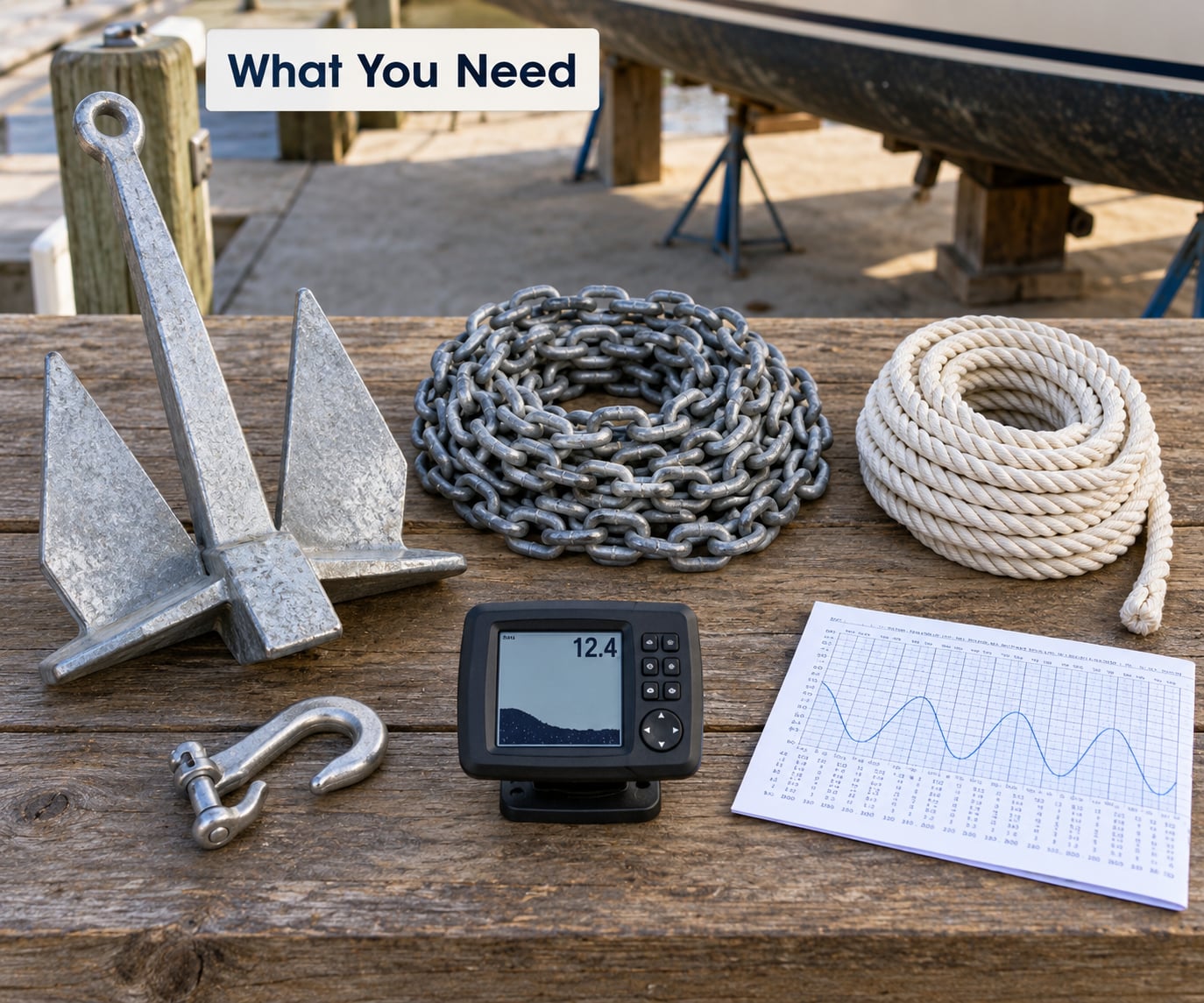
Ground tackle is cheap compared with a boat on the rocks, and you can build a working setup from a short list. The pieces below are the ones that change what happens when the current builds.
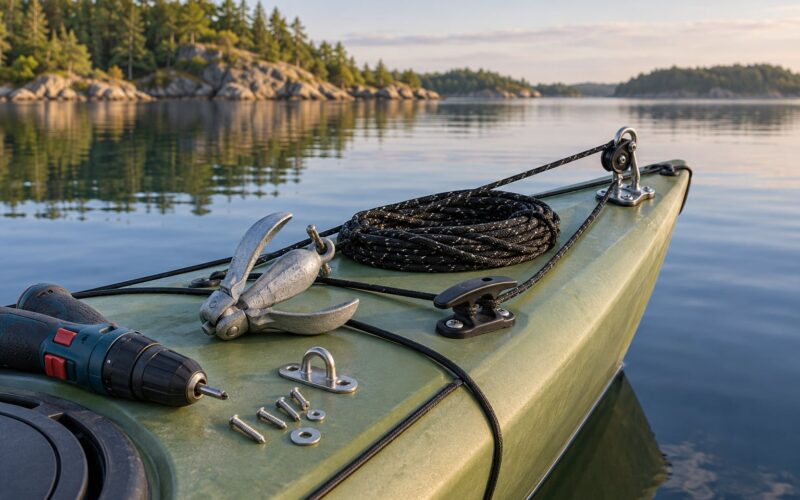
- Anchor sized to the boat. A useful published baseline for an 8 m boat is a 12 kg anchor with 8 m of 8 mm chain and 50 m of 10 mm nylon line, which gives you scope without a pile of hardware.
- Rode made up of 6 to 8 ft of chain at the anchor end, then rope or more chain to reach your scope. The chain leader keeps the pull angle low so the flukes dig instead of lifting.
- Snubber — a chain hook with a rolling hitch, or a purpose-made line snubber spliced with a thimble. It takes the first shock load instead of your cleat and chain.
- Hardware: shackle, thimble, and monel or stainless locking wire so nothing unscrews itself under sustained load.
- Trip line and sentinel weight on a light line from the anchor eye to a shackle on deck, so a buried anchor can be recovered instead of lost.
- Windlass sized so you can raise the anchor under hand power alone, plus the tools to wind the chain leader onto the gypsy.
- Navigation gear: depth sounder, GPS or chartplotter with an anchor alarm, NOAA tide predictions, USCG tidal current tables, and a working VHF on channel 16.
Which of those you can leave out depends on your situation. A calm-weather lunch hook in shallow water on a small open boat needs a light fluke anchor, a length of nylon and a folding shackle. A 40 ft boat lying overnight in a 2-knot ebb in an estuary needs a heavier anchor, a windlass, a snubber, a second anchor and enough rode that scope is not the weak link.
Bottom type is the other variable. Firm mud and coarse sand give the best holding, soft mud and eelgrass are workable, and rock or gravel is where an anchor either buries or skates. Depth sets your rode requirement, and current strength sets how hard the rode will be pulled. Boats that drag in moving water usually fail on one of those three, not on the anchor breaking.
Step-by-Step: How to Anchor a Boat in a Tidal Current
1. Read the tide, wind, and current before choosing a spot
Start at the tide table, not at the chart. Tides tell you the height of the water and, through the rule of twelfths, roughly how fast the stream runs: about one twelfth of the range in the first hour after slack, two twelfths in the second, three in the third, then three, two and one again on the way down. The current is usually strongest around mid-tide, not at high or low water, and slack water is the short window when the stream stops.
Then check four things on the chart. What is the depth at mean low water, not the depth your sounder shows right now. What is the bottom made of. How much room the boat has to swing in a full circle once the tide reverses. And what sits inside that circle: shoals, rocks, a channel, prop wash from a ferry, or other boats already at anchor.
Anchoring is a decision about depth at low water. If you choose a spot that gives 10 ft at high water and 3 ft at low water, a boat drawing 4 ft is aground before the tide stops falling. Skippers on rivers also warn against anchoring close to the bank, because the boat swings onto it as the current turns.
2. Select an anchor and rode matched to the boat
Anchor weight is the argument everyone has, and it is the least useful one. A weighty anchor on too little rode will drag in current, because the load pulls the rode up off the bottom and the flukes never engage. Adequate scope, sound hardware and a rode that stays down do more for you than another few kilos on the flukes.
Pick the design for the bottom and for how fast you need it to set.
| Design | Holds best in | Setting speed | When the current reverses |
|---|---|---|---|
| Fluke or Danforth | Sand, mud | Quick | Settles on the new tack if the scope holds |
| Plow or Delta | Mud, sand, shell | Slow unless weighted at the tip | Rolls back onto a new angle of attack and re-digs |
| Claw, Bruce or Rocna | Sand and gravel | Moderate, roll bar helps | Resets well once it is buried |
| Grapnel | Rock and reef | Very slow | Grips, but skips across rock |
Weight at the tip and a roll bar are the two features that matter in current, because they let the anchor enter the bottom without a long backward pull. For a kayak, a drifting jon or a small inflatable, the setup is much simpler: a 2 to 4 lb fluke anchor with 15 to 20 ft of line and a soft-shackled loop, carried in a grab bag. Never use a kayak or an open boat as an overnight anchorage in a real tide stream.
3. Set the anchor with enough scope for the conditions
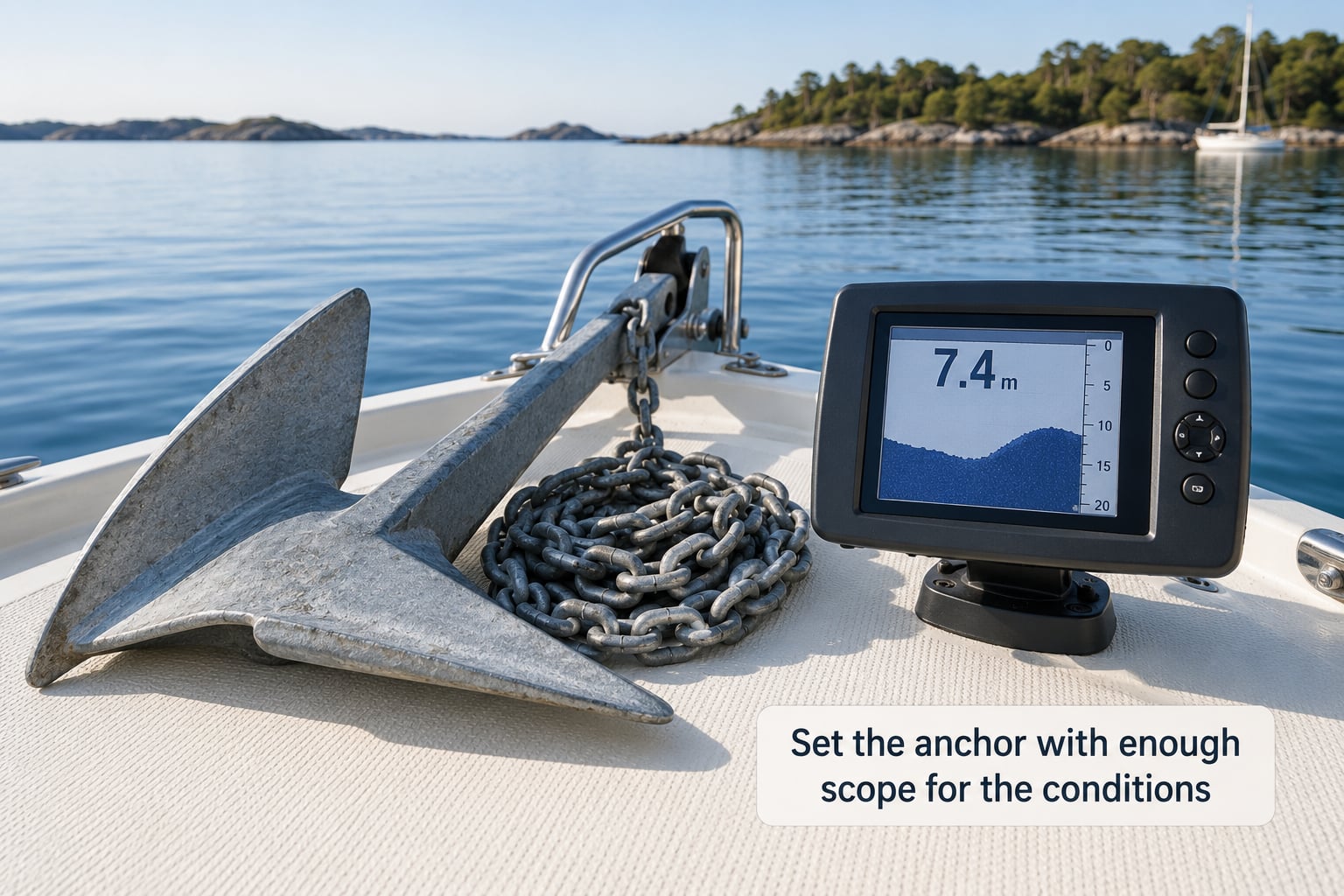
Scope is the ratio of rode paid out to the depth beneath the bow, and it is the number that decides whether the anchor sets. Work it out from the depth at high water, because that is when you have the least rode in use and the shallowest clearance under the keel.
| Depth at high water | 5:1 scope | 7:1 scope | 10:1 scope |
|---|---|---|---|
| 10 ft | 50 ft | 70 ft | 100 ft |
| 15 ft | 75 ft | 105 ft | 150 ft |
| 20 ft | 100 ft | 140 ft | 200 ft |
| 25 ft | 125 ft | 175 ft | 250 ft |
Treat 5:1 as the floor for a calm day, 7:1 as the working figure for an overnight stop in a tidal anchorage, and 10:1 for a strong ebb or a forecast blow. If your depth sounder shows 20 ft and your rode is 140 ft, that is your 7:1 scope for this anchorage, and it will stretch further as the tide drops.
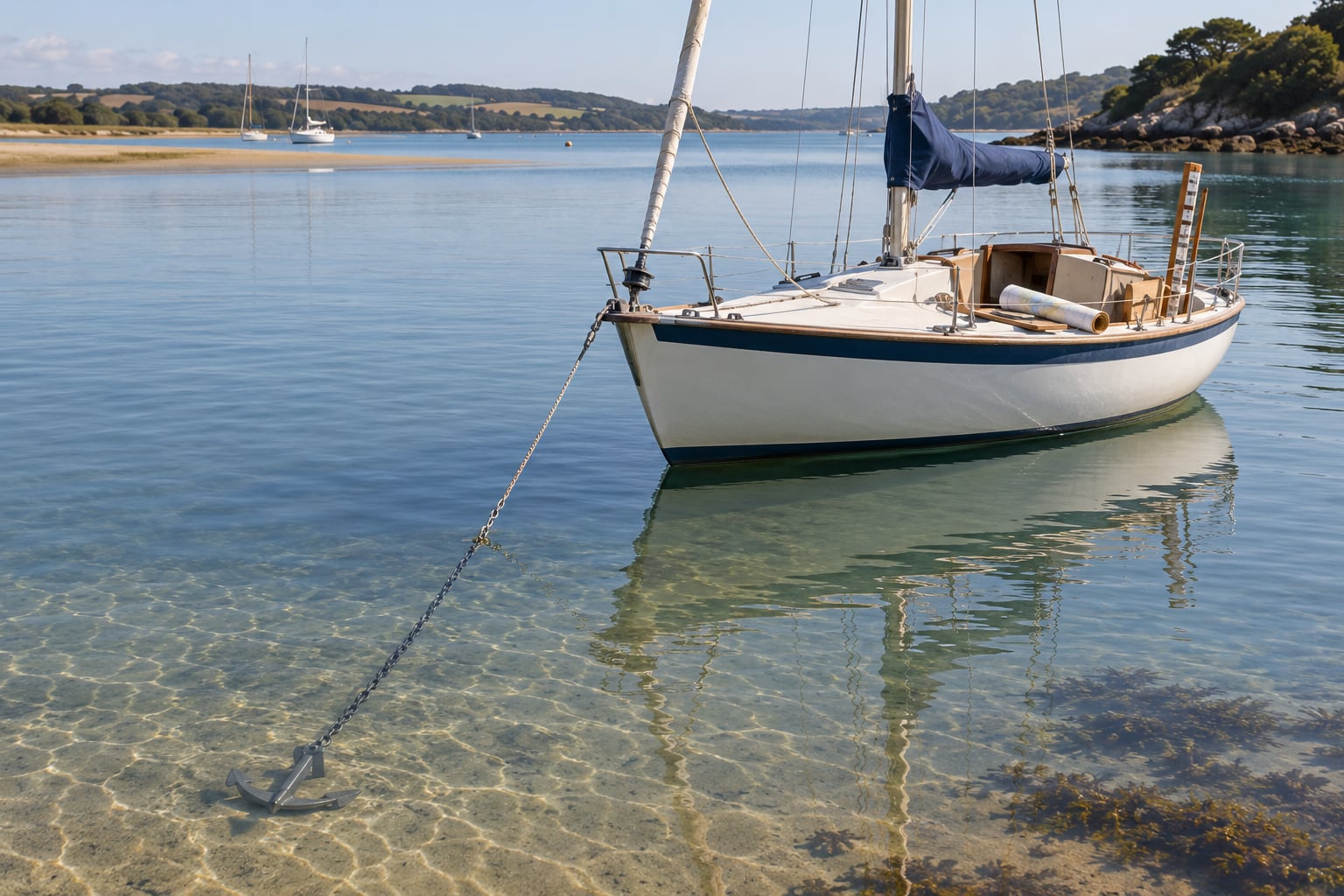
Now the order of operations. Position up-current so the boat is making the least way possible through the water, then stop the boat and let her drift forward. The anchor goes in at that moment, not before, and not after you have drifted past the spot. Pay out the rode as the boat comes back onto the line so it forms a catenary, the curve that takes the edge off the shock of the anchor biting. Never let the rode run under the hull, never let the anchor go down flat on its back, and never anchor in water deeper than your rode can cover at a useful ratio.
Once the rode is out, snub it and hold the boat on the brakes. Then back down in reverse, a few metres at a time, to drive the flukes in. Current set the anchor on your way down; backing down is what makes it hold for the next six hours.
4. Use a snubber and secure the boat for tide movement
The snubber is the cheapest part of the whole rig and the one most people skip. A chain hook with a rolling hitch around three or four links, or a line snubber spliced to a thimble and shackled to the bitter end, absorbs the surge that arrives when the anchor buries or when the current steps up. It also keeps the load on the anchor shank. Without it, the pull can flip the anchor over and drag it bow-ward toward the boat.
Size the chain hook to your chain, and give the wrapped section room so it cannot slide down onto the shank under load. Once it is set, clear the foredeck of loose line and leave nothing at shin height that someone will trip over in the dark.
When a second line earns its place: over a hard bottom, in a current above about 1.5 knots, or for a multi-day stop. The common layout is a second bow anchor set roughly 180 degrees from the first, so the boat lies to one anchor on the flood and the other on the ebb. A bridle spreader works on a firm bottom for the same reason. On any of these, run the lines so they cannot cross the foredeck, and remember that a second line doubles the swing circle you need.
5. Check that the anchor is actually holding
Five minutes of checking after you set the anchor saves the night. Watch the rode for a minute: it should hang in a steady catenary and the chain should sit on the bottom rather than jumping link over link. If the chain is dancing, the anchor is not set, and more scope usually fixes it.
Look at the angle between the chain at the bow and the water. Very steep means not enough scope. Shallow and stable is what you want.
Then take a bearing to a fixed point ashore — a rock, a corner of a building, a mooring buoy — and write it down or note it on your plotter. Take it again in ten minutes. If the bearing changes, you are moving. Repeat this during the first hour and then as the tide builds. A depth sounder gives you the same answer from onboard: if the number under the transducer stops matching your anchoring depth, the boat has shifted. Set an anchor alarm if your plotter has one, and learn how far from the anchor position it considers a fault.
If you discover the boat has moved, do not go back to sleep. Note the new position, check the swing room still exists in the new spot, and decide whether to recover the anchor properly or run for daylight and deeper water.
6. Monitor the anchor through the changing tide
Understand what the tide does to your load and the checks get easier. As the water falls, the boat settles down toward the anchor and the rode angle steepens, which reduces holding power exactly when you have less clearance. As the water rises, the rode lifts off the bottom and its effective scope grows. Around slack water the load flips from one end of the catenary to the other, and the anchor has to re-orient itself onto a new angle of attack.
That reversal is where single-anchor setups fail. The boat comes around to lie the other way, the rode goes across the bow, and if scope is marginal the anchor drags. Users report boats that walk upstream in strong ebb current for exactly this reason, the anchor ploughing before it buries.
A workable routine: check the anchor and the depth sounder every half hour in daylight and hourly at night, re-check the bearing ashore each time, and keep the first watch yourself rather than trusting a night off. Keep one hand on the situation at slack water, the hour when most trouble starts. Watch the weather forecast and the traffic, because a rising wind changes what you anchored for, and pick an early departure time and a plan for it.
Weigh anchor before you are boxed in. Run the trip line, wind the chain onto the windlass, and if you must leave in current, start the engine early enough to build steerage way and let the anchor come up clean rather than dragging it astern.
Common Mistakes
Almost every anchoring casualty traces back to one of these, and nearly all of them are decided before the anchor touches the bottom.
- Paying out too little scope. In current the rode comes up off the bottom and the flukes never dig. Fix: work out 7:1 from the depth at high water, and go to 10:1 if the stream is running hard. Tip: if the chain is jumping, add scope before you add chain.
- Choosing poor holding ground. Rock, gravel and eelgrass give an anchor nothing to bite into. Fix: look for firm mud or coarse sand on the chart, and stay off the rocky point even when the depth is attractive. Tip: a sheltered cove with mediocre bottom beats an exposed one with perfect bottom.
- Anchoring on the depth at high water. The boat grounds at low water while everyone slept. Fix: subtract the tidal range from your depth and check you still have clearance under your keel. Tip: carry your draft and a rule on the chart, not just the sounder reading.
- Using a weak or mismatched rode. Short lengths of chain tied to the bow cleat chafe and part under a steady load. Fix: shackle to a thimble on a chain leader, lock it with wire, and size everything for the boat. Tip: inspect chafe points at every anchor watch.
- Leaving the snubber off. The first surge goes straight into the cleat and can trip the anchor toward the bow. Fix: rig a chain hook or line snubber every single time. Tip: wrap enough turns to hold under load, and keep the deck clear.
- Anchoring too close to a hazard. The boat swings a full circle as the tide reverses, and the arc is wider than it looks from the helm. Fix: leave room for the whole swing circle, plus a margin, and check what the ebb side of the circle contains. Tip: keep well clear of channels, bridges and prop wash.
- Treating a rising or falling tide as holding ground. A depth reading that changes under you is not a sign the boat is anchored. Fix: verify with a bearing to something fixed ashore and with the depth sounder. Tip: two bearings ten minutes apart beat any single reading.
- Anchoring from the stern. The boat lies tail to the current, gets slewed by the first gust or stream, and can be backed onto the bank or a moored boat. Fix: anchor from the bow, and if you must lay a second line, lead it from the bow too. Tip: if you are forced to stern anchor, accept it as a last resort and never in current.
- Waiting too long to leave. The tide has moved on and the boat is in shallower water with less swing room. Fix: set a departure time with slack water behind it. Tip: leaving early in good light is nearly always easier than leaving at 3am in a flood.
Frequently Asked Questions
How much scope should I use when anchoring in a tidal current?
Use at least 7:1 in a tidal anchorage, measured from the depth at high water rather than the depth right now. 5:1 is the minimum for a calm daytime stop, and 10:1 is sensible in a strong ebb or with wind on the nose. Check you have enough rode to reach the ratio you want, because a 7:1 scope in 20 ft of water means 140 ft of rode.
Can an anchor hold in a strong tidal current?
Yes, if the setup is right, but current punishes every shortcut. You need enough chain at the anchor end to hold the flukes down, enough scope that the rode stays on the bottom, a snubber to absorb the surge, and swing room for the boat to turn when the tide reverses. Above roughly 1.5 knots, add a second bow anchor set about 180 degrees away from the first.
Is it better to anchor with the bow or stern facing the current?
Bow, every time. A bow anchor lets the boat ride into the load and swing around it as the tide turns. A stern anchor leaves the boat being pushed sideways by any change in wind or stream, and that sideways load drags the anchor or sets you up on the bank. Skippers anchoring on rivers report that a stern anchor in current is the fastest way to lose the boat and the anchor.
How do I know whether my anchor is dragging?
Take a bearing to a fixed object ashore and take it again ten minutes later. If the bearing shifts, the boat has moved. Watch the chain too, because link over link jumping at the bow roller means the anchor is not set. A depth sounder that no longer matches your anchoring depth tells you the same thing, and a GPS anchor alarm will chirp at a set distance from your anchor position.
Can a kayak or small paddleboat be anchored safely in moving water?
Only in sheltered water, and not overnight. A kayak anchor needs a soft shackle, a short rode and enough scope to stay down, and it needs to be within reach from the cockpit. Real tide streams will either sweep you, drag you or leave you holding a fouled line. Treat a paddlecraft anchor as a stop in flat water or a lee shore, never as overnight shelter.
Conclusion
The safest way to learn how to anchor a boat in a tidal current is to practise in sheltered water first, where a mistake costs you an afternoon instead of a boat. Read the tide table before you choose the spot, pick firm mud or sand with clearance at low water, and pay out at least 7:1 from the depth at high water.
An anchor is not a guarantee. It is a piece of gear that holds only while the scope, the bottom, the weather and the tide all stay reasonable, so check it, watch the swing, and be ready to leave. Do those things and a reversing current stops being frightening and becomes just another set of conditions you planned for.