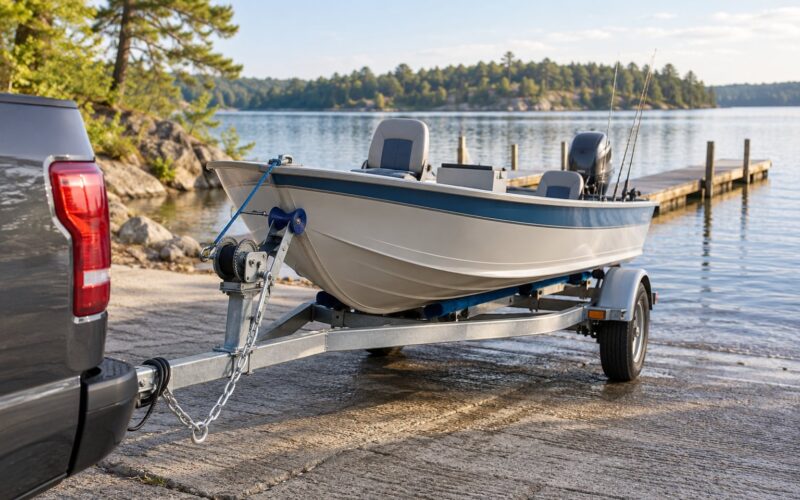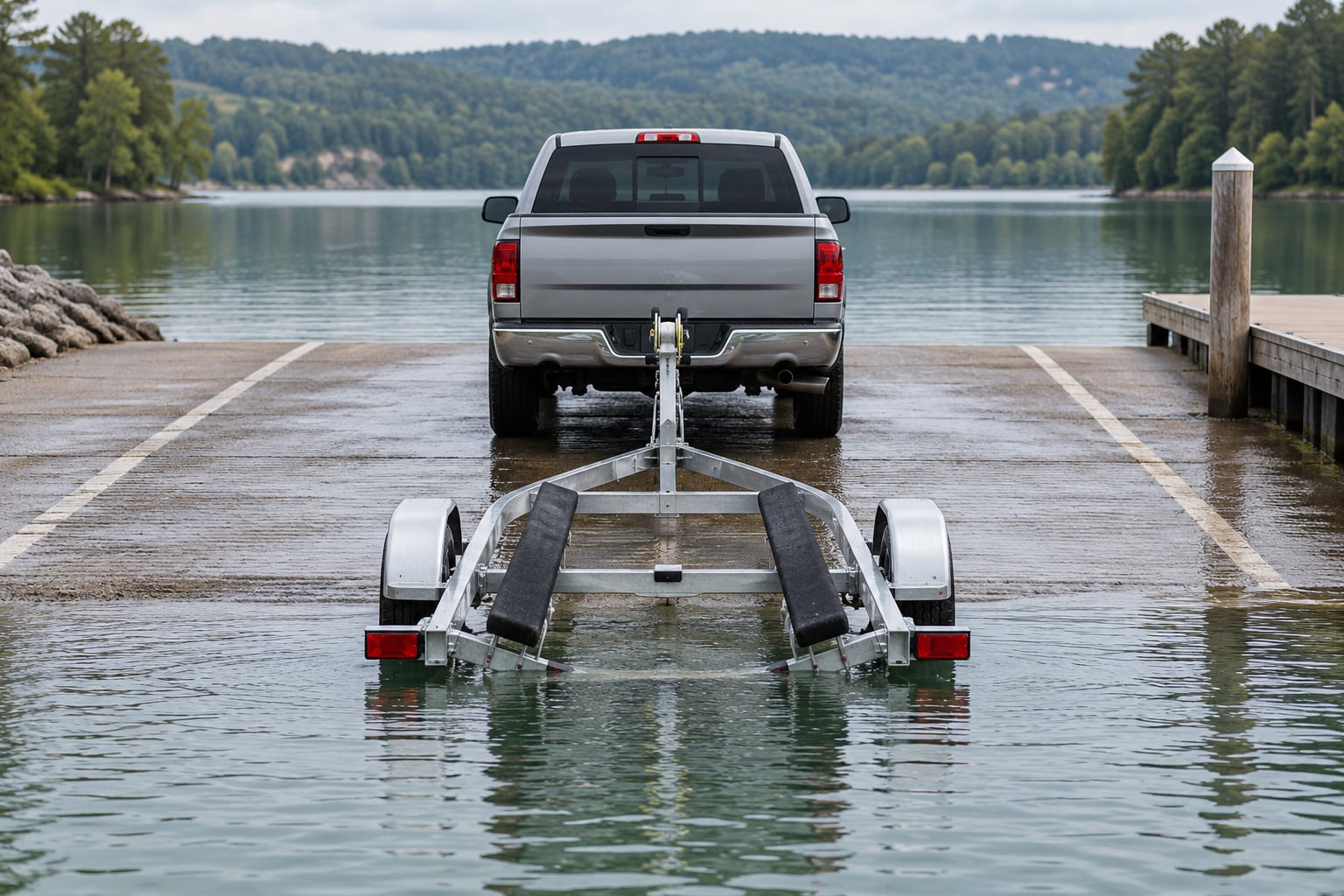
To back a boat trailer down a ramp, line the trailer straight with the ramp centreline, select reverse, and creep backwards at idle while watching the trailer in your mirrors rather than the tow vehicle. Make small steering inputs, drop into neutral to let the slope hold the line, and stop when about two thirds of the bunks or rollers are submerged so the hull can float free.
That is genuinely the whole technique. What makes it hard is not the difficulty but the audience: a concrete slope, a queue of trailers behind you, and a steering response that feels inverted to anyone who has driven a car for twenty years. Hesitation is what causes jackknifes. Nobody remembers the person who backed in smoothly and quietly.
Everyone is bad at this the first few times. Then it becomes the most boring four minutes of the boating day.
Table of Contents
- What You Need
- Step-by-Step: How to Back a Boat Trailer Down a Ramp
- 1. Position the Vehicle Straight and Close to the Ramp
- 2. Put the Vehicle and Trailer in Reverse
- 3. Make Small Steering Corrections: The Trick to Backing Down a Ramp
- 4. Watch the Trailer, Ramp Edges, and Water Depth
- 5. Stop at the Right Depth to Launch the Boat
- 6. Set the Brake, Unhitch, and Move the Vehicle Forward
- Common Mistakes to Avoid
- Jackknife Recovery: Pull Forward, Never Reverse Out
- Backing an Empty Trailer or Going Solo
- Troubleshooting: Symptom, Cause, Fix
- Frequently Asked Questions
- What is the trick to backing up a trailer?
- Why does my boat trailer lock up when I try to reverse it?
- How deep should I back the trailer into the water to launch?
- Do I need a spotter to back a boat trailer down a ramp?
- What is the Z method for backing a trailer?
- What is the 1/3 rule in boating?
- Conclusion
What You Need
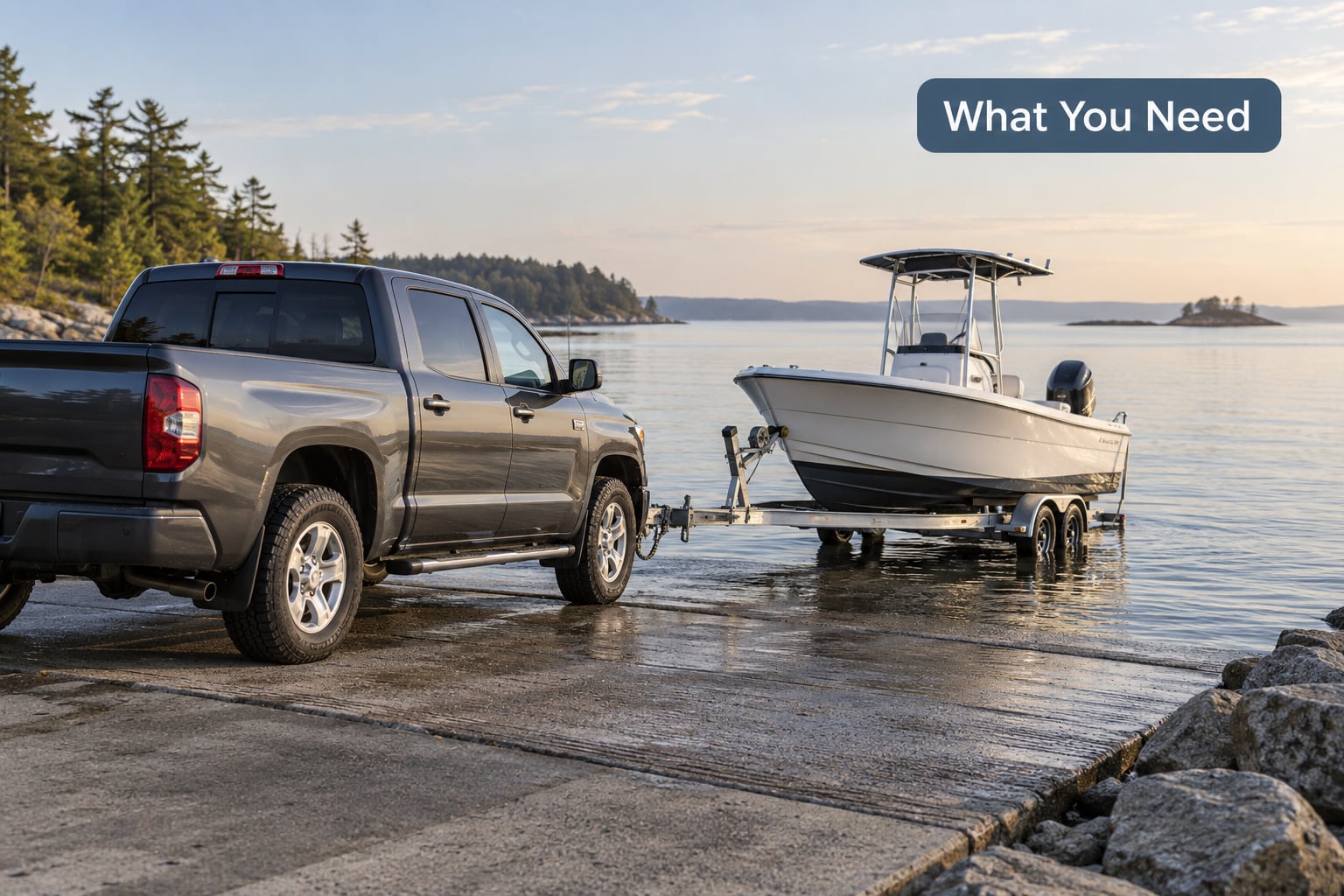
Get the rig right in the staging area and the ramp itself becomes the easy part. Ten minutes here saves the kind of scramble that ends with a flooded trailer.
- A tow vehicle rated for the loaded trailer. Check the tow ball rating and the vehicle’s tow capacity against the trailer’s gross weight with the boat aboard, not the empty weight printed on the frame.
- Extended side mirrors, or drop-in tow mirrors if the truck does not have factory extended units. On a steep ramp the trailer drops out of the mirror almost immediately.
- A working breakaway cable clipped to the tow vehicle, separate from the safety chains.
- Fenders and docklines rigged on both sides before the trailer moves, not once you are in the water.
- A drain plug bungee cord or carabiner clipped to the steering wheel, so the plug cannot end up somewhere in the bilge.
- A transom strap, winch strap and bow eye to secure the boat on the trailer, plus a spare transom strap.
- The parking brake, set before you step out of the vehicle at any point.
- A spotter if one is available, and a set of hand signals agreed on before you move.
Do a slow walk-around at the staging area. Lights work, chains are crossed and hooked, the jockey wheel is up and clear of the ground, the trailer tires are inflated, and the winch strap has two wraps on the bow eye.
Step-by-Step: How to Back a Boat Trailer Down a Ramp
1. Position the Vehicle Straight and Close to the Ramp
Stop the tow vehicle well back from the water, wheels straight, and line up along the ramp centreline. If your mirrors show the trailer already angled, fix it now by pulling forward and repositioning the whole rig, not by correcting with the wheel.
Look for a fixed reference point: a ramp seam, a painted lane edge, a dock post. Once you are reversing to that landmark instead of reacting to the trailer, the whole job gets calmer. That is the single biggest change people make between their first launch and their tenth.
Leave the parking brake on until you are ready to move. On a steep ramp, drive gear alone is not a holding brake.
2. Put the Vehicle and Trailer in Reverse
Check both mirrors and both blind spots before selecting reverse. Anyone walking a dog or a kid on the ramp should already be clear, and it is worth looking twice.
Shift into reverse and come off the parking brake. Keep the transmission at idle; you want a creep, not a walk. On most ramps the trailer is heavier than the tongue feels, so the vehicle will follow it down whether you are on the gas or not.
If the incline is steep, some drivers select neutral and let gravity carry the rig down the slope in a straight line. It works, and it works well as a first-timer crutch, but hold the wheel and stay ready to put it back in drive the moment the trailer starts to wander.
3. Make Small Steering Corrections: The Trick to Backing Down a Ramp
Here is the part that feels wrong to everyone. The trailer pivots around its own rear axle, not around the tow vehicle’s front wheels. Turn the wheel toward the passenger side and the trailer’s stern swings toward the driver’s side. The front of the vehicle finishes up pointing the opposite way, which is why the whole rig appears to fold in on itself.
The community trick that makes this click is hand position. Put one hand at the bottom of the steering wheel, at six o’clock, and then move your hand the direction you want the trailer to go. Your hand travels the short way around the rim while the wheel turns the long way, which keeps your arm from crossing over and puts your hand exactly where the trailer is going.
Move the hand a little. Wait. Watch what the trailer does. Move it again. That is the entire correction cycle, and it repeats every two or three seconds on a straight ramp.
Most jackknifes come from speed, not from bad judgement. If you are correcting constantly, you are going too fast, so slow down and lengthen the gap between inputs.
4. Watch the Trailer, Ramp Edges, and Water Depth
Keep your head facing forward and read the trailer in the mirrors. Craning your neck to look directly at it costs you your forward view, and on an incline the trailer disappears downward anyway. If the mirrors are not enough, sit up tall and use the rear window as a secondary check.
Watch the lane edges rather than the trailer’s absolute position. Two parallel lines that stay parallel mean you are tracking straight, even if the whole rig is drifting across the ramp gradually. Correct for that drift early and gently.
This is the stage where the ramp geometry matters more than the steering. On a multi-lane ramp the far trailer can block your view, so you may have to pull across both lanes into the driveway and then reverse back in from the shoulder, angling in as you go. Nudge out into the staging area to get a clear line rather than creeping blind.
Bow-in and stern-in launches change the approach too. Backing a stern-in boat usually means the trailer guides you into position with the ramp grade doing most of the work. For a bow-in launch you are typically positioning to one side and backing diagonally, so the alignment tolerance is much tighter and the straight-line discipline matters more.
5. Stop at the Right Depth to Launch the Boat
Back until the hull sits over enough water to lift off the bunks or rollers. The working rule that certified boating courses use is roughly two thirds of the bunks submerged, and that is the number to aim for rather than a vague judgement of depth.
Too shallow and you end up pushing the boat off by hand with the winch strap still attached, which is where boats get damaged and fingers get hurt. Too deep and the trailer can drop off the rollers or hang up on the ramp’s underwater grade, and you are winching back up in front of the queue.
On a tidal ramp the water depth changes the stopping point between visits. The ramp looks identical, the water does not. Learn where the drop-off or the low spot is so you are not discovering it with the trailer already over it.
6. Set the Brake, Unhitch, and Move the Vehicle Forward
Once the boat floats free, put the vehicle into park and set the parking brake. Do not rely on park gear alone on a wet incline.
Disconnect the safety chains, unclip the breakaway cable, and pull the winch strap free of the bow eye. If your boat has a tilt switch, transom saver or other shallow-water aid, reset it now while you are still in the trailer.
Pull the tow vehicle forward and clear of the lane quickly. It is the single most courteous thing a boater can do, and the queue behind you will notice. Move to the staging area to rig the boat before you start tidying up.
Common Mistakes to Avoid
| Mistake | Why it goes wrong | The fix |
|---|---|---|
| Starting at an angle | Any lateral offset gets amplified as you descend | Pull forward and reset against a centreline reference |
| Watching the vehicle instead of the trailer | You steer toward where the tow ball is, not where the trailer is going | Read the trailer in the mirrors, ignore the front wheels |
| Reversing too fast | Over-correction turns into a snake and then a jackknife | Idle creep, one small input, then wait |
| Large steering inputs | The trailer cannot follow the curve, so it pivots sharply | Inputs of a few centimetres at the rim |
| Trying to reverse out of a jackknife | Reversing folds the angle tighter | Stop, select drive, pull forward and realign |
| Backing off the ramp edge | A tire drops into the soft shoulder and the trailer digs in | Stop, pull forward, re-centre on the lane |
| Backing in with no gas on a steep ramp | The rig rolls back faster than you can react | Keep enough revs to creep, not enough to lunge |
| Launching before the trailer is straight | The boat lands diagonally on the bunks | Correct to parallel before the stern reaches the water |
Jackknife Recovery: Pull Forward, Never Reverse Out
A jackknife is the trailer forming roughly a 45 degree or sharper angle with the tow vehicle. Past that point the trailer’s path stops following the vehicle’s, and continuing to reverse just tightens the fold until something hits the ramp edge or another trailer.
The recovery is always the same: stop, select drive, and pull forward. Straighten up, put the trailer back near the centreline, and start again. It feels counter-intuitive because you are moving away from where you wanted to go, but pulling forward is the only direction that opens the angle back up.
Backing an Empty Trailer or Going Solo
An empty trailer is a genuinely harder skill, and people ask about it constantly. Without the boat, the bunks and rollers give you no visible reference for where the hull is, the tongue feels lighter, and on a steep ramp the trailer sits so low that the mirrors show mostly sky. Owners backing a brand-new trailer with the boat still at home hit exactly this.
Without a spotter, set up your reference points before you move rather than correcting afterwards. Note the trailer’s relationship to a fixed landmark at the top of the ramp, then reverse to that same landmark. Adjust your mirrors so you can see the trailer fenders and the lane edges at the same time, and on a very steep ramp fit tow mirrors or a camera with a downward view.
Keep the exercise slow. If a spotter is available, stand behind and to one side, out of the trailer’s path, with agreed signals: arm out to one side means move that way, and both hands up means stop immediately. Then treat every signal as if it were real, because the day you need it, nobody is waving.
Troubleshooting: Symptom, Cause, Fix
| Symptom | Cause | Fix |
|---|---|---|
| Trailer locks up or won’t reverse underwater | Submerged trailer brakes staying applied, or a bent or snagged part of the running gear | Check the breakaway switch and brake fluid, raise the trailer onto a dock or shoreline before inspecting |
| You cannot see the trailer at all | Standard mirrors on a steep empty ramp | Tow mirrors, extended mirrors, or a downward camera view |
| Trailer will not track straight | A bent axle, a seized roller, or uneven tire pressure | Inspect rollers and bunks for debris, check tire pressure, check the axle against a straight line |
| Vehicle stalls or loses drive on the incline | Tow rating exceeded, or too much trailer weight on the tongue | Use a vehicle rated for the loaded trailer, or launch in more than one trip |
| Boat will not float off | Backed in too shallow, or the hull is snagged on the rollers | Back in further, slowly, keeping the trailer straight |
| Rig creeps while you are getting out | Parking brake not set, or set without the transmission in park | Transmission in park and parking brake set, every time you leave the seat |
| Water comes into the boat during backing | Drain plug not in, or not bunged after the last trip | Plug in before the trailer moves, bungee the plug to the steering wheel |
Frequently Asked Questions
What is the trick to backing up a trailer?
The trick is to place one hand at the bottom of the steering wheel and move it the way you want the trailer to go, while your head stays forward and you watch the trailer in the mirrors. The trailer pivots at its own rear axle, so the vehicle swings opposite to the trailer. Slow creep speed and one small input at a time matter as much as the hand position.
Why does my boat trailer lock up when I try to reverse it?
The most common cause is the trailer brakes staying applied once the wheels are submerged, which happens if the breakaway switch has not been reset or if brake fluid has crept into the actuators. Bent axle parts, a snagged roller, or debris around the bunks can stop it too. Raise the trailer onto a dock or shoreline before inspecting anything rather than working on it in deep water.
How deep should I back the trailer into the water to launch?
Back until about two thirds of the bunks or rollers are submerged and the hull is floating over the trailer bed. That is usually deep enough for the boat to slide off without a push. Going too shallow means winching or shoving the boat clear by hand, and going too deep risks dropping the trailer off the rollers or into a low spot at the ramp’s base.
Do I need a spotter to back a boat trailer down a ramp?
A spotter makes it far safer, especially on a steep, narrow, or crowded ramp, and anyone reversing near people or vehicles should use one whenever possible. You can launch alone if you set up tow mirrors, agree on nothing but your own reference points, reverse to a fixed landmark, and keep the creep speed low. Practice the approach in an empty car park with buckets marking the lane edges first.
What is the Z method for backing a trailer?
The Z method is a pattern for tight reverse manoeuvres: steer one way, then stop and pull forward straight, then steer the other way, repeating so the trailer follows a zig-zag path rather than a single sweeping curve. It is most useful when recovering from an off-line start, because the forward-and-straight move opens the angle back up instead of folding it tighter. It is slower, and slower is correct here.
What is the 1/3 rule in boating?
The 1/3 rule is a fuel planning guideline rather than a trailer rule: keep at least one third of your fuel capacity in reserve on return, so you always have enough to reach shore. Boaters extend it to safety gear, where a third of your flotation devices should be worn by the people aboard. It is a habit of leaving margin, which is the same instinct behind backing in slower than feels necessary.
Conclusion
The first thing to do is not at the ramp at all. Take twenty minutes in an empty car park, put two buckets where the ramp edges would be, and back between them until it stops being interesting.
Three habits carry the rest. Watch the trailer, not the truck. Make inputs small and creep slowly. Stop and pull forward rather than fighting an angle. Set the parking brake before you touch the bow eye, and move out of the lane quickly once the boat is floating.
Get those right and launching becomes the least memorable part of the day. Practise on a familiar, uncrowded ramp a couple of times before you try it alone somewhere busy, and you will never again be the person holding up the queue.