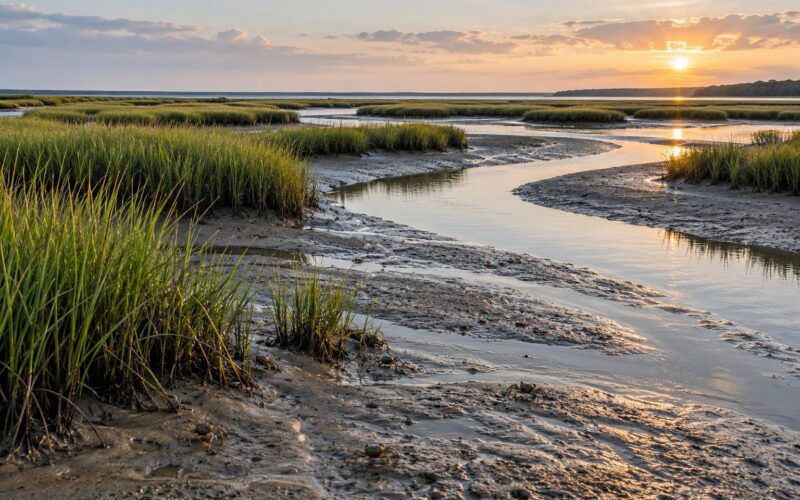
Reading a marsh for redfish tails means learning to see what a redfish leaves behind in shallow, skinny water: a tail breaking the surface, a bulge that becomes a V-shaped wake, nervous water, mud clouds, a flash of copper or bronze. Catch that sign early and you can place your first cast where the fish is instead of where it was.
It takes practice, and most anglers are bad at it for one predictable reason. They scan a quarter mile of grass at once, then wonder why a fish two feet from the boat went unnoticed. The fix is a routine, not better eyes. Work the tide, then the water, then the movement, then the mud, then the birds, then the structure, and only then decide what the fish is doing.
The signs themselves are simple. What takes practice is telling them apart, especially once wind puts ripples on the surface. Here is the short version, and then the full routine.
First, the signs worth training your eye on, in rough order of how often you will meet them:
- V-wake — two lines opening from a point; a redfish traveling through the water.
- Bulge — a slight rise in the surface just ahead of the wake; the earliest tell on a moving fish.
- Mud puff or boil — silt lifting in a soft column; a fish working the bottom.
- Tail breaking the surface — the curved wedge most anglers are looking for.
- Nervous water — texture in the surface with no visible source; usually several fish feeding together.
- Pinholes — small repeated dimples with no plume; a fish working tiny crabs.
- Copper or bronze flash — a flank turning in clean light; confirmation, never a stand-alone sign.
- Head-down posture — the tail up, the body angle down; the fish is focused on the mud.
- Back breach — the fish arches and rolls, usually on a drop or under pressure.
Below is how to actually work the marsh rather than just recognize the list.
Table of Contents
- What You Need: Viewing and Boating Gear That Actually Helps
- Step-by-Step: Reading the Marsh in Seven Steps
- 1. Start with the tide and water direction
- 2. Scan the surface for tail movements
- 3. Look for disturbance in the water
- 4. Read mud signs along the banks
- 5. Use birds as marsh alarms
- 6. Interpret marsh structure and edges
- 7. Confirm the fish before you choose a cast
- Common Mistakes Reading a Marsh (and the Fix for Each)
- Scanning too much water
- Mistaking wind ripple for fish movement
- Ignoring tide stage
- Fishing only under the bird
- Chasing old mud signs
- Casting loud over a head-down fish
- Underestimating how far noise carries
- Frequently Asked Questions
- Are redfish tails always easy to see in a marsh?
- What tide is best for spotting redfish tails?
- What does a redfish tail look like in shallow marsh water?
- Do mud puffs always mean redfish are nearby?
- How do I tell fish movement apart from wind ripples?
- Should I fish near birds in a marsh?
- Conclusion
What You Need: Viewing and Boating Gear That Actually Helps
You do not need a new boat or a cart full of equipment to sight fish a flat. You need four things that make looking easier, and most anglers who complain about seeing no tails are missing at least one.
Polarized sunglasses. Glare off shallow water hides everything. Polarized lenses cut the surface reflection and let you see the shape under the water a foot or two down, which is usually where the fish body is even when the tail is up. Anglers who switch to a polarized pair usually report spotting more fish in the first ten minutes than in a whole blind trip.
A quiet platform. A poling skiff, a drift boat, a kayak or wading all work. A motor running down a grass edge is the one option that reliably ends the outing, because hull noise and displacement travel much further in a few feet of water than they sound like they will. Marsh anglers report their best success when poling or drifting slowly rather than running.
Tide information for the exact spot. A general window is not good enough. Tide stage decides whether fish are on hard bank crawling or up on the grass slithering, and both look completely different from the bank.
A field notebook. Sounds fussy, but write down the sign, the tide stage, the wind and what you cast. Patterns show up on the second or third trip and never in memory.
Light tackle belongs here too, but only in one sentence: if you cannot land the cast quietly near the fish, none of the reading you did matters. Rod and reel choices matter far less to experienced marsh anglers than positioning, light and quiet.
Step-by-Step: Reading the Marsh in Seven Steps
Run these in order every trip. Each step narrows the water you have to watch, which is the whole point, because scanning too much water is the mistake that costs beginners the most fish.
1. Start with the tide and water direction
Tide stage is the filter that decides everything downstream. On a rising tide, reds push onto the grass edges and feed in the seams where new water meets the marsh, so you will mostly see slithering fish and slow pushes along a grass line. On falling water, fish drop back into the creeks and onto hard bank, where you get crawlers, tighter mud signs and fish that hold position instead of moving.
The best windows sit near the turns. The first two hours after low water and the last two hours before low water concentrate fish on the edges that will soon be exposed or covered, and both of those periods give you shallower, clearer water to look through.
Current direction matters as much as height. Water pushing past a point creates a seam where bait collects and where reds pause to feed. Fish on a moving seam often show only a bulge, because the current smears the wake. Water with no push lets a tail read cleanly, but there are fewer fish working it.
Wind deserves the same respect. Once it blows past roughly 15 knots the flats turn to chop and surface signs get buried in texture. That threshold comes up constantly in marsh fishing threads, and it is about visibility rather than fish activity: reds keep feeding, you just cannot see them. Glassy water in light wind is the best of both worlds.
2. Scan the surface for tail movements
A redfish tail in shallow water reads as a curved, dark line with a flash of color, usually pointed and slightly wider at the top than the water line suggests. Because the tail leaves the water last as the fish pitches forward, you usually see a distinct wedge rather than a full fin.
Timing tells you what the fish is doing. A slow, steady push means a fish grazing or cruising, and the wake grows behind it. A quick flick with a splash is a fish striking or repositioning. Repeated short tail movements without much travel mean a head-down feeder working the bottom, which is the tailing behavior most people are hunting.
Tails are often easier to catch than backs, which surprises beginners. A dark back against dark water is nearly invisible, while a tail breaks the surface and catches light against it. That contrast is why polarization matters so much, and why low sun behind you produces more visible tails than sun flat on the water in front of you.
Train yourself to work a small section rather than the whole flat. Pick a ten-foot stretch of grass edge, stare at it until you can describe what is normal there, and only then start picking out what is not. Movement before shape is the rule. Something that moves is worth a second look even if you cannot identify it.
3. Look for disturbance in the water
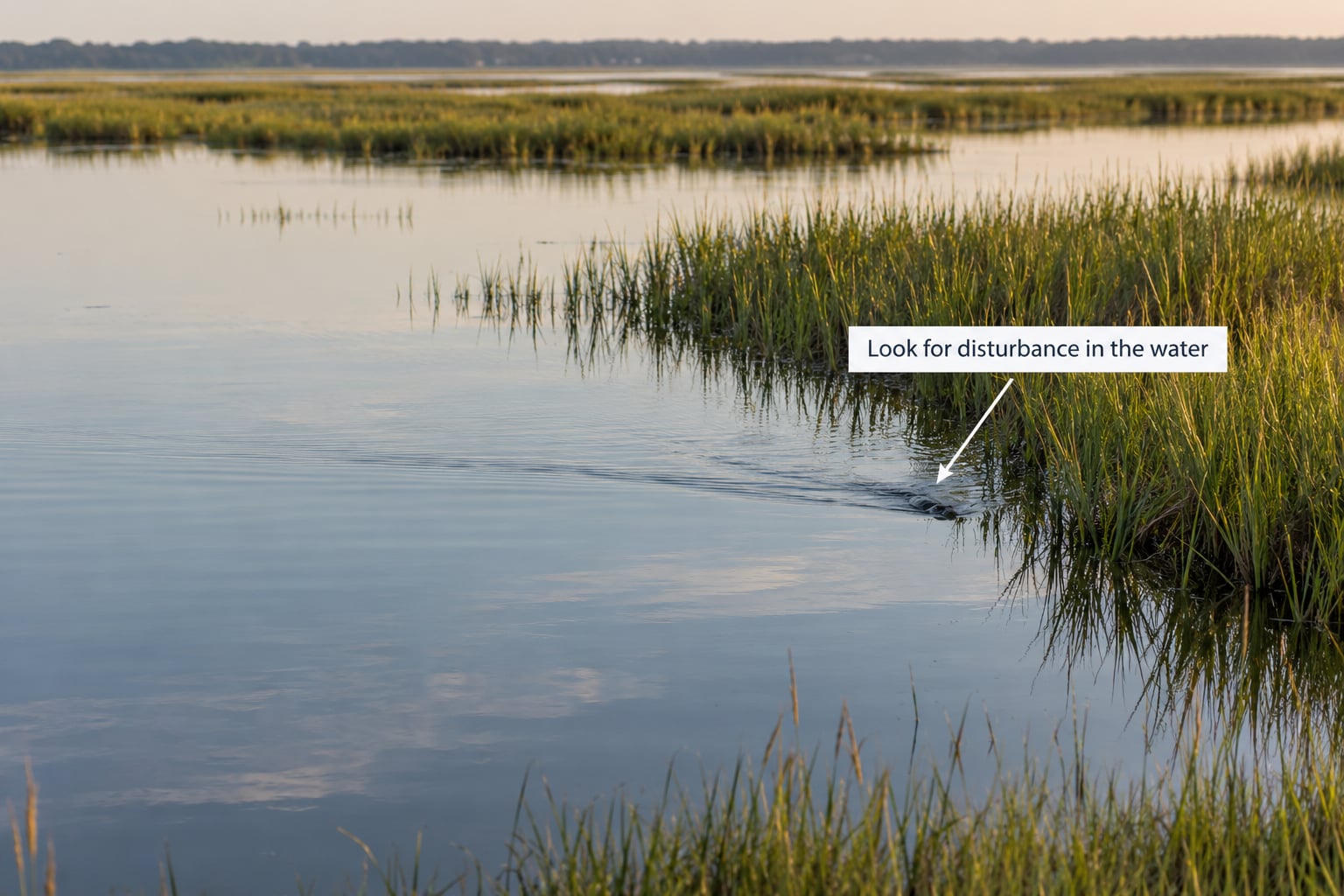
Not every redfish shows a tail. Most show a disturbance, and that is often where your first real reads come from.
- The bulge. A patch of water that rises slightly before a wake forms. The bulge appears first and is the earliest tell on a moving fish.
- The V-wake. Two lines opening from a single point. It is the classic sight-fishing signature and it carries for a long way on calm water.
- The circular push. A ring or a rounded swirl, produced by a fish that turns or stops rather than traveling straight.
- The dimple. A small surface pucker with no wake behind it, often a fish feeding in one spot rather than moving through.
- The nervous patch. A stretch of water that looks textured without a visible source, caused by several fish working the same area.
- The back breach. The fish arches and rolls, usually on a drop or when it feels pressure. Rare, memorable.
- The color flash. Copper or bronze where a flank turns in clean light. It is not a sign on its own; it is confirmation of a movement you already spotted.
Wind and current produce their own versions of all of these, so you have to separate them. Wind ripples run in parallel bands and drift with the breeze. Current pushes form a consistent line along one edge and stay in the same place for minutes. A wake does neither: it starts at a point and travels away from it.
One more thing worth watching: pressure waves travel through shallow water much faster and further than sound travels through air. A hull that looks like it is sitting still can be pushing a wave ahead of itself that reaches a fish well before you notice anything. That is why slow, quiet movement is not just preference in the marsh.
4. Read mud signs along the banks
Mud signs are the most reliable evidence of a feeding redfish, and the most often misused. They tell you a fish was there. They do not tell you it is there now.
Fresh signs have a definite look. A puff of silt rises in a soft column and hangs before drifting. A boil is the same thing tighter and more abrupt, usually a hard downward pick followed by a burst. Pinholes are small, repeated dimples with no mud plume, often a fish working tiny crabs. Trails are a line of disturbed mud with a wake moving away from it, and displaced mud at the base of a bank shows a fish holding position against the edge.
Older signs look different, and the difference matters. Old puffs have slumped and settled into a smooth stain. Pinholes have softened at the edges. The giveaway is whether the sign is sitting on the surface or has partly filled back in, which happens fast on soft bottom during a falling tide.
Timing tells you the rest. Mud signs matter most on falling water, when fish are working hard bank and mud for crabs. On the flood, fish push onto the grass and you see almost no mud activity at all. If you find a fresh puff on a falling tide, check the current direction and look back upstream, because the fish that made it is usually a few feet ahead of the sign.
5. Use birds as marsh alarms
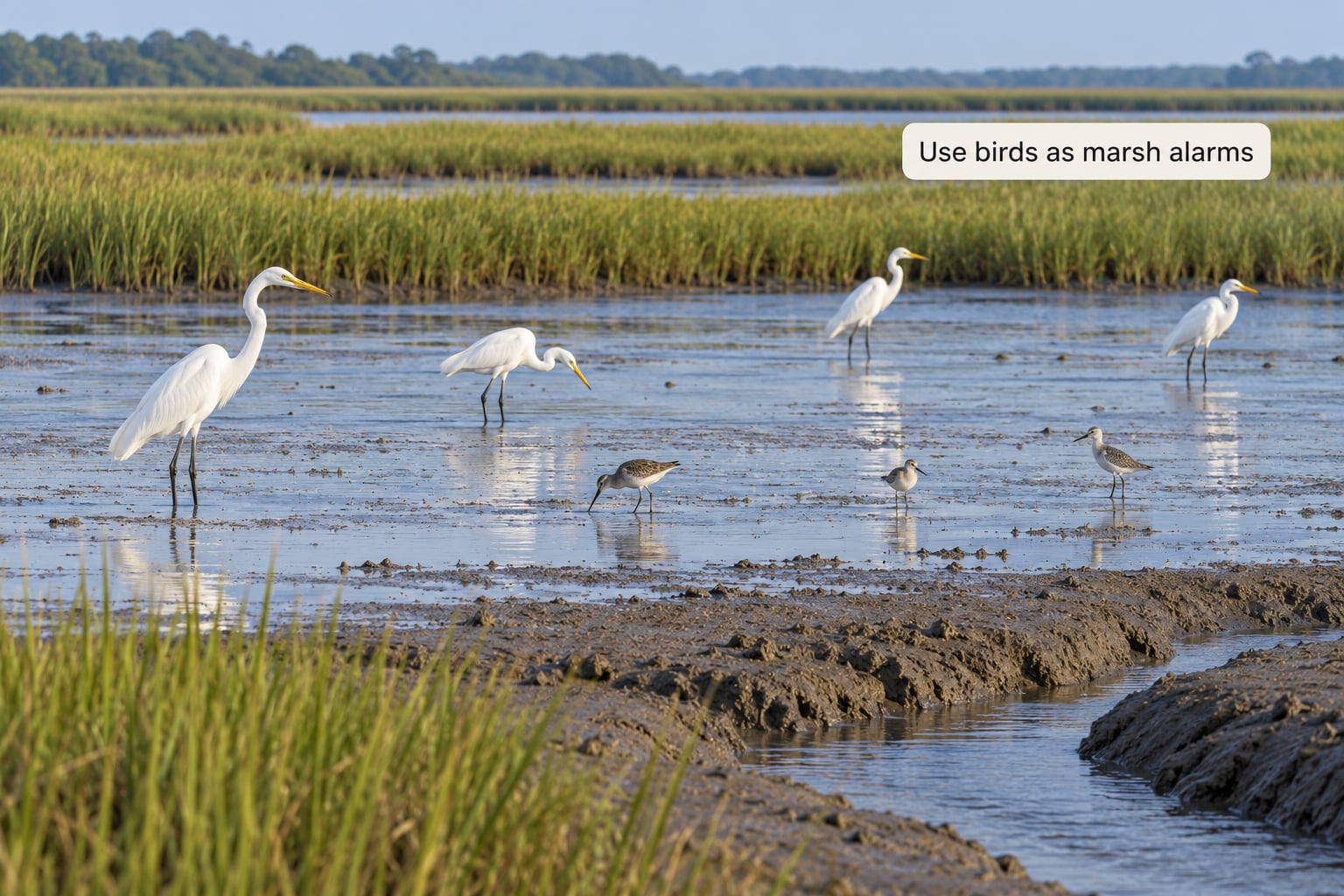
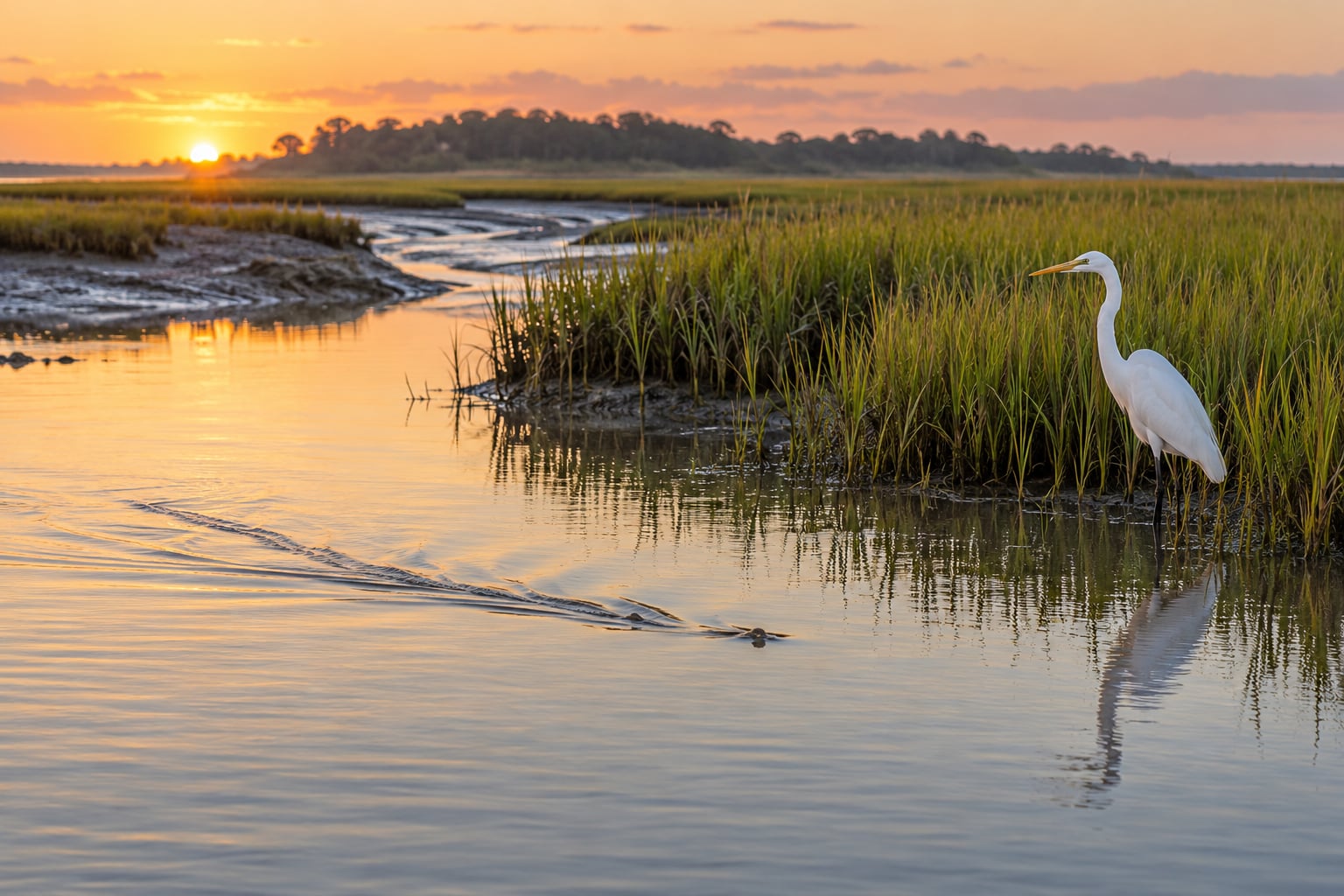
Wading birds are the best locating tool in the marsh and most anglers ignore them. An egret or ibis standing still and then stabbing repeatedly is not looking for a lost phone. It is eating whatever the fish are pushing out of the bottom.
That is the whole signal. Birds mark where feeding activity is concentrated, and feeding activity means redfish, usually a concentration of them rather than a lone fish. You can see a working bird across open water that you could never fish across without spooking everything.
The mistake is fishing only under the bird. The bird is on the far side of the concentration, not the near side. Redfish push prey toward birds, so the fish are generally between you and the bird, spread out in a loose group, and often a good distance from the bird itself.
Shorebirds tell a similar story with a different signal. A scatter of small birds lifting and resettling means something flushed them, which is often a fish or a small predator moving through. Watch where they resettle and check the water in front of that spot.
6. Interpret marsh structure and edges
Sign reading is much faster when you are reading the right water. Creek mouths concentrate everything, because bait washes in and out with the tide and reds sit there waiting on it. Inside bends and mouths, fish hold position rather than travel, which makes them easier to see and easier to fool.
Grassy points matter for the same reason. A point is where a moving fish has to choose a side, so fish pause and inspect, and that pause is what you see. Islands and hard-bottom tongues are the same idea: the transition from open water to structure is where feeding happens.
Drop-offs and current boundaries deserve attention too. A drop-off concentrates bait because current brings it and the deeper edge gives fish cover, and fish working the seam often show only a bulge because the current erases the wake behind them. Boundary water between two depths is consistently better water than either depth alone.
Watch how fish use cover. Reds come out of grass to feed on a mud or sand pocket and go back. Their movement is a shuttle, not a search, so the second pass usually follows the same route as the first. If you see one fish at an edge, you have probably seen the same fish twice, and there are often more along that edge.
7. Confirm the fish before you choose a cast
Only now do you pick a lure. Start by naming the behavior, because it sets the lead distance and the presentation.
Crawling means a fish pressed against hard bank, mud or oyster, usually on falling water, moving slowly and deliberately along the edge. It is feeding on bottom-dwellers. Lead it about ten feet and let a bottom-bouncing presentation do the work, because a crawler is looking down.
Slithering means a fish moving across the top of the grass, often on the flood. It is picking items off the surface and moving steadily. Lead it one to one-and-a-half times its body length and use a slow, quiet surface presentation with a pause between strips.
Tailing means a fish working the mud head-down with its tail up. It is focused on the bottom and will not look up for a lure passing above it. Lead it one to two feet and put the lure on the bottom, where the food is.
Then confirm with a second look before you cast. Two or more independent signs together, a fresh mud puff with a moving bulge, or a fish that has repeated the same edge twice, all mean fish are there and working. A single dimple with no wake, no mud and no repeat is usually a curious fish that is already leaving.
Cast quiet, not far. Loud, long casts spook fish in skinny water, and the splash arrives before the lure does. Wait for the fish to settle, keep the line out of the water where you can, and let the lure arrive before the fish notices you.
Common Mistakes Reading a Marsh (and the Fix for Each)
Almost every bad day in the marsh traces back to one of these, and all of them are fixable.
Scanning too much water
Looking at a half mile of grass and reporting nothing is the most common failure. Divide the water you can reach into ten-foot sections, work one section until you can describe what belongs there, then move. Beginners who try this usually find fish in the first two sections.
Mistaking wind ripple for fish movement
Parallel texture drifting with the breeze is wind. A wake that starts at a point and travels away from it is a fish. When in doubt, wait: fish movement has an origin and a direction, ripples do not.
Ignoring tide stage
Fishing the same flat all day at all stages wastes the tide. Falling water moves fish to mud and hard bank, rising water moves them to grass edges. Pick your window around low water and let the tide do the locating.
Fishing only under the bird
The bird marks the concentration, not the fish. Cast to the water between you and the bird, spread out, and check the edges on both sides of the bird rather than only the spot beneath it.
Chasing old mud signs
Signs that have slumped or filled in belong to a fish that already left. Read mud only when it is fresh, and then assume the fish is a few feet ahead of the sign with the current.
Casting loud over a head-down fish
A tailing redfish is looking at the mud, not at you, and it will not chase a surface lure. Shorten the lead, land it softly, and bounce it along the bottom where the crabs are.
Underestimating how far noise carries
A conversation, a hull slap or a hard landing travels a long way through two feet of water. Cut the motor, drop the trolling motor into a slow crawl or pole, and slow down before the fish slows down.
A few field habits tie it together. Note the wind, tide and sign in your notebook each trip. Give a marsh edge ten minutes before judging it. Come back to the same edge a different hour, because light changes what you can see more than most people expect.
Frequently Asked Questions
Are redfish tails always easy to see in a marsh?
No. Tails read clearly only on calm water with light behind you, and even then most reds feed head-down without showing one at all. Wakes, bulges, mud puffs and nervous water are more common signs than tails. Wind above roughly 15 knots covers the surface texture and hides all of them, even when fish are feeding heavily underneath.
What tide is best for spotting redfish tails?
The first two hours after low water and the last two hours before low water work best, because water is shallow and clear and fish are concentrated on hard bank, creek edges and mud. Rising water pushes reds onto grass edges where you will see slow pushes instead of tails. Choose the window around low water and read the creek mouths and points rather than the open flat.
What does a redfish tail look like in shallow marsh water?
It looks like a curved, dark wedge with a flash of copper or bronze, usually wider at the top than the waterline makes it seem, because the tail leaves last as the fish pitches forward. A tail moving slowly and repeatedly means the fish is feeding head-down on the bottom. A quick flick with a splash usually means a strike or a reposition.
Do mud puffs always mean redfish are nearby?
They mean a fish disturbed that mud, but not necessarily that it is still there. A fresh plume of silt rising in a soft column is recent, while a settled stain or a filled-in pinhole is old. On falling water, look a few feet ahead of a fresh sign with the current, since the fish usually moved on after working it. Mud signs matter most when reds are feeding on crabs along hard bank.
How do I tell fish movement apart from wind ripples?
Wind ripples run in parallel bands and drift consistently with the breeze. Fish movement starts at a single point and travels away from it, so a V-wake, a circular push or a dimple has a visible source. Current produces a steady line along one edge that stays in the same place for minutes. If you cannot find where the movement begins, it is probably weather.
Should I fish near birds in a marsh?
Birds are useful for locating feeding fish, but usually not for casting directly at them. An egret or ibis feeding on flats is eating what redfish push out of the bottom, so the fish are generally spread out between you and the bird. Watch the water around the bird, cast ahead of it, and check both edges rather than fishing only the spot underneath.
Conclusion
Reading a marsh for redfish tails comes down to a fixed order: tide first, then surface movement, then mud, then birds, then structure, then a confirmation before the cast. Every step narrows the water you have to watch, and the water you are not watching is the water you would have wasted.
Start simply on your next trip. Check the tide, pick one good marsh edge with a creek mouth or a grass point in it, put on polarized glasses, and give that edge a full ten minutes of quiet, systematic scanning. Watch for one tail, one bulge or one fresh mud puff, then decide what the fish is doing before you pick a lure. Ten focused minutes at one edge will teach you more than an hour of casting blind across ten.