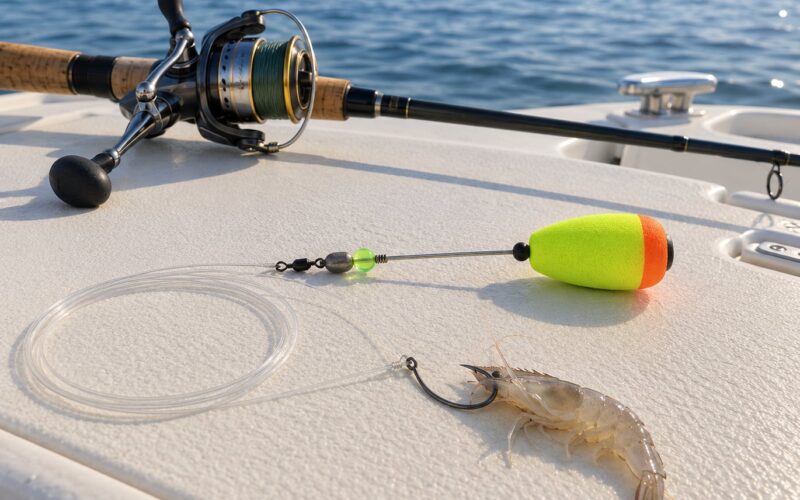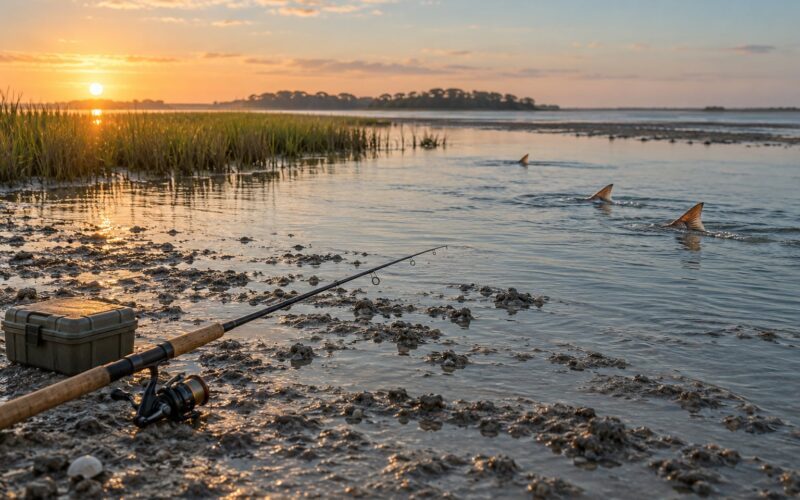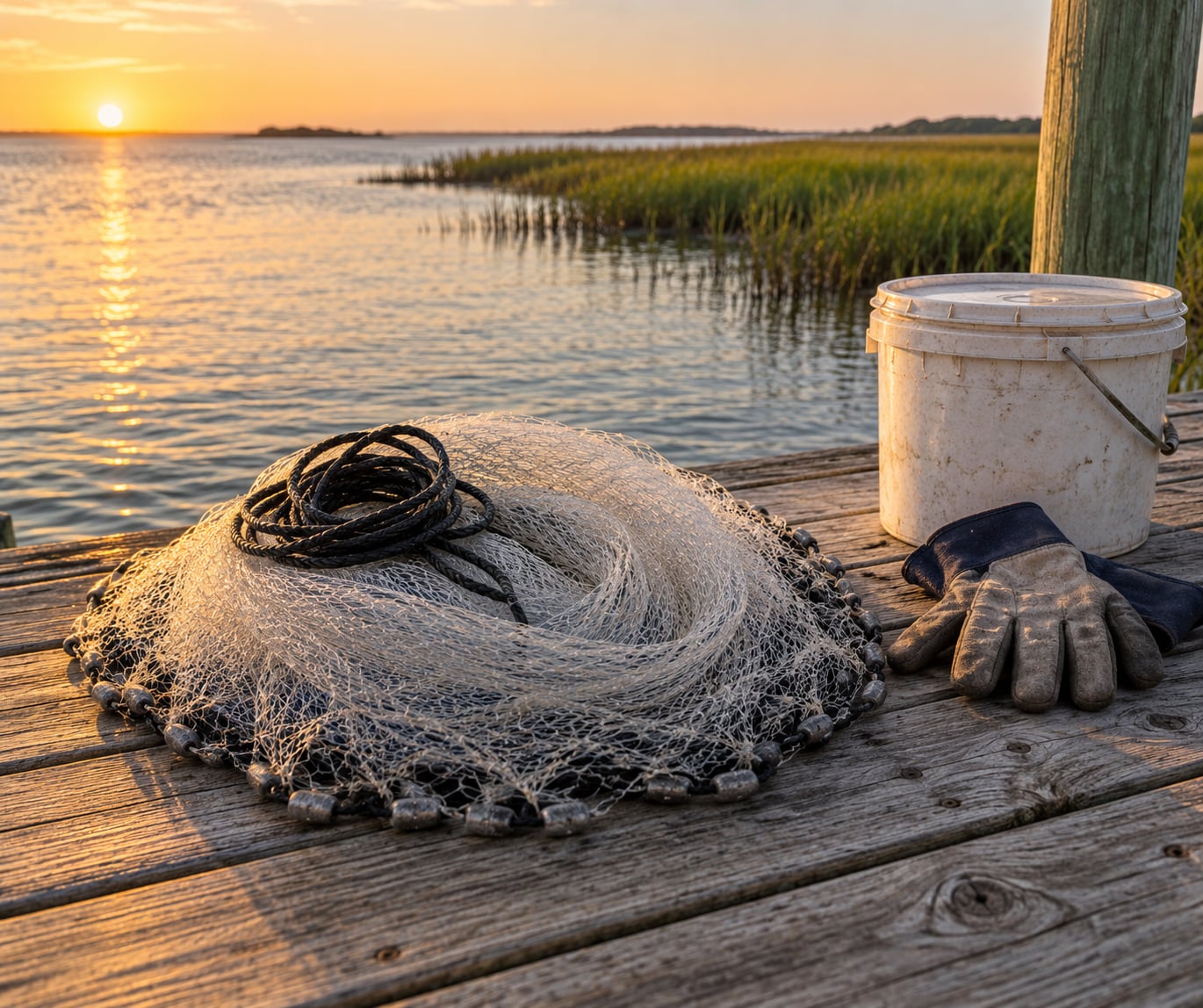
A cast net is a cone of mesh with a weighted rim, and it is the fastest way to put a bucket of live bait shrimp together in a single throw. You coil the rope into your throwing hand, fold the net under the ring, step and pivot toward the target, release the rim so it spreads into a flat circle, then let it sink and pull the rope to close it around whatever was underneath. Budget the first two or three outings as pure practice, because the release is the part that takes repetition. The throw itself takes about four seconds.
Shrimp netting differs from general bait netting in two ways. The targets sit tight to the bottom instead of hanging in a school, and a clean spread matters more than distance, since you are usually working a creek bank or a grass edge you can walk to. The rest of this guide walks through gear, the full sequence, and the fixes for the failures every beginner runs into.
Table of Contents
- What You Need Before You Use a Cast Net for Bait Shrimp
- Net size and mesh that suit shrimp
- Hand line and lead weight
- The rest of the kit
- How to Use a Cast Net for Bait Shrimp: Step by Step
- 1. Check the rules, the water, and the bottom first
- 2. Inspect and prepare the net before it goes in the water
- 3. Load the net into a consistent bundle
- 4. Stand in a stable casting position
- 5. Throw the net in a flat, open pattern
- 6. Let the net sink, then retrieve it slowly
- 7. Remove the shrimp and secure the bait
- Common Cast Net Mistakes and How to Fix Them
- The net lands in a rope instead of a circle
- The net opens but floats away from the shrimp
- The cast curves off to one side
- The net snags and the rim will not close
- Rope tangles around your arm or hand
- You are pulling too much mesh into the cast
- The practice checklist
- Frequently Asked Questions
- What size cast net is best for beginners catching bait shrimp?
- Are cast nets legal for catching shrimp bait?
- How do I throw a cast net straight when it is windy?
- What should I do if my cast net keeps missing the target?
- How do I keep shrimp fresh after catching them?
- What lead weight should I use for a cast net?
- Conclusion
What You Need Before You Use a Cast Net for Bait Shrimp
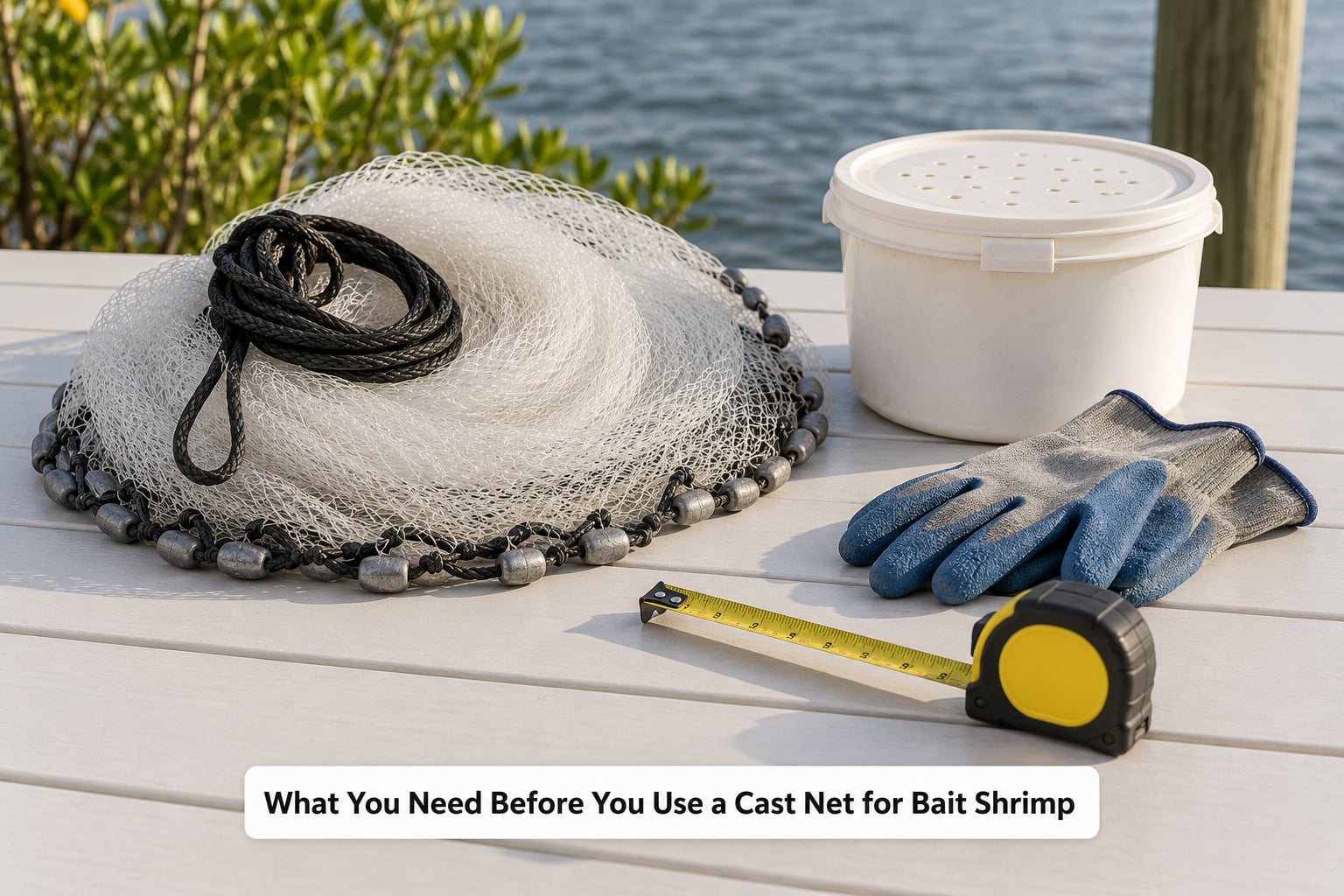
The gear list is short, and the details on it decide whether your net opens or sits in a ball on the bottom.
Net size and mesh that suit shrimp
Start with a radius between 4 and 6 feet. A small net that opens cleanly catches more shrimp than a 10-foot net you cannot control, and shrimp anglers usually work close enough to shore that reach is not the problem. Anything past 8 feet adds weight and distance without adding shrimp.
Mesh is the choice people get wrong. Quarter-inch mesh holds small shrimp and juvenile baitfish, which is what you want when you are after a full baitwell for the day. Three-eighth-inch mesh lets the smallest shrimp slip through but keeps larger whites, browns, and small baitfish in. If your water is clear and the shrimp are big, 3/8 inch saves you from hauling a heavy catch of sand specks.
On material, monofilament is nearly invisible underwater and sinks harder than nylon, which matters on a bottom-holding target. Nylon is tougher and easier on the hands, but it stretches when it dries out and holds a knot longer. Cotton line with chain weights stays flexible in cold water but corrodes faster in salt.
Hand line and lead weight
Use a non-floating polyester hand line. A floating rope rides the surface, pulls the rim sideways, and drags the net off the bottom. For shallow creek and flat work, most anglers run line somewhere around 15 to 25 feet, and longer rope only pays off once you are working drops in eight feet of water or more.
The lead line itself is what makes a cast net sink instead of drifting like laundry. If the rim floats or settles too slowly, add lead. Too much weight and the rim drops before the mesh finishes opening, which is its own kind of failure.
The rest of the kit
- Cut-resistant gloves or mesh gloves, because a heavy rim landing on bare knuckles is how people lose a fingertip.
- Non-slip footwear if you are wading. A slick bottom plus a full hand line is how most wading injuries happen.
- A lidded, shaded bait container with enough water to cover the catch. A plain bucket with a flat lid beats an open bucket every time.
- A small aerator or a squeeze bottle of clean seawater for the ride home.
- A spare weight ring, because a damaged rim is not something you fix in the field.
And check the rules before you leave. Recreational cast netting for shrimp is regulated differently in every state, with size limits, gear limits, closed areas, and in some places a prohibition on netting shrimp for bait at all. Your state wildlife agency page has the current version, and nothing on this page overrides it.
How to Use a Cast Net for Bait Shrimp: Step by Step
1. Check the rules, the water, and the bottom first
Start by standing still and reading the spot. Creek mouths, marsh edges, and the drop-off shoulders of grass flats hold shrimp on a moving tide, and slack water scatters them into pockets you will not find by casting.
Look at the bottom before you commit to a spot. Shrimp work sand, mud, and seagrass, and a net thrown on rock, oyster bed, or shell debris will snag and possibly break free with your lead line attached. Stay off turtle grass, oyster reefs, and any marked sensitive habitat, and keep clear of swimming areas and people wading nearby.
Know how you are going to get out of there, too. Netting from a bridge or high dock is a genuinely different proposition from working a bank, and the rope needs to be longer than the distance you are trying to reach.
You will know the location is workable when the water is a few feet deep, the bottom reads soft, and nothing about the shoreline stops you from walking out. Only then does the rest of the process matter.
2. Inspect and prepare the net before it goes in the water
Run your hands down every seam and pull gently on the mesh. Look for pulled strands, glazed or stiff spots from sun and salt, and any place the mesh has separated from the rim.
Check the hardware closely. The swivel between the rope and the ring should spin freely with no rust, the bridle strings should be tied solid, and the sinkers should be tight on the perimeter line. Rusted hardware is the single most common reason a good net is retired early.
Work every tangle out on the ground. A knot you leave in the bundle does not open, it just carries the whole net into a lump. Grab a small lead weight and a length of line so you can rehearse the release on dry land before you make noise at the fish.
The net is ready when the mesh hangs evenly from the ring, the rim is heavy enough that the test weight drops fast, and nothing snags when you shake it out.
3. Load the net into a consistent bundle
Most beginners load the net differently every time, which is most of the reason their spread varies. Pick one method and repeat it until your hands do it without thought.
The fold-and-pivot method is the one consistently recommended across experienced cast netters. Coil the rope into a bundle in your non-throwing hand rather than a loose loop, hold the net by the ring with the mesh hanging below it, and let the mesh divide evenly between the two sides of the ring so the weight balances.
Gather the loose mesh into the same hand as the rope so everything leaves your body in one motion. Keep the mesh free of twists, because a single twisted section pulls one side of the circle closed while the other side flies out.
You will feel it when the load is right. It sits compactly against your hip, it feels balanced rather than lopsided, and when you shift your grip the mesh settles without springing apart.
4. Stand in a stable casting position
Feet about shoulder width, one foot slightly ahead of the other. Turn your body sideways so your target is off your throwing shoulder rather than in front of your face.
Bring the net up and over the throwing shoulder with the mesh hanging behind you, and let the non-throwing hand stay relaxed at your side. Keep both hands soft. Tension in the arms before the throw pulls the release early and ruins the spread.
Before you commit, look at your lane. You want open water in front of you with no people, no boat, no dock line, and nothing overhead. A cast net has a long reach and it does not care what is behind it.
You are set when your weight is centered over your back foot and your eyes are on the spot you want the center of the circle to land on, not at the edge of it.
5. Throw the net in a flat, open pattern
The cast breaks into four movements. A short step forward with the back foot, a smooth arm sweep that carries the net out over the water, a snap of the wrist that starts the rotation, and the release, which happens at the end of the pivot when your hand is closest to the water.
Aim the belly of the net, not the rim. The belly is the inside of the cone and it is what hits the water flat and starts the circular spread. Throwing the rim straight down punches a hole in the surface and folds the mesh.
Never twist your wrists on the release. A snapped twist makes the net spin like a Frisbee and land in a rope instead of a circle.
You will know the cast was clean when the net lands with a wide, full splash and the rim goes under almost at the same moment across the whole circle. A thin, narrow splash means you released early or the mesh loaded unevenly, and the fix is almost always in step 3 rather than step 5.
6. Let the net sink, then retrieve it slowly
Give the mesh time to reach the bottom before you pull anything. In shallow water that is a few seconds. In deeper water near a drop-off, count it out loud and start counting again from where you stopped.
Pull the hand line evenly, both hands on the rope, working it hand over hand toward your hip. Do not snatch. The rope is gathering the rim inward, and steady tension folds the mesh in on itself instead of letting a section escape.
As the rim closes, work your hands along the perimeter line and gather the mesh upward so you can look into the bag. This is where beginners lose nets. Rushing the retrieval lifts the rim off the bottom and floats the whole net back to the surface half open, and a rope that is too short for the depth turns that into a lost net and a tired shoulder.
The retrieval is done when the mesh is bunched in your hands and the closed rim sits on the bottom at your feet. Nothing should be moving on the floor of the net.
7. Remove the shrimp and secure the bait
Keep the catch low and shaded while you sort it. Find the seam of the bag, open a small gap rather than spreading the mesh across the ground, and pull out what you want first, which is normally the shrimp.
Sort as you go. Anything that is not your target goes back in the water quickly and gently, and undersized shrimp go back too, because they are the ones holding the spot together for everyone else. A cast net is not selective and it is your job to make the catch selective.
Move the shrimp into the lidded container with seawater from the same body of water, not fresh from a hose. Shade it and keep it out of direct sun, and if you are running more than an hour, a trickle of air from a battery pump keeps them lively. Finish with a freshwater rinse on the mesh at home so salt does not crystallize in the strands and pit the hardware.
A good trip ends with the bait alive, the net rinsed, and nothing left behind on the bank but your footprints.
Common Cast Net Mistakes and How to Fix Them
Almost every bad cast traces back to one of a handful of things, and once you know which one you are doing, the fix is usually simple.
The net lands in a rope instead of a circle
That is a load problem, not an arm problem. Uneven mesh between the two sides of the ring means one side of the circle is heavier and pulls the whole shape closed. Divide the mesh evenly, keep loose ends gathered, and make sure there is no twist hiding in the bundle.
The net opens but floats away from the shrimp
Too little lead for the water, or too much current for the weight you have. Add weight to the perimeter in small increments and test again. If the current is genuinely strong, that spot is not a beginner’s spot, and waiting for slack water beats fighting a net that will not sink.
The cast curves off to one side
Usually wind, occasionally a pivoting hip. In a crosswind, turn your body slightly into the wind so you throw with it instead of across it. Aim a few feet downwind of your target to start, then correct. Forgetting to rotate through the pivot instead of throwing over the shoulder is the other cause, and it is the more common one.
The net snags and the rim will not close
Bad bottom, or too much time on the bottom. Learn to read the bottom before you cast, and if you do snag, do not pull hard. Move in the direction the snag seems to be leaning, take the tension off with your hand, and free it slowly. Force is how nets and lead lines are lost.
Rope tangles around your arm or hand
Coil the rope into a compact bundle, not a loop, and let the coil sit in your palm with the loose end running out to your hip. Rope coiled as a loop feeds itself through the bundle at the worst possible moment.
You are pulling too much mesh into the cast
If the load hangs past your knees, you have more net in the bundle than your hands can control. Pull some mesh back and hold it, or step closer to the water. A shorter cast that lands where you are standing beats a long one that lands somewhere else.
The practice checklist
- Rehearse the release on land with a small weight until your hand opens at the same point every time.
- Watch your own throw once. Your ears tell you what went wrong before your eyes do.
- Expect a couple of weeks of practice before clean casts stop surprising you. That is normal.
- Start each session with three deliberate casts at a fixed target before you change your load.
- Stop while it is still working. Fatigue is where the shoulder injuries come from.
Frequently Asked Questions
What size cast net is best for beginners catching bait shrimp?
A 4 to 6 foot radius is the sweet spot for beginners. Shrimp work close to shore and along creek banks, so reach is rarely the issue, and a smaller net is far easier to open into a full circle. Save the 8 foot and up nets for after your release is consistent. Buy for the mesh you need rather than the diameter you think you want.
Are cast nets legal for catching shrimp bait?
It varies a lot by state and it is worth reading before you go. Some states limit cast netting for shrimp or restrict it to specific waters, and nearly all of them set size limits, gear limits, and closed seasons. Check your state wildlife agency regulations for the current rules, and treat marsh and nursery areas as off limits regardless of what is legal.
How do I throw a cast net straight when it is windy?
Turn your body so the wind comes off your throwing shoulder and you are casting with it, not across it. Aim a little downwind of your target and let the rotation carry the rest. Keep the mesh loaded evenly, because wind exposes any lopsided bundle instantly. A steady light breeze is workable; gusty onshore wind is a good day to skip the cast entirely.
What should I do if my cast net keeps missing the target?
Fix the load before you fix the throw. Nine times out of ten a missed target comes from uneven mesh, a loose end that flew free, or releasing too early in the pivot. Coil the rope as a bundle, divide the mesh evenly around the ring, and release when your hand reaches the water at the end of the step. Practice on land with a small weight until the release is automatic.
How do I keep shrimp fresh after catching them?
Put them straight into a shaded container of seawater from the body of water you netted, not fresh from a hose. Keep the container out of direct sun, leave room above the water line, and add a trickle of air if you will be out for more than an hour. Sorting and rinsing with fresh water happens at the end, not at the net.
What lead weight should I use for a cast net?
Match the weight to the depth and the current rather than to the net size. For shallow creek and flat work, a net with modest perimeter lead will sink in a few seconds, and adding more makes the rim drop before the mesh finishes opening. For deeper water or running current, add lead in small testable increments. Too little floats the net off the shrimp; too much collapses the spread.
Conclusion
The fastest route to a clean cast is unexciting: pick a legal spot with soft bottom and a few feet of water, match the lead weight to the depth, build the same balanced bundle every time, step and pivot smoothly, and retrieve slowly. All of it goes wrong in the same two places, the load and the release, and both are fixed on land with a small weight before you ever get wet.
Start there. Once your hand opens at the same point on every practice throw, take it to a creek bank on a moving tide, keep your catch shaded, and go from there.