If you are new to paddling, this kayak safety gear checklist for beginners gives you the ten items that matter most, in the order to pack them. The short answer: a properly fitted USCG-approved life jacket comes first and stays on the water, and everything else supports it.
Most beginner mistakes are not exotic. They are a loose PFD still sitting in the car, a whistle clipped where you cannot reach it, and a bilge pump that was never opened out of the box to see whether it works. Ten minutes of setup fixes nearly all of that.
What follows is the list I hand new paddlers, ordered so nothing on it is useless until the item before it is in place. Items marked essential are the ones I would not send a beginner onto open water without. The rest can wait a season.
Table of Contents
- Kayak Safety Gear Checklist for Beginners at a Glance
- 1. A Properly Fitted Personal Flotation Device
- How to check the fit before you ever get on the water
- 2. A Sound Whistle Attached to the PFD
- 3. A Paddle Suited to the Kayak and Paddler
- The paddle leash rule most beginners get wrong
- 4. A Bilge Pump and Manual Bailer
- 5. A Dry Bag for Clothing, Phones, and Emergency Items
- 6. Water Shoes or Other Foot Protection
- 7. A Sheathed Kayak Rescue Knife
- 8. Waterproof Communication and Navigation Tools
- What the US Coast Guard requires of a kayak
- 9. A Compact Waterproof First-Aid Kit
- 10. A Waterproof Light for Low-Light Conditions
- Frequently Asked Questions
- What is the most important kayak safety gear for a beginner?
- Do I need a bilge pump in a sit-on-top kayak?
- Should beginners wear water shoes when kayaking?
- What should I pack in a waterproof dry bag?
- Is a waterproof phone case enough for kayaking alone?
- How do I check my PFD fits properly?
- Conclusion
Kayak Safety Gear Checklist for Beginners at a Glance
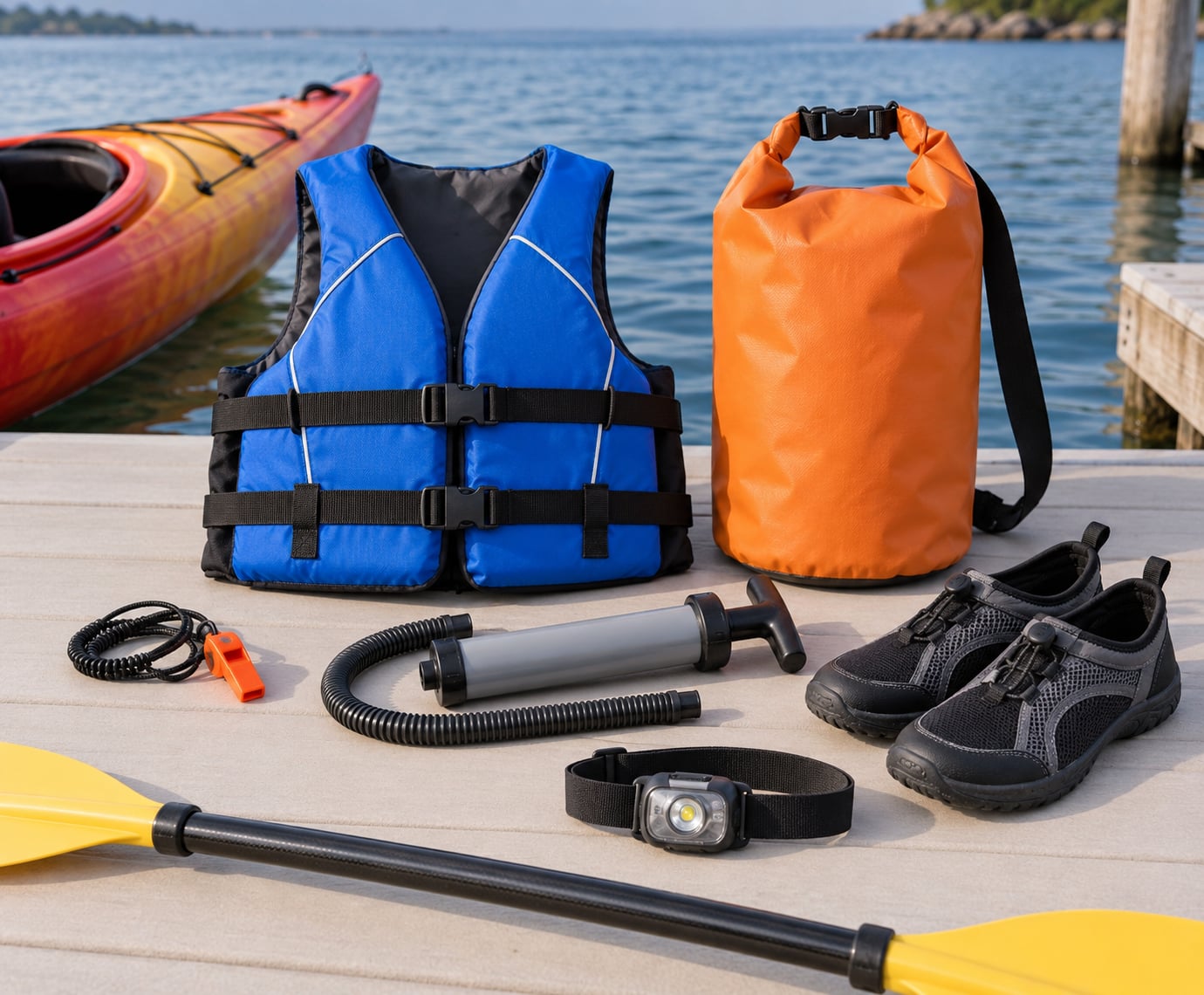
Here is the whole list on one screen, with the reason each item earns its place and the feature to check before you buy or pack it.
| # | Item | Why it matters | What to check | Timing |
|---|---|---|---|---|
| 1 | USCG-approved PFD (life jacket) | Keeps you buoyant and face-up after a capsize | Foam fit, strap tension, range of motion | Essential |
| 2 | Whistle on the PFD | Carries over wind, waves and engine noise | Reachable without unclipping, still attached | Essential |
| 3 | Paddle plus spare | A dropped paddle ends a trip you cannot finish | Correct length, float if alone | Paddle essential, spare deferrable on a pond |
| 4 | Bilge pump or bailer | Removes water that makes the boat unstable | Works one-handed, hose fits the drain plug | Essential |
| 5 | Dry bag | Keeps spare clothing, phone and meds dry | Roll-top seal, clip or lashing to the deck | Essential |
| 6 | Water shoes | Protects feet at launch and in the cockpit | Closed toe, drainage, grip sole | Essential |
| 7 | Sheathed rescue knife | Cuts a jammed spray skirt or a trapped leash | Blunt tip, lash tab, sheathed | Recommended |
| 8 | Waterproof phone or VHF radio | Reaches help, or tells someone where to look | Floating case, charged battery, float plan | Phone essential, radio depends on water |
| 9 | Compact first-aid kit | Handles the small injuries that end trips | Waterproof case, your own medication | Recommended |
| 10 | Waterproof light | You and others need to see each other at dusk | Sealed, spare battery, steady burn | Essential for dawn or dusk |
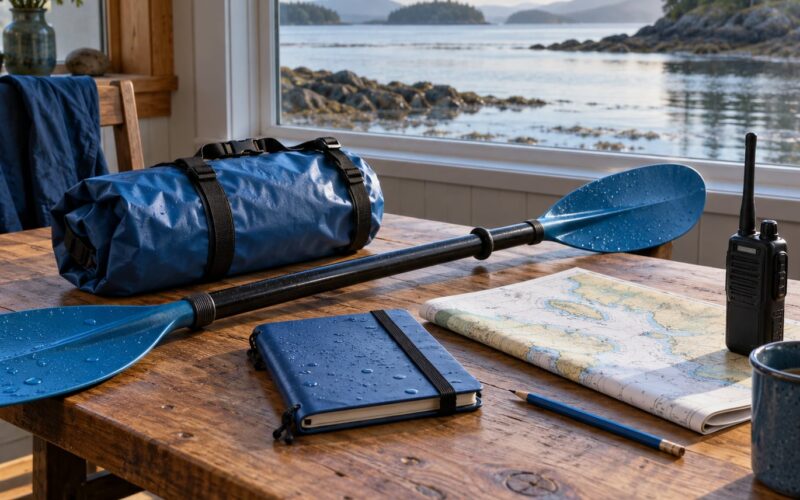
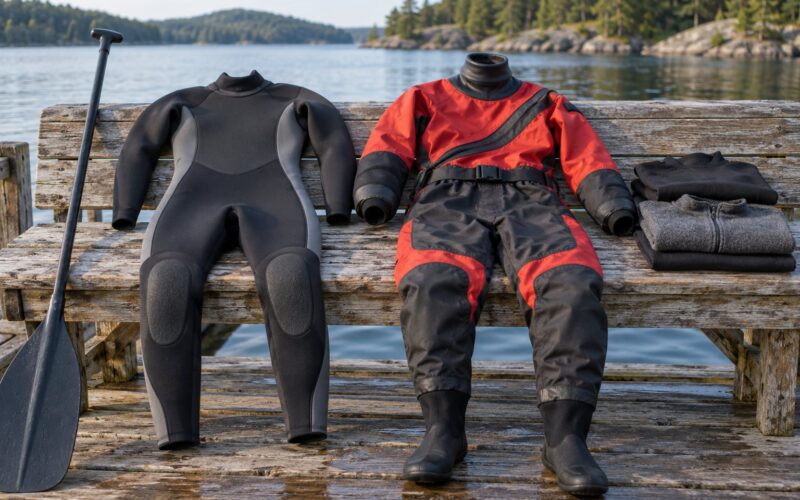
A word on what is not in this table. A VHF radio, a personal locator beacon, a drysuit and a helmet are all sensible gear for some paddling, but none of them help a beginner on a warm afternoon on a small lake. Deferring them is not scrimping, it is packing the right kit for the water you are actually on.
1. A Properly Fitted Personal Flotation Device
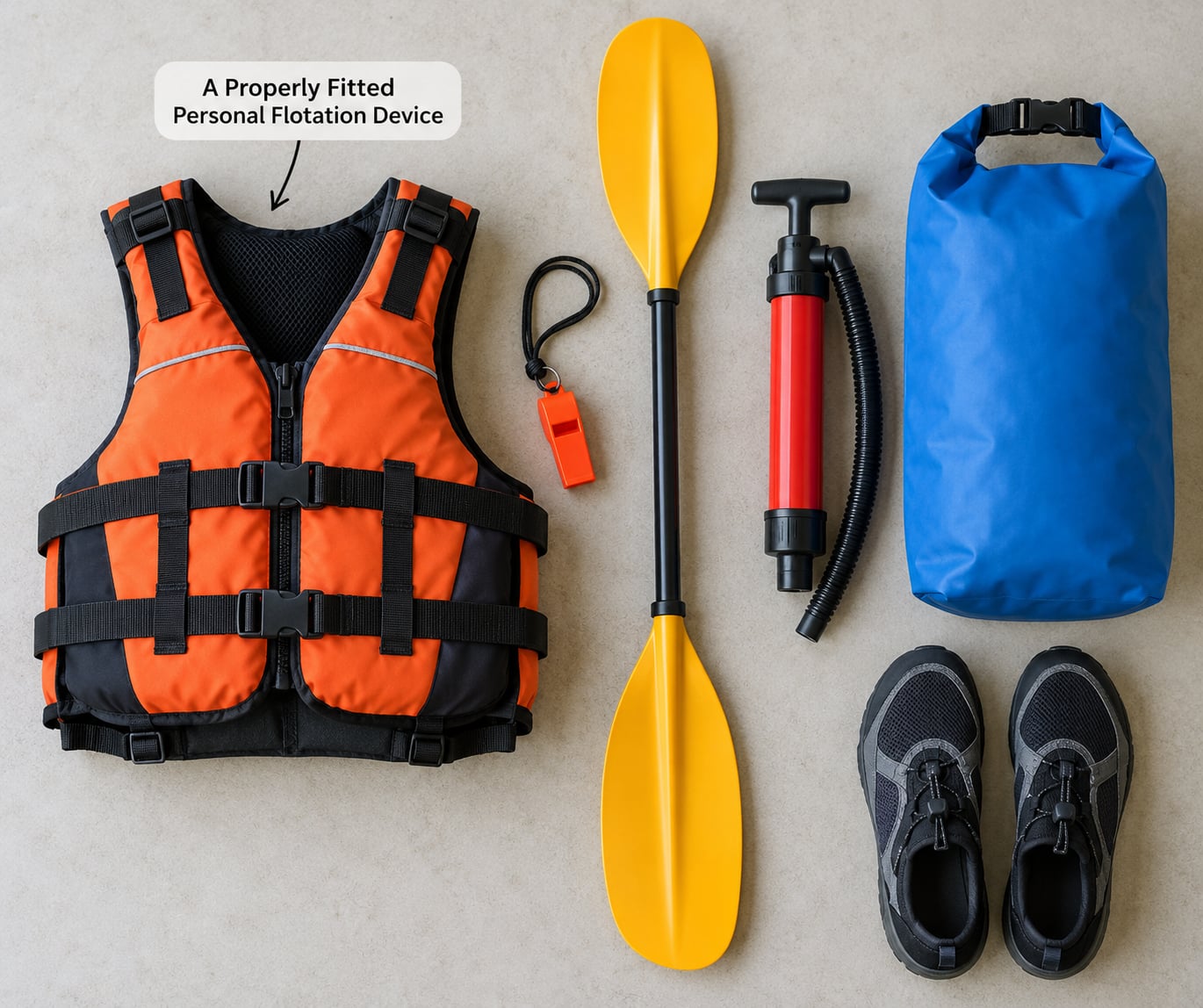
A PFD is the one item with no exceptions and no alternatives. It is also the one beginners most often get wrong, usually by wearing one that is a size too big and calling it good enough.
Buy a USCG-approved foam PFD rather than an inflatable model for your first season. Foam keeps you buoyant the moment you hit the water; inflatables need a trigger pull and have a failure history that is not worth thinking about before you can wet-exit in under ten seconds.
For a sit-on-top kayak, look for a high-back design so the foam does not ride up between your shoulder blades as you paddle. For a sit-inside, a low-profile touring or whitewater model sits better against the seat and does not interfere with your knees.
How to check the fit before you ever get on the water
Stand up and buckle every strap, then pull each one snug. There should be no slack you can push a fist through.
- Zip or buckle the PFD fully before tightening anything else.
- Tighten the lower straps first so the foam cannot ride up.
- Pull the shoulder straps until the vest sits flat against your chest.
- Lift both arms straight overhead. The PFD should stay in place and not ride past your chin.
- Grab both shoulder panels and squeeze inward. You should not be able to pull them together more than a few inches.
If you can pull the shoulders together, the fit is wrong. Try a smaller size before you try to compensate with more strap tension, because an over-tightened PFD cuts range of motion and you will start unfastening it somewhere on the water to get comfortable.
2. A Sound Whistle Attached to the PFD
A whistle is the cheapest item on this list and the one that survives the conditions that ruin a shout. Human voices fade fast across water with any wind, and a wave train swallows them entirely. A whistle tone cuts through.
Three short blasts is the international distress signal and the one to practise. Anyone nearby, on shore or on another boat, has heard it and knows to look.
Attach it to the PFD itself, not to a pocket or a deck bungee where it swings out of reach. Tether it with a short cord so it stays put, and tug the cord before every launch to make sure the clip has not rusted shut or the keeper loop has snapped.
Replace it if you have had it a few seasons. Pea whistles crack, and a cracked pea is a quiet pea.
3. A Paddle Suited to the Kayak and Paddler
A paddle that is too long hits the deck on every stroke and twists your lower back; too short and you overreach for the catch. A reasonable starting point for a recreational adult is roughly the distance from your wrist to the tip of your middle finger when the paddle lies across your lap, though the boat beam matters more than the number.
Narrow recreational hulls suit a longer shaft, wide sit-on-tops and fishing kayaks a shorter one. Feather angle is a preference: most beginners are fine with 0 degrees because it feels symmetrical, while paddlers who rotate their torso like a sea kayaker tend to prefer 45 degrees.
Grip size is the detail people skip and regret. A shaft that is too big gives you blisters inside an hour and a numb forearm by the second.
Now the spare paddle. If you paddle alone on water wider than a swimming pool, carry one, lashed under the deck bungees where it will not swing. Most spare paddles have a small foam float bag for exactly this purpose.
On a shallow lake with a buddy, defer the spare for a season. Do not defer the spare if there is current, wind, cold water or shipping traffic anywhere in your route.
The paddle leash rule most beginners get wrong
If you use a paddle leash, clip it to the boat, not to your body. A leash attached to your PFD or wrist can trap you or your paddle when you lose the boat, and in moving water that has ended trips. If you will not accept that risk, leave the leash at home and float the spare paddle instead.
4. A Bilge Pump and Manual Bailer
Water in a kayak is not an emergency. A hull with several litres of water inside makes the boat sluggish, harder to steer and prone to bow-diving on the next wave. Removing it takes under a minute.
For a sit-inside, a manual bilge pump on a short hose that reaches your drain plug is the standard answer. Check the reach with the seat fully occupied and wearing your PFD, because the pump is often stashed where your arms cannot find it.
For a sit-on-top, a hull is self-draining and a pump is optional, but a small scoop or sponge bailer is still worth carrying for taking on water after a big wave or a wet re-entry.
Test both at the dock before you need them. Open the kit, fit the hose, and pump a bowl of water out of a practice kayak. Gear you have never operated is not gear, it is luggage.
5. A Dry Bag for Clothing, Phones, and Emergency Items
A dry bag protects two things you cannot replace on the water: warm spare clothing and a phone. Pick a size that fits your kit with room to roll, because the closure eats capacity.
Roll-top closures with a separate buckle are the most reliable on a kayak deck, where the bag lies at a low angle and gets wet from spray. A zip-top dry tote is fine for a car trunk and a poor choice forward of the bow.
Lash the bag down rather than trusting friction. A cross-lashing through the deck bungees keeps it near you after a capsize, and keeps it from bouncing down the deck in current.
My basic kit: one warm mid-layer in a plastic bag, a spare hat, a thin wool or synthetic layer for cold water, a phone in a sealed case, a spare whistle, snacks, a small first-aid pouch and a spare set of keys. Choose synthetic over cotton, since wet cotton stays cold far longer.
6. Water Shoes or Other Foot Protection
Most kayak injuries start on shore. Launches are usually gravel, mud, algae over concrete, or a slippery boat ramp, and beginners walk these surfaces in a hurry, often barefoot.
Closed-toe water shoes handle the common case well: a rubber sole for grip, a quick-draining upper so they do not hold water, and protection from submerged sticks, shells and rocks during a beach launch.
Neoprene booties are the better pick in cold or shoulder-season water, or when you are wading a shallow bottom to push off. The tradeoff is bulk, which makes footwork fiddly until you get used to them.
Sandals work for a flat sandy entry on a warm day and nowhere else. If you intend to paddle a rocky shore where you must step over submerged debris, go with the closed toe.
7. A Sheathed Kayak Rescue Knife
A rescue knife is small insurance against one specific, common and infuriating problem: a spray skirt or deck lid that will not release after a capsize. In moving water or cold conditions, that failure turns a two-minute self-rescue into a serious problem.
Choose a blunt or partly serrated blade short enough to reach with one hand, with a sheath and a lash tab so you can tether it to your PFD or grab loop. The blunt tip matters because you will be cutting near your own legs and torso in dark, moving water.
Wear or stow it where it cannot stab you in the cockpit, and keep it sheathed during normal paddling. Practise the motions once: cut a loop of cord in shallow water, then a jam strap with no knife at all.
8. Waterproof Communication and Navigation Tools
Communication is layered, and each layer covers a gap the others cannot. A phone in a sealed, floating case gives you maps, a weather check and a location message, but only where there is coverage. A VHF marine radio reaches boats, marinas and rescuers far beyond cell range, though it needs a working antenna and a charge. A personal locator beacon broadcasts your position to a rescue service through satellites and needs no one listening on the other end.
For a beginner on a small lake or a slow river, a phone in a waterproof case plus a whistle is enough. Open coastal water, big lakes and anything with current on it justifies a VHF radio or a beacon.
What the US Coast Guard requires of a kayak
Federal rules for a kayak carried on a vessel treated as a vessel require a USCG-approved PFD, a sound-producing device such as a whistle, and a white light when operating at night. Many paddlers also carry a handheld light, which is not the same requirement but is more visible from a distance. State and park rules are often stricter and sometimes describe the boat rather than the gear, so check with the agency that manages your launch before your first trip.
Whatever you carry, tell someone the plan. A float plan with your route, launch point, paddle-out time and check-in deadline is the cheapest safety equipment on this page, and it does nothing when you are the one in trouble.
9. A Compact Waterproof First-Aid Kit
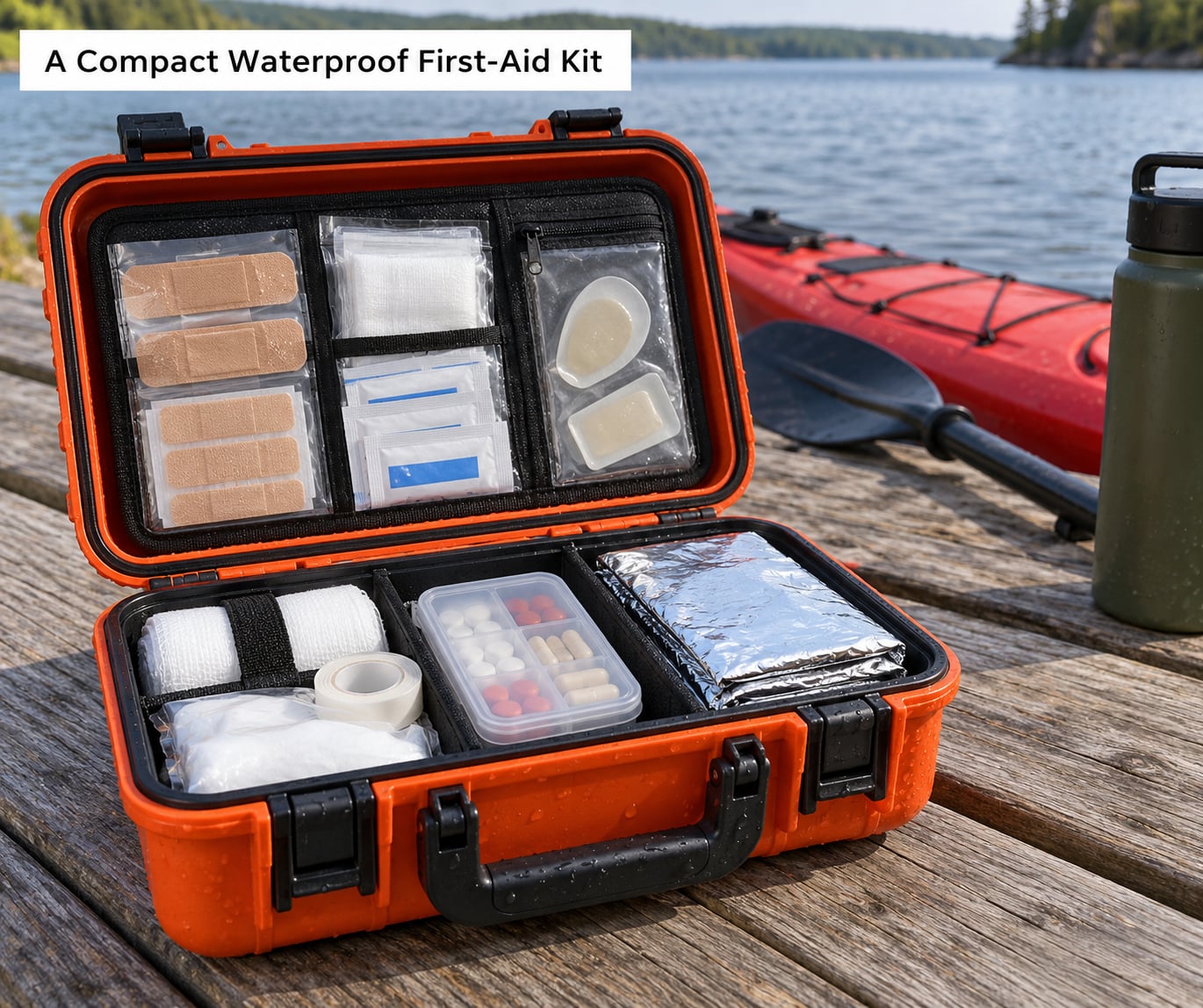
Keep the kit small enough that it actually stays aboard. A hard waterproof case is better than a zip bag, and it lives in the dry bag or behind the bulkhead, not loose behind your seat.
Stock adhesive bandages for cuts and blisters, sterile gauze and tape, antiseptic wipes, a wrap for a sprain, tweezers for a hooked fishhook, and any medication you personally need. Write your name, allergies and blood type on a card inside the case.
Two things beginners overpack: a full first-aid field kit the size of a shoebox, and the assumption that the kit covers a serious injury. It does not. It covers the minor injuries that spoil a trip or turn an ankle; anything more serious needs trained care, which is why the float plan matters as much as the kit.
Know the basics before you go: how to apply pressure to a bleeding wound, how to check for a concussion after a head bump, and when to call for help instead of trying to paddle back.
10. A Waterproof Light for Low-Light Conditions
If there is any chance you will be off the water near dusk or dawn, a light is not optional gear. Water is a mirror and a dark boat on dark water is nearly invisible to a boat with a wake.
A small headlamp hands-free and points where you look, which makes it the better choice for launching, bailing and paddle work in poor light. A clip-on safety light usually burns longer on one charge, and a strobe is easier to spot at distance than a steady beam.
Check for a sealed housing, because a light that dies after one splash is decoration. Run it for the full expected outing before the trip, carry a spare battery or a second light, and confirm it stays on rather than relying on a press.
Frequently Asked Questions
What is the most important kayak safety gear for a beginner?
A properly fitted, USCG-approved personal flotation device, worn rather than stowed. It is the only item that helps when you are swimming and unable to reach your boat or gear. Choose foam over inflatable, tighten every strap, and confirm it stays put when you raise your arms. Everything else on the list supports or replaces the PFD in some scenario.
Do I need a bilge pump in a sit-on-top kayak?
Not strictly, since sit-on-top hulls are usually self-draining. A small scoop or sponge bailer is still worth carrying so you can clear water after a wave dumps into the cockpit or you wet-exit and swim back to the boat. Sit-inside paddlers do need a pump, because water inside the hull quickly makes the boat heavy, slow and harder to steer.
Should beginners wear water shoes when kayaking?
Yes, closed-toe water shoes with a grippy sole, mainly for the launch. Beginners carry their kayak down gravel ramps, over mud and across algae-slick surfaces in a hurry, and that is where most paddling injuries happen. Neoprene booties are the better option in cold water. On a sandy entry on a warm day, sandals do the job.
What should I pack in a waterproof dry bag?
One warm mid-layer, a spare hat, a thin synthetic layer, a phone in a sealed case, a spare whistle, snacks, a compact first-aid kit and a spare set of keys. Skip cotton, which stays cold far longer than synthetics when wet. Choose a roll-top closure and lash the bag to the deck bungees so it does not slide away after a capsize.
Is a waterproof phone case enough for kayaking alone?
It is the minimum, not the full answer. A sealed case that floats gives you maps and a phone call where coverage exists, and nothing at all where it does not. For solo paddling beyond reliable cell coverage, add a VHF radio or a personal locator beacon, and leave a float plan with a person who knows when to start asking questions.
How do I check my PFD fits properly?
Buckle everything, tighten the lower straps first, then the shoulder straps, and confirm the vest sits flat on your chest. Raise both arms overhead and check that it does not ride past your chin. Then squeeze the two shoulder panels together in front; if you can pull them more than a few inches apart, the size is wrong. Buy the smaller size rather than over-tightening the straps.
Conclusion
Start with the PFD. Buy a foam USCG-approved model in your size, buckle it before you leave the parking area, and never take it off on the water. Then clip a whistle to it and blow three blasts a few times so the sound is familiar.
After that, work down the list in this order: a working bilge pump, a lashed dry bag with a spare layer and phone, closed-toe water shoes, a rescue knife, a first-aid kit, and a light if you will be near dusk. Run the pump and the wet-exit drill once at the dock before you rely on either, and leave a float plan with someone ashore every time you paddle alone.
That is the whole kayak safety gear checklist for beginners. Ten items, no specialist electronics, and the two skills that actually matter: staying with your boat and getting back into it.