To identify a salt marsh plant by sight, work in three passes. Confirm the plant is growing in genuinely salty, tidally flooded ground. Sort it into one of four growth forms: cordgrass, rush, fleshy succulent, or low forb. Then use the marsh zone and the leaves, stem, and fruit to pick one species from the two or three that are left. Most of the naming happens in the first two minutes.
A salt marsh is a coastal wetland flushed twice a day by brackish water. The plants that live there are called halophytes, which just means salt-tolerant plants. They are the reason the marsh works: their stems trap sediment, build the mud that shorebirds feed on, and hold the shoreline in place during a storm.
The awkward part of marsh botany is that most of these plants have tiny greenish flowers that are easy to walk past, and most field guides are arranged by family, so they assume you already have a bloom in hand. Working from growth form and habitat gets you a long way without either.
Nothing here needs a shovel or a sample bag. Everything can be done from a boardwalk, a boat, or the edge of a salt pan with your phone in your hand.
Table of Contents
- What You Need
- Step-by-Step
- 1. Start with the Plant’s Growth Form
- 2. Note the Habitat and Growing Zone
- 3. Examine the Leaves
- 4. Look at Stems and Growth Pattern
- 5. Check Roots and Bases
- 6. Identify Flowers, Seed Heads, and Fruit
- 7. Compare the Clues and Confirm the Match
- Common Mistakes
- Frequently Asked Questions
- What is the easiest way to tell a salt marsh grass from a sedge?
- Can I identify a salt marsh plant when it is not flowering?
- What are the most common salt marsh plants in the southeastern United States?
- Should I pull up an unknown marsh plant to examine its roots?
- How do seasonal tides and plant color affect identification?
- What should I do if I cannot confidently identify a salt marsh plant?
- Conclusion
What You Need
Most salt marsh plant identification happens with your eyes and one phone app. The gear list is short because the habitat punishes anything bulky.
- A regional field guide or flora — one covering your coast, not a national guide. Atlantic and Gulf species differ from Pacific ones, and Pacific readers will find nothing written about smooth cordgrass (Spartina alterniflora) in their local flora at all.
- Your phone — for close photos and for a photo-ID tool. Shoot in daylight, get one whole-plant frame, then move in.
- A 10x hand lens — cheap, and the only way to see leaf surface, stem hairs, and fruiting bracts on a jointed succulent.
- A notebook or a notes app — six lines of sketch beats a memory of green.
- Access checked in advance — many marshes have boardwalks only, and some close during nesting season. Check the site rules before you park.
Leave the waders behind unless you are going in with a partner and a plan. Marsh mud is genuinely deep in places and pulls ankles, and boots leave lasting holes in cordgrass flats.
Step-by-Step
1. Start with the Plant’s Growth Form
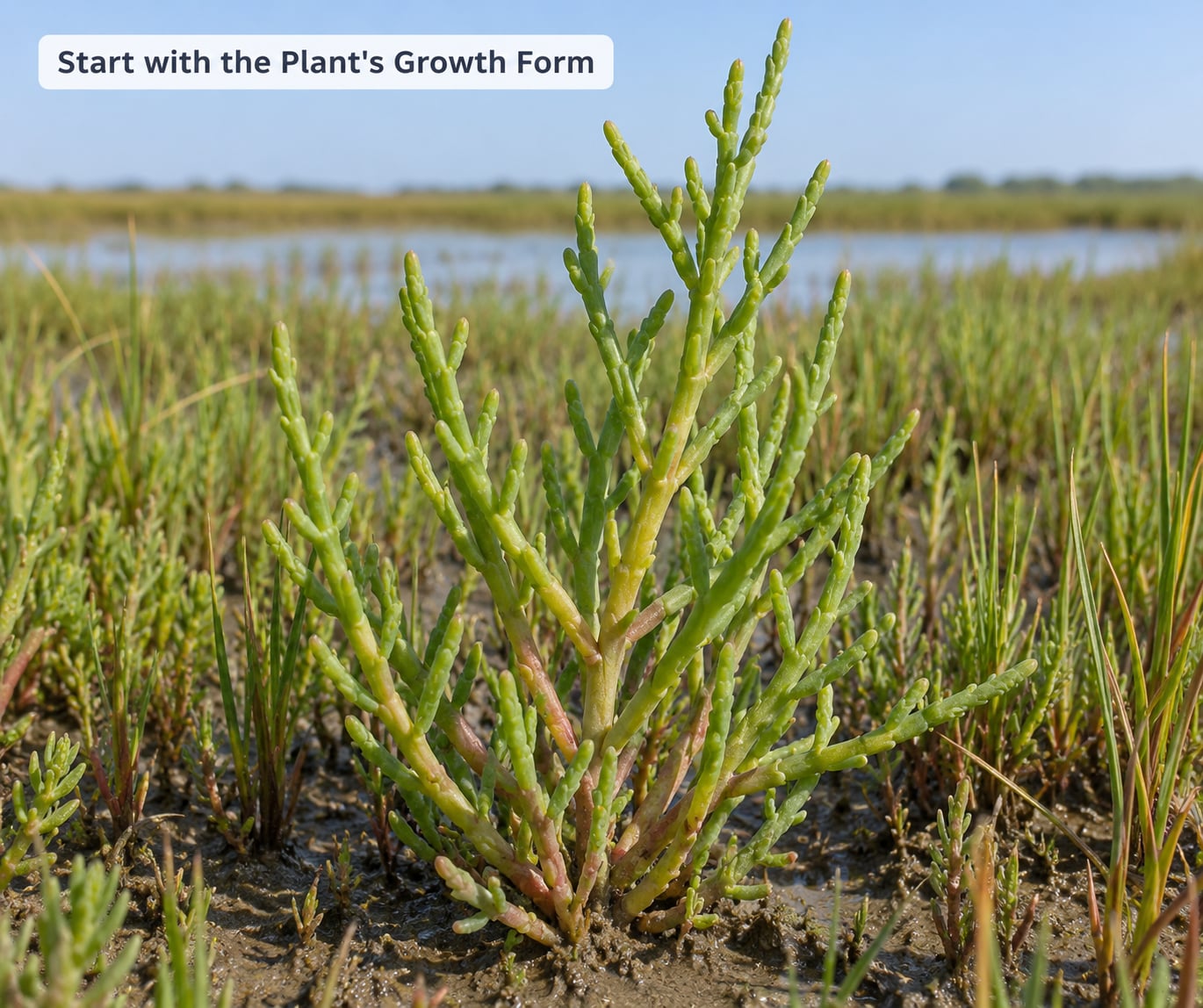
Before anything else, stand back far enough to see the whole plant and answer one question: what shape is it?
- Grass. Narrow, flat leaves coming off a jointed stem, and a plume or spike at the top. Cordgrass and salt grass sit here.
- Rush or sedge. Round or triangular stems, no obvious flat leaves, small brown or greenish spikelets clustered near the tip. Black needlerush and saltmarsh bulrush sit here.
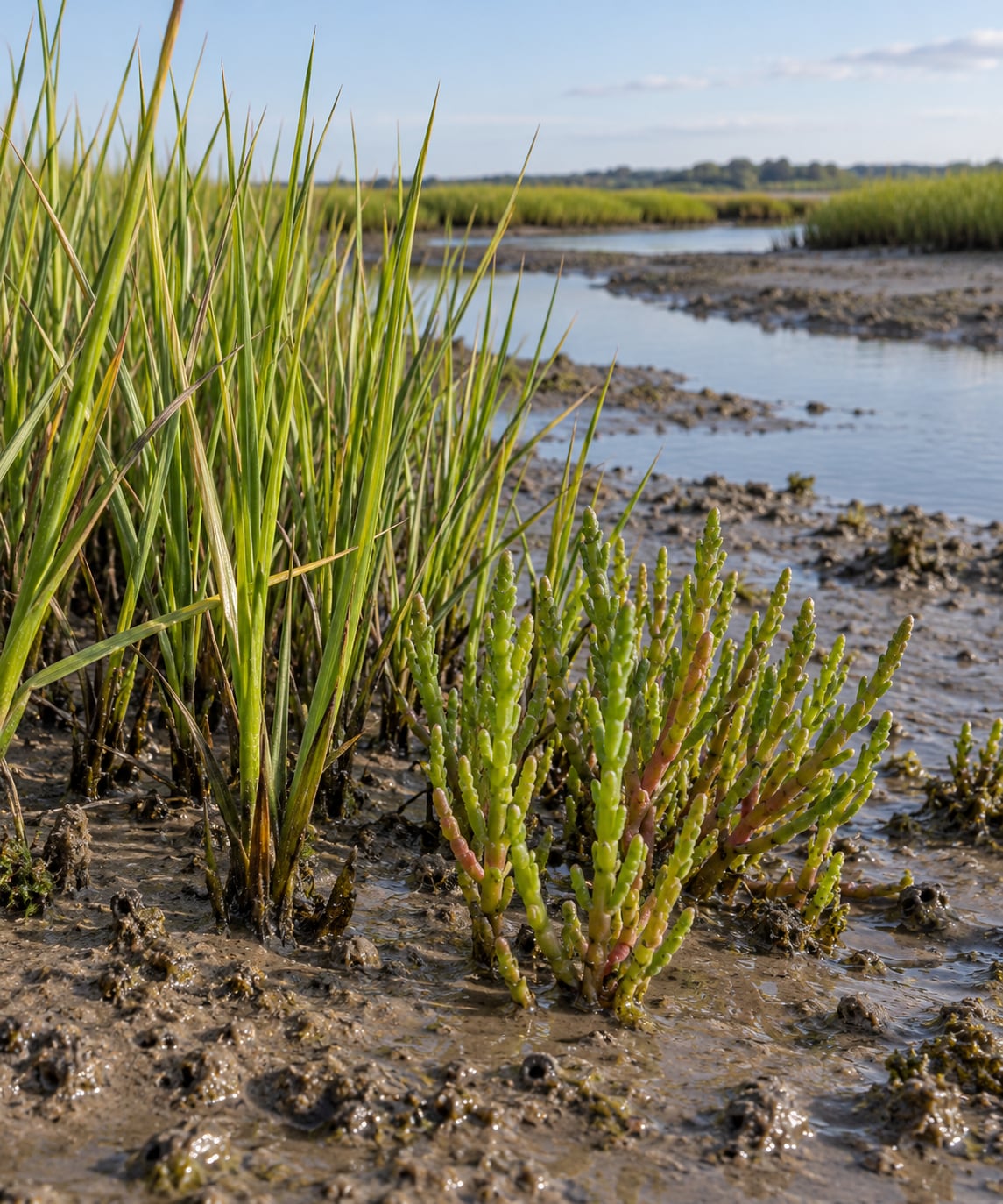
- Fleshy succulent. Segmented, bead-like or cylindrical stems and no real leaves. Pickleweed, glasswort, sea-blite, and saltwort sit here.
- Low forb or shrub. Broad flat leaves on a branching stem, often with a daisy-like flower. Seaside daisy (Borrichia frutescens), groundsel bush, and sea lavender sit here.
Ferns and true shrubs of the upland edge are a fifth possibility, and if you land there you have probably walked out of the marsh. That is a useful result too.
2. Note the Habitat and Growing Zone
Elevation relative to tides tells you more than any single plant feature. It is the fastest shortcut in this whole guide, because it eliminates candidates before you have looked closely at anything.
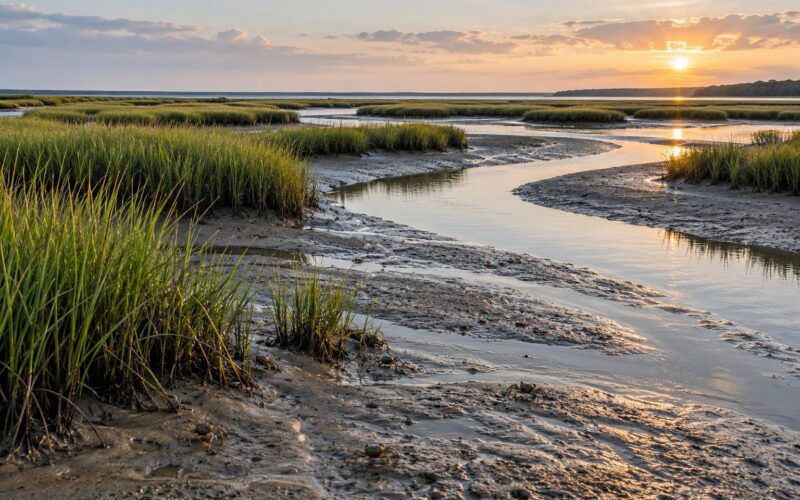
- Mudflat and oyster reef edge — flooded most tides, nearly bare. Barely any plants, just algal mats and a fringe of smooth cordgrass at the high-water line.
- Low marsh — flooded twice daily. Tall, dense stands of smooth cordgrass, and glasswort where the water is shallow.
- Marsh panne and salt pan — shallow flooded depressions inside the high marsh. Seaside daisy, salt grass, and pickleweed do well here.
- High marsh — flooded only on spring tides. Saltmeadow cordgrass, black needlerush, and saltmarsh bulrush.
- Upland edge — rarely flooded. Groundsel bush, salt bush, and prairie grass at the margin.
Mark the zone in your notes before you examine the plant. A species you cannot grow in the zone you are standing in is not that species.
3. Examine the Leaves
Leaf traits are where this kind of salt marsh plant identification separates a grass from a rush and both from a succulent. Look without breaking anything.
- Width and length. Smooth cordgrass leaves are broad and flat, roughly half an inch wide and two feet long on a mature plant. Saltmeadow cordgrass leaves are half to two thirds as wide and noticeably shorter.
- Flat versus round. Flat blades mean grass or sedge. Round, pencil-thick, jointed or cylindrical structures mean rush or succulent. A truly flat stem with sharp edges is more likely a sedge.
- Attachment. Cordgrass leaves wrap around the stem with a collar-like sheath. Rush stems carry no blades at all, which surprises people the first time.
- Texture. Squeezed between finger and thumb, a glasswort segment splits into wet and dry halves like tiny beach peas. Nothing else in the marsh does that.
- Color and margin. Look for the reddish or orange cast that cordgrass leaves develop under salt stress, and for the fine saw-toothed margin on seaside daisy.
4. Look at Stems and Growth Pattern
How the plant sits in the soil tells you about its roots before you ever see one.
Round stems point to rushes. Square-ish or keeled stems point to a broadleaf forb. Jointed, swollen stems point to pickleweed or one of the glassworts. And the growth habit separates the four main groups cleanly: cordgrass grows in tall dense monoculture stands from creeping rhizome, salt grass spreads low and mats out from its base, black needlerush grows in tight round clumps, and the succulents spread as sprawling mats over bare mud.
Grass and sedge are the pair people most often mix up. Check the stem: grass stems are round and hollow between nodes, sedge stems are usually solid and often triangular in cross-section. Sedge leaves also line up in three ranks along the stem, which you can sometimes feel with a fingertip.
5. Check Roots and Bases
You can read a lot without digging, and you should not dig. Cordgrass has long fibrous rhizomes that bind the mud, which is the entire structural point of the plant. Breaking into a stand to look for them loosens sediment and creates a hole that takes years to close.
What you can see from outside: a firm, pale, sheathed base at the waterline is typical of cordgrass. A loose, open, fibrous tuft that lifts slightly at the edge is typical of salt grass. A dark, wet, hollow-looking base in a clump of round stems is a rush.
If the ground is already soft and you have no business on it, an exposed cut bank along a tidal creek will show you the same root types without walking into the marsh.
6. Identify Flowers, Seed Heads, and Fruit
Flowering is where a guess turns into an identification, and it is worth learning what to look for in each group because the structures are not alike.
Grass panicles are the easiest to spot: cordgrass and salt grass both carry a dense, brush-like seed head above the leaves, and the two can often be told apart by height and by how tightly the head sits. Rushes carry tiny flowers pressed tight against the stem in clusters, brown and easily missed. The succulents carry flowers so reduced they look like scale leaves sitting in the joints of the stem. Forbs are obvious when they bloom — seaside daisy gives a yellow daisy head on a low sprawling plant, sea lavender gives small pink-purple flower clusters on a tall bare stalk.
One warning worth carrying with you: many goosefoots and amaranth family members cannot be told apart by leaf alone. They need fruiting structures, and those usually do not appear until September. If you are there in July, the honest answer is that you have a family, not a species.
7. Compare the Clues and Confirm the Match
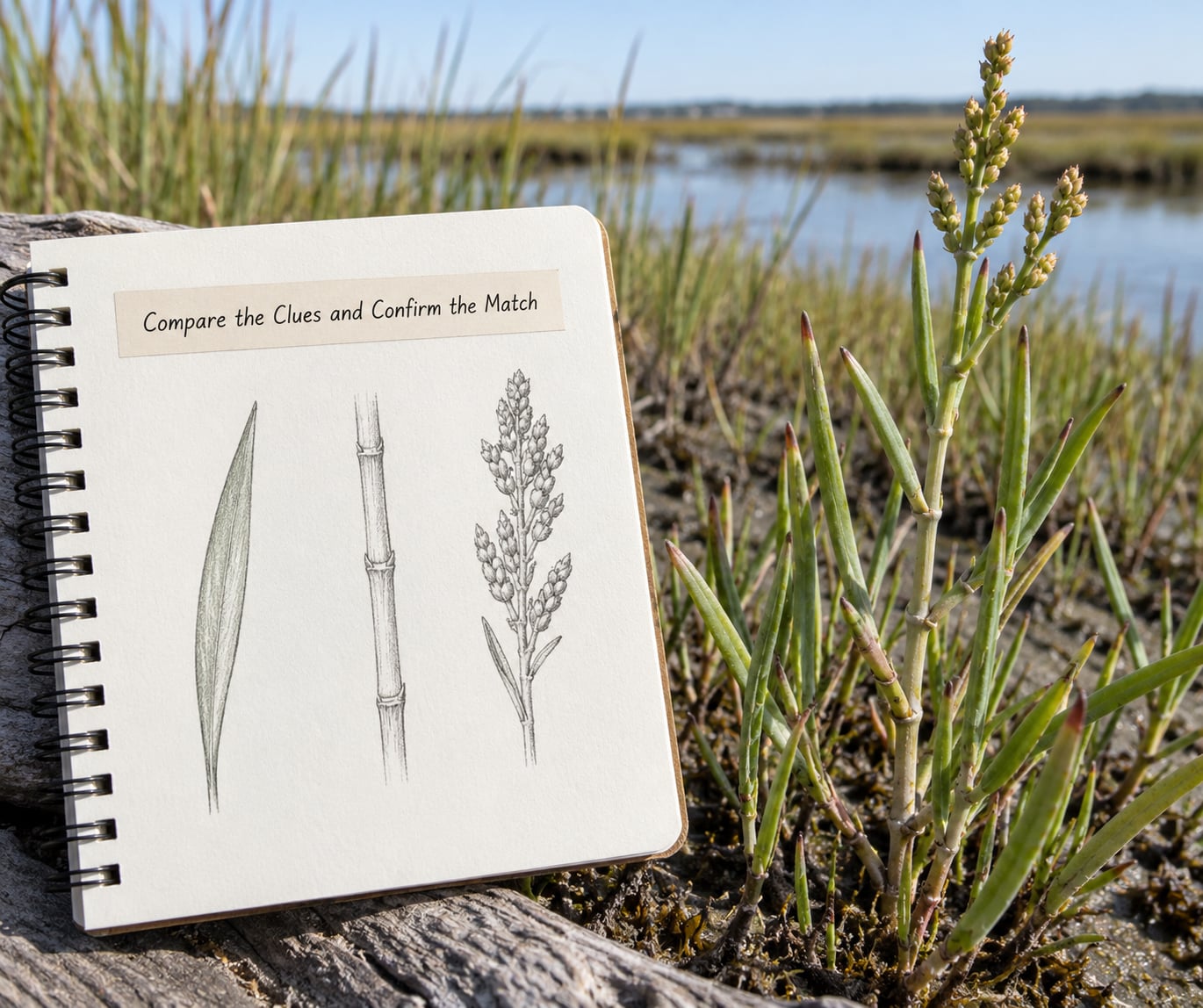
Now put the pieces side by side. Write down growth form, zone, height, stem shape, and what the flower or fruit looks like. That five-line profile will match a small number of species instead of everything in the book.
Check it against a regional field guide or a university extension or Sea Grant resource for your coast, then look specifically at the look-alike table in that guide. Do not rely on a photo comparison site alone: misapplied common names are common in this group, and Virginia glasswort in particular is used loosely in most field books for a plant that belongs under a different name.
If you want a second opinion, post the profile to iNaturalist with the location and your notes. A geotagged observation with a habitat description gets a far better answer than a bare photo, which is the single most common complaint in plant-ID communities.
Common Mistakes
Judging by color. Cordgrass goes red-brown under salt stress and everything dies back to straw in late summer. Color in a marsh mostly tells you about stress and season, not identity. Fix: decide species from structure first, then let color confirm.
Assuming every grass-like plant is a grass. Rushes and sedges fill the same habitat and look similar at a distance. Fix: check the stem in cross-section and look for whether the plant has blades at all.
Ignoring the zone. This is the expensive mistake, because it sends you into a book looking for a match that could never grow where you are standing. Fix: record the elevation and flooding frequency before you start.
Pulling a plant to examine it. Some marsh plants anchor sediment with rhizomes, and most marsh soil is anaerobic and smells of sulfur. Fix: read the base from outside the clump, or use a cut bank.
Expecting flowers in the wrong month. Spring marshes look nearly bare, and summer marshes are mostly dead brown stems. Fall is when the glassworts color up and fruiting structures appear. Fix: match what you see to the season.
Trusting common names across regions. Pickleweed, glasswort, and sea-blite get swapped around in books and online. Fix: record the scientific binomial alongside the common name, and use one guide consistently.
A few habits make the rest easier. Shoot photos from the same distance every time so they are comparable later. Log every observation you can, even the ones you could not name, because the un-named ones tell you what is actually growing there. And if a marsh has fiddler crabs on the mud or barnacles and mussels on the creek edge, you are in the right community.
Frequently Asked Questions
What is the easiest way to tell a salt marsh grass from a sedge?
Look at the stem. Grass stems are round and hollow between the nodes, and grass leaves attach in two ranks with a collar-like sheath. Sedge stems are usually solid and often triangular in cross-section, with leaves arranged in three ranks. In practice the fastest field clue is that a sedge clump has round, pencil-thick stems with no flat blades at all, while a grass clump shows flat leaves from the base upward.
Can I identify a salt marsh plant when it is not flowering?
Often yes, to the level of growth form and genus. Growth form, height, stem shape, and marsh zone are all available without a flower. Several marsh species genuinely cannot be separated without fruiting structures, though, and those usually do not show up until September. If you cannot reach a species, record the family or group and come back later in the season rather than guessing.
What are the most common salt marsh plants in the southeastern United States?
In the southeastern United States the dominant plants are smooth cordgrass (Spartina alterniflora) in the low marsh, saltmeadow cordgrass (Spartina patens) in the high marsh, black needlerush (Juncus roemerianus) in wet high marsh, pickleweed or glasswort (Salicornia and Sarcocornia species) on mud and salt pans, seaside daisy (Borrichia frutescens) in panne edges, and saltwort (Batis maritima) on the lower shore. Salt grass (Distichlis spicata) fills disturbed high marsh and berms.
Should I pull up an unknown marsh plant to examine its roots?
No. Salt marsh plants grow in anaerobic mud, so their root systems are adapted to low oxygen, and cordgrass binds sediment with rhizomes that hold the marsh together structurally. Pulling a plant loosens mud and leaves a hole that can take years to recover. Read the base from outside the clump, or find an eroded cut bank along a tidal creek where roots are already exposed and visible.
How do seasonal tides and plant color affect identification?
Color mostly reflects stress and season rather than species. Cordgrass often flushes orange or red under salt stress and cures to pale straw through late summer, and spring marshes can look nearly bare because growth has not started. Glasswort colors up brightest in fall. Always pair a color observation with a structural one, and note the date so a guide search matches what is actually on the plant.
What should I do if I cannot confidently identify a salt marsh plant?
Log it anyway, with the location, date, growth form, and habitat zone, and attach photos rather than a specimen. An observation without a name is still useful data for the site. For a real answer, post it to iNaturalist with coordinates and a short habitat description, which gives identifiers far more to work with than a close-up photo alone, or ask your state extension office or Sea Grant program.
Conclusion
Start with the growth form and the zone you are standing in, because those two answers do most of the work in this kind of salt marsh plant identification. Then read leaves, stem shape, and fruit, check your match against a guide written for your coast, and write down what you saw while you are still standing there. Six lines of notes beats a confident guess every time.