Your paddle length comes down to two numbers: how tall you are and how wide your boat is. Height gives you a starting band, boat width pushes the answer longer, and paddling style can pull it back a few centimetres. Most paddlers land between 200 cm and 250 cm (79 to 98 inches) depending on those three things.
That is the short version. The rest of this guide covers how to choose a paddle length for your height without getting trapped by charts that assume a boat you do not own.
Nobody publishes one perfect chart because the honest answer changes with the hull in front of you. What I can do is give you a repeatable method: find your reference length, adjust for the boat, then test it on flat water before you commit.
Table of Contents
- What You Need
- Step-by-Step: How to Choose a Paddle Length for Your Height
- How to Choose a Paddle Length for Your Height by Craft
- Account for the Kayak’s Size and Your Fit
- Choose a Shaft Style and Measure the Right Section
- Test the Fit on Water
- Make the Final Adjustment
- Common Mistakes
- Frequently Asked Questions
- What paddle length should I use if I am between two height ranges?
- Does a longer paddle work better for a wider kayak?
- Should I measure paddle length from the grip to the tip?
- Do kayak paddles and paddle-board paddles use the same sizing?
- Can I change a paddle’s length if the chart is not quite right?
- Conclusion
What You Need
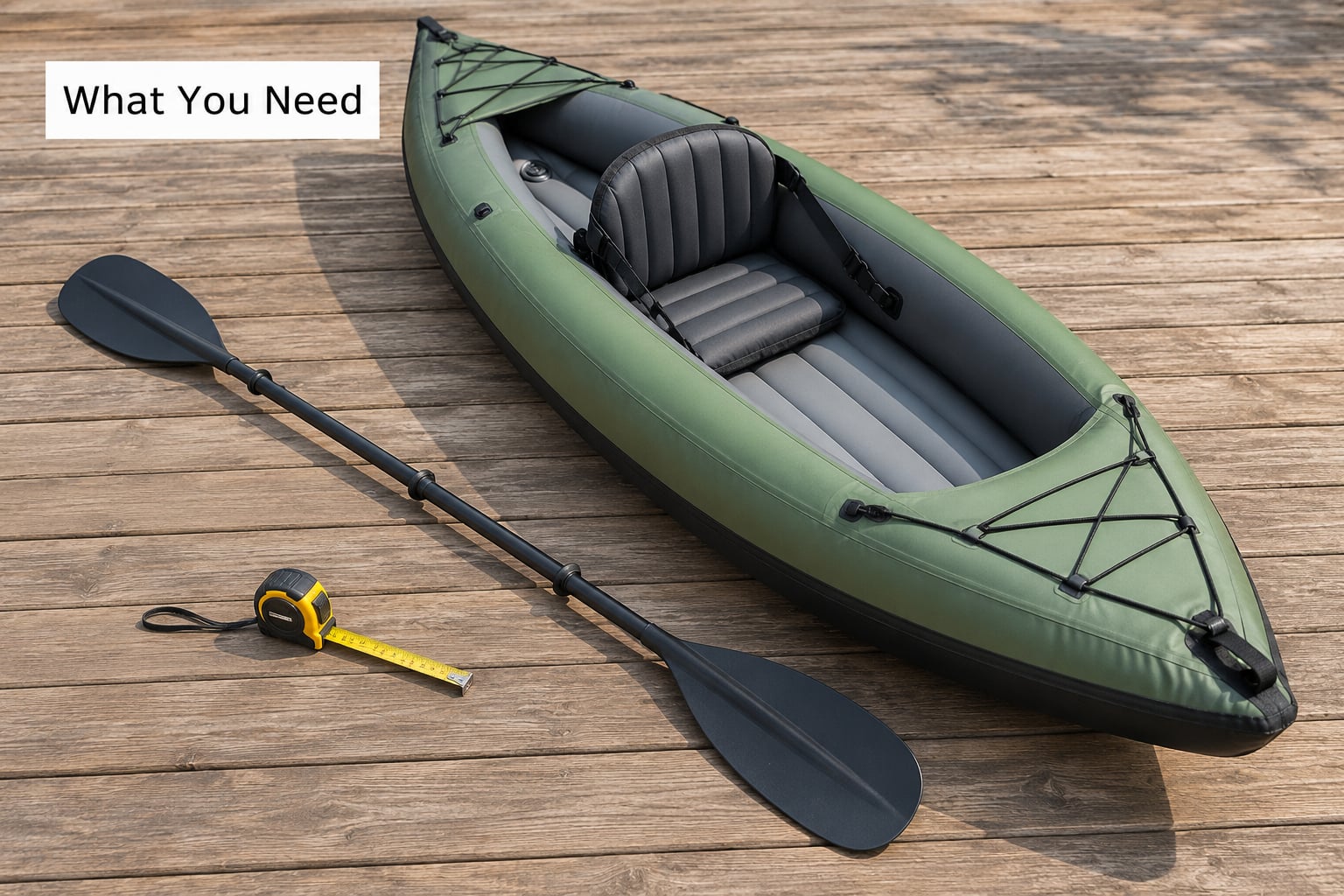
Three things, and you can gather all of them in ten minutes.
A tape measure, for your height and for the beam of your boat. Measure the hull at its widest point, usually just behind the cockpit or amidships, and write it down in both centimetres and inches.
The boat’s type and dimensions. A recreational sit-on-top, a narrow touring sea kayak, a canoe and a paddle board each have their own sizing logic, and mixing up their numbers is the most common sizing mistake I see.
The manufacturer’s sizing chart for the paddle you are considering. Brand charts disagree with each other, and several quietly assume a narrow touring boat while you are sitting in something 81 cm (32 inches) wide.
Access to calm, familiar flat water for a test paddle. A lake inlet or a slow river stretch in the first hour of the morning works fine. You do not need current, and you do not need a group.
Step-by-Step: How to Choose a Paddle Length for Your Height
How to Choose a Paddle Length for Your Height by Craft
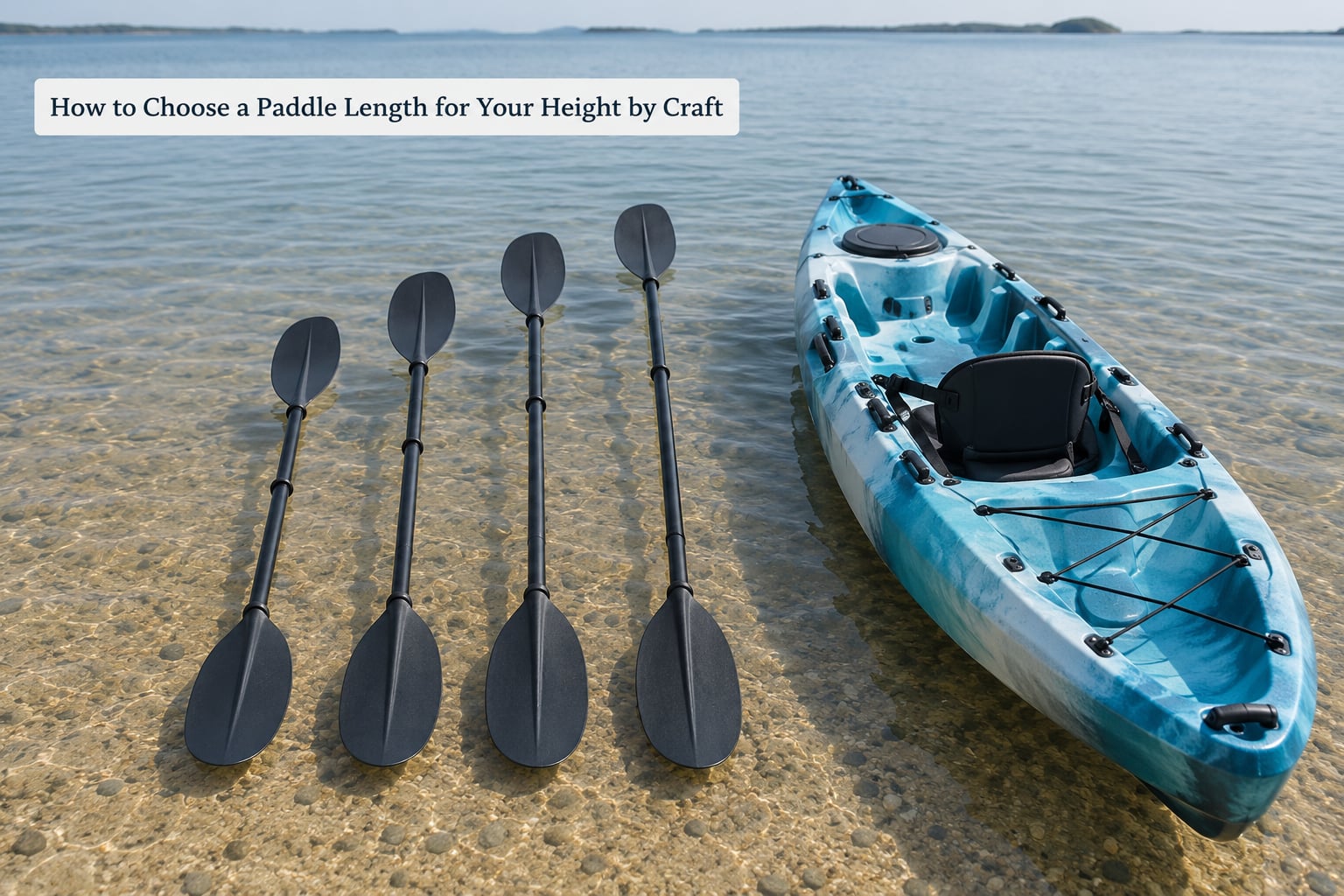
Start with height, then adjust. The ranges below are reference points for a flatwater paddler of average build, not a verdict.
| Paddler height | Recreational kayak (78-83 cm / 31-33 in wide) | Touring or sea kayak (under 60 cm / 24 in wide) | Whitewater kayak |
|---|---|---|---|
| Up to 165 cm (5 ft 5 in) | 200-210 cm (79-83 in) | 195-205 cm (77-81 in) | 185-195 cm (73-77 in) |
| 166-175 cm (5 ft 5 in to 5 ft 9 in) | 210-220 cm (83-87 in) | 205-215 cm (81-85 in) | 195-210 cm (77-83 in) |
| 176-183 cm (5 ft 9 in to 6 ft) | 225-235 cm (88-92 in) | 215-230 cm (85-91 in) | 210-220 cm (83-87 in) |
| Over 183 cm (over 6 ft) | 235-250 cm (92-98 in) | 230-245 cm (91-96 in) | 220-235 cm (87-92 in) |
Whitewater sits shorter on purpose. A shorter paddle recovers faster for a brace or a roll, which is why whitewater paddlers in forum threads keep clustering on 210 to 220 cm (83 to 87 inches) even when they are tall.
Canoes follow a different method entirely, so do not use the kayak table for one. Kneel in the boat as you would on the water, measure from the floor to the tip of your nose, add the blade length, then subtract about 5 cm (2 inches) if the shaft is bent.
Paddle boards are simpler. Flatwater and touring SUP paddles run roughly 8 to 12 inches (20 to 30 cm) longer than your height in inches, with the longer end of that range going to touring, fishing and fitness use. Shorter boards suit river running and surfing, where a quick catch beats extra reach.
For kids, work from height rather than age, since growth rates vary wildly. A child under 130 cm (4 ft 3 in) is usually well served by a 180 to 200 cm (71 to 79 inch) paddle, and a 130 to 150 cm (4 ft 3 in to 4 ft 11 in) paddler by 200 to 215 cm (79 to 85 inches). Adjustable youth paddles cover the awkward in-between years well.
If your hull falls outside every band above, or you sit at a raised seat for fishing or a pedal drive, work from the widest part of the boat rather than the seat and expect to move up one band. Anyone under 155 cm (5 ft 1 in) can struggle to find an off-the-shelf length that fits a very wide recreational kayak, and a four-piece adjustable shaft is usually the cheapest fix.
Account for the Kayak’s Size and Your Fit
Boat width sets the floor for paddle length. On a wide sit-on-top, you brace your knees outward and your lower hand sits further from the centreline, so your top hand has to travel further forward to clear the hull. Narrow sea kayaks use a narrower brace, so the same paddler can hold a shorter paddle without the blade fouling the deck.
Seat height does the same thing. Kneeling positions in a canoe or a surf ski lift your shoulders and extend your reach, so going one step up the table is reasonable. A raised fishing seat or a pedal-drive seat raises you by another 10 to 15 cm, and angling set-ups that use a paddle leash or a mounted bracket can add a little more.
Watch the wording on nominal length. Some brands measure the whole shaft from grip to tip, others measure only the section that carries the load, and a few quote a size that includes a shaft overlap. Comparing two paddles quoted under the same number is not always comparing the same thing.
Weight and experience matter too, and published charts ignore both. Heavier paddlers covering lots of distance usually want the longer end of their band, and a first-year paddler on a big hull will do more work with a shorter paddle.
Choose a Shaft Style and Measure the Right Section
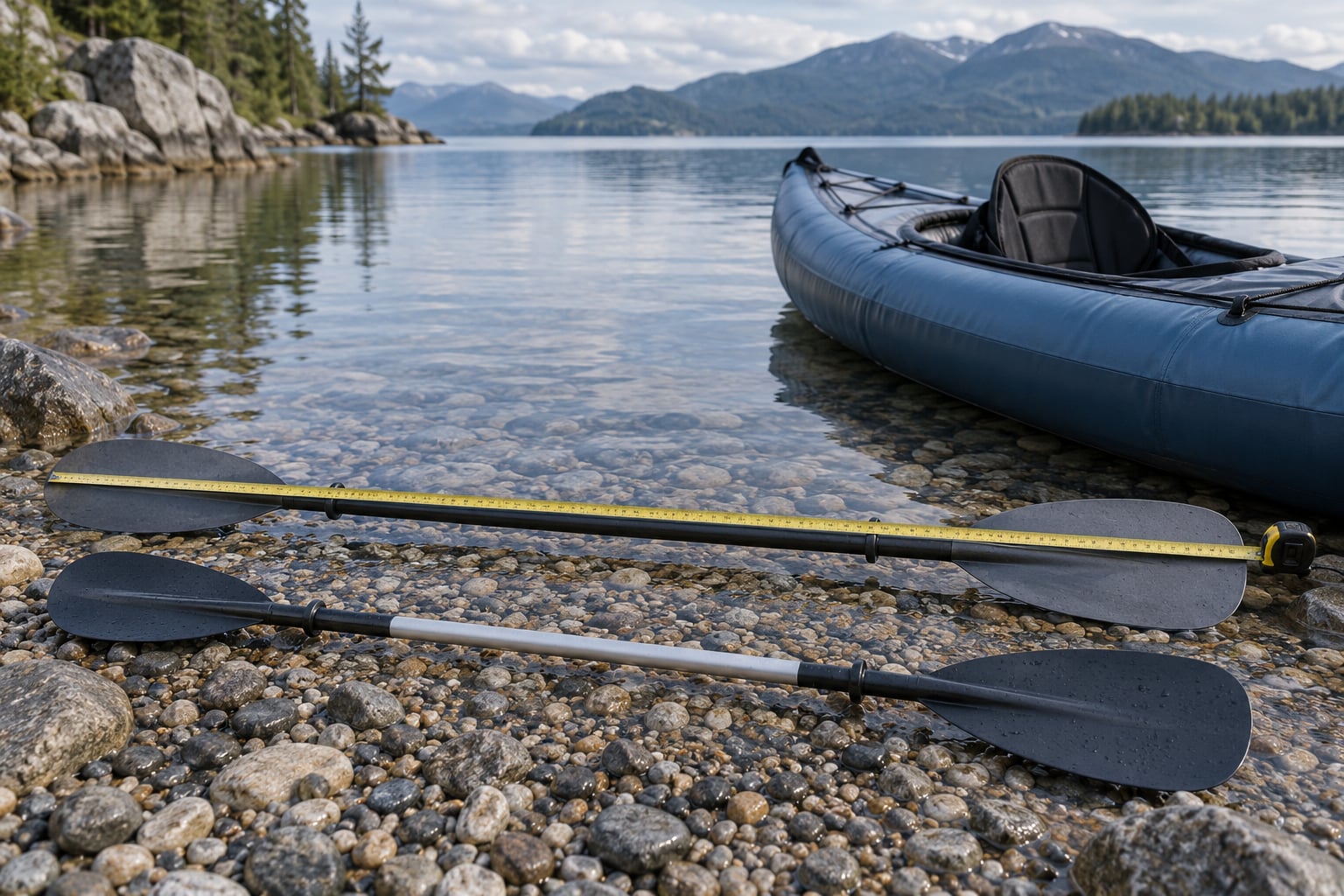
For kayak paddles, measure end to end: top grip to blade tip is the number the chart should match. For canoe paddles, the manufacturer usually publishes both the shaft length and the overall length with the blade fitted, so check which one you are reading before comparing.
Segmented paddles add another wrinkle. A two-piece paddle is measured across both halves including the join. A four-piece paddle is usually quoted at its longest setting, so dial it down for sizing and check that your needed length falls inside the adjustment range before you buy.
Feather angle is a separate setting, not a length issue, but it interacts with how the paddle feels. A feathered paddle rotates your upper hand, which reduces wrist fatigue over a long day and gives you a cleaner catch in current; an unfeathered paddle keeps both blades in line and feels more stable for beginners and for low-angle styles. Start at 30 or 45 degrees unless the manufacturer suggests otherwise.
Shaft diameter matters for smaller hands. If your fingers wrap the grip and your thumb and index finger touch, try the next size down. Grip diameter and paddle length are independent choices, so a short paddler does not have to accept a thick shaft.
Test the Fit on Water
Before you commit, paddle for ten minutes on flat water and watch four things.
Blade recovery. Bring the blade up and see whether it clears the hull, the deck and your own legs without a deliberate lift. A paddle that is too long tends to swing wide and clip on the exit.
Reach at the catch. Your top hand should reach forward to about shoulder height without your shoulder rounding. If you are leaning or shrug-pressing to get the blade in, it is long.
Power at the finish. The lower hand should end near your hip or just past it. Finishing well behind the hip means the length is right for an efficient stroke; finishing far in front of the hip means you are pulling too early.
Comfort in the hand. Watch your wrists, not just your shoulders. Ten minutes with a neutral wrist tells you far more than an hour of numbness.
The field heuristic paddlers share online is that a paddle you can stand beside and just reach the tip of is about right for many kayaks. It is a decent starting sanity check, not a rule, and it does not apply to a wide hull where you sit higher.
Make the Final Adjustment
When you land between two lengths, go slightly longer rather than shorter. Most paddlers can shorten their stroke to suit a longer paddle far more easily than they can reach out and bury a short one, and this holds across kayak, canoe and SUP use.
Signs the paddle is too long: your top hand finishes low, the blade clips on exit, you feel load in the lower back, and the boat feels slow to accelerate even though you are working harder.
Signs it is too short: you take two or more strokes to build speed, the blade skids instead of catching, your cadence climbs, and your shoulders burn first because your arms are reaching instead of pulling.
Both mistakes feel like a bad paddle rather than a bad length, which is why the test paddle matters. If the size you need is outside what a brand sells, ask an outfitter about a custom shaft or a four-piece model with a wider adjustment range before you order anything custom-made, which usually costs more than buying the adjustable option.
Common Mistakes
Choosing on height alone. Boat width and seat height can move the answer a whole band, which is the single biggest error on this list.
Comparing advertised overall length across brands. One maker may include the grip overlap, another may not, so the same number can mean two different paddles. Check the measurement points on the spec page.
Ignoring cockpit width. A 230 cm (91 inch) paddle that feels great in a narrow touring boat can feel oversized in a wide recreational hull, and the reverse is true for shorter paddlers.
Going heavy on feather. 60-degree feathering is efficient for experienced paddlers but awkward while you are still learning to keep the blade buried. 30 to 45 degrees is a comfortable starting point.
Skipping the water test. A store measurement gets you close. Ten minutes on flat water decides it.
Treating a generic chart as more authoritative than the maker’s chart for that boat. Manufacturer guidance for your hull beats any table on this page.
Finally, read the maker’s spec page rather than a generic chart. It names the hull width it assumes, it states which points it measures between, and it will tell you the adjustment range of a telescoping shaft before you buy rather than after.
Frequently Asked Questions
What paddle length should I use if I am between two height ranges?
Go with the longer of the two lengths. Most paddlers can shorten a stroke to suit a longer paddle more easily than they can reach out far enough to use a short one properly. If you are still unsure, check your boat’s beam against the width column in the sizing table, then confirm with ten minutes on flat water.
Does a longer paddle work better for a wider kayak?
Usually yes. A wide hull pushes your knees and lower hand outward, so your top hand has to travel further forward to clear the deck. That extra reach is why recreational kayaks of 78 to 83 cm (31 to 33 inches) push the same paddler one band higher than a narrow touring boat. Seat height and kneeling positions do the same thing.
Should I measure paddle length from the grip to the tip?
For a kayak paddle, yes, measure the top grip to the blade tip and match that to the maker’s chart. Canoe paddles are often quoted as shaft length and overall length separately, so check which one the manufacturer is using. Four-piece paddles are quoted at their longest setting, so measure at the setting you plan to use.
Do kayak paddles and paddle-board paddles use the same sizing?
No. Kayak paddles are sized against hull width, so a wide sit-on-top asks for a longer paddle than a narrow touring boat. Paddle boards are sized against height, running roughly 8 to 12 inches (20 to 30 cm) longer than your height in inches for flatwater, with river surfing calling for a shorter paddle. Converting between the two sets of numbers does not work.
Can I change a paddle’s length if the chart is not quite right?
Only if you buy an adjustable model. Two-piece and four-piece paddles let you change length within a set range, usually around 10 to 20 cm (4 to 8 inches). A one-piece carbon or fibreglass shaft is fixed, so getting it wrong means a return trip. If you know you sit between two sizes or share a boat, an adjustable shaft is worth it.
Conclusion
Use your height to pick the nearest reference length in the table, check it against your boat’s width and seat height, then confirm with ten minutes of paddling on flat water. If two lengths still fit, take the longer one and test it.
That is how to choose a paddle length for your height in practice: one chart, one adjustment for your boat, and one short session on the water before the purchase decision is final.