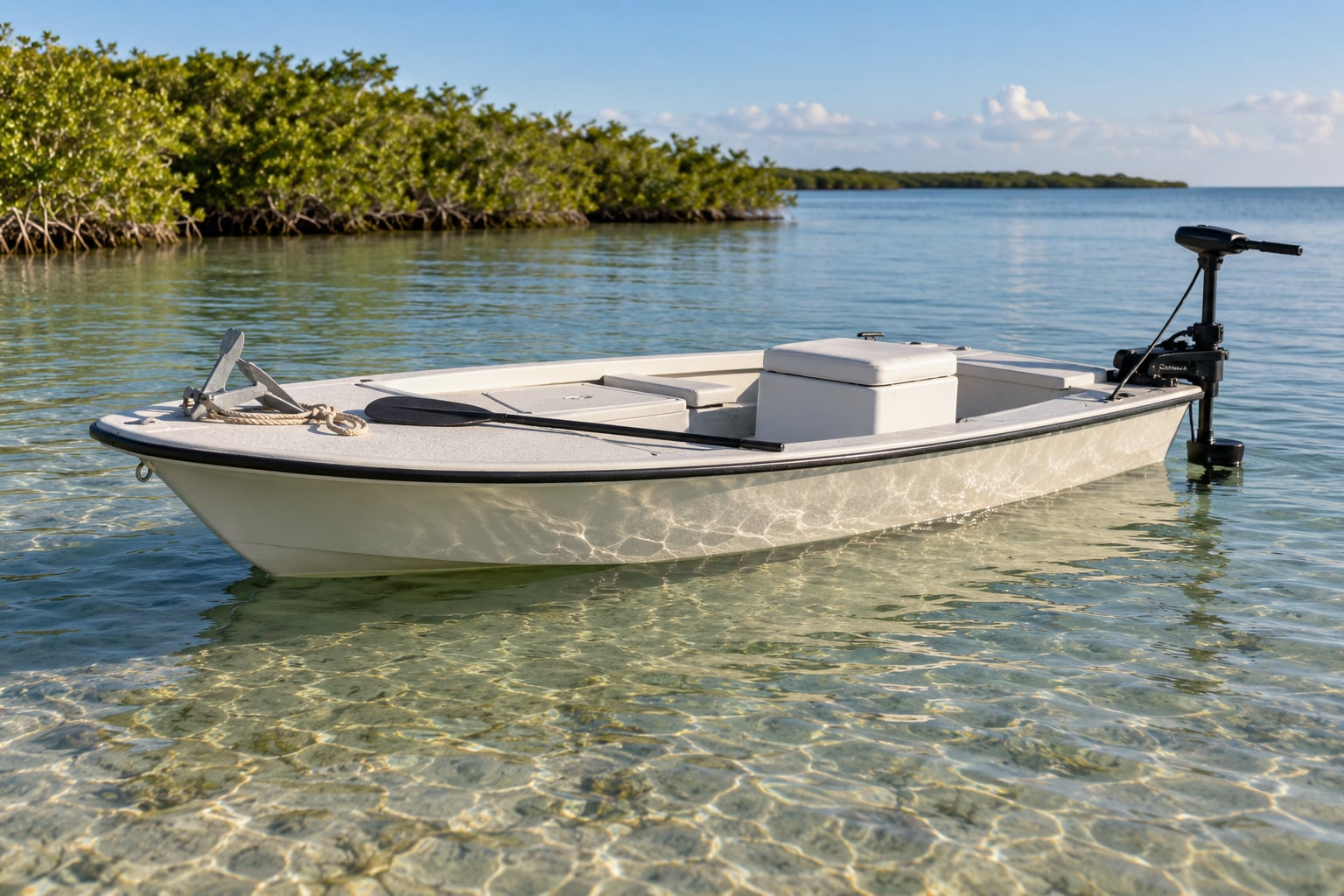
Using a trolling motor in shallow water comes down to three things: set the prop just under the surface, lock the depth collar so it stays there, and run slow enough that the blades stay submerged. Get those right and you can hold position over a 2-foot flat or inch through a mangrove edge. Get them wrong and you will cavitate, fog up the bottom, or walk your boat onto a mudbank. Here is the whole procedure, from checking the route to stowing the motor.
The shallow-water game is mostly about noise, not thrust. A prop throwing bubbles spooks redfish and speckled trout at 200 yards. A motor that is quiet, high on the shaft and moving at a crawl will put you over fish that an outboard running at 1500 rpm never sees.
Table of Contents
- What You Need
- Step-by-Step: How to Use a Trolling Motor in Shallow Water
- 1. Check the Route and Water Depth
- 2. Inspect and Position the Motor
- 3. Adjust Speed for Shallow Water
- 4. Steer Around Submerged Hazards
- 5. Watch for Changing Conditions
- 6. Shut Down Safely
- Common Mistakes
- Frequently Asked Questions
- How deep should my trolling motor be in the water?
- Can you use a trolling motor in 2 feet of water?
- Why does my trolling motor lose power in shallow water?
- Is a trolling motor worth it in water under 18 inches?
- How long should the shaft be on my trolling motor?
- Can you run a trolling motor without water?
- Conclusion
What You Need
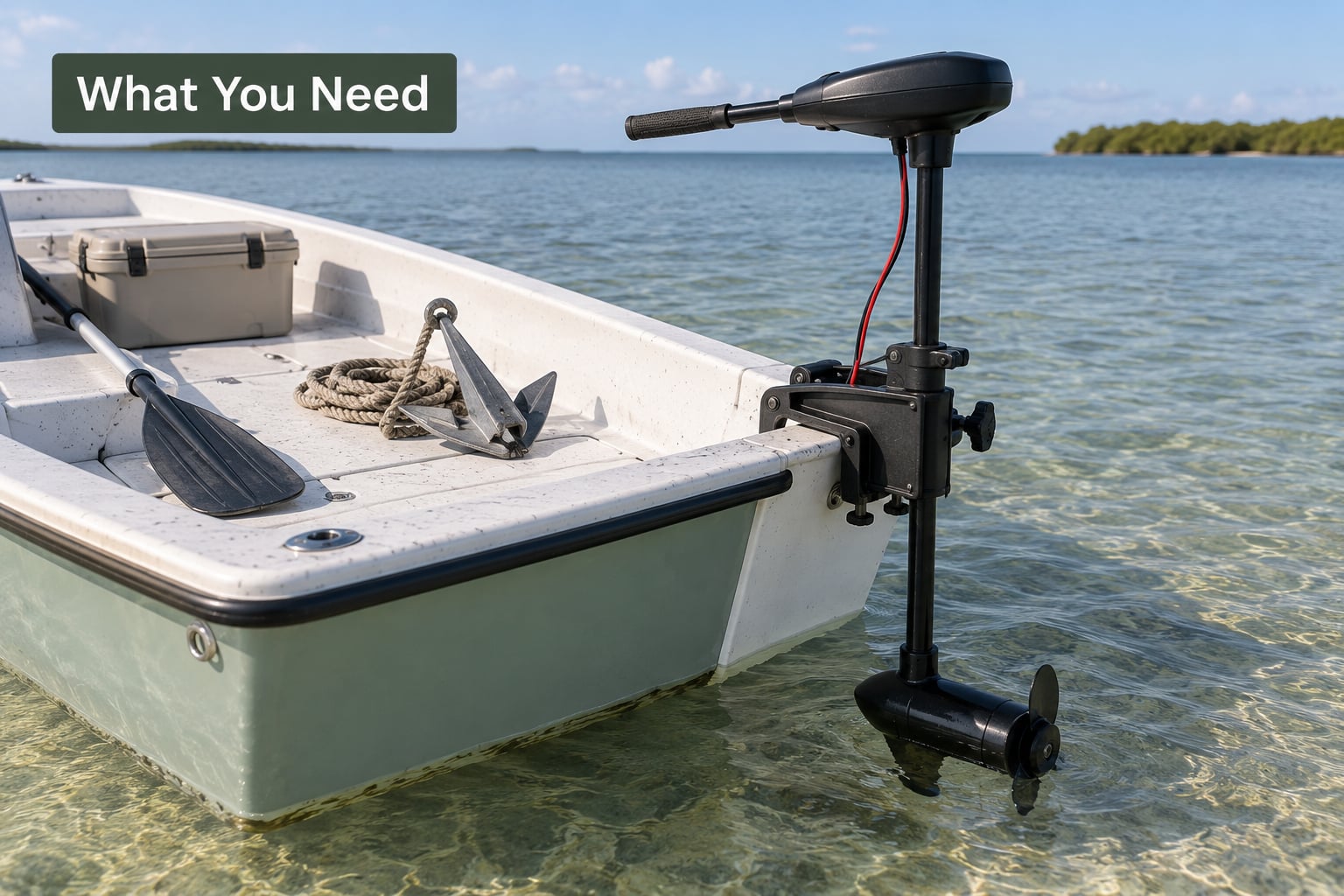
The boat and the motor matter less than what you know before you drop the shaft. Anglers who ground their skiffs in the marsh flats did it because they trusted the depth finder over the tide table, not because of a bad motor.
- A chart or mapping app with depth contours. Look for the number, not just the colour band. Most apps show a blue band where the chart only guarantees a few feet.
- Tide data for the hours you will be out, not just the height at launch. Falling tide turns a safe route into a mudbank walk over two hours.
- A paddle or oars within reach. This is the single most useful item on the list.
- A working anchor and enough line to reach bottom where the water is too shallow for a trolling motor.
- The owner’s manual and a wrench for your motor. You will adjust the depth collar, the trim, and sometimes the steering tension.
- A fully charged battery with a known rating, and a way to check it while you run.
- The kill switch lanyard clipped to you from the moment you start the motor.
- A soft pair of hands and a way to raise the boat. The motor is a backup in skinny water, never your only plan.
If your boat has a power pole or spike pole on the trolling motor shaft, that counts as your shallow-water backup and it is worth knowing how to drop it before you need it.
Step-by-Step: How to Use a Trolling Motor in Shallow Water
1. Check the Route and Water Depth
Plan the route before the engine starts. Mark the entry point, the thinnest spot along the path, and at least one place you can turn around or get a pole up.
Then work the tide into it. Two hours of falling tide is often a foot of water, and on a flat that foot is the difference between a prop clearing the bottom and the prop stirring up shell hash. Water depth, motor depth and speed are one decision, not three separate ones, so write them down together before you leave the ramp.
You know it worked when you can name the shallowest point on the trip out loud and say how much water you expect to have there. If you cannot, that trip is not ready.
2. Inspect and Position the Motor
Before the shaft goes in the water, look at it. Check the prop for bent blades or wrapped line, look at the shear pin, and run the shaft up and down by hand to confirm the collar threads are clean and the motor does not drop past where you want it.
Set your depth from the bow-to-waterline measurement. Measure the vertical distance from the mount surface down to the waterline with the boat in its normal trim, then pick a shaft that keeps the lower unit at least about 12 inches under the surface in calm water. Add roughly 5 inches for rough water or a chop you will actually be running in.
In shallow water, tighten the depth-adjustment collar so the motor physically cannot drop lower than your chosen setting. Anglers on The Hull Truth treat this as the standard trick for skinny water, and it is the difference between a controlled motor and one that finds the bottom when you cross a sandbar.
You know it worked when you can raise and lower the boat’s trim a few inches and the motor stays put at your set depth.
3. Adjust Speed for Shallow Water
Start on the lowest throttle setting that will move the boat and add speed only when the water deepens. In most skinny water you never leave that first setting. Short bursts at a lower throttle beat a long run at a higher one because the prop spends more of its time fully wet.
Work from this table rather than guessing. It assumes calm water and a normally trimmed boat.
| Water depth | Motor depth setting | Typical speed setting | Best approach |
|---|---|---|---|
| Under 18 in | Motor stowed | None | Pole, paddle, anchor and drift |
| 18 to 24 in | Prop tip just under the surface, collar locked | 1 to 2 | Motor for repositioning only; poling is quieter |
| 2 to 3 ft | Lower unit about 6 in below the surface | 1 to 3 | Slow troll, or anchor and drift |
| 3 to 4 ft | Lower unit about 12 in below the surface | 2 to 4 | Normal slow troll |
| 4 to 6 ft | Lower unit fully submerged | 3 to 5 | Standard trolling |
| 6 ft and up, in chop | Fully submerged with the 5 in rough-water allowance | 3 to 6 | Standard trolling; keep clearance over structure |
Crowded boats that fish shallow water year-round tend to treat roughly 18 inches as the practical floor. Below that, the motor noise costs more fish than the convenience is worth, and poling a skiff over a flat is faster anyway.
You know it worked when the boat makes almost no noise at the rail and no bubbles trail behind the transom.
4. Steer Around Submerged Hazards
Watch the water ahead rather than the fish finder. Scan two boat lengths minimum, and more in clear water where stumps and grass banks show early as a change in colour.
Make corrections early and small. A hard turn at full throttle throws the stern around and puts the prop somewhere you did not plan. Cross a hazard at an angle rather than straight at it when you can, so a glancing hit does not stop you dead.
Know your tilt pin before you need it. Most trolling motors have a pin at the mount that lets the shaft swing up when it hits something, protecting the unit and the lower unit. A kayak angler asked on a fishing forum whether it can be removed so the motor can bump over oyster beds instead of stopping; the practical answer is that the tilt pin is the mechanism you want, and it is what keeps a stump from going through the gear housing. Re-seat it before you continue.
You know it worked when you pass the obstacle with the prop still spinning and the boat’s attitude unchanged.
5. Watch for Changing Conditions
Tide, wind and prop wash all change what is safe in the next ten minutes. The biggest of these is prop wash, because it stirs bottom sediment into your own propeller and cuts thrust exactly where you need it most. Cross a shallow bank at a slow setting and stay off the throttle while the prop is over it.
Watch the motor itself too. Vibration you did not feel a minute ago, a change in how the boat pulls, or a voltage drop under load all mean the prop is no longer fully in clean water.
Two different noises get confused constantly. Experienced anglers have warned for years not to mix them up, so here they are side by side.
| Symptom | What you hear or see | Cause | Fix |
|---|---|---|---|
| Ventilation | Sudden loud gravelly roar, thrust drops or vanishes, often after a wake or wave | Air drawn into the prop from above the waterline | Lower the motor, return to a steady speed, and lock the collar so it cannot ride up on a wave |
| Cavitation | Buzzing or hissing with fine bubbles and spray off the prop blades, worst in very shallow water or at high throttle | Prop breaking the surface or starved of water | Lower the motor until the lower unit has about 12 in of immersion and drop to a lower throttle setting |
If the boat drifts into water that is too shallow, kill the throttle, raise the shaft, and get the paddle in your hands. Backing water off a flat at a dead stop is slow and loud, but it is far better than a buried prop.
6. Shut Down Safely
Return to water deep enough for the motor before you stow it. Bring the boat into deeper water, drop the throttle to zero, and let the motor sit for a moment while the prop stops spinning.
Then raise the shaft on the tilt or lift, release the collar, and pull the motor up until the prop is clear of the hull. Stowing with the prop dragging in the water is how people damage a unit on the way back to the ramp.
Before you leave the boat, run a hand down the blades and check the shear pin. If you hit something hard, the shear pin is designed to snap and save the gear housing, so a pin that sheared is a good outcome and a two-minute fix, not a failure.
You know it worked when the prop comes up clean and the collar retightens without binding.
Common Mistakes
Most of these are quiet mistakes. They do not feel wrong until the boat is aground.
- Running the prop too high. A half-submerged prop makes noise and loses thrust. Drop it until the lower unit has about 12 inches of immersion, then tighten the collar.
- Leaving the depth collar loose. The motor will find the deepest setting it has on the first drop into a dip. Tighten it before you deploy, not after.
- Trusting a narrow chart scale. Between the last marked contour and the shoreline there can be almost no water. Read the contour spacing, and treat a wide blue band as a warning, not a clearance.
- Ignoring the tide on a falling tide. The route you planned at 9 a.m. can be a foot shallower by noon. Plan the return on the falling number.
- Turning at full throttle in skinny water. A hard turn swings the stern into water you have not checked. Make early, small corrections instead.
- Mowing vegetation on the way to a spot. A prop through eelgrass or a turtlegrass flat tears up the bottom and chases every fish off it. Raise the motor, cross at the shallowest safe setting, then drop it back down.
- Running a big motor at crawl speed all day. High thrust at low throttle pulls a lot of amps for very little movement, and shallow-water trips end when the battery does. Match the motor to the boat and use a pole once you are holding fish.
Frequently Asked Questions
How deep should my trolling motor be in the water?
Keep the lower unit fully submerged with about 12 inches of it under the surface in calm water, and add roughly 5 inches if you will be running in chop. In shallow water, tighten the depth adjustment collar so the motor cannot drop lower than that setting. Half a prop out of the water ventilates or cavitates, which costs you thrust and makes a lot of noise.
Can you use a trolling motor in 2 feet of water?
Yes, with the shaft set shallow and the collar locked so it cannot drop. Set the lower unit about 6 inches under the surface and stay on throttle 1 to 3. In 2 feet you have very little prop clearance, so watch the depth and your own prop wash, and be ready to switch to poling if the bottom starts coming up.
Why does my trolling motor lose power in shallow water?
Usually the prop is breaking the surface or picking up bottom. Bubbles trailing behind the prop mean cavitation, which you fix by lowering the shaft and dropping a throttle setting. A sudden gravelly roar after a wave is ventilation, which you fix by locking the collar lower. Churned-up sediment cuts thrust too, so slow down over shallow banks.
Is a trolling motor worth it in water under 18 inches?
Most anglers treat roughly 18 inches as the practical floor. Below that the motor noise spooks shallow-water fish before you get in range, and a pole or paddle puts the boat where you want it faster and quieter. Many still run the motor for repositioning and dropping to a pole once they are over fish.
How long should the shaft be on my trolling motor?
Pick the shortest shaft that still keeps the lower unit submerged at your normal trim. Rough ranges: micro skiff 36 to 54 inches, flats boat 48 to 60 inches, bay boat 60 inches, large bay boat 72 to 75 inches, offshore center console 84 to 90 inches. Add about 5 inches for rough water, and remember you can always adjust up but never below the shaft length.
Can you run a trolling motor without water?
You can, but only briefly and only to deploy or stow it. A motor run dry spins the prop with no cooling water flowing over the windings and no thrust to load it, which overheats it fast. Deploy it before you leave the ramp, and if it must stay up in shallow water, cut the throttle and raise the shaft instead of leaving it running dry.
Conclusion
The safest first move in shallow water is unglamorous: check the route and the tide, set the motor to your intended depth, tighten the collar so it cannot drop, and start on the lowest throttle setting that moves the boat. Keep a paddle within reach and know the point on the trip where you switch to poling or anchoring. Done that way, learning how to use a trolling motor in shallow water is not about more power. It is about keeping the prop wet, the bottom undisturbed and the boat quiet.