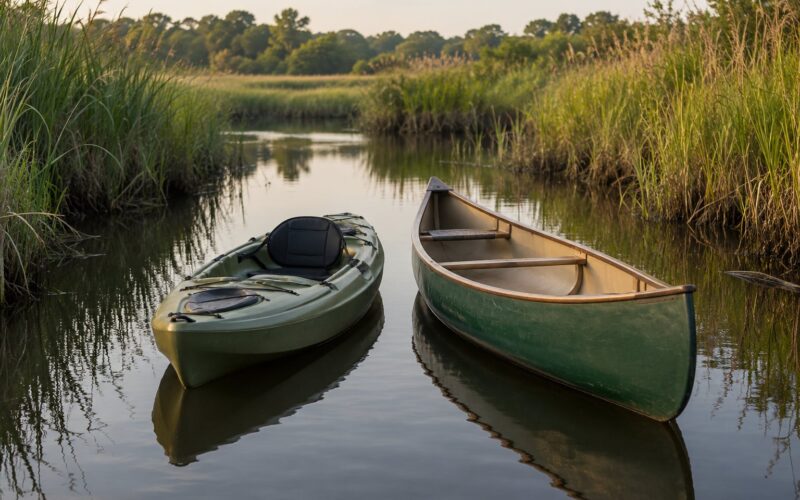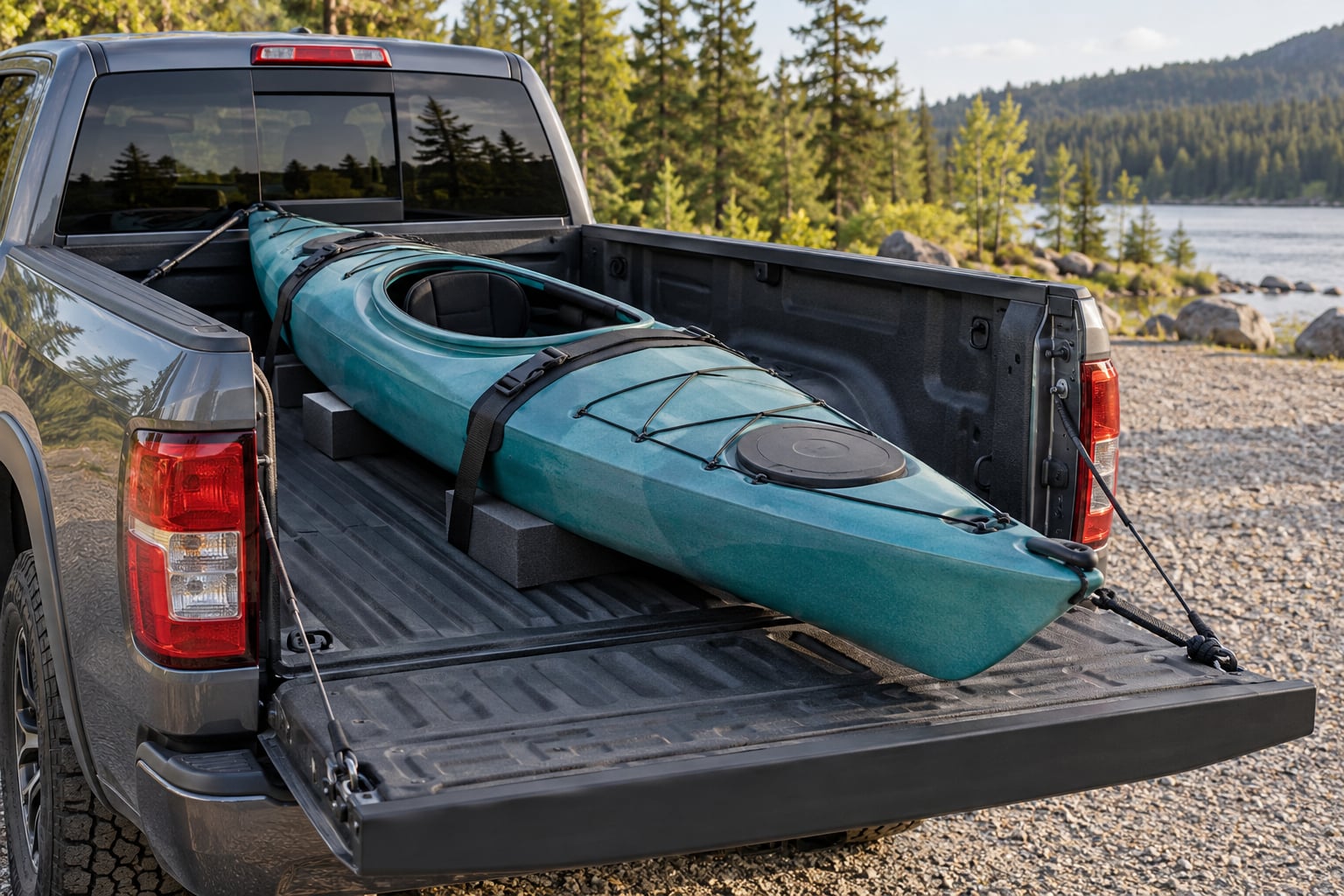
You can transport a kayak without a roof rack by laying it in a pickup bed or on a small trailer with cam straps over the hull plus bow and stern lines to a solid anchor, or by folding an inflatable into a bag in your back seat. Pick the method that matches your boat’s length and your vehicle, secure it in under 15 minutes, and check it again after the first 20 miles.
The honest part of that answer is that a bare roof, a truck bed and a trailer are not equally safe. A truck bed gives you four walls to strap against. A trailer gives you a frame built for exactly this. A naked roof relies on straps through the cabin doors, which works fine on a 20-minute run to the lake and makes me genuinely uneasy on a three-hour interstate stretch with a 14-foot tandem.
Below is the method-by-method breakdown, starting with the gear and ending with the inspection I run before every trip.
Table of Contents
- What You Need
- Step-by-Step
- 1. Choose a Transport Method That Fits Your Kayak When You Have No Rack
- 2. Transport a Kayak in a Pickup Truck Bed
- 3. Use a Small Utility Trailer
- 4. Carry or Store an Inflatable or Folding Kayak
- 5. Carry a Compact Kayak Without a Vehicle Rack
- 6. Perform a Final Safety Check
- Common Mistakes
- Frequently Asked Questions
- Do you need a roof rack to transport a kayak?
- How fast can you drive with a kayak on the roof?
- Are pool noodles strong enough to hold a kayak?
- Where do you attach bow and stern lines with no tow hook?
- Can you transport two kayaks without a roof rack?
- Is a rental or company vehicle bad for hauling a kayak?
- Conclusion
What You Need
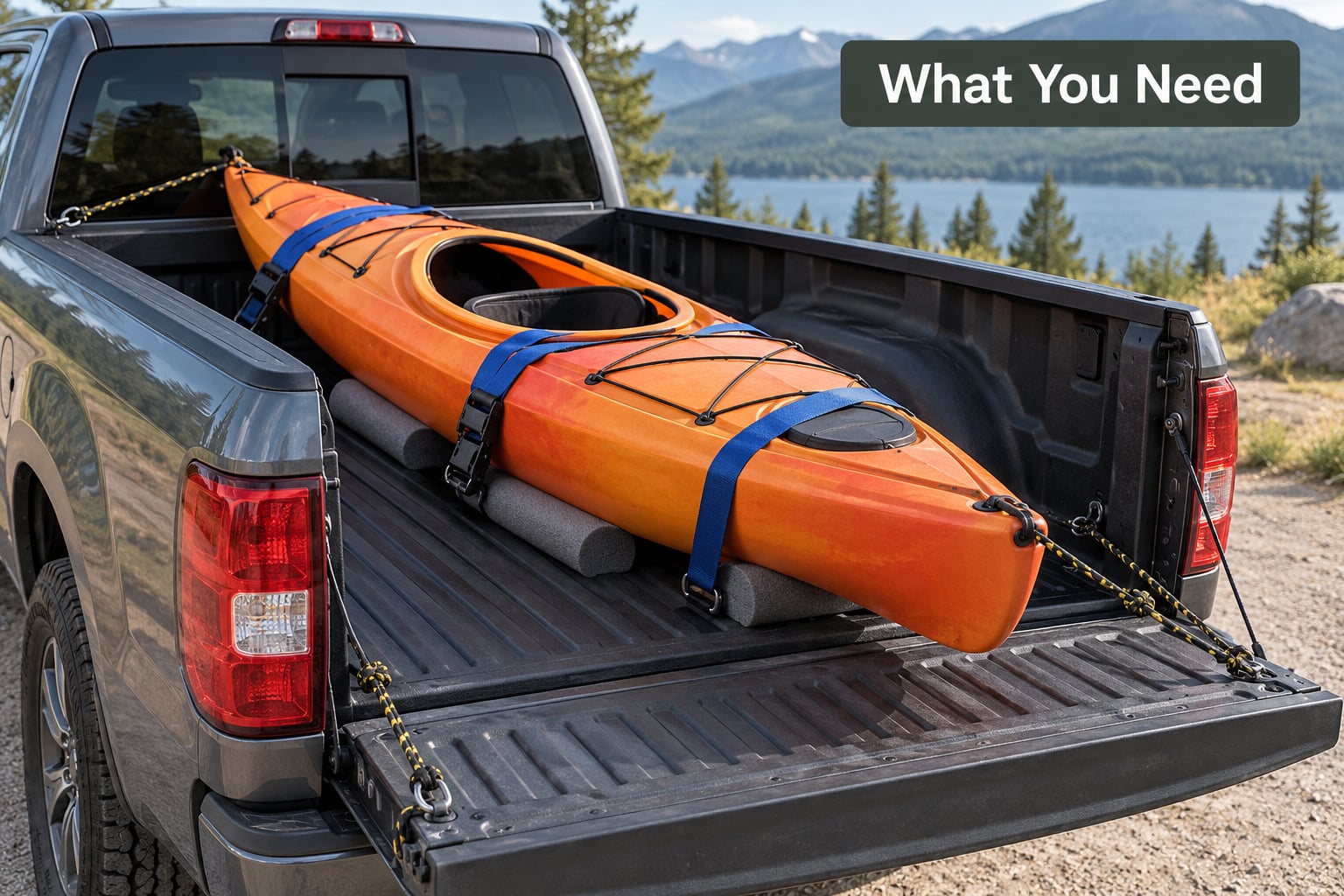
Start with tie-downs, because everything else is optional padding. Two 10 to 12 foot cam straps with a working tensioner, one or two more straps for the bow and stern lines, and something non-stretch to tie them with.
Then add contact padding, a bow line, a stern line, and the usual safety kit.
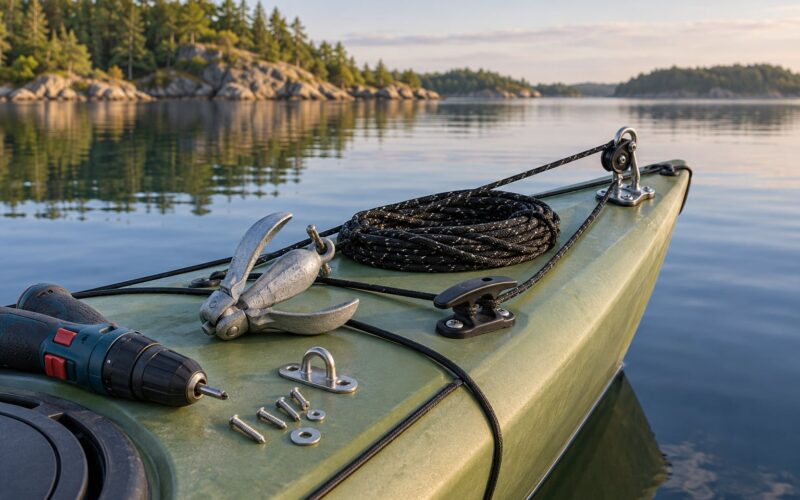
- Cam straps, 10 to 12 ft long, 1 inch wide, with metal or reinforced buckles. These are the workhorse. Skip elastic bungee cords entirely; they stretch, they let the hull creep, and paddling forums are full of boats lost off roofs after a cord snapped.
- Closed-cell foam blocks or pool noodles for the contact points. Foam blocks resist crushing and do not roll. Pool noodles are cheaper and roll, so slide a length of PVC pipe inside each one for stiffness.
- Bow line and stern line, 10 ft of nylon rope each, roughly 1000 lb test. This is what stops fore-aft travel under braking.
- Anchor points: bed rail tie-downs, a trailer frame rail, a bumper, a tow hook, or hood loops and door hinges on a sedan.
- Roof protection: a roof blanket, a piece of carpet, or thick pool towels if you are running across a bare roof.
- Safety kit: a red flag or slow-moving vehicle triangle if any part of the load extends past the vehicle, tie-wrap or a spare strap, and a bungee-free way to cover loose ends.
If you want a route to the hardware, there are dedicated bow and stern line kits and strap-and-block bundles sold for exactly this purpose, so you are not assembling the whole thing from whatever is in the trunk.
Step-by-Step
1. Choose a Transport Method That Fits Your Kayak When You Have No Rack
Match the method to the boat first. A rigid 10 to 12 foot fishing kayak fits in a bed behind the cab of most half-ton pickups with the tailgate down, a folding kayak fits anywhere including inside the cabin, and a rigid 14-foot tandem usually belongs on a trailer or inside a pickup bed with the tailgate down and a bridge across the rails.
Then check three numbers before you lift anything: kayak length, vehicle payload, and trip length.
- Rigid hulls need a bed, trailer, or bare roof. Length is the constraint. A 14-foot tandem on a sedan roof overhangs the rear glass badly and changes how the car handles.
- Inflatables deflate, fold into a duffel, and ride in a back seat or a truck bed in about ten minutes.
- Folding packrafts assemble and disassemble in the same window, so they suit a trip where you walk in from a trailhead rather than launch from a car.
Keep in mind that a 12 foot recreational kayak typically weighs 45 to 60 pounds and a 14.5 foot tandem can run past 70 pounds, which is genuinely awkward to lift onto a bare roof alone. If your boat is over about 70 pounds or longer than 12 feet, a pickup bed or trailer is the safer call and the cheaper one in the long run.
2. Transport a Kayak in a Pickup Truck Bed
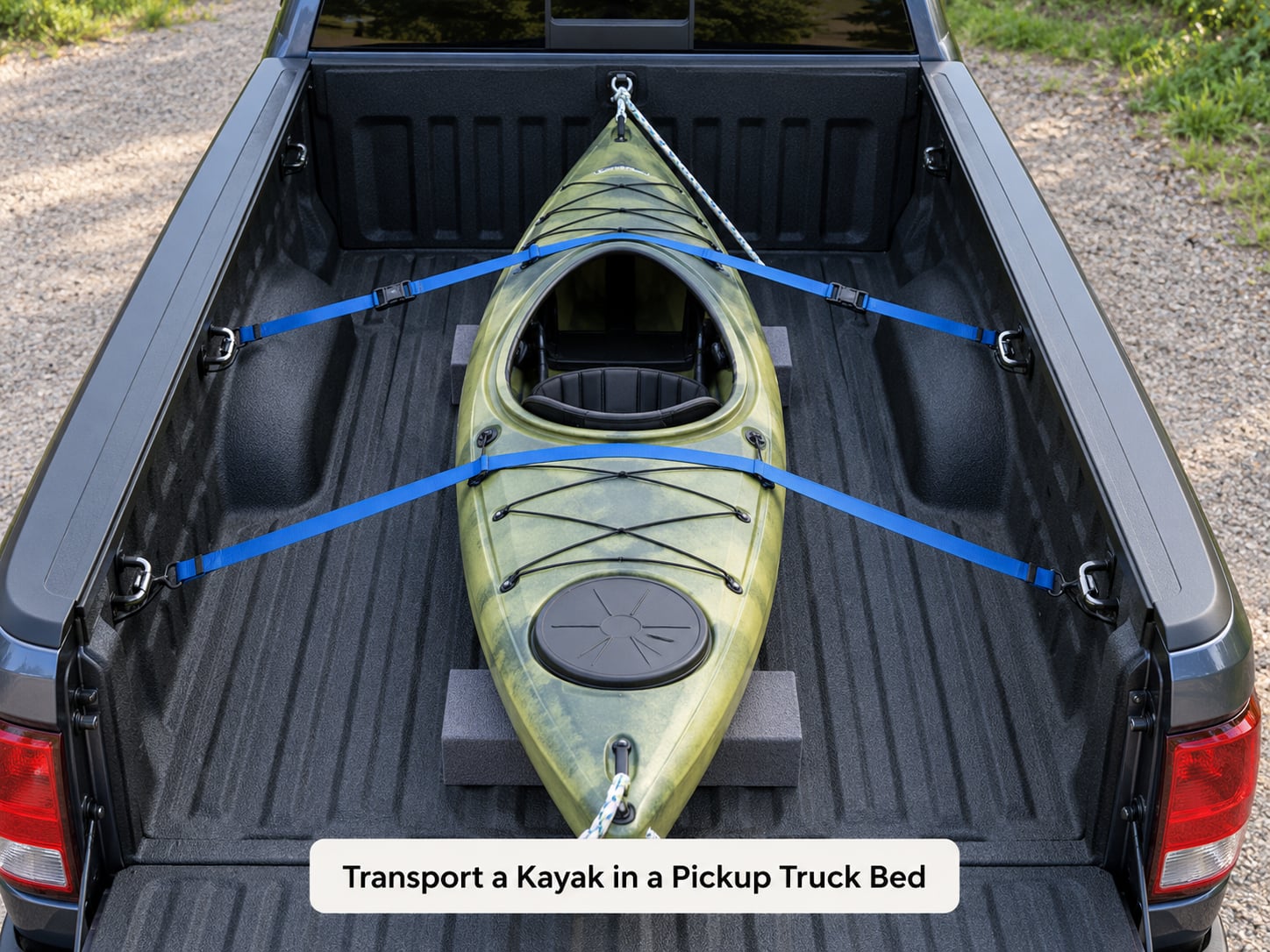
A pickup bed is the best no-rack option that most paddlers have access to. The bed rails give you anchor points, and the sidewalls keep the boat from sliding sideways.
- Clear and line the bed. Sweep out grit, because grit is exactly what scratches a hull. Lay a moving blanket, carpet remnants, or foam pads along the bed floor where the hull will sit.
- Set the boat in the bed. Bow forward, hull up or hull down, whichever clears your tailgate. Hull up is easier to tie over and keeps the cockpit rim from carrying road spray.
- Add padding at the contact points. Foam blocks or stiffened pool noodles under the hull at roughly the front and rear third. These spread the load and stop the boat from denting on a bed liner ridge.
- Run two cam straps over the hull into the bed rail tie-down loops on each side, or over the top to opposite-side rail anchors. Tighten until the boat stops moving under a firm hand push, then stop. Bending the hull is worse than the rattles you are trying to remove.
- Tie the bow and stern lines from the grab loop or handle to the front and rear bed anchor points. These are not decorative. They absorb the load change when you brake hard or stand on the throttle.
- Handle the tailgate. If the boat overhangs, support the tailgate with a tailgate assist or a prop rod and strap the boat to it, never to a strap hanging in mid-air. Do not drive with an unsupported open tailgate carrying loose weight.
A 73 pound, 14.5 foot tandem is heavy but it does fit a bed with the tailgate down and two straps across, and paddlers regularly run that setup for a few hundred miles without it shifting.
3. Use a Small Utility Trailer
A trailer is the best answer when the trip is long and you own the boat. The frame does the work that a naked roof asks your straps to do, and it keeps a heavy tandem off your back.
- Set the kayak on the trailer frame centred on the rails, bow forward, on foam blocks or on saddles if the trailer has them.
- Secure to the proper attachment points. Strap each end to a frame rail or cross-member, then run a second strap across the hull. On a trailer with bunks, run the straps through the bunks so the boat cannot lift out.
- Add bow and stern restraints. Bow line to a frame rail, stern line to a rail on the opposite side so the boat cannot pivot or slide.
- Cross the coupler. Safety chains must be crossed under the coupler, not parallel, so they cannot come off if the coupler fails. Plug in the wiring for lights if the trailer has any, and check that they work.
- Check tires and lights. Inflate to the pressure on the tire sidewall, not to a number you remember. Verify all lights at the connector, then confirm the boat does not extend so far that you need a slow-moving vehicle flag.
Trailers add weight, so the tow vehicle’s tongue weight rating and the trailer’s own weight rating both have to work in your favour. Every safety chain, coupler pin and tire is a wear item, so check them before each trip.
4. Carry or Store an Inflatable or Folding Kayak
Inflatables and folding boats skip the tie-down problem almost entirely, which is why they win on rented cars and short lake launches.
- Deflate fully and dry it. Fold the hull in its manufacturer panels, seat first, and roll the air valve inward so the last bit of air cannot escape.
- Use the correct bag and straps. The original duffel with its compression straps is the answer. Keep the floor mat or drop-stitch repair kit in the same bag.
- Place it in a truck bed or vehicle interior. In the bed, lay it along one side wall, low against the bed floor, and strap it to the rail with one cam strap so it cannot slide forward under braking. Inside the cabin, lay it flat across the rear seat footwell or along the cargo floor with the seatbelt run through the bag handles.
- Protect it from moisture and abrasion. A wet packed bag in a hot bed will mildew. Wipe the hull dry before packing, and keep the bag off a bare bed liner with a blanket underneath it.
Inflatable pontoons need a rigid cargo deck rather than loose bags, and a folding kayak frame should be strapped at two points rather than laid loose. If you have several people and short paddles, a rigid trailer is the easiest option.
5. Carry a Compact Kayak Without a Vehicle Rack
When the launch is close, carrying beats strapping. You control the whole movement and nothing can shift at 60 mph.
- Check the route first. Distance, grade, crosswalks and traffic decide whether a solo carry is realistic. A 12 foot boat on a shoulder is awkward above about a mile.
- Use a two-person shoulder carry for anything long. One person at each cockpit, hands under the rim, boat level. If you are solo, a kayak cart with large wheels and a foam block cradle will roll on pavement and firm trail but will not work on soft sand or mud.
- Balance the load. Keep the bow slightly up, walk on the side away from traffic, and take breaks every 10 to 15 minutes rather than carrying to failure.
- Protect during rest stops. Set the boat hull-up on a towel or grass, not on gravel, and never leave a hull in direct sun on hot pavement for long. Plastic hulls can warp in heat.
6. Perform a Final Safety Check
The pre-trip inspection is the same every time, and it takes about three minutes. Run it before you pull away and again after the first stretch of road.
- Straps: hand-tight plus a firm pull. Every strap sits flat and does not twist. No strap crosses a hatch, an antenna, a door seal, or an airbag sensor.
- Lines: bow and stern lines attached to real anchor points, not to a plastic trim clip. Nothing hangs loose where it can slap the paint.
- Hull movement: push the boat hard side to side. If the boat does not move under your hands while the hull stays put, the straps are doing their job. If the hull slides, tighten one more notch and re-test.
- Clearance: nothing within a few inches of the roof, the doors, the mirrors or a garage door on the route. Re-measure before you drive under anything low.
- Trailer: chains crossed, coupler pinned, lights working, tires at sidewall pressure, and the boat clear of the tongue and hitch.
- Re-check schedule: stop at 5 miles, 10 miles, and again around 15 to 20 miles. Vibration loosens straps in the first few miles, and most shift failures happen before people think to look. A speed of about 65 mph on the highway is a sane ceiling for a bed or trailer load, or a bare roof; go slower in crosswinds and on rough pavement.
Common Mistakes
Almost every kayak that comes off a vehicle comes off for one of a handful of reasons, and all of them are avoidable.
- Using bungee cords. Elastic stretches, so the hull creeps a little on every bump and eventually slides free. Use non-stretch cam straps or rope instead, and never rely on bungees even as a backup.
- Over-tightening ratchet straps. The ratchet gives you fine tension, which tempts you to keep going, and the concentrated point load can crack or permanently deform a hull. Cam straps with a fixed-length tail are better because tensioning is more repeatable.
- Leaving the kayak on an unsupported tailgate. A tailgate with a kayak on it and nothing under it can fail in the first hard corner. Prop it and strap it, or move the load fully into the bed.
- Forgetting bow or stern lines. Crossbars and straps hold the boat down. Bow and stern lines are what stop it travelling, and under braking the load tries to move forward no matter how tight the straps are.
- Exceeding payload or roof load limits. A kayak is 45 to 80 pounds of sail on top of everything else, and the dynamic load in a swerve is higher than the static weight. If the load affects braking or steering, split it into two trips.
- Driving with an open tailgate or loose gear. If the tailgate must be open, support it, secure it, and mark any overhang with a slow-moving vehicle triangle as your state requires.
- Not re-checking after the first few miles. This is the one that surprises people. Nothing feels wrong and the straps have already moved.
If your car has no rails and you want a permanent fix, a bare-roof crossbar system from Thule, Yakima or the vehicle manufacturer clamps on with no drilling. Forum consensus is firm on this: avoid lookalike bars sold on marketplaces, because the feet and towers are what fail, and they fail at highway speed.
Frequently Asked Questions
Do you need a roof rack to transport a kayak?
No, not for short trips. A pickup bed or small trailer is the safest no-rack option because the bed rails or trailer frame give you solid anchor points. A bare roof works too, with foam blocks or stiffened pool noodles as pads, cam straps through the open cabin doors, and bow and stern lines. For long highway runs or heavy tandems, a rack or trailer is worth installing.
How fast can you drive with a kayak on the roof?
About 65 mph on a dry, straight highway is a sensible ceiling, and slower in crosswinds, rain or on rough pavement. Speed is not the main risk; wind and vibration are. Slow down noticeably when a strong crosswind comes from either side, because a kayak acts like a wing and can push the boat sideways on the pads.
Are pool noodles strong enough to hold a kayak?
They can be, but only with a core. A plain pool noodle crushes at the bow and stern where the hull loads it hardest, and it rolls, letting the hull scrape along the roof. Slide a length of PVC pipe inside each noodle to stop both problems. Foam blocks are still the safer choice for a heavy tandem or a longer trip.
Where do you attach bow and stern lines with no tow hook?
Work down from strong to weak. Look for a tow hook, then the frame behind the front bumper or license plate area, then hood hinges or hood loop anchors, then the front wheel well. Use at least two anchor points per line so the load shares. Never tie to a plastic trim clip or to the door handle, and check that the line does not cross the hood where it can chafe paint.
Can you transport two kayaks without a roof rack?
Yes, but stack them carefully and strap the group as one unit. Run one strap around all boats rather than treating each separately, add extra padding between the hulls and between the hull and the roof, and keep the combined stack low. Three boats in a pickup bed with the tailgate down is workable for a short trip; four is where things get genuinely unsafe.
Is a rental or company vehicle bad for hauling a kayak?
It is workable if you never drill or modify anything. Use strap-on foam blocks, cam straps through the doors, and hood loops or bumper ties for the bow and stern lines, then remove every trace before you return the vehicle. Check the rental agreement first, because many companies treat an unsecured load as damage and bill for it.
Conclusion
Start with the vehicle you already own: a pickup bed is the safest general answer to how to transport a kayak without a roof rack, a small trailer is the best answer for long trips and heavy tandems, and an inflatable in a back seat beats everything for a quick lake launch. Whichever you pick, strap the hull down with non-stretch cam straps, add bow and stern lines to real anchor points, and treat the rock test as the final word.
Then check it again at 5, 10 and 20 miles, because that is where a loose strap becomes a loose boat. If you are doing this often, a clamp-on bare-roof crossbar system from a known maker solves the problem once and for all.