Leave no trace for marsh and river trips means pushing the seven outdoor ethics principles past the water’s edge: pack out everything you carry in, land and camp only on durable surfaces, contain fires and waste, watch wildlife from a distance, and leave the shoreline looking the way you found it. And no, it is not just for hikers. Paddlers, anglers, birders and small-boat campers are exactly the people whose daily habits decide whether a marsh comes back next spring.
Water trips are harder than trail trips for one reason: everything you drop travels. A wrapper left on a gravel bar ends up on someone else’s shore downstream, and a single trampled bank can keep eroding for years. Salt marsh, tidal flats and cold-water river systems rebuild slowly, so a busy season of careless landings can undo decades of growth.
Updated for 2026 and checked against current outdoor ethics guidance for tidal and river corridors.
Table of Contents
- What You Need
- Step-by-Step: leave no trace for marsh and river trips
- 1. Check tides, weather, and route conditions
- 2. Plan for tides, access points, and sensitive areas
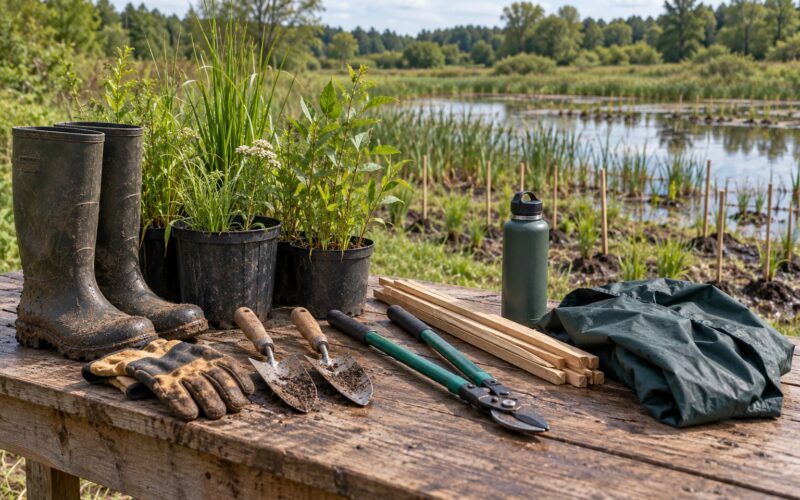
- 3. Pack a compact low-impact kit
- 4. Travel and camp without damaging the shoreline
- 5. Observe wildlife and share the habitat responsibly
- 6. Manage food, sanitation, and fires safely
- 7. Inspect the site and remove every trace
- Common Mistakes
- Frequently Asked Questions
- Can biodegradable food scraps be left in a marsh or river?
- Where should paddlers rinse muddy gear after a river trip?
- How should I store food to protect marsh wildlife?
- What should I do if fires are prohibited at my campsite?
- What should I do after disturbing wildlife or spilling fuel?
- Conclusion
What You Need
You need two things before the boat goes in the water: the information to make good decisions, and a kit that lets you remove everything you create.
Before you go, gather the following:
- A tide table and a current forecast for the day, plus the river gauge reading for your stretch
- The weather forecast for wind direction, storms and visibility
- A route map showing access points, designated camps, portages, no-wake zones and closed areas
- Current regulations for the waterbody: permits, camp setbacks, fire restrictions and seasonal closures
- A communications plan: phone in a waterproof case, a satellite messenger or beacon where there is no service, and someone at home who has your route
Pack these for the trip itself:
- A water filter or purification tablets for multi-day routes where a reliable source exists
- Food in reusable containers, plus enough fuel and a backup fuel source
- Hand sanitizer, a small amount of biodegradable soap and a dishwater strainer
- A trowel, waste bags, toilet paper and a sealable container large enough to carry waste out
- A fire pan or a camp stove, and a fire starter that works wet
- A repair kit: duct tape, tenacious tape, spare straps, spare line, patches and a multitool
- A trash bag kept inside a durable container, not hanging loose on the boat
One rule overrides everything above: regulations and site-specific restrictions at the launch take precedence over general practices. Designated camp rules in a permit area, seasonal nesting closures and daily fire bans are the actual law on that waterbody. When they conflict with a habit described here, follow the closure.
Step-by-Step: leave no trace for marsh and river trips
1. Check tides, weather, and route conditions
On a marsh or an estuary, the tide decides where you can go. A channel that paddles easily at mid tide can turn into waist-deep mud with no visible route an hour later, and a low bar that looks like a free campsite can be underwater when you wake up.
Before you launch, confirm the tide window against your route length, check the wind for the exposed fetch you will be crossing, and read the closure list for the access point. Coastal flood watches, thunderstorm warnings and strong onshore wind all change the risk picture on open water.
Shorten the route or cancel outright when the tide has turned against you with less daylight than the return trip needs, when an onshore breeze will push water over a low bank, or when the gate is chained and closed. Verify the plan by stating your turnaround time out loud before you paddle and writing it down where your contacts can see it.
2. Plan for tides, access points, and sensitive areas
Plan the launch and the recovery point separately, and make sure the recovery point is not the one that floods first. Build the day around daylight and slack water rather than around how far you can paddle.
Then check for the rules that quietly govern marsh and river corridors:
- Designated sites. In permit backcountry such as the Boundary Waters Canoe Area Wilderness, you camp only at numbered sites with a permit, and the standard is 200 feet from the water’s edge and a camp footprint no wider than the average party space. Other managed river systems use similar setbacks measured from the high-water line.
- Private property. On many navigable rivers, the public right ends at the high-water line, so the strip of bank between the water and the flood mark can belong to someone else. Check who owns the bank before you plan a beach stop.
- Nesting closures and no-wake zones. Some estuaries close to boats during shorebird and waterfowl nesting, and speed restrictions near roosts and feeding flats are common.
- Group size limits on sensitive reaches, and day-use-only designations on popular bars.
Confirm all of this at the launch or from the managing agency, not from memory. A ten-minute call to a ranger or the agency office saves a trip.
3. Pack a compact low-impact kit
A low-impact kit is light, removable and repairable. Nothing on the list gets left behind as a fixture, and every item has a designated home in the boat so the final sweep is fast.
Favor removable gear over anything permanent. Clip-in fittings beat drilled mounts, straps beat screws, and a repair kit you actually carry beats a permanent fix you rely on forever. Reusable containers and one wash tub beat disposable packaging. On routes without reliable water, carry a personal water filter and know where the refill points are.
Size the waste container for the trip, not for the first day. Fruit peels, wet socks, tape, food scraps and the contents of a toilet all have to fit inside it with room to spare.
Verify the kit by counting gear items onto the boat at the launch and counting them off again at the trailer or the dock. Reports from paddling forums make one habit clear: forgotten tent stakes, airline tags, pocket knives and coils of line are the most common things left behind, and every one of them is on the list of things you packed.
4. Travel and camp without damaging the shoreline
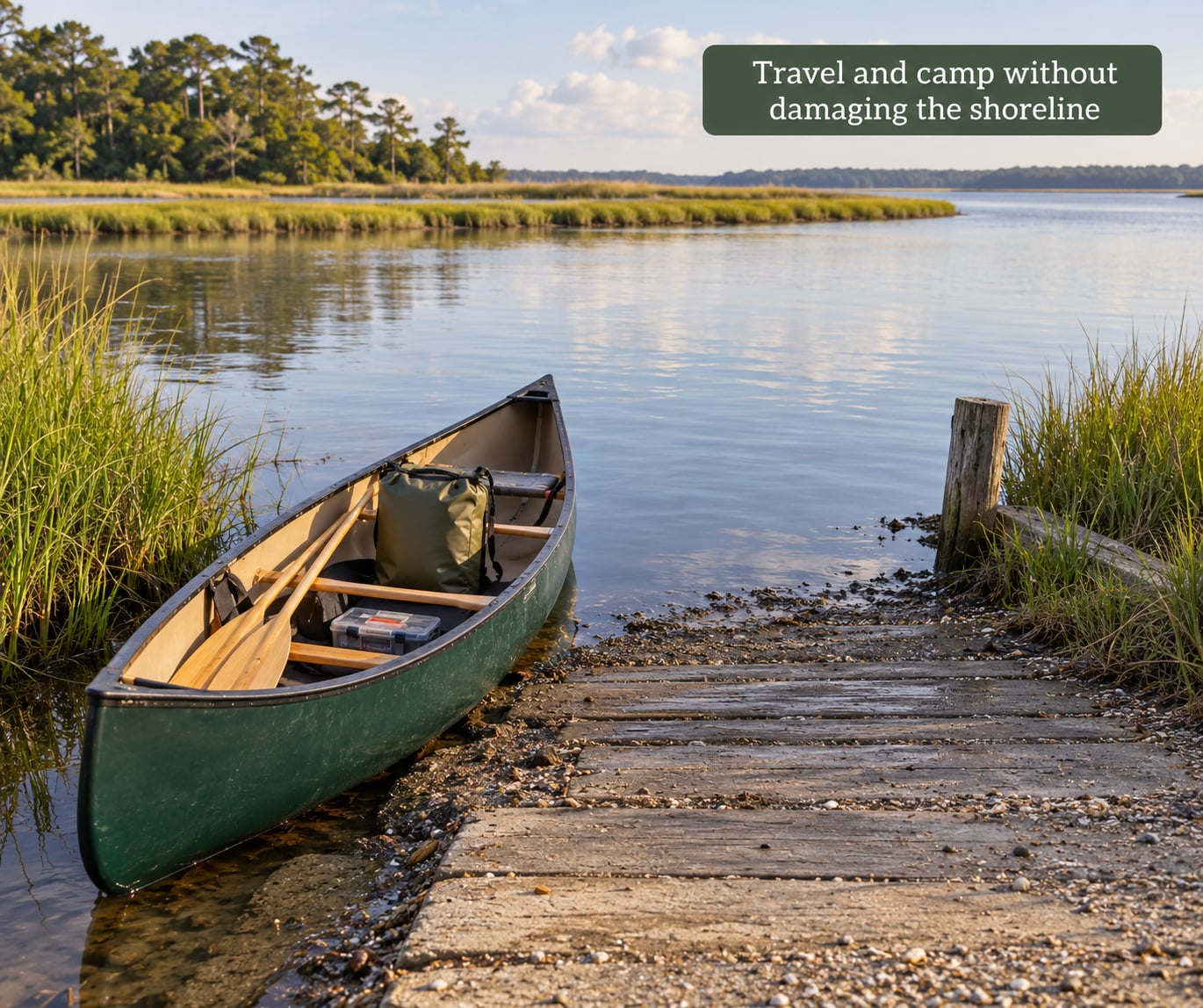
Treat every landing as an event on the bank. Wading up a beach spreads mud and kills whatever grows in it, so walk a single track rather than cross-cutting a soft bank, and step over mud on logs, rocks and boards instead of skirting the puddle.
Land on durable surfaces: gravel bars, sand, rock, boardwalks and existing paths. Cordgrass and salt marsh vegetation hold the shoreline together, and walking through it opens a hole that widens each year as water finds the gap. Do not cut a path through grass, sit on hummocks, or drag gear across rooted vegetation. If you must move a rock to get your skiff off, put it back on departure.
In shallow channels, pole rather than wade, and pole along the firm edge rather than through the soft middle. Where you need to hold position, use a mooring ball or hold the boat with a paddle. Anchors and stakes tear up rooted bottom in shallow flats, which is exactly where shellfish beds and eelgrass grow.
On an island or a camping bar, camp above the driftwood line on the highest point you can find. Tie loose gear down on the boat so a gust does not put your kit in the water, and do not beach the hull on marsh grass; float it light or rest it on boards.
5. Observe wildlife and share the habitat responsibly
Marsh birds are doing their most delicate work in a narrow band around the water, which is exactly where paddlers and waders want to be. A sensible rule is to stay at least 100 yards from nesting and feeding flocks of shorebirds, herons, egrets and waterfowl, and to add distance the moment birds change what they are doing.
Alarm calls, head turning, taking flight and birds leaving the water are all signals that you are too close. Back up and watch from a longer distance with binoculars or a spotting scope instead of moving in. Do not approach a sitting bird, a chick, or a young animal on the chance it looks abandoned; it is not abandoned, and quiet hands move the few feet needed.
Rules that keep wildlife safe on shared habitat:
- Never feed wildlife, including gulls, ducks and raccoons, and never bait or call birds in with recorded or handheld sound.
- Keep drones well away from roosts and nesting areas. A drone can flush a whole roost in seconds and many agencies restrict drone use over wildlife refuges and nesting sites. Never launch one at low tide over a feeding flat.
- Keep dogs leashed near shorebirds and nesting waterfowl, and away from roosts.
- Run engines off and keep voices low at blinds and overlooks, and do not cut a new trail to reach a better view.
- Report injured wildlife and any disturbance to birds or mammals to the land manager, and check whether a sighting belongs in a citizen science record such as eBird or iNaturalist before you publish coordinates of a sensitive spot.
6. Manage food, sanitation, and fires safely
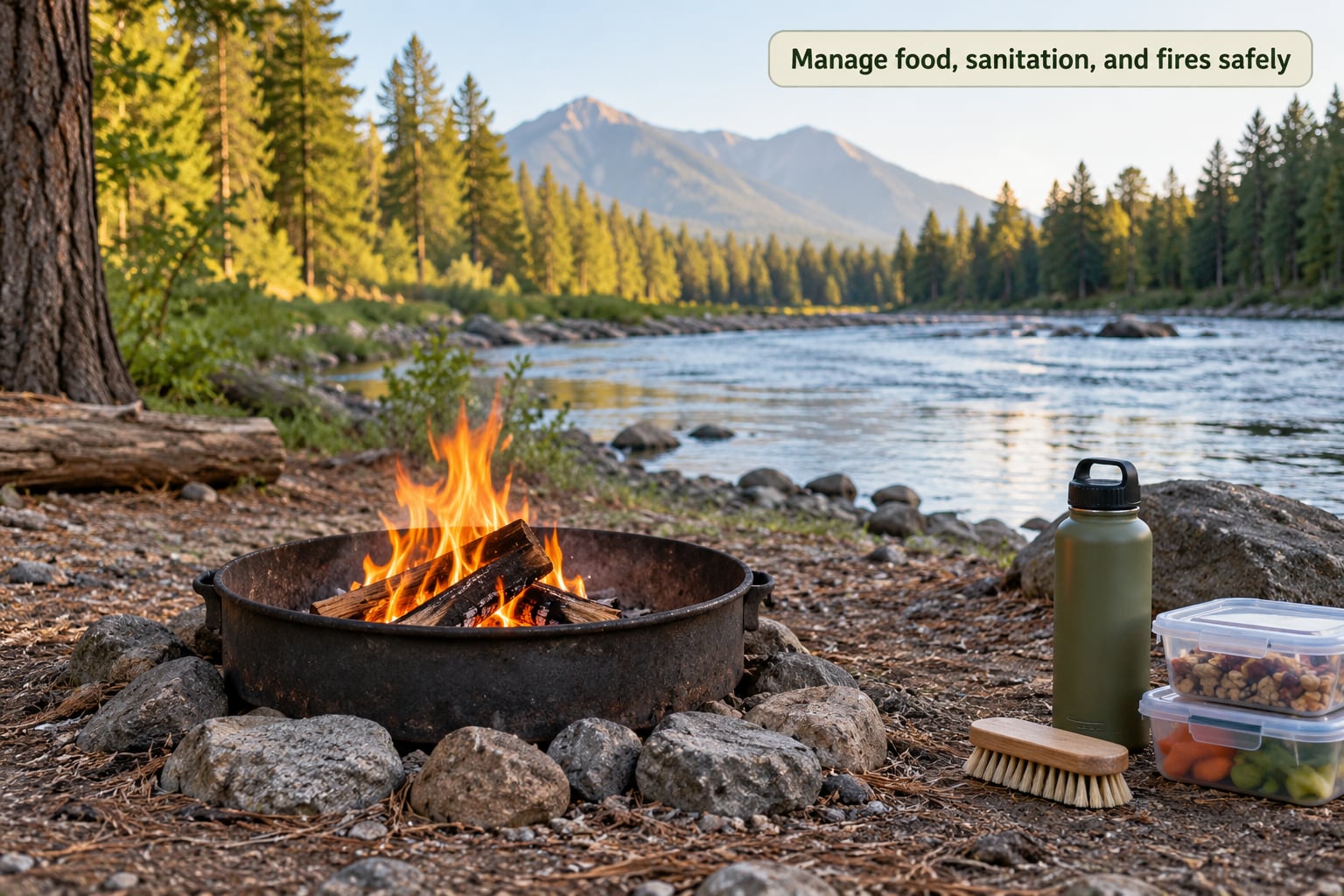
Sanitation is the part that goes wrong most often. Sanitize your hands before and after handling food and after using the toilet, and do the washing at least 100 m from the water, well above the flood line.
Scrape leftovers into a bag instead of throwing them into the river or the wet grass. Strain grey water through a fine mesh strainer, pack out the solids, and scatter the strained liquid over ground above the high-water line. Never dump soap, fish guts or food processing scraps directly into the water.
Handle human waste with the method the local regulation requires. Where packing out is required, carry a sealable container or a portable toilet and pack out everything, including toilet paper. Where it is not, dig a cat hole 10 to 15 cm deep, at least 60 m from water, camps and trails, above the flood line, and pack out the paper and used waste material. Many river paddlers use a small shovel with a long handle for exactly this, and the habit of carrying one prevents a bad decision at the wrong moment.
Fires follow a clear preference order. A stove causes less damage than a campfire, so use one whenever fires are restricted or the ground is dry. Where fires are allowed, build small, use an existing ring or a fire pan rather than cutting a new fire site, keep the flame low and the fuel short, and never leave it unattended. Drown the coals, stir them, drown them again until cold, then scatter the ashes thin. A fire site is not done when the flames die; it is done when you cannot feel any heat.
7. Inspect the site and remove every trace
The departure sweep is the step that separates a tidy camp from a no-trace camp. Give it five minutes, walk the whole site including the water’s edge and the spot where the boat was loaded, and pick up everything.
What turns up most often:
- Fishing line, lures, hooks and broken tackle, which can strangle birds and mammals. Cut line into short pieces and bag it.
- Food scraps, peels, cores, seeds and nut shells, which draw raccoons, gulls and rodents into camps they had been avoiding.
- Tape, duct tape scraps, zip tie ends, rope, dental floss, cigarette filters, bottle caps and can pull tabs.
- Gear items: tent stakes, a knife, a sunglasses strap, an airline tag, a map, a camp chair leg.
- Trash bags and absorbent pads used for sanitizing or spills.
Clean and deflate equipment away from the water, on a hard surface where wash water does not run into the channel. Then naturalize the site: fluff crushed grass back upright, brush out boot prints, move rocks back where they were, and remove the fire pan or ring if you built one from scratch. Do not leave a rock ring or a stone pedestal for someone else to interpret. Leave driftwood, shells, dead wood and rooted vegetation exactly where you found them.
Finish by checking the water itself. From the boat, look back at the shoreline for anything of yours that is floating, wedged in vegetation or caught on an anchor line.
Common Mistakes
Most marsh damage traces back to a small number of habits, and every one of them has a straightforward fix.
Launching from an unmarked bank. Boats parked on an informal bank create ruts, widen into channels and spread mud onto a trail that used to hold together. Use the developed ramp or parking area, and if it is soft, walk the established path or step over the mud.
Washing dishes in the river. Move at least 100 m from the water, strain the grey water, pack out the food solids and scatter only the strained liquid above the flood line. A handful of biodegradable soap used 100 m from water is not the problem; food scraps in the current are.
Treating biodegradable as the same as harmless. A biodegradable label does not make a food scrap safe for a marsh, because what breaks down in a compost pile does not break down on a tidal flat. Pack out all organic kitchen waste in a durable container.
Building a fire or flying a drone where rules or wildlife say no. A stove replaces most fire needs outright, and a drone over a roost at low tide can empty it. Check restrictions for the waterbody, keep the aircraft and campfire well away from birds, and treat a closed gate as a complete answer.
Moving closer to wildlife for a photo or a fish. If a bird changes its behavior because of you, you are too close regardless of the lens you are holding. Zoom from where you stand, and treat flight from a nest as the signal to double your distance.
Drying wet gear on marsh vegetation or a bank. Hanging gear on shrubs breaks living stems, and wet gear is how invasive species travel between waters. Hang it on a rack away from the bank, and once you are home, clean, drain and dry it fully for a few days before it goes near another waterbody.
Three reminders cover most of the rest. Prepare properly, because a well-planned trip is the cheapest way to reduce impact. Stay flexible, since tide, wind and closures will change your day and a shorter route is a better outcome than a wrecked one. And commit to pack it in, pack it out, every time, including on the trips where nobody is checking.
Frequently Asked Questions
Can biodegradable food scraps be left in a marsh or river?
No. Pack them out in a sealed container. In a salt marsh, scraps and especially citrus attract rats, gulls and raccoons and can spread disease, and in moving water anything dropped travels downstream to a shoreline that is not yours. Biodegradable labels apply to soap used sparingly far from water, not to food waste. Scrape leftovers into a bag, strain grey water at least 100 m from the bank, and scatter only the strained liquid above the flood line.
Where should paddlers rinse muddy gear after a river trip?
At home, on a hard surface, never at the launch or the bank. Rinse gear away from the water, scrub hulls, paddles and boots, and let everything dry fully for a few days before the next body of water. That clean, drain and dry routine is what stops zebra mussels, hydrilla and Eurasian watermilfoil from hitching a ride on wet gear into a system that does not have them.
How should I store food to protect marsh wildlife?
Treat every marsh food rule as strict, because habituated raccoons, minks and gulls will destroy nests once they learn where people eat. Keep food, trash and scented items in hard-sided containers inside your boat or vehicle, never loose in camp. Do not feed wildlife, including gulls, and keep dishes away from the water while you eat so nothing spills into the current.
What should I do if fires are prohibited at my campsite?
Switch to a small camp stove, which is permitted in most places where fires are banned, and cook on a stable surface away from dry grass. Do not use an existing fire ring if rings are prohibited too, since it is often not allowed under current rules. Check fire restrictions before you leave because they change daily in dry river corridors and are often posted at the launch itself.
What should I do after disturbing wildlife or spilling fuel?
Give the animals space immediately and do not go back, even to check a nest. Flushed birds can abandon eggs or chicks, and a second approach finishes the damage. Note the time and location for the land manager. For a fuel spill on water or a marsh flat, stop the leak if it is safe, contain it with absorbent pads, and report it to the agency or emergency line for that waterbody right away.
Conclusion
Start before the boat touches the water: check tides, wind, closures and camp rules. Stay on ramps, boardwalks and durable surfaces, camp above the flood line, and give birds and other wildlife more room than feels necessary. Contain every scrap, every wipe of grease and every ember. Then give the site five minutes of attention on the way out and pick up anything that is not native rock, grass or driftwood.
That routine, done consistently on every trip, is what leave no trace for marsh and river trips actually looks like.