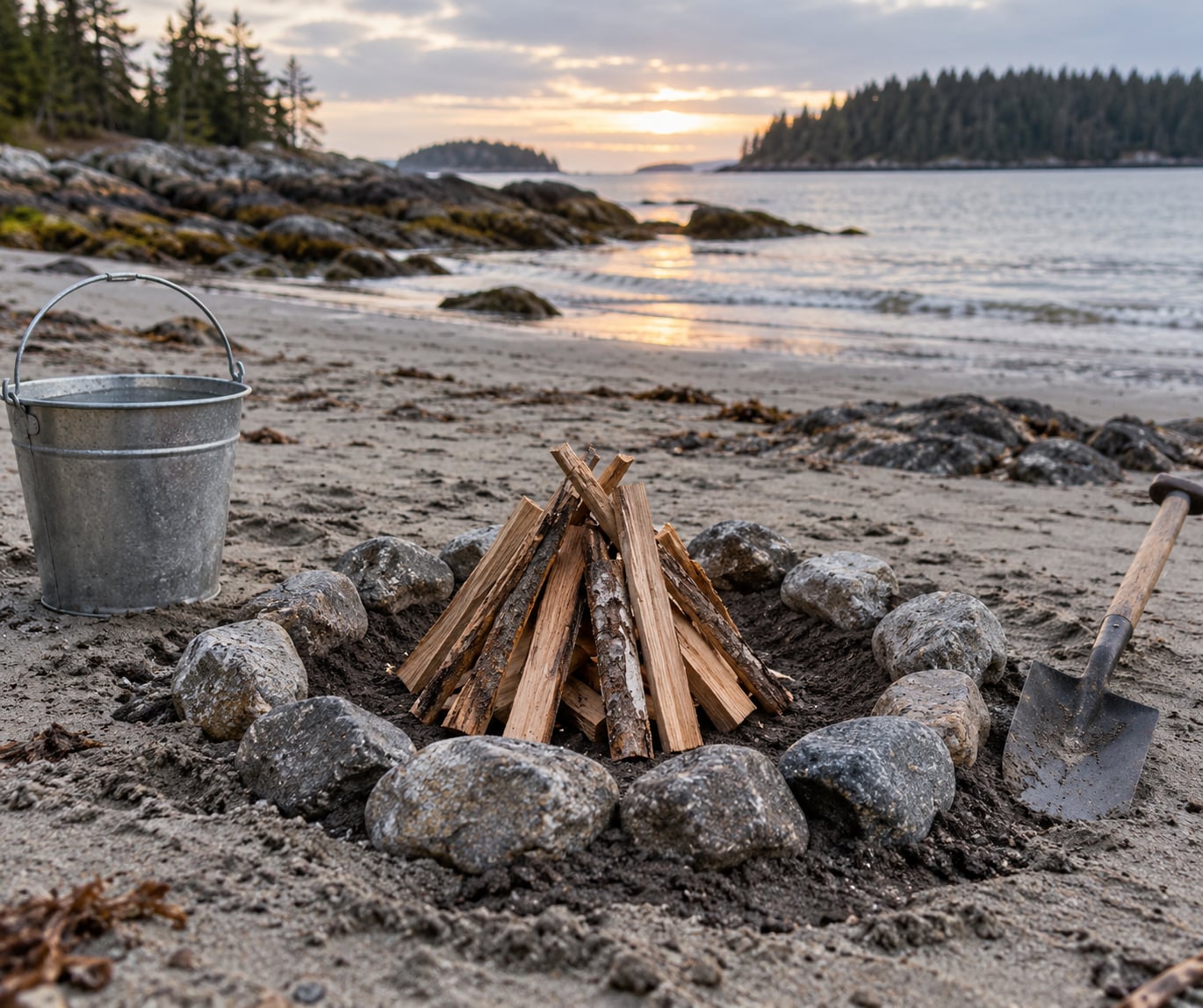
To build a safe campfire in sandy soil, dig a shallow depression four to six inches deep in damp mineral soil, contain it with a fire ring or dry rocks, light a small teepee of short kindling on the upwind side, and put it out with water rather than burying it. The whole process takes about fifteen minutes once you have wood and water on hand. Sand is a genuinely different substrate from grass or bare dirt, and treating it like ordinary ground is how sparks and buried embers cause trouble.
I have watched people try to do this the wrong way more times than I care to remember. The usual version involves scraping a shallow bowl into dry dune sand, dropping a load of driftwood in, and walking off to eat dinner. That fire throws sparks for an hour and leaves glowing coals a foot down that nobody knows about until the next dry week.
The fix is not complicated. It is mostly about getting the fire into mineral soil with side walls, keeping it small, and having water within arm’s reach the entire time it burns.
Table of Contents
- What You Need
- What Sand Should You Use Under a Fire Pit?
- Step-by-Step: How to Build a Safe Campfire in Sandy Soil
- Choose a Safe and Legal Fire Site
- Clear and Stabilize the Sandy Ground
- Build a Compact Layered Fire
- Light the Fire on the Leeward Side
- Keep the Fire Small and Under Control
- Extinguish and Check the Fire
- Common Mistakes and How to Fix Them
- Frequently Asked Questions
- Why is it unsafe to build a campfire directly in loose sand?
- Can I use a fire ring on a beach or in protected coastal habitat?
- What is the best way to build a campfire when it is windy?
- Should I pour water or sand over a campfire to put it out?
- How do I know my campfire is completely extinguished?
- Conclusion
What You Need
Before you touch a match, check three things: whether fires are legal where you are, how hard the wind is blowing, and how much water you can reach in under five seconds. If any of those go wrong in the middle of a fire, you want a correction available, not an expedition.
| Item | Why you need it | Note |
|---|---|---|
| Water, about five gallons | Drowns the fire and cools the ash bed to the touch | A full bucket, a collapsible water container, or a hose |
| Shovel or long-handled scraper | Moves coals and ash during extinguishing | Works in sand better than a trowel |
| Fire ring, steel pan, or dry rock | Holds the fire footprint and stops stray coals | Leave airflow gaps under the ring |
| Dry tinder and pencil-size kindling | Starts the fire without accelerant | Carry it in, do not scavenge it |
| Seasoned firewood, cut short | Burns evenly and stays inside the ring | Never driftwood or live wood |
| Wind screen, optional | Reduces spark scatter on exposed sites | A compact car camping mirror panel works |
| Gloves and a bucket | Protects hands when handling coals and sand | Sand stays hot longer than you expect |
Bring your own firewood. Beach regulations and Leave No Trace guidance both point the same direction, because driftwood supports nesting insects and removing it strips the shore of material the ecosystem expects. Firewood sold seasoned at home is also drier than anything you will find loose, and green wood is roughly half water by weight.
Now the part people skip: look up your local fire restrictions. County fire bans, Stage 2 burn bans, park rules, and beach ordinances all differ, and a fire ban is a legal restriction, not a suggestion. On dunes and in coastal habitat, fires may be prohibited outright during nesting season.
What Sand Should You Use Under a Fire Pit?
Use damp, dark mineral soil rather than the pale dry sand on top. It has organic matter already worked through it, holds together when you scoop it, and stays cool a few inches below the surface. Dry beach sand works only as a windbreak on the rim, never as the base layer or as the thing you pour on embers at the end.
Step-by-Step: How to Build a Safe Campfire in Sandy Soil
Choose a Safe and Legal Fire Site
Keep the fire at least 10 feet from tents, vehicles, trees, brush, dry grass, and anything you would hate to explain losing. Many guides and campground rules ask for 15 feet instead, and on open sand with a sea breeze I use the larger number every time.
Find an existing fire ring if the site has one, because that spot has already burned and nothing around it is going to surprise you. Skip anywhere under dead limbs, under a leaning tree, or on the edge of dune vegetation where a stray spark travels fast through cured grass.
Watch the wind before you dig, not after you light. If it is gusting hard enough to flatten grass or move sand across your campsite, the correct fire to build is none. A propane fire pit or a liquid fuel stove gives you heat with no sparks at all, and that is the answer on any windy night.
Clear and Stabilize the Sandy Ground
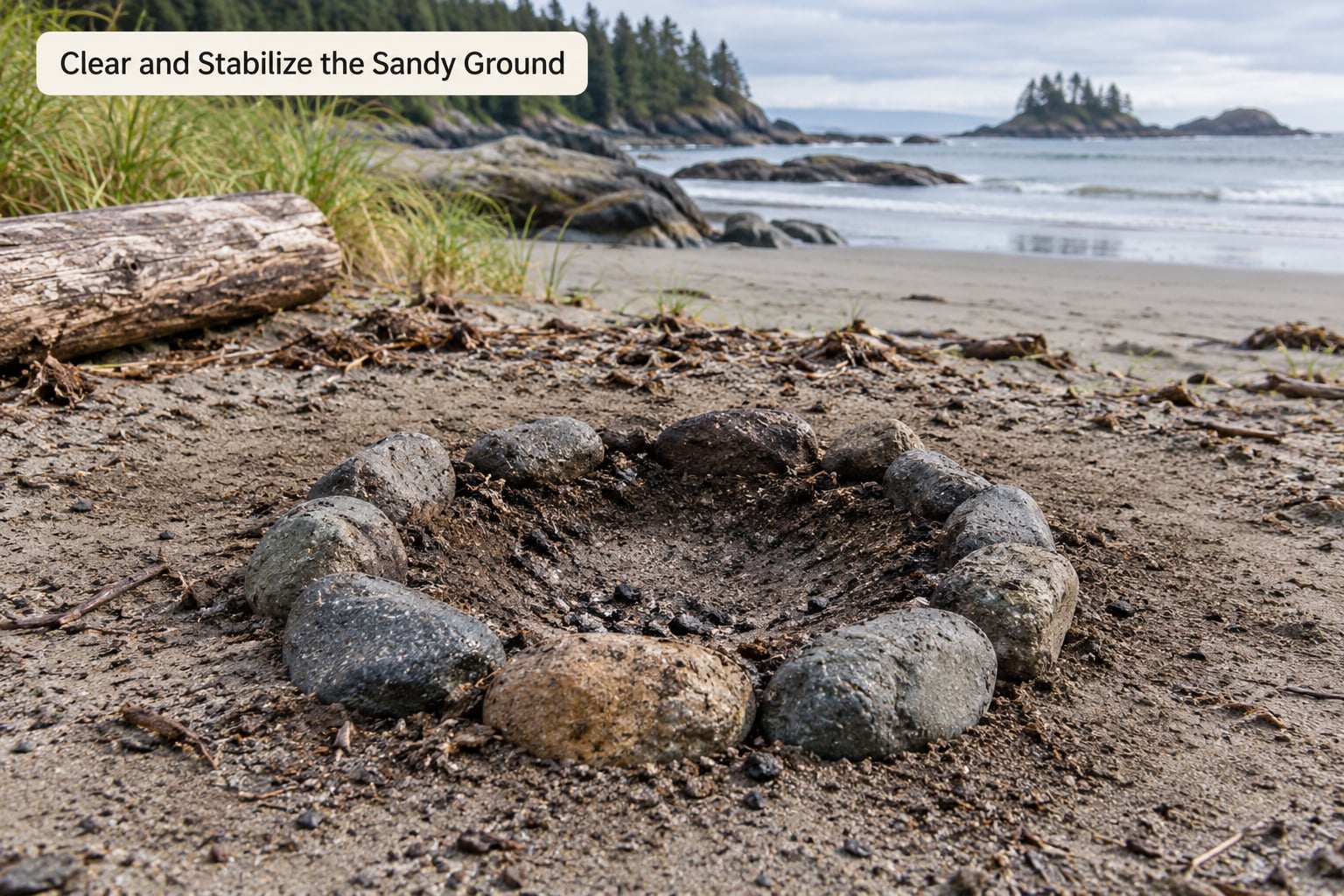
Loose dry sand has no structure, so a fire built on the surface sinks into a smoldering saucer and the sides collapse inward. Scoop out loose sand and leave it where you found it, then dig down four to six inches until you hit darker, damper soil that holds a shovel cut.
Shape the hole so the fire sits slightly below the rim. That depth gives you side walls of mineral soil that block wind and stop coals from rolling out, which is the single biggest improvement you can make over the usual scrape-a-bowl attempt.
Set your containment ring around the lip. A steel fire ring or fire pan is the easiest option, and if you are improvising, use dry rock that is dense and non-porous. Never use river stones, wet rock, or anything that came out of a creek, because water trapped inside the stone turns to steam and can split the rock violently.
On protected ground, digging a hole may not be allowed. In that case build a mound fire instead: bring in mineral soil from a sand or gravel bar well below the root zone, pile it into a stable mound, and burn on top. It leaves the site intact and gives you the same side-wall protection.
Build a Compact Layered Fire
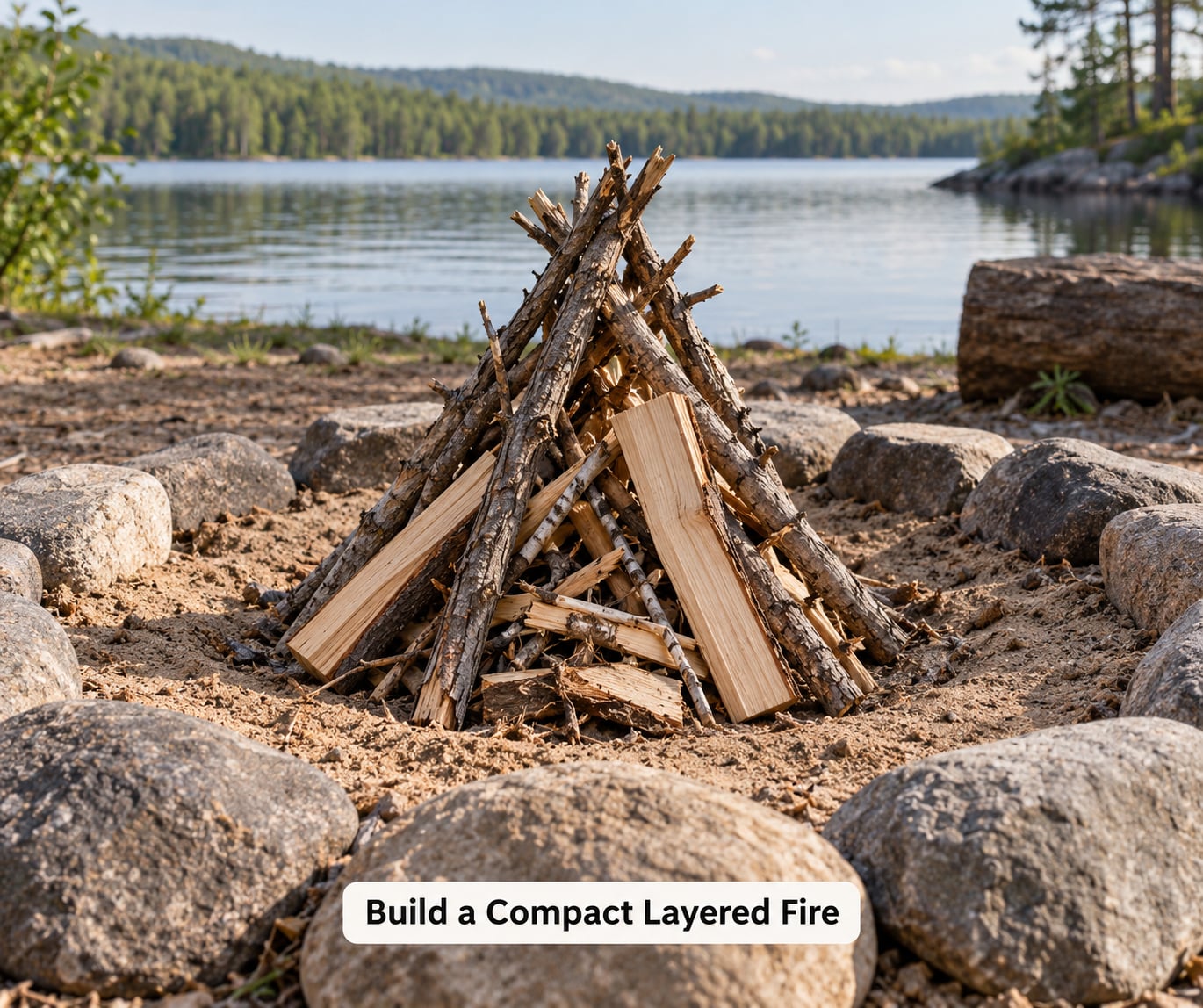
A teepee of pencil-size kindling over two or three small split logs burns hot and stays inside a 3-foot cleared circle. A towering pile of branches throws sparks in every direction and needs fuel you will not have time to feed one piece at a time.
Build in this order:
- Place two or three short pieces of firewood at the center of the depression, leaving finger-width gaps.
- Lean pencil-size kindling against them in a loose teepee with room for air between the pieces.
- Crush a small wad of natural tinder, such as dry grass or wood shavings, into the center base.
- Keep every piece under about the length of your forearm. Long fuel is what reaches out and ignites things you did not clear.
Clear a 3-foot radius of everything burnable around the ring before you light. That circle is also the space where a kid or a dog can reach the sand, and sand at the fire edge can stay hot enough to burn well after the flames drop.
Light the Fire on the Leeward Side
Position yourself upwind so the flame and any sparks blow away from you, toward the open side of the circle. Light the tinder at the base first and let it catch before you add anything else. A long lighter or a firestarter keeps your hands out of the flame and out of the smoke.
Feed kindling in slowly, a few pieces at a time, until the base is established and only then touch the larger firewood. Patience here is the whole technique. A fire lit all at once in sand is a fire nobody can control.
Never use gasoline, lighter fluid, charcoal starter, or any accelerant. On sand those products soak into the ground and keep burning below the surface long after the visible flame is out.
Keep the Fire Small and Under Control
Add fuel one piece at a time and only while the previous piece has burned down. If you need more heat, feed it more often rather than bigger, and stop while the fire is still manageable. A cooking fire needs less wood than most people pile in.
Let the flame sit below the rim of the ring. Flames climbing above the containment are the sign that you have built it too tall, and high flames are what send embers downwind into grass and onto vehicles.
Do not fan the fire with anything that could blow ash out of the ring, and do not stand over it with your body blocking the airflow the coals need. If a gust starts pushing embers or smoke toward something you care about, stop feeding it and drown it early rather than fighting it.
Keep water within reach the whole time. That is the whole safety system, and it only works if you did not walk it down to the lake.
Extinguish and Check the Fire
Do not bury embers under sand. Dry sand is an insulator, not a coolant, so it locks heat in and you get a fire that looks dead and stays hot deep enough to re-ignite when wind exposes fresh oxygen. Burning, buried coals under a foot of sand are a leading cause of human-caused wildfires.
Use the drown, stir, drown sequence instead. Water is what removes heat, and sand cannot do that job.
- Drown: pour water over all coals and ashes, including the edges of the fire bed.
- Stir: turn the wet ash and embers with the shovel or a stick to expose the hot center.
- Drown again: add more water and stir a second time until the hissing stops.
- Feel: hold the back of your hand a few inches above every part of the ash bed.
If it hisses, drench it. If it is too hot to hold your hand near, drench it. When the ash is cool enough to touch with the back of your hand, stir the whole thing once more, check the fire ring, and check the sand a foot or two beyond the ring where wind-blown embers often land.
| Extinguishing method | Does it work? | Use it when |
|---|---|---|
| Water | Yes, the only reliable option on sand | Always, as part of drown, stir, drown |
| Dirt or ash | Poorly, smothers flames but traps heat | Only to smother a small flame with water still coming |
| Dry sand | No, it insulates buried coals | Never for extinguishing |
| Water on hot rocks | Risky, can crack rock and throw steam | Pour slowly and from a distance |
Once the ashes are cold, leave the burned wood visible on the site rather than scattering it, and check the surrounding sand once more for smoke. Do not walk away until you could not find a warm spot if you looked for one.
Common Mistakes and How to Fix Them
Building on the surface of loose sand. The fire sinks, the walls collapse, and coals scatter outside the footprint. Dig down four to six inches into damp mineral soil, or bring in mineral soil and build a mound.
Using river rocks or wet stone. Trapped water flashes to steam and can explode the rock, throwing hot fragments well outside the fire ring. Use dry, dense, non-porous rock and skip anything that has been in water.
Under dead limbs or a leaning tree. Wind sends flame and sparks up into overhead wood faster than you can react. Check the sky above your fire site before you clear the ground.
Using accelerants or burning driftwood. Starter fluid soaks into sand and burns below the surface, and driftwood carries salt and contaminants that smoke your gear. Bring seasoned wood from home instead.
Leaving before the ashes are cold. This is the single most repeated mistake in every campfire discussion I have read. Wind can fan buried coals for hours after the flame dies.
Trusting your sense of the wind. Beach wind shifts fast and gusts hard. Reassess direction every few minutes, keep the flame low, and have a plan for putting it out immediately if it changes.
Two smaller ones worth naming: never leave water where a gust can tip it, and never let children or dogs into the fire edge, because sand holds heat far longer than grass does.
Frequently Asked Questions
Why is it unsafe to build a campfire directly in loose sand?
Loose sand collapses inward under heat, so the fire sinks into a smoldering saucer and embers spread outward under the surface where you cannot see them. Sand also blocks airflow, which keeps the flame low and smoldering rather than hot and clean. Digging into damp mineral soil gives you side walls, keeps the heat inside the ring, and puts every ember where your water can reach it.
Can I use a fire ring on a beach or in protected coastal habitat?
Only where it is allowed, and many beaches and dune systems close fires during nesting season or under high fire risk. Check the local fire restriction page, the park or beach rules, and your county burn status before you dig anything. Where digging is prohibited, build a mound fire on mineral soil carried in from a sand or gravel bar, and never build below the high tide line.
What is the best way to build a campfire when it is windy?
The best way to build a campfire when it is windy is to dig four to six inches down so the mineral soil walls shield the flame, keep the fire below the rim of the ring, and add fuel one piece at a time. A reflective wind screen or a compact panel behind the ring cuts spark scatter further. If gusts are strong enough to move sand across camp, use a propane fire pit instead.
Should I pour water or sand over a campfire to put it out?
Water. Sand cannot put out a fire because it insulates instead of cooling, so buried embers keep their heat deep under the surface and can re-ignite when wind moves air through them. Use the drown, stir, drown sequence: soak all coals and ash with water, stir the wet bed to expose the hot center, then soak it again until the hissing stops and the ash is cool to the back of your hand.
How do I know my campfire is completely extinguished?
Hold the back of your hand a few inches above every part of the ash bed, the fire ring, and the sand two feet beyond the ring. Any hiss, warmth, or smoke means more water and more stirring. Then check again after a few minutes, because buried coals under ash in damp sand can hold heat for hours. Only leave when nothing anywhere in the site is warm to the touch.
Conclusion
Check your fire restrictions and the wind before anything else, then dig four to six inches into damp mineral soil, ring it, and light a small teepee that stays below the rim. Keep water and a shovel within arm’s reach for the whole burn. And do not leave until the ashes, the ring, and the sand around it are completely cold to the touch, because a fire buried in sand will happily keep burning without you.