If you are searching how to prepare for sudden fog on a river, the short answer is this: check the forecast for temperature and dew point spread, pick a conservative route with a named turnaround point, leave a float plan, and carry lights and a whistle. When visibility drops, slow to minimum steerage, sound a fog signal every 60 seconds, and stay in the marked channel.
Fog is the fastest way a clear river trip turns into a dangerous one. Water that was visible for half a mile at 6 a.m. can disappear twenty minutes later, and the hazards you can no longer see are the ones that actually kill people: submerged rocks, strainers, snags, low-head dams, low bridges and blind bends.
Most of the writing on this topic assumes a powerboat with radar and a chartplotter. If you are paddling a kayak, canoe, raft, SUP or drifting in a jon boat, you have less equipment, a thinner safety margin and a much bigger blind spot. That changes the plan.
Table of Contents
- What You Need to Prepare for Sudden Fog on a River
- Planning and paperwork
- Communication
- Navigation and lighting
- Clothing for a longer exposure
- Emergency and rescue
- Safety essentials that are not optional
- Step-by-Step
- 1. Check forecasts and local conditions before departure
- 2. Plan a conservative route and turnaround point
- 3. Tell someone your route and expected return time
- 4. Equip the boat and every person for low visibility
- 5. Watch the sky, water and wind for signs of arriving fog
- 6. Reduce speed and use controlled navigation in the fog
- 7. Turn back, anchor, or seek shelter when conditions become unsafe
- Fog Signals and Visibility Bands
- Common Mistakes
- Frequently Asked Questions
- Can sudden fog form quickly on a river?
- How fast should a boat travel when fog reduces visibility?
- Should I keep using GPS when navigating a foggy river?
- What should I do if I cannot see the riverbank?
- Can I anchor in a river during sudden fog?
- What equipment should every passenger carry in a small boat?
- Start With the Decision Not to Launch
What You Need to Prepare for Sudden Fog on a River
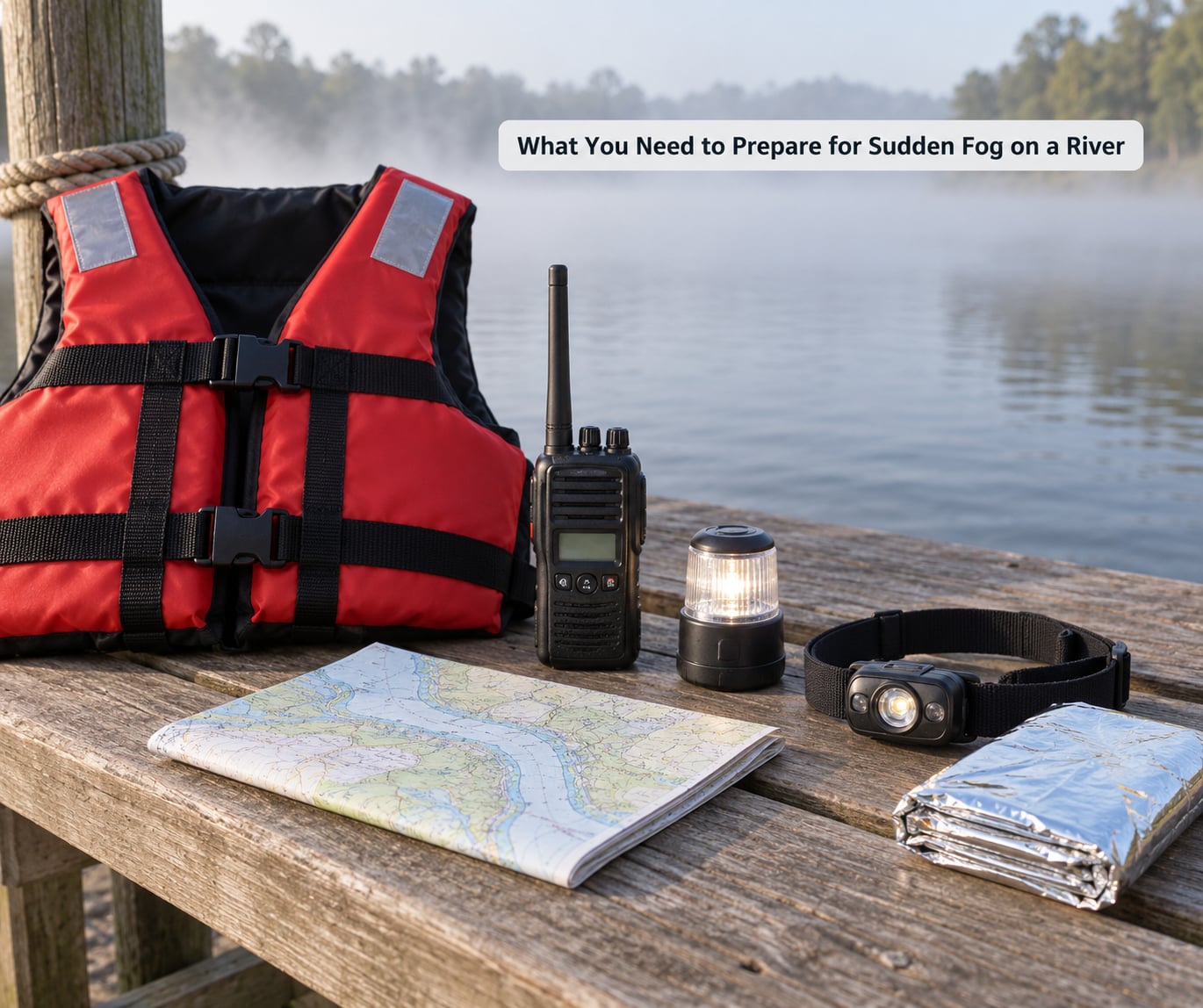
Everything below is cheap, light, and worth carrying on any river trip where fog is possible. Group it by job, because most people pack half of it.
Planning and paperwork
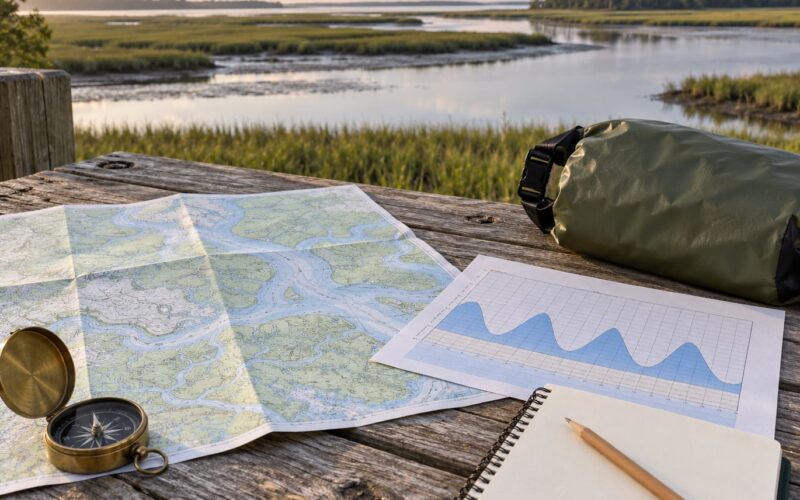
A paper chart of the reach you are running, marked with the hazards you care about, plus a compass you have actually used before. A phone with the river section downloaded for offline use is a backup, not a substitute.
A written float plan: put-in, take-out, boat type, number of people, vehicle description and expected return time.
Communication
A whistle on a lanyard attached to your PFD, so it stays with you when you are separated from the boat. A waterproof handheld VHF radio if you are on a wide or heavily travelled river. A charged phone in a dry bag.
Navigation and lighting
A white bow light and, if your craft has a stern light, a red stern light. A headlamp with a red mode, because a white beam destroys your night adaptation and blinds anyone coming toward you. Reflective tape on the deck of the boat and on your paddle blades.
Clothing for a longer exposure
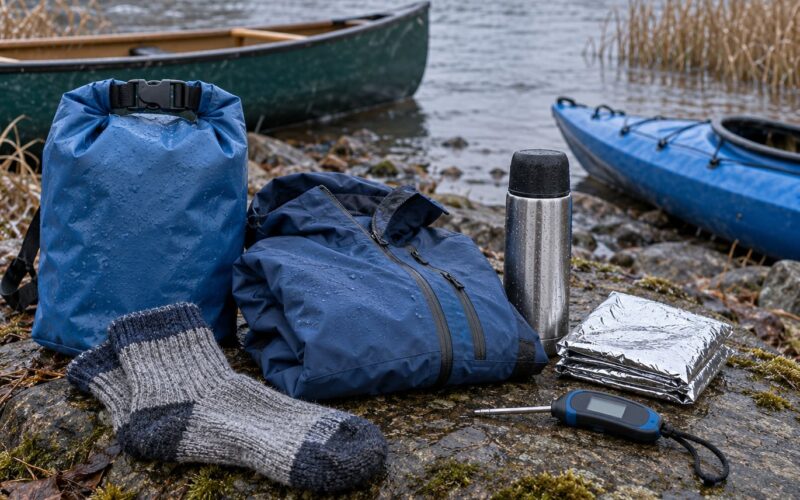
Dress for the trip you might have instead of the trip you planned. Fog usually arrives in the cold hours before dawn, so fog often means rain gear, a spare warm layer sealed in a dry bag, and neoprene booties if the water is cold. Wet and stuck in fog is how people get hypothermic without capsizing.
Emergency and rescue
A throw bag or rescue line at the bow, a first aid kit, a whistle, an emergency bivy or blanket, and a spare PFD. A PFD with a light on the shoulder strap gets you seen earlier by a boat that would otherwise pass behind you.
Safety essentials that are not optional
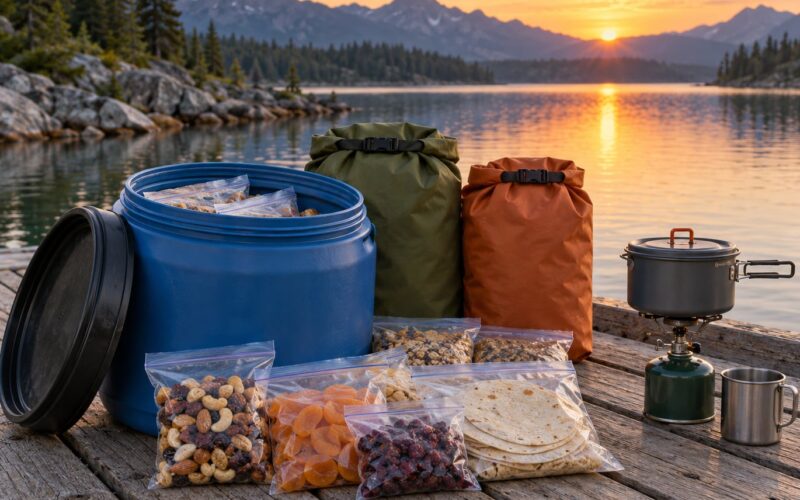
A properly fitted PFD for every person on board, worn before you leave the bank, not stowed under a deck hatch. Food and water for longer than planned. And a plan for what you do if you cannot see the take-out.
Step-by-Step
1. Check forecasts and local conditions before departure
Start with the dew point spread. Fog becomes likely when the overnight low approaches the dew point, especially on a clear, still night with light wind. A temperature that stays above the dew point by several degrees is a decent reason to leave at dawn rather than sit through the afternoon.
Then check three things most people skip: the National Water Prediction Service river gauges for your reach, a smoke map if anyone upwind is burning, and a satellite loop. Fog is visible on satellite before you walk to the river. It forms as a cool grey patch over the valley floor, and that patch tells you more than the hourly icon does.
Add a local observation. Look at the water. A mirror-flat surface on an overcast morning is the classic setup for radiation fog.
2. Plan a conservative route and turnaround point
Choose the route you can finish in poor visibility, not the route you can finish in good weather. Mark a turnaround point on the chart, a specific feature with a time attached to it, and write it down.
Identify hazards along the reach: where the channel moves, where the current quickens, where a bridge sits low, where a dam creates a recirculating boil below it. If you cannot describe the exit before you launch, you have not planned the trip.
3. Tell someone your route and expected return time
A float plan is three minutes of work and it is what turns a delayed return into a routine phone call instead of a search. Leave it with someone who is not paddling with you.
Include the put-in and take-out, your planned route, the boat colour and type, the number of people aboard, your phone number, and when you expect to be back. If you are solo, that check-in matters more, not less.
Agree on what triggers a call. If you are not back by your expected time plus a margin, the person holding your plan calls you, then calls the emergency number.
4. Equip the boat and every person for low visibility
Lights on before the fog, not after. A bow light and a stern light running in clear air is not a problem; running lights in fog is the correct response to restricted visibility.
Every person wears a PFD, and every person has a whistle on it. Group boats stay within speaking distance or within a chain of light, and nobody starts a conversation on shore without telling the rest of the group.
5. Watch the sky, water and wind for signs of arriving fog
The horizon going soft and grey while the water stays dark is the first sign. So is a sudden drop in contrast: the far bank stops being a shape and becomes a guess.
Watch for a wind shift, a drop in temperature, condensation forming on a deck or hull, and visibility falling faster than the wind. Dew forming on everything means the air has reached its dew point, and fog is minutes away.
When you see these, decide now whether to launch, wait, or turn back. Deciding in fog is much worse than deciding in clear air.
6. Reduce speed and use controlled navigation in the fog
Slow to minimum steerage speed, the speed at which you can still hold your line and stop or turn in a useful distance. For a paddler that usually means a few strokes a minute, not a hard sprint to the next bend.
Keep a dedicated lookout, eyes moving, scanning the whole arc ahead. Do not stare into the fog; fixed staring destroys depth perception and makes everything look closer and less predictable. Use the point where water meets fog as a reference for where the far bank should be.
Keep to the marked channel. People on a long-running SUP thread about fog reach the same conclusion: follow the buoys, stay near no-wake and swim zones, and let the markers be your eyes. In fog, people also need to hear you, so sound a signal every 60 seconds.
7. Turn back, anchor, or seek shelter when conditions become unsafe
If you cannot see the water ahead of the boat, do not run a rapid. Whitewater in fog is a plan for portage or waiting, not for a push through.
Turn back upstream when the river is wide, calm and familiar, and you can retrace your route. Paddle to a known bank, not an unknown one: an unseen bank can be an undercut, a deadfall pile or a four-foot drop. Anchor only in a slow, protected place out of the main current, never in a channel where your anchor line can cross the navigation path.
Contact emergency services if someone is in the water, if you are pinned, or if you have genuinely lost your position. Fog slows rescue craft down, so call early.
Fog Signals and Visibility Bands
Sound signals exist because you are the one thing the other boat cannot see. A fog signal tells other craft your position and, in the pattern, your activity. The standard patterns are short, and worth learning by ear before you need them:
- One short blast — altering course to starboard.
- Two short blasts — altering course to port.
- Three short blasts — operating astern propulsion, backing up.
- One prolonged blast — approaching a bend or a danger you cannot see.
- Five or more short, rapid blasts — you are in doubt about what another boat is doing.
- One short, one long, one short — someone is in the water and in distress, or a danger is ahead.
For paddlers, a whistle is the practical version of this. Three short blasts mean trouble, and repeated groups are easier to locate than a single blast.
Visibility bands turn that signal into a decision. The bands below are the ones that govern larger craft on regulated waterways, but the logic scales straight down to a jon boat or a raft:
- Under 0.5 nautical miles (very poor) — stay on the marked channel, hold a no-passage distance, and treat the reach as closed to new traffic.
- 0.5 to 2 nautical miles (poor) — minimum safe speed, a fog signal every 60 seconds, lights on, dedicated lookout.
- 2 to 5 nautical miles (moderate) — workable for a small craft with lights and sound signals, but still slow down to what you can actually see.
- Over 5 nautical miles (good) — normal operation, while still watching for patches and smoke.
Common Mistakes
Relying on a phone alone. Battery dies, the screen washes out in glare, and a phone drifting in a current is not a chart. Carry a paper chart and know the compass before you need them.
Ignoring a horizon that has gone soft. The most reliable fog forecast on the water is the one your own eyes give you. If the far bank is fading, it is already happening.
Speeding up to beat the fog. Racing the clock in reduced visibility trades a small time gain for a much larger collision risk with something you cannot see. Slow down instead.
Paddling without a PFD on. Fog and cold water combine fast. Cold-water immersion can impair movement in minutes, and the PFD is what keeps you on the surface long enough to be found.
Launching without telling anyone. A float plan takes three minutes and it is what makes a search a check-in rather than a rescue.
Getting out onto an unseen bank. You do not know what is there. Stay with the boat unless the shore is clearly identified.
Four habits cover most of the rest: keep the boat moving at minimum steerage, keep the lights on and the whistle on your PFD, keep every person within sight or within speaking distance, and keep the plan written down where someone else can see it.
Frequently Asked Questions
Can sudden fog form quickly on a river?
Yes. Fog forms when air cools to its dew point, and rivers can make that happen fast, often in minutes. On a clear, still night the valley floor radiates heat away, water stays cold, and a shallow fog layer can pool and thicken before you finish tying your boat to the trailer. Warm moist air moving over cold water does the same thing in a few minutes. The change from clear air to a few feet of visibility is genuinely abrupt, which is why a pre-launch check matters more than a forecast made at dawn.
How fast should a boat travel when fog reduces visibility?
Slow to minimum steerage speed, the lowest speed at which you can hold your course and still turn or stop. For a motorboat that usually means idle; for a kayak or canoe it means a few strokes a minute. Your actual stopping distance and how much water you can see ahead both shrink or fade at higher speeds, and the river keeps moving regardless. Keep a safe distance, sound a fog signal every 60 seconds, and assign a lookout whose only job is watching.
Should I keep using GPS when navigating a foggy river?
Keep using it, but treat it as a check on your surroundings rather than a view of them. Download the river section before you launch so it works with no signal, carry a paper chart and compass as backup, and keep the unit where you can glance at it without taking your eyes off the water. A GPS tells you where you were, not what is in front of you, and it will happily show a straight line through a strainer. Use it to confirm position and to stay on the marked channel.
What should I do if I cannot see the riverbank?
Slow down first, then hold your heading and keep a dedicated lookout with eyes moving. Stay on the marked channel and use the buoys, which are built to be seen when nothing else is. If you must get out, do it only where you have positively identified the bank from a chart, a bearing or a known feature, because an unseen bank can hide undercut earth, deadfall and a drop. Get back into the boat the moment you can, and tell your float plan contact before you do, not after.
Can I anchor in a river during sudden fog?
Only in a slow, protected place that is out of the main current and out of any navigation channel. Anchor where the bottom holds, in enough depth that you are not sitting on your own line, and leave room to swing. Never anchor where your line could cross a channel or a launching area, and keep a sound signal going because other craft in fog cannot see your anchor either. On a fast reach, drifting gently with lights on is often safer than holding a bad anchor in the dark.
What equipment should every passenger carry in a small boat?
A properly fitted PFD worn before launch, a whistle on a lanyard attached to it, a headlamp, a charged phone in a dry bag, and a warm layer sealed against the wet. At the boat level, keep a throw bag, a paper chart, a compass, a first aid kit and navigation lights running. In fog, treat the throw bag and the whistle as the equipment that matters most: one lets you help somebody else, and the other is how a person who has been separated gets found in white water.
Start With the Decision Not to Launch
The first real step in how to prepare for sudden fog on a river happens on shore. If the dew point spread is closing and the satellite shows a cool grey patch sitting in your valley, wait or go home; no reach is worth a decision made in white water.
If you do launch, the priorities never change: lights on, whistle on the PFD, minimum steerage speed, a signal every 60 seconds, the marked channel, and a float plan someone at home is holding. Fog is not the hazard. The unprepared craft inside it is.