Packing food for a multi-day paddling trip comes down to four jobs: work out how much energy you burn per day, choose food that is calorie dense rather than light, portion every meal into labeled waterproof bags, and eat the fresh stuff early while the shelf-stable stuff covers the back half. A canoe holds far more volume than a backpack, so bulk and spoilage risk matter more than gram-for-gram weight. Plan it on paper before you shop, and the trip goes smoother than you expect.
- Set your numbers. Multiply trip nights by your daily calorie target, then add one full emergency day nobody plans to eat but everybody needs.
- Build the menu around calories per cubic inch, not calories per ounce: nut butter, hard cheese, jerky, nuts, dried fruit, tortillas, oats and pasta.
- Pick meals you can turn the burner off on. Couscous, instant rice, ramen and dehydrated dinners rehydrate and cook from the moment water boils, which saves stove fuel on long days.
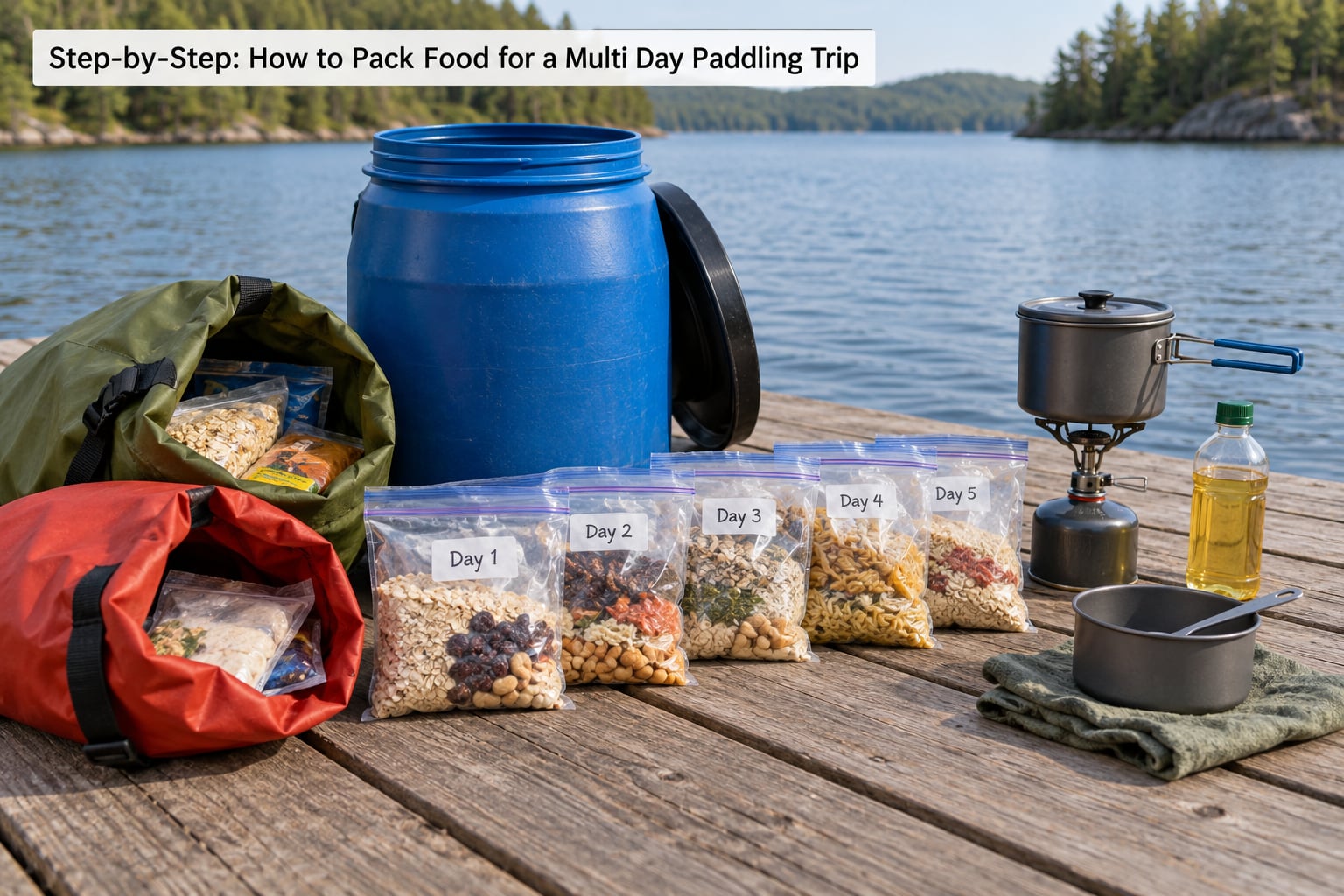
- Portion and label everything. One zip bag per person per meal, dry ingredients and spice packet inside, marker on the bag, day and meal number written on it.
- Group bags into color-coded dry bags by meal type or by day, with a liner bag inside each one in case a zipper fails.
- Schedule perishables early. Fresh meat, dairy, cut fruit and anything frozen goes into the first one to two days of the trip, not the last.
- Weigh the load at the truck. If the food bag is heavier than your plan, remove a luxury item before you remove calories.
Table of Contents
- What You Need
- Step-by-Step: How to Pack Food for a Multi Day Paddling Trip
- How to Calculate Food and Water Needs
- Choose Compact, High-Energy Foods
- Plan Meals and Portion Them
- Use Waterproof, Lightweight Storage
- Keep Food Safe in Heat and Cold
- Test the Pack Before Leaving
- Common Mistakes
- Frequently Asked Questions
- How much food do I need per person per day on a multi-day paddling trip?
- How do you keep food from spoiling on a canoe trip without a cooler?
- Do I need a bear canister for multi-day canoe camping?
- What is the fastest way to pack food for a multi day paddling trip?
- Can I count on catching fish for food during a multi-day trip?
- What do I do with trash and packaging after a week on the water?
- Conclusion
What You Need
You need four categories of supplies: food, water handling, storage, and cooking gear, plus a safety layer. The list changes more from route rules and weather than from taste.
- Food: three to five shelf-stable meals per person per day depending on output, two to three snack items, breakfast items that do not need cooking, and one extra day of emergency calories.
- Water handling: a filter, purification tablets as a backup, two containers minimum, and a way to carry the extra two liters a person most paddlers underestimate.
- Storage: a food barrel or two large dry bags, liner bags, gallon zip bags for trash, and a bear canister if your route requires one.
- Cooking: a small stove, one pot that doubles as a bowl and a pan if you want hot food, a lighter, a knife, a cutting board, and a sponge or a scrubber.
- Safety: a manual can opener, a lighter with fuel for the stove, a water filter, a first aid kit, and a written meal list sealed in a zip bag so it survives the rain.
Five variables shrink or expand that list. Trip length sets the volume of food. Group size sets the number of bags, not the weight per bag, because food divides cleanly. Refrigeration decides whether you are cooking fresh meat or not at all. Weather decides whether you are carrying a cold source. And backcountry rules decide your entire storage approach, so check the land manager before you buy a single item.
Some routes have zero tolerance. In the Boundary Waters, the Quetico, much of Algonquin and most of Alaska’s designated wilderness, all food, trash and scented items must go in an approved bear canister or a certified hanging system, every night, no exceptions. Other backcountry permits simply require a bear hang. Know which one you are dealing with before you design the food bag.
Step-by-Step: How to Pack Food for a Multi Day Paddling Trip
How to Calculate Food and Water Needs
Start with calories per person per day, then adjust for how hard the days actually are. A relaxed lake-camp day burns far less than a day of long strokes, headwind, and a portage with a loaded canoe yoke on your shoulders.
A reasonable range is 2,500 to 3,500 calories per person per day for a typical paddling trip, with 3,000 to 4,000 for cold weather, heavy portaging, or sustained high-mileage days. Treat those as planning ranges, not requirements. Your own body and your own days decide, and the honest test is whether you are running out of energy by midafternoon on day three.
| Trip length | Calories per person per day | Food weight per person per day | Notes |
|---|---|---|---|
| 1 night | 2,500 to 3,000 | 1.5 to 2 lb | No-cook is fine for one night |
| 3 days | 2,500 to 3,000 | 2 to 2.5 lb | One pot meal a day maximum |
| 5 days | 3,000 to 3,500 | 2.5 to 3 lb | Add a hot breakfast |
| 7 days | 3,000 to 3,500 | 2.5 to 3 lb | Plan a resupply or a stocked cache |
| 14 days | 3,000 to 4,000 | 3 lb or more | Volume becomes the binding constraint |
Add a full extra day of food on top of those numbers. Injury, a headwind, a washed-out portage or a storm that keeps you in camp will eat that reserve, and it is the cheapest safety equipment you will ever carry.
For water, most paddlers underestimate. A workable planning number is one gallon per person per day as a starting point for moderate weather and moderate output, plus extra for heat, dry air, or a route with no reliable fresh water. Filter, treat or boil everything you drink, and treat water you collect in stagnant pools differently from water you collect from a running river.
Choose Compact, High-Energy Foods
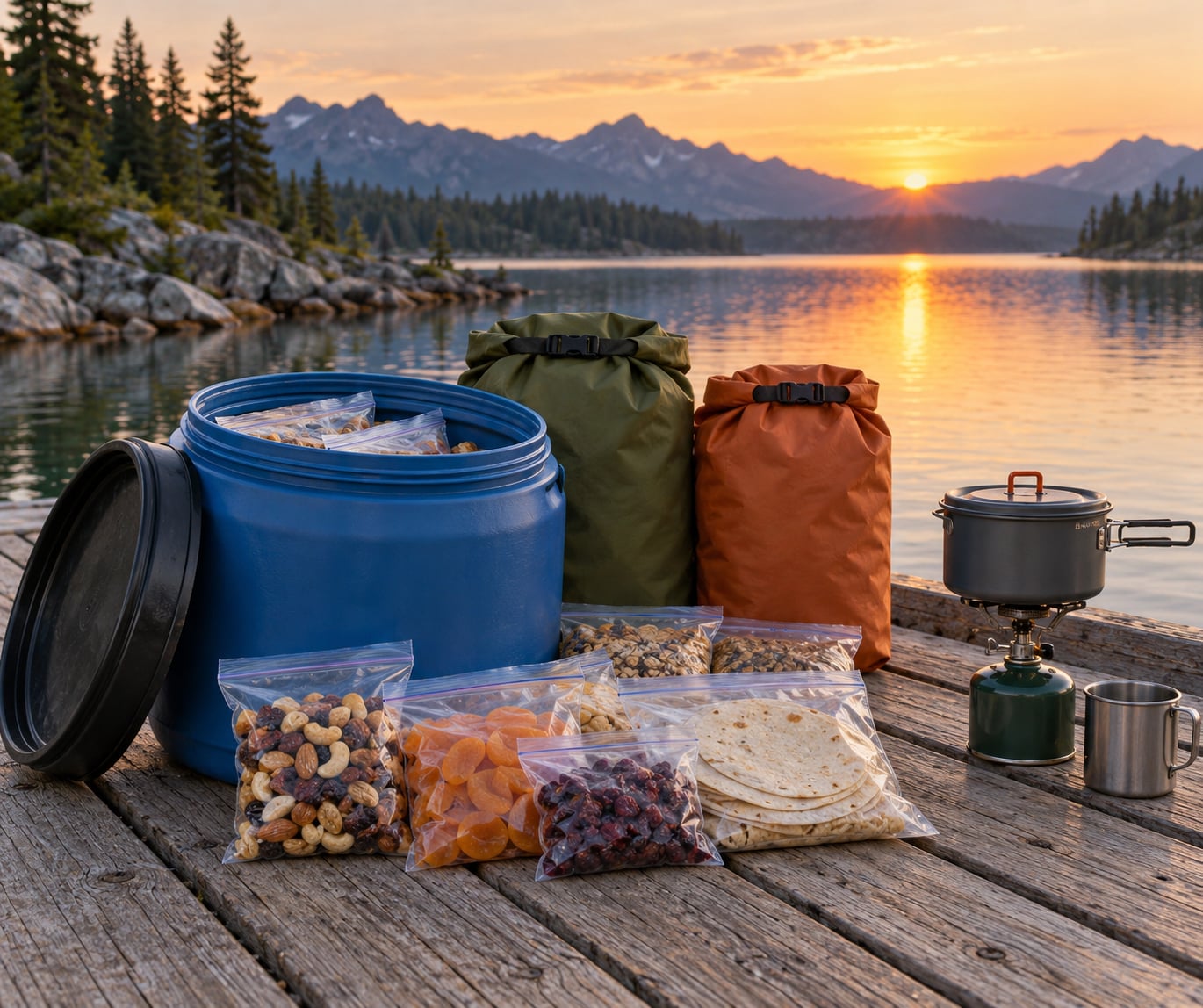
Choose foods that pack small and deliver a lot. Calorie dense means high calories for the volume it occupies in your dry bag, which is the constraint that actually matters in a boat.
- Nut butter is the single most efficient dense calorie you can carry. It goes on tortillas, wraps, apples and crackers, and it survives anything short of a bear.
- Nuts, seeds and dried fruit give you fat and carbohydrate together, which keeps you fuller longer than bars alone.
- Jerky and salami need no cooking, no water and no cleanup.
- Tortillas or wraps hold anything, do not need refrigeration, and replace bread that goes stale or moldy by day three.
- Hard cheese and wax-bound cheese survive days without a cold source.
- Oats, pasta, rice, couscous and instant noodles are cheap, light and rehydrate in a few minutes.
- Shelf-stable meals are the fallback, not the whole plan. Ten identical pouches on day six is a morale problem.
Read the label, not the front of the pouch. Added sugar gets you a fast spike and a crash, and it hits harder when you are pulling a loaded boat all afternoon.
Fresh food is the biggest mistake paddlers make, and it is not carrying it. Long paddlers on forums consistently point out that a canoe can haul far more than a backpack, so you can carry real ingredients. The limit is volume, not weight.
| Food type | Typical weight per meal | Prep time | Shelf life unrefrigerated | Best use |
|---|---|---|---|---|
| Fresh, real ingredients | 1 to 3 lb | 10 to 20 min | 2 to 3 days safely | First one to two days of the trip |
| Canned | 1 to 1.5 lb | 5 min | Years | Quick hot meals, but heavy trash |
| Dehydrated | 3 to 6 oz | 5 to 10 min | Months to a year | Back half of the trip, one-pot dinners |
| Freeze-dried | 2 to 4 oz | 5 to 10 min | Years | Longest trips where volume is critical |
Fresh meat is the item to schedule, not just carry. Freeze it solid, put it in a sealed bag, and eat it on night one. A paddler on a ten-day Sweden trip ran steaks, chicken and salmon on specific nights and everything else dehydrated, and that is the pattern most experienced canoe trippers follow.
Plan Meals and Portion Them
Plan meals before you buy food, and the shopping list writes itself. Write the plan by day, not by meal type, so you can see the fresh items clustering at the front where they belong.
Here is a four-day plan for one person that assumes a stove, a pot, and a moderate output day. Scale it up and add snacks for each additional paddler.
| Day | Breakfast | Lunch | Dinner |
|---|---|---|---|
| Day 1 | Overnight oats with dried fruit and nuts | Tortilla wraps with nut butter and hard cheese, apple | Tortilla pizza with canned sauce, shredded cheese and pepperoni |
| Day 2 | Overnight oats with dried fruit and nuts | Trail mix, jerky, candy bar | Pasta with canned tomato sauce, cheese and a dried tomato pack |
| Day 3 | Dehydrated scrambled eggs rehydrated in hot water, jerky | Cheese and salami wraps, nuts | Ramen with a cheese slice and a dried vegetable pack, or couscous |
| Day 4 | Oats cooked on the burner, candy bar | Remaining snacks, fresh fruit | Shelf-stable meal or a big PB and J wrap |
Once the menu exists, portion it. One zip bag per person per meal, with dry ingredients, a small packet of spices and any cheese in the same bag. Write the day number and the meal on the bag with a permanent marker. Freezer bags work well, and double-bagging anything with liquid or oil prevents a leak from reaching the rest of the bag.
Keep ingredients that get used together in the same bag, so one meal is one bag and nothing is missing. Print the menu, seal it in a zip bag, and put it in the dry bag with the food. Reading a soggy list in the rain ruins a trip faster than a missed meal.
Use Waterproof, Lightweight Storage
Waterproof storage is where most food loss happens. A soaked meal is a ruined meal, and on a remote route you cannot replace it.
- Dry bags roll shut and clamp, are easy to organize by color, and let you pull one meal bag without unpacking the rest.
- Food barrels are harder to get wet, easier to sit on, and better in a canoe with dogs or gear shifting around. A barrel in a yoke canoe needs to be lashed where it cannot roll.
- Liner bags go inside everything. Zipper failure happens; a liner is a few cents of insurance.
- Gallon zip bags collect every wrapper, can and dirty spoon so trash never leaks into the food bags.
Color code and you stop digging. One color for breakfast, one for lunch, one for dinner, one for snacks and emergency food. On a two-week trip, a bag per day beats a bag per meal, because you can empty yesterday’s bag and reuse it for trash.
For a group, agree on the system before you launch. One large food barrel that rotates between boats spreads the weight, and rotating it means nobody carries the heavy bag on the same rough water twice. Splitting into per-boat kits removes the bottleneck of digging through one pile while five people stand there waiting.
Give every boat a manual can opener, a spare lighter, a small knife and a trash bag. If any of those is in the wrong boat, you will find out on a windy afternoon.
Keep Food Safe in Heat and Cold
Without refrigeration, the safe approach is simple: eat perishable food early, keep what remains cold, and throw away anything you cannot vouch for.
If you carry fresh meat, poultry, seafood, dairy, cut fruit or cooked leftovers, keep them at or below 40F (4C). In a hot climate, freeze water jugs instead of using loose ice. Two frozen one-gallon jugs and a few frozen one-liter bottles do the cooling job and become drinking water as they thaw, while bagged ice turns into dead weight you carry all day and water in your bilge.
If you buy fresh meat from a store, freeze it solid, seal it well and eat it on the first night. Frozen meat that thaws once, sits in 90F heat and refreezes is not food you want to gamble on in the backcountry.
Cook to these minimum internal temperatures, measured in the thickest part:
- 165F (74C) for poultry, stuffed foods and reheated leftovers.
- 160F (71C) for ground meat.
- 145F (63C) for whole cuts of beef, pork, lamb and veal, and for fish.
Discard perishable food that has been above 40F for more than two hours, or one hour when the air temperature is above 90F (32C). Smell is not a reliable safety test, and a mild stomach bug on day four of a trip can end it early. When in doubt, throw it out.
Two cold-weather adjustments matter. Add 300 to 500 calories per person per day, because your body burns more staying warm, and those calories have to come from somewhere. And prioritize hot meals: a hot drink and a hot dinner do more for morale on a cold, wet evening than any amount of cold convenience food.
Test the Pack Before Leaving
The final check happens at the vehicle, and it takes ten minutes. Everything you find out at the launch is a problem you carry for the whole trip.
- Weigh it. Put the food bag on a scale. Compare it to your plan. If it is heavy, take out a luxury item before you take out calories.
- Check the waterproofing. Test each dry bag and barrel in a sink or shower, not a puddle. Look for seams, not just zippers.
- Match bags to the plan. Count the bags and compare to the day-by-day menu. Any gap gets filled now at the store.
- Confirm the shared gear. Stove, fuel, lighter, pot, manual can opener, knife, water filter, tablets, bear canister, trash bags. Every boat needs an opener and a lighter.
- Confirm the rules. Re-read the permit for storage method, fire restrictions and group size, since a violation costs you a trip.
Last, add the emergency reserve in a separate bag that stays easy to reach. One extra day of calories for every person, plus a small amount of real food, not just sugar.
Common Mistakes
Most food problems on multi-day paddling trips are not exotic. They are the same handful of mistakes, and each has a simple fix.
- Overpacking the first trip and running short on the last. This is the single most common complaint in paddling forums, and it usually comes from planning for the best-case day. Fix: plan for your average day, and keep the extra day separate.
- Treating weight as the problem when volume is. A canoe carries more than a backpack, so removing food to save ounces is backwards. Fix: cut bulky low-calorie items like crackers and large cans, and keep the dense stuff.
- Counting on sandwiches that will not last. Peanut butter and jelly sandwiches are a hard sell after roughly half a day in a warm canoe, and bread goes moldy fast. Fix: use tortillas for wraps, and keep nut butter separate.
- Carrying loose ice. Ice melts, weighs the boat down all day, and ends up in your hull. Fix: freeze water jugs and one-liter bottles, which work as cold sources and then as drinking water.
- Forgetting a manual can opener. One can of tomato sauce can stop a whole trip. Fix: one opener per boat, plus a spare.
- Too much perishable food, carried too long. Fresh meat scheduled for night four is gambling. Fix: eat fresh in the first two nights, and let dried and canned food cover the back half.
- Under-waterproofing the food. A wet bag is a lost bag. Fix: liner bags inside every dry bag, and a test in the sink before you leave.
- Dehydrating at home with no dehydrator and no time. Home dehydration produces good food but takes far more time than people expect. Fix: buy freeze-dried or dehydrated for the bulk of the trip, and make one homemade dish at home if you have a spare afternoon.
- Planning to catch fish and treating it as food. Paddlers are consistent about this: a catch is a bonus, not a plan. Fix: carry full rations and treat anything caught as an extra meal.
- No emergency day. Delays happen and food does not appear. Fix: pack one extra day per person and keep it out of the daily bags.
- Letting trash accumulate in the food bags. Over a week, cans and wrappers take real volume. Fix: a dedicated trash bag per boat, emptied nightly, and pack it all out.
Frequently Asked Questions
How much food do I need per person per day on a multi-day paddling trip?
Plan on 2,500 to 3,500 calories and roughly 2.5 to 3 pounds of food per person per day. Add 300 to 500 calories per person in cold weather or on heavy portage days, and pack one full extra day on top as your emergency reserve. Fresh, calorie-dense foods like nut butter, nuts, jerky and hard cheese give you the most energy for the space they take in a dry bag.
How do you keep food from spoiling on a canoe trip without a cooler?
Eat perishable food in the first two days and make the rest of the trip shelf-stable. Freeze fresh meat solid and schedule it for night one, and cut fresh dairy and cut fruit from trips longer than three days. If you do carry perishables, hold them at or below 40F (4C) using frozen water jugs rather than bagged ice, which melts all day and adds weight to the boat.
Do I need a bear canister for multi-day canoe camping?
On many routes you do, and the requirement is not optional. The Boundary Waters, Quetico, much of Algonquin and most designated wilderness in Alaska require all food, trash and scented items in an approved bear canister or a certified hang every single night. Other backcountry permits require a hang without a canister. Check the land manager for your specific route before you design the food bag, because the canister size drives how you pack.
What is the fastest way to pack food for a multi day paddling trip?
Use zip bags, not boxes or totes. Portion one bag per person per meal with dry ingredients and spices inside, label it with the day and meal, then sort the bags into color-coded dry bags with a liner inside each one. Finish by weighing the whole food bag at the vehicle and removing a luxury item before you remove any calories.
Can I count on catching fish for food during a multi-day trip?
No. Experienced paddlers treat fishing as a bonus, never as a plan, because the catch is not guaranteed on any given stretch of water. Carry full rations for every day plus your emergency day, and if you do land fish, that becomes an extra hot dinner rather than a meal you skipped. Never rely on a catch to replace calories on a remote route.
What do I do with trash and packaging after a week on the water?
Pack it all out, and budget for the volume. A dedicated gallon bag per boat, emptied nightly into a larger trash bag, keeps wrappers and cans from taking up dry bag space. Avoid cans where you can, since they are heavy and awkward to store. In bear country all trash goes in the canister with the food, every night, and back at the takeout when you are done.
Conclusion
The first thing to do is put the trip length and group size on paper and turn them into a daily calorie number and a food weight number, then add one emergency day. From there, choose food that is calorie dense rather than merely light, write a day-by-day menu with the fresh meals at the front, and portion every meal into a labeled zip bag. Sort those bags into waterproof dry bags, keep perishables cold with frozen water jugs rather than ice, and check your route’s bear storage rules before you design anything. Finally, weigh the food bag at the vehicle and remove a luxury item rather than a meal. Get that done and the rest of the trip is just paddling.