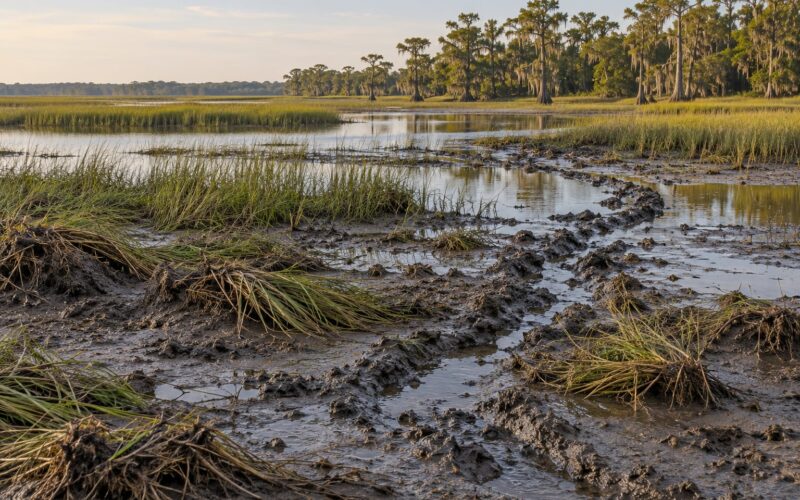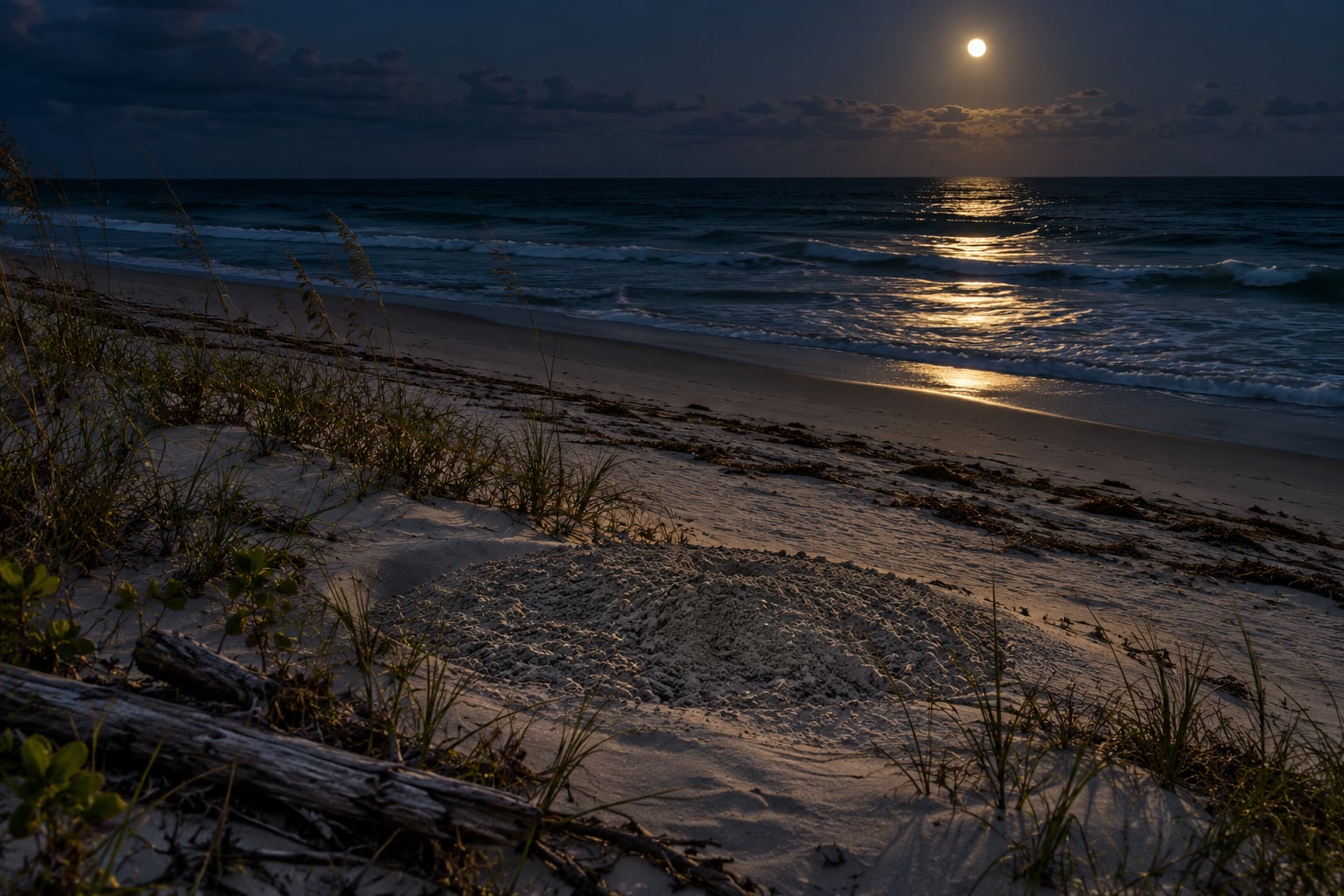
Sea turtles nest on Southeastern beaches the same way they have for millions of years: the female crawls ashore after dark, digs a chamber in the sand with her flippers and her body, lays a clutch of roughly 100 to 200 eggs, covers and camouflages the hole, and goes back to the sea. She never sees the eggs again, and never meets her offspring. Everything that happens next depends on the sand, the weather, and how people behave on that stretch of beach.
That is the short version. Below is what the process actually looks like up close, which species do it along the Atlantic and Gulf coasts, when it happens, what goes on inside the nest, and how to be on the beach at night without wrecking a clutch.
Worth stating plainly: nesting is slow, quiet work. If you are walking a beach in the Southeast between May and October, you are standing in an active nursery whether you know it or not.
Table of Contents
- How Sea Turtles Nest on Southeastern Beaches
- Which Sea Turtles Nest Along the Southeastern United States?
- When and Where Do They Lay Their Eggs?
- The Nesting Process Step by Step
- How Sea Turtles Nest on Southeastern Beaches Step by Step
- What Happens Inside a Sea Turtle Nest?
- How Do Baby Sea Turtles Find the Ocean?
- Why Are Southeastern Sea Turtle Nests Vulnerable?
- How to Watch Nesting Without Disturbing the Turtles
- Frequently Asked Questions
- When do sea turtles start nesting on Southeastern beaches?
- Can visitors watch a sea turtle lay her eggs?
- What should I do if I find a sea turtle nest?
- Why are baby sea turtles drawn toward beach lights?
- Can I move a sea turtle nest or disturbed eggs?
- What to Do If You See a Nest or Nesting Turtle
How Sea Turtles Nest on Southeastern Beaches
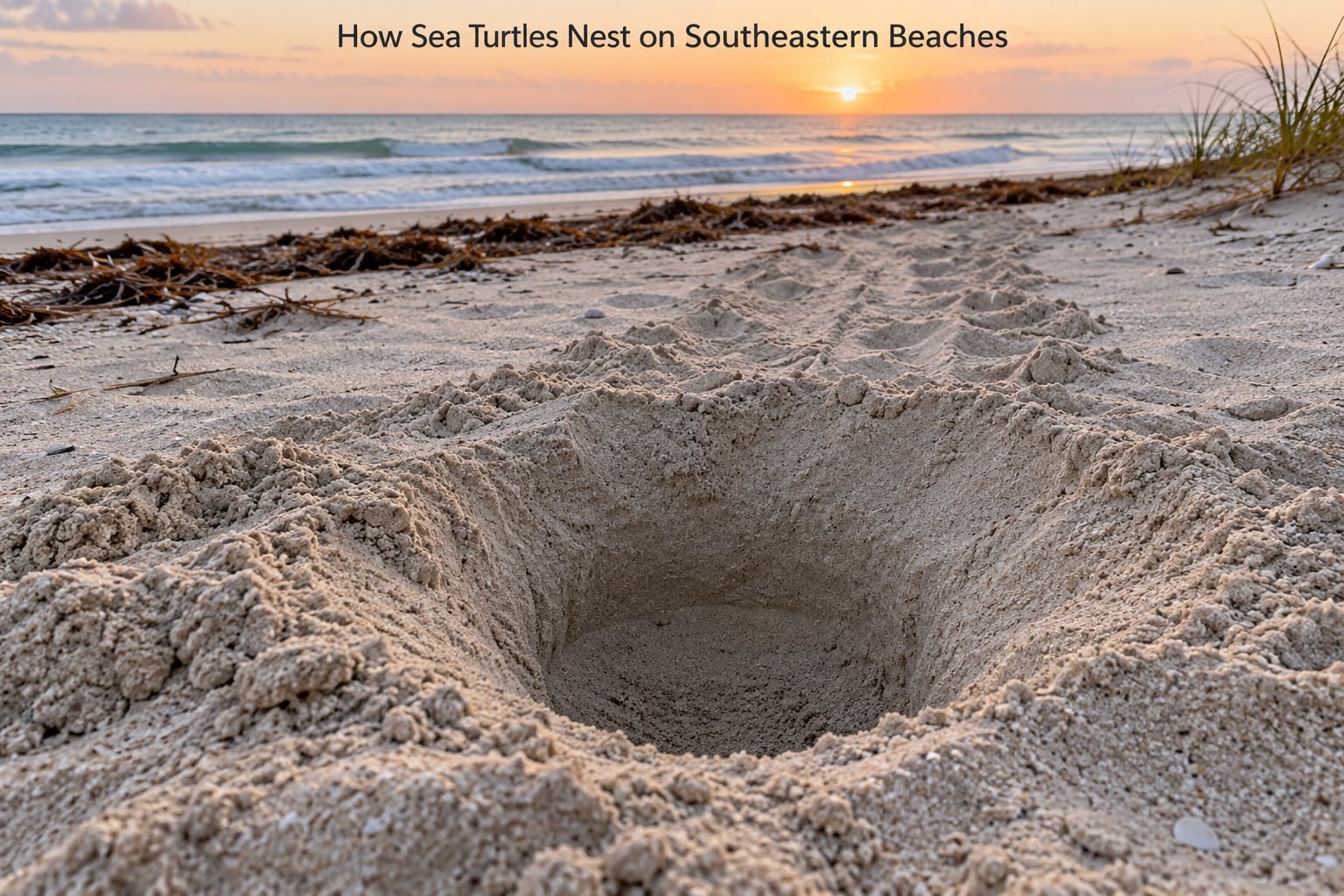
A nesting female is a large, deliberate animal working in the dark. She needs open beach, a firm but workable sand, and a spot high enough that the coming tides will not reach her eggs. Anything shaded, crowded, or below the high-tide line gets passed over.
She excavates a slanted body pit, then an egg chamber at the bottom of it, drops the clutch in batches, rearranges the eggs, backfills the pit, and packs the surface with her rear flippers and her body until the sand looks untouched. Then she returns to the surf and does not come back.
That last part is the detail most people find hard to accept. There is no parental care. The eggs sit unattended for roughly two months, and the temperature of the sand, not the mother, decides what comes out.
Some females crawl the whole beach and leave without laying. That is a false crawl, and it is completely normal, especially for a female who cannot find a spot that works. It is one of the most common sources of confusion for people walking the shoreline at night.
Which Sea Turtles Nest Along the Southeastern United States?
Four species nest regularly on Atlantic and Gulf beaches. The loggerhead accounts for the overwhelming majority of Southeastern nests, which is why almost everything you read on a local beach guide is really a loggerhead guide.
| Species | Adult size | Typical clutch | Nesting months | Where it nests in the Southeast |
|---|---|---|---|---|
| Loggerhead (Caretta caretta) | About 3 feet, 70 to 300+ pounds | 100 to 200 eggs | May through October | Nearly the whole coast, from North Carolina to the Texas barrier island |
| Green sea turtle (Chelonia mydas) | About 3 feet, 300 to 350 pounds | 100 to 150 eggs | June through August | Florida east coast, especially the Space Coast and Indian River area |
| Leatherback (Dermochelys coriacea) | Up to 6.5 feet, 300 to 1,000+ pounds | 50 to 100 eggs | Spring through late summer | Rare, but nests on Florida and North Carolina beaches |
| Kemp’s ridley (Lepidochelys kempii) | About 2 feet, 40 to 100 pounds | 100 to 175 eggs | May through August | Mostly the Florida Panhandle and the lower Texas coast |
Size and clutch figures are typical published ranges rather than fixed numbers, and every one of these species is protected under the Endangered Species Act and the Marine Turtle Protection Act. Disturbing a nest is not something a beach rule can waive.
If you see tracks, a crawl, or what looks like a nest, report it to the state wildlife agency for that beach or to the authorized monitoring group running patrols there. In Florida that is the State Wildlife Action Center at 888-404-3922, and a permitted turtle walk or nest-monitoring group will have the same reporting line. A false crawl gets logged too, and it is useful data, not a wasted call.
When and Where Do They Lay Their Eggs?
Nesting is nocturnal, and it is tied to temperature. Turtles make the crawl in the dark because moving slowly across open sand in daylight is both dangerous and dehydrating, and because sand that has been cooling overnight holds moisture better. Warm air and bright moon phases do not stop nesting, but a cold snap can push activity back by days.
Tide matters too, in an indirect way. The female picks a site above the high-tide line of a normal high tide, not of a storm tide. A nest that seemed safe in June can be underwater in September if a hurricane pushes water across the berm.
| State | Typical nesting window | Note |
|---|---|---|
| Florida | May 1 to October 31 | The official nesting season; most activity is nocturnal |
| Georgia | May through August | Loggerheads dominate; peak counts often come early in the window |
| South Carolina | May through August | Loggerheads on most barrier islands, with leatherbacks in low numbers |
| North Carolina | Late May through August | Loggerheads and leatherbacks, including the Outer Banks |
| Alabama and Mississippi | May through August | Loggerheads and Kemp’s ridleys on the Gulf barrier islands |
| Texas | May through August | Loggerheads and Kemp’s ridleys on the lower coast |
These are regional windows, not guarantees. Individual years shift with water temperature and weather, and turtles can be on the sand outside them. No one should ever walk up to a nest, marked or not, because the calendar says the season is closed.
Location is not a preference so much as an inheritance. Female sea turtles imprint on the beach where they hatched, sometimes with a magnetic sense that lets them pick the right stretch of coastline out of hundreds of miles. They return to nest there for decades, which is why a single heavily lit or developed beach can lose a population over time without the cause being obvious.
The Nesting Process Step by Step
How Sea Turtles Nest on Southeastern Beaches Step by Step
Here is the sequence as it happens on a dark beach, from the first flipper out of the water to the last track filling with wind.
- Crawl ashore above the wash line
- Pace the beach, sometimes for a long time
- Test candidate sites for soft, dry sand
- Clear the spot with her front flippers
- Slant a body pit down with her rear flippers
- Excavate the egg chamber at the bottom
- Lay the clutch in small batches
- Reposition eggs, then cover the chamber
- Backfill the pit and pack the surface flat
- Return to the sea and abandon the nest
Arrival takes a while. A big loggerhead covering a few hundred yards of beach can spend a substantial part of an hour in transit, pausing often. Some of that time is spent pacing, and some females make several false crawls before committing.
Nest construction is the part people find hardest to believe. She first scoops away vegetation and loose sand with her front flippers, then uses her rear flippers and her weight to drive a slanted tunnel down and back. The body pit can be a couple of feet long and she lies across it while she digs, so the excavation is as much a pushing operation as a digging one. The egg chamber at the bottom is shaped with the rear flippers and is adjusted more than once before she is satisfied.
Egg laying takes 20 to 30 minutes. Eggs are soft, leathery, and about the size of a ping-pong ball, and they go down in small clusters rather than all at once. Between batches she lets them shift, which keeps them from settling into a sealed air pocket. Then the chamber is filled in, the pit backfilled, and the surface packed with a few firm presses of the body that smooth the sand and reduce the visual signature of a fresh nest.
What remains is often a broad, flattened patch of sand with no obvious mound. That is normal, and it is also why patrol programs mark nests rather than trusting a passerby to spot one.
What Happens Inside a Sea Turtle Nest?
The eggs incubate in the sand for roughly 50 to 60 days, and the sand is doing the work of both incubator and environment. Temperatures inside a clutch can run several degrees above the surface reading on a hot afternoon, and those temperatures decide the sex of every turtle in the nest.
Temperature-dependent sex determination is exactly what it sounds like. Cooler sand in a nest produces males, warmer sand produces females, and shifting patterns in temperature have pushed the ratio on some Southeastern beaches heavily toward females. Nesting beaches that used to produce balanced hatchling sexes now produce mostly female hatchlings on many stretches of the Gulf Coast.
| Stage | Approximate timing | What is happening |
|---|---|---|
| Egg laying and settling | Week 0 | Clutch deposited and covered, then left alone |
| Early embryo | First two to three weeks | Cell division, very little external movement |
| Growing embryo | Weeks 3 to 6 | Organs form, bones begin to harden |
| Late embryo, pipping | Final week or so | Hatchlings break the shell from inside but wait in the nest |
| Emergence | End of incubation | The whole nest digs upward together, usually over one to three nights |
Timings vary with sand temperature and moisture, and cooler nests can stretch well past 60 days. Emergence is also not a single night. A nest typically releases its hatchlings over a span of a few nights, and researchers who dig up a nest after the fact count the unhatched eggs to calculate hatching success for that season.
A second, quieter problem sits alongside heat. Sand that is too dry or too compacted can kill a clutch outright, and beach nourishment, driving, and heavy foot traffic all change the conditions a nest depends on. Erosion and the loss of dune vegetation remove both the shading and the slope the female uses as a guide when she looks for a site.
How Do Baby Sea Turtles Find the Ocean?
Hatchlings do not need to be taught. They dig upward through the sand column as a group, break the surface together, and head for the brightest, most open part of the horizon. On a natural beach, that brightness is the sky reflected off the open water beyond the dune line, with the moon and the low glow of the night sky reinforcing the direction.
Every part of that system is calibrated for a dark coast. Put a bright light source on the landward side of the beach and the brightest horizon is no longer the sea, so the hatchlings go the wrong way. They crawl inland, exhaust themselves in soft sand or hot pavement, and are picked up by crabs, raccoons, or nothing at all.
This is why the rule is not simply “no flash photography.” Anything brighter than the open horizon can pull hatchlings off course, which includes a phone screen held low, a bright headlamp, a fishing pier light, a rental patio lamp, and a fire pit. A red or amber filter over a light is the common accommodation because long wavelengths disturb marine turtles far less, but a dim light aimed down at your own feet is the safest option of all.
People ask whether they can carry a wandering hatchling back to the surf. Do not. A hatchling that has already oriented on the wrong light source will be turned again by the same cue, and the attempt to help adds stress without fixing the cause. Turn off the light, clear the area, and let trained monitors handle it.
Why Are Southeastern Sea Turtle Nests Vulnerable?
Most losses are caused by things nobody can control. Storms surge over the berm and wash out clutches. Prolonged heat kills embryos in shallow or poorly shaded nests. Beach erosion eats the back of the dune and removes the buffer a nest needs.
Then there are the predators, which is where the first serious pushback usually comes from. Raccoons and feral hogs can destroy dozens of nests in a single night. Ghost crabs take individual eggs and hatchlings rather than whole nests, and they are a smaller but constant drain. On any single beach, predation rates vary enormously depending on the predator community present and whether a screen or exclosure program is running.
Human-caused losses are the preventable ones, and they usually come down to a short list: artificial light disorienting hatchlings, vehicle strikes on crawls and nests, off-road vehicles driving over marked nests, people handling or repositioning eggs, a female abandoning a site because of blocked access or noise, unfilled holes and deep tire ruts that trap hatchlings, plastic and fishing line entanglement, and unmanaged dogs. Add coastal armoring that removes the beach itself and you get a long-term problem that no amount of individual restraint fixes.
That distinction is the point. A raccoon eating a clutch is a natural loss. A hatchling dying in a parking lot because someone left a floodlight on is a choice somebody made.
How to Watch Nesting Without Disturbing the Turtles
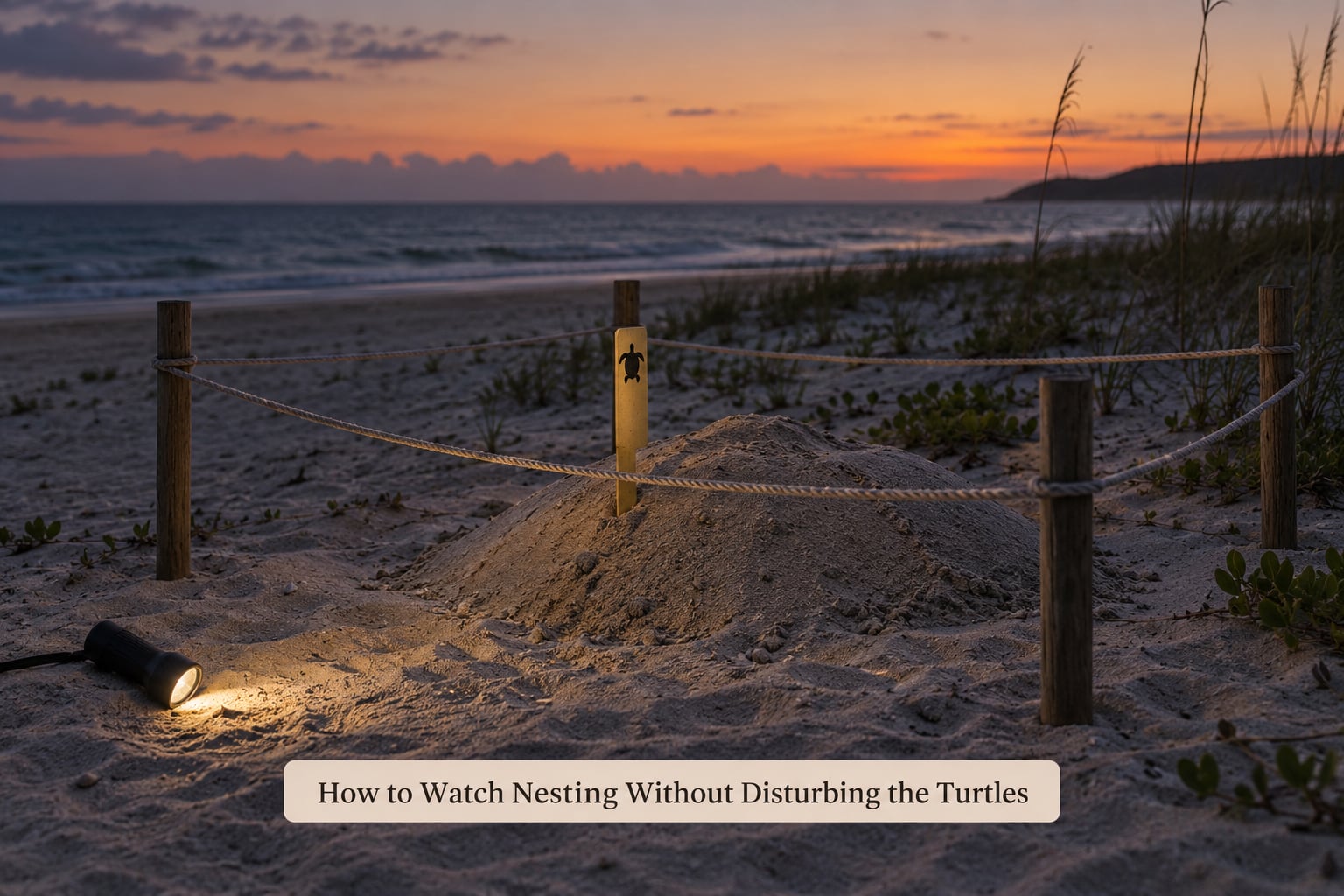
Watching turtles is one of the easiest wildlife experiences on the Gulf and Atlantic coasts, and most of the work is restraint. If you follow the list below, you will not cost a single clutch.
- Keep 50 feet of distance, or more, and put the dune between you and the animal
- Keep the beach dark, indoors, and to the seaward side of any marked area
- Aim any light at your own feet, and prefer red or amber if you need more
- Leave the sand bare: no coolers, chairs, towels, or tents after sunset
- Fill in every hole you dig, including shallow sandcastles
- Keep dogs leashed and out of any stake-and-rope enclosure
- Stay off marked nests entirely, including the seaward side where the rope is hard to see
- Never handle eggs, hatchlings, or an adult turtle
- Report any crawl, scrape, or suspected nest, including stranded and cold-stunned turtles
The 50-foot figure comes up constantly, usually because people have seen different numbers quoted. It is a safe floor rather than a magic line, and the higher the dune, the more of the animal you can see without reducing the distance.
Turtle walk programs are run by state agencies, national seashores, and volunteer groups, and they handle permits, lighting, and the awkward moments. If you want to be on the beach at night with a knowledgeable guide rather than guessing, that is the route to book.
On your own property, the same logic applies. Beachfront rentals and campgrounds are asked to shut off unnecessary exterior lighting, shield what stays on, and keep fixtures from shining on the sand. Visitors frequently report that clearing their own gear off the beach is the one change they most readily make, because it takes nothing but a few minutes before sunset.
Late October is the trap. Hatchling emergence runs into the autumn, and it collides with fire pits, beach parties, and Halloween setups on exactly the nights when volunteers are thinnest. If you are hosting anything lit on a Southeastern beach in the fall, move it inland.
Frequently Asked Questions
When do sea turtles start nesting on Southeastern beaches?
Nesting on Southeastern beaches generally runs from May through October, with most activity concentrated in the middle of that window. Florida officially sets its nesting season as May 1 to October 31, while Georgia, South Carolina, North Carolina, Alabama, and Texas see most nests between May and August. Individual years shift with water temperature and weather, so treat these as a rough calendar rather than a guarantee, and never approach a nest because you assume the season is closed.
Can visitors watch a sea turtle lay her eggs?
Yes, but only under supervised conditions. Permitted turtle walk programs, run by state wildlife agencies, national seashores, and volunteer monitoring groups, take visitors out at night where nesting is occurring. They set the distance, control the lighting, and stop the walk if the female changes her mind. Unguided watching is where people get too close, use bright lights, and cause a female to abandon a site, which costs the whole clutch.
What should I do if I find a sea turtle nest?
Do not touch it and do not stand over it, even if you cannot see anything. A nest is often an invisible, flattened patch of sand, so give the area a wide berth and keep out of any stake-and-rope enclosure you find. If you see a crawl, a scrape, a turtle, or a suspected nest, report it to the state wildlife agency for that beach or to the local monitoring group. In Florida, call the State Wildlife Action Center at 888-404-3922.
Why are baby sea turtles drawn toward beach lights?
Hatchlings orient toward the brightest, most open part of the horizon, which on a natural dark beach is the open sea reflecting the night sky. Put a bright light on the landward side and that cue points inland instead, so the hatchlings crawl the wrong way, exhaust themselves, and often do not survive. That is why beachfront properties are asked to shut off or shield exterior lighting, and why any light on the sand should be dim, covered, and red or amber.
Can I move a sea turtle nest or disturbed eggs?
No. Never move a nest, and never dig up or reposition eggs, even if you are trying to help them hatch or reach the water. Relocation and screening are done under a state permit because a nest moved to a spot with the wrong sand, moisture, or temperature can destroy the whole clutch. Disturbing a nest also carries federal penalties under the Endangered Species Act and the Marine Turtle Protection Act. Call the wildlife hotline and let trained personnel take over.
What to Do If You See a Nest or Nesting Turtle
The first thing to do when you find a nest or a nesting turtle is to get quiet and give it room. Stay 50 feet back or more, keep the dune between you and the animal, and turn off or shield any light you brought with you. Do not touch eggs or hatchlings, and do not cross a stake-and-rope enclosure even when the boundary is hard to see in the dark.
Second, make the call. Report the crawl, the scrape, or the turtle to the state wildlife agency for that beach or to the authorized monitoring group running patrols, and give them the location and what you saw. In Florida that is the State Wildlife Action Center at 888-404-3922. A false crawl counts as a report too, and volunteers would rather log one than chase a sighting that might have been a tire track.
Everything after that belongs to people with permits. Understanding how sea turtles nest on Southeastern beaches is useful on its own, but the nest, the eggs, and the hatchlings are handled by trained crews who know the difference between a nest that needs screening and one that needs to sit untouched. Let them make that call.