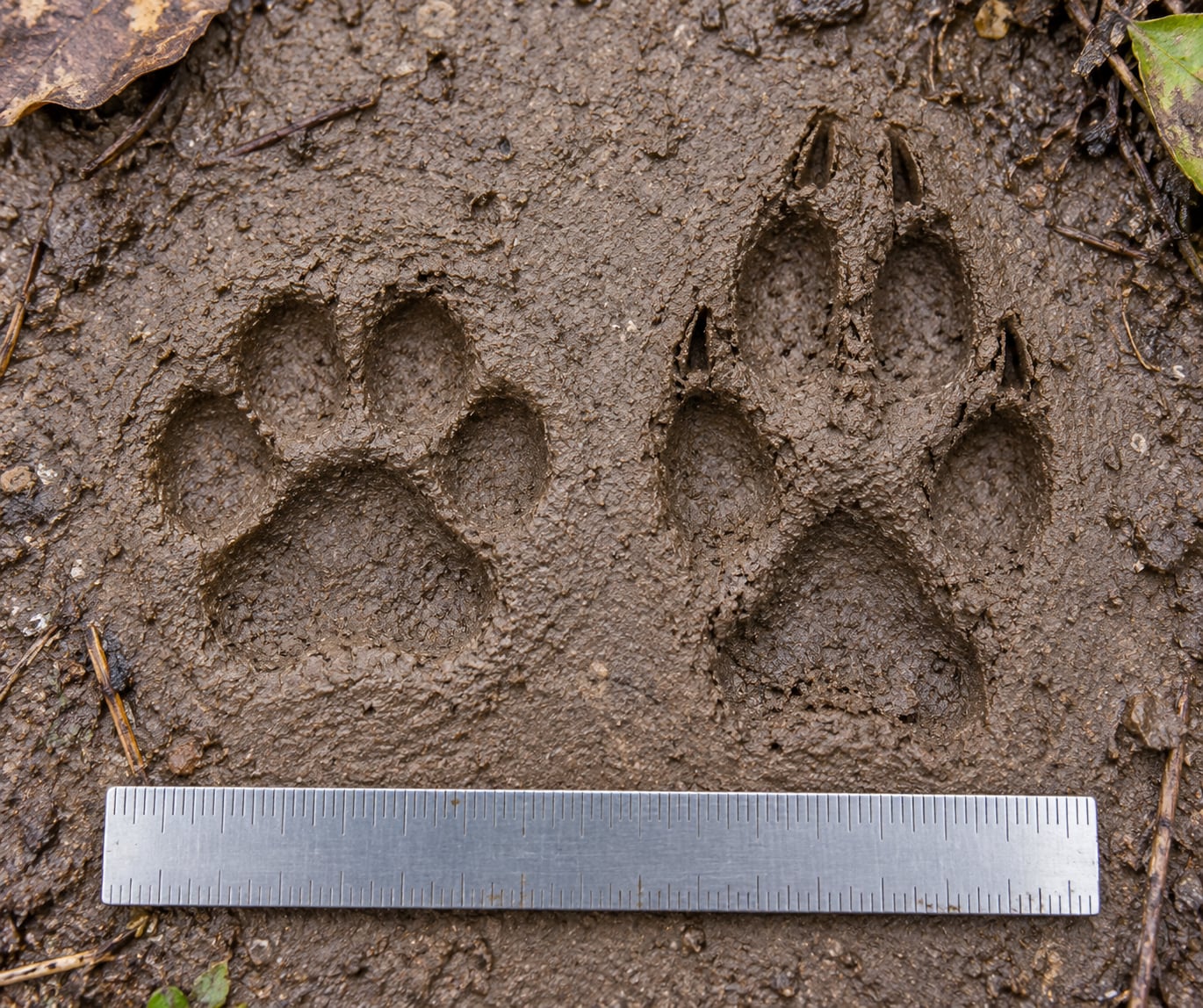
To tell a bobcat track from a dog track, look for three things in this order: claw marks, overall shape, and heel pad shape. A bobcat print is compact and nearly round with no claw marks ahead of the toes and a broad heel pad with two front lobes and three rear lobes. A dog print is more oval or elongated, usually shows two claw marks ahead of the two center toes, and has a narrower pad with one front lobe and two rear lobes.
Size is the one thing most people lean on, and it is the thing that fails them most often. A bobcat print runs roughly 1.5 to 2.5 inches wide, which overlaps almost exactly with the prints of a beagle, a jack Russell, or a corgi. Hand and boot references get misjudged constantly in photo ID threads, so I start every identification with shape and claws and treat size only as a sanity check afterward.
Everything below takes about ten minutes per trail if you have a ruler, or a few more if you do not. Most single prints are genuinely undecidable on their own, and knowing when to stop and follow the trail is half the skill.
Table of Contents
- What You Need
- Bobcat Track vs Dog Track at a Glance
- How to Tell a Bobcat Track from a Dog Track Step by Step
- 1. Compare the Overall Track Shape
- 2. Check the Toe Arrangement and Claw Marks
- 3. Examine the Heel Pad and Track Edges
- 4. Look at Stride and Track Patterns
- 5. Use Size as a Supporting Clue, Not the Answer
- Common Bobcat Track and Dog Track Mistakes
- Assuming every dog track shows claws
- Calling a feline print a canid because it looks small and neat
- Trusting track length on its own
- Reading a distorted print as an accurate one
- Photographing without scale
- Frequently Asked Questions
- Do bobcats leave claw marks in their tracks?
- Can a dog track look round?
- How far apart should I measure a bobcat’s stride?
- What should I do when the print is smudged or incomplete?
- What should I do if I find a bobcat track near my chickens or a small dog?
- Conclusion: Start With Shape and Clues Together
What You Need
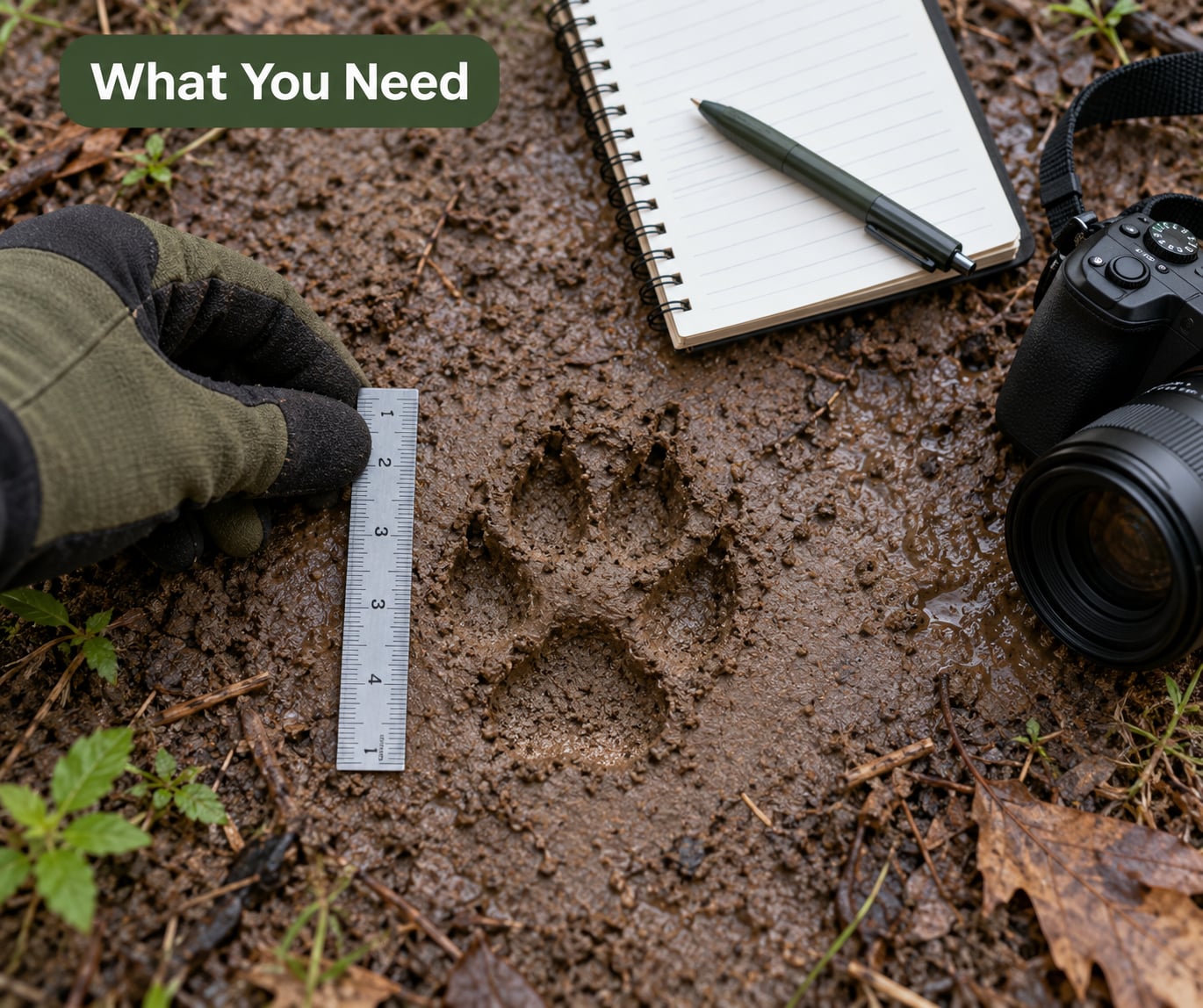
You need very little. A six-inch ruler or a tape measure is ideal, and if you have neither, a standard coin or a credit card gives you a known scale, which matters more than most people think. Gloves keep your hands clean and, more importantly, keep you from standing in your own fresh boot print next to the one you are studying.
A camera matters more than a notebook because a photo with scale in frame can be sent to someone who knows more than you do. A notebook is still useful for noting time, weather, and which direction the trail runs.
The substrate matters too. Look for soft mud, damp sand, or fresh snow, and check the print from a low angle with light raking across it. Side lighting throws the pad and toe relief into shadow, and a print that looks ambiguous under flat overhead sun often resolves itself that way. Finally, give yourself time to walk the trail in both directions. A line of prints tells you things a single print never will.
Bobcat Track vs Dog Track at a Glance
| Feature | Bobcat | Domestic dog |
|---|---|---|
| Claw marks | Usually none; claws retract while walking | Usually two, ahead of the center toes |
| Overall shape | Compact, nearly round, about as wide as long | Oval to elongated, or evenly proportioned in squat breeds |
| Heel pad | Broad, two front lobes and three rear lobes, M-shaped | Narrower, one front lobe and two rear lobes |
| Toe arrangement | Four toe pads bunched in a tight arc at the front | Four toes with the center pair projecting forward |
| Negative space | Rounded, C-shaped gap between toes and pad | Narrow, X-shaped crossing |
| Typical size | About 1.5 to 2.5 inches wide | Varies from under 1 inch to 5 inches or more |
| Trail pattern | Hind feet land in or near the front prints, reads as two-legged | More varied; often meandering, trotting, or curving |
| Stride | Roughly 6 to 14 inches | Roughly 10 to 24 inches depending on breed and speed |
| Nearby sign | Hair, rub marks on trees, den sites, scat with tapered ends | Dog scat, a worn path, human foot traffic |
Two entries in that table deserve emphasis. The claw row is the fastest test and the least reliable, because it disappears under specific conditions. The shape row is slower but survives almost any substrate, which is why it comes before size in this guide.
How to Tell a Bobcat Track from a Dog Track Step by Step
1. Compare the Overall Track Shape
A bobcat track is compact and nearly round, roughly as wide as it is long, with the toes forming a shallow arc across the front. A dog track is typically longer than it is wide, with a narrower waist and toes that splay more widely. This is the single most dependable difference between the two.
The complication is squat breeds. A bulldog or a basset hound can leave a print almost as round as a bobcat’s, and a corgi’s track is famously close to feline in proportion. If you are deciding by shape alone, treat a round print with a wide splay and a heavy pad as probably canine, and confirm it with the next two steps before you commit.
Also keep in mind that juvenile bobcats track small. A young cat the size of a house cat leaves a house cat track, and no amount of careful measurement fixes that.
2. Check the Toe Arrangement and Claw Marks
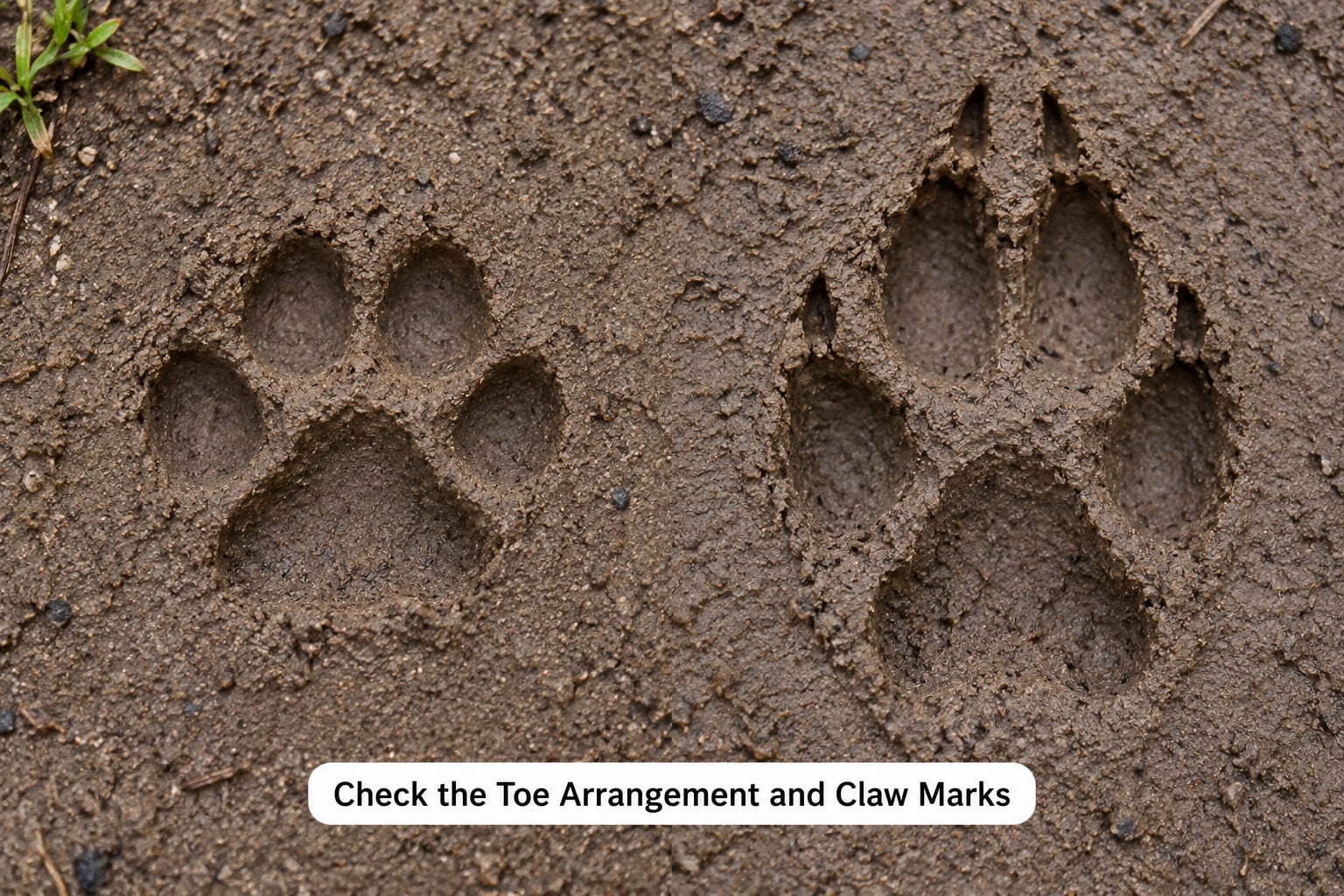
Bobcats have four toe pads visible ahead of the heel pad, arranged in a tight, bunched row. Their claws are retractable and held back while walking, so a relaxed walking print shows clean toe pads with little or no claw impression. Dogs cannot retract their claws, so their prints almost always carry two claw marks extending forward from the two center toes.
Experienced trackers call a cat foot tight and bunched and a dog foot wide and splayed, and that is the phrasing worth borrowing because it describes the whole foot rather than one feature. On a r/Hunting track ID thread, the consensus answer was exactly that: canine tracks are heralded by visible claws with wide pads, while cats have a nail-less, tighter bunched foot.
The claw test fails in three situations, and knowing them saves you from a confident wrong call. It fails on hard ground or frozen soil where only the deepest parts of the pad register. It fails when the animal is running, because cats extend their claws for traction at speed, and even a dog that normally shows claws can lose them to a crumbling edge. It fails in deep or melting snow, where the print collapses into a blur of soft impressions. In all three cases, drop back to shape and heel pad.
3. Examine the Heel Pad and Track Edges
The feline heel pad is broad and made of two front lobes and three rear lobes, which produces a blotched M shape when filled with mud. Many field people use the rear lobes as a memory hook, counting three on the hind foot. The canine pad is narrower, with one front lobe and two rear lobes, and from above it often looks like the roof of an old Beetle.
Here is the detail almost nobody mentions: on many bobcat prints there is a small notch centered just ahead of the heel pad. It is subtle, easy to lose in a photo, and it is one of the more reliable confirmations once you know to look for it.
Edges tell you what the substrate did. Crisp, raised margins and sharp pad relief mean a fresh print in good substrate. A print with slumping edges, filled-in toe hollows, or a pad outline that has gone soft and flat has been through rain, thaw, or a night of temperature swings. Erosion along one side of every print usually means wind or water moved through rather than an animal scraping around.
Measure the heel pad across its widest point and the whole track from the leading toe to the back of the pad. Keeping both numbers lets you separate genuine feline proportions from a track that is merely small.
4. Look at Stride and Track Patterns
A line of prints is worth more than the best single print, and this is the step that breaks most ties. Bobcats commonly travel in a diagonal or registered pattern, with the hind feet landing in or near the front prints, so the trail can read as almost two-legged with a second set of prints slightly offset. Many sources instead call bobcats a direct-register walker, and the two descriptions get used interchangeably even though strict direct register means the hind foot lands exactly in the front print. Either way, the practical field impression is the same: the feline trail looks tightly paired and narrow, not a tidy single-file chain of separate prints.
Dog trails vary far more. A dog trotting at a steady pace lays a regular two-beat pattern that most people find obvious, and a dog wandering a yard or working a scent produces curves, backtracks, and clusters of overlapping prints that look nothing like a deliberate travel line. A dog moving slowly through one spot often registers both front and hind feet close together, with lots of scuffing.
Measure stride as the distance from the front of one print to the front of the next. Bobcats typically run about 6 to 14 inches, while dogs span roughly 10 to 24 inches depending on breed and speed. Front tracks are larger than hind tracks and slightly wider, and the two leading toes point in the direction of travel, so you can read direction without seeing the animal.
5. Use Size as a Supporting Clue, Not the Answer
Bobcat tracks generally measure about 1.5 to 2.5 inches wide, with regional variation. Toward the northern edge of the range tracks tend to run smaller, and across the South they can run larger, so a fixed size rule fails geographically as well as individually.
Dog tracks span a much wider range than most people expect. A small terrier can print under an inch and a half, a beagle or corgi sits squarely in bobcat range, a lab or hound prints 3 to 4 inches, and a rottweiler or shepherd runs 4 to 5 inches. That spread means size can rule an animal out at the extremes and can never confirm one in the middle.
Get scale into the frame. Put a coin, a credit card, or your boot beside the print before you photograph it, and measure something with known dimensions rather than trusting your memory of your own hand. If you must estimate without a ruler, a quarter is about the diameter of a large adult thumb, which is roughly the width of a bobcat print, and a quarter sits comfortably inside most beagle prints.
When shape, claws, and heel pad all point one way but size points the other, trust the anatomy. When the anatomy is muddy, go looking for other sign: hair caught on barb wire, fresh rub marks on a tree at shoulder height, a scratch or den site in a rock or brush pile, or scat with tapered, twisted ends and buried in a scrape. Habitat matters too. A bobcat trail usually runs along a cover transition, through rocky country, or along a creek edge, while dog trails follow human routes.
If two or more clues conflict and the trail runs out quickly, say you are not sure. That answer is defensible, and it is a better one than a confident call you cannot support.
Common Bobcat Track and Dog Track Mistakes
Assuming every dog track shows claws
Not all of them do. Dewclaws, torn nails, muddy collapses, and a hard substrate can erase claw marks, and plenty of dogs have dewclaws set so low they barely register. Treat visible claws as strong evidence for a dog and missing claws as weak evidence for a cat. Check the heel pad and the overall shape before you decide.
Calling a feline print a canid because it looks small and neat
Neatness gets misread as domestic. The correction is to count heel pad lobes and compare the negative space: a rounded, C-shaped gap between the toe pads and the heel pad is feline, while a narrow X-shaped crossing is canine. Experienced readers on North Carolina tracking forums lean on exactly those two features when a print looks ambiguous.
Trusting track length on its own
The rule that a canid track is longer than it is wide is useful, but it is a family-level test, not a bobcat-versus-dog test. Plenty of dogs print nearly round, and a hunting forum post that claims all domestic dogs print round while coyotes print elongated is wrong often enough to mislead people. Use length as a clue, then confirm with pad and claw anatomy.
Reading a distorted print as an accurate one
Rain fills a print and softens its edges. Snow collapses under weight. Mud splay pushes toes apart and can fake a claw mark. Sand records shape beautifully but loses the fine pad lobes. The fix is simple: when the print looks wrong for any species you know, assume the substrate did it, and find a better patch of ground before you decide.
Photographing without scale
Most track photos online are unusable because nobody put anything of known size next to the print. When you post a photo for help, include a coin or card for scale, name the substrate, show a stretch of the trail rather than a single print, and include at least one front and one hind print. That single habit fixes most of the arguments you see in comments.
Frequently Asked Questions
Do bobcats leave claw marks in their tracks?
Usually not. A walking bobcat retracts its claws, so the print shows four clean toe pads ahead of the heel pad with no claw impression. Dogs cannot retract their claws and normally register two marks ahead of the center toes. The rule breaks when a cat is running, when the ground is hard or frozen, and in deep or melting snow. In those conditions, judge by shape and heel pad lobes instead.
Can a dog track look round?
Yes, and it confuses people constantly. Squat breeds such as bulldogs, basset hounds, and corgis leave prints that are nearly as round as a bobcat’s. The distinguishing features are the pad and the toes, not the outline. A dog print shows a narrower heel pad with one front and two rear lobes, center toes that project forward, and usually visible claw marks.
How far apart should I measure a bobcat’s stride?
Measure from the front of one print to the front of the next, along the line of travel. Bobcats typically stride about 6 to 14 inches, with most walking travel near the lower end. Dogs generally cover 10 to 24 inches depending on breed and pace. Overlap in those ranges is why stride confirms a trail rather than identifies a single print, so use it after shape and claws.
What should I do when the print is smudged or incomplete?
Do not call it from that print. Note the time and weather, photograph it with a scale object in frame, and walk the trail in both directions until you find a cleaner print or a longer line of them. A partial print usually still shows the heel pad outline or the leading toes, and those two features carry the identification on their own.
What should I do if I find a bobcat track near my chickens or a small dog?
Treat it as real until proven otherwise, and act on the property rather than the print. Move poultry into a secure enclosure before dusk, keep small pets indoors overnight, and remove attractants such as unsecured feed, fallen fruit, and carcasses. Bobcats are most active from dusk through the pre-dawn hours. If losses are ongoing, contact your state wildlife agency for guidance specific to your area.
Conclusion: Start With Shape and Clues Together
Claw marks, then shape, then heel pad lobes, then the line of the trail. Size only checks whether your conclusion is plausible, and if the anatomy disagrees with the ruler, the anatomy wins. Your first move at any track is to put a coin or a card next to it, photograph it from a low angle with raking light, then walk the trail far enough to see the pattern and the stride.
And when the clues still conflict, an honest not sure is a real answer. Nobody gets penalized for it, and it beats a confident guess you build a chicken coop defense on.