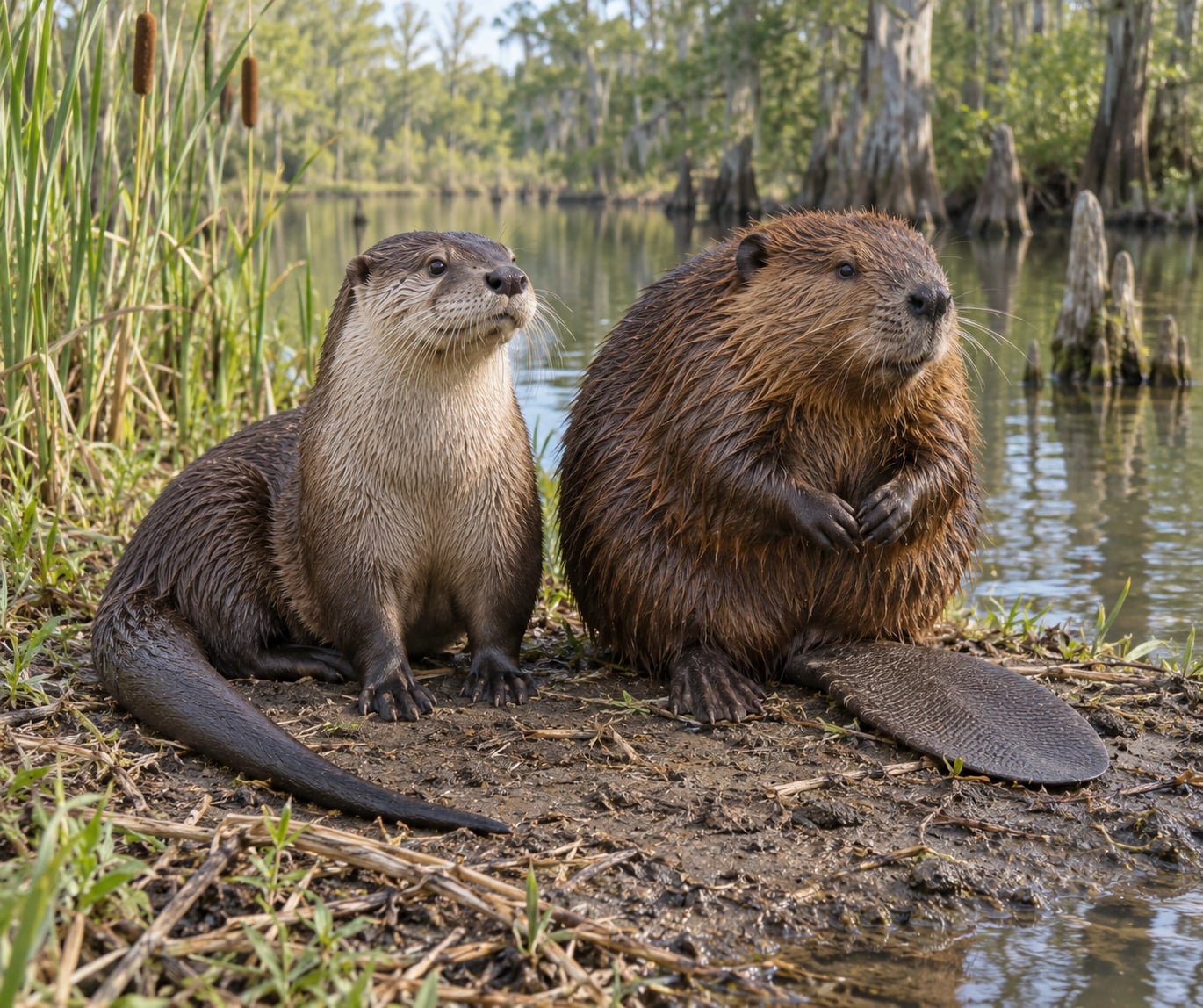
If you want to know how to identify a river otter vs a beaver, look at the tail first. A beaver’s tail is broad, flat, oval, and scaly, and it will slap the water as a warning. A river otter’s tail is long, thick at the base, tapered to a point, and fully furred, and it works as a rudder. No other clue separates the two animals as cleanly.
The trouble is that the tail is usually the one thing you do not see. An animal surfaces for two seconds, shows a head and a back, and is gone. Head shape, ear size, and neck posture do most of the work on those short surfacings, and almost every written guide I found skips straight to the tail and leaves you stuck.
This guide puts the tail rule first, then builds out the second- and third-best clues in the order you can actually use them from a canoe, a dock, a bank, or a marsh boardwalk. It also covers the look-alikes, and muskrat in particular, because that is the animal people actually misidentify most often.
Table of Contents
- How to Identify a River Otter vs a Beaver at a Glance
- Size and Body Shape
- Head shape when the tail never comes up
- Tails, Feet, and Fur
- Heads, Teeth, and Sounds
- Tracks and Sign Along Waterways
- Behavior and Habitat Clues
- How to Tell Them Apart Safely at a Distance
- Which Should You Choose?
- Frequently Asked Questions
- Are river otters and beavers related?
- How do I tell the difference between a beaver and an otter?
- Does a missing dam mean it is not a beaver?
- Do otters and beavers get along?
- Which US states have river otters?
- What is the closest animal to a beaver?
- Conclusion
How to Identify a River Otter vs a Beaver at a Glance
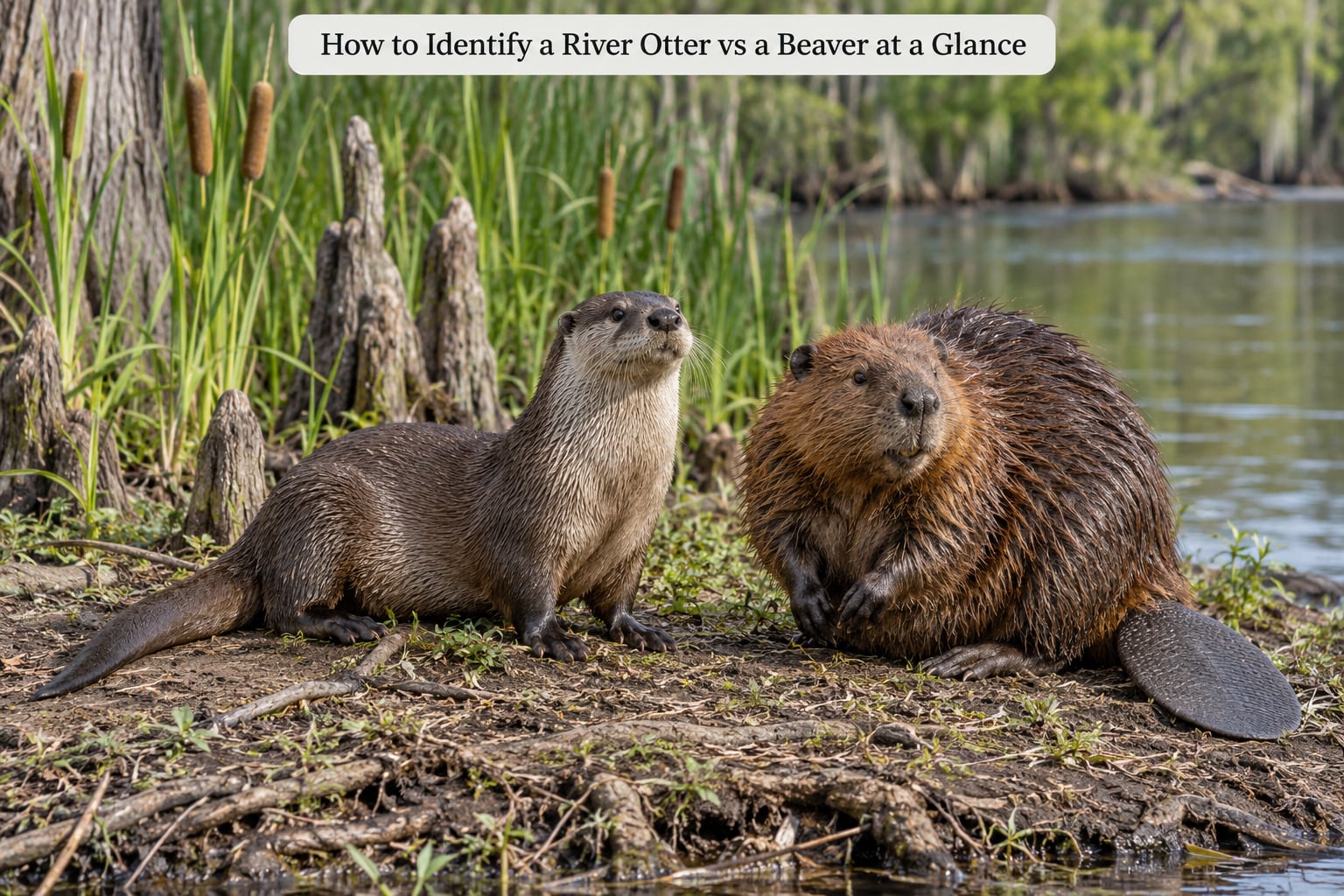
River otters and beavers share a habitat but almost nothing else. One is a long-bodied fish hunter in the weasel family. The other is a heavy, plant-eating rodent that moves water. Seven criteria separate them every time.
| Feature | River Otter (Lutra canadensis) | Beaver (Castor canadensis) |
|---|---|---|
| Tail | Long, muscular, tapered to a point, fully furred | Broad, flat, oval paddle, scaly and mostly hairless |
| Teeth | Small, pale, blunt canines for gripping fish | Large bright orange incisors, constantly gnawed |
| Diet | Fish, crayfish, frogs, occasionally plants | Aquatic plants, bark, twigs, woody stems |
| Length | Up to about 4 feet including a tail that can reach 3 feet | Around 3 to 4 feet nose to tail tip |
| Weight | About 15 to 20 pounds | About 35 to 60 pounds or more |
| Body build | Slender, long neck, under a foot tall at the shoulder | Stocky, blocky head, thick neck, no visible waist |
| Sign | Fish scat, bank slides, five-toed prints, no construction | Dams, lodges, bank burrows, gnawed stems, cone-shaped droppings |
Quick ID check, in the order I work through it: tail shape, then teeth, then body build and head shape, then what the animal is doing, then the tracks and sign on the bank.
Size and Body Shape
A river otter is long and low. It is under a foot tall at the shoulder and can carry nearly half its length in that tail, which is thick at the base and then narrows to a whip. On the surface it reads as a sinuous, eel-like shape rather than a lump.
Beavers are built like a small dog with a heavy ratchet head. The shoulders are higher than the hips, the neck is short and thick, and there is no visible waist between chest and hindquarters. On the surface a beaver shows a broad back and a head that sits forward of the shoulders, so the whole animal looks blocky from behind.
If you are trying to settle an identification by size alone, use total length. An animal over two feet nose to tail tip is large for a muskrat, which is the most common misidentification in wildlife ID threads, and well within beaver range. A river otter at four feet is longer than most beavers but far thinner, so length and build have to be judged together.
Head shape when the tail never comes up
When you only get a head and shoulders out of the water, head shape is the most reliable second clue. An otter has a rounded, narrow head, a noticeably long neck, small close-set ears, and a thick pale or grizzled coat that looks lighter than the back. A beaver has a broad, blocky, almost rectangular head, small ears, a blunt whiskered muzzle, and a uniform chestnut or dark brown coat with no light throat.
Regulars on wildlife identification forums put it more bluntly. Commenters on r/animalid threads describe otter heads as not square, with much longer necks and tiny ears, while beavers draw the opposite read: a large blocky head with noticeably big ears and lighter chestnut coloration. That matches what I see from a canoe. The square head and thick neck is the beaver.
Tails, Feet, and Fur
The tail settles the question in most cases, so learn the two shapes and then stop worrying. A beaver’s tail is a flat oval paddle held horizontally behind the body, textured with scales like a hand-held fan, and nearly hairless. A river otter’s tail is round in cross-section, fully furred the same brown as the body, thick where it joins the hips, and tapering steadily to a narrow tip.
Feet give you a second look. A beaver’s hind feet are large and webbed, and the webbing shows between widely splayed toes when it walks. An otter has webbed hind feet too, but they are smaller relative to a longer body, and its front feet are splayed and partly webbed rather than paddle-like. On mud you will see the webbing spread at the toe tips.
Fur color is the clue people trust most and it is the least reliable. River otters are usually dark brown above and paler, sometimes yellowish, on the throat and face. Beavers range from light chestnut to nearly black. Both get slick and darker when wet, so the two species overlap in color constantly. If your identification rests on fur shade, you have nothing yet.
Heads, Teeth, and Sounds
Teeth are the giveaway when you get close enough or the photo is sharp. A beaver’s two front incisors are large, bright orange, and self-sharpening, which is why you see a pale orange wedge in a photo of a gnawing animal. A river otter’s teeth are small, pale, and blunt, built for gripping fish rather than cutting wood, and they are rarely visible at all.
Sound separates them too. A beaver that feels threatened dives and slaps the water hard with that flat tail, a loud warning that carries a long way across a pond. An otter rolls at the surface, porpoises, and dives head-first with a rolling motion that throws a little spray. In a pond with both species present, the flat crack of a tail slap is not something an otter can imitate.
Both are active at dawn, dusk, and through the night, and both can be out in daylight on overcast days. Activity timing will not separate them on its own.
Tracks and Sign Along Waterways
Tracks are where written guides go quiet, and they are the best evidence you can collect without getting close to the animal. Both species make five-toed prints and both drag the tail between tracks, so look at the whole pattern rather than one print.
Otter tracks show five teardrop-shaped toes arranged around a crescent-shaped heel pad, with the toes splayed wider than the pad and webbing often visible in soft mud. They appear in a loping pattern with the prints grouped loosely, and a tail drag line often connects them.
Beaver tracks are larger overall, and the hind prints land ahead of the front prints because of the animal’s gait, so you often see a staggered arrangement with the big hind prints leading. Look for the same tail drag, then for what surrounds the track.
- Beaver sign: gnawed stems with pale, angled cut faces, bark stripped from trunks, branches stacked underwater just below the surface, cone-shaped droppings about the size of a large carrot packed with woody material, and dam or lodge construction.
- Otter sign: fish remains and fishy-smelling scat on a prominent rock, log, or ice shelf, scuff and rub marks along a bank, and a well-worn path or slide at the water’s edge.
One correction worth making, because it comes up constantly in forums: no dam and no lodge does not rule out a beaver. Beavers often burrow into a bank and live in the tunnel instead of building anything you can see from the water. A beaver in a pond with no structure is common, not impossible.
Winter is the easiest sign season on northern rivers and streams. Snow fills in the lagoon behind a dam, and any open water surrounded by a fan of sticks is a good reason to look closer.
Behavior and Habitat Clues
A river otter lives in rivers, streams, lakes, marshes, and estuaries with a fish supply and current. It is most often seen swimming a channel, surfacing every few seconds, rolling, and occasionally porpoising clear of the water. On the far bank you may find a rub where it comes up out of the water and works its coat.
A beaver lives on slow water with woody plants, which in practice means creeks, ponds, the backwaters of a river, and flooded edges. It is most often seen sitting still on a bank or lodge with its tail in the water, or moving between a bank and a patch of food. The dam is the giveaway, but a bank burrow is the quiet version.
Range overlaps heavily in most of the country. Beavers hold essentially all of North America north of Mexico, while river otters were extirpated from much of the central and southern United States and have only recently recovered to a fraction of their historic range, so their range map now moves around between states.
Where they do share water, otters get along fine with beavers. State wildlife agencies note that river otters are commonly found where beavers are and will reuse abandoned beaver dens for shelter, so a den complex with fresh otter sign around it is not unusual.
How to Tell Them Apart Safely at a Distance
Use this order from a canoe seat, a dock, or the end of a trail. It costs about a minute.
- Look at the silhouette. Long and sinuous with a low head, or blocky and broad with a high back? Long and low points to an otter, blocky to a beaver.
- Look at the tail. Flat paddle or tapered whip? This is the only feature that never overlaps, so weight your confidence here when it is visible.
- Look at the neck. A visible neck between head and shoulders is an otter. No neck at all, head sitting on the chest, is a beaver.
- Watch what happens next. A hard tail slap is a beaver. A rolling dive, porpoising, or repeated surface rolls in one spot is an otter hunting.
- Check the sign behind you. Gnawed stems, pale cut faces, bark piles, and cone-shaped droppings mean beaver. Fish scat on a log and a rubbed bank mean otter.
Keep your distance either way. Beavers can be defensive near a lodge or an exposed den entrance, and both animals move faster in water than they look. Dogs belong on a leash at any den site, and neither animal should be approached or handled. In most states both are regulated game animals with seasons, harvest rules, and permits, so report a problem animal to your state wildlife agency rather than acting on it yourself.
For a photo ID to work, you need more than a head. Get the whole body if you can, get the tail if you can, and always record the location, date, water body type, and an estimate of length. Head-only surfacing shots from a distance are usually unidentifiable, and that is true for the experts reading them too.
Which Should You Choose?
Choosing the right clue depends on the situation you are actually in.
- Watching an animal swim or surface: use silhouette, neck, and head shape, since the tail is often underwater. Then use behavior, since a tail slap or a rolling dive is decisive.
- Reading shoreline sign with no animal in sight: use tracks and feeding sign. Gnaw cones, pale cut faces, and underwater branch piles are beaver; fish scat and bank rubs are otter.
- Confirming a photo ID: the tail first, then teeth, then overall proportions against something of known size. Location and water type break the remaining ties.
- Ruling out the usual suspects: if the tail is narrow and laterally flattened, standing edge-on like a fin, you are probably looking at a muskrat or a nutria, not a beaver or an otter.
On the muskrat and nutria confusion specifically: both are much smaller than a beaver, both have long narrow tails compressed side to side rather than flattened top to bottom like a beaver’s paddle, and both are far smaller than an otter. The mammal you can most easily confuse with a beaver is the muskrat, and most of the time the tail is what resolves it.
Frequently Asked Questions
Are river otters and beavers related?
No. Both are semiaquatic mammals, but they sit in different families. River otters are members of the weasel family, in the subfamily that includes all the otters, while beavers are rodents. Their body plans, tails, teeth, tracks, and behavior differ so much that a single clear feature is usually enough to tell them apart.
How do I tell the difference between a beaver and an otter?
Start with the tail. A beaver’s tail is broad, flat, oval, and scaly, and it slaps the water as a warning. An otter’s tail is long, thick at the base, tapered, and fully furred, and it acts as a rudder. If the tail is hidden, use head and neck shape: a beaver has a blocky head with no visible neck, and an otter has a narrow head on a noticeably long neck.
Does a missing dam mean it is not a beaver?
It does not. Beavers frequently live in bank burrows, tunnels dug into a steep shoreline, and leave no dam or lodge you can see from the water. A pond with no structure can still hold a beaver. Look instead for gnawed stems with pale cut faces, stripped bark, underwater branch piles, and cone-shaped droppings packed with woody material.
Do otters and beavers get along?
In practice, yes. State wildlife agencies note that river otters are commonly found where beavers are, and otters will reuse abandoned beaver dens for shelter. The two rarely compete directly, because one eats woody plants and the other eats fish. A den complex with fresh otter sign around an active beaver lodge is a normal scene, not a conflict.
Which US states have river otters?
River otters were extirpated from much of the central and southern United States by overhunting and habitat loss, and many of those populations have since recovered. Their present range now shifts around between states, so the fastest answer for your water is a state wildlife agency species page rather than a static map. Beavers, by contrast, range across essentially all of North America north of Mexico.
What is the closest animal to a beaver?
Muskrat is the usual answer in the field, and it is the most common misidentification. The easiest tell is the tail. A beaver’s tail is flattened top to bottom into a paddle, while a muskrat and a nutria both have tails compressed side to side, so they stand edge-on like a fin. Size helps too: over two feet nose to tail tip is large for a muskrat.
Conclusion
Start with the tail, because it is the one feature that never overlaps. If the tail stays underwater, work the silhouette, then the neck, then what the animal does when it dives, because a tail slap or a rolling dive tells you as much as any anatomical clue.
Then step back to the bank and read the sign. Gnaw cones and pale cut faces mean beaver, fish scat and bank rubs mean otter. Either way, keep your distance and check with your state wildlife agency before you act on an identification.