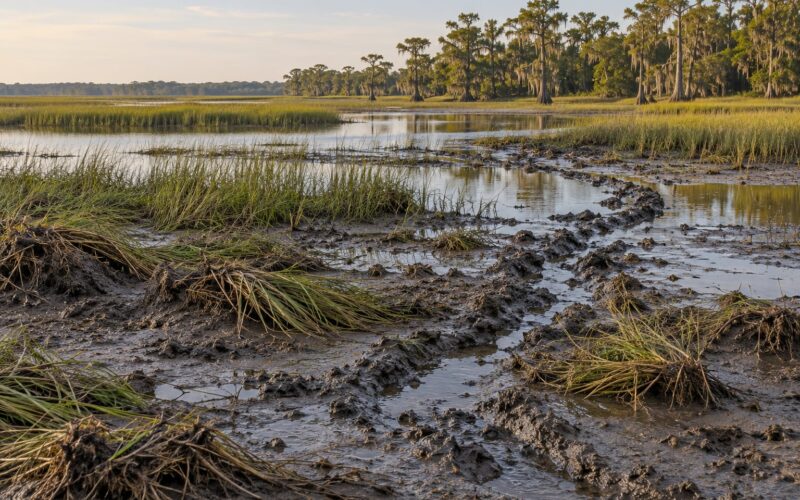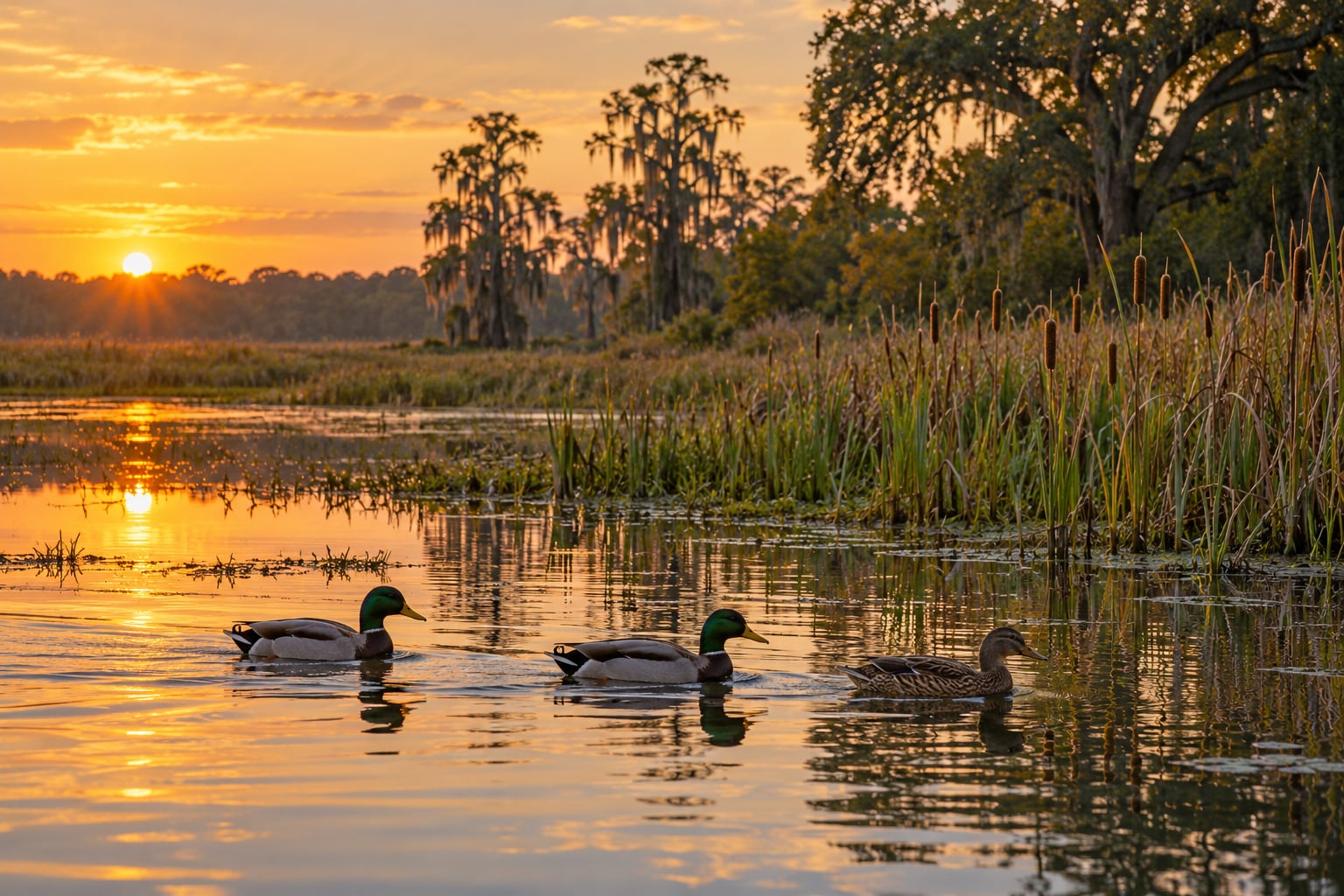
Federal duck stamps fund wetland conservation because 98 cents of every dollar spent on them is deposited by law into the Migratory Bird Conservation Fund, and the Migratory Bird Conservation Commission then approves how that money is used. In practice, the U.S. Fish and Wildlife Service spends it buying wetland outright, placing land under conservation easement, leasing it, or awarding matching grants through the North American Wetlands Conservation Act.
The stamp itself carries a 25 dollar face value, and it is required before anyone hunts migratory birds in the United States. Since 1934, sales have raised more than 1.3 billion dollars for habitat work that now protects over 6 million acres of wetlands nationwide.
Here is the honest version of the mechanism, including the parts that get argued about in hunting forums and birding circles.
Table of Contents
- What Are Federal Duck Stamps?
- Who Buys Federal Duck Stamps?
- How Federal Duck Stamps Fund Wetland Conservation
- How the Money Moves From Sale to Habitat Project
- What Lands and Habitat Projects Are Funded?
- Who Can Submit a Project for Duck Stamp Funding?
- How Federal Duck Stamps Fund Wetland Conservation in Practice
- How Much Money Does the Program Raise?
- How Are Conservation Results and Accountability Tracked?
- Why Does the Duck Stamp Program Matter?
- Frequently Asked Questions
- How much of a federal duck stamp goes to wetland conservation?
- Do federal duck stamp proceeds pay hunters or provide hunting access?
- Can duck stamp money be used for private land?
- What kinds of projects receive federal duck stamp funding?
- Does every duck stamp dollar create new wetland acreage?
- Conclusion: Start with the U.S. Fish and Wildlife Service
What Are Federal Duck Stamps?
A federal duck stamp is the Migratory Bird Hunting and Conservation Stamp, an annual revenue stamp sold by the U.S. Fish and Wildlife Service. It is not a license by itself; it is the federal prerequisite that sits alongside your state waterfowl hunting license.
The legal foundation runs back to the Migratory Bird Conservation Act of 1929, which created the Migratory Bird Conservation Commission and gave federal agencies authority to protect birds. The Migratory Bird Hunting and Conservation Stamp Act of 1934 added the purchase requirement and, crucially, attached the revenue to a dedicated fund.
State waterfowl stamps are a completely separate system. A state stamp pays for state license plates, state game management areas, and that state’s own hunter programs. Only the federal stamp money flows to the Migratory Bird Conservation Fund, which is why the two are not interchangeable when you are tracking conservation dollars.
Who Buys Federal Duck Stamps?
Anyone who hunts migratory game birds, which in practice means ducks, geese, and coots, must carry the current federal stamp. The stamp is valid from July 1 through June 30, so the hunting season of one calendar year and the stamp year do not line up neatly.
The exemptions are narrow. Persons who are blind or otherwise visually impaired, and Alaska residents hunting on the islands of the Alexander Archipelago, are not required to buy one. States cannot waive the requirement on their own, and a state license does not substitute for it.
You can buy the stamp at many post offices and retail outlets, or order it online from the Fish and Wildlife Service, which mails it before opening day if you order early. Physical stamps need to be carried with your license while you hunt; most states also record the electronic stamp number in their licensing system.
Birders use the stamp too, though they are not required to. It doubles as a free annual entrance pass to any National Wildlife Refuge that charges an entry fee, for anyone 16 or older. Plenty of non-hunters buy a second stamp as a straight donation.
How Federal Duck Stamps Fund Wetland Conservation
The money path is short and it is written into statute rather than negotiated each year in an appropriations bill. That is what separates this program from most federal land spending, and it is why the balance has grown every year since 1934 without a single annual appropriation fight.
| Stage | What happens | Who handles it |
|---|---|---|
| Sale | Stamp sold at a post office, retail outlet, or through the Fish and Wildlife Service online store | Authorized stamp outlet |
| Deposit | 98 cents of every dollar goes to the Migratory Bird Conservation Fund; the remaining 2 cents covers stamp production and distribution | U.S. Treasury |
| Proposal development | Agency and partner projects are described, costed, and ranked | USFWS Division of Realty |
| Review | Commissioners examine projects against Waterfowl Management Plan and flyway priorities | Migratory Bird Conservation Commission |
| Approval | Funding is approved at twice-yearly meetings, typically announced by the Department of the Interior | MBCC |
| Acquisition or grant | Fee title purchase, conservation easement, lease, or a cost-share grant through NAWCA | USFWS and partner sponsors |
| Management | Refuge staff or partner organizations restore, monitor, and hold the land in public trust | Refuge managers, Ducks Unlimited, state agencies |
One correction to a common assumption: stamp sales are the largest single source of Migratory Bird Conservation Fund revenue, but not the only one. Import duties collected on arms and ammunition go into the same pot, as do appropriations under the Wetlands Loan Act, land disposals, rights-of-way sales, and refuge entrance fees.
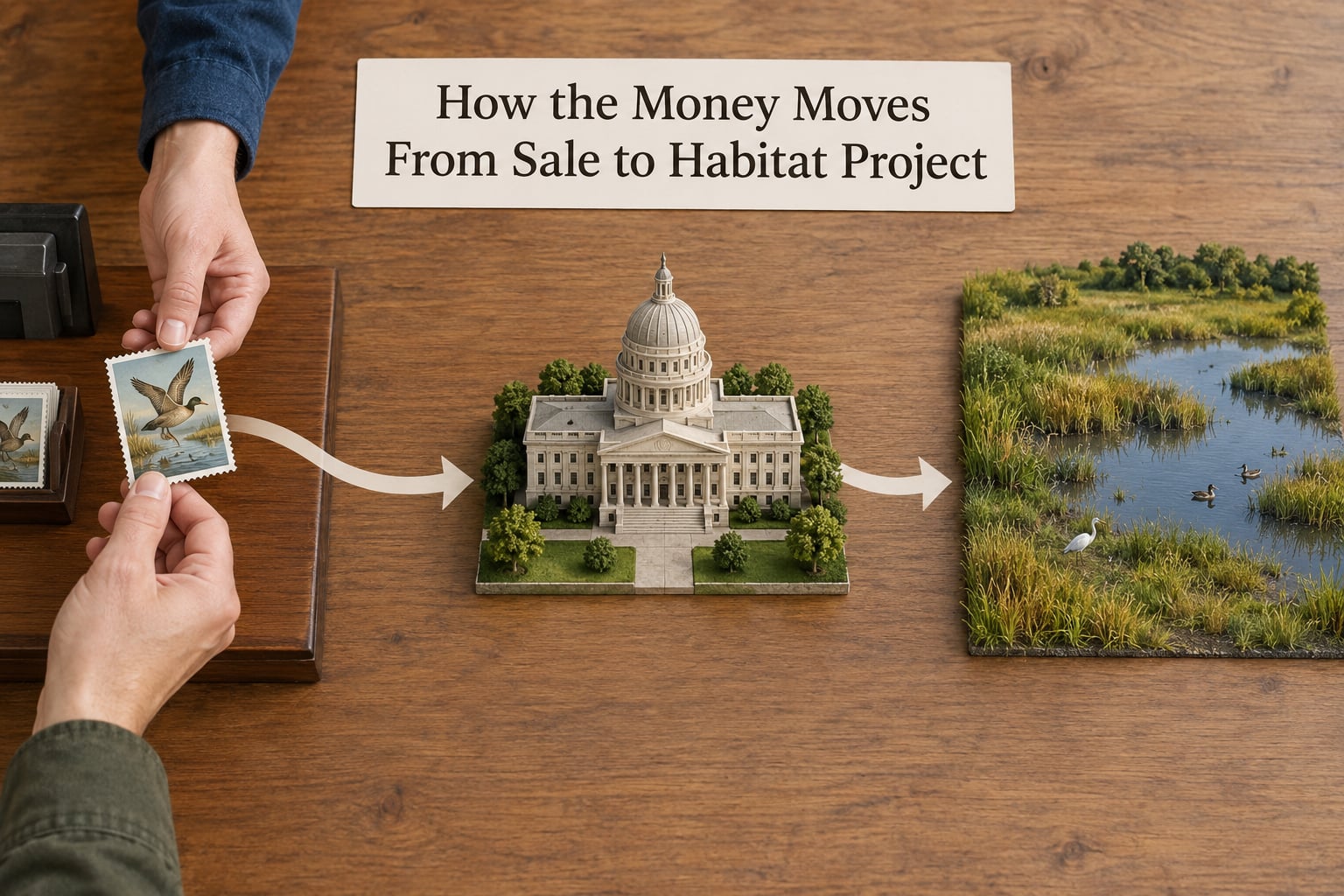
How the Money Moves From Sale to Habitat Project
A single stamp is not tied to a single project. Nobody rings up a bird and gets an acre in return. The fund pools, the commission allocates, and the money lands wherever the habitat case is strongest that cycle.
- The stamp sells through an authorized outlet. Federal agencies distribute the stamps, and each sale routes 98 cents of the dollar into the Migratory Bird Conservation Fund.
- The Fish and Wildlife Service Division of Realty develops acquisition and grant proposals, working with state wildlife agencies, tribal nations, and nonprofit conservation groups.
- Projects are ranked against the North American Waterfowl Management Plan and flyway-level habitat priorities.
- The Migratory Bird Conservation Commission reviews the list at its twice-yearly meetings and votes on which projects get funded.
- Approved money goes out as a fee title purchase, an easement payment, a lease, or a NAWCA grant.
- For grants, the partner supplies a matching share, so an approved MBCF dollar can bring more conservation dollars into the project.
- Refuge staff and partners restore and monitor the habitat for the long term, which is what turns a purchase into permanent protection.
What Lands and Habitat Projects Are Funded?
Money can reach a project in four legal forms. Fee title purchase means the refuge or partner agency owns the ground outright. A conservation easement pays a landowner and removes the right to develop, drain, or fill, while the landowner keeps ownership and often keeps farming or ranching. A lease is a shorter-term arrangement, commonly for Waterfowl Production Areas. A NAWCA grant supports work on land someone else owns, provided a partner matches the funds.
The habitat work on that land covers the usual restoration list: water-control structures that re-flood drained marshes, re-seeding with native wetland plants, control of invasive species such as tussock grass and Brazilian pepper, and management aimed at waterfowl nesting, brood-rearing, and wintering habitat along the Atlantic, Mississippi, Central, and Pacific flyways.
Waterfowl Production Areas are the category most people miss. These are smaller managed units, often in the Prairie Pothole Region, that function like mini-refuges without being full refuges. Stamp money buys them routinely.
National priorities do not override regional needs entirely. Flyway plans, state wildlife agency input, and regional habitat gaps shape the ranked list, so a project in the Dakotas competes on its own merits alongside one in Louisiana.
Who Can Submit a Project for Duck Stamp Funding?
Individuals cannot. The sponsors eligible for Migratory Bird Conservation Fund support are public agencies and established conservation organizations: the Fish and Wildlife Service, state wildlife agencies, tribal governments, and groups such as Ducks Unlimited or the North American Wetlands Conservation Council.
A private landowner does not apply for a grant for their own parcel. What a landowner can do is sell the land, accept a conservation easement, or sign a lease with the agency, and then the agency or a partner carries the funding application.
Selection is competitive. Proposals compete within the funding round rather than in a queue by application date, which is why a well-documented project with flyway priority and a matching partner often wins against an equally well-intentioned proposal with neither.
How Federal Duck Stamps Fund Wetland Conservation in Practice
A southeastern example makes the arithmetic concrete. In 2023 MBCC funding rounds, individual National Wildlife Refuge acquisitions included Green River NWR at 11,372,000 dollars for 1,335 acres, Clarks River NWR at 6,621,000 dollars for 2,482 acres, Grays Lake NWR at 6,240,000 dollars for 2,496 acres, and Cape Romain NWR at 5,000,000 dollars for 446 acres. Small acreage, high price per acre, and that ratio is the single biggest complaint about the program.
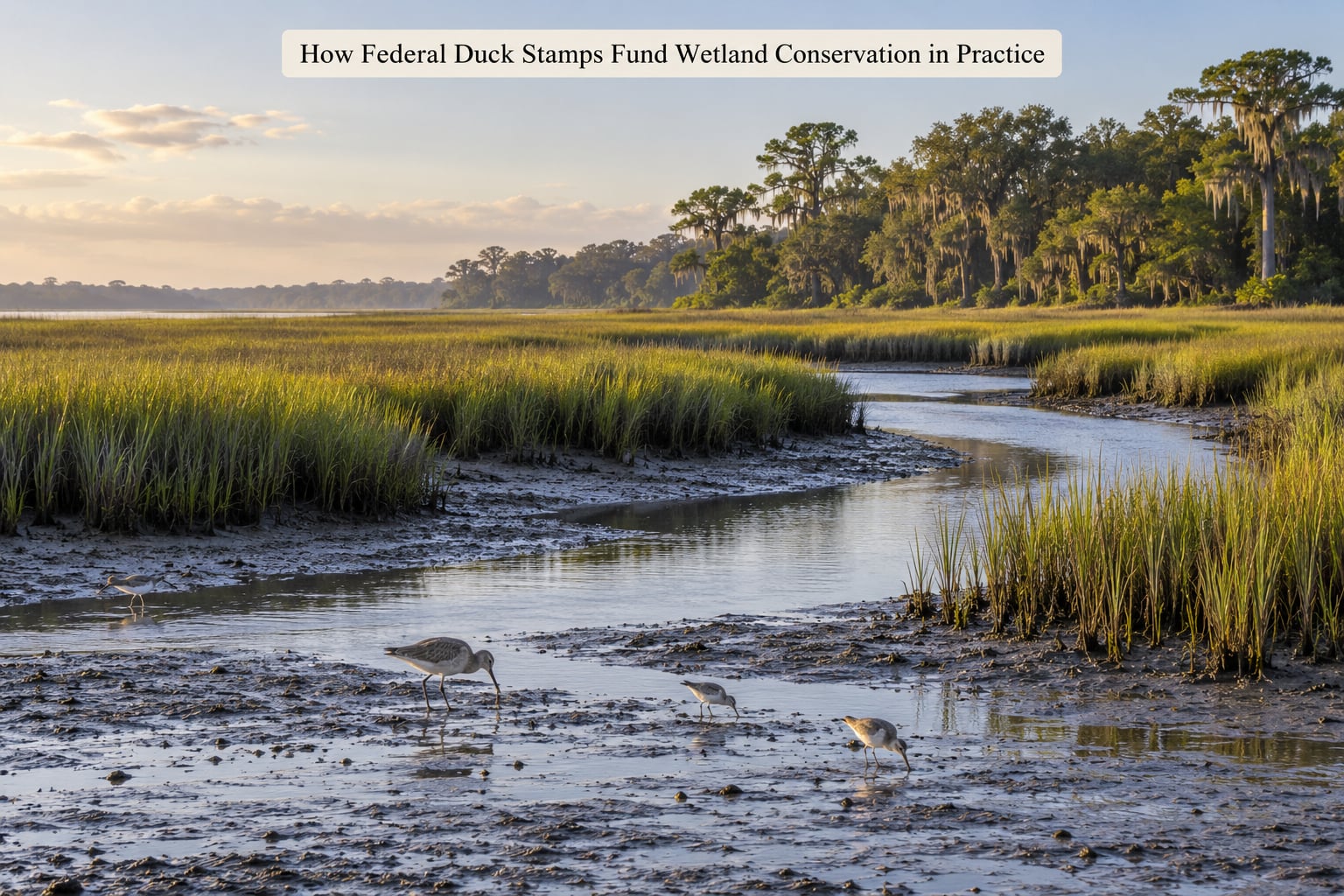
Those coastal and bottomland sites are not purchased for ducks alone. A Grays Lake or Cape Romain purchase carries wading birds like the black rail and piping plover, forage fish that support the shrimp and speckled seatrout anglers pull, tidal marsh that buffers storm surge, and oak and cypress forest that holds water through a dry autumn.
That wider value is real, but it is also the source of the resentment you will meet in waterfowl forums. Hunters hear that their 25 dollars helped buy a forest tract and conclude the program drifted from waterfowl. Sometimes the overlap is thin, and nobody spins that away.
How Much Money Does the Program Raise?
Annual totals move with stamp sales, import duty receipts, interest, and how large the approval rounds happen to be, so no single figure is a current total. Label the year and the round and the numbers are solid.
| Year and round | Amount approved | Acres or scope |
|---|---|---|
| April 2023 MBCC round | 146 million dollars | 242,000 acres conserved or restored |
| September 2023 MBCC round | 50.6 million dollars | 106,600 acres conserved or restored |
| September 2024 Interior Department release | More than 157 million dollars, including 11.7 million dollars from the MBCF | Wetland conservation projects across partners and refuges |
| FY2016 MBCF snapshot | 85 million dollars collected, 76 million dollars obligated | Program-wide revenue and commitments |
| Since 1934, program to date | More than 1.3 billion dollars | More than 6 million acres of wetlands habitat |
The gap between collected and obligated in the FY2016 snapshot is normal. Money lands in the fund faster than land appraisals, title reviews, and closing work can absorb it, so a carryover balance is a sign of a slow transaction process, not of waste.
How Are Conservation Results and Accountability Tracked?
The Fish and Wildlife Service reports acres purchased, leased, or restored, the refuge or partner holding each parcel, the habitat type, and the matching funds committed by partners. The Migratory Bird Conservation Commission publishes an annual report, and the Interior Department issues press releases when it approves a funding round.
Those are the places to check the money. The USFWS Realty Archives holds the MBCC meeting records and annual reports, DOI press releases carry the round totals, and the refuge acreage figures on the Fish and Wildlife Service MBCF refuges page let you compare totals over time.
Here is the discrepancy worth understanding rather than arguing about. You will see more than 6 million acres cited as the program’s conservation impact since 1934, and you will also see about 2.6 million acres purchased or leased at 264 national wildlife refuges as of 2024. Both are correct. The larger number covers the whole program, including NAWCA grants and Waterfowl Production Areas. The smaller number counts only direct Migratory Bird Conservation Fund acquisitions at refuges, and an older accounting cited 2,406,000 purchased acres plus 136,000 leased acres across 253 refuges.
Acreage alone also flattens quality. A 500-acre bottomland hardwood forest and 500 acres of brackish marsh are both 500 acres, and they serve entirely different species. Waterfowl use, plant diversity, and whether the parcel sits on a flyway bottleneck tell you more about the outcome.
Why Does the Duck Stamp Program Matter?
The structural argument is the strongest one. Because the funding comes from a purchase requirement rather than an annual appropriation, it has grown for over ninety years while most conservation programs flatlined or shrank. Purchased and eased land stays protected in a way that a funded restoration project does not.
Wetlands earn that protection back several times over. They filter sediment and nutrients out of water, hold back floodwater, store carbon in saturated soil, and feed fish, amphibians, insects, and birds well beyond the species named on the stamp.
There are real limits worth stating plainly. Cost per acre runs high in coastal real estate markets, so a big dollar total can buy a surprisingly small parcel. The commission that approves spending is made up of cabinet-level officials and members of Congress rather than elected refuge managers, which is a fair thing to object to in a program this large. And the hunter awareness gap is genuine: a 2017 study by Miller and Ahlers of Illinois waterfowl hunters found most respondents did not know how the funds were actually spent.
Legislation on the program has been pending too. The Duck Stamp Modernization Act of 2023 pushed for changes to issuance, design, and youth access, and it is part of an active legislative thread rather than settled policy.
Frequently Asked Questions
How much of a federal duck stamp goes to wetland conservation?
98 cents of every dollar spent on a federal duck stamp is deposited into the Migratory Bird Conservation Fund, which pays for wetland acquisition, easements, leases, and matching grants. The remaining 2 cents covers the cost of printing and distributing the stamps. That allocation is set in statute, not decided each year, and stamp sales have added up to more than 1.3 billion dollars since 1934.
Do federal duck stamp proceeds pay hunters or provide hunting access?
No. Proceeds from duck stamp sales fund habitat acquisition and restoration only. The stamp does not purchase a hunting license, and it does not open any hunting area. It does double as a free annual entrance pass to fee-charging National Wildlife Refuges for anyone 16 or older, so birders and sightseers get a benefit from it, but hunters get no direct rebate.
Can duck stamp money be used for private land?
Indirectly, yes. Migratory Bird Conservation Fund money can pay a landowner for a conservation easement or a lease, or it can fund restoration on private land through a matching grant to an eligible partner such as Ducks Unlimited or a state wildlife agency. No individual landowner receives a direct grant application from the fund for their own parcel.
What kinds of projects receive federal duck stamp funding?
Four main forms: fee title purchases, conservation easements, leases that include Waterfowl Production Areas, and cost-share grants under the North American Wetlands Conservation Act. Habitat work typically covers water-control structures, re-seeding with native wetland plants, invasive species control, and improving nesting, brood-rearing, and wintering habitat along all four North American flyways.
Does every duck stamp dollar create new wetland acreage?
No. Some approved money goes to restoring habitat on land that is already owned or protected, to leases rather than permanent acquisition, or to projects still moving through appraisal and closing. Programs often report more acres conserved than were newly purchased, which is why the more than 6 million acre program total is larger than the roughly 2.6 million acquisition-only acres at refuges.
Conclusion: Start with the U.S. Fish and Wildlife Service
How federal duck stamps fund wetland conservation comes down to four steps: 98 cents of every stamp dollar enters the Migratory Bird Conservation Fund, the Migratory Bird Conservation Commission approves projects ranked against flyway priorities, the Fish and Wildlife Service acquires or restores the land, and partners manage it afterward. That structure has put more than 1.3 billion dollars and millions of acres of habitat behind a purchase requirement rather than a budget line.
For current revenue reports, the latest approved project list, and this season’s stamp requirements, go straight to the U.S. Fish and Wildlife Service duck stamp pages and the Interior Department press releases. They publish the funding rounds faster than any secondhand summary can keep up with.