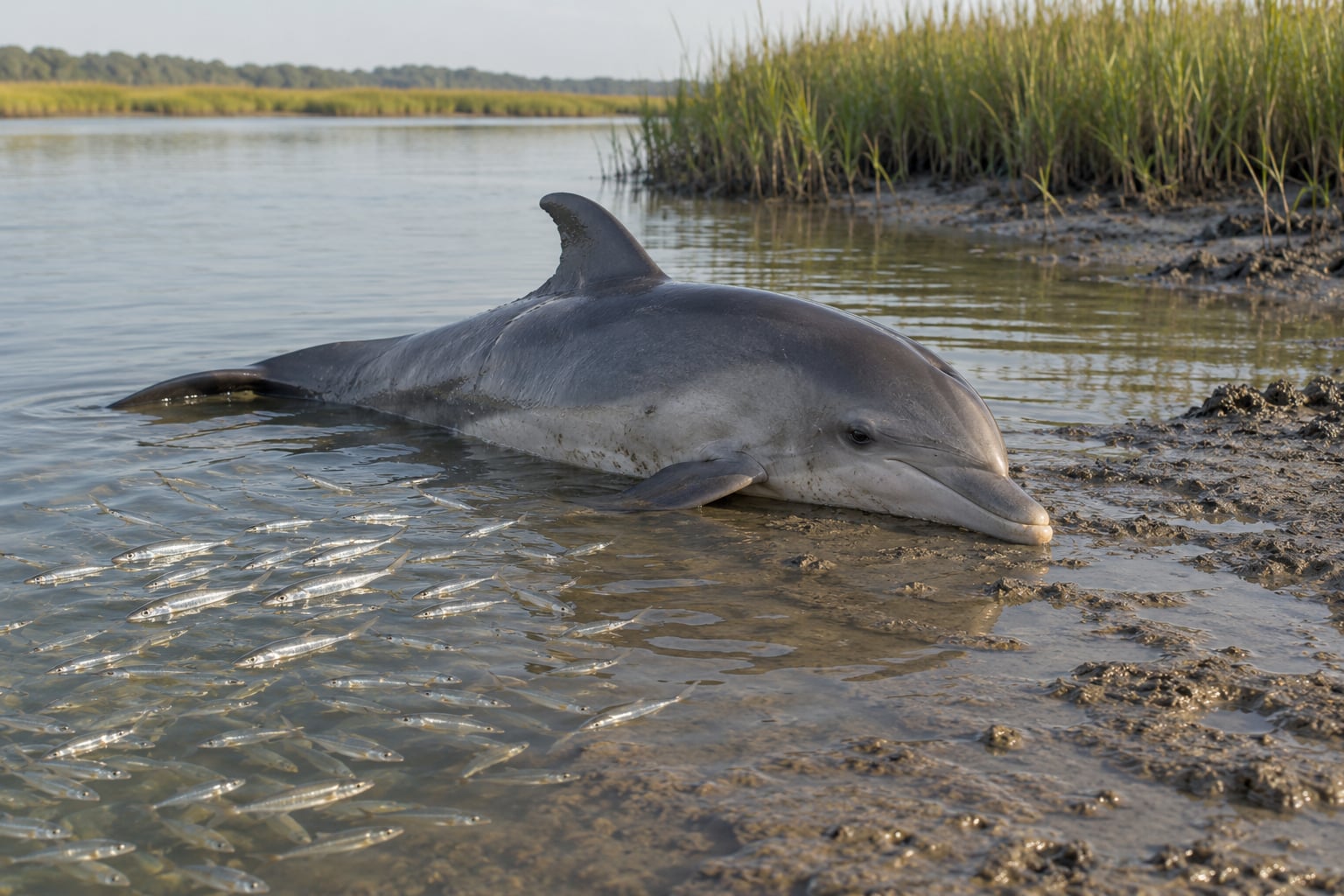
Strand feeding is a cooperative foraging behavior in which small groups of bottlenose dolphins herd baitfish into a tight ball, line up side by side, and surge onto a shallow shoreline together so the fish are left stranded in front of them. Instead of chasing prey through open water, the animals eat on the mud or sand and slide back into deeper water in seconds. It looks alarming the first time you see it. It is not, in almost every case, a dolphin in trouble.
I have watched this happen on tidal creeks in coastal South Carolina and Georgia more times than I can count, and the reaction from people on the bank is nearly always the same: somebody says the dolphin is stuck. That single misread is the reason this guide exists. Below I break down what strand feeding by dolphins actually is, how it works, when it happens, and how to watch it without ruining the event for the animals that are doing it.
A few words first, so the rest is easier. The dolphins doing this are almost always common bottlenose dolphins, Tursiops truncatus. The prey is almost always schooling baitfish, and in the Southeast that means mullet. The place is almost always a tidal creek, estuary, or open mud bank that has drained out with the falling tide. If you want the short version of everything else, the table further down maps the signs you are watching for to what each one means.
Table of Contents
- What Is Strand Feeding by Dolphins?
- How Do Dolphins Catch Fish at the Water’s Edge?
- Why Do Dolphins Strand Feed?
- Which Dolphins Commonly Strand Feed?
- How to Tell Strand Feeding by Dolphins From a Real Stranding
- What Conditions Make Strand Feeding Easier to Spot?
- Is Strand Feeding Dangerous for Dolphins?
- How Can You Watch Strand Feeding Responsibly?
- What to Do If You See a Dolphin Feeding on the Shore
- Frequently Asked Questions
- Is strand feeding the same as a dolphin stranding?
- Do all bottlenose dolphins strand feed?
- What time of day is best for seeing strand feeding?
- Where is the best place to see strand feeding dolphins?
- Are strand feeding dolphins in danger?
- Why are dolphins being herded onto the shore?
- Conclusion
What Is Strand Feeding by Dolphins?
Strand feeding is a cooperative foraging technique. A group of dolphins, typically two to six animals, pushes a school of baitfish into a tight bait ball and drives that ball toward a shoreline. At the last moment the animals accelerate together, ride their own bow wave up onto the bank, and pick fish off the exposed mud before sliding or bounding back into the water.
The key word is cooperative. One dolphin cannot strand feed. The pressure wave that traps the fish comes from several bodies moving at once, in a horizontal row, and the fish only get stranded if the group keeps the ball compressed right up to the shoreline. Break the formation and the technique fails.
Two other distinctions matter before you go further. First, this is a feeding event, not a stranding event. A stranded dolphin is usually alone, often on a beach with no water access, and does not repeat the behavior. A strand feeding group comes back to the same creek on later tides. Second, the technique depends on a specific piece of geography: a gently sloping bank with no oyster bed or rock cover on it. That single requirement is why strand feeding dolphins are rare even where bottlenose dolphins are everywhere.
Wildlife watchers in the Lowcountry also use the terms surf feeding and bank feeding loosely for the same thing. You will see it called all three in local reports, so do not read those as three different behaviors.
How Do Dolphins Catch Fish at the Water’s Edge?
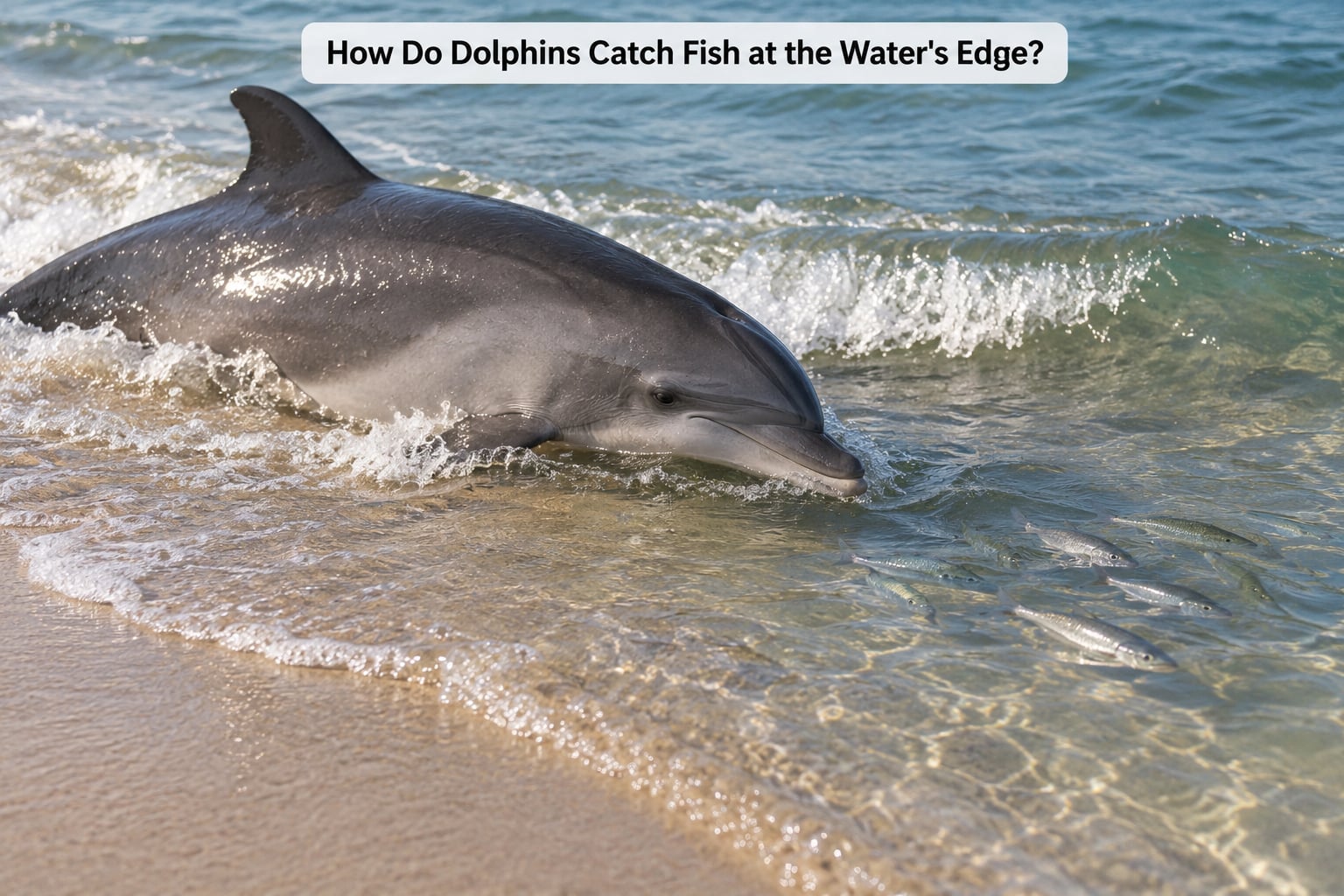
The sequence is remarkably consistent once you know what to look for. Five steps cover almost every observation on record.
- Corral. Two to six dolphins locate a school of baitfish in a creek or near a shoal and push it inward, away from open water. The fish respond by tightening into a bait ball.
- Align. The dolphins spread into a horizontal line abreast of each other, roughly parallel to the bank. This row is the working formation. Width matters, because the group needs to cover the escape routes along the shore.
- Charge. They accelerate together toward the bank. The bow wave each body generates pushes water and fish ahead of it, and the sum of those waves is what drives the ball up onto the mud.
- Beach and feed. Each dolphin rides the surge out of the water, grabs fish directly, and gets back off the bank. The animals take turns rather than all beaching at once.
- Reset. Any fish that got past them goes back into the creek. Usually the group re-forms the row and runs the technique again within a minute or two.
That last step is the one that settles the argument for most skeptics. A distressed animal does not square up and repeat the maneuver on the next pass.
Here is how the visible signs map to what is actually happening.
| Sign you see | What it suggests |
|---|---|
| Two or more dolphins in a straight line, same heading, same speed | They are setting up the row formation before a run at the bank |
| A tight, silvery cluster of fish turning together near shore | That is the bait ball under compression; herding is working |
| Visible splash or spray as the group hits shallow water | The bow wave phase, the moment the ball gets pushed onto the bank |
| One dolphin partly out of the water, mouth at the mud line | An individual feeding pass, not a stuck animal |
| The group repeats the maneuver after returning to the water | Confirms deliberate feeding behavior rather than accidental grounding |
| A single dolphin lying still, not responding, on open beach with no creek nearby | Possible stranding or injury, not strand feeding |
| Dolphins lingering where the tide has just covered a bank | Normal low-tide foraging, not the coordinated technique |
Newborn calves have been recorded taking part in these runs, identifiable by the vertical crease lines called fetal folds still visible on a very young animal’s body. Calves generally stay in deeper water close to an adult, which is also how you can tell a feeding pass from a calf being inadvertently caught up in the maneuver.
Why Do Dolphins Strand Feed?
There is no single published reason, but the ecological pieces line up well. Start with prey density. Baitfish in an estuary bunch up in shallow water over mud and sand flats where they can feed on whatever the tide exposes. A concentrated ball of fish in ankle-to-calf-deep water is an easy target, and it is available in a place where a chasing dolphin cannot build speed.
Chasing fish costs energy. Dolphin bodies are built for sustained high-speed pursuit in open water, not for a sprint over a mud bank. Strand feeding lets a group catch prey that would otherwise be unattainable without a long chase, and it takes seconds per fish instead of a minute of high-speed swimming.
Geometry is the third factor. The bank has to slope gently enough that the bow wave carries fish far enough up to strand them, but steep enough that the dolphins can slide back into water immediately. A bank studded with oyster beds or rock is close to unusable, because beaching onto it risks injury to the dolphin and cuts off the return path.
Then there is the tide and the learned part. A resident pod that returns to the same creek builds site knowledge of which banks work and when. Calves learn the technique by watching adults and by being allowed to participate near an experienced animal. The same behavior also has to be learned, so resident pods strand feed while migratory visitors passing through the area generally do not.
None of this is distress, and it is worth being blunt about the distinction. Entanglement in fishing gear, a bad reaction to a boat, or an injury can leave a dolphin on the mud for hours. Strand feeding animals are on the bank for seconds and then swim back.
Which Dolphins Commonly Strand Feed?
Common bottlenose dolphins, Tursiops truncatus, are the species most often recorded doing it, and the coastal resident populations are the ones doing it. That distinction carries all the weight: migratory individuals passing through an estuary usually hunt in deeper water and have no reason to learn a shoreline technique.
In the United States, the behavior is best documented in the Lowcountry of South Carolina, where tidal creeks and open mud banks are common. Locals and researchers have recorded it around Bull Creek, May River near Bluffton, Capn Sams Spit, and in the Kiawah River near Captain Sam’s Inlet, among other places. The South Carolina Department of Natural Resources has cited it as a normal seasonal behavior in that coastal system, and a peer-reviewed observational paper on strand feeding by bottlenose dolphins in Bull Creek is the most useful primary source available on the mechanics.
Elsewhere, shore-based cooperative feeding by bottlenose dolphins has been recorded in other warm, shallow, productive systems. The technique is not exclusive to one American coastline, but the published record is thin and the specific sites are local knowledge more often than literature. Treat any named spot you have not heard of as unconfirmed until someone shows you dated evidence.
Do not expect it everywhere dolphins live. It is absent from many resident populations in entirely suitable-looking habitat, which is the strongest argument that this is a cultural behavior rather than a universal instinct.
How to Tell Strand Feeding by Dolphins From a Real Stranding
| Strand feeding | Mass stranding or a stranded animal |
|---|---|
| Two to six animals, coordinated, moving together | Usually one animal, or many animals scattered and unresponsive |
| Repeated runs at the bank, then back to water | No repetition, no attempt to move back to the channel |
| Alert, fast, follows the group | Sluggish, listing, breathing heavily at the surface or not surfacing normally |
| On the bank for seconds at a time | Out of the water for hours |
| On a creek bank that still connects to water | On open beach, marsh or a mud flat cut off by the tide |
| No action needed, keep your distance | Report it to a stranding hotline or state wildlife agency |
If you cannot tell which one you are looking at, assume nothing is wrong only if the animals are clearly behaving as a group and returning to the water. The moment that stops, it stops being a feeding event.
What Conditions Make Strand Feeding Easier to Spot?
Reading strand feeding dolphins off a tide table is easier than most people expect, because the animals are working with the same water level you are. The window is generally the last stretch of the falling tide into low water and the first part of the flood, when shallow banks are exposed and fish are concentrated on them. Best results usually come in the couple of hours either side of low tide.
Early morning and late afternoon tend to hold more light and less boat traffic, and that combination matters more for photography than for the dolphins themselves. Fall through early winter is reported as a stronger season in parts of the Lowcountry, largely because of how the baitfish move as the water cools.
| Condition | What it tends to offer |
|---|---|
| Falling tide into low water | Exposed mud banks, concentrated baitfish, the best odds of a full sequence |
| Gently sloping mud or sand bank | The surface the technique actually needs |
| Bank free of oyster beds and rock | Safe beaching and a clear return path to water |
| Tidal creek or estuary with an active mullet school | Something worth herding in the first place |
| Calm surface, little wind chop | Easier to see the row formation and to photograph or film it |
| Very low or very high tide | Often too deep or too exposed; the technique needs the middle ground |
| Heavy boat traffic in the channel | More risk to the animals, and the group often abandons the attempt |
None of this guarantees a sighting. A pod that knows a spot will simply be somewhere else on a given tide, and locals describe the technique as reliable at a few sites and completely unpredictable at most. Treat the tide table as a reason to get outside, not a promise.
Is Strand Feeding Dangerous for Dolphins?
Yes, there are real risks, and the answer is more useful than a simple yes or no. A competent dolphin does this regularly and comes off the bank cleanly, because animals that could not do that would not keep attempting it. The hazards come from the environment and from people.
- Propulsion injuries. A feeding happens a few feet from shore in a channel that is still navigable. A boat coming through at speed converts a feeding event into a serious injury.
- Boat traffic. More boats mean more disturbance, and a disturbed group abandons the run rather than risk a collision.
- Bad banks. Oyster beds and rock make beaching hazardous. The dolphins prefer smooth banks for good reason.
- Stranding risk. A rising tide can cut off a shallow bank faster than an animal expects, particularly if it is distracted or injured.
- Human crowding. Beachgoers who surround a feeding group on foot cause the technique to fail outright, and the animals abandon the area.
- Dropped fish. Baitfish left behind on the mud draw scavengers and shorebirds, which is normal, though repeated human interruption keeps the animals from feeding efficiently.
An animal that is genuinely stuck tends to look different. It lies still, gives weak or irregular responses, does not re-form with others, or sits where the water cannot reach it. If you see that, treat it as a rescue situation and report it rather than photographing it.
How Can You Watch Strand Feeding Responsibly?
Watching from shore is the whole answer to most of this section. You do not need a boat, and a boat adds risk to the animals and none to your experience.
- Give the dolphins space. Well back on the bank, with a clear view of their escape route to the creek. If they break off and move away, you were too close.
- Do not surround or approach them. Standing between a feeding group and the water ends the event.
- Never touch or feed a wild dolphin. Not to help, not to take a photo closer, and not with bait. Dolphins that approach people are usually in trouble, not friendly.
- Keep the tide channel clear. If you are in a boat, give the area a wide berth and never approach a feeding group.
- Leave drones grounded. Under federal marine mammal protection rules, flying a drone over marine mammals for filming or observation is not legal. Drone footage circulating locally does not make it legal.
- Skip flash and noisy shutters. Silence and a longer lens get you a better photo without pushing the animals off.
- Follow posted rules. Coastal reserves and state parks carry their own rules about approach and drones, and they are stricter than the baseline federal rules.
On swimming with wild dolphins, the practical answer is that it is a bad idea regardless of the question. Wild animals carry marine animal disease risks, and swim-with programs built around captive and provisioned animals were wound down after research showed the provisioning itself changed the animals’ behavior. That is a separate issue from strand feeding, but the same restraint applies.
What to Do If You See a Dolphin Feeding on the Shore
- Back up and stop moving toward them. Watch from where you are for a minute and let the sequence play out.
- Look for repetition. Group movement, a second run at the bank, and animals returning to the water all confirm normal feeding.
- Check for a single unresponsive animal. One dolphin lying still, out of the water, with no group around it is a different situation entirely.
- Do not enter the water or lift a dolphin back. Handling causes stress and can injure both you and the animal.
- Report genuine strandings. In the United States, use the NOAA Marine Mammal Hotline in South Carolina and nearby coastal states, or your state wildlife agency. Photos from a distance help responders.
- Note the location and time. For a normal feeding event, a log entry with the tide stage is genuinely useful to anyone tracking this behavior locally.
Most calls that reach volunteers on the Lowcountry turn out to be strand feeding, and local beach-watching programs have had to run beachgoer education sessions for exactly that reason.
Frequently Asked Questions
Is strand feeding the same as a dolphin stranding?
No. Strand feeding is deliberate cooperative hunting: a group of bottlenose dolphins drives baitfish onto a shallow bank, feeds for a few seconds, and returns to the water. A stranding is a single animal, or many animals, out of the water and unable to get back, usually with no feeding behavior and no repetition. Group coordination and repeated runs are the clearest signs you are watching feeding, not a rescue situation.
Do all bottlenose dolphins strand feed?
No, and that is one of the most interesting things about the behavior. It shows up in some resident coastal populations, particularly in the Lowcountry of South Carolina, while migratory dolphins passing through the same water usually do not do it. Because calves learn the technique by watching adults, it appears to pass between generations. Habitat alone does not explain it, which is why researchers treat it as a culturally transmitted behavior rather than an instinct.
What time of day is best for seeing strand feeding?
Tide matters more than clock time. The window runs from the last part of the falling tide through low water and into the early flood, when shallow banks are exposed and baitfish are concentrated on them. Early morning and late afternoon add better light and less boat traffic, which makes the event easier to see and safer for the animals. Fall through early winter is often reported as a stronger season in parts of the Lowcountry.
Where is the best place to see strand feeding dolphins?
The best-documented area is coastal South Carolina, especially the tidal creeks and mud banks of the Lowcountry. Locals and researchers have recorded the behavior around Bull Creek, May River near Bluffton, Capn Sams Spit, and the Kiawah River near Captain Sam’s Inlet. Tide stage matters as much as the spot: the last hours of the falling tide into low water give the best odds. No location is guaranteed, since a familiar pod may be somewhere else entirely.
Are strand feeding dolphins in danger?
The animals are not in danger from the feeding itself, but the circumstances carry real risk. A feeding happens in shallow water a few feet from shore, so boat traffic and propulsion injuries are genuine concerns, and a rising tide can cut off a shallow bank. Human disturbance is the risk people control: crowding a feeding group on foot causes the technique to fail and pushes animals away from an area they rely on. Watching from a distance keeps both the event and the site intact.
Why are dolphins being herded onto the shore?
The prey is what draws them, and shallow water concentrates it. Baitfish gather over exposed mud and sand flats as the tide drops, and a school in calf-deep water cannot build up enough speed to escape a charging predator. Working together, the dolphins push the ball toward the bank and ride their own bow wave up onto the mud, then grab fish without diving. It is a low-energy technique that lets them catch prey they could not chase down in open water.
Conclusion
Strand feeding is a cooperative hunting technique, not a distress event. A small group of bottlenose dolphins herds baitfish into a ball, lines up abreast, and surges onto a shallow bank so it can grab fish without diving, then returns to the water and does it again. That repetition and group coordination are exactly what separates it from a stranding.
Start by watching from a distance, well back from the creek, and give the animals an open escape route to the water. Time your visit to the falling tide into low water, and be aware that a familiar site can be empty on any given day. If a single dolphin is lying still and cannot get back to the channel, that is the one situation worth a phone call to a stranding hotline or your state wildlife agency. Updated guidance on viewing wildlife on tidal creeks changes often, so check current rules before you go.