If you find a bird wearing a numbered leg band, the answer is simple: go to reportband.gov, the reporting portal run by the USGS Bird Banding Laboratory at the Patuxent Wildlife Research Center, and submit the band number along with the species, the date, the exact location and how to reach you. That takes about five minutes. The band is a research record, not litter, and the report is the only way it ever gets matched back to the researcher who put it there.
Below is the field-first version of that process: how to look at the bird without stressing it, how to get a legible photo of the number, and what to send when you have only half the information. If the bird is hurt or tangled, skip straight to the injured-bird section, because that is the one situation where a phone call beats a web form.
Table of Contents
- What You Need
- How to Report a Banded Bird You Found: Step-by-Step
- Step 1: Keep a Safe Distance and Observe the Bird
- Step 2: Identify the Species and Band Type
- Step 3: Record the Band Number and Sighting Details
- Step 4: How to Report a Banded Bird You Found Safely
- Step 5: Confirm What Happens Next
- Common Mistakes
- Frequently Asked Questions
- Should you report banded birds you see?
- What do the numbers on a bird leg band mean?
- What if I cannot read the band number?
- What if reportband.gov will not load?
- Should I report a racing pigeon band or a state game bird band?
- What if the banded bird is injured or entangled?
- What to Do First
What You Need
You need very little. Most people who submit a perfectly good report are doing it with a phone and ten minutes of patience.
- Binoculars, or a camera with a zoom lens. Digiscoping with a phone through a spotting scope works fine too, and so does a good pair of 8x42s for anything larger than a sparrow.
- A phone or notebook for the date, time, coordinates and behavior. Write it down before you pack up, because memory for numbers gets unreliable fast.
- A field guide or a bird ID app for the species. “Unknown bird” is an acceptable entry, but a real identification is worth far more to the project.
- Free photo editing so you can crop and sharpen the band image at home. This is the single biggest upgrade to your report quality.
- The exact spot noted as you watch, ideally as coordinates or a clear description of habitat, trail and nearest landmark.
What you do not need is as important. Do not buy or borrow leg bands, pliers, band cutters, hose clamps or any kind of restraint equipment. Federal bands come off with specialized tools used by trained personnel, and improvised removal can cut the bird’s leg or start a lawsuit under the Migratory Bird Treaty Act.
Never re-catch a banded bird to read its number. It is not worth it to you, and it costs the bird stress plus part of a leg.
How to Report a Banded Bird You Found: Step-by-Step
Step 1: Keep a Safe Distance and Observe the Bird
Stay where the bird already has room. Birds that are foraging or perched in open cover will tolerate a distant observer; birds that flush and keep moving are telling you the encounter costs them more than the record is worth.
Do not chase, corner, feed or call the bird in. Do not flush a sitting bird to get a better look at the leg. Sit or stand still for a minute, take a breath, and let the bird settle before you start shooting.
Work out whether the band is still attached. A metal ring on the leg, a colored plastic ring on the tarsus, a numbered wing tag, or a small antenna above the back each mean different things and each have a different reporting route. If the band is lying on the ground with no bird, skip to the loose-band notes further down.
If the bird is calm and behaving normally, you are cleared to continue.
Step 2: Identify the Species and Band Type
Identify the bird first, the marker second. A band number without a species is much less useful, because the same number could belong to a different bird in another project.
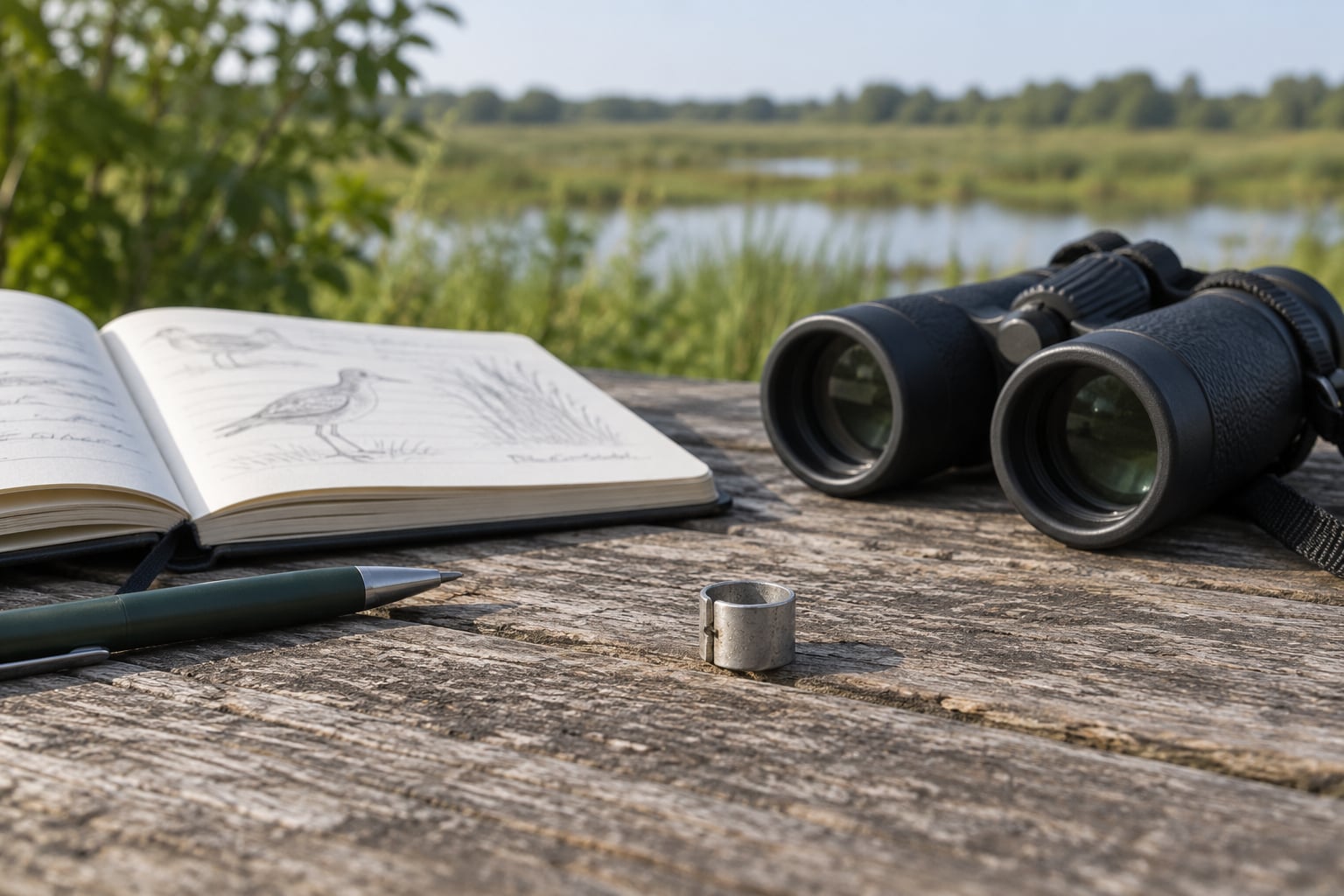
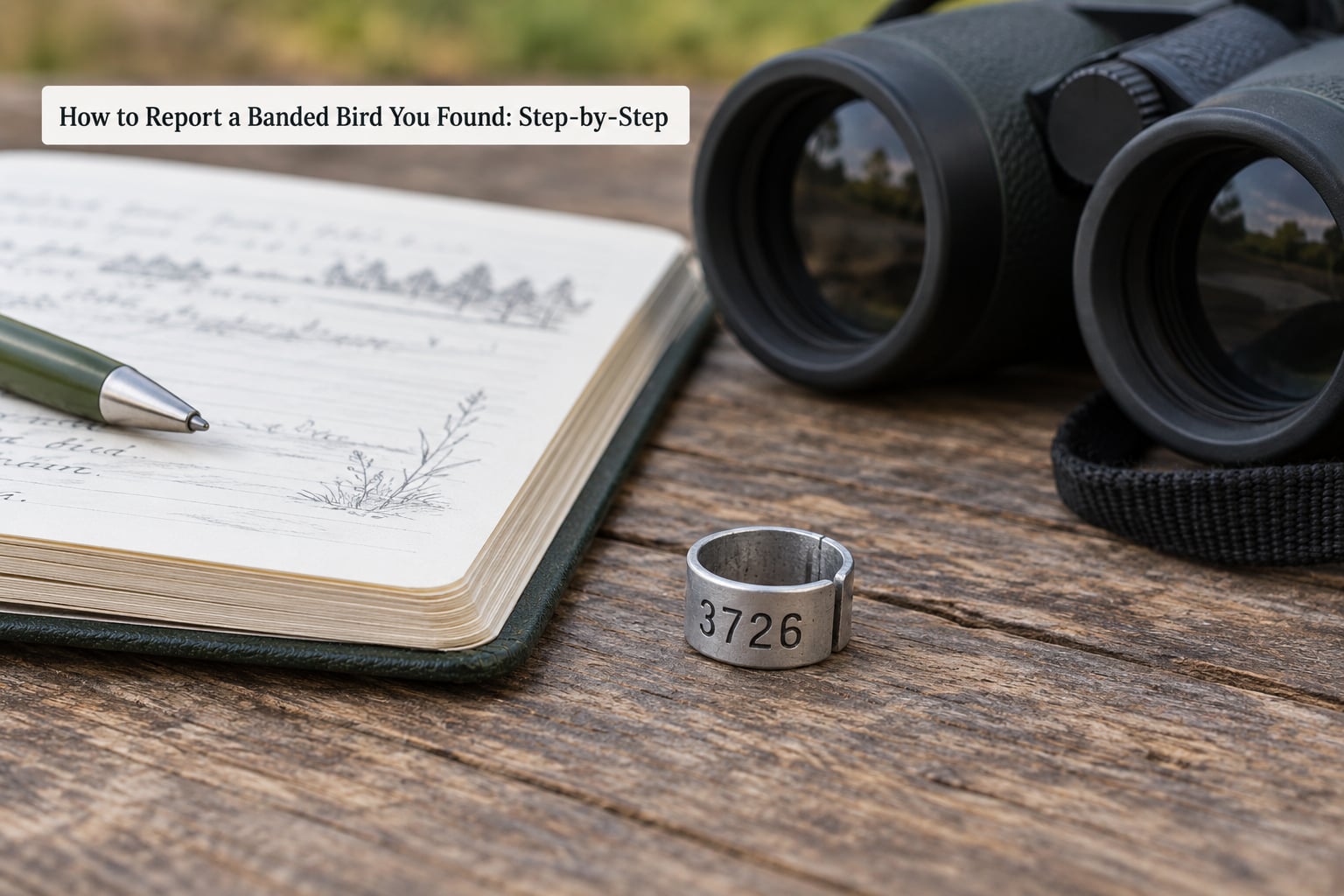
Federal bands are small aluminum or steel rings with a unique nine-digit code: a four-digit prefix, a hyphen, then a five-digit suffix. They usually carry www.reportband.gov stamped on the metal. Older bands from before the web portal existed carry a phone number instead, and those still go through the same website.
Color bands are unnumbered plastic rings read as a combination rather than a serial. Many projects follow a convention of females on one leg and males on the other, but plenty of species invert it, so record colors and leg position exactly as you see them rather than inferring.
Wing tags are numbered plastic or metal markers used on larger birds and birds too small to leg band. Radio transmitters are the battery-powered antenna units on the back or leg of raptors, seabirds and some waterfowl, and those are reported to the state wildlife agency rather than to the Bird Banding Laboratory.
State bands show up on quail, grouse, pheasant, dove and other galliforms, which sit outside federal migratory bird jurisdiction. Racing pigeon bands are plastic leg rings from a homing club, not a research program. If you are unsure which category you have, describe the marking in plain words in the report and a biologist will sort it out.
Not being certain is fine. Say “band unreadable” or “color combination not fully resolvable” and the report still counts.
Step 3: Record the Band Number and Sighting Details
Getting a legible band number comes down to three things: light, angle and patience.
- Get light onto the band. A band on the shaded side of a leg reflects nothing and photographs as a gray blur. Shift a few steps, or wait for the bird to turn, rather than leaning in.
- Shoot bursts, not singles. Ten frames in a second gives you one where the number is level. Focus on the band, not the eye.
- Get the whole bird in one frame and the band in another. The wide shot documents the species and condition; the close shot documents the number. Submit both.
- Crop and sharpen at home. Enlarge to fill the frame, raise contrast slightly, and check the digits against the pattern in a federal band: four digits, hyphen, five digits.
Experienced birders also photograph whole flocks when a flock is moving, then scan the images on a computer afterward. Scanning a thousand distant birds for a flash of aluminum is far more productive than trying to read numbers in the field.
Write down the rest while you are still there: date, exact time, coordinates or a precise habitat description, species, number of birds, what the banded bird was doing, and the condition of the band itself, meaning worn, rusted, dented, partially obscured by feathers, or clearly too large.
Step 4: How to Report a Banded Bird You Found Safely
Start at reportband.gov. The portal is operated by the USGS Bird Banding Laboratory, which manages band inventory and encounter data for the Migratory Bird Treaty Act in coordination with Canada’s Bird Banding Office, so a report you file in Canada is handled through the same system.
The form asks for the data points above plus your contact information. Include an email address you actually read, because the reply comes there and it is the most interesting part of the whole exercise.
If the number is unreadable, use the photo upload path. Most versions of the form let you attach images and ask a biologist to read the band, which takes longer but succeeds on photos that look hopeless in the field.
Contact a state or regional coordinator instead when the band belongs to a project that does not use the federal system, when the bird was found on tribal land or inside a national park with its own banding program, or when you want a person rather than a form. A state wildlife agency will usually point you to the right bander.
When the bird is injured, entangled, trapped in a building or in immediate danger, the priority shifts completely. Call a state-authorized wildlife rehabilitator or your local wildlife agency. Never cut a band off an injured bird yourself, and never attempt a rescue that requires handling a wild bird without training.
If reportband.gov will not load, work down this ladder:
- Wait and retry. There is no official status page, but birders on r/birding and r/Ornithology have repeatedly found the portal simply down at certain hours, and it usually returns.
- Check your own connection and try a different browser or device before assuming the site is the problem.
- Email the state wildlife agency for the region where you found the bird. Agency staff will confirm receipt and help with an ambiguous band.
- Email the project or bander directly if you know which one placed the band, using the contact listed for the color-band project.
- Save your photos and notes and submit later. A report three days late is worth far more than one never filed.
Step 5: Confirm What Happens Next
Once submitted, your report is checked against the Report to Bander database at the Bird Banding Laboratory. The report is matched to the person who banded that bird, and that bander is notified.
If the match is not clean, a biologist may ask for a clearer image, a better date, or a corrected species. Keep the original files at full resolution so you can resend a crop without going back to the source photo.
If everything matches, you receive a certificate of appreciation, usually by email. It typically gives you the date and location where the bird was banded, its age or age estimate at banding, and sometimes the species and the project. A short-distance bird banded a few miles from your feeder can come back with a date a year earlier, which is the part people remember.
Set expectations honestly. Many reports produce a certificate quickly. Some produce nothing at all, and no reply does not mean the data was discarded. It still went into the record.
If the bird stays nearby, keep watching from the same safe distance and note anything that changes: a second band, a new color ring, a behavioral shift, or simply that it disappeared. Follow-up observations on the same bird are genuinely useful, especially for color-band projects tracking territory and lifespan.
Common Mistakes
- Cutting or loosening a band. Never. Bands are federally regulated markers under the Migratory Bird Treaty Act, and removal requires training and the right tools.
- Guessing at a partial number. A wrong digit sends the report to the wrong project and wastes the biologist’s time. Report the digits you can read and mark the rest as unreadable.
- Calling a general wildlife hotline about a healthy bird. Animal control and rescue lines are for emergencies. A calm banded bird is a reporting task, not a rescue.
- Posting precise coordinates publicly. Nesting and wintering locations for rare species can be sensitive. Share the detail with the biologist, not on a social media thread.
- Handling a stressed bird. If the bird is panting, struggling or repeatedly flying off, you already have your answer: stop and report what you saw.
- Re-catching the bird to improve the record. A partial report from a photograph is genuinely useful. A re-catch is not worth the stress to the bird.
Two field habits make the biggest difference. Get the sun behind you before you start, because bands are mirrors and they only give up their number when the light comes off them at an angle. And take one extra frame after you think you have the shot, since a bird turning its leg a few degrees is often the difference between a readable number and a gray smudge.
A few more situations worth knowing:
- Loose band, no bird. Report it with the location and date. Encounters from recovered bands still count, and it may simply have shed.
- Remains or a band at a kill site. Roadkill and raptor kill sites produce real predation data. Photograph the band in place, note the surroundings, and report it as a recovery.
- Color bands with no numbers. Yes, report them. Photograph every leg, record the color sequence and which leg each ring is on, and send it to reportband.gov along with the species.
- A rehab band. Bands placed by wildlife hospitals before release are still federal bands in most cases, so report them the same way.
- A bird found on private land. Report it, and note the managing organization or landowner if there is one. Many sites have their own banding program with its own records.
Frequently Asked Questions
Should you report banded birds you see?
Yes, every time you can do it without disturbing the bird. Band resightings feed long-term studies of migration, survival and lifespan, and there is no way to collect that data except from people who are already out there watching birds. A report takes about five minutes, and even a partial one, such as a single color band or an approximate date, is useful to the researcher who placed it.
What do the numbers on a bird leg band mean?
A federally issued leg band carries a unique nine-digit code made of a four-digit prefix, a hyphen and a five-digit suffix, and most also have www.reportband.gov stamped on the metal. The prefix identifies the project that placed the band and the band size. The whole string together is the bird’s individual identifier, and typing all nine digits into reportband.gov is what triggers the lookup.
What if I cannot read the band number?
Report it anyway. Attach your best photographs to the report and note in the description that the number is unreadable, then a biologist can attempt the read on a clearer version. Cropping and enlarging the original at home often recovers digits that looked impossible in the field. A report with a species, date and location but no number is still logged in the database.
What if reportband.gov will not load?
Retry later, and try a different browser or device first, because the portal goes down intermittently without a public status page. If it is still not working, email the state wildlife agency for the region where you found the bird and they will help or pass it along. Keep your photos and notes and submit the report later rather than letting a temporary outage lose the sighting.
Should I report a racing pigeon band or a state game bird band?
Not to the Bird Banding Laboratory. Racing pigeon bands are plastic homing-club rings and are not traceable research records. State bands on quail, grouse, pheasant and doves fall outside federal migratory bird jurisdiction, so report those to your state wildlife agency, which will pass them to the state upland game bird biologist. Bands with no recognizable state or federal marking go to the same place.
What if the banded bird is injured or entangled?
Call a state-authorized wildlife rehabilitator or your local wildlife agency, and do not attempt a rescue that requires handling a wild bird. Never cut the band off yourself, since improvised removal can injure the leg and the band itself is a federally regulated marker. Keep the bird warm, dark and quiet in a ventilated box while you wait, and let the professional decide whether the band can come off safely.
What to Do First
Observe without touching, keep your distance, and photograph the band and the whole bird together. Write down the location and the time while you are still standing there. Then submit the sighting to reportband.gov with the species, the band number or a note that it was unreadable, and an email address you actually read.
If the bird is hurt or tangled, call a wildlife rehabilitator instead of filing a form. If the site is down, save the photos and send the report later.