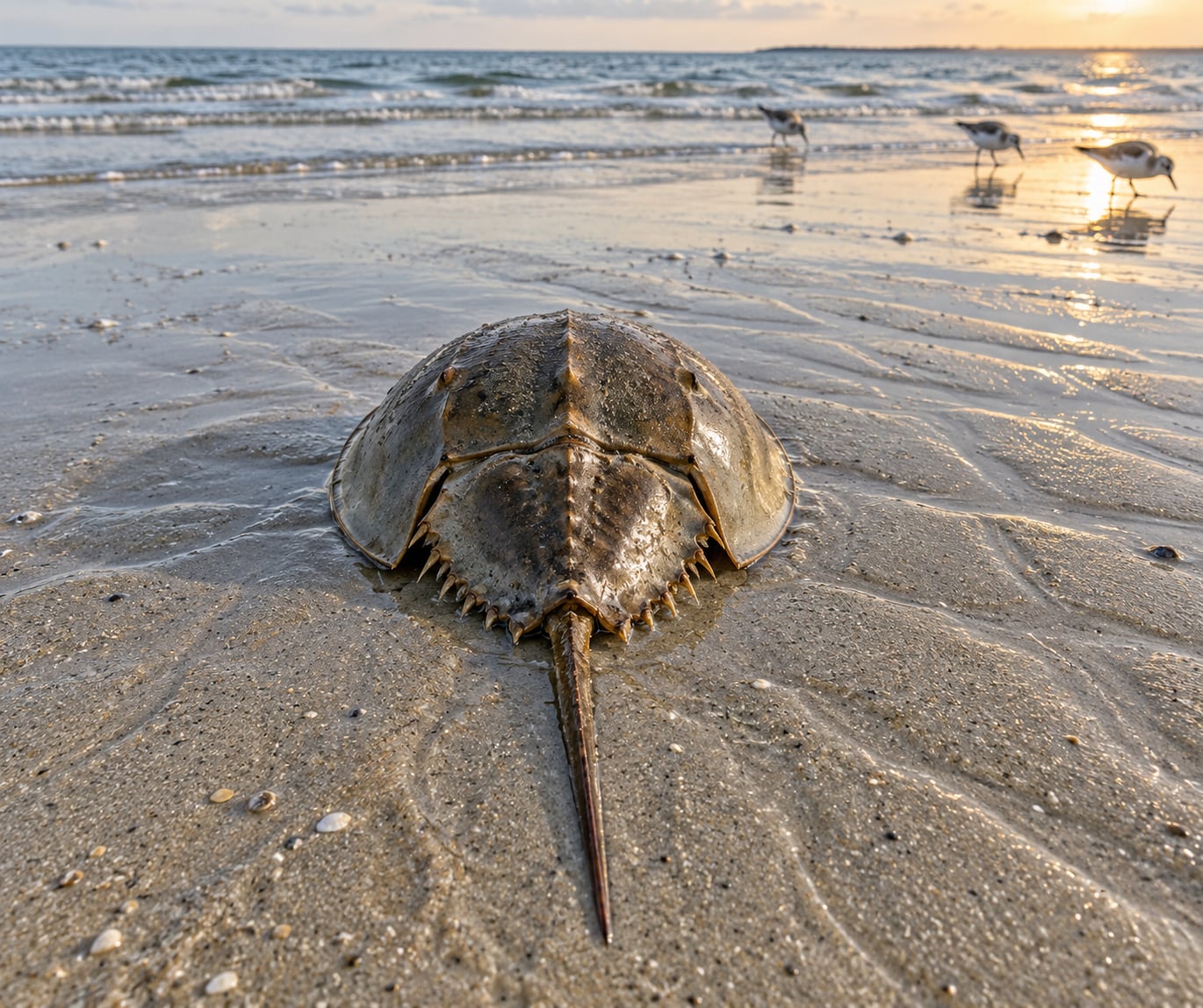
A horseshoe crab is easy to identify once you know the marks: one smooth domed shell shaped like a U, a long straight tail spike, no claws, and a pale underside with book-like gills. That tail looks like a stinger but cannot sting or inject venom, so the animal is harmless to touch. Here is how to confirm a find in the order a first-time beachgoer would actually check it, plus why the species matters well beyond one shoreline.
One thing to say up front, because it stops most people cold: the tail is called a telson, and it is a rigid spine used for steering and for flipping the animal upright. It has no stinger, no barb, and no venom. Beachcombers in Connecticut report flipping a dozen stranded crabs back over on a single walk, and that kind of hands-off help is genuinely useful during a mass stranding.
Table of Contents
- How to Identify a Horseshoe Crab
- How to identify a horseshoe crab from above
- How to recognize the underside and tail
- Where Horseshoe Crabs Are Found
- Horseshoe Crab or Something That Looks Similar
- What Horseshoe Crabs Eat and Do on the Beach
- Why a Horseshoe Crab Matters
- How to Observe Horseshoe Crabs Responsibly
- The Role of Horseshoe Crabs in Coastal Conservation
- Frequently Asked Questions
- Are horseshoe crabs dangerous to touch?
- Do horseshoe crab tails sting or inject venom?
- Why do some horseshoe crabs appear red?
- Are horseshoe crab shells soft like a turtle’s shell?
- What should I do if I find a stranded or injured horseshoe crab?
- What to Look for First
How to Identify a Horseshoe Crab
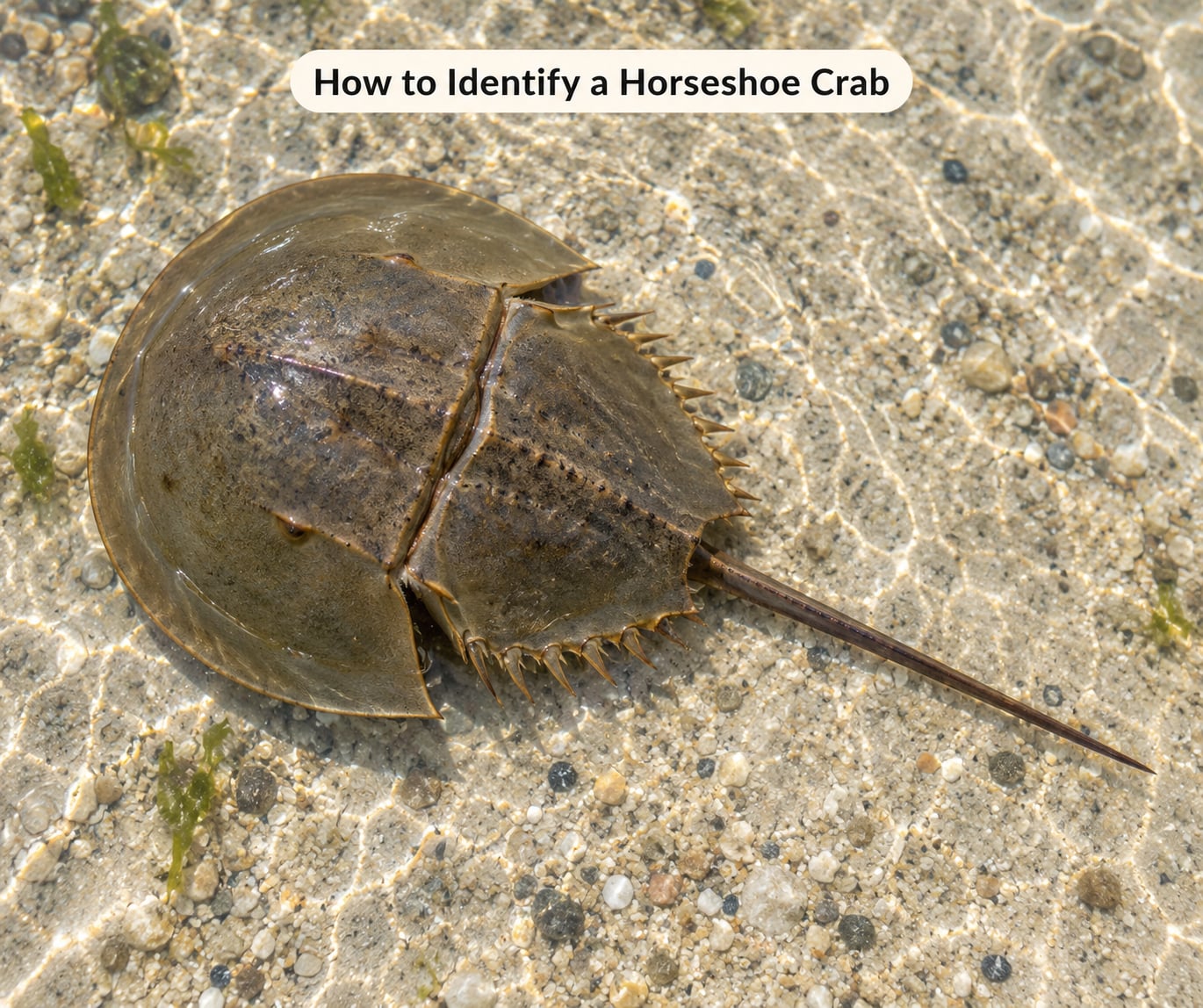
Check the animal in a fixed order: shell outline first, then the tail, then the top ridge and eyes, then the underside, then size. The combination of a broad domed shell and a straight pointed spine does nearly all the work. Any rounded thing washing up on a beach lacks one piece of that combination, which is how you rule look-alikes out in seconds.
Start with shape, because it is visible from several feet away and does not change with lighting or angle. Then check the tail. Then get down close.
How to identify a horseshoe crab from above
From above, a horseshoe crab shows a single smooth dome with a rounded front edge, a straight rear edge, and a raised central ridge running front to back. Two small lateral compound eyes sit partway along that ridge, with a pair of smaller median eyes in front of them. Read the top side in this sequence:
- Horseshoe-shaped carapace: a broad, domed shell wider than it is long, with a smooth rounded front margin and no notches or spikes along the edge.
- Central dorsal ridge: one raised keel running the length of the shell. Sand dollars and true crabs have no equivalent ridge.
- Rigid tapering abdomen: a rear section fused to the shell, narrower than the front, ending where the spine begins.
- A straight, needle-like telson: long, stiff, and pointed, roughly the same length as the shell or a little longer.
- No antennae and no mandibles: true crabs have both. A horseshoe crab has neither, which is one of the fastest ways to separate the two.
- No claws: the front legs end in points, not pincers.
Adult Atlantic horseshoe crabs, Limulus polyphemus, run about 18 to 19 inches across the shell for females and 14 to 15 inches for males, with the largest individuals occasionally exceeding that. Juveniles are the size of a fingernail for their first few years and do not reach adult shape until maturity at roughly ten years, so a small find is not automatically a different animal.
Tell the sexes apart with the rear of the shell. A female has a wider, more rounded opisthosoma with a notch along the back edge; a male’s is narrower with straight edges, and mature males carry a pair of claspers used to grip a female during spawning.
How to recognize the underside and tail
Turn it over and you will see the reason for every field mark. The underside is pale and lined with overlapping plates that look like the pages of a book, those are the book gills, and between them sit five pairs of walking legs plus a smaller front pair called chelicerae that handle food. There is no face, no mouth with lips, no antennae, and no pincer anywhere on the animal.
The telson itself is a stiff, triangular, unsegmented spine attached to the rear of the shell. It works as a rudder and as a lever: a horseshoe crab knocked upside down plants the spine in the sand, arches the shell, and flips back over in one motion. Nothing about that arrangement is defensive, and the animal has no way to deliver a bite.
Shape alone is unreliable when the crab is partly buried or rolling in moving water. In those conditions, movement settles it. A live crab walks slowly with its legs, bobs with the surge, and rights itself quickly; a shell or a dead carapace stays exactly where the water puts it and has no attached spine joint, no legs, and usually a faded or broken rear edge.
Where Horseshoe Crabs Are Found
Horseshoe crabs live on the bottom of shallow coastal water, favoring sandy, muddy, and shelly flats, estuaries, bays, and inlets where tidal flow moves sediment and brings food. On the Atlantic coast they run from Maine south to the Gulf of Mexico, and a separate population occupies the Gulf of Mexico shoreline. The species you will meet in North America is Limulus polyphemus; the other three living species are all Indo-Pacific.
They spend most of the year on tidal flats feeding in the shallow subtidal zone, and they move toward deeper water as the season turns. Late spring and early summer is when spawning runs on the Atlantic coast, with the biggest aggregations in Delaware Bay, though timing shifts with latitude and water temperature. Night spawns coincide with the spring tides around the full and new moon, when high water reaches far up the beach.
Eggs are laid in clusters of roughly 4,000, and a single female can deposit around 20,000 in a night and about 100,000 across a season. Those eggs are the reason beach and estuary conditions matter far beyond this one species.
Horseshoe Crab or Something That Looks Similar
Almost everything people mistake for a horseshoe crab fails on the tail or on the appendages. Use this table when a rounded object lands at your feet and you want a fast answer.
| Object | Shell or outline | Tail or spine | Underside |
|---|---|---|---|
| Horseshoe crab | Single smooth dome, U-shaped, one central ridge | Long straight rigid spine | Pale plates, book gills, walking legs, no claws |
| Whelk or conch shell | Single spiral, pointed spire, no ridge | None, sometimes a flared lip | One large opening, spiral whorls inside |
| Lightning whelk egg casing | Flat disc of tightly coiled egg strings | None | Thin membrane with a spiral pattern |
| Sand dollar | Flat round disc, faint five-petal pattern | None | Short stubby spines and tube feet |
| Mole crab (sand flea) | Segmented, oval, hairy antennae | None | Burrowing legs, long antennae |
| True blue or rock crab | Flat, wide, jointed, often spotted | No spine | Ten legs with pincers, antennae, mouthparts |
| Horseshoe crab molt | Complete empty shell, often split along the back | Spine may be left behind | Shed, translucent skin, hollow |
The molts are the most common confusing find. A shed shell is complete and hollow, often cracked or with a clean split down the middle of the back, and it lacks the firm muscle tone and jointed legs of a live animal. Do not count it as a live crab, and do not treat a split shell as a sign of death by capture either.
Beach groups in the Carolinas spend more time sorting out whelk shells than anything else, which is a good sign of scale. The whelk confusion is so common that locals correct it constantly.
What Horseshoe Crabs Eat and Do on the Beach
Horseshoe crabs are not predators and they do not chase anything. They feed on worms, mollusks, and small organisms in the sediment, and they do it by disturbing the sand and mud with the front legs and chelicerae, then sorting what comes up.
That digging leaves marks. Behind a feeding crab you will find parallel grooves and short trails in soft mud, sometimes with a disturbed crescent where it stopped. On a firm sand flat at low water, you may see almost nothing, which is one reason people assume nothing is out there.
Feeding happens mostly in the subtidal zone between tides, so a crab that looks abandoned on dry sand is often one wave away from being back in the water. Juveniles spend their early years in sheltered tidal flats and shallow bays, where they blend in almost completely.
Why a Horseshoe Crab Matters
The second half of this question has four concrete answers, and each one affects something people care about. Horseshoe crabs anchor a coastal food web, fuel migrating shorebirds and sea turtles, supply the assay used to test most injectable medicine for contamination, and give scientists a 450-million-year-old baseline for measuring change in marine ecosystems. Here is why a horseshoe crab matters in each sense.
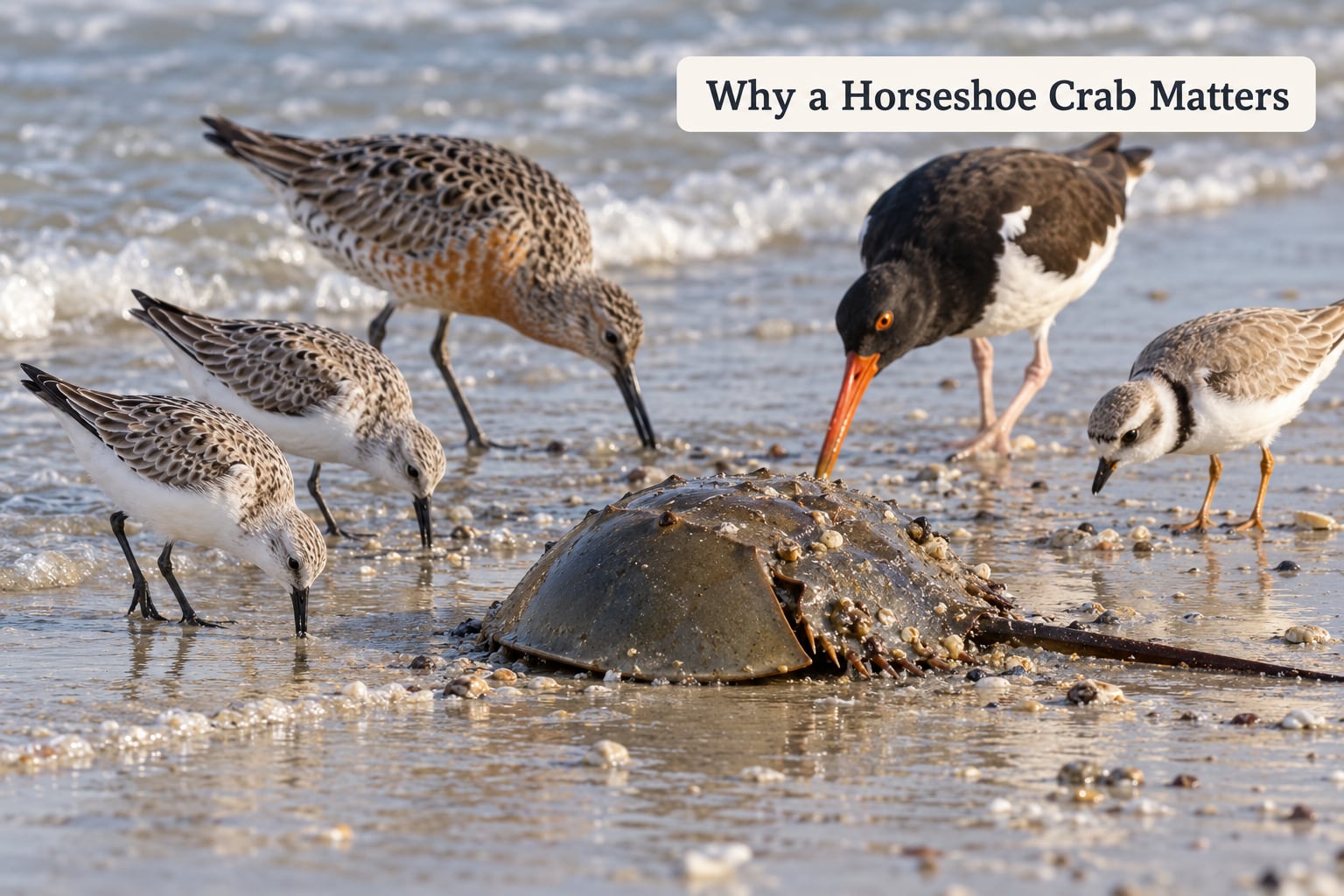
1. Coastal food web. Adult crabs, their molts, larvae, and eggs all get eaten. Shorebirds, sea turtles, striped bass, and plenty of other fish feed on them, and crabs in turn work the sediment that supports clams, worms, and amphipods. Pull the crabs out and the whole chain above them loses a link.
2. Migration fuel for shorebirds. The eggs are dense, rich, and available precisely when birds need calories. Red knots and other shorebirds time their spring and fall stopovers to the spawning window, and a poor egg year on Delaware Bay means birds leave a stopover underweight. Egg availability is one of several food sources these birds use, but it is a large one and it is seasonal to the point of being predictable.
3. The LAL endotoxin test. Horseshoe crab blood is blue because it uses copper-based hemocyanin rather than iron-based hemoglobin. When a crab is bled, its amebocytes clot around bacterial endotoxin, and that reaction, distilled into limulus amebocyte lysate, is used to screen injectable drugs, vaccines, and implanted medical devices for contamination. Synthetic alternatives now exist for some uses, but the natural reagent remains standard in much of the industry.
4. A living-fossil baseline. The lineage is roughly 450 million years old, older than flowering plants, forests, and dinosaurs. Very little about the basic body plan changed in that time, which makes it useful for comparative physiology and for reading long-term shifts in coastal water quality.
How to Observe Horseshoe Crabs Responsibly
You can get a confident identification without picking the animal up, so observation should be the default. Handling is optional, and the rules around it vary by state.
- Look first, touch second. Confirm the shell shape and telson from a foot away before you decide anything.
- Right crabs by the shell. If a crab is flipped, lift it under the edge of the carapace. Never lift by the telson, which is rigid and can snap off, leaving a wounded animal with a missing rudder and no flip-righting ability.
- Do not block a spawning path. An amplexed pair on the move toward the water should have a clear route. Step around, never step on.
- Give tagged and marked areas a wide berth. Researchers tag crabs to track movement, and disturb those beach zones during a survey and you are damaging somebody’s dataset.
- Keep dogs leashed where rules require it. Running crabs get flipped and injured by a tail that cannot right them.
- Do not remove a live crab, and do not take a shell without checking first. Rules differ by state on handling live animals, collecting shells, and keeping molts. Several states limit harvest or close seasons outright; Maine, for instance, operates a permit system with a daily limit and a closed season. Check your state wildlife agency before you pocket anything.
- Report strandings rather than relocating animals on your own. Mass strandings are studied by state agencies and volunteer rescue groups, and moving crabs away from a study beach or waterline can hurt an animal already under stress.
The Role of Horseshoe Crabs in Coastal Conservation
A healthy horseshoe crab population is a working indicator of an estuary, and that is why coastal managers care about it. The species needs clean water, sediment that is neither smothering nor scoured away, tidal flow that reaches into the flats, and beaches that are not walled off by seawalls and bulkheads. Where spawning habitat disappears, the crabs leave, and the eggs that shorebirds were counting on disappear with them.
The pressures stacking up are mostly human and mostly local. Beach nourishment buries spawning substrate and changes the shoreline profile. Shoreline armoring removes the soft intertidal flats the species depends on. Coastal development closes the areas where large numbers gather. Bait harvest for eel and clam fisheries adds direct pressure, and estimates put the share of bled crabs that do not survive at 10 to 30 percent, which is a heavy cost for a species that matures at about ten years and can live twenty years or more.
Regulation does not line up neatly across borders. The Atlantic States Marine Fisheries Commission manages the harvest along the Atlantic coast, individual states set their own rules, and the species is listed as Vulnerable on the IUCN Red List with its status assessed again under a review process that began in the 2020s. Locally, you are dealing with state regulations and beach ordinances. Nationally and internationally, the species carries weight because shorebird migration crosses borders and because the biomedical supply is global.
Frequently Asked Questions
Are horseshoe crabs dangerous to touch?
No. A horseshoe crab cannot bite, sting, or pinch. It has no claws, no antennae, and no venom, and the pointed tail called a telson is a rigid spine used for steering and for flipping over, not for defense. Many people lift a crab by the tail and break it off, so if you do help a stranded one, slide your hand under the edge of the shell instead. Handle it briefly and keep it out of heat and direct sun.
Do horseshoe crab tails sting or inject venom?
No, the telson cannot sting. It is a solid, unsegmented triangular spine fixed to the rear of the shell with no grooves, barbs, or hollow channel, so there is nothing for a stinger to deliver. Horseshoe crabs evolved long before the venomous tail stingers of some whip-tailed scorpions, which belong to a completely different lineage. The telson functions as a rudder and as a lever the animal uses to lever itself upright when a wave flips it.
Why do some horseshoe crabs appear red?
Shell color varies with the animal, the substrate, and staining. Many are dark brown, olive, or gray, and some develop a reddish or rust-colored cast after weeks feeding in iron-rich sediment, which also dulls the shell. Bleached or weathered shells go pale gray, and freshly molted crabs look lighter and softer than mature animals. Shell color is not a reliable ID character, so base your identification on shape, ridge, telson, and underside instead.
Are horseshoe crab shells soft like a turtle’s shell?
The carapace is hard, not soft, though it is thinner and more flexible than the shell of a hard-shelled sea turtle. It is a chitinous exoskeleton, and the animal grows by shedding it, which happens 16 to 17 times across a life. A freshly molted crab has a soft, pale shell for a short window before the new one hardens, so it is more vulnerable to handling during that period than at any other time.
What should I do if I find a stranded or injured horseshoe crab?
If it is flipped, lift it under the shell rather than by the tail, and if it is upright and still moving, leave it for the returning tide. Do not carry it away, and do not relocate it to another beach, because stranding events are tracked by state agencies and volunteer groups. Note the date and location, and report a mass stranding or an animal that appears badly damaged to your state wildlife agency or local stranding hotline.
What to Look for First
Look for the combination, not any single mark: a broad U-shaped dome with one central ridge, and a long straight spine at the rear. Add the pale underside with book gills and no claws, and you have an identification you can make from the waterline in a few seconds.
Then leave it alone unless it is upside down. Right it under the shell if you must, keep your dog away, and let the tide do the rest. That is the whole routine, and it is why a species this old keeps showing up on beaches people walk every day.