Knowing how to walk a beach without disturbing nests comes down to four habits: walk below the high-tide line where the sand is firm, keep dogs leashed or at home, read every posted sign before you cross it, and give any bird working the sand about 50 yards of room. Beach-nesting birds lay their eggs directly on open sand with no shelter, so the only thing between a clutch and a crow is whether anyone walking past notices it.
Planning takes about ten minutes and no specialist gear. Nearly all of it happens in one window: the stretch from March into September, when plovers, terns and skimmers are sitting on eggs or chasing precocial chicks that cannot outrun you yet. Some states go further and close the beach outright during that window, and a closure is a legal boundary rather than a courtesy, so the first thing to establish is which rules apply to the beach in front of you.
The rest is reading the sand before you step on it, and knowing exactly what to do in the ten seconds after a bird tells you that you are far too close.
Table of Contents
- What You Need
- Step-by-Step: How to Walk a Beach Without Disturbing Nests
- Plan Around Tides, Weather, and Protected Areas
- Read Signs and Identify Likely Nesting Habitat
- Choose the Right Route and Distance
- Respond to Birds That Move, Call, or Approach
- Common Mistakes
- Frequently Asked Questions
- How close should I stay to a beach bird or nest?
- Is staying far away enough to protect a nest?
- Can I walk around a beach nesting area instead of staying on a marked path?
- What should I do if a bird tries to lure me away from its nest?
- Are dogs allowed on beaches with nesting birds?
- When should I contact wildlife authorities about a nest or injured bird?
- Conclusion
What You Need
None of this is equipment-heavy. It is a short list, and half of it is decisions you make before the car doors shut.
- Footwear that tolerates soft sand. Bare feet and thin sandals make you slow and awkward, and slow, awkward walkers spread out and wander across dry sand instead of following the tide line.
- Water and sun protection. There is no shade on an open beach, and heat has pushed plenty of nesting birds off the sand at the worst possible hour.
- A field guide or a birding app. You do not need to become an expert. You need to recognize that a small, pale, round-bellied bird running ahead of you on foot is probably a Piping Plover or a Snowy Plover, not a lost chicken.
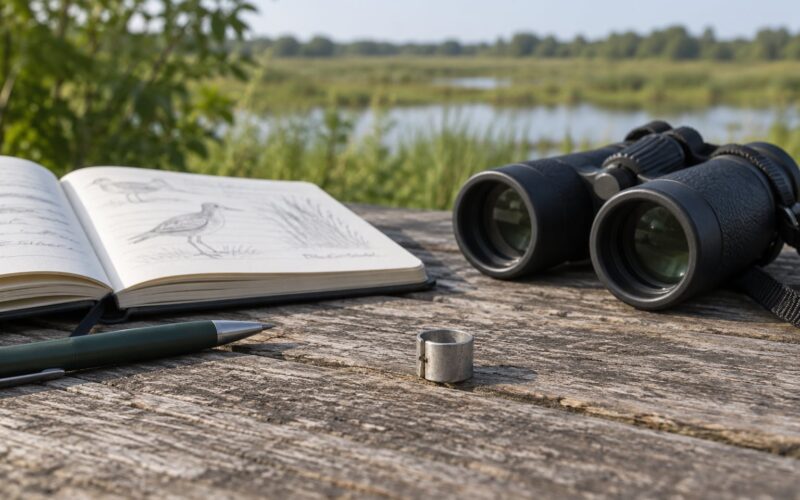
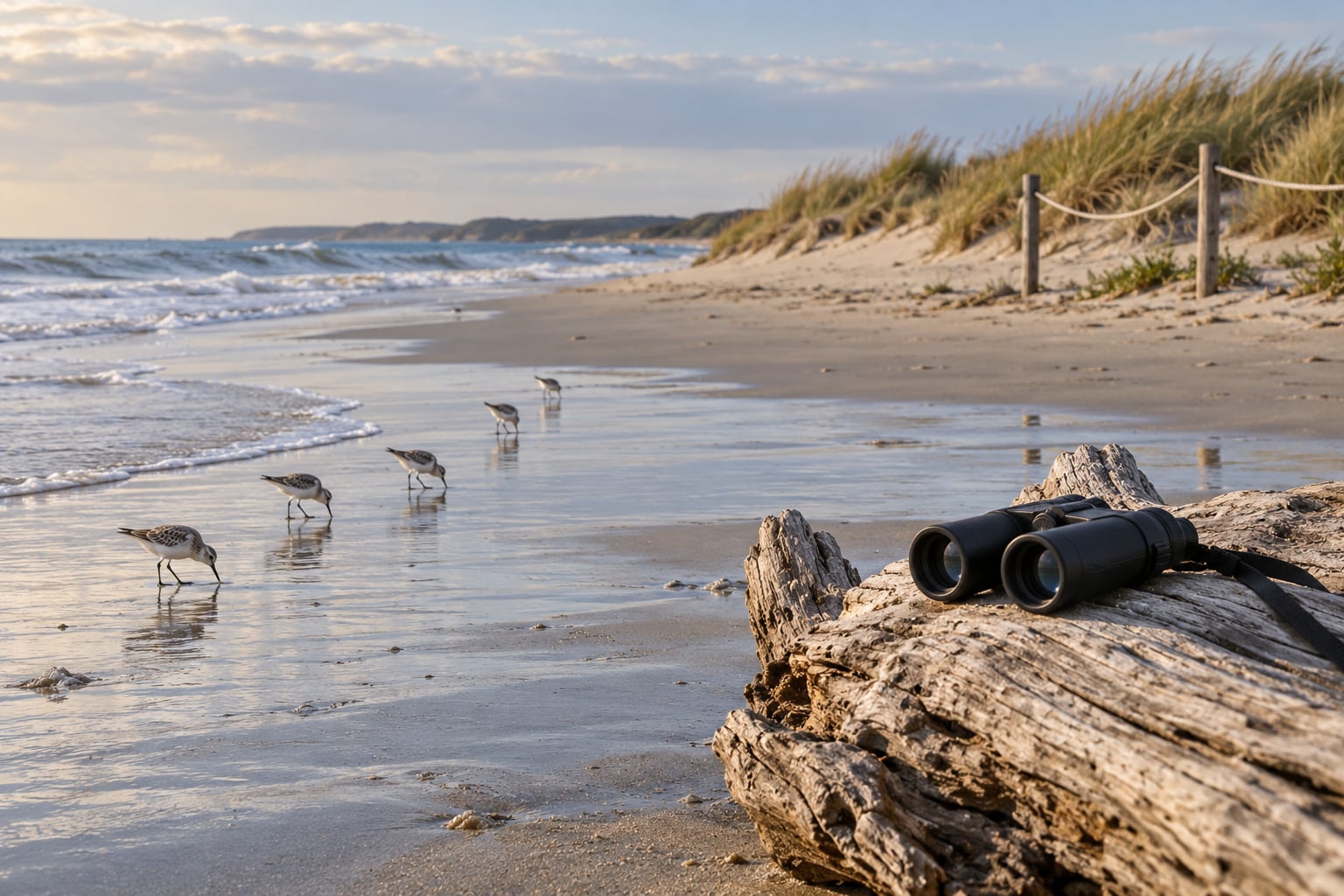
- Binoculars, any decent pair. 8×42 or 10×42 is plenty. They are the single best tool for keeping your distance and still seeing detail.
- A map or the local access page for that beach. Look it up before you drive. State park, wildlife agency and USFWS pages list current closures, buffer distances and dog rules by beach, and they change year to year.
- A dog decision, made in advance. Leashed, or at home. Deciding this at the parking lot when the dog is already pulling toward a flock of gulls is how most rules get broken.
- Your state wildlife agency’s phone number. Saves a search if you find an active nest in an unmarked area or an injured bird.
Three things are non-negotiable no matter what the beach allows. Never approach, feed, handle or relocate wildlife, including chicks that look abandoned. Never move eggs or cover a scrape, because a human handprints on a nest is a cue that tells a predator exactly where the food is. And never cross a rope, stake, dune fence or closed gate, even when the path around it looks obvious and empty.
Step-by-Step: How to Walk a Beach Without Disturbing Nests
The order matters, and it runs from the least costly decision to the most immediate one: plan before you arrive, read the beach from a distance, pick a route, and only then react to what birds do. Most beach nesting seasons run about four weeks of incubation followed by a few more of chick-rearing, which is why the same route that was fine in February can be a problem by April.
Plan Around Tides, Weather, and Protected Areas
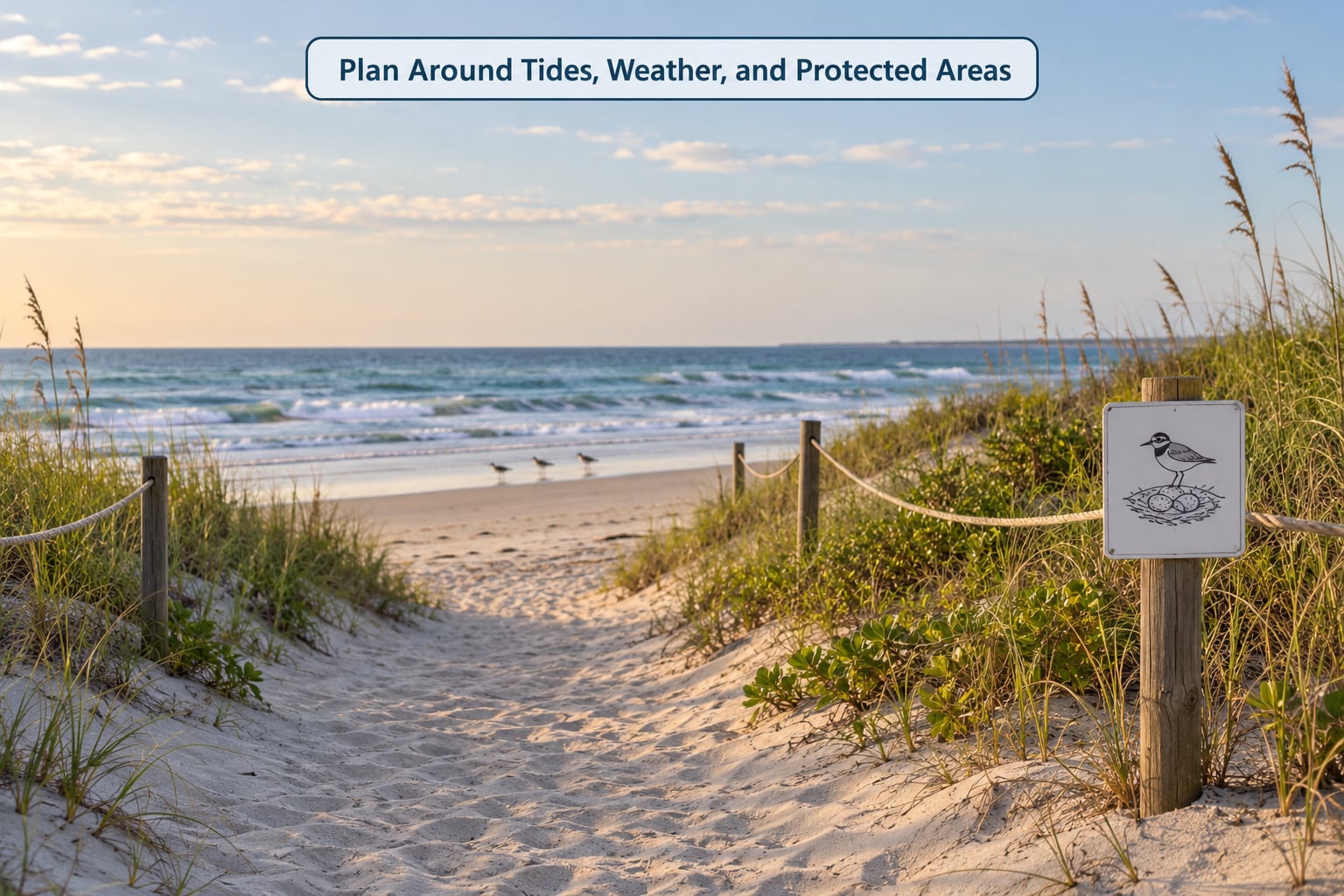
Check the closure list and the nesting-season dates for your coast before you set out, because both are set by state agencies and they differ a lot from one beach to the next. Oregon closes plover beaches from March 15 to September 15, and during that window all other recreation is off limits on both wet and dry sand, including walking a dog even on a leash. Washington asks visitors to steer clear of nesting areas from April 1 through September 15 for species including the Snowy Plover and the Streaked Horned Lark.
Then check the tide. The safe corridor is the band of wet sand between the swash line and the high-tide line, and that band is widest around low to mid tide. Arrive too late in the day and the water closes the corridor in front of you, which forces you either back up the beach through the dune zone or into a wait. Scouting a tide chart takes a minute and removes the only realistic excuse for ending up in the wrong place.
Weather matters more than most walkers expect. Storms, nor’easters and king tides wreck nests, and shorebird managers in Massachusetts were still working with barely-flighted chicks after a May storm flattened nests along the coast. The flip side of that is re-nesting: a lost clutch is often replaced within days, so the effective season routinely runs past the published end date. If a big weather event just passed, treat the whole area as active.
Read Signs and Identify Likely Nesting Habitat
A nesting area is almost always obvious once you know what managers put on the sand. Look for posted signs, orange tape, string fence on short stakes, and low chicken-wire exclosures ringing a scrape, which is a deliberate mesh ring installed around a nest to keep predators out while the eggs are on the ground. Exclosures and string fencing are a good tell because they mean a biologist has confirmed an active nest here, not a bird that happened to be resting.
Ground signs are subtler. Fresh whitewash droppings in a tight cluster, a patch of smooth cleared sand a few inches across, shells and pebbles arranged around its edge, a scatter of tiny footprints in soft sand, or one adult bird spending more than a few seconds on the ground rather than flying. Alarm calling and a bird that runs or flushes well ahead of your path are the loudest signals, and they usually mean you are already inside a nest’s comfort zone.
Telling a real scrape from beach junk is mostly a matter of scale and pattern. The wrack line is a continuous strand of eelgrass, seaweed and shell fragments following the curve of the last high tide. A nest scrape is a single smooth depression, sometimes with a slight mound of excavated sand around it, and nothing is growing through it. A pile of kelp, a crab hole, a tire track, a footprint or a hollow where the sand slumped is not a nest. When you cannot tell, treat the spot as sensitive and give it a wide berth; you do not need to crouch down and check, because a bird will usually tell you if you are close, and the only outcome of investigating is you get closer.
Choose the Right Route and Distance
Read the beach as a series of bands, from the water up. The swash zone is where waves actively break, then the wrack line of dried weed and shell, then the intertidal or wet sand exposed at low tide, then dry sand, then the foredune with its sparse beach grass, and finally the backdune with taller vegetation and the storm-dune line. Shorebirds nest on the dry sand, the wrack line and the open foredune. The wet sand between the swash and the wrack line is the band that is hardest for them to nest on because it floods.
So the route is simple: enter at a firm, wet access point, walk parallel to the water below the high-tide line, and stay above the swash so the tide cannot trap you. If you are walking a dog, a bike, a kite or a board, that wet-sand corridor is the only place all of it belongs.
How to walk a beach without disturbing nests comes down to that corridor plus a number. American Bird Conservancy asks people to let birds fish, swim and play from 50 yards away, and 50 yards is a good default when a local rule does not give you one. Posted buffers on individual beaches are often tighter, and hard closures override everything, so treat the posted number as the real rule.
When you see a bird, change your viewing method instead of your route. Binoculars, a spotter scope or a long lens let you stay put and get more detail than a walk-up ever would. Sitting down on the wet sand for a few minutes gets you better photographs than standing over a bird ever does, and it keeps the bird settled. Skip playback calls, which make birds call defensively and can draw a predator in, and never bait, use a call, or feed anything to draw a bird closer. Professionals work the same way: the Audubon biologists who monitor these sites minimize their own footprints on approach, partly because crows follow tread marks like a breadcrumb trail back to the eggs.
Two more route rules. If you have already made a footprint path, stay on it rather than crisscrossing, because a wide scatter of tracks spreads the same problem. And never go around the back of a roped-off area to reach a nicer stretch of sand; walk back the way you came or take the wet sand past it.
Respond to Birds That Move, Call, or Approach
When a bird tells you something, do the smallest sensible thing: back away, slowly.
The broken-wing display is the one that confuses people most. A plover or tern drops to the sand, beats one wing as if broken and drags itself along as if unable to fly, usually heading away from the nest. It is a performance, and the bird is usually completely fine. Many people see it and try to rescue, feed or pick the bird up, which is exactly the wrong response, because the display only ends when the perceived threat leaves. Do not approach it, do not pick it up, and do not try to photograph it from three feet away. Move back along the route you came in on until the bird stops performing and returns to the nest area.
Other signals follow the same script. Loud alarm calling or repeated calls mean you are close to a nest or chicks, so stop advancing. A bird leaving the nest, hovering, tumbling or circling overhead means the same thing. A parent running on foot ahead of you, head down, is trying to make itself the interesting target instead of the nest, so let it succeed.
Specific things that help: do not run, because sudden movement reads as a chase and triggers a flush. Do not crouch over a bird. Keep a leashed dog short and calm, and pick the dog up if it starts pulling toward birds. Keep yourself between the bird and the water only if you are unavoidably in that position; otherwise stay out of the straight line between a bird and the shore or its feeding area, since that is the route it may need in the next thirty seconds.
Then leave the stretch of beach. Not because the rules say so, but because the birds’ behavior is telling you the space is occupied, and their read on the situation is better than yours.
Common Mistakes
Every one of these has a straightforward fix.
- Assuming every shell pile or hollow is a nest. A wrack line, a kelp pile, a crab hole and a slump in the sand all look similar from a distance. Fix: treat anything you cannot identify as a possible nest and give it a wide berth, rather than walking over to check.
- Taking the dog off-leash “for five minutes.” Off-leash dogs are the most frequently recorded disturbance at monitored nesting sites. Fix: leash the dog for the whole walk, or leave the dog at home. Both, not either.
- Assuming a gentle dog is harmless. A plover cannot tell a friendly Labrador from a fox or a coyote, and both parents leaving the nest at once is the moment crows take eggs. Fix: keep the dog leashed near birds regardless of temperament.
- Flying a drone over the beach. Overhead hovering flushes birds reliably and is a disturbance to protected species, and local rules and park policies frequently prohibit it near birds and dunes. Fix: launch from your yard, not over the beach, and check the park’s and the agency’s rules first.
- Using a flashlight on a night walk over sea turtle nesting beaches. Hatchlings orient to light and crawl toward it instead of the ocean, and on some beaches artificial light during nesting season is restricted. Fix: use a dim red headlamp, keep the beam pointed at the ground, and stay off the marked dune side after dark.
- Crossing a rope, going around a staked area, or walking around the back of a closure. A roped area marks a nest, not a queue. Fix: go back to the water side and pass on the wet sand, or turn around.
- Moving eggs, covering a scrape, or repositioning a chick. Human scent and handprints guide predators to the nest, and chicks are rarely where they appear to be abandoned. Fix: leave everything exactly as it is, back away, and report it if you are concerned.
- Feeding gulls and leaving food out. Gulls learn to associate people with food, then hang around the same stretch of beach where eggs and chicks are, and human food is nutritionally wrong for them anyway. Fix: pack food in, take plastic and fishing line back with you, and never feed a bird.
- Rescuing a bird doing a broken-wing display. The bird is not injured and the display stops when you leave. Fix: back away, do not approach, do not feed.
- Skipping the date and route check because last year was fine. Closures shift with nesting success, storm damage and re-nesting attempts, and enforcement and signage vary beach to beach. Fix: check the current closure page and posted signs every single time, in every single season.
One reminder that settles most arguments about convenience: habitat protection and local rules outrank a better photograph, a shorter walk, or an off-leash hour. The beach is public, but a nesting closure is not a preference.
Frequently Asked Questions
How close should I stay to a beach bird or nest?
Aim for 50 yards, the distance American Bird Conservancy uses in its fish, swim and play from 50 yards away guidance, and treat any posted buffer as the real rule. On beaches with no posted number, that 50-yard buffer is a good default for birds on the ground, nests, and chicks. Use binoculars instead of closing the gap, and give more space, not less, when a bird is calling, circling or performing a broken-wing display.
Is staying far away enough to protect a nest?
Usually, yes, because the harm is usually flushing rather than trampling. A parent that leaves the nest exposes eggs and chicks to crows, gulls, foxes and raccoons within minutes, and repeated flushing across a season can end in abandonment. Staying 50 yards away, keeping dogs leashed and staying on wet sand below the high-tide line removes almost all of a walker’s impact. Walking a route that already has footprints on it is better than a fresh path through dry sand.
Can I walk around a beach nesting area instead of staying on a marked path?
Only if the local rules allow it, and many do not. Oregon’s plover closures from March 15 to September 15 remove all other recreation from both wet and dry sand, so there is no route around it that is legal. On beaches with a marked buffer rather than a closure, the wet-sand corridor below the high-tide line is usually the intended alternative, but confirm the local rules rather than assuming a detour is permitted.
What should I do if a bird tries to lure me away from its nest?
Back away slowly and leave. What looks like an injury is usually a broken-wing distraction display, a deliberate performance that draws a perceived threat away from eggs or chicks. The bird is fine, and the display ends when you stop being a threat. Do not approach it, do not pick it up, do not feed it, and do not follow it. Walk back along the route you came in on until the bird returns to the nest area.
Are dogs allowed on beaches with nesting birds?
It depends entirely on the beach and the season. During a hard closure, even a leashed dog is off limits, and on many plover beaches leash rules tighten for the whole nesting season. Leashes are also not always sufficient, because shorebirds react to a dog the way they react to a fox, and both parents leaving the nest is when eggs and chicks get taken. Check the local rules, leash the dog on wet sand, and keep the dog home when the beach is closed.
When should I contact wildlife authorities about a nest or injured bird?
Report a nest you find in an area with no signs or fencing, so staff can confirm it and protect it, and report any injured bird, especially a fledging tern or oystercatcher chick unable to fly. A beach with a documented nest is a beach with a buffer and possibly a closure, so reporting helps other visitors too. Use your state wildlife agency, and a wildlife rehabilitator for injuries. Never move eggs or handle the bird yourself.
Conclusion
Before anything else, check the current rules for that specific beach and pick a route that stays off the marked and occupied nesting areas, because a closure or buffer is the one instruction you cannot work around later. From there, keep the dog leashed or at home, stay on the wet sand below the high-tide line, and give birds on the ground a wide berth rather than a close look.
Slow down and use binoculars. When a bird performs, you back off slowly and let it go back to work. That is genuinely all of how to walk a beach without disturbing nests, and it costs a walker almost nothing beyond paying attention.