To join a Christmas Bird Count, find the count circle that covers your home using the National Audubon Society’s Circle Finder, contact that circle’s compiler, and sign up for a field route or a feeder watch. The count is free, no experience is required, and the whole process takes one email plus one day of observation.
That is genuinely all it takes. There is no membership to buy, no exam to pass, and no fee of any kind. The one thing that does matter is timing, because each circle picks a single day between December 14 and January 5, and you have to be ready on that day rather than whenever you feel like it.
Here is what the count actually is. The Christmas Bird Count is an annual bird census run by the National Audubon Society with around 2,700 volunteer-organized circles across the Western Hemisphere. Each circle is a fixed area 15 miles in diameter, and every circle is counted during one 24-hour period inside the December 14 to January 5 window.
Volunteers walk routes, sit at feeders, and record the highest number of each species they see at any single moment. The result is a continent-wide snapshot of winter bird populations that repeats in exactly the same places every year, which is the only reason the numbers mean anything.
Bird watchers started it in 1900 as a rebuke. Frank Chapman, then editor of Bird-Lore, was so disturbed by the tradition of hunting birds for sport that he proposed counting them instead. That first season covered 25 locations and about 2,700 birds, and it has run every winter since.
The U.S. Fish and Wildlife Service uses the data, the Cornell Lab of Ornithology draws on it, and roughly three hundred peer-reviewed papers have been built from it. Because every circle repeats the same protocol in the same place, the data reveal trends nobody else can see: a species arriving three weeks later each year, a wintering range sliding north, a local population that quietly halves. That regular record is what makes the count a conservation instrument rather than a hobby.
The rest of this guide walks through the join process in order, from finding your circle to turning in your numbers.
Table of Contents
- What You Need
- How to Join a Christmas Bird Count: Step by Step
- Step 1: Find Your Nearest Christmas Bird Count
- Step 2: Contact the Count Coordinator
- Step 3: Register and Learn the Count Area
- Step 4: Prepare and Complete Your Observations
- Step 5: Submit or Report Your Sighting Data
- Common Mistakes
- Frequently Asked Questions
- Do I need to be an experienced birder to join a Christmas Bird Count?
- Is the Christmas Bird Count free to join?
- How long does the Christmas Bird Count take?
- Can I do the Christmas Bird Count from my backyard?
- Can kids participate in the Christmas Bird Count?
- What happens to the data the Christmas Bird Count collects?
- Conclusion
What You Need
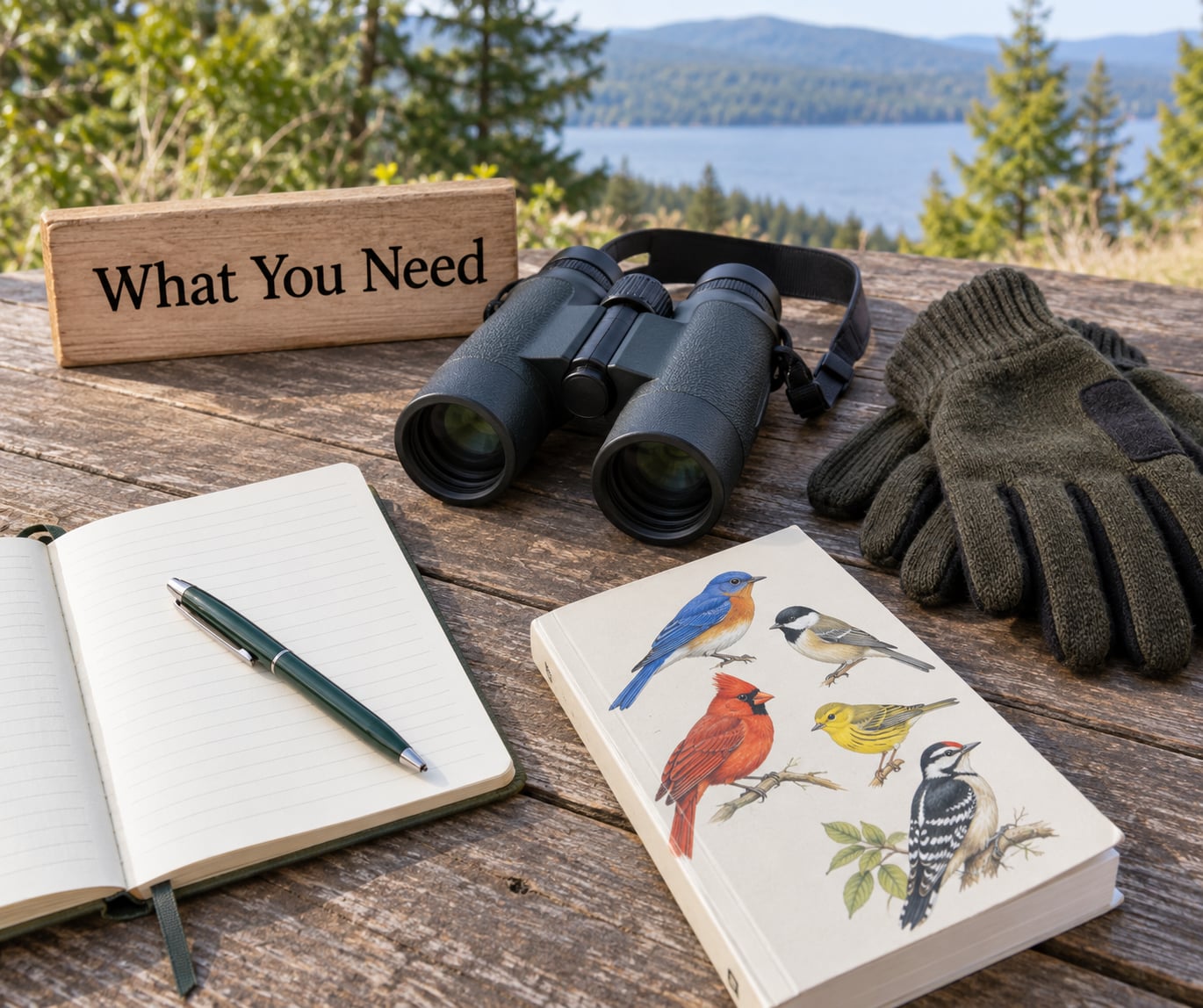
You need less than most people expect. The list below covers a full field day; the first four items are the only ones that matter for a feeder watch.
- A local count contact. The compiler or co-coordinator for the circle covering your location, found through the Circle Finder. Nothing else can happen without this.
- Warm, layered clothing. Count day is midwinter. Most routes look easy on a map and turn into a slog at 25 degrees with wind coming off the water. Merino or wool base layer, insulated mid-layer, windproof shell, waterproof boots, and two pairs of socks you are willing to sacrifice.
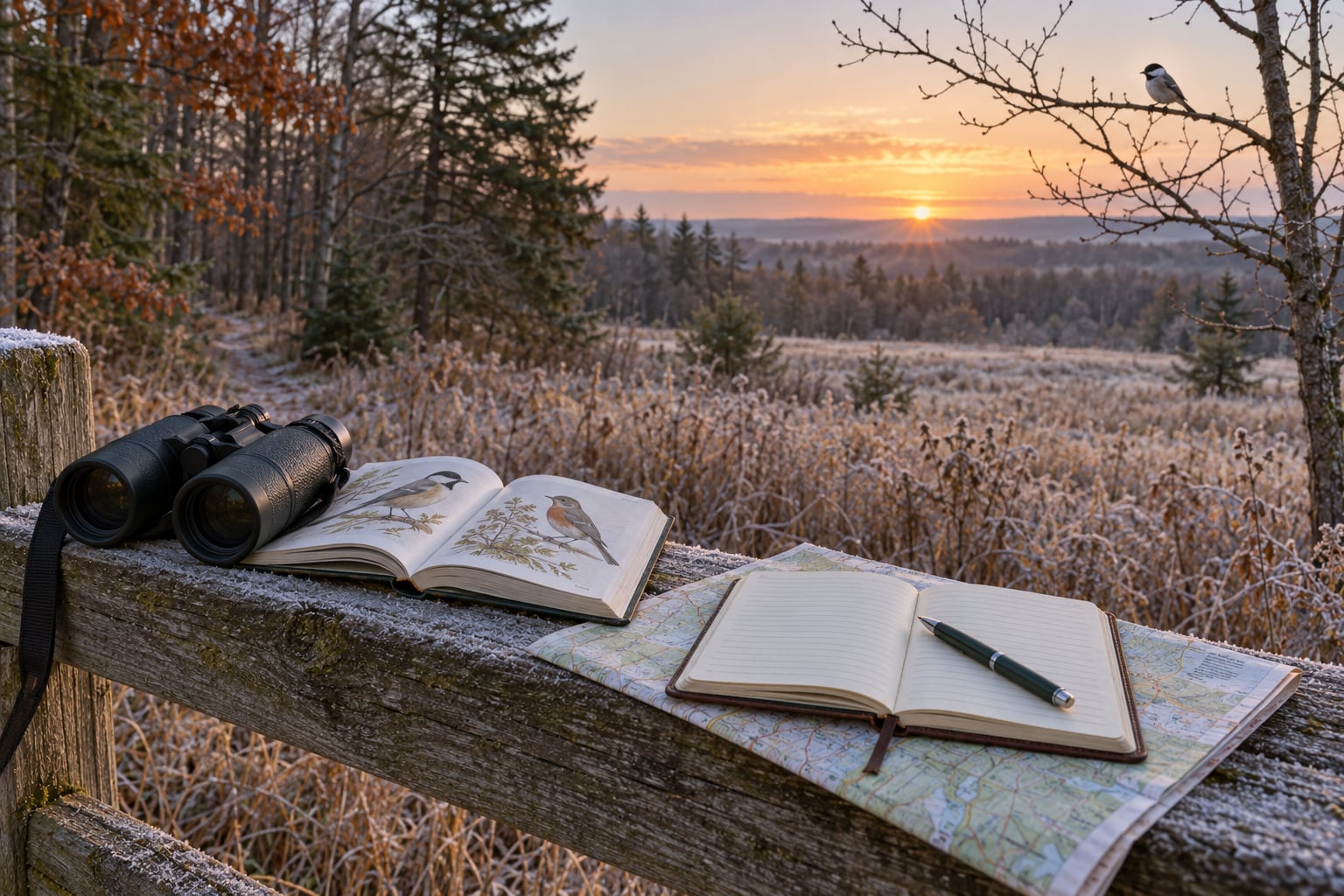
- Binoculars, or a request for loaner pairs. Many circles keep a small supply of loaner binoculars and hand them out at the morning meetup, but they must be requested in advance rather than assumed. Ask your coordinator in the same email where you introduce yourself.
- A field notebook and a pen. Paper works in cold hands when a phone screen refuses to wake up. Give each species its own line so tallying at the end is a straight read-down the column.
- A bird identification resource. A regional field guide is genuinely better than a national one because it shows the species that actually occur where you live. A mobile identification app is a good backup, not a replacement, since the batteries die in the cold and the calls are hard to scroll through in gloves.
- A way to record time and place. Your start time, your route or feeder location, and the times you checked. Effort data is not optional bookkeeping; without it, the compiler cannot interpret a low count.
- Food, water, and a thermos. A field count is often a full day outdoors from before dawn to late afternoon.
- Transport and a charged phone. Field routes usually start at a single meeting point, often well before sunrise, and the compiler needs a way to reach you if you are running late.
On preparation, one free resource is worth more than the rest combined: Audubon’s CBC 101 webinar and the field protocol quick-start guides in the CBC Resource Hub. They are recorded, so you can watch them in the weeks before count day rather than the night before. Many chapters also run their own short training session, and those are usually the best place to learn the local birds.
How to Join a Christmas Bird Count: Step by Step
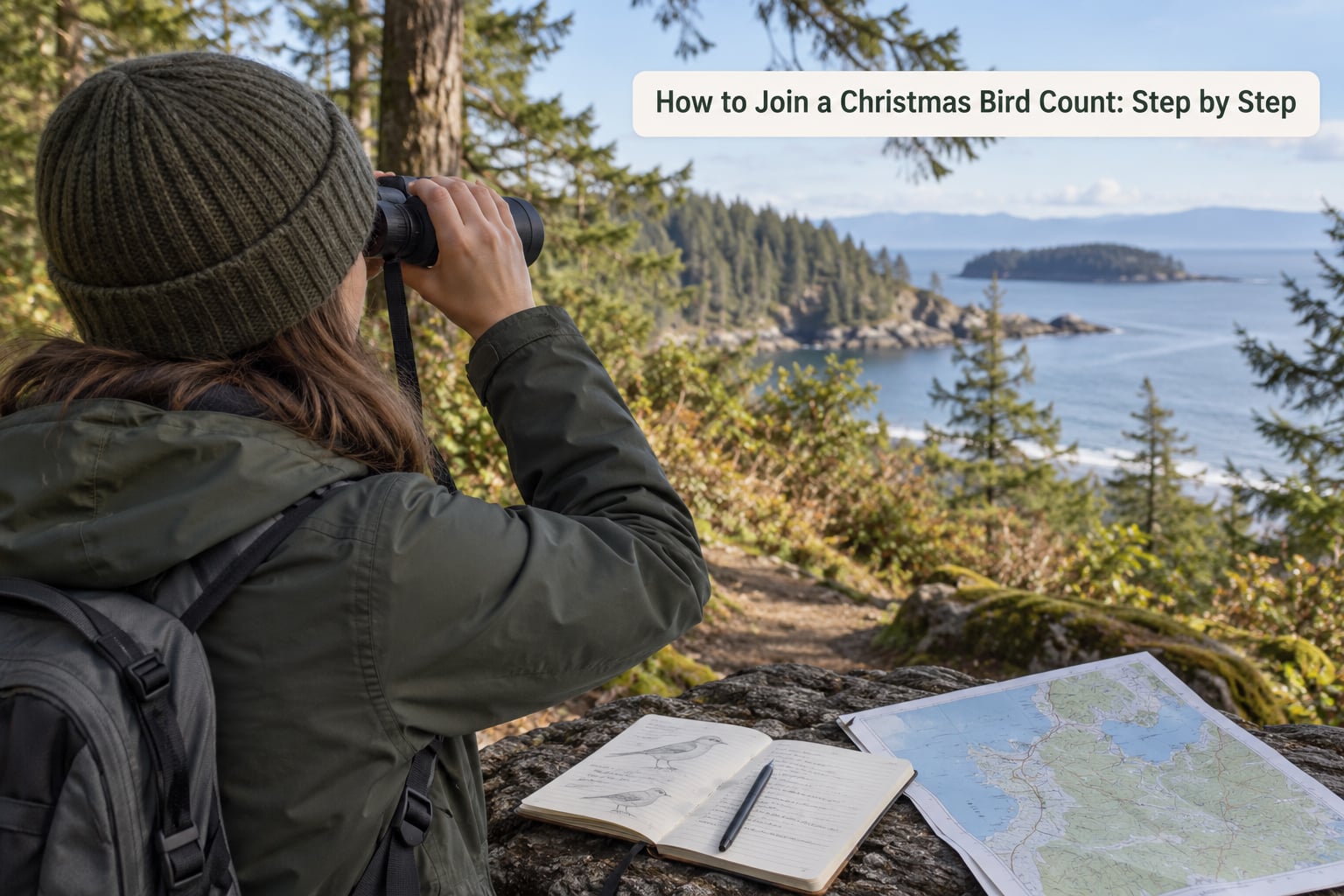
Step 1: Find Your Nearest Christmas Bird Count
Start with the official Circle Finder, not a general search. The Circle Finder is a map of established count circles, and searching “how to join a Christmas Bird Count” will mostly land you on chapter homepages instead of the circle that actually covers your street.
Zoom to your neighborhood, click the circle covering it, and you will get a name, a compiler, and usually a chapter or local bird alliance. If you live near a circle boundary, click both circles and mention it in your email; the compiler can tell you which side your street sits on more reliably than the map can.
If the map shows nothing near you, you have three options. You may be inside a gap between circles, and an Audubon chapter or bird alliance may already be planning a new one. If not, you can start a circle yourself, which is a bigger commitment involving route design and several years of recruiting counters. The easiest option is to check the Great Backyard Bird Count, the eBird Christmas Bird Count, or a local winter bird survey instead, since those run on a national schedule and accept observations from anywhere.
Canadian readers should know that Birds Canada runs the parallel Christmas Bird Count program, and many local circles there are organized through provincial and national bird federations rather than Audubon chapters.
Step 2: Contact the Count Coordinator
This is the step everyone skips and regrets. One short email sets the whole thing up, and the coordinator will usually answer within a few days once count season opens.
Ask for the specifics rather than a general “how do I join.” You want to know:
- The exact count date for your circle, since each one is different.
- The meeting location and time, and whether that is before sunrise.
- Whether routes are assigned or first-come, and how many counters a route can absorb. Placement is often a preference system, not a guarantee, so give a first and second choice if you have a preference.
- Whether there is a half-day or shorter option. Many circles run a dawn-to-late-afternoon route but will also split a route in two for people who cannot do the whole day.
- What identification skill is expected. Some chapters require at least one confident identifier per field team, and some will not add a beginner to a route alone.
- Whether loaner binoculars are available and how to reserve one.
- Any accessibility notes, whether the terrain is walkable, uneven, or steep, and whether rest stops exist along the route.
- Whether there is a training session beforehand, and whether a post-count potluck is planned.
Say plainly whether you are a beginner. Coordinators hear “I am not very good at birds” far more often than the fear of looking foolish suggests, and that sentence usually gets you a patient partner instead of a brush-off. It also lets them put you on a route where an experienced counter can cover the tricky species while you focus on the common ones.
Step 3: Register and Learn the Count Area
Register by replying to the coordinator, then find out three things before count day: your route, your sector, and the count day itself. The sector matters more than it sounds, because the compiler’s final total is a sum of sector totals, and a sector with two counters covering the same patch produces a number that is too high.
Two participation styles exist, and the field-versus-feeder choice is the biggest decision you make.
| Factor | Field count | Feeder or at-home count |
|---|---|---|
| Time commitment | Usually a full day, from before sunrise to midafternoon | About 60 to 90 minutes of checks across the day |
| Where you count | An assigned route or sector inside the circle | Your own yard, feeder, patio, or nearby greenspace |
| Typical gear | Binoculars, spotting scope, field guide, warm layers, water and food | Binoculars or a field guide, a notebook, a feeder |
| Skill level | One confident identifier per team, plus paired beginners | Beginner friendly; many species are close and easy |
| Data entry | Online datasheet, eBird lists shared to the circle group, or paper sheet | Same, usually the simplest of the three |
| Best for | People who want the full day, the route, and the potluck | Families, people with limited mobility, apartment dwellers, beginners |
Whichever you pick, learn the count circle’s boundaries before you start. A circle is 15 miles across, centered on a fixed point, and it does not move or resize once established. That fixedness is the entire scientific point: it means this year’s numbers and last year’s numbers describe the same place. Count outside the circle and your data gets discarded, which sounds harsh until you understand that a single wandered bird can distort a twenty-year trend line.
Feeder counts have two hard conditions. Your feeder must sit inside the circle, and you must count only on your circle’s count day. A feeder three miles over the boundary is not a feeder count, however many birds visit it.
Step 4: Prepare and Complete Your Observations
Count day itself follows a rhythm, and knowing it removes most of the stress.
Field teams gather around 8 a.m. or earlier, often in the dark, and the first hours are the most productive. Winter birds are most active in the first two hours after sunrise, and counting at dawn gives you the peak number for the day before the flock thins out. Plan to keep working through late morning, since some species barely move until the temperature climbs. A full day sounds punishing, but it is mostly standing still, scanning, and walking short stretches between stops.
Feeder counters make repeated short visits instead, checking the feeder every hour or so. Long observation sessions are unnecessary; a dozen quick checks spread across the day gives you the same peak number with none of the cold sitting.
Four rules govern what you write down:
- Count only what is inside the circle, and stay on your assigned route or at your feeder.
- Count only on your circle’s count day, within the 24-hour period that begins at midnight.
- Record the highest number of each species seen at one time, not a running total. If twelve robins come to the feeder in the morning and the same twelve stay all day, the answer is 12, not 36. The Blue Jay case is the classic one: five jays fly in together, two leave an hour later, and three more arrive at noon. You record 5, the peak that was present at any single moment, because that reflects how many birds actually use the area rather than how much foot traffic it sees.
- Do not double count. When birds move between sectors, each sector leader reports what their own observers saw, and the compiler resolves overlaps. Two people counting the same flock from two cars is the failure mode that produces the classic inflated number.
When you cannot identify something with confidence, record it as unknown rather than guessing. A wrong identification is worse than a gap, because it becomes a data point that researchers trust and act on. Note the number, the rough location, the habitat, and what you could see or hear, and let the compiler resolve it. Many circles also run a separate nocturnal owl and night-active species survey, usually the evening before or after the count day, if that appeals more than a dawn start.
Cold hands and low light are the two things that end counts early, so treat your gloves and your thermos as data collection gear rather than extras. Dress for the temperature at the trailhead, not the forecast high a town away.
Step 5: Submit or Report Your Sighting Data
Nobody who counts forgets their own work, but papers, apps, and memory all fail. Get your numbers to the compiler using the method your circle uses, and follow their deadline, which is often within a few days of count day.
There are three common routes. The online datasheet is Audubon’s own form, and it is the default for many circles because it maps directly to the national database. The eBird route works well if your circle is set up for it: start and stop a separate list for each observation session rather than leaving one list running all day, then share the lists to the circle’s group so the compiler can see them. The paper datasheet still exists and is a perfectly respectable fallback when you have no signal, which happens more often in a woodlot than you would expect.
Whichever route you use, capture the same details. A typical datasheet wants the observers’ names, the feeder or sector location, times to the nearest quarter hour, every species, and the maximum number seen. Your compiler verifies the data, combines it across the circle, and submits the circle’s totals.
Most circles also hold a post-count potluck, and if you have never been to one, go. It is part family reunion, part election night, with a species roll call at the end where somebody reads off the full list and the room goes quiet at the first rarity. The roll call is the most persuasive recruitment tool the count has.
For a sense of what the data becomes: the circle totals go into Audubon’s annual results, where they are compared against the same circle’s history and the same species’ history elsewhere. Population declines, range shifts, and arrival-time changes feed conservation planning, habitat decisions, and at times Endangered Species Act policy. The individual sighting you write down in your notebook is one cell in a record that is more than a century long and still running.
Common Mistakes
Most first-time problems are avoidable with a little preparation. These are the ones that come up every season.
Showing up without confirming the meeting point. Field teams start in the dark at a specific spot at a specific time, and a counter who arrives twenty minutes late at the wrong trailhead is a real problem for the sector total. Fix: reconfirm the day before, and ask whether the coordinator wants you there fifteen minutes early for assignment and a group photo.
Skipping orientation. The ten minutes at the meetup where the sector leader explains the route, the species likely to be tricky, and the reporting method is the difference between a useful tally and a random walk. Fix: treat the meetup as part of the count, not a delay before it.
Counting outside the circle. A detour to a good-looking park or a productive pond across the boundary invalidates the data. Fix: check the boundary on a map before you start and stay inside it, even when the birds are better elsewhere.
Adding up every bird you see. Totaling sightings over a day inflates numbers, because birds move and flyers pass through without staying. Fix: write the peak count per species, the highest number present at one moment, and let the running total go.
Double counting across sectors. Two observers covering overlapping ground submit overlapping birds, and the compiler has no way to know. Fix: follow the sector boundary strictly, and if a flock crosses sectors, note the direction it moved so the compiler can flag it.
Guessing on a hard identification. A confident wrong entry becomes a data point that may be acted on. Fix: record the count and the description, mark it unknown, and let the compiler or the sector leader resolve it. Every experienced counter does this.
Not recording effort. A count of 12 birds on a route walked in twenty minutes is not comparable to 12 birds on a full route in poor weather, and the compiler cannot tell which it was without your notes. Fix: log your start and end times, the route covered, and the weather.
Filing the data late. Compilers assemble dozens of sector reports on a deadline, and a late sheet means a circle total that never gets published. Fix: submit within the window your coordinator gives you, even if the paper copy is handwritten.
One last piece of advice, and it is the most useful thing I can pass on: learn ten species before count day. Not two hundred, ten. Pick the birds in your area that are present all winter and unmistakable, such as cardinals, jays, nuthatches, and woodpeckers. They give you a reliable floor, and everything else you identify on top of that floor is a genuine observation.
Frequently Asked Questions
Do I need to be an experienced birder to join a Christmas Bird Count?
No. Participation is free and no experience is required. Most circles pair beginners with experienced counters on a field route, and a feeder count from your own yard is a natural first option. If a chapter does require one confident identifier per team, that person is already on the route. Tell the compiler you are a beginner and ask to be paired.
Is the Christmas Bird Count free to join?
Yes. The count is free, and there is no membership fee, no registration charge, and no cost to join a field route or run a feeder watch. Organizers occasionally hold a post-count potluck and some ask for a small suggested donation to cover compilation supplies, but paying is never a condition of taking part.
How long does the Christmas Bird Count take?
The count season runs from December 14 to January 5, and each circle picks one day within that window to count for a 24-hour period. A field count usually runs from before sunrise to midafternoon, roughly a full day. A feeder or at-home count takes about 60 to 90 minutes of checks spread across the day, plus a few minutes of data entry afterward.
Can I do the Christmas Bird Count from my backyard?
Yes, as long as your property sits inside an established count circle and you count only on your circle’s chosen day. Count the highest number of each species at one time rather than a running total, log the time of each check to the nearest quarter hour, and report through the online datasheet, an eBird list shared to the circle group, or the paper form.
Can kids participate in the Christmas Bird Count?
They can, and it is one of the best family birding habits you can start. Younger children are easiest at a feeder count from home, where the birds come back all day and the waiting is short. Older children can join a field route with a parent or guardian. Some chapters set a minimum age for field routes, so ask the compiler before count day rather than arriving with an eight-year-old at dawn.
What happens to the data the Christmas Bird Count collects?
Compilers combine sector reports into one circle total and submit them to the National Audubon Society, which publishes annual results by circle and species. Researchers use the century-long record to track wintering population trends, range shifts, and changes in arrival times, and those findings feed habitat planning and conservation policy. Individual submissions are credited to the circle rather than to you, which is the trade for having comparable data.
If you are wondering how this differs from the Great Backyard Bird Count, the short version is that the Great Backyard Bird Count is a single global weekend in January where anyone anywhere can submit a list with no circle and no rules, while the Christmas Bird Count is stricter, circle-based, and produces a figure you can compare against the same circle’s history for a century. eBird’s version of the Christmas Bird Count is a streamlined regional event that uses eBird checklists instead of the traditional datasheet.
Conclusion
Your first move is simple: open the Circle Finder, click the circle over your house, and email that compiler today. Ask what the count date is, whether you can take a field route or a feeder watch, and whether loaner binoculars are available. Say whether you are a beginner, because the answer is almost always yes.
That is the whole process. Bring warm layers, a notebook, and enough patience to sit still for an hour. The birds do the rest, and what you write down becomes part of a record that researchers have been reading since 1900.