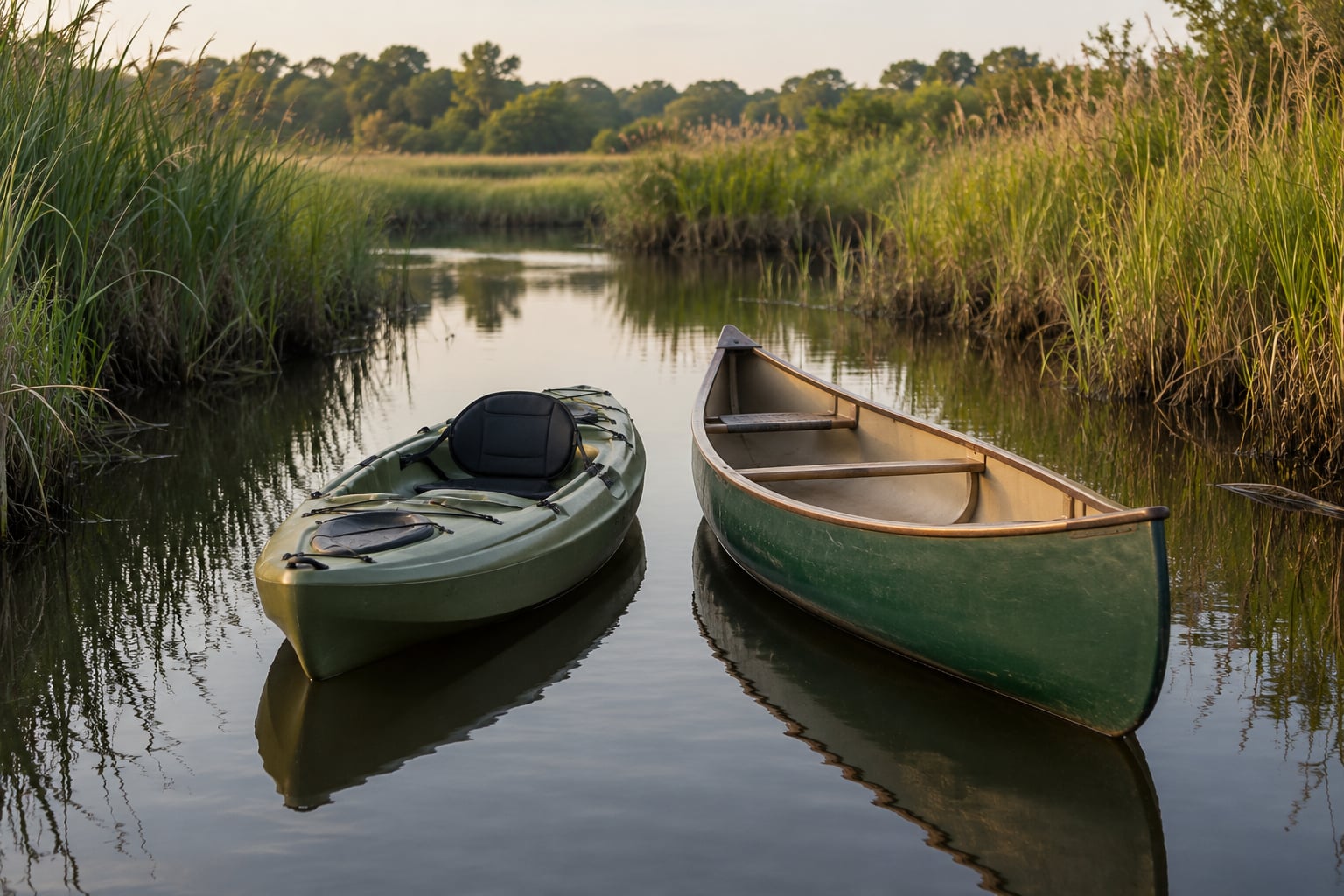
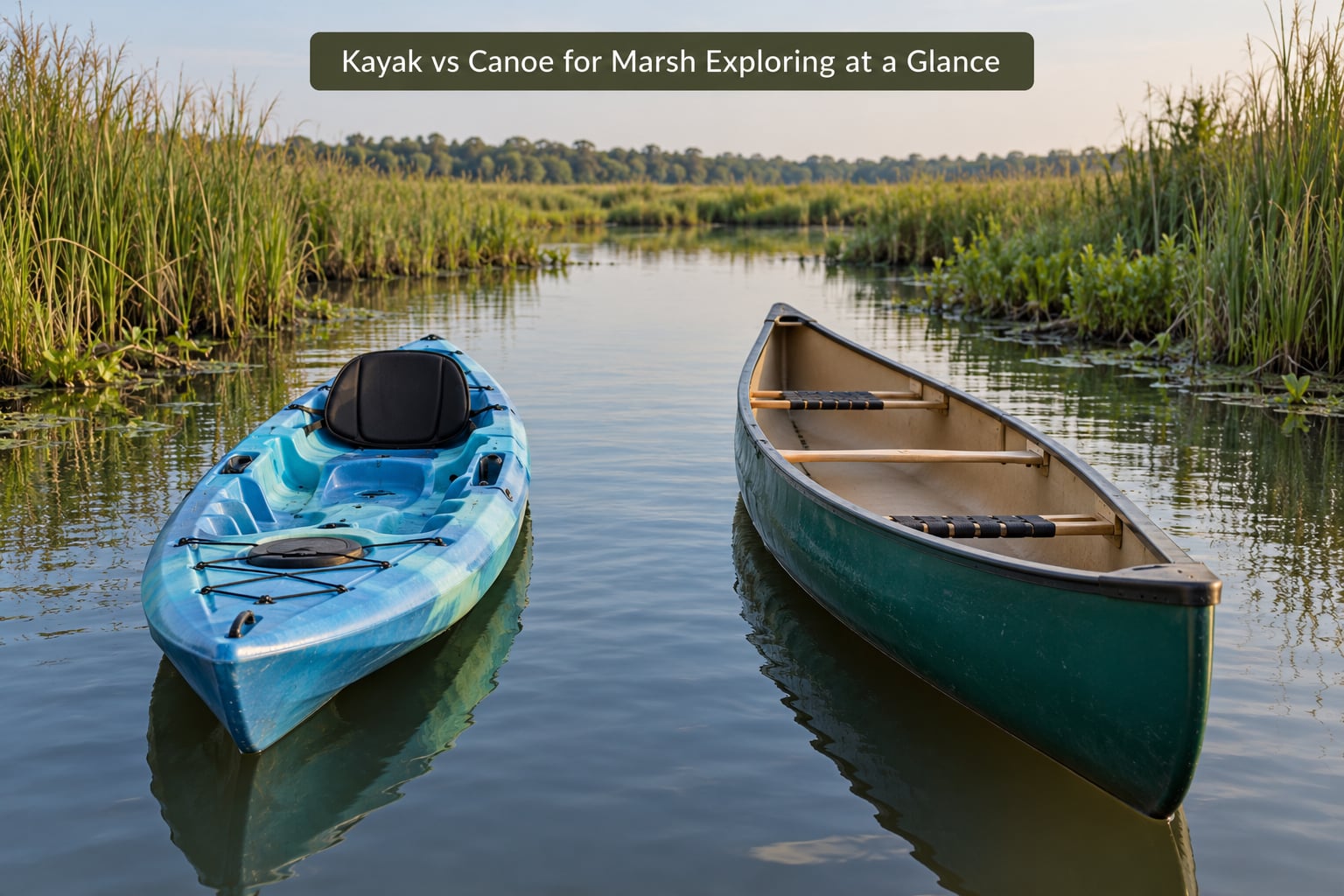
A kayak is the better boat for most marsh exploring, because a low hull, a low seat and a small draft let you work water a canoe cannot reach without the wind shoving you sideways. A canoe wins when you are carrying real gear, working with a second person, or need a flat platform for decoys and a blind.
Marsh water is shallow, dark, flat and treeless. That combination kills the usual reasons to pick a canoe. Speed matters far less than draft, and stability matters far less than how quietly you sit against a backdrop of black water and brown grass.
Below is how the two boats compare on the things that actually decide a day in a marsh, plus the third boat most readers never consider until a kayak grounds out on them.
Table of Contents
- Kayak vs Canoe for Marsh Exploring at a Glance
- Stability and Safety in Shallow Marsh Water
- What actually causes a capsize in a marsh
- Speed, Tracking, and Crossing Open Water
- Maneuverability in Narrow Channels and Around Obstacles
- Poling beats paddling in shallow water
- Wind, Weather, and Tidal Conditions
- Tide decides the boat more often than wind does
- Gear Capacity and Field Comfort
- Portage, Launching, and Getting to the Water
- How Kayak vs Canoe for Marsh Exploring Handles Different Routes
- Narrow tidal creeks
- Open marsh flats
- Flooded timber and overhanging branches
- Longer wildlife-viewing routes
- Which Should You Choose?
- A quick etiquette note before you launch
- Frequently Asked Questions
- Is a kayak or canoe better for exploring a marsh?
- Can a regular canoe handle shallow marsh channels?
- What type of kayak is easiest for beginners on flat water?
- Is a canoe better than a kayak for fishing and carrying gear?
- Should I choose a sit-on-top or sit-inside kayak for a marsh?
- How do wind and tide affect canoe and kayak choice?
- Conclusion
Kayak vs Canoe for Marsh Exploring at a Glance
| Criterion | Kayak | Canoe | Layout / sneak boat |
|---|---|---|---|
| Best fit | Solo birding and scouting | Two people with gear | Hunting and close-range photography |
| Typical draft | 3 to 6 inches | 5 to 9 inches | 3 to 5 inches |
| Seat height | Low, 5 to 10 inches off the water | High, on benches 12 to 15 inches up | Very low, near water level |
| Initial stability | Good | Very good | Very good until weight shifts |
| Crosswind exposure | Low | High | Lowest |
| Tracking | Excellent solo | Fair solo, good tandem | Poor, usually poled |
| Maneuverability | Very good | Moderate | Poor |
| Gear capacity | Limited, needs deck rigging | Best | Fair, open floor |
| Quiet approach | Good | Fair | Best |
| Best shallow water | 6 inches or more | 10 inches or more | Under 6 inches |
Read the draft row first. If your marsh has any water under 10 inches on the route you plan to run, a standard canoe is the wrong tool, and a lot of canoes in the 14 to 16 foot range draw closer to 8 inches than their owners assume.
Stability and Safety in Shallow Marsh Water
A wide canoe is more stable than a kayak in the way most people mean stable, which is how it feels sitting still on open water. A wide, flat-bottomed canoe rocks very little when you shift weight, and it tolerates standing or kneeling to cast a line.
A kayak wins on the second kind of stability, which is secondary stability, meaning how the boat behaves after it has already started to tip. Wide planing hulls used on fishing kayaks push back hard once they lean past the balance point, which matters when you are braced against an oyster bed or lifting a heavy decoy bag over the side.
What actually causes a capsize in a marsh
Marsh capsizes are almost never caused by waves. They are caused by catching a submerged branch, striking a mud lump, stepping off a ledge onto the seat, or standing up in a hull with no deck under your feet.
The real safety difference is how you get out of it. From a sit-on-top kayak you can unclip a PFD, get out, stand in the water and walk the boat off. From a sit-inside kayak with a skirt on, getting unstuck alone in 18 inches of water over soft mud is a genuine struggle, and paddlers on hunting forums describe bailing out a hundred pounds of water by hand after a flip in a shallow spot near a sand bar.
A canoe is the easiest of the three to escape from, because an open hull with high sides gives you room to get your head above the waterline and hold onto the gunwale. That is the one respect in which the canoe is genuinely the safer boat, and it is why it stays on my list for beginners and for anyone working water with heavy submerged structure.
Whichever boat you pick, wear a properly fitted PFD. In brackish marsh water in autumn, sitting low in a boat at water level is a real exposure problem, and cold water plus wind is how paddling hypothermia actually happens.
Speed, Tracking, and Crossing Open Water
A kayak is faster and tracks better solo. Its narrow hull and double-bladed paddle give it a straight line with far less corrective steering, which matters every time you cross a 300-yard creek mouth with wind coming across it.
A canoe carries more weight without losing much speed, so on a long run with two paddlers, a tent, a cooler and a full camera kit, the canoe often arrives at the far bank sooner. Speed on a marsh route is rarely the constraint anyway. Distance is short and you stop constantly.
The tradeoff is turning circle. Kayaks are short and pivot in a few strokes. A 16-foot tandem canoe needs a lot of water and a lot of commitment to change direction, and in a marsh, those two things are usually in short supply.
One more speed factor sits under all of it. If you are constantly paddling hard to fight a crosswind, your noise rises and every bird within a quarter mile knows you are there. Quiet beats fast in a marsh.
Maneuverability in Narrow Channels and Around Obstacles
A kayak is easier to maneuver, and in a marsh that is not a minor benefit. Channels narrow to less than a boat length, dead ends appear behind stands of sawgrass, and flooded timber does not move out of your way. Shorter hulls with lower draft can pivot inside a space a canoe cannot.
Draft matters more than length in most marsh spots. A canoe draws water, so once you are in 8 inches over soft mud you are not going anywhere with a paddle, no matter how hard you try. A shallow-draft sit-on-top will float over ground that stops a canoe dead.
Even kayaks have a floor. The Vancouver Sun reported paddlers at Roberts Bank where the hull of a kayak barely skimmed the muddy bottom and forced constant paddling. If your route runs across exposed flats at low water, poling or a different hull beats both boats.
Poling beats paddling in shallow water
Once the water is down to a few inches, stop paddling and start poling. Push a paddle, paddle shaft or push pole against the bottom and walk it backward along the hull to move the boat forward quietly.
The technique is quieter than a paddle stroke, needs almost no water depth, and gives you control to slide off a mud lump instead of burying the bow. If you ground out, paddle flat-side-down over the gunwale, push the hull forward and back a few times, and you usually free it without standing up.
If you are solo and truly stuck in soft mud, that is when hull shape earned its keep. Sit-on-top kayaks float with a low center of gravity and no skirt to trap water, and most can be wriggled free and pushed along the bottom in knee-deep water.
Wind, Weather, and Tidal Conditions
A kayak handles wind better because it presents a small target close to the water. A canoe catches crosswind on its full length and its high open sides, and over treeless marsh water there is nowhere to hide.
On a strong crosswind day a loaded canoe can drift sideways at a steady clip, with the bow pointed somewhere useful and the boat going somewhere else. People who paddle canoes through coastal marshes plan around this, choosing routes that run with the wind instead of across it.
Tide decides the boat more often than wind does
On a tidal marsh, the same route can be paddled at high water and walked at low. Water three feet deep at high tide can be six inches at low tide two hours before slack, and that is the difference between making the run and dragging.
The simple rule is to check the tide table against the depth you know your boat draws, and add margin. Plan a trip around the tide rather than around the weather forecast, because the tide sets the water depth and the water depth sets the boat.
Marsh water also eats hardware quietly. Salt and brackish water corrode screws, zippers, paddle ferrules and anything stainless that is not marine grade. Rinse the hull, deck fittings and paddle with fresh water after every trip, and let the boat dry in the shade before you stow it.
If the forecast has a squall line, strong gusts and no time to get off the water, do not go. Every boat in this comparison is a sit-on-top boat that fills with water when it capsizes, and marsh shorelines are often soft enough that bailing and dragging are your only recovery.
Gear Capacity and Field Comfort
A canoe carries more, and that is the honest answer when you are loading a boat. Rods, tackle, a cooler, a spotting scope, a tripod, a dry bag of clothing and a second person all fit better in an open hull than in a cockpit with a lap belt.
The tradeoff is comfort over a long day. Sit-on-top kayaks with a framed seat and backrest are fine for a few hours but leave you wet from spray and cold from wind. A sit-inside keeps you warmer and drier, at the cost of harder entry and a harder time getting unstuck.
For optics, a canoe’s open middle is a genuine advantage. You can lay a spotting scope on the cross thwarts and rest a long lens on the gunwale, or mount a tripod between your legs. In a kayak that gear goes on a rail in front of you or in a lap quiver, and everything is one-handed.
Seating is where canoes win and kayaks tie. Canoe benches let you kneel, stand and spread out, which anglers use constantly. Kayaks win on one thing: your seat height. A sit-on-top puts your eyes six to ten inches above the water, and that is the difference between birds seeing you and you seeing birds first.
For duck hunters running decoys, forum advice converges on the same solution: a solo paddler balances 15 to 20 decoys on the bow, weighted so the boat still tracks, and waxes the hull for concealment. A canoe gives you more room to do this without overloading the stern.
Portage, Launching, and Getting to the Water
Weight and carry distance decide the boat as often as anything on the water. Marsh launches are usually soft ramps that turn to quicksand at the waterline, so the last fifty yards is a carry or a cart regardless of what you launched from.
A sit-on-top kayak in the 10 to 12 foot range is a one-person load you can shoulder and carry to a remote put-in. A tandem canoe is a two-person load or a cart job, and a cart through mud and sawgrass is its own unpleasant project.
One fix is worth knowing if you like the canoe’s capacity but paddle alone: a solo canoe paddled with a double-bladed kayak paddle. It is the most-repeated free fix on paddling forums, and it cures the number one complaint about solo canoes, which is that a single blade on the off side makes you zig-zag.
Plan launches by tide too. A ramp that works at high water can be a mud wall at low water, and floating docks that work in a coastal inlet can be stranded above the channel at the bottom of the tide.
How Kayak vs Canoe for Marsh Exploring Handles Different Routes
Narrow tidal creeks
A kayak handles these cleanly. Short length, low draft and a tight turning circle let you work a six-foot creek that turns twice before it ends. A canoe can do it but will ground out in the tight spots and needs the whole width of the channel to turn around.
Open marsh flats
This is where the canoe is at its worst and the kayak is merely adequate. There is no wind shadow, and the canoe’s high-sided open hull gets pushed. On a long crossing with a load, take a kayak with a skeg and a rudder, or pick a route with a wind shore.
Flooded timber and overhanging branches
A canoe ducks under limbs better than you expect and takes hits well, but its length makes it hard to reverse out of a snag. A kayak turns in a much smaller circle, which is the difference between backing off and wrapping around a cypress knee.
Longer wildlife-viewing routes
Once a day stretches past four hours with two people and real gear, the canoe’s capacity starts to matter more than the kayak’s speed. The deciding factor becomes comfort and storage, not turning circle, and the canoe is usually the more comfortable seat for a full day.
Which Should You Choose?
Choose a kayak for solo marsh exploring. It is low, quiet, shallow-draft and easy to get unstuck alone, and it is the boat most marsh birders and wildlife photographers actually use.
Choose a canoe when you are carrying gear for two, when a second paddler is part of the trip, or when you want to stand, kneel or spread a spotting scope and tripod across a flat bottom. Add a kayak paddle if you will be paddling it solo.
Choose a layout boat or sneak boat when the water drops below what any paddle boat draws, or when you are hunting or photographing at close range in tall grass. These are flat-bottomed utility boats with very low profiles, built to be hidden rather than to be paddled efficiently.
Be honest about when a layout boat stops working. Hunters on hunting forums describe grassed-over emergent vegetation as the point where a layout boat loses its advantage entirely, and one hunter described laying over self up to the armpits in three feet of water when the hull is grassed. A mud motor on a small flat-bottom skiff is the honest answer when paddling is not going to happen, because it can cross ground a paddle boat cannot touch.
A quick etiquette note before you launch
Marsh wildlife is under enough pressure without you adding to it. Stay far back from roosting and nesting birds, keep the paddle in the water and move it slowly so it does not slap, stop when birds stop feeding, and never approach a roost at dusk. On public water, keep a respectful distance from other hunters’ decoy spreads and do not push through a pod of birds for a shortcut.
Frequently Asked Questions
Is a kayak or canoe better for exploring a marsh?
A kayak is usually better for marsh exploring because it is low to the water, has a shallow draft, tracks well with a double-bladed paddle and turns in a short radius. A canoe is better when you carry gear for two people or need an open floor for a spotting scope, decoys or a blind. On water under 10 inches deep, neither is ideal and a layout boat or mud motor is the right call.
Can a regular canoe handle shallow marsh channels?
Only if the water stays deeper than its draft, which on most 14 to 16 foot recreational canoes is roughly 5 to 9 inches. In shallower water you will ground out on mud, and a grounded canoe is very hard to free solo. A poling pole or push paddle lets you move a canoe through a few inches of water quietly, but a flat-bottom skiff or layout boat handles it properly.
What type of kayak is easiest for beginners on flat water?
A wide, sit-on-top kayak with a flat or shallow-arch bottom and minimal rocker. It is stable, it sprays less than expected because the water is flat, and you can get out and walk it if you tip. Avoid narrow touring or sea kayaks, which feel twitchy on a first outing and draw deeper water than most marsh routes offer.
Is a canoe better than a kayak for fishing and carrying gear?
For gear, yes. A canoe holds rods, tackle, a cooler, a camera tripod and a dry bag with room to spare, and its flat bottom lets you stand to cast from the front seats. For casting from one position while seated, a fishing kayak with rod holders and a tackle tray is faster and easier. Cold water and a full day on the water favour the kayak’s storage and stability.
Should I choose a sit-on-top or sit-inside kayak for a marsh?
A sit-on-top for salt and tidal marshes, because you can exit easily, it rides over submerged vegetation and you cannot swamp it. A sit-inside for cool water or long cold-weather days, because the enclosed cockpit keeps spray and wind out. Sit-insides need a skirt and practice to escape, so they are a poor match for water you may have to get out of quickly.
How do wind and tide affect canoe and kayak choice?
Wind favours the kayak, whose small low profile resists being pushed sideways; a high-sided open canoe drifts across the wind on exposed marsh water. Tide decides depth, and depth decides the boat. Check the tide table against your hull’s draft and plan the trip around slack water and rising water, leaving margin for shallow channels you may have underestimated.
Conclusion
For most people paddling a marsh, a shallow-draft sit-on-top kayak is the right answer, because draft, seat height and windage decide the day and a kayak wins all three. A canoe makes sense when capacity and a second paddler matter more than quiet approach and turning circle.
Before you buy anything, check the shallowest depth on your route against the draft of the boat, then decide how exposed that water is to wind. If you are paddling solo, keep it light and carry it yourself. If the route runs over flats that go under six inches, skip both and look at a layout boat or a mud motor.