Trailing a small boat for the first time comes down to four things: matching the boat, trailer and tow vehicle, hitching up correctly, securing the hull so it cannot move, and backing into the ramp slowly. Do a full dry run in your own driveway before you touch a launch ramp, and the whole job stops feeling mysterious.
Most first-timers find the actual hitching and winching quicker than expected. What eats the nerves is backing down a ramp alone, and the fear of a boat sliding off the trailer in deep water. Both are technique problems with known fixes, and both are covered below.
Allow about an hour for your first launch, and most of that is unhurried, not difficult. You are not doing anything fancy, and nothing on a small single-axle trailer is beyond a beginner with a checklist and one calm practice session.
Table of Contents
- What You Need
- Step-by-Step: How to Trailer a Small Boat for the First Time
- Check the boat and trailer before you hitch up
- Hitch and load it correctly
- Make the final safety checks before you pull out
- Tow, launch and return without surprises
- Common mistakes first-timers actually make
- Frequently Asked Questions
- How hard is it to trailer a small boat for the first time?
- How deep should I put my boat trailer in the water?
- Do you trailer a boat with the engine up or down?
- How do I put a boat on a trailer by myself?
- What is the correct tongue weight for a boat trailer?
- Do I need a licence to tow a boat trailer?
- Conclusion
What You Need
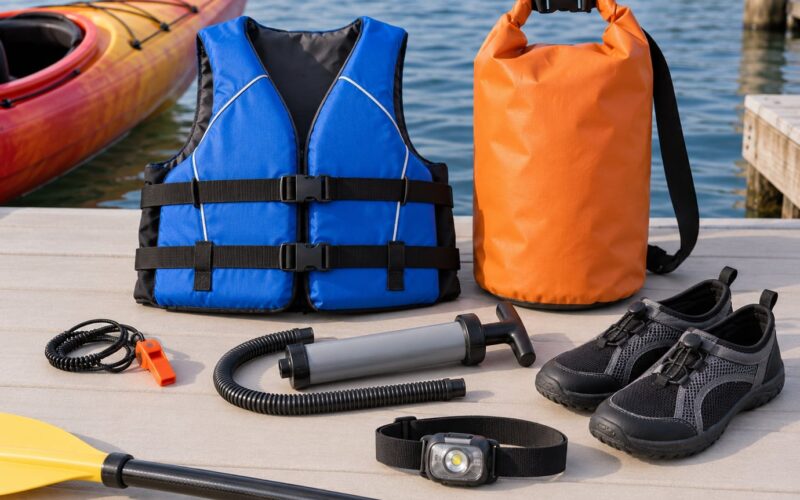
Get the boat, trailer and vehicle sorted at home, in daylight, where a mistake costs nothing. Everything below can be checked or bought before you reach the water.
- A boat that matches the trailer. The hull should sit on the bunks without hanging over the ends, and the boat’s dry weight should sit under the trailer’s GVWR plate value. A common mismatch is a trailer built for a heavier boat than the one attached to it, which leaves the bow light and the trailer fishtailing.
- A tow vehicle with rated towing capacity for the loaded trailer. Check the door-jamb sticker or owner’s manual for tow rating, and remember that passengers and cargo inside the vehicle count toward the total.
- A properly sized hitch. Ball size has to match the coupler, and the hitch’s weight rating has to cover the loaded trailer. Most small boats use a 2 inch ball.
- Two safety chains and a breakaway cable. The breakaway switch is a small box on the tongue that pulls the cable out if the trailer separates.
- A winch with a strap, plus a hand cleat or crank handle. Never use the winch strap as the only thing holding the boat to the trailer.
- A bow line and two stern side lines. The winch strap pulls the bow up; the bow line stops the boat from pivoting off the bunks and coming off in the water.
- Bunk pads or towels. A cheap carpet remnant or closed-cell foam pad between the strap and the gelcoat prevents scuffs and stops the strap from chalking the hull.
- A transom saver or a second roller. Small outboard boats benefit; it keeps the strap away from the motor bracket and the sharp corner of the transom.
- A drain plug and a spare. Carry a spare in the truck. Soaking a hull because the plug was still on the trailer deck is a common and very avoidable first-timer story.
- A spare drain plug key, a tire gauge, a grease gun, a ratchet strap and a wheel chock. Ten minutes of setup can save a roadside night.
- Fenders, if there is a dock or trailer parking pad. Most boat ramps do not have one, but a trailer parking area might.
- Boat boots, and a second person if you can find one. Ramp veterans keep a dedicated pair of hip-high boots in the truck for exactly this. A spotter on the ramp is the single biggest safety improvement you can make.
- Paperwork. Registration for the boat and the trailer, a valid licence for whoever is driving, insurance, and any state permit required for a trailer wider than the legal width. Requirements vary, so check your state’s motorboat rules.
Read the boat’s and trailer’s own instructions as well. The numbers on the plate, the owner’s manual and the manufacturer’s guide always beat any general rule of thumb, including the ones in this article.
Step-by-Step: How to Trailer a Small Boat for the First Time
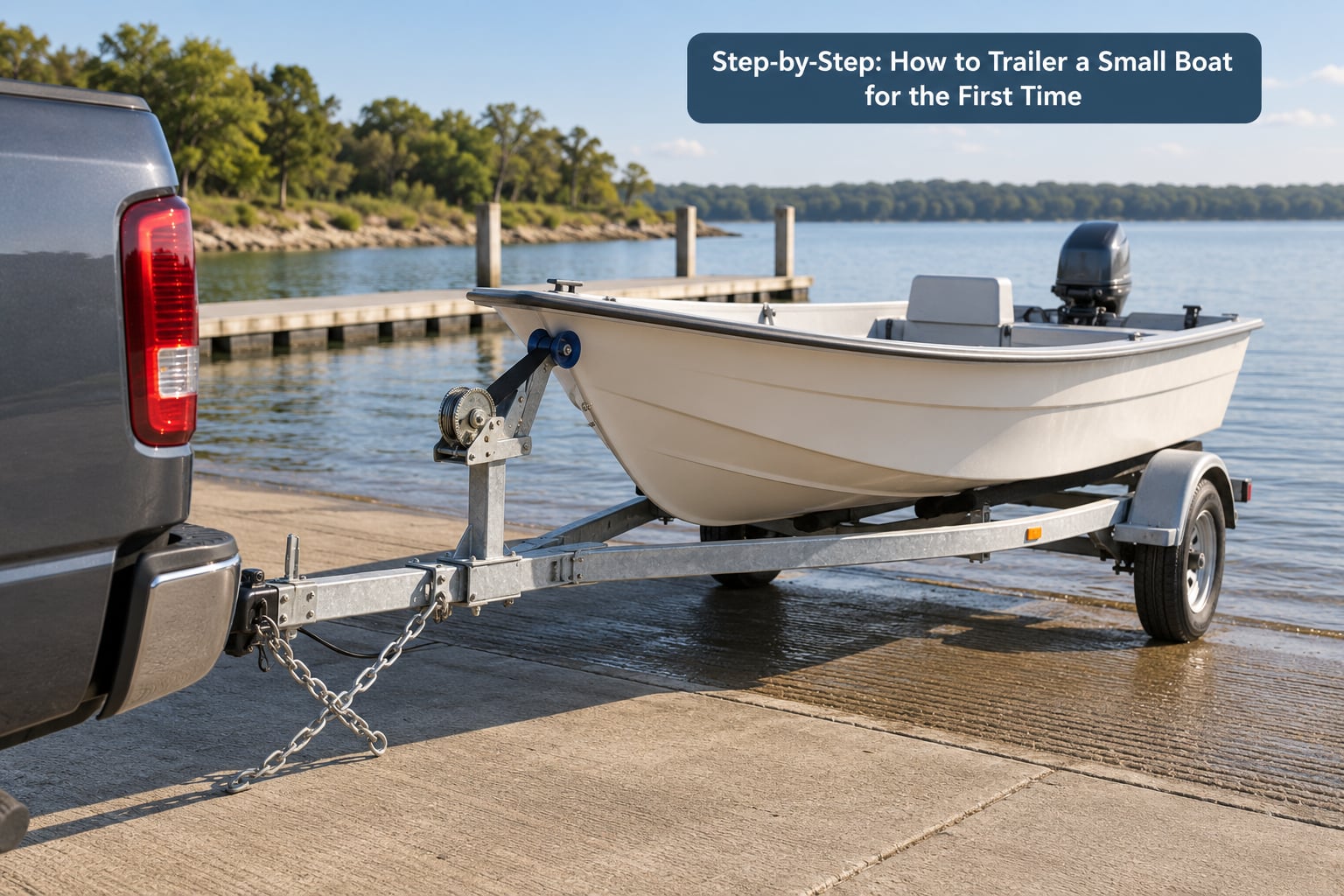
The sequence below runs in the order the job actually happens: match the equipment, hitch and load, walk the trailer to confirm everything is locked, then tow, launch and come back.
Check the boat and trailer before you hitch up
Start with a match check: the loaded trailer has to sit inside both the trailer’s GVWR and the tow vehicle’s rated towing capacity, and the ball on the hitch has to match the coupler on the tongue. Tongue weight is the number most beginners skip, and it is the one that decides whether the trailer tracks straight or fishtails behind you.
For most small boat trailers, aim for 7 to 10 percent of the total loaded weight sitting on the tongue. That is where the often-quoted 80/20 rule comes from, roughly speaking: the vehicle carries about four-fifths of the load and the hitch carries about one-fifth of the trailer’s own weight. Boaters on r/boating give the same 7 to 10 percent figure, and the accompanying warning is simple: if the trailer keeps tilting back when you pull away, the setup is wrong.
The setup test that experienced owners actually use is the one-hand lift. Jack the trailer up until the coupler is just off the ball, then try to lift the tongue with one hand. It should be light enough to raise without strain. Heavier means too much weight forward on the bunks, lighter means the boat is sitting too far back or the trailer is mismatched. This matches the widely used 60/40 idea, where roughly 60 percent of the trailer’s load is carried over the axles and 40 percent is handled through the tongue and the boat’s balance forward of them.
Then inspect the hardware. Run the trailer lights, check both brake lights and both turn signals, and look at the wiring harness for exposed copper. Check tire pressure cold against the sidewall or the tire’s own rating, and look for cuts, bulges and cords showing through the tread. Push and wiggle each wheel; anything that feels rough or has play in it needs attention before you tow.
Grab the jack handle and grease the wheel bearings if the trailer has not been greased this season. Grease is cheap and bearing failure at highway speed is not. Check the safety chains for rust or kinks, confirm the winch strap is not frayed, and confirm the drain plug is in the boat and the spare is in the truck.
Hitch and load it correctly
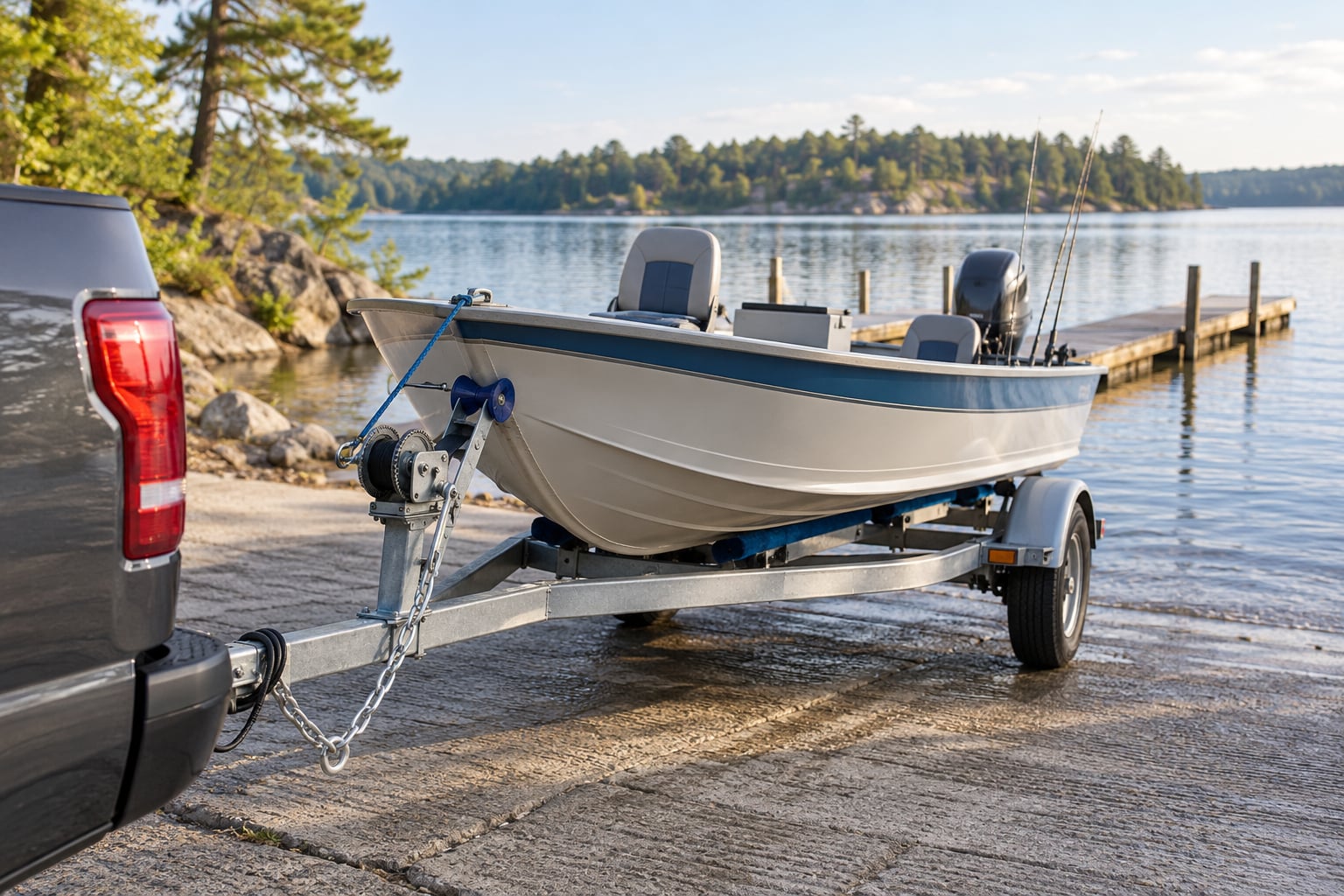
Position the trailer square to the hitch, lower the coupler onto the ball, drop the latch until it clicks, and pull up hard on the handle to make sure the latch is not resting on a worn ball. Then run the jack up, cross the safety chains under the tongue, and hook each one into a different anchor point so a chain cannot be knocked loose by a single point of contact. Plug the light harness into the vehicle and connect the breakaway cable to the vehicle’s breakaway switch, not to the trailer frame.
Load the boat by hand or with the winch, and winch the bow up slowly. The important detail is watching where the hull sits: the keel should be centered on the center roller, the stringers should rest on the bunks, and the boat should sit straight rather than angled. A boat that never fully seats on the bunks can back off the trailer in deep water, which is the failure first-timers report most often.
Use a pad between every strap and the hull. The strap pulls straight forward to the winch, tight enough to compress the bunk padding but not so tight that it dents the hull or pulls a soft-sided boat out of shape. Many owners run the strap over the bow eye and then add a separate bow line; a handful of experienced builders say firmly that the bow eye alone is never enough, because it lets the bow swivel. Add a bow line plus two stern side lines tied to the trailer’s side tie-down points, passing under the hull and up over the bunks.
Raise the trailer jack, chock the wheels, and take the boat off the rollers. Then tow slowly for a few minutes, stop, and re-check the strap and the lines. A strap that was snug at the driveway can settle on the first bend in the road.
Make the final safety checks before you pull out
Walk the whole rig once, from hitch to stern, and confirm: hitch pin or latch locked, coupler seated with nothing between the ball and the coupler, safety chains crossed and hooked, breakaway cable attached, straps tight with no twists, side lines attached, drain plug in, lights and brakes working, tires seated and inflated, and no part of the boat or motor hanging down over the side or the transom.
Give the whole trailer a hard shove at the stern. If the boat shifts, creaks or rocks on the bunks, stop and find out why. A rock at the bow usually means a loose winch strap or a strap hooked on only one side. A shift at the transom usually means the stern side lines are missing or the hull is not fully seated.
Also check the propeller and rudder. Trim the engine fully up and pin the tilt so the prop cannot reach the ramp bottom, and on a shallow ramp, do not let the boat float off the trailer until the prop is clear of the ground. Tilt trailers and prop damage are how beginners end up with a ruined skeg on the first outing.
Tow, launch and return without surprises
Tow under the speed limit, well below it on a straight highway, and give the trailer extra braking distance. Leave room for sway, use wide turns instead of cutting corners, and check your mirrors at low speed before merging. If the hitch feels light or the trailer starts to sway at steady speed, pull over and re-check tongue weight and tire pressure before continuing.
At the ramp, back down in a straight line with the wheels straight. If someone is with you, let them stand clear of the trailer path as a spotter and agree on hand signals first. Solo, use a folding ladder, drop the trailer’s mirrors, and back slowly enough that you can stop instantly.
Stop when the first roller is roughly 6 inches under the water. This is the most repeated number from people who load boats every week, and going deeper works against you: the rollers lose their bite and solo loading gets harder. Put the boat in neutral, take some of the load off the winch until the bow floats free, then unhook the winch strap and the bow line. Some owners hold the bow line from the trailer tongue so the boat cannot swing onto the prop while it drifts out.
Drive forward until the trailer straps come off the bow, and never pull the straps out from under the boat as it floats away. Once the boat is clear, pull the trailer up and park it out of the launch lane. Waiting behind other boaters while your trailer sits in the water holding up a full ramp is the fastest way to make enemies.
Retrieval is the same process in reverse. Keep the boat lined up straight, ease in beside the trailer, attach the bow line, center the hull on the rollers, then winch it up. The difference on the way out is urgency: do not rev the motor, and move away slowly to keep the prop clear of the trailer frame.
Common mistakes first-timers actually make
Most first-timer mistakes share one root cause: rushing the last step. Slow down at the bunks and the pin and most of these disappear.
- Leaving the winch strap unhooked. A strap still on the winch post snags the trailer on the first ripple. Check the winch by hand before you even start the motor.
- Towing with the strap on the bow eye only. That lets the bow swivel and the boat walk back on the bunks. Add the bow line and the two stern side lines every single trip.
- Not seating the hull fully on the bunks. A boat riding too high or too far back can back off in deep water. Look at the stringers resting on the bunks before you pull away.
- Forgetting the drain plug. A plug left on the trailer deck floods the bilge in shallow water and can soak the whole boat. Check it and check it again in the water.
- Overloading the trailer or the tow vehicle. Exceeding the trailer’s GVWR bends axles, tires or the frame, and that is a hard failure on the road. Stay under both the trailer’s plate and the vehicle’s tow rating.
- Weight too far aft. Too much ballast in the back of the boat and too little on the tongue gives you a light, fishtailing hitch. Aim for 7 to 10 percent.
- Towing faster than the load allows. Trailers with high tongue weight push back hard, and stopping distance grows quickly. Give it room and take turns wide.
- Backing a boat onto the trailer at speed. The winch does the work. Throttling up and driving the boat onto the bunks is how propellers and skegs get destroyed.
- Losing the motor on the ramp. Trim it fully up and pin the tilt before the hull settles onto the bunks, not after.
Frequently Asked Questions
How hard is it to trailer a small boat for the first time?
Less hard than most first-timers expect. Hitching, winching and securing a small boat takes about 20 minutes once you have done it once, and the only genuinely difficult part is backing down a ramp alone. Do a full dry run in your own driveway at low speed, then practice backing on flat ground with a spotter before you touch a ramp.
How deep should I put my boat trailer in the water?
Back in until the first roller is about 6 inches under the surface. That is the number experienced owners repeat most, because the rollers keep their bite and the boat floats off the bunks cleanly. Going deeper stops the rollers working and makes solo loading harder. Back straight, keep the wheels straight, and stop early rather than late.
Do you trailer a boat with the engine up or down?
Up, always, and fully trimmed with the tilt pinned before the hull settles on the bunks. On the road, a tilted motor adds wind drag and steals clearance. At the ramp it is about damage control: if the ramp is shallow or steep, the prop and skeg are close to the ground, and a tilted motor is what protects them.
How do I put a boat on a trailer by myself?
Tie a rope about 10 feet longer than the boat to the bow eye, run it to the winch post, and back in until the hull floats off the rollers. Walk the rope around the front of the trailer, keep the hull straight with your hands, then drive forward slowly and winch the bow up. Guide poles and a spotter make it much easier, so bring help when you can.
What is the correct tongue weight for a boat trailer?
About 7 to 10 percent of the total loaded weight should rest on the tongue. Jack the trailer until the coupler is just off the ball and try lifting the tongue with one hand; it should come up without strain. Too heavy means the boat is too far forward, too light means it is too far back or the trailer is mismatched. If the trailer tilts back as you pull away, it is too light.
Do I need a licence to tow a boat trailer?
Usually the same licence you hold to drive the vehicle, plus a valid registration for the boat and the trailer. The extra rules that catch people out are state-specific: a permit for a trailer wider than the legal width, weight limits on certain routes, and insurance that covers towing. Check your state motorboat rules before the first trip.
Conclusion
Do not make your first trip a solo trip to a unfamiliar ramp. Hitch the trailer up at home in daylight, load the boat on the driveway, walk every check on this page, tow a short low-speed loop with a spotter riding along, and practice backing on flat ground until it stops surprising you.
Then go to a ramp you know, ideally one with a gentle slope and enough room to straighten out, ideally early in the day when the launch lane is quiet. Bring a second person if you can, keep the drain plug in your pocket until the boat is in the water, and back in until that first roller is about 6 inches under.
Re-read the boat and trailer instructions, and check your local boating and towing rules. They change, and they are the authority when anything above conflicts with them.