If your boat engine dies in a creek, put on a life jacket, cut the engine, and deal with where the boat is going before you touch the motor. A dead outboard in moving water is a drifting boat, and the drift is what gets people hurt. Anchor if you can reach bottom, paddle toward a flat bank or into a back eddy, call it in on VHF channel 16, and only then start diagnosing. The whole sequence below takes about ten minutes on the water and an hour of work at the ramp.
Night makes it harder but not different. The one thing darkness changes is that you cannot see the rock you are about to hit, so sound, light and a shouted word to a passing boat take on more weight. Everything else on this page works the same at two in the afternoon.
Below is the order I would actually follow, gear first, then the timed sequence, then the mistakes that turn a dead motor into a wrecked boat. Rules vary by waterway and by state, and your boat’s owner’s manual always outranks anything written here.
Table of Contents
- What You Need
- Step-by-Step: What to Do If Your Boat Engine Dies in a Creek
- First 60 Seconds: What to Do If Your Boat Engine Dies in a Creek
- Control the Boat Before Troubleshooting
- Decide Whether the Situation Is an Emergency
- Signal for Help and Report Your Location
- Run a Simple Engine-Diagnosis Checklist
- Make No More Than Two Cautious Restart Attempts
- Paddle, Tow, or Arrange Recovery
- Mistakes to Avoid Before You Touch the Motor
- Get Home and Address the Failure
- Common Mistakes
- Frequently Asked Questions
- Should I restart the boat engine after it dies in a creek?
- Why did my outboard lose power in shallow water?
- How do I keep my boat from drifting downstream?
- When should I call for help after an engine dies?
- Can I paddle a small boat to shore after the engine fails?
- Is it safe to remove a propeller obstruction from the water?
- Conclusion
What You Need
None of this is useful if it is in the truck bed. Every item below has to be on the boat and reachable from the helm before you cast off.
- A properly fitted life jacket for every person aboard, worn, not stowed. A boat with three adults and two children needs five jackets, and a child’s needs its own fit.
- Throwable flotation – a cushion or ring with a light on it, because a life jacket is for the person wearing it.
- An anchor with enough line – at least five times the depth you expect to fish, plus a way to get it back on the bow eye when it snags.
- A paddle or oars stowed where a seated person can reach them, not lying under a tackle box.
- Signaling gear – a charged VHF radio, a whistle, a signal mirror, and a flashlight with fresh batteries. At night the flashlight is a working light, not just a distress signal.
- A charged phone in a waterproof pouch, plus a portable battery if the phone is your only radio.
- Basic tools – a multitool, a spark plug socket that fits your engine, jumper cables, and a basic multimeter.
- Spare fuel in a portable tank with a working primer bulb, if your boat runs out of arm’s reach from the dock.
- Your boat’s owner’s manual, photographed on your phone or in a waterproof binder in the console.
A trolling motor as a backup is worth more on a creek than on a big lake, and so is a spare propeller pin and cotter pin in a small dry bag. Veteran river boaters carry oars and a second anchor specifically for the motor-death scenario, and the reasoning is sound: on moving water you will get one chance to not drift into something.
Step-by-Step: What to Do If Your Boat Engine Dies in a Creek
First 60 Seconds: What to Do If Your Boat Engine Dies in a Creek
Everyone puts a life jacket on. Say it out loud and check each person, because the instinct in the first second is to reach for the controls instead.
Then keep steering. A boat with no power still has a rudder and a paddle, and steering into the current or toward a bank buys you the ninety seconds you need to think.
Note two things while the picture is still fresh: your position, and the nearest safe shoreline. Later you will be asked for both, and at night guessing at them wastes the call.
Look for the actual hazard in the next thirty seconds. Drifting toward a rock shelf, a strainer at a dam, a log jam, a shoal, or another boat matters far more than the motor. If you are heading toward any of them, treat it as an emergency and skip straight to the last step in this list.
Confirm the engine is fully off and stay off the throttle. The kill switch lanyard, clipped to your wrist or PFD, is the fastest stop if the motor was left in a start or run position. Never disable it and never clip it permanently to the boat.
Control the Boat Before Troubleshooting
Get a rough read on the water before you do anything else: how deep it is, which way the current runs, how fast it is moving at the boat, where the wind is pushing, and what is down-current within a few minutes of travel.
In a creek, a small change in heading changes your ground speed a lot. Point the bow at an eddy line, a slack corner behind a point bar, or the inside of a bend, and you can sit nearly still without an anchor. Cross-currents at a confluence will also hold a drifting hull sideways toward a bank.
Put the drive in neutral if the boat has a shift. On many small outboards the neutral safety interlock will not even allow a start unless the control is in neutral, and a boat in gear with a spinning prop while you work on it is how people get hurt.
Anchor only if the conditions suit it. Good conditions mean soft bottom, enough scope to not drag, and no current that will swing the boat onto a rock. In fast water an anchor can hold a boat in one bad place worse than the drift would have. Set it so the boat’s bow is into the current, not broadside, so it can weather-storm and drift back to you rather than pin itself.
Then paddle. Aim for the nearest flat bank, a shallow inside bend, or a slack-water pocket behind a point bar. A pole is useful for gauging depth without putting your head in the water, and a paddle gets you there faster than poling.
Decide Whether the Situation Is an Emergency
Most engine deaths in a creek are an inconvenience. A stopped motor a quarter mile from the ramp with three people in life jackets, daylight, no current, and a working anchor is a tow, not a rescue.
It becomes a response emergency when any of these are true: you are drifting toward a hazard with no way to stop, water is coming into the boat faster than the bilge pump clears it, there is fire, smoke, or a fuel smell, lightning is close enough to hear it, someone is injured or has gone overboard, a person is overdue and unaccounted for, the anchor is dragging, night is falling and you have no lights, or your only communication gear is dead.
On a creek the two that get missed are a strainer or a low-head dam down-current and a hull that starts filling. A boat that founders in three feet of water is a total loss, and it happens while the owner is still crouched over the motor trying one more start.
If you are not sure, call. A short radio call costs nothing, and dispatch would far rather hear from a boat that turns out to be fine.
Signal for Help and Report Your Location
Work in this order and stop at the first one that connects.
- VHF marine radio, channel 16. Hail “any station, any station, this is a disabled vessel on [waterway], position [lat and long or mile marker and side of the channel], one adult, [number] aboard, no power.” Say it slowly and repeat it. Channel 16 is the distress and hailing channel; switch to a working channel only if the station you are talking to asks you to.
- Marine patrol or the Coast Guard Auxiliary on the VHF, by phone, or at a dock. Auxiliary patrols volunteer and will relay a call for you.
- 911 or your local marine patrol number by phone. A cell call works from a creek only if you have usable bars, and a call placed near a bend or under trees may not go through. Get high and clear, or move toward an opening.
- Passing boaters. Flash your lights, wave a bright cloth, use your horn, and give them your position and a flat statement: “Need a tow, I am at mile marker 12 on the north bank.”
Report your position the way locals describe it: mile marker, river mile, landmark, channel side, and nearest ramp. A GPS coordinate is better, but only if you can read it out loud without fumbling.
If a call will not go through, keep trying rather than draining the battery hunting for bars. Switch to your spare device, and know that a dead phone with a dead radio leaves you with an anchor, a paddle and patience. That is why the float plan matters: someone on shore who can raise help if you cannot.
Run a Simple Engine-Diagnosis Checklist
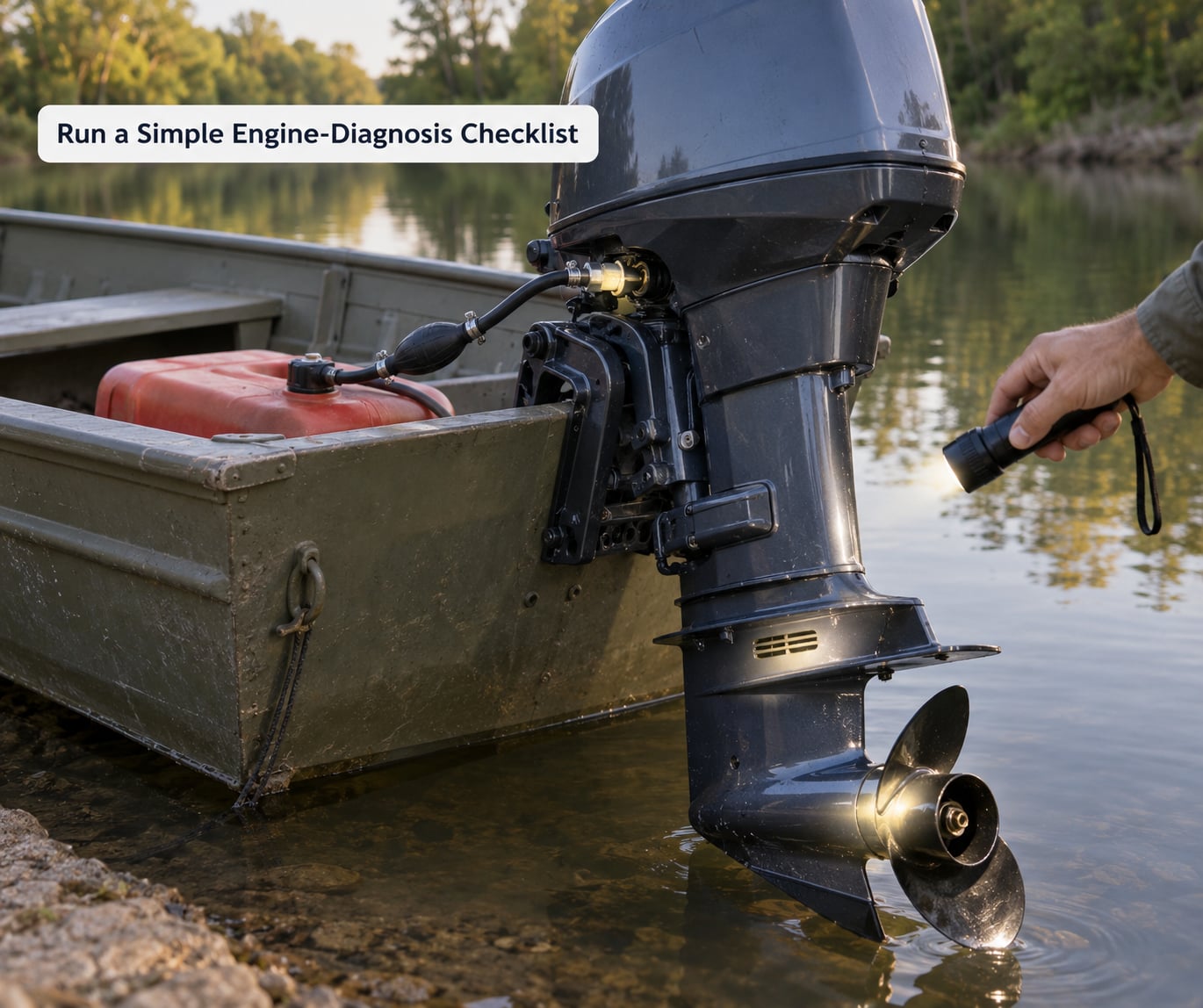
Work the motor from the outside in, and only from a stable position. Never lean over a transom into moving water to look at a propeller, and never remove a cover near a hot exhaust.
Kill switch and interlock. Lanyard clipped to you, shift handle in neutral, throttle closed.
Fuel. Fuel in the tank? Tank vent open? Any fuel on the ground under the tank? An empty tank and a closed vent produce the same symptom, and they are the two easiest things to confirm by looking.
Primer bulb and fuel filter. Squeeze the bulb. Hard with no fuel supply reaching the engine, soft and gurgly means the fuel is getting there, hard with fuel at the tank means a blocked filter or a suction-side problem. Squeeze it repeatedly, watching for fuel to reach the filter glass.
Battery. A fully charged 12-volt battery reads about 12.6 volts at rest, and 12.0 volts or lower means it will probably not crank reliably. Look for corrosion on the terminals, a loose ground, or a swollen or hot battery, which is a fire hazard rather than a no-start problem.
Cooling water intake. Pull the raw water intake strainer out of the water and look at it. In a creek this is the most likely mechanical cause of all: weeds, a leaf wad, a stick, or a fishing line wrapped around the impeller will make the motor run hot and then die. Do this with the motor stopped, cooled, and only if you can reach it safely.
Propeller. With the motor off and the boat held steady, look at the prop and the lower unit. Fishing line, monofilament, rope, or a hook snagged on the shaft is common and it is the difference between a ten-minute fix and a trip home.
Exhaust and leaks. A bubble of gas from the exhaust while cranking can be a flooding issue. A fuel smell, a wet fuel hose, or fuel sheen on the water means stop and call for help. Fresh fuel hose that is soft, spongy, or leaking at the fitting is a fire and flooding hazard, not a five-minute repair.
This chart maps what you hear and see to the usual cause and the first thing to look at. It saves a lot of parts-cannonading.
| What you notice | Most likely cause | First thing to check | Fixable on the water? |
|---|---|---|---|
| Died once, cranks but will not fire | Fuel delivery or spark | Primer bulb and tank vent | Usually yes |
| Runs fine at idle, dies above idle | Carburetor or fuel pump | Fuel filter and fuel quality | Sometimes |
| Dies after 5 to 15 minutes, restarts cold | Heat soak or vapor lock | Fuel line condition, then wait 10 to 15 minutes | Not really |
| Dies in shallow or weedy water, may be hot | Cooling intake blocked | Raw water strainer and impeller | Sometimes |
| Starts and stalls when put in gear | Propeller fouled | Prop and shaft for line, weeds, rope | Often yes |
| Will not crank at all, no sound | Battery, ground, or safety switch | Terminals, 12.6 volt resting reading, lanyard | Often yes |
| Smoke, fuel odor, milky oil, or water in fuel | Do not keep running it | Stop the engine and call for a tow | No |
Make No More Than Two Cautious Restart Attempts
Two. That is the ceiling, and it exists because cranking a flooded or overheated engine is what turns a mechanical annoyance into an expensive one.
Use the manufacturer’s starting procedure from the manual rather than muscle memory. Trim the motor, set the throttle where the manual says, confirm neutral, close the choke or enricher if it is cold, and turn the key. Listen to what the starter does: a fast healthy whir, a slow grinding drag, or nothing at all each point somewhere different.
Stop immediately if the motor smokes heavily, smells of fuel, leaks, runs hot, or revs but will not move the boat. If the first two attempts fail, the diagnosis has told you enough: it is a tow, not a third try. Mechanics on the forums are consistent on this – a repeated crank on a fuel-starved or heat-soaked engine makes the original fault worse.
One exception earns a wait rather than a crank. If it died hot and will crank but not fire, let it sit 10 to 15 minutes and try once more. Heat-soak and vapor lock both clear with cooling time, and hurrying the process is exactly what makes it worse.
Paddle, Tow, or Arrange Recovery
Small boats paddle. If yours is a jon boat, a skiff, or a canoe with an auxiliary motor, a seated paddle and a flat bank 200 yards off is a normal end to a bad day.
Tow only when conditions allow. A towline goes from a solid point on the towing boat, never to a person or a cleat you can pull off under load. Watch the line stays out of the water, because a moving line in a creek will cut through anything it touches, and expect the tow to steer badly with no power of its own.
Call a marina, a marine patrol station, or a commercial towing outfit for anything bigger. Here is the part people learn the hard way: a tow moves a boat that floats, and salvage is recovering a boat from rocks, mud, a strainer or a dam. Agencies will come to you and assist with your safety. They often will not move your boat, and that is a private commercial job. Call your boaters insurance before you pay anyone out of pocket – many policies include towing coverage, and the company frequently tells you which operator to use.
If you are far from anyone and the boat floats, anchoring securely and waiting is a legitimate plan. Stay with the boat, keep a watch, run the bilge pump, and keep warm. It is far safer than swimming a creek in current to reach a road.
Mistakes to Avoid Before You Touch the Motor
The errors that turn a dead motor into a bad outcome are predictable, and each has a correction.
- Cranking repeatedly. Floods the engine, wears the starter, and hides the original symptom. Two attempts, then stop.
- Standing in a boat that is taking on water. Move to the lowest safe place in the hull and get everyone into life jackets before anything else. A swamped boat with a person in it can flip.
- Opening a hot cooling system. Scalding steam burns are the reason you let an overheated motor cool for an hour before touching the cap or hoses.
- Leaving a passenger behind on shore or in the water. Count heads before and after every move.
- Drifting without a plan. Decide between anchor, paddle and call within the first couple of minutes, not after the boat is against a rock.
- Restarting without looking at the prop. A line-wrapped prop will run badly and stay wrapped, and pulling it by hand in water is how fingers get hurt.
- Swimming in current. A creek that looks ankle-deep from the bank can sweep a swimmer into a log jam, an undercut bank, or a low-head dam. Staying with the boat is the safer answer.
Get Home and Address the Failure
Get back to a safe landing first, whether that is the ramp, a dock, or a flat bank you can secure the boat to. Do not run the same water immediately on an engine you do not trust.
At the ramp, photograph the boat, the motor, the propeller and anything wet or damaged before you start cleaning it up. Note the time it died, the conditions, the water temperature and depth, and what the motor did on the restart attempts. That note is what makes a diagnosis fast.
Stop and get qualified service when the cause is unknown, or whenever it involves fuel, electrical, cooling or steering. Milky oil in the crankcase, no spark, low compression across all cylinders, or a sheared flywheel key are all dock or shop work. So is anything that leaked fuel or overheated.
If you can, call your insurance company before authorizing a repair. A claimed failure is documented before anyone opens the engine, and that is often the difference between a covered teardown and a bill you eat.
Common Mistakes
Most engine deaths in a creek trace back to five things, and every one of them is cheaper to prevent than to fix at a ramp.
Bad fuel. Old gasoline, ethanol phase separation, or water in the tank causes most no-start and die-under-load calls. A fuel stabilizer, a full tank before a trip, and a clean filter on older engines prevent the majority of them.
A tired battery. Corroded terminals and a battery that will not hold a charge are routine, and they are the cause of a lot of engines that will crank but not fire. Clean the terminals seasonally and keep the battery charged during storage.
A plugged cooling intake. In weedy or silty water, a strainer can clog fast. A raw water telltale that shows exhaust, or a motor that runs hot and then dies, is your cue to clear it and inspect the impeller. An impeller is cheap compared with a warped head.
Prop fouling. Carry a spare pin and cotter pin, and get in the habit of looking at the prop after every trip. Fishing line wrapped around a shaft gets under the hub and stays there.
Missing safety gear. The gear that causes the most regret is not a tool. It is the anchor, the paddle, the life jackets, and the radio, because without them a mechanical problem becomes a drifting boat.
A few habits close the rest of the gaps. Use the one-third rule for fuel: a third of the tank on the way out, a third to get back, and a third in reserve. Write down who is on board and when you expect to return, and leave that with someone on shore. Keep the owner’s manual in the boat. And write the marine patrol and Coast Guard Auxiliary contacts on a card in the console, because nobody remembers a phone number in a dark creek.
Frequently Asked Questions
Should I restart the boat engine after it dies in a creek?
Yes, but only after the boat is under control and only twice. Get everyone into life jackets, confirm the anchor is set or the bow is holding, and put the drive in neutral before you turn the key. If the motor will crank but will not fire, listen to the starter and watch for smoke, leaks or heat. Two failed attempts means stop and arrange a tow, because a third crank rarely fixes fuel starvation or heat soak and often makes it worse.
Why did my outboard lose power in shallow water?
Shallow, weedy or silty water is the most common creek cause. The raw water intake strainer clogs with weeds, leaves or a fishing line wrapped around the impeller, the cooling flow drops, the motor runs hot, and it dies. A motor that dies in shallow water and then will not restart is often heat-soaked rather than out of fuel. Do not run it hard, let it cool, clear the strainer if you can do that safely, and expect a tow if the impeller is damaged.
How do I keep my boat from drifting downstream?
Anchor first, if the bottom and current allow it. Set the boat bow-into the current with enough scope that it will not drag, and watch for the anchor holding. If you cannot get bottom, use a paddle or pole toward a slack pocket, the inside of a bend, or a back eddy behind a point bar, where the current is not pulling the hull. Pointing the bow into the current dramatically reduces drift speed even with no engine. Do not drift toward a strainer, a dam, or an undercut bank.
When should I call for help after an engine dies?
Call immediately if you are drifting toward rocks, a log jam, a dam or another boat, if water is coming in faster than the bilge pump clears it, or if you see fire, smoke or a fuel smell. Also call for lightning, an injury, an overdue person, a dead radio and phone, or night falling with no lights. If the boat is stable, anchored or holding in an eddy, everyone is in a life jacket, and a tow will reach you in an hour, make the call but do not panic. Reporting early costs nothing.
Can I paddle a small boat to shore after the engine fails?
Yes, and on a jon boat, skiff or canoe with an auxiliary motor it is often the best plan. Paddle seated, to the nearest flat bank or a shallow inside bend, and keep the bow pointed into any current you cross. Pole if the water is too shallow for a paddle, and check depth with the pole rather than leaning over the side. If the bank is undercut or the current is strong, stay with the boat and call for a tow. Swimming a creek in current is how capable swimmers get into trouble.
Is it safe to remove a propeller obstruction from the water?
Only once the engine is fully off, cool, and the boat is held steady by an anchor or a second person. Switch the ignition off and pull the lanyard so it cannot start, then look at the prop and the shaft for line, monofilament, rope, weeds or a hook. Never put your hand near a propeller to find what is wrong, and never lean over a transom into moving water. If the line is wound under the hub, or you cannot steady the boat, leave it and call for help.
Conclusion
Here is the whole thing in order. Life jackets on, all of them, right now. Keep steering and note your position and the nearest safe bank. Decide between anchoring, paddling into an eddy, and calling, and do it in the first two minutes. Tell someone on the phone or the radio who you are and exactly where you are. Work the diagnosis from the outside in, from the kill switch to the fuel system to the cooling intake to the propeller. Two restart attempts, no more, unless the motor died hot and genuinely needs 10 to 15 minutes to cool. Then tow, paddle, or arrange recovery.
The broken motor is rarely the real problem in a creek. The real problem is a boat with no power in moving water, in the dark, drifting toward something solid. Handle that first and the rest is an inconvenience instead of a wreck.
Reviewed for October 2026. Waterway rules, emergency numbers and required equipment differ by state and by waterway, so check the local marine patrol or Coast Guard Auxiliary station before you launch, and follow your boat’s owner’s manual over anything here.