To avoid stingrays while wading, slide your feet along the bottom instead of lifting and planting them, wear puncture-resistant footwear over your toes and ankles, and probe the sand ahead of you with a long-handled tool before each step. Rays feel pressure through the seafloor long before they notice you standing over them, so a slow drag gives them time to swim off. That combination cuts your risk sharply. It does not remove it.
Most of what gets written about stingrays is either a product pitch or a single warning to shuffle your feet. Neither is much help on a flat at 6 a.m. with a rising tide. This guide layers the advice the way experienced waders actually use it: read the water, dress for it, move like you have somewhere to be, and know exactly what you will do in the ten seconds after contact.
Table of Contents
- What You Need Before You Wade Stingray Habitat
- Step-by-Step: How to Avoid Stingrays While Wading
- 1. Check the water and sand before you enter
- 2. Wear protective footwear and leg coverage
- 3. Move slowly and watch where you place each step
- 4. Use a pole, net, or long-handled tool to check ahead
- 5. Avoid stirring up sand and mud
- 6. Keep clear of swimming areas and crowded shallows
- 7. Watch for warning signs and local guidance
- 8. Know the safe response if contact occurs
- Common Mistakes That Put Your Foot in Barb Range
- Swimming, Kids and Dogs Near Stingrays
- Frequently Asked Questions
- What neutralizes stingray venom?
- What beaches have the most stingrays?
- Do water shoes prevent stingray stings?
- How do people swim with stingrays without getting stung?
- When should a stingray sting send you to the ER?
- Conclusion
What You Need Before You Wade Stingray Habitat
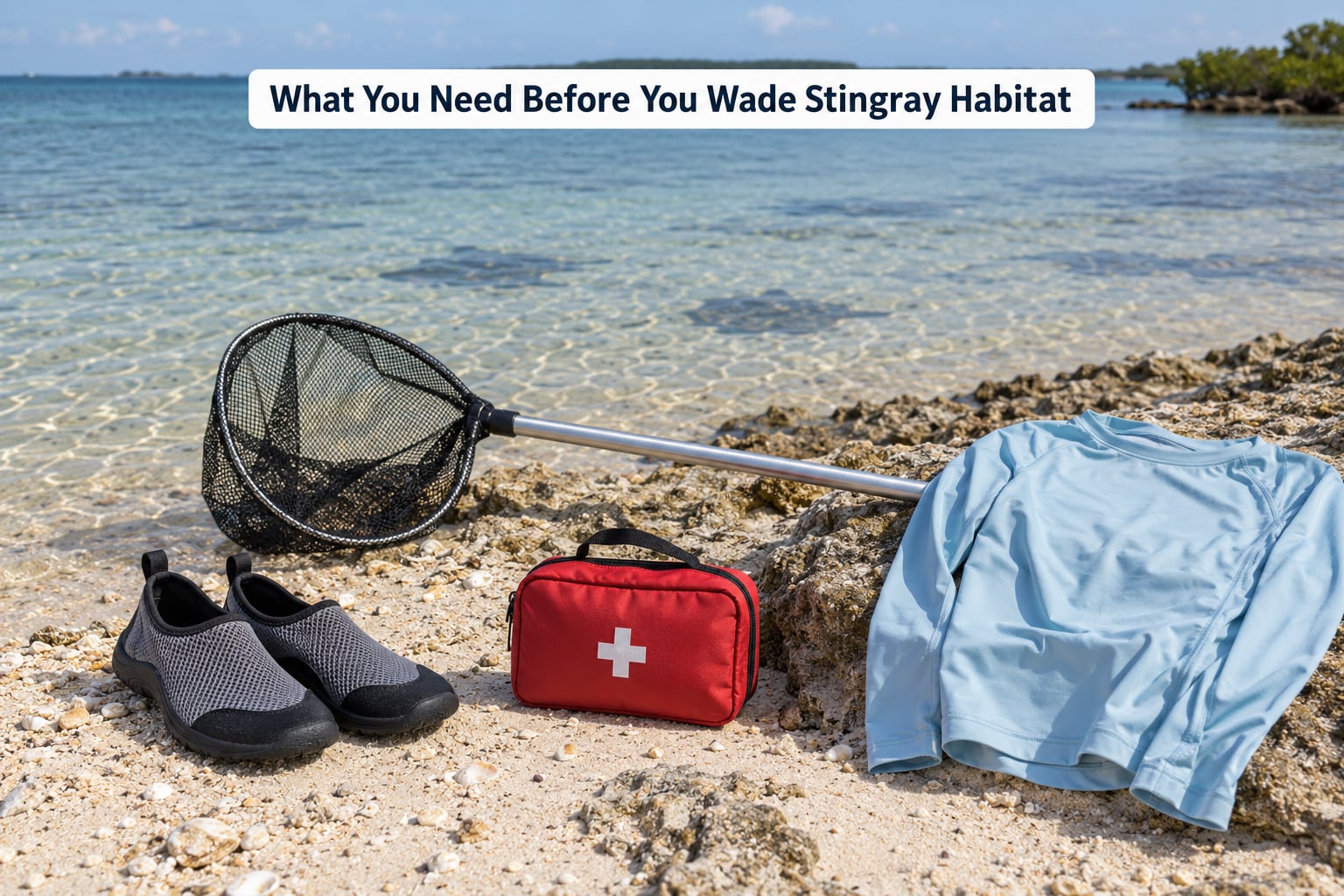
Nothing here is exotic. The list is long because each item covers a different failure point: some protect your foot, some buy you warning time, and some matter only after something goes wrong.
- Ray guard boots or stingray-resistant booties. Look for dense rubber over the toe, instep and ankle, not just a padded shoe. Salt Strong’s own guidance, and the boot penetration test documented by Texas Saltwater Fishing Magazine, both point to the toe and ankle as the areas you are most likely to be hit.
- Shinguards, if you wade knee-deep or deeper. They cover the calf, which is where a taller ray’s barb reaches.
- Neoprene wading socks, for warmth in cool water. Note that most manufacturers tell you to size your boots up a half size when you wear them over socks, because a snug boot is the boot you will dig your heel into.
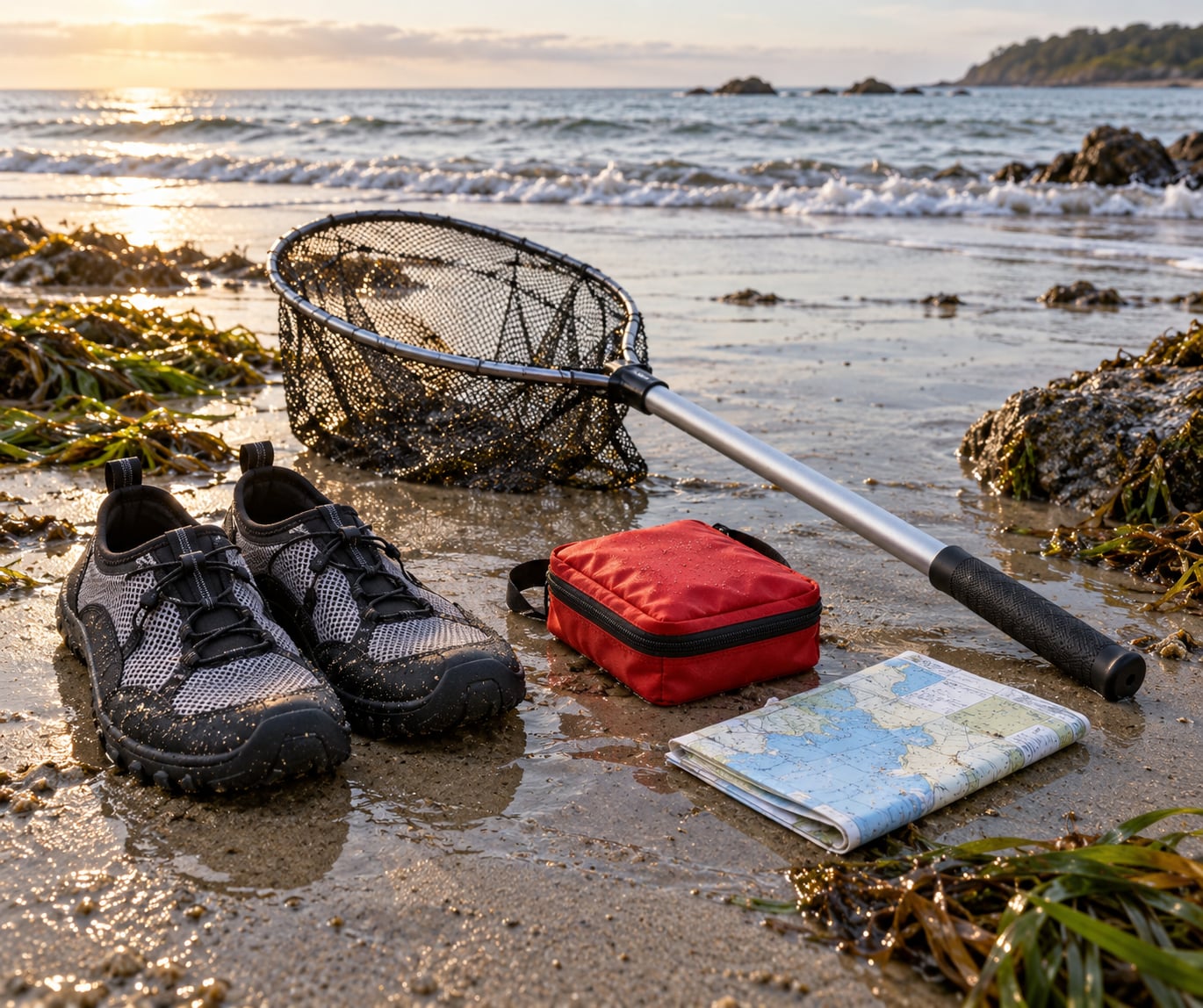
- A long-handled probe — a landing net, a canoe paddle, a walking stick, a crabbing rake. Its job is to feel along the bottom a few feet ahead of your feet.
- A small first aid kit with clean water for rinsing, a towel, and a way to get a call out. A phone in a waterproof pouch counts as part of the kit.
- Local knowledge: posted signage, lifeguard advice, ranger station reports, and a tide table. Water depth and current change the picture completely.
One honest note before we go further. Even a full set of guards is a probability reducer, not a shield. Every experienced wader takes on some risk the moment they step off the bank.
Step-by-Step: How to Avoid Stingrays While Wading
1. Check the water and sand before you enter
Spend thirty seconds at the waterline before you get wet. Sandy flats, tidal channels, and the edges of seagrass beds are where rays feed and rest. Look for darker patches, fresh divots, or a cloud of disturbed sand, and check for rays in ankle-deep water before you commit to waist-deep water.
How do you know a ray is bedded under you? You often do not. Water clarity helps, and the vibration response is the only warning you get.
2. Wear protective footwear and leg coverage
Standard water shoes and thin sandals do not do much against a barb. What changes the outcome is dense rubber or reinforced panels over the toe, instep and ankle, plus shinguards when the water is deep enough for a larger ray to reach your calf.
If you already own hunting waders, some waders carry built-in Cordura panels from the boot to mid-thigh, and waders of that style work well as a backstop. Salt Strong member Justin Bradburn, who wades often, recommends that route specifically for people who do not want to buy fishing gear.
3. Move slowly and watch where you place each step
This is the stingray shuffle, and it works because of what it does and doesn’t do. You drag the sole of your foot along the surface of the bottom with a continuous low pressure, then slide the other foot forward to follow. You never lift your foot clear of the bottom and drop it.
The lift-and-plant is the problem. A sudden load arrives with no warning attached, and a buried ray has no reason to be gone. The slide gives it vibration and pressure it can feel through the sand in time to launch. Keep a slow cadence, roughly one deliberate slide per second, and keep your eyes down where you can actually see the bottom.
4. Use a pole, net, or long-handled tool to check ahead
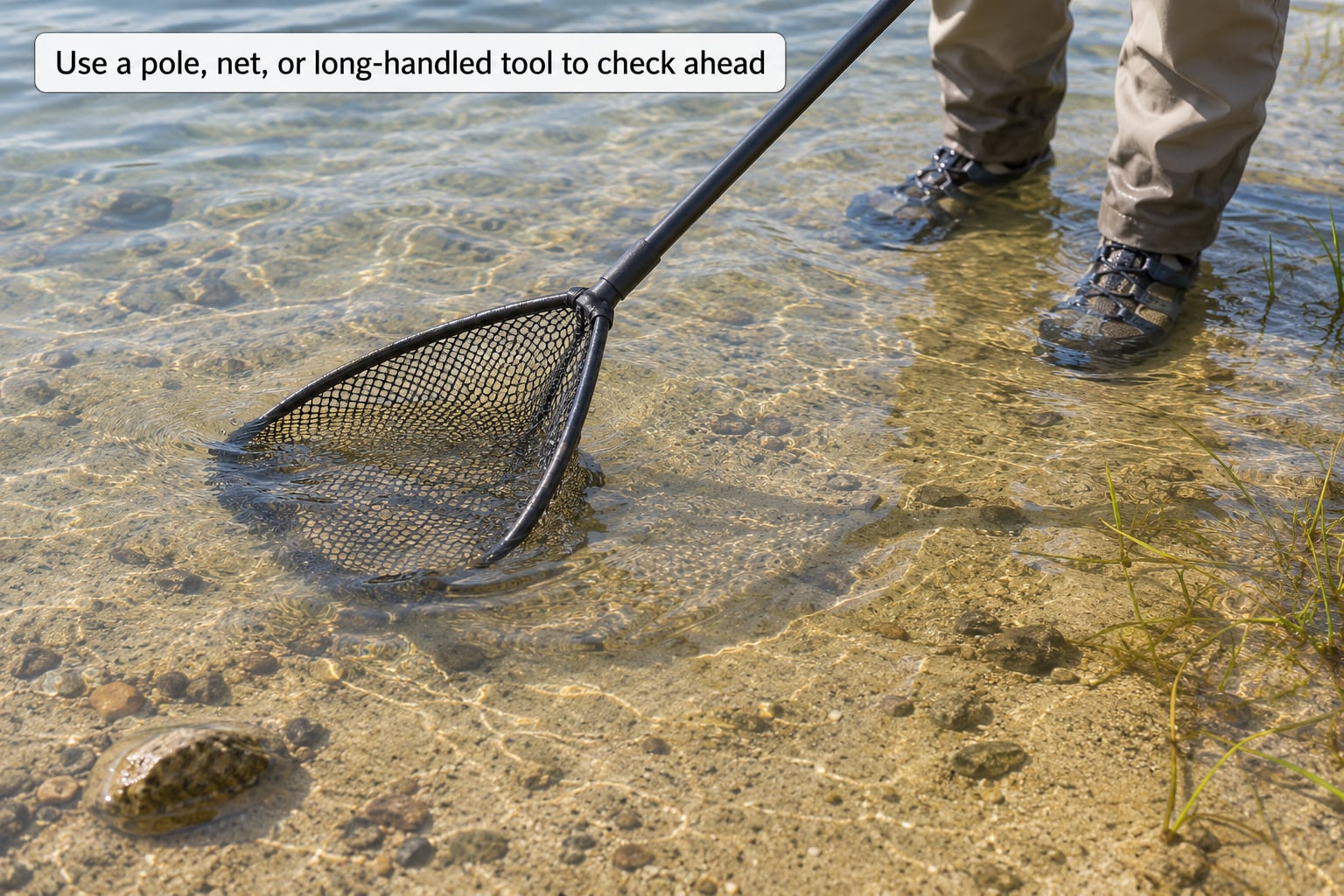
Probing ahead is the upgrade most waders never bother with. Extend the tool two to three feet in front of you, drag it lightly across the bottom, and feel for a soft rise that was not there on the last pass. If something moves, stop and give it room to leave before you walk anywhere near it.
If a ray is already swimming at you rather than buried, the same tool settles it. Salt Strong describes anglers using a rod point to gently poke a curious ray so it scatters. The idea is to nudge it away from you, not to fight it. And the tail is not a snake — a stingray pushes with a prehensile tail rather than lashing out like a whip, which the Texas Saltwater Fishing Magazine field test documented clearly.
5. Avoid stirring up sand and mud
Murk is not a safety feature. Every kick sends a cloud of bottom into suspension, and rays are opportunistic hunters that follow disturbance to feed on whatever got flushed loose. Wade quietly enough and your own wake stays behind you instead of announcing where you are going.
6. Keep clear of swimming areas and crowded shallows
You cannot see what is under the water at a popular beach entry point, and neither can the person standing next to you. Where possible, use maintained entry points and ramps, and give shallow sandy areas near swimmers and sandcastles a wide berth. Local conditions matter more than any rule on this list.
7. Watch for warning signs and local guidance
Posted stingrays signs, lifeguard instructions, closure flags, and local fishing reports are there because the local numbers say the risk is up this week. Season counts too. Ray activity tracks water temperature, and many places see a spike once the water turns warm. Ask the ranger station or the dockhand. Nobody has ever talked down to you for asking.
After dark, in murky water, or in strong current, raise the bar rather than lowering it. Night wading removes your ability to see the bottom, murky water removes your sightline entirely, and current makes you dig your toes in to stay upright — three separate ways to put your foot down hard. If you wade in any of those conditions, protective gear stops being optional.
8. Know the safe response if contact occurs
Get out of the water first. Then stay still long enough to look at the wound before you move on, because what you find changes what you do next.
Rinse the wound with seawater or clean water to clear sand and any remaining venom, then get into water at 110 to 115 F and soak for 30 to 90 minutes. Heat is what neutralizes the stingray venom protein, and it is far more effective than anything else you can do at home. Ibuprofen helps with the pain and swelling. Do not use ice — it does not neutralize venom and can make tissue damage worse.
Look closely at the entry point. Barbs are large, wide, backward-pointing and shaped much like a catfish spine, which is why they are hard to pull out by hand. Les Garten, a longtime Florida paramedic who has seen plenty of these, describes large stings as needing surgical removal, where a doctor cores around the barb. If you can see a barb, or the pain is not easing after the soak, get to urgent care.
Warm saltwater carries Vibrio vulnificus, and that is the reason for the ER threshold rather than a hot soak and hope. Watch for redness spreading from the wound, swelling that keeps climbing, pus, fever, chills, or feeling generally unwell. Salt Strong member Michael Knapick has seen how fast Gulf of Mexico summer water can turn an ordinary sting into an emergency. Any of those signs means same-day medical care.
Common Mistakes That Put Your Foot in Barb Range
Most stingings people describe happened during one of five habits.
Backtracking over your own disturbed bottom. This is the rule experienced waders repeat and almost no article bothers to write down. Salt Strong member Neal Hagood, who watches rays around Aransas Pass and Rockport, Texas, says do not backtrack on the same path and do not follow another wader’s trail — rays move into disturbed bottom to feed on what was flushed out. Walk a fresh path on the way back, or walk back the way you came at a wide offset.
Digging your heel in to hold position. Standing still in current means pressing down, and pressing down is the exact thing the shuffle avoids. Rest your weight between feet, shuffle to hold station, or move out of the current.
Stopping dead when you see a ray. Freeze with one foot raised and you have loaded that foot already. Set it down gently, slide away slowly, and let the ray leave.
Crossing another wader’s wake. That churned cloud of bottom is an invitation. Give other waders room and go around.
Trusting thin footwear. A comfortable-looking beach shoe with a mesh upper does nothing when a barb pushes. Density of material over the foot is the whole game.
A few extra habits round out the defense. Watch where you put your hands when you lose balance, and never reach down to touch or pick up a ray, however calm it looks. Keep an eye on a dog that likes to dig, and teach kids to shuffle rather than run in the shallows.
Swimming, Kids and Dogs Near Stingrays
Most beach stingings happen to people who are not even trying to catch anything. Swimmers who are walking on the bottom in waist-deep water put themselves exactly where a bedded ray is resting.
Float instead. Staying on a board, or swimming where your feet are clear of the bottom, takes you out of the range that matters. If you have to stand in the shallows, shuffle. When a ray approaches, move your hand or pole through the water in front of it so it feels you and leaves, and do not chase it. In the surf zone, rays are more common where small fish concentrate, which is often right where waves break and where children play.
Frequently Asked Questions
What neutralizes stingray venom?
Hot water is the answer. Immerse the wound in water at 110 to 115 F for 30 to 90 minutes. Heat denatures the venom protein, which is why soaking eases the pain faster than anything else. Do not use ice, since it does not neutralize venom and can add tissue damage. After the soak, rinse the wound with seawater or clean water to clear any sand and leftover venom.
What beaches have the most stingrays?
Sandy beaches, shallow bays, estuaries and seagrass edges are the places to expect them, especially in warm water and gentle surf. High-pressure regions include the Texas flats, the Florida Gulf, Southern California and Hawaii. Southern rays are far more dangerous to waders than the smaller northern Atlantic species. Posted signage and local reports beat any general rule, so check them before you walk in.
Do water shoes prevent stingray stings?
Standard water shoes and thin sandals do very little. What meaningfully reduces risk is dense rubber or reinforced panels over the toe, instep and ankle, ideally with shinguards for deeper water. Even good stingray-resistant booties are a strong deterrent, not a guarantee. That is why the shuffle still matters: gear and technique have to work together.
How do people swim with stingrays without getting stung?
Keep off the bottom. Float, swim in water deeper than your feet, or stay on a board so your legs are never the first thing touching sand. In the shallows, shuffle rather than walk. Never reach down to touch a ray, and use a hand or pole to nudge a curious one away. Watch kids and dogs, since both dig in sand exactly where rays rest.
When should a stingray sting send you to the ER?
Go for same-day care if you can see a barb still in the wound, if the pain is not easing after a long hot soak, or if the entry point looks dirty and deep. Emergency care is warranted for spreading redness, swelling that keeps climbing, pus, fever, chills, or feeling generally unwell. Warm saltwater carries Vibrio vulnificus, and that infection moves faster than most people expect.
Conclusion
Five actions carry most of the weight. Read the bottom and the local signage before you enter. Put protective footwear on your feet and shinguards on your legs. Slide your feet instead of lifting them, and never backtrack over ground you already disturbed. Probe ahead when you cannot see your own boots. And if a ray is close, move away slowly and give it room to leave.
None of that is exotic. It is the difference between a wade that ends with you putting gear away and one that ends at the clinic, and it works because you are dealing with a fish that feels the ground, not one that has to see you. The gear lowers the odds. The shuffle is what buys you time.