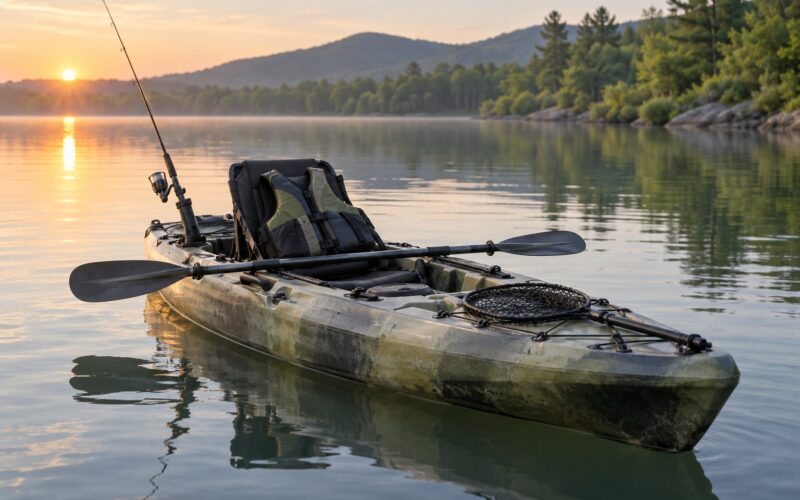
To stand up and fish from a kayak, you rise slowly from a seated start with the paddle planted in the water, feet wide on the deck, knees bent, and your weight centred over the hull before you shift anything else. Do it in flat, shallow water first, in a wide sit-on-top or hybrid kayak, and only once you can hold a stable crouch without the boat leaning. Expect a few sessions before it feels automatic.
Standing is worth the trouble for sight fishing, because your eyes get a few inches higher and you can spot fish shapes over the edge of a shallow flat. It also makes casting land closer to where you aimed and gives you more leverage when something runs. It is not worth it for trolling, and it is genuinely risky in a crosswind.
This guide covers the movement itself, the mistakes that end trips early, and the conditions where sitting down is the smarter call.
Table of Contents
- What You Need
- Step-by-Step: How to Stand Up and Fish From a Kayak
- 1. Choose a Stable Fishing Kayak
- 2. Check Conditions and Secure the Gear
- 3. Start in a Seated Position
- 4. Find Your Stable Standing Position
- 5. Stand Up Slowly
- 6. Control the Paddle and Maintain Balance
- 7. Fish Safely While Standing
- Common Mistakes
- Balance Drills to Practise Off the Water
- Frequently Asked Questions
- Is it safe to stand up and fish from a kayak?
- What type of kayak is best for standing and fishing?
- Can I cast a fishing rod while standing in a kayak?
- What should I do if I start losing balance in a kayak?
- Is it better to fish standing or sitting from a kayak?
- What is the 120 rule for kayaking?
- Conclusion
What You Need
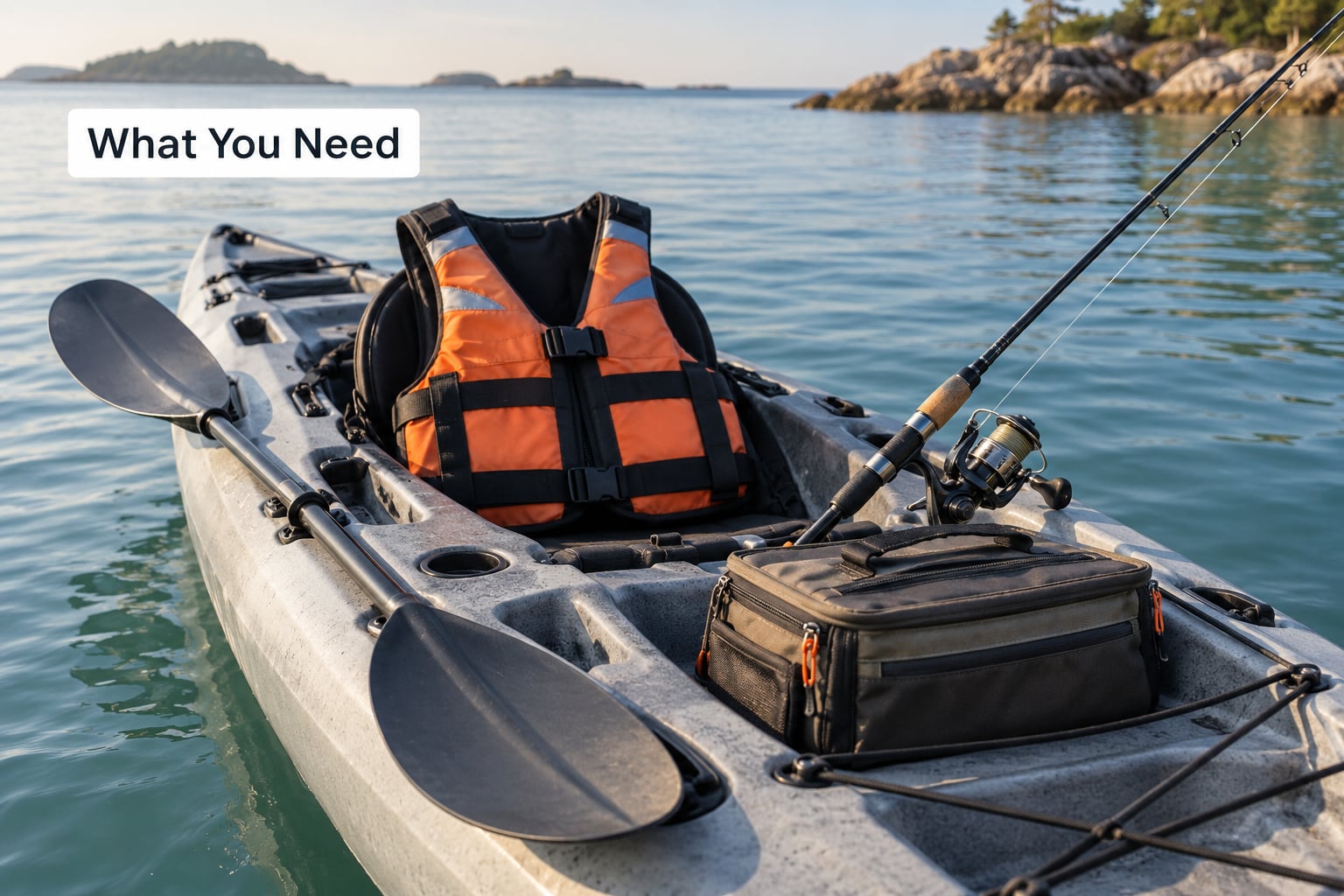
Most of what you need is standard paddling kit. A few items matter more when you plan to stand.
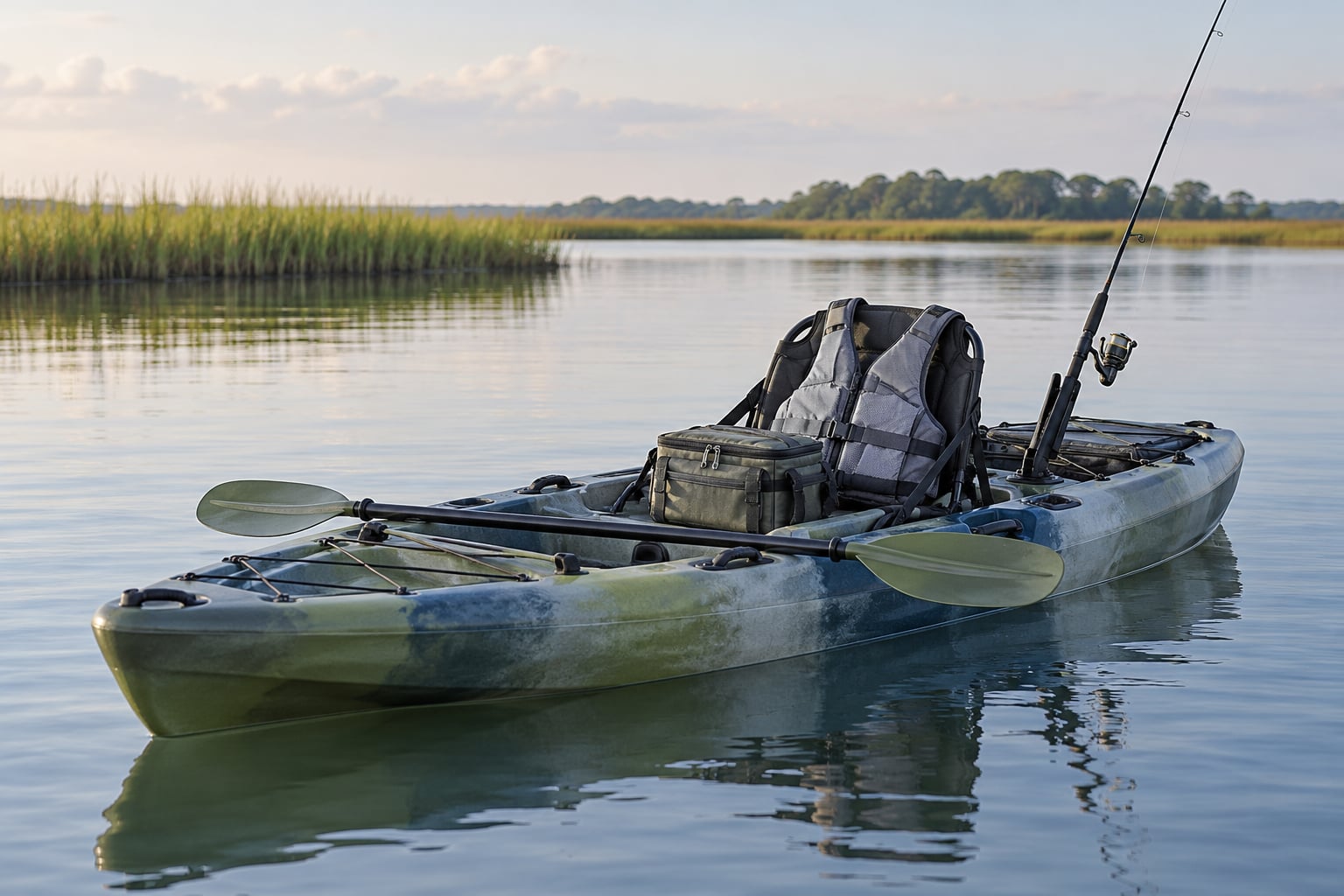
- A wide sit-on-top or hybrid kayak. Total width of 32 inches or more gives you room to move your feet without tipping. Wide boats track slowly, which is fine for fishing and frustrating for covering water.
- A PFD you will actually wear. A loose fit lets you move and keeps you from sliding sideways when the boat rolls. Crotch straps matter more than brand.
- A paddle with a leash. You will be using it as a third point of contact the whole time you are standing. A leash keeps it from drifting away mid-correction.
- Grippy footwear. Wet EVA foam or carpeted decks are slick. Water shoes with a rubber sole give your feet something to push against.
- A rod holder. Once you are up, you cannot reach gear on the deck. Secure the rod in a holder or strap it to the hull-side bungee before you stand.
- A tackle bag that stays put. Small bag, clipped or bungeed to the deck. A loose bag shifts your centre of gravity every time you open it.
- A whistle and a signalling mirror. Both cheap, both clipped to your PFD where you can reach them from the seat.
Optional but useful: a paddle float, a rod leash, and a dry bag for your phone and keys. If the water is cold, a dry suit beats a life jacket for warmth, and you can wear both.
Step-by-Step: How to Stand Up and Fish From a Kayak
The sequence below moves from kayak choice to casting. Skipping ahead to step 5 is how most beginners end up in the water.
1. Choose a Stable Fishing Kayak
Stability comes from total width, then from hull shape, then from seat height. Deck width matters less than the number printed on the hull, because your feet need space to spread.
- Sit-on-top models widest and simplest, with high seats that make standing easy. Harder to pedal or paddle efficiently.
- Hybrid designs combine a sit-on-top’s width with a canoe-style hull, and the raised sidewalls give your knees something to brace against. Popular with anglers who have trouble with balance.
- Sit-in kayaks are narrow. You can stand in one, but not on your first outing.
What the width numbers actually feel like once you are up:
- Under 30 inches: tedious, with constant micro-corrections. Seated fishing only.
- 30 to 32 inches: workable with a light paddle and calm water. Experienced anglers and short sessions.
- 32 to 34 inches: a comfortable crouch that forgives you when you move. Most standing anglers land here.
- 34 inches and up: stands like a floor, but tracks slowly. Good for newcomers and windier days.
Angling forums are full of anglers who bought a narrow boat that marketed well and tipped the moment they stood. Demo one if you can, and stand in it in the parking lot fully loaded with your gear. You will know within five seconds.
2. Check Conditions and Secure the Gear
Standing raises your centre of gravity, so conditions matter more than they do when seated. Before you launch, check wind, wave height, current, tide and local rules for the water you are entering.
Keep the 120 degree rule in mind: air temperature plus water temperature should total 120 degrees or higher before you skip a dry suit. A standing angler in cold water has further to fall and a slower recovery.
On the boat, clip the paddle leash, stow loose line away from your feet, and tie the rod to something fixed. A free-swinging rod on a six-foot cast is how a boat rolls.
3. Start in a Seated Position
Sit with both feet on the deck, not on the footrests. Feet apart at roughly hip width, knees slightly bent, weight forward of the seat and centred between your feet.
Plant the paddle blade in the water beside the hull, straight down and a little forward of your hip. Practise getting up and back down twice without moving the paddle. Those first three repetitions teach your body where the boat’s centre is.
4. Find Your Stable Standing Position
A stable standing position in a kayak is a wide, bent-knee crouch, not an upright stance. Think knees soft, hips low, shoulders over your feet.
Set one foot near the centre of the deck and the other out toward the hull edge, then reverse if it feels tippy. Keep your hips between your feet. If your hips drift behind your heels, you will feel the stern drop; if they drift past your toes, the bow dips.
Your paddle stays planted through all of this. It is not decoration and you should not stow it while standing.
5. Stand Up Slowly
This is the core answer to how to stand up and fish from a kayak without falling in, and it is a controlled movement, not a hop.
- Weight into both feet, knees bent, paddle planted firm.
- Bring your hips up slightly and forward to a kneeling or high crouch, keeping the paddle down.
- Pause. Check that the boat is level and your weight is centred.
- Push through both feet slowly to bring your hips up above your feet.
- Stay in the bent-knee crouch. Resist straightening your legs fully.
It helps to look at your feet, not the horizon. Take four or five seconds for the whole rise. If the boat moves sideways, sit back down rather than fighting it.
6. Control the Paddle and Maintain Balance
Most experienced stand-up anglers describe the paddle as a third leg. When the hull starts to rock, push down on the paddle instead of throwing your arms out.
Move smoothly and slowly. Turning your torso instead of twisting your hips keeps your weight over the same spot on the deck, which keeps the boat flat. If you need to relocate your feet, sit down first, move, then rise again.
Legs do the work. Bent knees act as shock absorbers when a wave lifts one end of the boat, and loose ankles are what you are trying to avoid.
7. Fish Safely While Standing
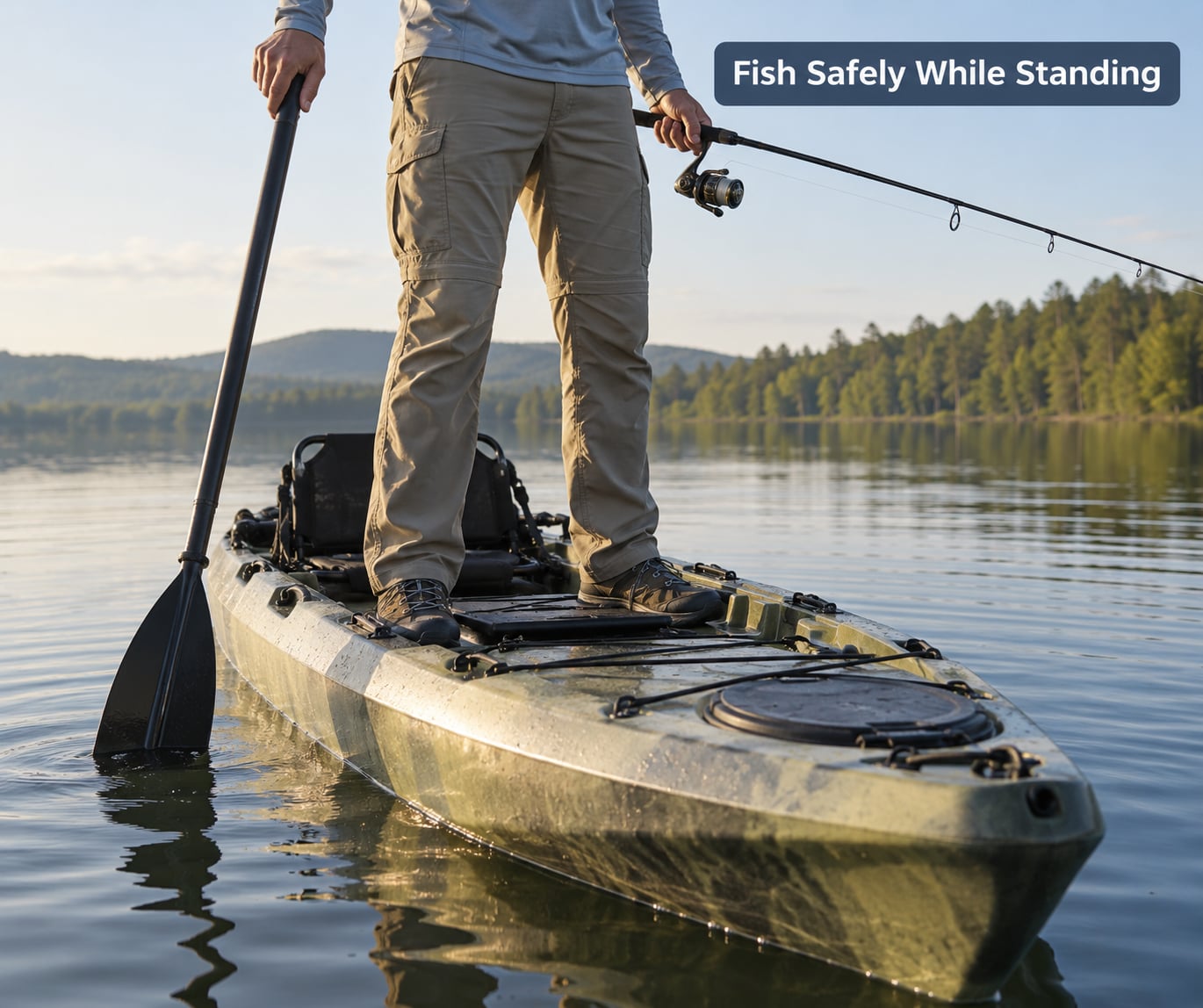
Casting from a crouch is manageable. Keep the rod in one hand, paddle in the other, and make short casts. Timing matters: cast during a lull when the boat is flat, not as a wave passes under you.
Keep the retrieve smooth and slow. Jerking the rod tip sideways is the fastest way to put an unexpected weight shift into a narrow boat.
When a fish comes in, the safest move for most anglers is to sit back down and land it seated. That is not a compromise. Anglers who insist on landing big fish standing typically control the leader with one hand and step a leg into the water for a brace, which only works in shallow, calm water.
Have a seated fallback ready for rough water, strong wind or any moment you feel the boat starting to move under you. Sitting down has never wrecked a fishing trip.
Common Mistakes
Standing too fast. The fastest way to capsize is a quick push out of the seat. Slow the rise to a count of five and keep the paddle planted the entire time.
Standing in the wrong conditions. A steady crosswind or a short chop will move a standing angler far more than a seated one. If you are picking your way through whitecaps, stay seated.
Reaching outside the boat. Casting or grabbing tackle beyond the hull puts your weight off the platform. Bring tackle to you, or sit down before reaching.
Leaving gear loose. A tackle bag sliding one foot changes your balance without warning. Clip everything, including the rod and the spare paddle.
Stowing the paddle. Once you are up, the paddle is your only reach outside the hull. Tying it away removes your best correction tool.
Buying wide enough on paper only. Specifications ignore body type. Anglers with broader shoulders or a heavier frame consistently report more trouble on the same hull others find stable. Demo before you commit.
Balance Drills to Practise Off the Water
Here are four drills worth doing on land, in order of how quickly they pay off.
- Seated-to-crouch repeats on a floor or foam mat. No boat, no risk. Ten slow rises with the paddle held out in front of you teaches the timing that matters most.
- Single-leg balance on a cushion or folded towel. Stand on one foot for 60 seconds, switch, repeat. This trains the ankles, which handle most of the small corrections once you are up.
- Balance disc work. Ten minutes of standing on a disc, first two feet then one, keeps the core switched on in a way that rocking on a balance board will not.
- Shadow swings. Stand on flat ground with a 6-foot broom handle and make twenty slow casting motions. The point is smooth, even weight transfer, not distance.
Most people report weeks rather than minutes before it stops feeling like an event. Anyone with a knee, hip or back issue should talk to a physiotherapist before adding the standing work, and stick to the crouch until they are cleared.
Frequently Asked Questions
Is it safe to stand up and fish from a kayak?
Yes, on flat or lightly rippled water in a wide sit-on-top or hybrid kayak, provided you wear a PFD, keep your paddle leash on, and rise slowly with the paddle planted. Standing raises your centre of gravity, so avoid strong crosswinds, chop and cold water. Practise the movement in shallow, calm water before you try it on a fishing trip.
What type of kayak is best for standing and fishing?
A wide sit-on-top or hybrid model with a total width of 32 inches or more and a raised seat. Hybrid kayaks add sidewalls your knees can brace against, which helps anglers with marginal balance. Sit-in kayaks can be stood in but are narrow and unforgiving. Whatever you choose, load it with your real gear and stand in it before you buy.
Can I cast a fishing rod while standing in a kayak?
You can, and most sight anglers do it every trip. Stay in a bent-knee crouch, keep one hand on the paddle, use short casts, and cast while the boat is flat rather than as a wave lifts it. Keep your retrieve smooth, and sit back down if you have to reach for the lure or fight something bigger than you expected.
What should I do if I start losing balance in a kayak?
Push down on your paddle to add a third point of contact, widen your stance and lower your hips, then sit back down. Small corrections early beat big ones late. If the boat is going over, get your body low and away from the hull rather than standing tall. Falling clear of the kayak matters more than staying in it, so never clip yourself to the boat.
Is it better to fish standing or sitting from a kayak?
Standing wins for sight fishing, because you see over the water and cast more accurately. Sitting wins for trolling, bottom fishing, strong wind, cold water and landing larger fish. Many anglers spend the trip in both positions, standing to spot and cast, then sitting down to fight and land whatever shows up.
What is the 120 rule for kayaking?
The 120 rule says that air temperature plus water temperature should equal 120 degrees or higher before you paddle without a dry suit. If the sum is lower, cold water shock can knock out a competent swimmer within minutes. It matters even more when standing, since a fall in cold water is harder to recover from on a moving hull.
Conclusion
Start seated in shallow, calm water, paddle planted beside the hull, and practise the rise to a bent-knee crouch three or four times before you think about fishing. Once that feels controlled, stand to spot and cast, and sit back down to land whatever you hook. Technique, not boat specs, is what makes standing in a kayak safe.