Learning how to fish from a kayak without tipping comes down to four habits: keep your weight low and centered in the boat, stow every loose item along the middle of the hull, wear your flotation device instead of stowing it, and stay seated when a hooked fish pulls. A sit-on-top fishing kayak is far harder to flip than most new anglers expect, and an afternoon of practice on flat water sets you up for years of safe trips.
The fear of going over is the single biggest reason people never try. That fear is mostly about technique rather than the boat itself. Kayaks are narrow, but they are also buoyant, and the water gives you back a surprising amount of forgiveness when your weight stays inside the hull.
Here is the gear, the sequence, and the recovery plan I would hand a beginner.
Table of Contents
- What You Need to Fish from a Kayak Without Tipping
- Safety kit that is not optional
- Paddle, seat and hull
- Fishing kit that stays put
- Step-by-Step: Staying Stable While You Fish
- Set a Stable Base: The Core of Fishing from a Kayak Without Tipping
- Control the Paddle, Not Just the Boat
- Set Up Gear So Nothing Shifts
- Cast Without Overreaching
- Fight the Fish Without Being Pulled Out
- Land and Release Without Standing Up
- Recover from a Wobble or a Swamp
- Common Kayak Fishing Mistakes
- Frequently Asked Questions
- Is it hard to tip a kayak?
- How do I make my kayak more stable for fishing?
- Can you still flip a kayak with outriggers fitted?
- Should I sit or stand when casting from a kayak?
- What do I do if I fall out of a kayak while fishing?
- How should I rig a fishing kayak as a beginner?
- Conclusion
What You Need to Fish from a Kayak Without Tipping
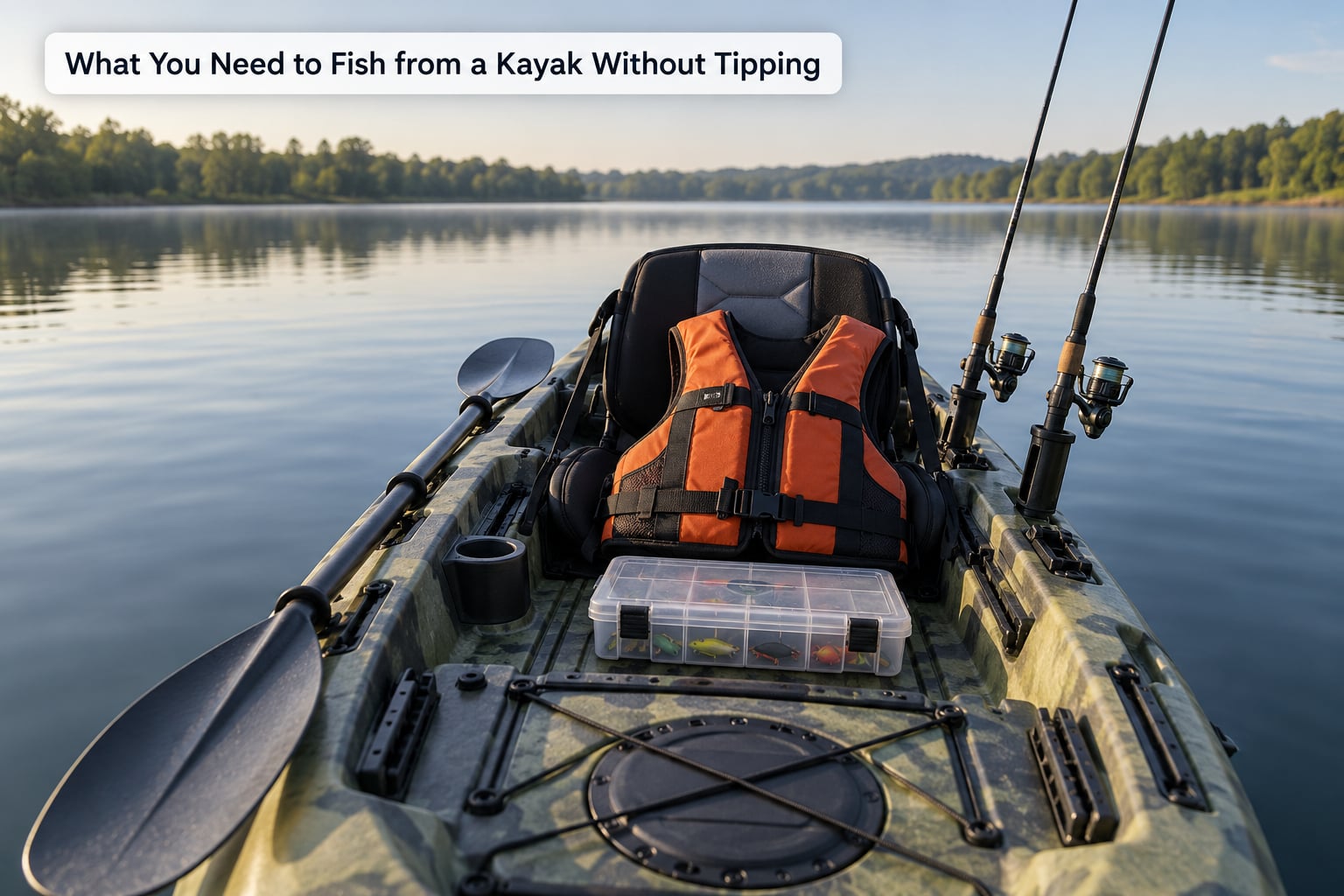
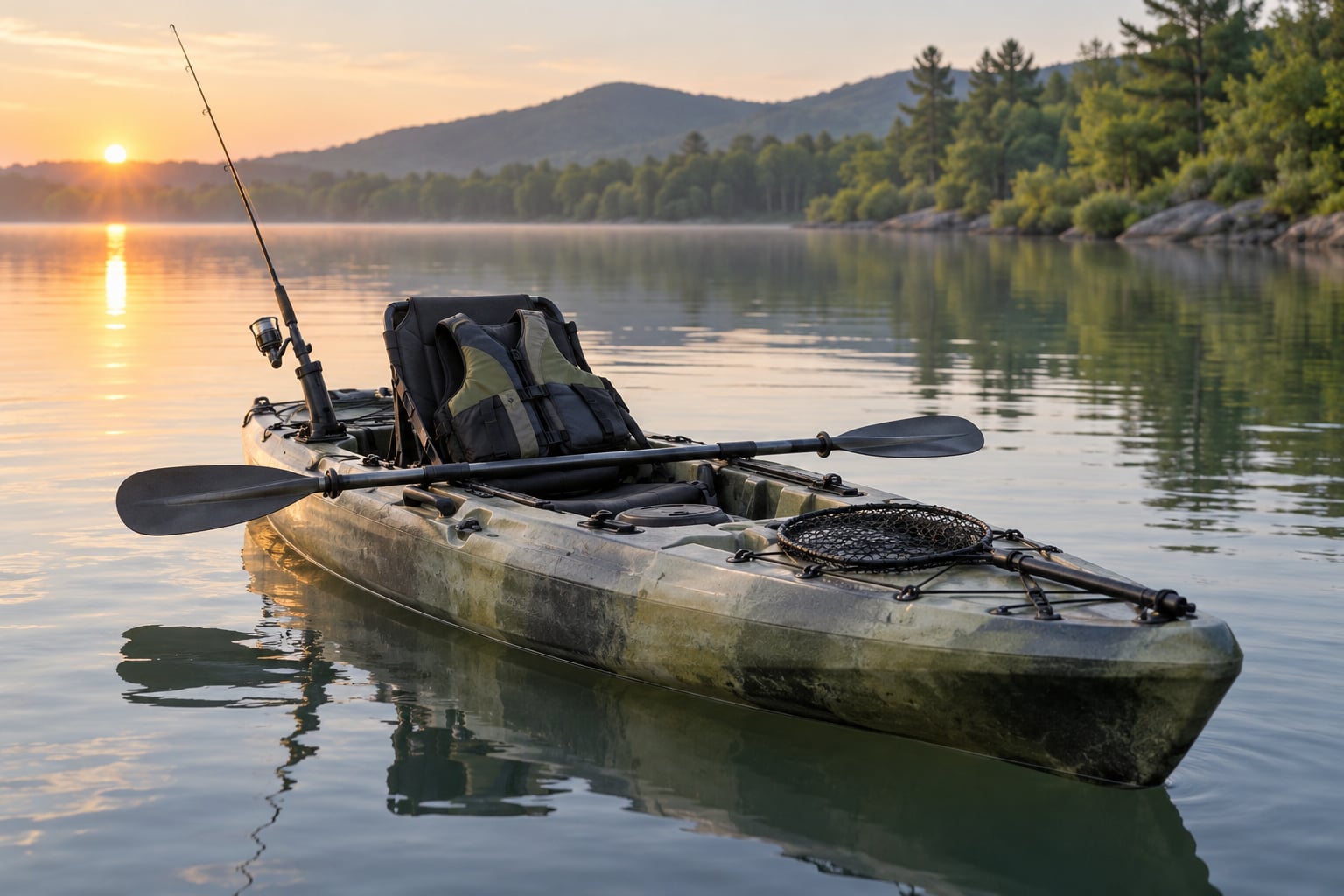
You do not need a deck full of gadgets. You need a properly fitted PFD, a leash for almost everything else, and a boat with enough width that an accidental lean does not become a swim.
Safety kit that is not optional
- A PFD you are willing to wear for three hours. Buy one with a full arm range and a snug chest strap. A loose or stowed PFD is the difference between a wet shirt and a bad afternoon.
- A paddle leash. Coiled to the vest or the paddle shaft, not to your wrist.
- A whistle and a bow line. Cheap insurance on any water where help is more than a few minutes away.
- A working VHF radio or a phone in a waterproof case for solo trips on open water.
Paddle, seat and hull
- A paddle slightly shorter than you are. Too long and you cannot brace quickly; too short and you constantly hit the deck.
- A seat height that lets your knees sit slightly above the gunwale. Knees above the hull sides raise your effective center of gravity without you standing up.
- A wide hull for beginners. Beam matters more than length. Sit-on-top boats are easier to remount after a capsize; sit-ins are more efficient in wind and current.
Fishing kit that stays put
- A rod at least 6 feet 6 inches long. Length lets you steer a fish around the boat instead of pulling it into your knees.
- A rod leash and a reel with a drag that you have actually set.
- A soft landing net on a tether. A net on the deck is a fish-handling time saver and a stability time saver.
- A lip gripper clipped to the boat so a toothy bass can be held with one hand while the other hand works the hook.
- A tackle box and cooler latched down or tethered along the centerline. Anglers who run 12-inch tethers report far fewer lost items and easier recovery after a tip-out.
Step-by-Step: Staying Stable While You Fish
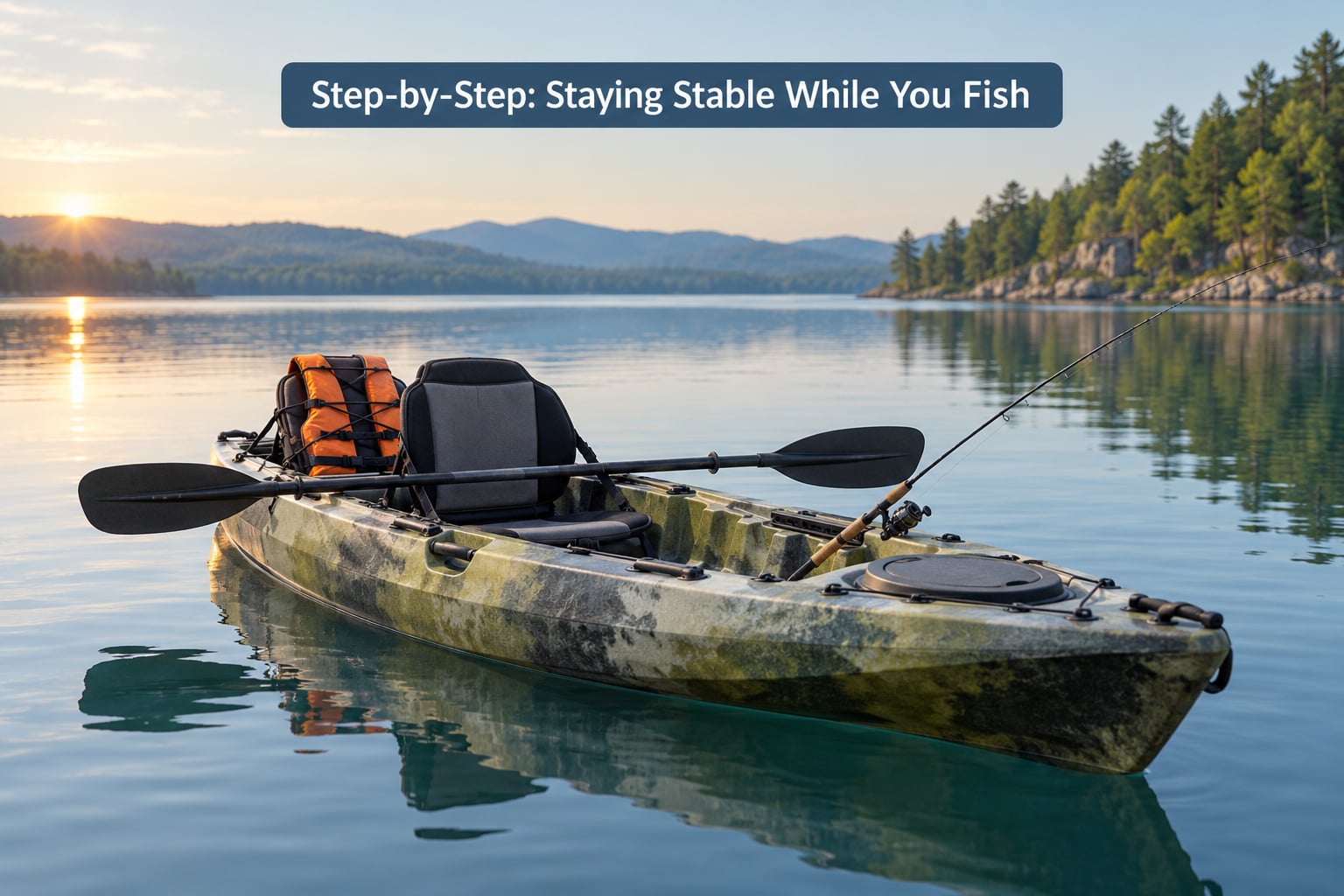
Work through these in order on your first few trips. Each one solves a specific way anglers end up in the water.
Set a Stable Base: The Core of Fishing from a Kayak Without Tipping
Sit down before you ever raise the rod, and sit down fully. Butt bones planted, knees up near the gunwale or in the foot braces, weight spread evenly front to back. A kayak that is level on the water will stay level if you stop making it list.
The rule anglers repeat most is simple: where your head goes, your body will follow. Reach your head out over the side to watch a lure and your torso follows it out within a second or two. Keep your head inside the boat and reach with your rod instead.
Check your trim every ten minutes. Bow heavy and you plow water; stern heavy and the current grabs you sideways. Slide gear or shift a few inches of body weight until the boat floats flat.
Control the Paddle, Not Just the Boat
Short, quiet strokes do the work. Reach forward, drop the blade in, pull back to your hip, feather out. Long sweeping strokes rotate your torso and put your weight off center, which is exactly what you do not want while a line is running.
Keep the paddle across your lap or in one hand when you are not actively driving. When you do need to brace, you have to be able to get it into the water in under a second.
Practice one-arm paddling on flat water before you need it. Bracing strokes with the paddle held straight out to one side, blade flat and face against the hull, are the fastest way to stop a developing lean. A bow-draw stroke in the open water is the fastest way to stop a spin.
Set Up Gear So Nothing Shifts
Everything loose in a kayak is a stability event waiting to happen. A tackle box sliding to one side adds weight off the centerline, and the boat responds exactly as you would hope it would not.
- Stow gear in the middle of the hull along its length rather than at the bow or stern.
- Keep the heaviest items low, below your knees, and close to the centerline.
- Use flush-mount rod holders for the rod you are not actively fishing.
- Tether the net, the gripper and any loose tool.
- Leave the deck around your knees clear so a leaning fish never catches a snag and rolls you.
Cast Without Overreaching
Turn with your hips and shoulders, not with your arm. Loosen the line, rotate your torso toward the target, and let the rod do the work on a short, controlled cast. Baitcasters who swing the rod from the hip have a lot more control than people who wind up over the gunwale.
Keep the line on the deck rather than letting it cut across your lap. A line under your leg is a jerk you did not choose, and a spool of loose line tangled around your hands is worse.
Standing up to cast feels good on flat water and is the most common cause of a beginner’s first swim. It is a different sport from a different sport. Sit for the whole session, or stand only on dead-calm water with a low seat height behind you.
Fight the Fish Without Being Pulled Out
Keep at least one rod length of line between the rod tip and the fish. That gap is your buffer. Reeling a fish right up to your knees turns a fight into an imbalance.
Let the drag do the work and point the bow into any waves or current coming at you. A fish pulling on your rod while the bow is turned broadside spins you far faster than the same pull with the bow pointed into it.
If the fish decides to run, deploy an anchor from an anchor trolley if you carry one. Then let the line run behind you and pick the fish up on its side as it comes around the hull. That is side-strike positioning, and it turns a tug of war into a controlled landing.
Keep the paddle leash on and ready. A brace stroke held against the hull while the other hand manages the rod is what saves the trip, not strength.
Land and Release Without Standing Up
Brace first, net second. Put the paddle blade against the hull on the side you are leaning to, take the net in that same hand, and sweep it under the fish as you guide it in with the rod. Do not try to scoop and lift at the same time; a net handle swings wide.
Once the fish is in the net, rest it across the deck rather than holding it high. Then either clamp the gripper and work the hook out one-handed, or use pliers on a short leader. Unhooking in the lap is the moment most anglers tip over, because it pulls them forward and down.
Store the catch in a tethered cooler. A fish thumping loose across the deck while you paddle is a classic capsize cause.
Recover from a Wobble or a Swamp
If the boat leans, stay seated and lower your torso toward the low side. A head and shoulders moving outboard is what actually flips a kayak, not the lean itself. Bring the paddle across your lap and brace against the water.
If water comes over the gunwale, weight shifts aft. Lean forward, paddle toward shallower water, and drain as you go. Staying in the boat is always the right move; a kayak with a foot of water in it still floats.
If you do go in, work on the wet exit, not the dry one. Get out through the cockpit or over the top of the hull rather than tipping the boat fully upside down. Swim to the kayak, hold the crossbar or grab loop, and get a knee on the deck before you push. An experienced practice session in a shallow pool, with a friend on a bank, is worth more than anything written here.
Common Kayak Fishing Mistakes
Almost every tip-over traces back to one of these. Each has a simple correction.
- Standing to cast on moving water. Correction: sit, and turn with the hips. Save standing casts for glass-calm water only.
- Loose gear in the hull. Correction: run every box, net and tool on a tether and keep the mass on the centerline.
- Paddling with the rod in one hand and a bent knee. Correction: secure the rod in a holder before you pick up the paddle. One-arm paddling practice makes the emergency version automatic.
- Reeling a hooked fish to your knees. Correction: keep one rod length of slack in the line and let the drag pull.
- Ignoring wind and current. Correction: read the water before you launch. If the chop is short and steep against a beam wind, come back in.
- Stowing the PFD in the hull. Correction: put it on before the boat touches the water. Nearly every serious kayak fatality is a drowning after a capsize, and an unworn PFD is the most common factor in that.
- Loading the boat beyond its rating. Weight capacity is a ceiling for safety, not a target. Most manufacturers also publish a lower maximum operator weight, and that is the number to design your load around.
Above all, start small. Carry only the rod and a couple of lures on your first paddles, get comfortable with wet exits in shallow water, and add gear as you learn what the boat can hold. Anglers who fished two-pound bass on ultralight tackle and kept their gear tied down report the most trouble-free transitions to kayak fishing.
Frequently Asked Questions
Is it hard to tip a kayak?
A sit-on-top or fishing kayak is reasonably difficult to flip when you are seated and moving normally. Most tip-overs come from standing up, leaning past the gunwale, sudden gear shifts, or being pulled sideways by a hooked fish. On flat water with a properly fitted PFD, beginners rarely go over during their first season.
How do I make my kayak more stable for fishing?
Three changes do most of the work. Sit with your knees at or above the gunwale to raise your effective center of gravity without standing, stow every loose item along the middle of the hull rather than at the bow or stern, and choose a wider hull if you are still shopping. Outriggers help secondary stability but do not fix a weight balance problem.
Can you still flip a kayak with outriggers fitted?
Yes. Outrigger stabilizer kits reduce the roll that starts a tip-over, but they add no buoyancy and no reserve when a fish pulls you off the seat or a wave lifts one outrigger clear. Treat them as a helpful accessory for a wide, steady boat, not as a replacement for a PFD, a paddle leash and staying seated.
Should I sit or stand when casting from a kayak?
Sit for nearly all fishing. A seated cast lets you turn with your hips and shoulders, keeps your head inside the hull, and stops you from stepping on gear. Standing casts are faster in tight cover, but they belong on dead-calm water with a low seat behind you. If you fish from a pedal or high-seat boat, you have more options but the same rule about head position.
What do I do if I fall out of a kayak while fishing?
Breathe, then treat it as a swim, not a capsize. Stay with the boat, which floats and is easier to find than you are. Swim to the hull, hold a grab loop or crossbar, get a knee onto the deck, and push up while the paddle stays tethered. Climbing back in over the side is safer than flipping the kayak upside down.
How should I rig a fishing kayak as a beginner?
Start with a PFD you will actually wear, a paddle leash, a rod leash, and a net and lip gripper tethered to the boat. Add an anchor trolley only once you are comfortable holding position in wind or current, and add a fish finder or trolling motor later. The beginner kit that matters is the flotation and the tethers.
Conclusion
The first thing to do before leaving shore is put the PFD on your body, not in the hull, and check the boat floats level with your gear loaded. Then practice on flat water: seated casts turned with the hips, one-arm paddle strokes, a brace stroke on command, and a wet exit in shallow water. Once those four drills are automatic, most of the rest of kayak fishing takes care of itself.