Learning how to identify a live oak from other oaks comes down to three characters that almost never lie together: small, thick, leathery leaves with smooth edges that hang on through winter, dark gray to nearly black bark deeply furrowed into narrow ridges, and small football-shaped acorns carried in clusters of one to five. Water oak will match two of those three, which is exactly where most wrong calls start.
Ten minutes at the tree with a hand lens is usually enough. The hard cases are juveniles, which look like nothing but a sapling, and winter, when the leaves that would settle it are lying on the ground.
One more thing that trips people up before they ever reach the tree: two different species are both called live oak. Quercus virginiana is the coastal and Atlantic-Gulf live oak. Quercus fusiformis is the Texas and Southwestern live oak, known in Texas as the encino. They share the same characters, so everything below works for either one.
Table of Contents
- What You Need
- Step-by-Step
- Step 1: Check the Leaf Shape and Margins
- Step 2: Look at the Bark and Branching Pattern
- Step 3: Examine the Acorns and Leaf Arrangement
- Step 4: Confirm the Tree in Its Habitat
- Common Mistakes
- Trusting one clue
- Assuming any evergreen oak is a live oak
- Reading the moss as a verdict
- Forgetting the two live oak species
- Testing a juvenile tree
- Panicking about spring leaf drop
- Trusting one app result
- Frequently Asked Questions
- Are live oak leaves always smooth?
- What does a live oak tree look like from a distance?
- How can I tell a live oak from a water oak?
- Do live oaks keep their leaves through winter?
- Can you identify a live oak by its bark alone?
- Where do live oaks grow in the Southeast?
- Conclusion
What You Need
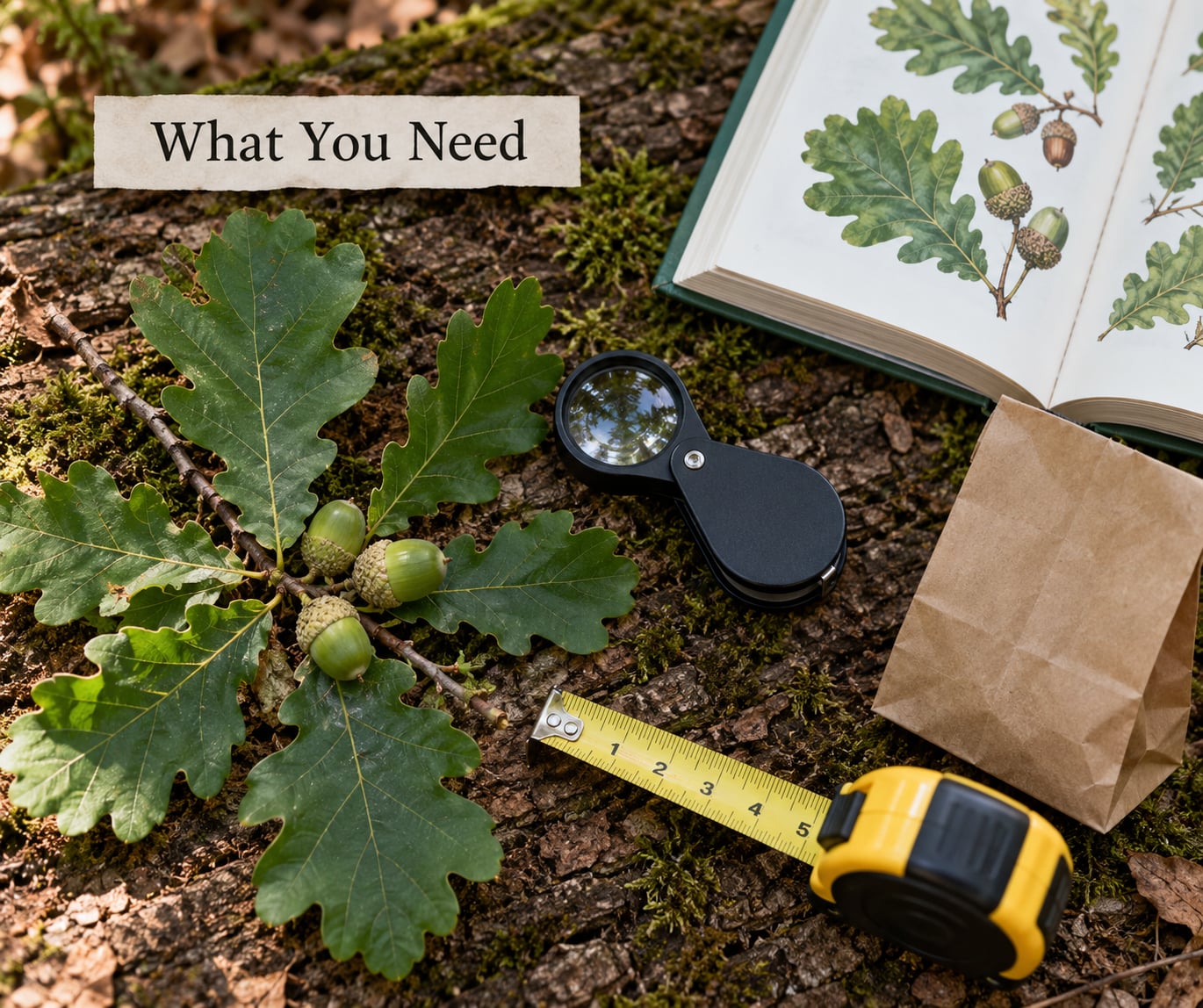
None of this is specialized equipment. It is the set of things that keep an identification from collapsing halfway through because you forgot to photograph something.
- A 10x hand lens. Margins, hairiness on the leaf underside, and the surface of the acorn cap are all too small to judge by eye at arm’s length.
- A field guide with a Southeast oak key. The Morton Arboretum’s tree guide and the county extension publications from Texas A&M Forest Service or UF/IFAS Extension both work.
- Leaf samples with the twig still attached. A loose leaf loses the arrangement, the bud, and the petiole, and those are often the characters that separate two look-alikes.
- A small paper bag for acorns. One to five on the twig is normal. Bag them whole so the cap stays on the nut.
- A tape measure and your phone. Leaf length in inches, plus photos of the bark, the full silhouette, and the whole crown from one side.
Write down where you are standing, too. Live oak versus laurel oak versus water oak often settles on range alone, and a photo without a location is half a specimen.
Step-by-Step
Step 1: Check the Leaf Shape and Margins
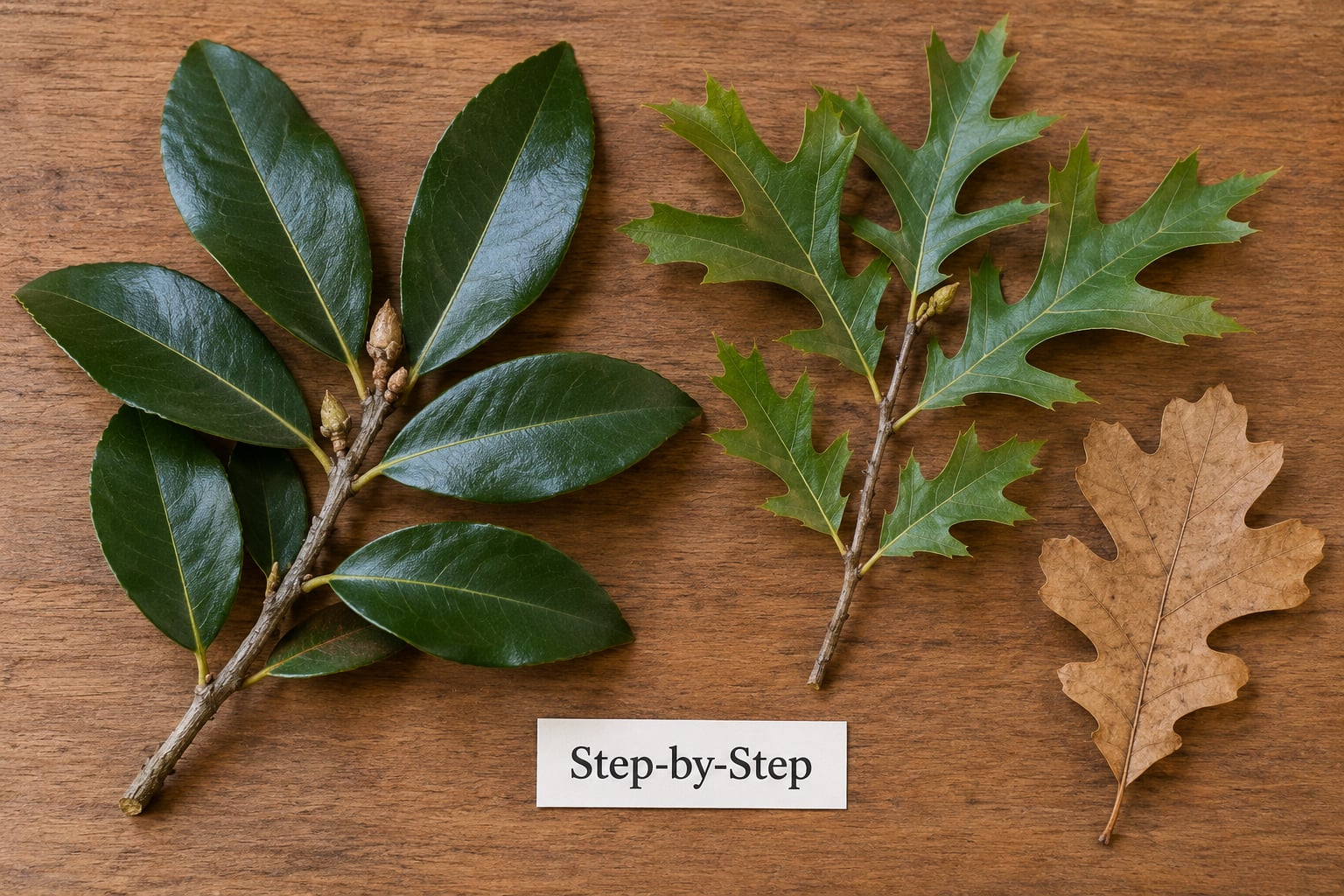
A live oak leaf is small, roughly one to two inches long, oblong to oval, and thick enough to feel like waxed leather when you roll it between your fingers. Margins are smooth or carry only a few tiny teeth. The tip rounds off rather than coming to a point.
Most other southeastern oaks fail that test somewhere. Water oak (Quercus nigra) has leaves two to four inches long with three distinct lobes at the tip. Post oak (Quercus stellata) has shallow rounded lobes on leaves that often turn bronze-red on the ground. Blackjack oak (Quercus marilandica) is small-leaved but its lobes end in obvious bristles.
That bristle is the group divider. A bristle is a stiff, hair-like tip on each lobe. Pointed lobes with bristles mean red oak group. Rounded lobes without bristles mean white oak group. Live oak sits in the white oak group, so its leaves are never bristle-tipped and usually not lobed at all.
On a live oak, the second species you will meet in the field is laurel oak (Quercus laurifolia), which is evergreen too. Laurel oak leaves are narrower, more lance-shaped, with more noticeable teeth along the margin. The live oak leaf is broader, rounder at the tip, and stiffer.
Check texture too. Live oak leaves and twigs are generally clean, without the rusty woolly fuzz found on the undersides of some oaks. A candidate whose leaves are hairy underneath and hairy on the stem is probably not a live oak.
Step 2: Look at the Bark and Branching Pattern
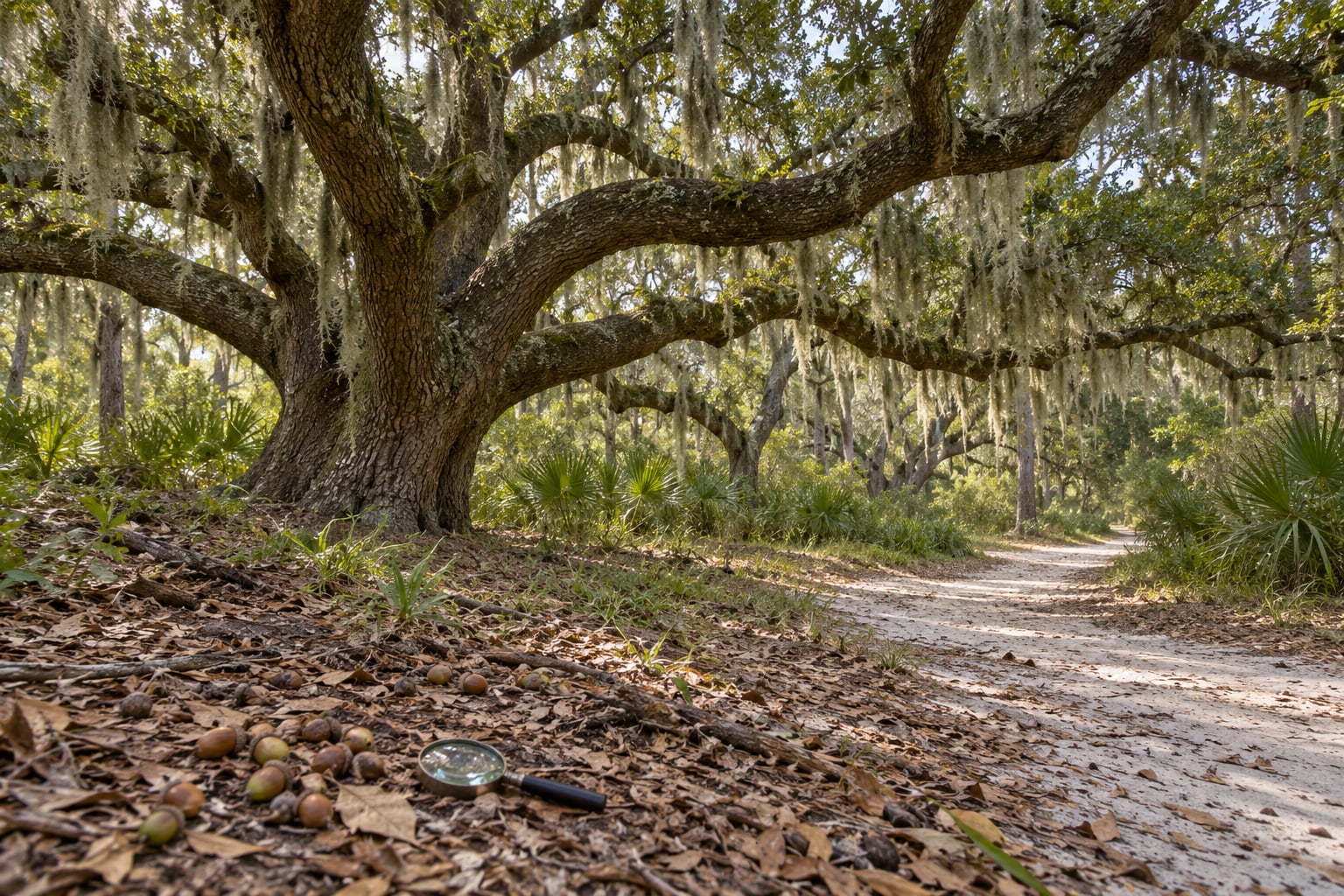
Mature live oak bark is dark gray, darkening toward nearly black, and deeply furrowed into narrow ridges. With age those ridges break into blocky or checkered plates, sometimes flat-topped, sometimes irregular. On a big tree the texture reads as tight, narrow, rectangular islands rather than broad smudged ridges.
This is where most guides send you wrong, because bark alone settles nothing. Water oak bark is blocky and gray but flatter and looser. Post oak develops thick corky ridges, almost like armor, with narrow pale furrows between them. Bark confirms an oak, or supports a live oak, but it never confirms one on its own.
The form is the stronger clue. A mature live oak sits low and wide, with heavy horizontal limbs, irregular forks, and gnarled twisting branches. Mature specimens are frequently broader than they are tall. A tree growing tall and narrow with a conical crown is a water oak, not a live oak.
Spanish moss and limb moss often hang from live oak branches, and it has become a habit of mind to treat moss as proof. It is a cue at best. Plenty of water oaks and other big oaks carry moss too.
Step 3: Examine the Acorns and Leaf Arrangement
The acorn is the single most diagnostic character, and it is the one most people never get to see. Live oak acorns are football-shaped, about three-quarters to one inch long, dark reddish brown with light brown striping running lengthwise. The nut sits in a squat cap that covers roughly a quarter of it. They ripen in a single season and hang in clusters of one to five on short stalks.
Compare that to the neighbors. Laurel oak acorns are darker and rounder with a thicker, rougher cap. Overcup oak (Quercus lyrata) has a cap that swallows nearly the whole nut. Chinkapin oak (Quercus muehlenbergii) and Texas red oak (Quercus buckleyi) carry small nuts in cups nearly as deep as the nut itself, with fringed or shallow-scaled caps. Bluff oak, the inland form often treated as a variant or hybrid of the Texas live oak, is the closest call of all and usually takes an acorn plus a habitat clue to separate.
Leaf arrangement matters less than people think. Oaks alternate their leaves and buds, so an opposite-looking arrangement at the shoot tip is a misread, not a character. Judge it on a twig, not a single node.
If you find no acorns, the tree is likely not producing that year, or the squirrels got there first. Live oaks do produce acorns. A common question from new owners, and the answer is yes, they fruit.
Step 4: Confirm the Tree in Its Habitat
Use habitat as confirmation, not proof. Quercus virginiana runs along the Atlantic and Gulf coastal plain, in coastal scrub, floodplains, river edges, low woods, and sandy ground. Quercus fusiformis takes the inland sites, especially limestone hills in the Texas Hill Country and Edwards Plateau, and the same bluff country across the Southwest. Hardiness runs roughly zones 8 to 10 for both.
Related oaks grow right alongside. A live oak on a dry ridge in north-central Texas raises questions that a live oak on a wet coastal hammock does not. Judge the site, then go back and confirm the characters.
If anything that matters will be decided by this call, get a second opinion from a certified arborist or your county extension office. That is a cheap hour of someone else’s expertise.
Common Mistakes
Trusting one clue
Fix: require three characters to agree. Leaves, bark, and acorn. A tree that passes two out of three is a maybe, and a tree that passes all three is a live oak.
Assuming any evergreen oak is a live oak
Fix: check the margin, not the habit. Water oak and laurel oak both hold leaves well in the warmer zones. The live oak giveaway is thick leaves, smooth or faintly toothed edges, and no bristle tips.
Reading the moss as a verdict
Fix: treat Spanish moss and limb moss as a supporting note. Big water oaks carry moss too.
Forgetting the two live oak species
Fix: name the binomial when you record the tree. Coastal live oak is Quercus virginiana, Texas live oak is Quercus fusiformis. Plenty of source disagreement on this topic is just the two getting swapped.
Testing a juvenile tree
Fix: come back later. A young live oak may have shinier, thinner, more pointed leaves than the adult form, and the broad spreading habit has not developed yet. Use the twig, bud, and bark, and verify next season.
Panicking about spring leaf drop
Fix: expect it. Live oaks drop and regrow leaves in spring, and it is not a disease. The same trees also drop old leaves in the fall as part of the evergreen cycle.
Trusting one app result
Fix: an app works from a photo, and a photo of one leaf from one branch is not a specimen. Get a leaf with its twig, a bark photo, an acorn if there is one, and the location, then submit the observation to a place like iNaturalist and read the discussion, where local identifiers weigh in.
Frequently Asked Questions
Are live oak leaves always smooth?
No. Live oak margins are usually smooth or very faintly toothed, and some leaves carry a few small teeth. The consistency that matters is texture rather than margin: live oak leaves are thick and leathery, oblong to oval, with a rounded tip. If your leaf is lobed, or if the lobes end in a stiff bristle, you are looking at a red oak group species, not a live oak.
What does a live oak tree look like from a distance?
It reads as a low, massive, wide-spreading tree with heavy horizontal limbs and irregular forks. Mature specimens are often broader than they are tall, with twisting gnarled branches that reach out sideways. A tree with a tall, narrow, conical crown is a water oak. Spanish moss on the limbs is a familiar cue but not proof, since other large oaks carry moss too.
How can I tell a live oak from a water oak?
Start with the leaf. Water oak leaves are two to four inches long with three clear lobes at the tip, often with bristle points, and they are thinner and flatter. Live oak leaves are one to two inches, unlobed or barely lobed, thick and leathery with smooth edges and a rounded tip. Then check the acorn: live oak acorns are football-shaped with light brown striping and a cap covering about a quarter of the nut, borne in clusters of one to five.
Do live oaks keep their leaves through winter?
They do, and that is one of the easiest ways to notice them in the southeast. Both live oak species are evergreen, putting on a flush of new growth in spring after dropping the previous season’s leaves. That drop is normal and can look alarming to a new owner. Water oak and laurel oak can also hold leaves in the warmer zones, so winter foliage alone is not a firm identification.
Can you identify a live oak by its bark alone?
No. Bark narrows the field but does not close it. Mature live oak bark is dark gray to nearly black, deeply furrowed into narrow ridges that break into blocky plates with age. Post oak has thick corky ridges, and water oak bark is blocky but flatter and looser. A tree in leaf with smooth thick foliage and a low spreading crown is the more useful combination to lean on.
Where do live oaks grow in the Southeast?
The coastal live oak, Quercus virginiana, follows the Atlantic and Gulf coastal plain in coastal scrub, low woods, floodplains, and sandy sites. The Texas live oak, Quercus fusiformis, takes the inland and western range, especially limestone hill country and plateau soils. Both fall in roughly USDA zones 8 to 10, and both grow in the same general region, so habitat confirms an identification without ever making it on its own.
Conclusion
Start with the leaf margin and the branching form, because those two settle most suspected live oaks in under a minute. Thick, leathery, unlobed or faintly toothed foliage in a broad, low, heavy-limbed tree is a live oak until proven otherwise.
Then corroborate. Dark blocky furrowed bark and a squat, striped, football-shaped acorn in a small cluster finish the case, and habitat confirms it. When the characters disagree, or the tree is young or leafless, gather a leaf with its twig, an acorn, a bark photo, and the location, and put it in front of a certified arborist or your county extension service. Updated for 2026.