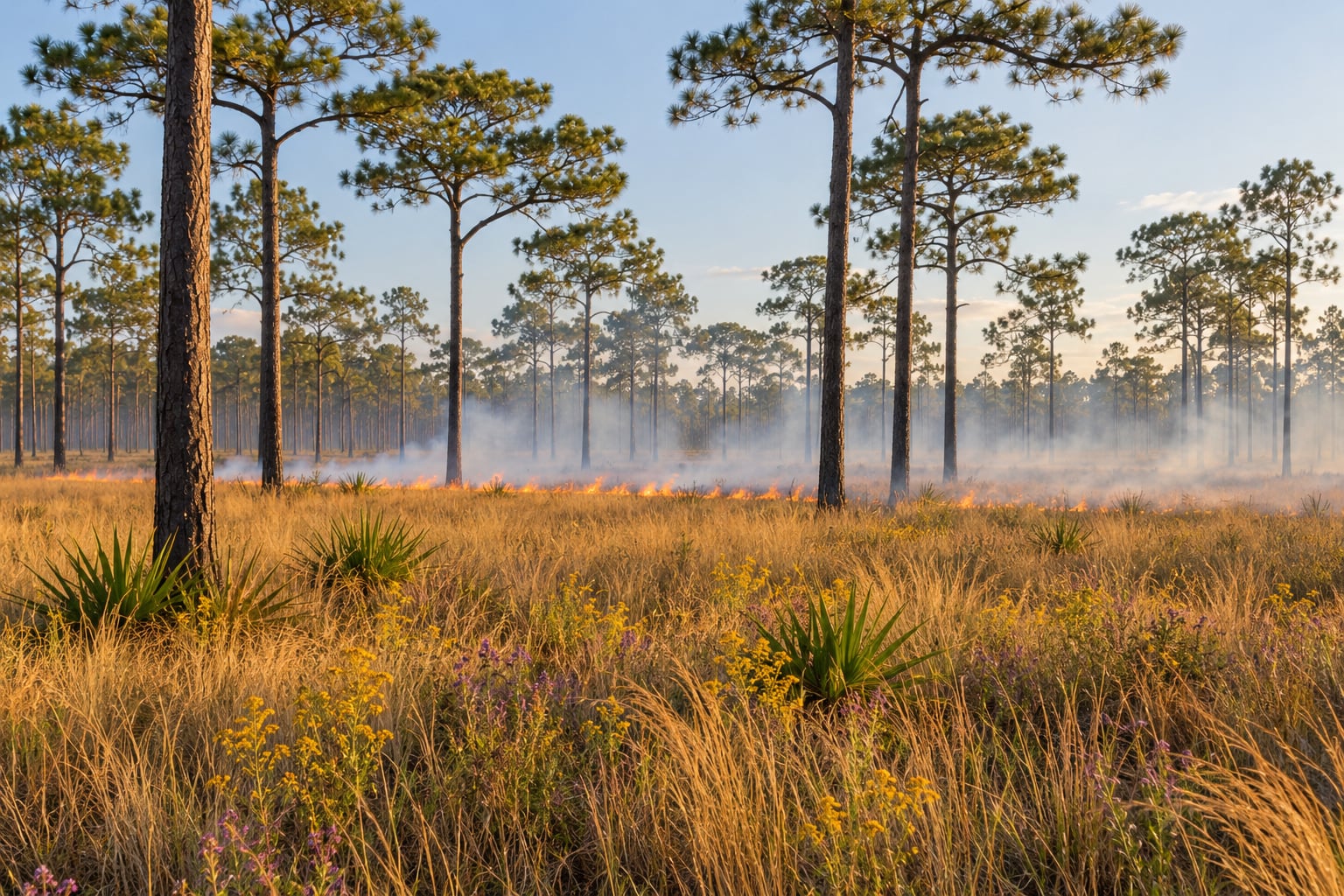
Longleaf pine forests are being restored because the tree is not just a timber species. It is the backbone of a fire-shaped savanna that once covered roughly 90 million acres of the Southeast, and rebuilding it returns habitat for dozens of imperiled species, puts more water into streams, stores carbon for decades, and lowers the fuel that feeds severe wildfire. Longleaf pine savanna is an open woodland of widely spaced mature pines over wiregrass and native forbs, kept that way by frequent fire.
The results on the ground can look unimpressive before they look good. A hardwood midstory comes out, the ground goes bare, and then pines and grasses move back in. Getting that sequence right takes decades, which is why the work looks unglamorous from a road and very obvious in the bird list.
Table of Contents
- What happened to longleaf pine forests?
- Why are longleaf pine forests being restored now?
- How does prescribed fire rebuild a longleaf pine ecosystem?
- Why longleaf pine forests are being restored through frequent fire
- What ecological benefits does restoration provide?
- How do restoration projects balance nature and forestry?
- Why longleaf pine forests are being restored across the Southeast
- What challenges can stop a longleaf pine restoration?
- How can readers support longleaf pine restoration?
- Frequently Asked Questions
- Why are longleaf pine forests being restored instead of left untouched?
- Are prescribed burns in longleaf pine forests dangerous?
- Which wildlife benefits most from longleaf pine restoration?
- Who pays for longleaf pine forest restoration in the Southeast?
- Can longleaf pine forests recover after decades without fire?
- Restoration starts with recreating a fire-shaped ecosystem
What happened to longleaf pine forests?
Longleaf once grew across millions of acres of the Coastal Plain and the lower Piedmont, from the piney woods of east Texas across Louisiana, Mississippi, Alabama, Georgia, the Carolinas and into Florida. It was the single largest forest type in North America.
Six forces took it apart. First, the naval stores era: longleaf was tapped for resin, turpentine and naval pitch, and resin-rich trees were repeatedly girdled until they died, which destroyed seed sources across huge tracts. Second, industrial logging, which took the remaining large timber. Third, agricultural clearing and land conversion, especially after the boll weevil collapsed cotton and old fields moved to pasture, row crops and, later, pine plantations. Fourth, fire suppression, the quiet killer: without frequent low-intensity burns, hardwoods moved in and shaded out the pine seedlings. Fifth, conversion to faster-growing loblolly and slash pine, which produced more board feet per acre and left closed, brushy, low-diversity stands. Sixth, development across Florida, Georgia and the Carolinas, which remains an active loss.
What remains is a small fraction of the original. The commonly cited figures are about 90 million acres historically and fewer than 5 million acres today, and some state-level framings put the surviving share of the historic extent below 3 percent.
| Measure | Figure |
|---|---|
| Historic extent across the Southeast | About 90 million acres |
| Extent today | Under 5 million acres; under 3 percent of the historic range in some state framings |
| Federal and state listed species dependent on longleaf habitat | More than 30 |
| Typical maintenance burn interval once a stand is established | Every 2 to 3 years |
| Typical cost-share coverage for site prep, planting and burning | Often 75 to 100 percent of the cost through agency programs |
| Time from planting to mature, high-value habitat | Decades, not seasons |
One correction worth making early: longleaf pine itself is not a federally endangered species. What is imperiled is the community it holds together, and many of those species are listed.
Why are longleaf pine forests being restored now?
The short version, in six lines:
- Habitat for more than 30 federally listed species is vanishing with the forest.
- Longleaf trees survive hurricanes, drought and pests better than faster pine species.
- Open longleaf stands deliver more water to streams, rivers and groundwater.
- Mature longleaf stands hold large carbon stores that persist for generations.
- Low, frequent burns remove the heavy fuels that drive severe wildfire.
- Federal and state programs now pay private landowners for most of the work.
Habitat is the strongest argument. A closed pine plantation can be green and still be biologically close to empty. The red-cockaded woodpecker, whose recovery plan is written entirely around longleaf habitat, needs mature pines with no resin leakage in the bole and an open, heavily burned understory. Gopher tortoise, eastern wild turkey, northern bobwhite, American kestrel and the Orianne indigo snake all key to the same open structure. When the savanna comes back, they come back with it.
Resilience is the second argument, and it is getting stronger as the climate changes. Longleaf has a deep taproot and a wide root plate, so it holds up better in a hurricane than a shallow-rooted, fast-growing plantation pine. It is adapted to soil water deficits, so it handles drought. Its resinous wood resists the beetle and disease pressure that hits other southern pines in a warm, wet year. Research cited by the Longleaf Alliance and reported at length by NPR member station WBUR frames longleaf as unusually well suited to a warmer, more variable Southeast.
Water runs through the same story. A longleaf savanna is a very leaky forest: heavy pine straw and wiregrass absorb rain, slow it, and release it gradually into sandy soils that recharge shallow aquifers and feed coastal streams. Closed-canopy plantations intercept more water and push more of it straight off the site as runoff, with the sediment to go with it. The Jones Center at Ichauway has published work on how longleaf watersheds affect stream flow and water availability.
Carbon is the argument people ask about least and misunderstand most. Longleaf is a marathon, not a sprint. A young plantation may out-produce it in the first few years, but mature longleaf stands live for centuries, and long-lived trunks plus a deep, dense root mass hold more carbon across a long horizon. The common comparison in the literature is that planting trees for carbon can be slow work, whereas restoring a long-lived canopy is closer to a bond that keeps paying.
Wildfire risk is the argument that travels best with people who do not care about ecology. A savanna burned every two or three years carries light, fine fuels and little accumulated slash. An unburned stand carries heavy deadwood, thick brush ladder and canopy. Same forest, same storm, wildly different outcome. Managers put it bluntly: burn now or burn later.
Economics and policy decided the timing. The USDA Forest Service, the Natural Resources Conservation Service, the National Fish and Wildlife Foundation and state forestry and wildlife agencies now treat longleaf as a measurable objective with money attached. Federal initiatives that once treated the tree as a regional curiosity now name longleaf savanna as a priority restoration target for the Southeast.
How does prescribed fire rebuild a longleaf pine ecosystem?
Restoration is a sequence, and skipping a step is how projects stall. Managers thin first, treat the midstory second, burn for site preparation third, then let seed fall or plant, and burn again for the life of the stand.
- Inventory and mark. A forester identifies remnant longleaf seed trees worth keeping and grades the site.
- Selective thinning. Competing pines are removed to open the canopy, and poor-quality stems are taken for timber.
- Midstory treatment. Hardwoods and shrubs in the understory layer are cut or treated once. This is the step that makes a stand look worst and work best.
- Site preparation burn. A planned burn removes slash and woody debris and exposes bare mineral soil where seed can land and germinate.
- Seed or planting. Existing longleaf seed trees often release enough seed naturally after the canopy opens. Plantings fill gaps where regeneration fails.
- Maintenance burns. Every 2 to 3 years, under safe conditions, to keep the understory low and the pine seedlings ungirdled.
Planting density is not a fixed number. Seedlings are typically planted well apart, spaced widely, because a mature longleaf savanna is open by definition, and because natural regeneration from existing seed trees is often cheaper and faster than planting every gap. Spacing follows site productivity, existing stock and the manager’s target.
Monitoring looks different from forestry. Crews check for new seedlings in the grass stage, count mature seed trees, track midstory cover, measure canopy openness, and use repeat photography from fixed points. Range-wide work is often coordinated through partners such as the Longleaf Alliance and the Jones Center, which maintain demonstration stands and share seed.
Why longleaf pine forests are being restored through frequent fire
Fire is the tool because longleaf is built for it. The single most confusing fact about this tree is its childhood: a young longleaf does not behave like a sapling. It spends the first few years as a grass-stage seedling, a small bundle of green needles under a few inches tall, and a first passing burn is what triggers it to grow into an actual tree. Reddit’s arborists have described watching this exact transition at a clearcut parcel in Big Thicket National Preserve, a site cut more than a century ago that has been slowly regenerating ever since.
Repeated fire does three jobs at once. It holds back hardwoods and shrubs that would otherwise close over the pines. It prevents the accumulation of heavy fuels that turn a dry spring day into a stand-replacing wildfire. And it keeps the canopy open, which is the whole point, since an open grassy understory is the habitat.
The carbon question comes up here and deserves a straight answer. Burning does release carbon immediately. So does a wildfire, and so does decay in a closed stand full of dead wood. A savanna that burns lightly every two or three years releases far less over time than one that builds fuel for twenty years and then loses everything in a single afternoon. Burn now or burn later is not a slogan; it is the accounting.
The grass-stage explanation also settles a common worry about fire safety on private ground. Well-timed, low-intensity burns under safe weather conditions are what let a longleaf seedling survive and grow. A longleaf stand is not fireproof, and a hot drought-driven wildfire is a different event from a prescribed burn, but the two are not interchangeable and the first is exactly what the second exists to prevent.
What ecological benefits does restoration provide?
Wildlife is the payoff most readers care about. Bobwhite quail gain the open weedy understory they nest and forage in. Turkey and deer browse the herbaceous layer that returns with the grasses. American kestrel use open pine with scattered snags for hunting perches. Red-cockaded woodpeckers get the mature, burned, resin-free pines they nest in, often with nest boxes installed where the habitat is not quite ready yet.
Plant diversity moves with it. A wiregrass-and-pine savanna can hold far more native forb species than a closed understory, which is a large part of the value for pollinators and for native wildflowers such as Texas trailing phlox.
Soil and water benefits follow. Heavy pine straw duff reduces erosion on sandy Coastal Plain soils, and the resulting cleaner, slower runoff reaches coastal estuaries in better condition.
Movement matters too. Restored sites scattered across a watershed give animals stepping stones between larger blocks, and coastal systems built on longleaf and palmetto hammock land are more resilient when storms strip the canopy because the root systems and duff hold soil in place.
A useful field test, if you own land or spend time in the woods: a healthy longleaf stand has widely spaced flat-topped mature pines, a thick pine straw layer, and an open understory of grasses and forbs with very little sapling growth. What you will not see is the dense loblolly thicket of uniform-height trees with a bare litter layer that most people picture when they hear Southern pine forest. If mature longleaf or old-growth hardwoods are scattered through the understory, that is often a sign the site was longleaf and is worth evaluating.
How do restoration projects balance nature and forestry?
The tension between producing timber and producing habitat is real but smaller than it sounds, and the table below is the clearest way to see it.
| Period | What the objective was | Typical condition |
|---|---|---|
| Past | Maximum board feet; naval stores extraction | Logged, resin-tapped, fire excluded, later replanted in rows |
| Present | Thin, treat the midstory, burn, regenerate, then burn on a 2 to 3 year cycle | Open canopy, recovering pine seedlings, grassy understory, few hardwoods in the midstory |
| Future | A functioning savanna with compatible timber and non-timber returns | Mature longleaf over wiregrass and forbs, burned often, low fuel load |
Compatible timber production happens inside that framework. Thinning removes lower-value stems, and high-grade longleaf timber is genuinely valuable because of its resinous, strong wood. Pine straw is a recurring non-timber revenue on a well-managed stand, which matters for private landowners deciding whether to keep working land rather than convert it.
One honest limitation: longleaf sawmills are scarce, and much pine straw harvesting has shifted to slash pine stands, which changes local markets and prices for growers. Landowners who plan for longleaf usually plan for wildlife, water and stewardship income alongside timber rather than expecting a plantation-style return.
Why longleaf pine forests are being restored across the Southeast
Public lands got there first. National forests, state wildlife areas, national preserves and local reserves use thinning and prescribed fire to rebuild savanna, and ranger programs explain the work to visitors. Weymouth Woods in Louisiana and the Carolina Sandhills are commonly cited demonstration sites, and the Apalachicola National Forest and the Escambia Experimental Forest in Florida have decades of longleaf management and research behind them.
Private land is where most of the acreage has to come from. Working landowners can enroll in Natural Resources Conservation Service programs and state equivalents that cover a large share of site preparation, planting, native seed and the burning that follows. In places where loblolly or slash is the realistic option, thinning plus prescribed fire can still create savanna-like conditions that benefit many of the same species.
Utility corridors and rights-of-way, burned-over areas, and land under conservation easement all offer footholds, because each one already contains remnant longleaf or a land manager motivated to do something with it. Tribal nations, local land trusts and university field stations add another layer, often working the same parcels that a public agency cannot easily reach.
That is why the phrase why longleaf pine forests are being restored shows up in regional news rather than only in policy documents. The work happens in places readers can actually visit.
What challenges can stop a longleaf pine restoration?
Smoke is the first and loudest objection, and it is usually a real planning problem, not a bad-faith one. Burning windows are narrow, weather-dependent, and often require notifying neighbors and local authorities, which makes some years go by without a burn and lets the midstory take back the site.
Then come the slower problems. Invasive plants move into a disturbed understory quickly and can defeat a burn program on their own. Funding is uncertain, and restoration is a commitment measured in decades while most programs are measured in one to five years. Severe weather disrupts burn windows and damages stands in ways that need new money to fix.
Fragmented ownership is an underrated obstacle. A burnable stand next to a subdivision is a burnable stand nobody will light, and that pattern repeats across a whole watershed.
There is also the measurement problem. A thinning looks like damage from the road, a bare site looks like abandonment, and a mature stand that is ecologically correct can look thin and unproductive. Managers who measure seedling counts, midstory cover and fuel loads rather than visual change can explain the difference, but it takes patience and funding.
Finally, timelines. People read that a site was clearcut a century ago and see young pines coming back and conclude recovery is fast. It is not. Big Thicket parcels regenerating for a hundred years are the honest example, and they are still incomplete.
How can readers support longleaf pine restoration?
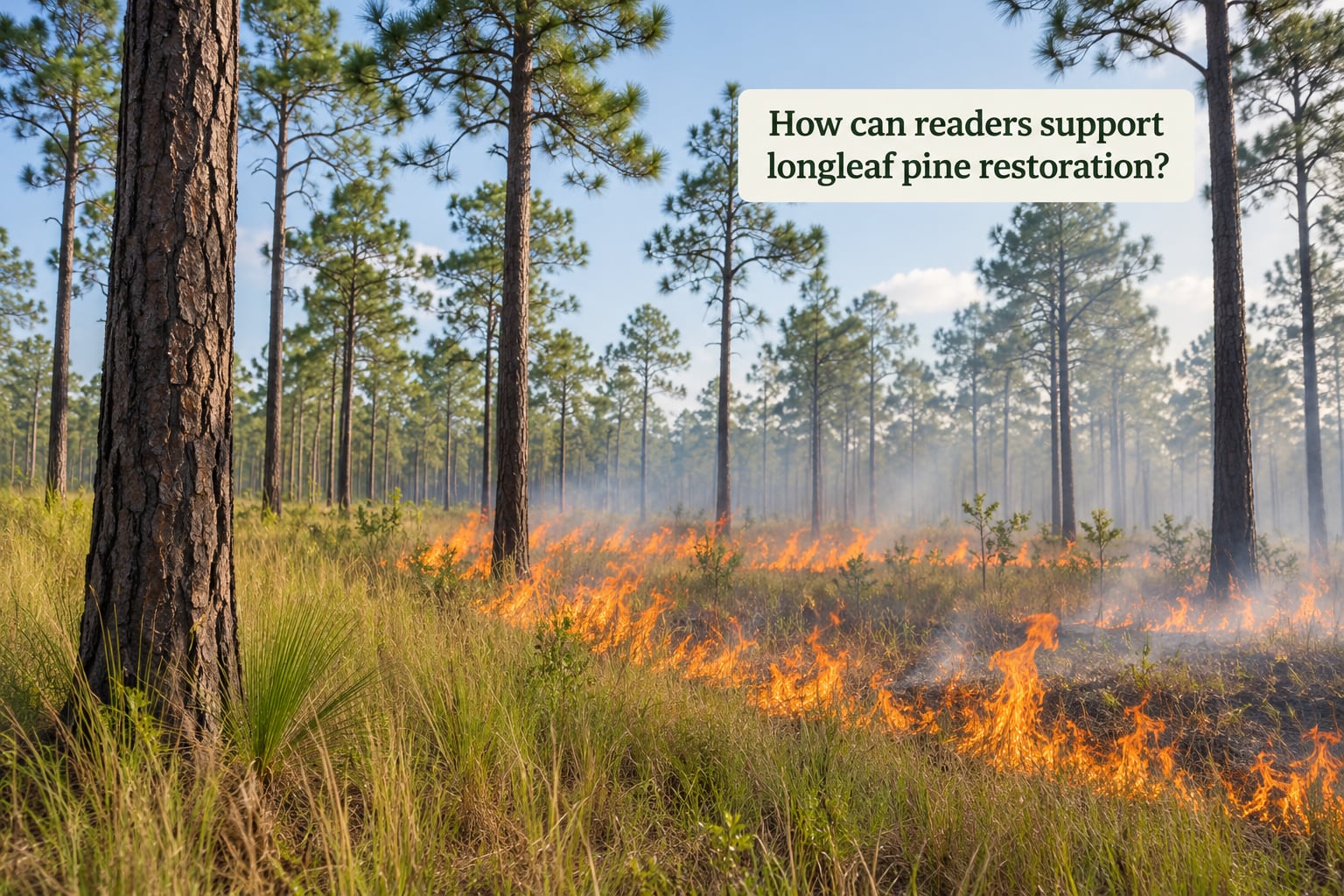
Start by knowing what you are looking at. Learn to tell longleaf from loblolly and slash in the field, and be able to say why a savanna with widely spaced trees is healthy and a dense uniform plantation is not. That vocabulary is what makes conversations with land managers and neighbors go somewhere.
Support the people doing the work on land you cannot reach. Public forest and preserve programs, state wildlife agencies, the Longleaf Alliance, the National Fish and Wildlife Foundation and local land trusts all depend on appropriations and contributions that individual readers can influence.
If you own land in the Coastal Plain or lower Piedmont, ask your state forestry agency about cost-share programs before you clear anything. Most readers in this situation are paying toward the work instead of receiving help for it, and that conversation takes one phone call.
Give prescribed fire the benefit of the doubt. It is planned, it is weather-limited, and it is frequently carried out by a trained crew. On your own ground, use burn barrels and other contained methods as your state’s guidance describes, and keep the fire out of pine straw piles, which are the most common cause of escaped debris burns in the South.
Finally, use public land as a field classroom. Ranger-led burn programs, volunteer seed collection and seed harvesting with a flail vac are real volunteer opportunities, and the Jones Center and similar sites coordinate them.
Frequently Asked Questions
Why are longleaf pine forests being restored instead of left untouched?
Because fire suppression, not climate, is what removed them. Without repeated low-intensity burns, hardwoods move into the understory and shade out longleaf seedlings, and closed stands carry the heavy fuels that drive severe wildfire. Restoring the fire-maintained structure brings back habitat for more than 30 listed species, improves water yield and stores carbon over centuries. Leaving an unburned remnant stand alone is how those species lose it.
Are prescribed burns in longleaf pine forests dangerous?
Prescribed burns are planned under narrow weather and fuel conditions, usually by trained crews with equipment and notifications in place, and the intensity is kept far below wildfire levels. The real hazards are smoke and escaped debris burns, which is why state rules and local coordination exist. Young longleaf in the grass stage actually depends on a first passing burn to trigger growth into a tree. A hot drought-driven wildfire is a different event entirely.
Which wildlife benefits most from longleaf pine restoration?
Species tied to the open savanna structure benefit most. Red-cockaded woodpeckers need mature longleaf with open, heavily burned understory. Gopher tortoise, eastern wild turkey and northern bobwhite gain the grassy layer they forage and nest in, and American kestrel use open pine for hunting perches. Native forbs such as Texas trailing phlox return with the grasses and carry the pollinators that depend on them. Longleaf pine itself is not federally listed; its dependent species are.
Who pays for longleaf pine forest restoration in the Southeast?
Public forests, preserves and state wildlife areas are funded through agencies including the USDA Forest Service and state forestry and wildlife agencies. Private landowners apply to Natural Resources Conservation Service programs, state cost-share programs and foundation grants such as those from the National Fish and Wildlife Foundation, which often cover 75 to 100 percent of site preparation, planting, native seed and burning. Land under conservation easement may also carry restoration obligations from its terms.
Can longleaf pine forests recover after decades without fire?
Yes, and slowly. Sites clearcut more than a century ago, including parcels in Big Thicket National Preserve, are still regenerating toward a savanna, which shows recovery is possible but not quick. Without fire, hardwoods encroach and shade out seedlings, so restoration means removing the midstory and reintroducing a 2 to 3 year burn cycle. Expect one to three years for visible seedling response and decades before mature habitat returns.
Restoration starts with recreating a fire-shaped ecosystem
Longleaf pine forests are being restored because they are an ecosystem, not a stand of trees: a fire-shaped savanna with a wide-spaced canopy, a grassy understory and hundreds of species that exist nowhere else. Bring back the burns and the hardwoods, and most of the rest follows.
The first practical step is smaller than it sounds. Learn what restoration looks like on the public or conserved land near you, take a ranger program or a burn walk if one is offered, and put a name to the local manager doing this work. Support that person through the next decade of funding decisions rather than treating one planting day as the finish line.