How to stay safe around alligators while paddling comes down to three things: give every animal a wide berth, keep your boat moving predictably, and leave the area early when one comes toward you. Almost every serious alligator incident on record traces back to a preventable moment — feeding, cornering, swimming, or a dog going in the water first.
That is worth putting in context before you read the rest. The Florida Fish and Wildlife Conservation Commission estimates roughly 1.3 million alligators living across 67 Florida counties. FWC records also show about 442 unprovoked bite incidents between 1948 and 2021, which works out to roughly six a year across an entire state. Wild alligators mostly want nothing to do with you, and the risk climbs sharply the moment a human changes that.
I have spent enough time on Florida creeks, cypress swamp and backwater rivers to know that the honest advice is less dramatic than the internet suggests. Stay alert, keep your hands inside the boat, and never feed anything. Everything below is general field guidance rather than a substitute for current rules from FWC or the land manager running the waterway you are on.
Last reviewed and updated in October 2026.
Table of Contents
- What You Need
- Step-by-Step
- Step 1: How to Stay Safe Around Alligators While Paddling at the Launch
- Step 2: Group Up and Choose a Clear Route
- Step 3: Keep a Wide, Predictable Distance
- Step 4: Watch for Stress Signals and Change Course
- Step 5: Protect Pets and Wildlife During Nesting Season
- Step 6: Handle Capsizes, Falling, and Bad Weather
- Step 7: Exit Calmly and Report the Encounter
- Common Mistakes
- Frequently Asked Questions
- Should I stay in my kayak if I see an alligator while paddling?
- How close should a canoe or kayak stay to an alligator?
- Do alligator safety rules apply in coastal saltwater marshes?
- What should I do if my dog jumps into water near an alligator?
- Why might an alligator paddle toward or follow my kayak briefly?
- What should I do if my kayak capsizes in alligator habitat?
- Final Paddling Safety Checklist
What You Need
Most paddling accidents in gator country are not caused by a missing weapon. They are caused by a person who was alone, underdressed for the water, and improvising. Here is the kit list I would not launch without, and the reason each item earns its place.
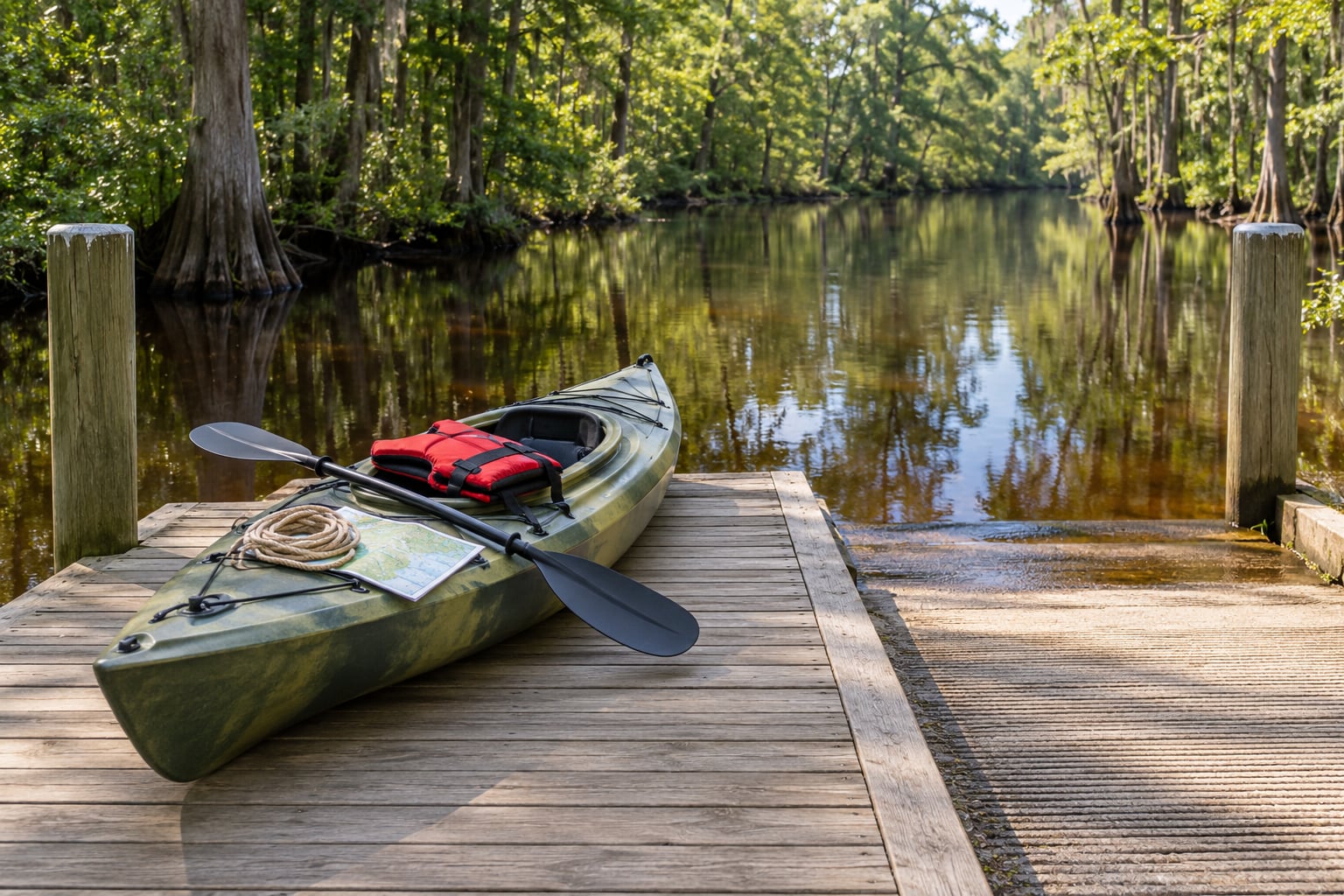
- A properly fitted, approved PFD. Every paddler wears one, every time, including strong swimmers and children. It needs to be fastened before you put a foot in the boat, not after something goes wrong.
- A whistle clipped to the PFD. A whistle carries further than a voice and takes no breath to use. If you are solo, it is your only way to signal after a capsize.
- A paddle and a boat you can control. Speed and steering matter more than any deterrent. A boat you can turn away quickly is the single best safety device on the water.
- A charged phone in a waterproof case, plus a satellite messenger or PLB. Cell coverage disappears exactly where gator habitat gets good. Know before you leave which stretches of the route have no bars.
- A chart and a compass or GPS. Retreat depends on knowing which direction is open water and which is a dead-end tannin creek.
- First-aid supplies in a dry bag. Dry, sealed, and reachable from the cockpit without unpacking.
- A fixed-blade knife in a sheath on the PFD. Useful for cutting a seat pad free or a paddle leash, and it stays on your chest if you go into the water.
- A throw rope. Ten dollars of rope is the cheapest rescue plan in paddling, and in a group it is the difference between a swim and a recovery.
- Drinking water, sun protection, and insect repellent. Long slow trips in gator habitat mean long slow hours of sun and mosquitoes. Dehydration turns a calm decision into a bad one.
Before you load the roof rack, spend five minutes on the administrative side of alligator safety. Check the forecast and wind, since a thunderstorm over open swamp water is its own emergency. Look up current water levels and flow at the access point, because a creek that was knee-deep last month can be pushing a great deal more water after rain upstream.
Then check access points, regulations, and posted wildlife warnings. Many sites carry seasonal closures for nesting, and some ramps carry a specific rule about where you may launch. Reading the sign at the ramp takes ten seconds and it is the only piece of official advice you will get all day.
Step-by-Step
Seven steps, in order, from planning the route to getting back to the truck. Each one tells you what to do, what to watch for, and how to tell you are handling it correctly.
Step 1: How to Stay Safe Around Alligators While Paddling at the Launch
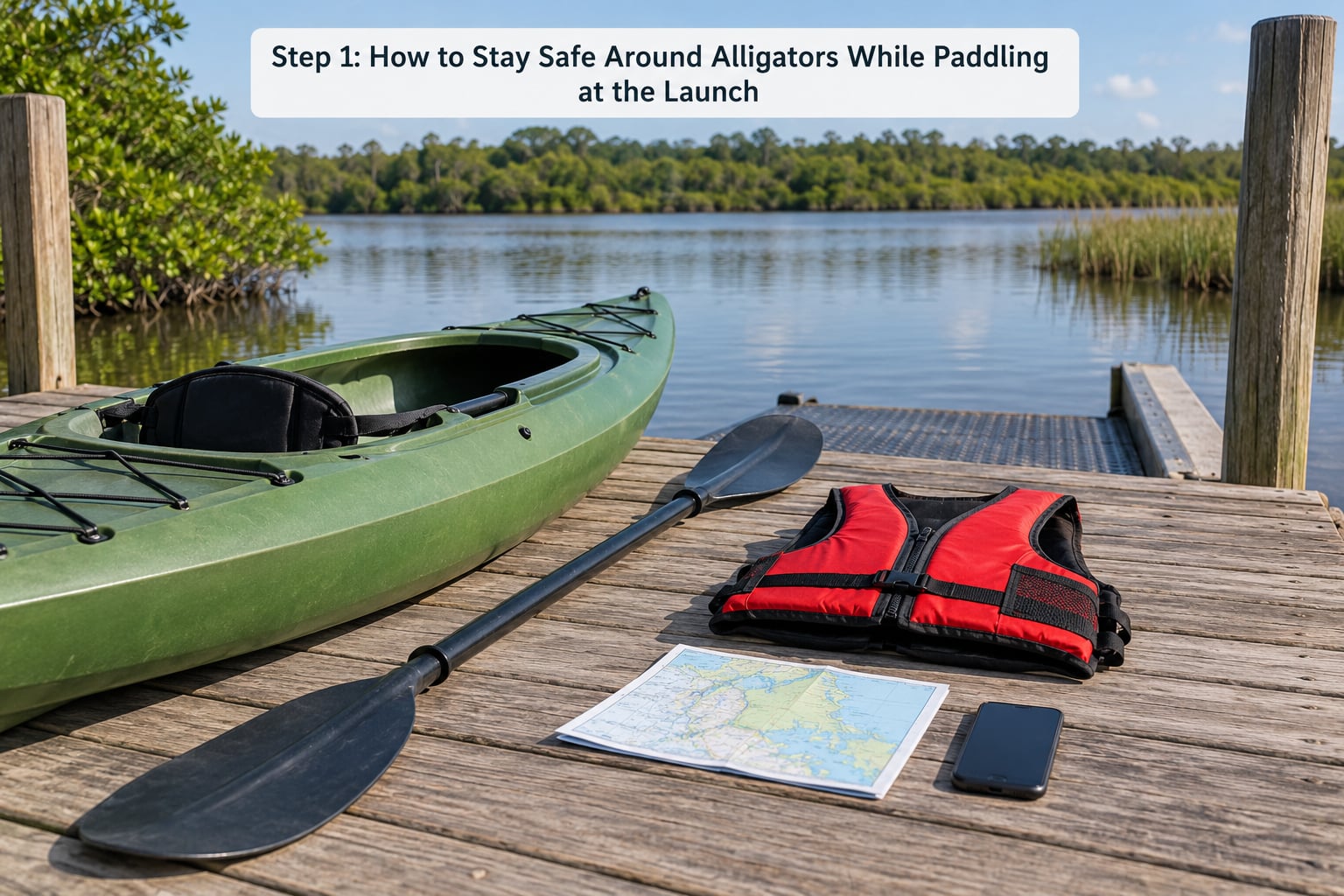
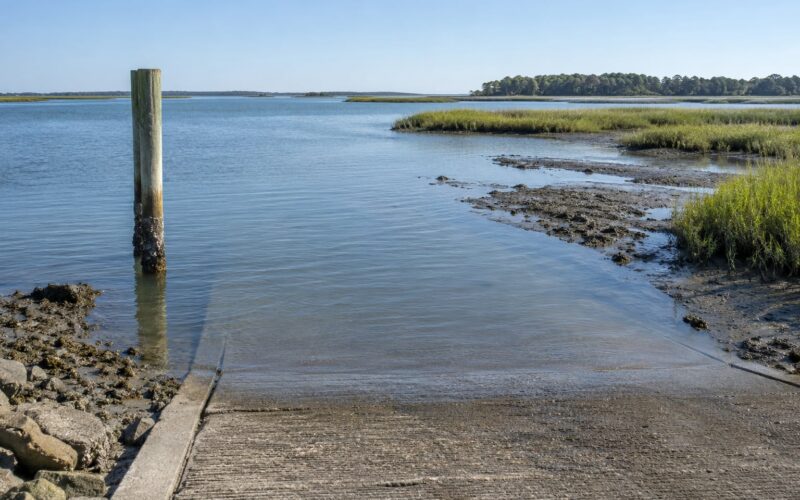
Start at the ramp, not on the water. Read every posted notice, check recent sighting reports for the waterway, and note any marked nesting areas or seasonal access restrictions. None of that requires you to walk the bank looking for animals.
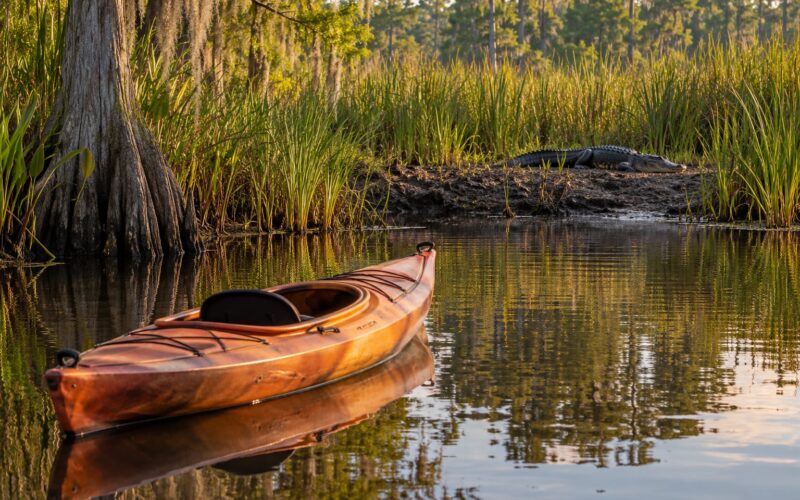
The safest launch is simply the one with no alligators in view. If you can see a gator basking, log sprawl, or a mud bank with a fresh scrape line, move your put-in. Mud banks are the serious ones — that is where they nest, and where you would be sitting at eye level with a nest mound.
You are handling it correctly when your launch point is clear of visible animals, basking sites, and exposed mud bank, and when you know where you are going to land again. A second piece of water you can bail out to beats a beautiful entry point every time.
One habitat detail catches newcomers: fresh and brackish water meeting points, tidal creek confluences, and slow edges collect more life than open river. They are also where paddlers bunch up because the fishing is good. Pick a different line.
Step 2: Group Up and Choose a Clear Route
Paddle with a buddy and stay in visual and voice contact. If you must go alone, leave your route and your expected return time with someone ashore, and give them a hard check-in time rather than a vague one.
Choose a route with multiple exit points. That single decision limits how many bad situations you can get into, because it gives you somewhere to go that does not involve paddling past whatever you just saw.
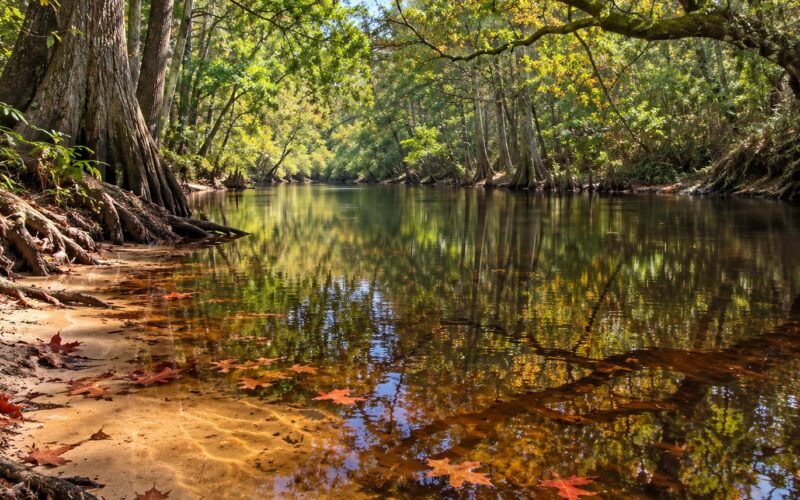
Currents and terrain matter here in a practical way: strong current, shallow water, blind bends, and submerged banks all reduce your options. A bend hides what is around it, a shallow bar gives you a place to stick the bow, and current decides whether you can get back upstream or not. Paddle the route once and ask yourself honestly where you would climb out if you needed to, right now.
Children and dogs change the risk calculation completely, and both need close supervision rather than loose supervision. A dog on a paddleboard has three times the reach and none of the judgment. Keep it leashed and keep it away from the waterline.
Step 3: Keep a Wide, Predictable Distance
Never chase, feed, touch, or try to paddle directly at an alligator. There is no distance that makes an encounter safe, so treat any published number as a floor rather than a promise.
When you spot one, keep paddling at a steady, deliberate pace. No sudden splashing, no slapping the water with the paddle blade, no revving the engine. Regular strokes and a straight line tell a basking animal that you are not a threat and not dinner.
Keep the whole group in a single line, nose to tail, so you are presenting one profile instead of several loose silhouettes. And do not dangle hands or feet over the gunwale — an alligator finds contact far more reliably than it finds movement.
You are handling it correctly when the animal keeps diving and moving away. That is what most of them do, because being submerged is how an alligator feels safe from you. The submergence is not the threat. What happens next is what you are watching for.
Step 4: Watch for Stress Signals and Change Course
Leave the area the moment an animal turns toward you, closes repeatedly, opens its mouth, hisses, lunges, or enters your paddle path. Those are the observable reasons to go, and none of them are worth negotiating with.
Nothing below reads well in the middle of an encounter, but reading it once while you are still calm is what builds the reflex. Here is what each signal usually means and what it calls for.
- Eyes and snout tip slide under, animal gone. A defensive dive — it is avoiding you. Keep paddling straight and give a wide berth.
- Only eye ridges above the surface, motionless. Basking or watching you. Take the widest distance you can manage. No approach.
- Head swings toward your boat, repeated approaches. Curiosity escalating into a deliberate close pass. Create distance and do not test it.
- Open mouth, hissing, head raised on the tail. A threat display, often defensive. Back away slowly toward open water. Never corner it.
- Sudden lunge into your path, or a wake closing fast. Serious; treat it as imminent contact. Paddle to open water or the nearest safe landing and skip the photo.
- Something rubs or bumps the hull. Contact you did not see coming. Move off line immediately, because contact is the escalation point.
You will handle it correctly when your boat is already pointed at open water before you have decided whether to worry. That is why the plan comes before the animal does.
Step 5: Protect Pets and Wildlife During Nesting Season
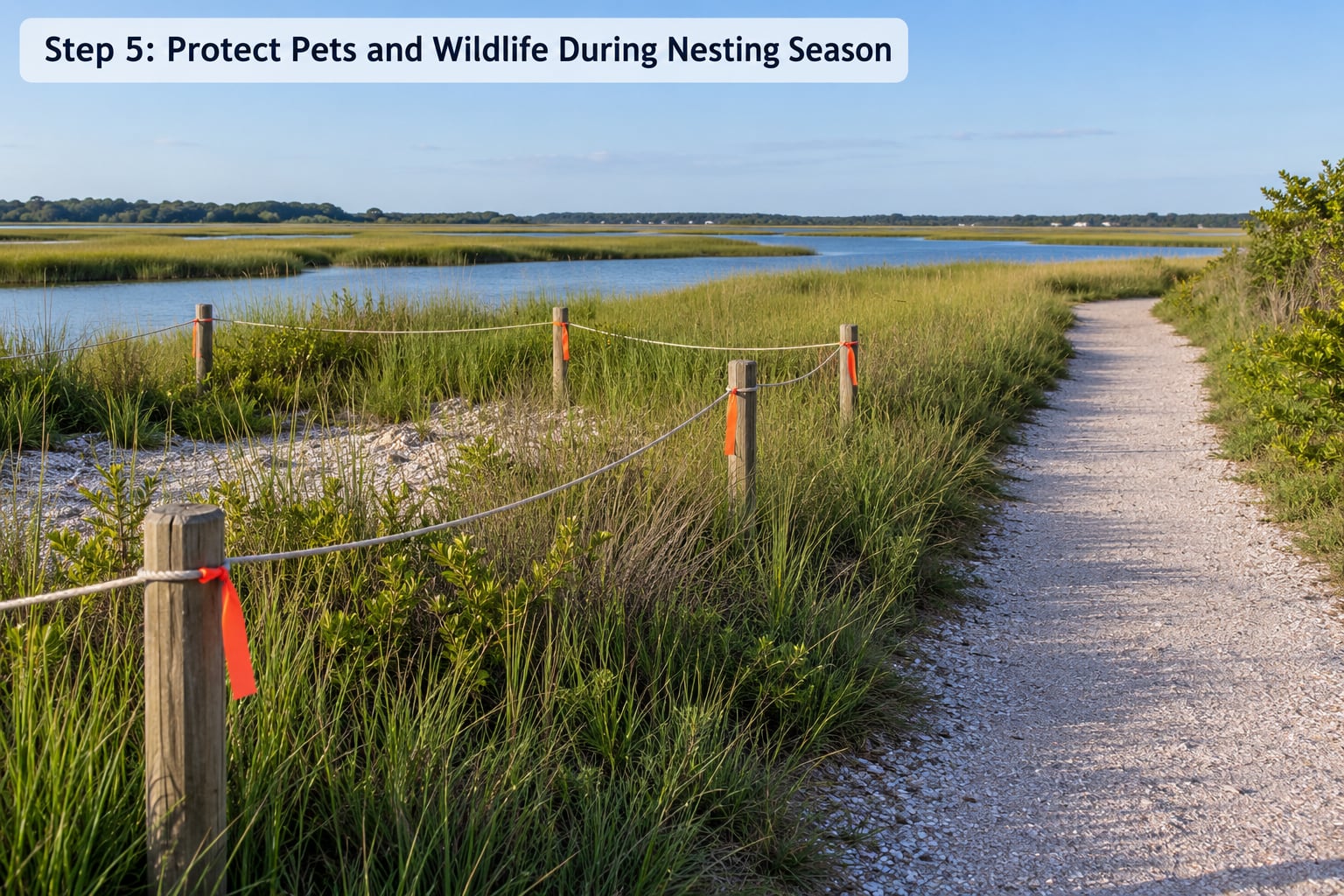
Nests, eggs, hatchlings, and the adults guarding them are the most sensitive situation you will encounter all year. A female that feels her nest is threatened is one of the few alligators that will genuinely go on the offensive.
Keep dogs leashed or pick another route entirely. Do not approach a nest, do not dig anything up, and do not go poking in dense bank vegetation where a nest is hidden — that is exactly where you cannot see what is beside you.
Follow closures and posted wildlife guidance without exception, and treat bank sections with dense vegetation, cut mud, or disturbed shoreline as places to pass rather than places to stop.
Nesting timing varies by latitude, so the closure dates on the sign matter more than a calendar you remember from last year. When in doubt, give the bank more room than feels necessary.
Step 6: Handle Capsizes, Falling, and Bad Weather
Stay with the paddle craft whenever it is buoyant. A kayak or canoe on the surface is a floating object, a platform, and something a person in the water can be seen beside. You are far easier to spot from a boat than from a swimming head.
Stay out of the water. Do not swim after a capsize in gator habitat, and do not step into water you cannot see the bottom of. Call for help first, using the whistle or the phone, and move toward the nearest safe exit only if you can do it without entering the water.
Abandoning your boat is worse than securing it and waiting. Boat, paddle, PFD, and knife all stay with you or within reach when the rescue boat arrives, and they are worth nothing floating away down a creek.
Weather ends the trip faster than any animal. Lightning over open water means get off the water now, not when the cell passes. High wind, sudden cold rain, darkness, flood conditions, and low visibility each take away the choices you need — see the bank, control the boat, and find your landing.
Step 7: Exit Calmly and Report the Encounter
Land at a designated access point rather than dragging your boat up anywhere convenient. Get out away from the waterline, so nothing is walking you home later, and secure pets, gear, and trash before you load the vehicle.
If an animal follows you toward shore, do not run. Running invites a chase and it ends badly for the runner. Stay calm, keep the boat between you and the water if there is one, and give the animal room to lose interest.
For a serious encounter, document the time, the location, the behavior you saw, any injuries, and the actions you took — from a safe place, not from ten feet away. Then notify the relevant land manager, the state wildlife agency, or emergency services. Reports are how agencies track habituated animals and close access when it is needed.
Common Mistakes
Most of what goes wrong in gator country is one of these, and each has a simple correction.
- Feeding or approaching an alligator. The biggest mistake you can make, and it changes that animal’s behavior permanently. Food conditioning turns a shy gator into a hazard for everyone who uses that water after you leave.
- Assuming every animal is harmless. Most are, until one is not. You cannot tell the difference at forty yards, so behave as though it matters.
- Splashing near a basking site. The idea that a little noise deters them is mostly wrong for an animal that feels safe. Sudden erratic splashing near a basking or nesting animal escalates the encounter instead of ending it.
- Letting your dog swim. Dogs provoke far more incidents than people do, and paddlers are the most commonly bitten group in Florida largely because they end up in the water. Leash the dog and let it ride.
- Swimming after a capsize. Stay with the boat, call for help, keep the knife and whistle on your chest. Water entry is where the real danger lives.
- Treating a close approach as a photo opportunity. Never turn back for a photograph, ever. Curiosity about a following animal is how a manageable moment becomes an emergency.
- Ignoring closures. Seasonal nesting closures are not suggestions, and the bank you are tempted to paddle is the bank you should stay off.
- Paddling alone without telling anyone. Solo is fine with preparation, not without it. Buddy, check-in plan, and a route with exits.
- Failing to communicate the route. A person ashore holding your route and a return time is your earliest warning system.
Three reminders carry most of the value. Distance first, always — the wide berth is the whole trick. Communication second, both to your buddy and to someone on shore. And leave early: almost every bad outcome started with a paddler deciding to stay a little longer and see what happened next.
One more worth naming, because experienced paddlers bring it up constantly: habituated animals are the highest-consequence category out there. Gators near campgrounds, docks, feeding tours, and heavily paddled stretches lose their fear of people, and they are far more likely than a wild animal to approach a boat and expect food.
Frequently Asked Questions
Should I stay in my kayak if I see an alligator while paddling?
Stay in your boat in nearly every case. A kayak gives you height, mobility, a floating platform, and the ability to move away quickly. Getting into the water turns a manageable sighting into the most dangerous part of the day. Keep paddling steadily toward open water, keep your hands and feet inside the boat, and only consider entering the water if your craft is sinking, swamped, or cannot be moved.
How close should a canoe or kayak stay to an alligator?
Far enough that you cannot tell how long its teeth are. Guides often quote a minimum standoff of about 20 feet, and that is a floor rather than a promise, since distance depends on the animal, the water, and whether it is nesting. Give basking animals and anything near a mud bank far more room. If the animal does not move away as you approach, widen the gap rather than holding your line.
Do alligator safety rules apply in coastal saltwater marshes?
Yes, and one thing changes. American crocodiles are the species in South Florida coastal and brackish areas, while alligators hold the freshwater rivers, lakes, creeks, and swamps further north and inland. Crocodiles are more tolerant of salt water and, in the American species, more likely to treat a paddler as a threat without provocation. Check the local species before you launch and adjust your distance accordingly.
What should I do if my dog jumps into water near an alligator?
Call the dog in with a low, calm voice and move your boat to intercept, rather than letting the dog swim toward an animal. Do not grab a dog that is panicking near an alligator, and do not enter the water. Recalling the dog is safer than trying to drag it. A large share of alligator bites involve pets in the water, which is why the safer answer for most trips is to leave the dog ashore.
Why might an alligator paddle toward or follow my kayak briefly?
Alligators sense pressure changes and movement in the water far better than they see or hear you, so an approaching boat registers long before you notice the animal. A short follow usually means curiosity about a moving object, a nest or hatchlings nearby, or an animal already habituated to people. All three are reasons to add distance rather than test the response. Knowing how to stay safe around alligators while paddling comes down to giving it room.
What should I do if my kayak capsizes in alligator habitat?
Stay with the boat if it is buoyant, get your torso out of the water, and do not swim. Blow your whistle, call emergency services, and send a location if you have signal. Keep your knife and whistle on your chest, not in a bag on the deck. Water entry after a capsize is the part paddlers underestimate most, and swimming in murky water with animals nearby is a far worse option than holding onto a floating boat and waiting for help.
Final Paddling Safety Checklist
Before the boat touches the water, run this list once. Prevention is safer than trying to manage an encounter that has already gone wrong.
- Conditions checked: forecast, water level, flow, access points, regulations, posted wildlife warnings.
- PFD on and fastened, whistle clipped to it, knife sheathed on the PFD, throw rope aboard.
- Buddy in the boat, and someone ashore holding your route and a hard return time.
- Route picked with at least two exits, and no nesting closures crossed.
- Pets leashed at the launch or left on shore.
- Hands, feet, and loose gear kept inside the boat at all times.
- Generous distance from every animal, basking site, and mud bank.
- Leaving the area the moment one turns toward you or enters your path.
- After a capsize: stay with the boat, out of the water, and calling for help.
- Serious encounter documented from a safe spot and reported to the land manager, wildlife agency, or emergency services.
Most paddlers who work gator water for years never have a problem, and the ones who do usually describe the same thing: something felt off earlier, and they pushed on to find out what it was. Trust the first signal. Back off, get to open water, and go watch the next one from shore.
Pack out everything you bring in, keep your dogs out of the water, and never feed an alligator, no matter how close it swims. Those three habits protect the animals and the paddlers who come after you.