To identify animal tracks in mud, work through five things in order: how many toes registered, whether claw marks show, the overall outline, the size measured against a coin or ruler, and the track pattern the animal left as it moved. Get those five and most prints fall into a species group within a couple of minutes. Bad prints take longer, mostly because people guess at size instead of measuring it.
It takes about five minutes per trail once you know the process, and no experience at all to start. Mud is the most forgiving surface you will ever track on, which is why a muddy game trail or creek bank is worth more than any field guide.
Table of Contents
- What You Need
- How to Identify Animal Tracks in Mud: Step-by-Step
- 1. Check the Conditions and Work Safely
- 2. Find a Clear, Isolated Track
- 3. Measure Without Guessing
- 4. Examine Toe and Pad Arrangement
- 5. Read the Track Shape and Outline
- 6. Use the Stride and Track Pattern
- 7. Consider Habitat and Nearby Evidence
- 8. Compare and Confirm the Identification
- Common Mistakes
- Frequently Asked Questions
- How do you tell coyote tracks from domestic dog tracks in mud?
- What is the difference between deer tracks and moose tracks?
- How can you tell how old a track in mud is?
- What mud conditions give the clearest animal tracks?
- Are there apps that can identify animal tracks from a photo?
- How do you tell a real animal track from a boot print or tire rut?
What You Need

A ruler, a coin or an old card for scale, your phone, and a regional field guide cover almost every situation. Everything else is optional.
- A ruler or tape measure. Inches, not centimeters, because almost every printed track chart in North America uses inches. A 6-inch ruler is ideal for a single print.
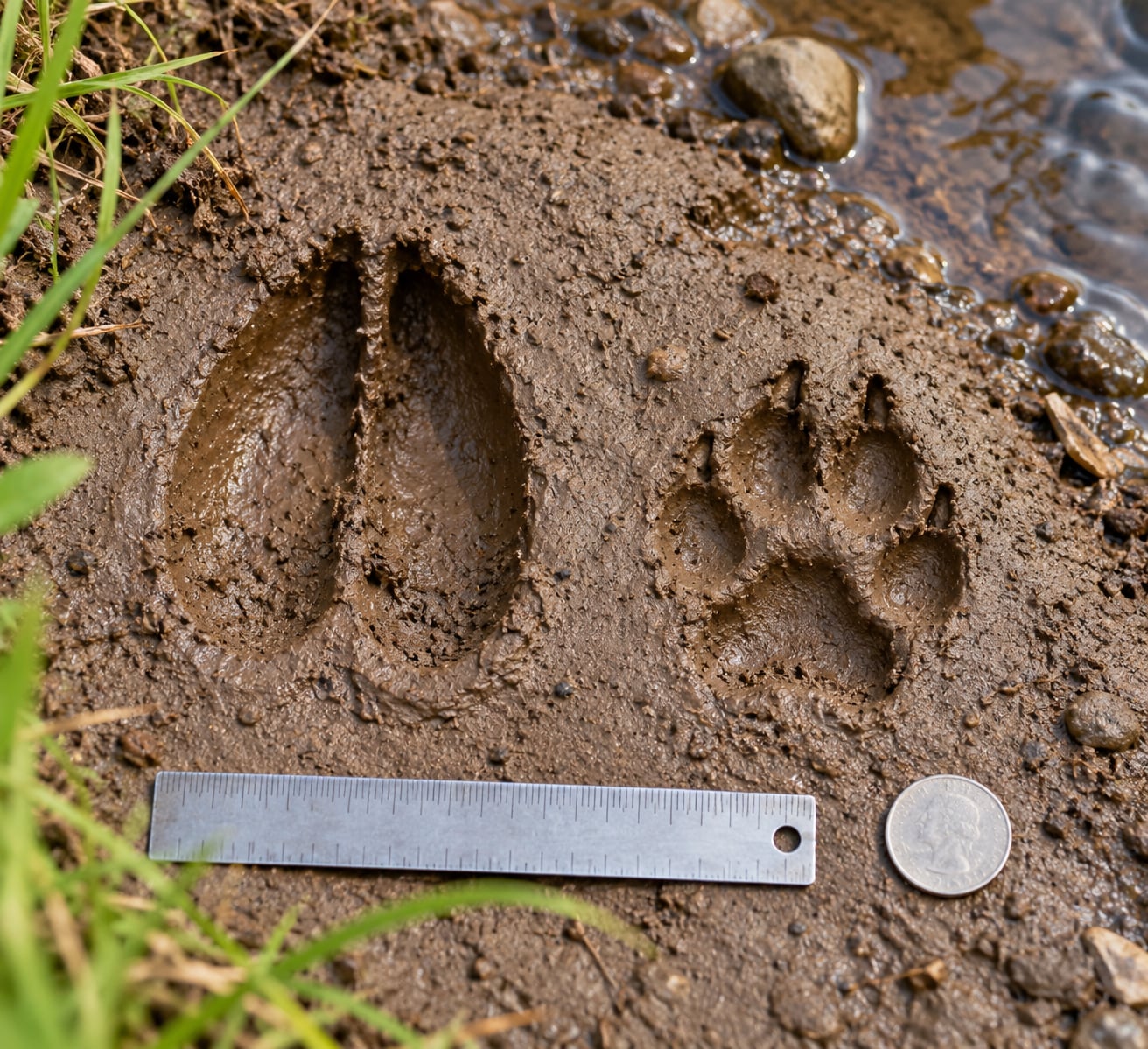
- A coin or a standard card for scale. A quarter works in a pinch; a credit card or driver’s license is better because everyone knows its size.
- Your phone camera. Straight down, with the scale object in the same frame, is the difference between a usable ID request and an unusable one.
- A hand lens or small mirror. Useful for the negative space between toes and the lobe count on a heel pad.
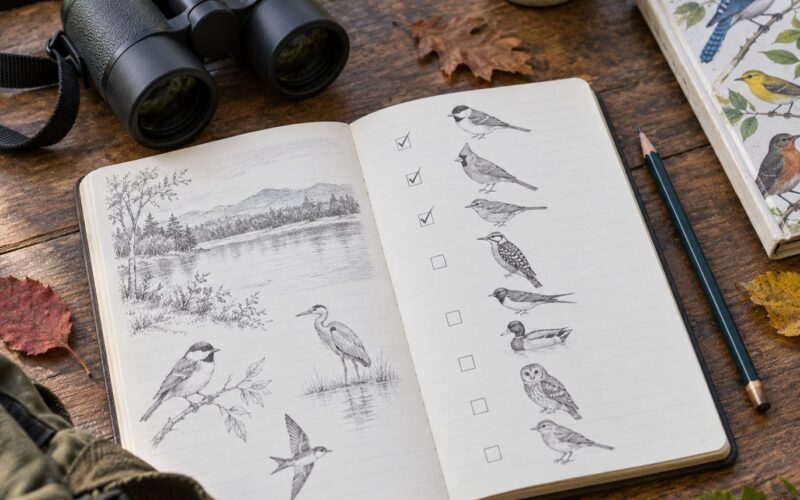
- A notebook. Draw the track as you see it, toe by toe. Drawing fixes errors faster than re-reading a chart.
- A regional field guide. Most state wildlife agencies publish a free pocket guide with real print dimensions for local species.
- A way to mark the spot. A flagging tie, a stone cairn, or a GPS pin in your phone. Never scratch a mark into the mud next to a track.
Wear gloves. They stop your hands from warming and smearing the print, which matters more than most beginners expect.
How to Identify Animal Tracks in Mud: Step-by-Step
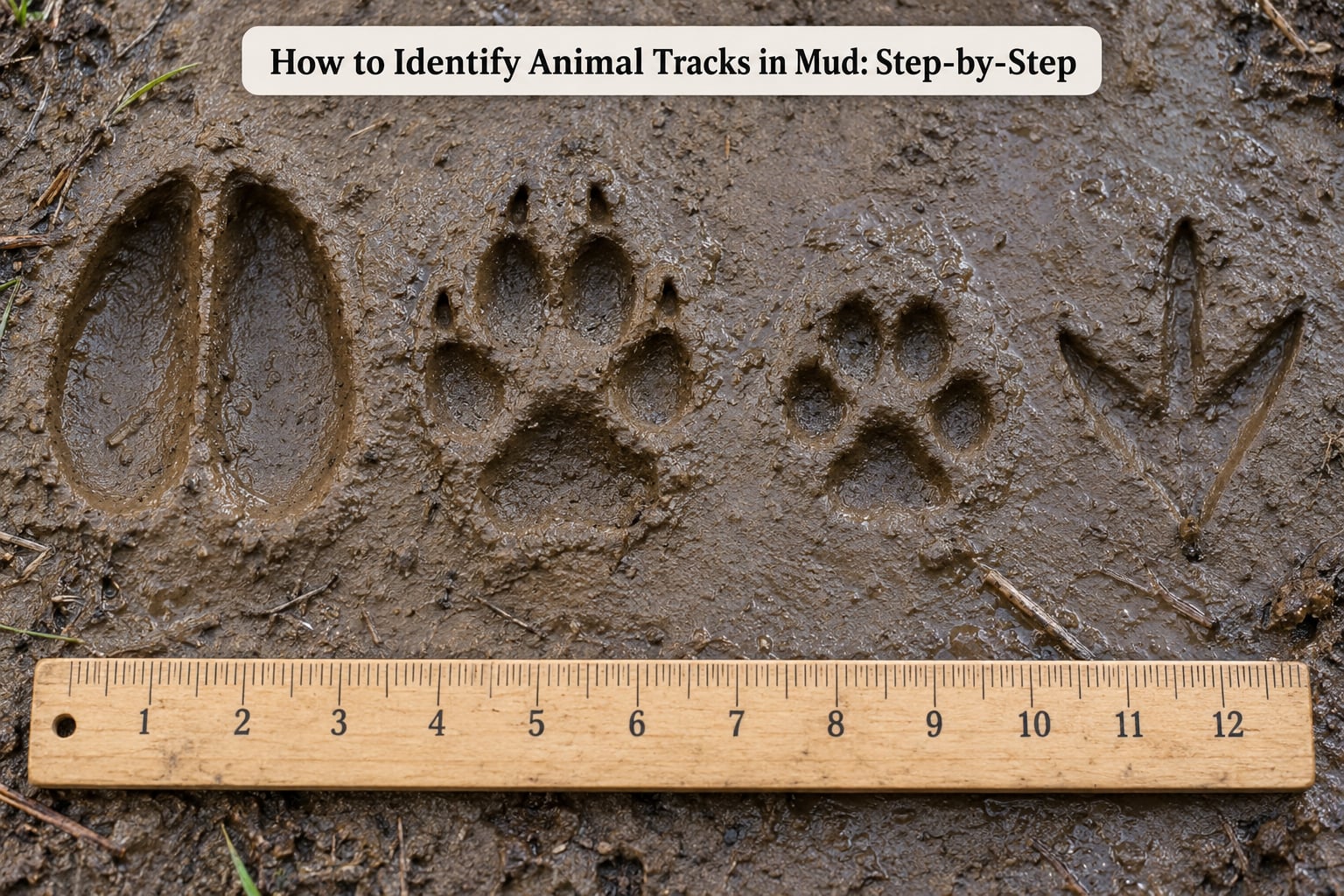
Work the steps in order and stop at each one long enough to write down what you see before you check the guide. Rushing straight to a picture is how people end up convinced a house cat is a mountain lion.
1. Check the Conditions and Work Safely
Mud quality decides whether the rest of this works at all. Saturated mud at the edge of a puddle records everything and blurs nothing, while mud that has dried for a day keeps its outline but loses fine detail like toe splay and hair texture. Look at the last few hours of weather too: rain after the print washed out the sharp rim, and a hard frost blurred the edges just as thoroughly.
Watch your footing. Creek banks collapse, mud hides holes, and a slick print on a steep slope is how people end up in the water. Check the weather before you commit to following a line, note the tide if you are on a shoreline, and know whose land you are standing on. Fresh bear sign, a bear moving in your direction, or any sign of an aggressive animal is the signal to back out the way you came.
2. Find a Clear, Isolated Track
The best track in a mudhole is usually not the one you spotted first. Pick a single print that stands alone, away from overlapping steps, so every toe and edge is visible. A print stamped over by a second animal is unreadable no matter how good your guide is.
Look for the details that mark a good one: crisp edges where the mud broke cleanly, a defined rim all the way around, visible toe pads and heel pad, and claw marks extending past the toe if the animal had them down. Skip anything sitting in standing water, under an overhanging root drip, or blurred by a fish or insect working the silt.
3. Measure Without Guessing
Measure four numbers and write them down: overall length from the front of the print to the back, overall width across the widest point, stride as the distance from one print to the next of the same foot, and straddle as the gap between left and right tracks. Use the same units every time, and measure both the front and the hind foot of at least one animal.
The distinction that confuses people is between measuring the print and measuring the pattern. The print is one impression, heel to toe. Stride and straddle need a second and third print, so lay your ruler along the ground rather than bridging the depression. If your numbers disagree with a guide by more than half an inch, you probably measured the wrong foot.
4. Examine Toe and Pad Arrangement
Toe count is the fastest single check and it takes about ten seconds. Four toes with claw marks ahead of them means a canine or a furbearer like a raccoon or skunk. Four toes with no claws usually means a feline. Five slender toes in a hand-like print with the big toe out to the side points to a bear or a human. Two halves meeting at a point is a cloven hoof, and a print with three forward toes plus one rear hallux is a bird.
Then look at the pad. Cats show a three-lobed heel pad shaped like an M; dogs and most canines show two lobes side by side. Soft mud registers claws more reliably than snow or hard ground, which is worth knowing before you apply the usual rule.
5. Read the Track Shape and Outline
Outline tells you the group before the size tells you the species. A heart or teardrop split down the middle is an ungulate, a round pad with a splayed toe arrangement is a carnivore, and a five-fingered hand is a bear or a person. Front and hind feet often differ, so judge on the front foot unless the guide you are using tells you otherwise.
Claws register more in soft mud because the foot sinks and the claw tip reaches lower, which means a cat can leave marks here that would never show up in snow. Treat claw marks as one clue, not a verdict.
6. Use the Stride and Track Pattern
A single print tells you almost nothing about who made it. The pattern of several prints tells you how it was moving, and that narrows the list fast. A direct-registered walking line means a large animal moving slowly; a straight trail with paired prints on a diagonal is a trot; groups of two prints landing together with the front larger than the hind is a bound.
Beginners often read the front-hind size difference in a bound as two species. It is one animal. Walking the line for ten or fifteen steps usually settles an identification that ten minutes of staring at a single track never will, because pace, stride, and body proportions have to agree with each other.
7. Consider Habitat and Nearby Evidence
Where the track is tells you who is likely to have made it. Beaver sign means you are near flowing water, a fresh scrape in soft mud near a wallow suggests a deer or a bear, and a repeated line along a game trail between two feeding areas is a route rather than a one-off crossing. Season matters too: expect fawns in late spring and early summer in most of North America, which changes what a small print beside a large one means.
Use scat, hair, feathers, feeding damage, mud spatter on vegetation, and calls as supporting evidence rather than proof. A drag mark through soft mud points to a tail or a heavy animal moving slowly, and it is one of the best mud clues you can get.
8. Compare and Confirm the Identification
Compare against a regional field guide or a reputable tracking reference, and match three things at once: toe count, overall size in inches, and track pattern. A match on two out of three is a guess. A match on all three, with habitat that fits, is an identification.
Know the look-alikes before you go looking, because the confusing pairs are where beginners get into trouble: coyote versus domestic dog, mountain lion versus bobcat, bobcat versus house cat, elk versus deer versus moose, and groundhog versus raccoon. When you cannot separate two candidates, say so and write both down. Honest uncertainty is a field skill, not a failure.
Common Mistakes
The same six errors account for nearly every wrong identification, and each one has a simple fix.
- Measuring only one foot. Front and hind prints differ, especially in bounding animals. Measure at least one front and one hind before checking a chart.
- Assuming every print belongs to one species. A crowded mudhole often holds three or four animals. Confirm a single animal by following the pattern, not by grouping nearby prints together.
- Ignoring mud conditions. Soft mud over-registers, making a house cat look like a big cat and lengthening long toes dramatically. If the print edges look melted, trust the pattern over the outline.
- Treating claws as an automatic verdict. Cats retract their claws, but very soft mud still registers them. Weigh claws against toe count, pad shape, and size instead of deciding on claws alone.
- Walking straight across the trail. Step over the line rather than through it, and step on the same side each time. You cannot follow a track you have destroyed.
- Crossing private land or disturbing signs. Stay on public land unless you have permission. Marking, casting, or moving wildlife sign is regulated on public and tribal land, and in many places a cast needs a permit, so leave the print as you found it.
Early morning and late evening light rake across the ground and cast shadows into the depressions, which is why the same trail can be unreadable at noon and obvious at seven. If you only have one shot at it, pick the hour with the low sun angle.
Frequently Asked Questions
How do you tell coyote tracks from domestic dog tracks in mud?
Coyote tracks are narrower and more oval than dog tracks, with toes held close together in a tight row. Domestic dogs splay their toes wider and leave more negative space between them, and larger breeds often show a rounder, heavier print. Coyote stride is long and direct-registered, while dogs wander, cross paths, or run alongside a person. Front and hind tracks of a coyote are similar in size, and coyote heel pads show two lobes side by side.
What is the difference between deer tracks and moose tracks?
Deer tracks are two narrow teardrop-shaped halves, usually around 2 to 3.5 inches long, with a heart-shaped print and a deep dew split. Moose tracks are far larger, commonly 4 to 8 inches long, with a more rounded hoof shape, heavier dewclaws, and legs that splay widely because the toes are spread to spread weight on soft ground. Size alone separates the two in almost every case.
How can you tell how old a track in mud is?
A fresh print has crisp, sharp edges, clean detail in the toe pads, and no silt inside it. After several hours the rim softens and fine silt begins collecting in the bottom. Overnight, edges round off, debris and insects move in, and the whole print looks slightly sunken and blurred. A print older than a day or two often holds standing water or a crust of dried silt. In wet mud, assume a crisp print is under a day old.
What mud conditions give the clearest animal tracks?
The clearest prints appear in firm, moist mud along a creek bank, pond edge, or mudbank stream, where the animal sinks about a quarter inch. Mud that is soaked and watery over-registers and blurs toe detail, while mud that has dried out loses fine texture and can crumble. Recently rained-on dirt roads, game trails between wet fields, and stock tank margins all tend to hold clean prints. Low morning or evening sun makes shallow prints easier to see.
Are there apps that can identify animal tracks from a photo?
Tracking apps exist and most rely on your measurements plus a species list, so they identify well only when you supply scale and location. Any app that guesses from a photo alone will be wrong often enough to be misleading, especially for look-alike pairs like coyote versus dog. The apps are most useful for checking your field guide and for logging where you found signs. A paper guide and a ruler still do the real work.
How do you tell a real animal track from a boot print or tire rut?
Boot prints show a flat, even tread pattern with a hard geometric edge and no toe pads or heel pad. Tire ruts are long continuous grooves with tread blocks and a smooth crowned shape rather than a discrete impression. Erosion features such as potholes and rain-cut channels lack a toe count entirely. Genuine animal prints show toe pads, a heel or dew area, and often change shape and direction along a line of several impressions.
Start at a mudbank crossing or the edge of a pond after rain, find one clean print with a coin beside it, and measure before you guess. Write down what you see, follow ten prints, then open the guide.