Shape is the fastest way to narrow a distant wading bird to a species, and it works before color ever comes into play. Every heron and egret shares one signature silhouette: a neck that folds back into a tight S-curve in flight, made possible by a modified sixth neck vertebra. Once you have confirmed that shape, bill thickness and color, then leg and foot color, will separate almost every species you will meet in the field. This guide walks through how to identify herons and egrets by shape, with the measures you can check through binoculars at a distance that makes feathers useless.
I spend most of my time at ponds, creeks and tidal edges where color washes out in glare or haze. The birds that give themselves away fastest are the ones whose outlines do not fit: a hunched white bird that is not an egret, a slim gray bird that is not a heron.
One word of housekeeping before the field marks. Herons and egrets are common names, not separate biological groups. They all belong to one family, Ardeidae, and some species carry both words in their names. The scientific name of the Tricolored Heron, Egretta tricolor, literally puts a heron inside the egret genus. So the useful question is not heron or egret, but which heron.
Table of Contents
- How to Identify Herons and Egrets by Shape
- What shape differences matter most at a distance?
- How can you tell a heron from an egret by shape?
- How do you identify Great Blue Herons and Great Egrets by shape?
- Great Blue Heron: the heavyweight shape
- Great Egret: the tall, slender shape
- How do you identify Snowy Egrets and Little Blue Herons?
- Snowy Egret: compact and animated
- Little Blue Heron: darker and more hunched
- How do you identify Tricolored Herons and Green Herons?
- Tricolored Heron: long-legged and forward-leaning
- Green Heron: small, stocky, and often crouched
- How do you identify Black, Yellow-crowned, and Cattle Egrets by shape?
- Black Heron: compact with a distinctive foraging shape
- Yellow-crowned Heron: sturdy and hunched
- Cattle Egret: rounded and upright
- What other features should you check after the shape?
- Frequently Asked Questions
- Is there a difference between an egret and a heron?
- What is special about a heron?
- How do you tell a white heron from an egret?
- What birds are mistaken for herons?
- Is the bill size difference between a heron and an egret reliable?
- Why does my perched egret look like it has no neck?
- Conclusion: Start with the silhouette
How to Identify Herons and Egrets by Shape

Read herons in four passes: overall silhouette, neck posture, bill profile, then legs and wing proportions. Color comes last, and habitat is the tiebreaker. Here is the same four-part read applied to the species most people actually see in the Southeast, from the inland reservoirs and creek bottoms up to the coastal marshes.
The heights below are standing heights, not total length. A folded heron looks far shorter than its measurements suggest, which is exactly why sizing by eye without a reference is so hard.
- Great Blue Heron — about 48 inches tall. Bulky body, folded S-neck, heavy dagger bill, legs roughly as long as the body is deep. Shallow water and shorelines.
- Great Egret — about 39 inches tall. Tall, narrow, extended neck, slim yellow bill, very long legs. Open water and flooded fields.
- Snowy Egret — about 22 to 26 inches. Small, compact, thin black bill, black legs, bright yellow feet. Edges and shallow pools.
- Cattle Egret — about 20 inches. Rounded, upright, compact bill, short neck. Grass, fields, wet pasture.
- Little Blue Heron — about 25 inches. Medium, dark, hunched, thick two-toned bill. Freshwater ponds and flooded woods.
- Tricolored Heron — about 26 inches. Slim, long-legged, forward-leaning, long thin bill. Brackish marsh and estuary.
- Yellow-crowned Heron — about 22 to 30 inches. Sturdy, heavy-billed, crouched. Mangrove edge and marsh margin.
- Green Heron — about 18 to 22 inches. Small, stocky, short neck, stout bill. Shaded water edges, branches, small openings.
- Black-crowned Night-Heron — about 22 to 26 inches. Compact, thick-necked, heavy bill. Roosts in trees, feeds at dusk.
Two entries there are worth flagging. The Little Blue Heron is a heron that is heron-sized, and the Green Heron is a heron that barely reaches the bottom of the egret size bracket. That is the first rule people get wrong.
What shape differences matter most at a distance?
Silhouette first, then proportions, then details. If you work in that order you will ID more birds and waste less time squinting at color.
Body size and bulk. Big birds show a long, heavy body line with a deep chest. Small herons and egrets look round and hunched, often with the head sunk toward the shoulders.
Neck carriage. Great Egrets and Great Blue Herons both hold a long, thin neck, but the Great Egret usually stands with it extended in a clean vertical line while the Great Blue folds its neck into a resting S with the head drawn back over the shoulders. Green Herons compress the neck almost completely, which makes small herons look headless at range.
Bill profile. Fine bills look like pins. Stout bills look like chisels. Snowy Egrets and Little Egrets carry noticeably fine needles; Great Blues, Yellow-crowned Herons and Night-Herons carry heavy daggers. In flight the bill is a straight spear aimed forward.
Leg and foot proportions. Long trailing legs held straight back in flight are a family trait. On the ground, Tricolored Herons and Great Egrets stand tall on long dark or yellow legs, while Green Herons and Night-Herons look squat.
Wing shape. Heron wings are broad and rounded, with the trailing edge bowed. They flap slowly and heavily, which is another way to pick them out of a mixed flock.
Posture and movement. This is the cue people forget. Great Blues stalk slowly and freeze. Great Egrets walk actively, swing their heads side to side, and hunt in open water. Snowy Egrets dance and shuffle their feet. Green Herons prefer to sit still and then dart.
Sizing a distant bird without a ruler comes down to familiar yardsticks. Compare it to a mallard for the small herons and egrets, to a crow for mid-sized birds, and to a Great Blue Heron for the giants. A football is a reasonable stand-in for a Great Egret at close range. Getting the bird into the right size bracket is usually enough to remove two or three species from consideration.
How can you tell a heron from an egret by shape?
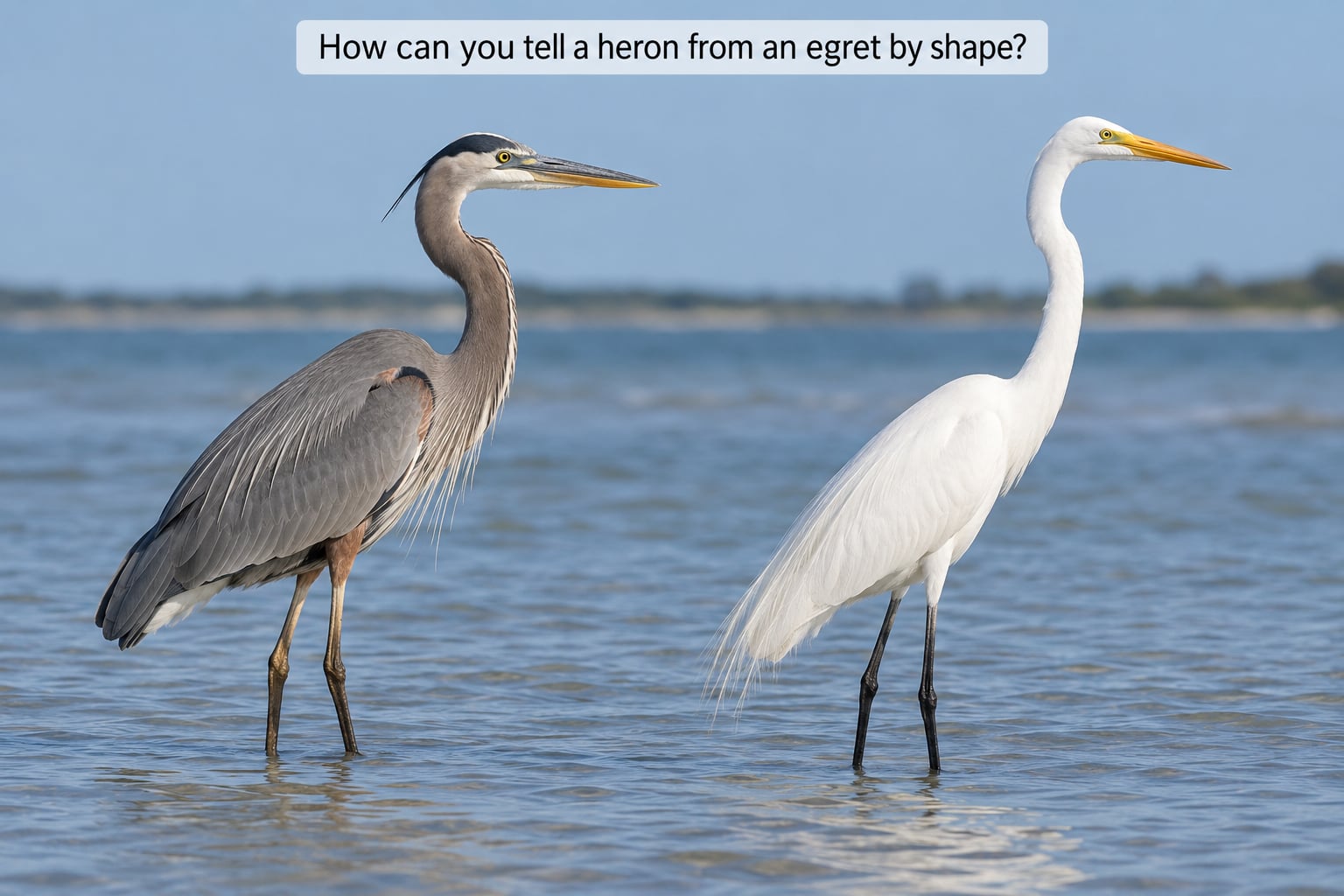
Mostly you cannot, and any guide that gives you a clean shape rule is oversimplifying. Herons tend to be stockier, shorter-necked and heavier-billed; egrets tend to be slimmer, longer-necked and finer-billed. That is a tendency, not a boundary, and posture and behavior overlap more than most articles admit.
Two overlap cases trip people up constantly. Night-Herons and the Green Heron are herons that are smaller than several egrets. And a perched Great Egret with its neck folded can easily read as a heron, which is why the neck angle matters so much.
That angle is a genuinely useful fine mark. BirdForum birders point out that the Great Egret’s neck kink is angled rather than smoothly sinuous, and that the lores, the skin between bill and eye, plus the slightly downcurved culmen, the top ridge of the bill, help separate it from lookalikes. Observers on the same forum also note the Great Blue Heron reads more like an egret in shape than like other large herons, apart from color. That is shape-first identification in practice, and it is why color alone sends people in circles.
How do you identify Great Blue Herons and Great Egrets by shape?
These two dominate almost every wetland visit, and they are the easiest pair to separate once you know the difference is a posture difference rather than a color difference.
Great Blue Heron: the heavyweight shape
The Great Blue Heron is long, deep and slow. The body is heavy through the chest and shoulders, the legs look disproportionately long, and the bill is a serious weapon, thick at the base and roughly as long as the head and neck combined.
Standing still, it folds its neck into a deep S with the head pulled back onto the shoulders, so a perched bird looks neckless. Many beginners assume something is wrong with it. When it moves, the walk is deliberate and heavy, one slow step then a long freeze.
Great Egret: the tall, slender shape
The Great Egret is the opposite build: narrow through the body, very long in the leg, with a slim yellow bill and an upright stance that keeps the neck straight and the head high. The outline is cleaner and more vertical than a Great Blue’s.
Behavior gives it away as much as shape. A Great Egret hunts actively, walking through shallow water with its head swinging, and it sometimes stands on one leg with the other tucked up along the tail. Flush one and the S-curve in the neck is unmistakable.
How do you identify Snowy Egrets and Little Blue Herons?
A small white bird and a small dark bird that can look white. Shape separates them, but only if you know which shape to look for.
Snowy Egret: compact and animated
The Snowy Egret is small, tight-bodied and rarely still. Its bill is thin and black, and it gives a quick, twitchy, almost dancing impression as it works the water’s edge and shuffles its feet to stir up prey.
The clincher at any range is the feet. Snowy Egrets have yellow feet that flash against their black legs, and they also show yellow on the face, near the gape line. Juvenile Snowy Egrets complicate this, with yellow-green legs that darken as they mature.
Little Blue Heron: darker and more hunched
An adult Little Blue Heron is a slate-blue-gray bird with a dark greenish to maroon-purple head and neck, a stout two-toned bill that is dark on top and paler below, and grayish-green legs. It carries its head low and often holds its neck in a forward slant, which reads as hunched.
Watch for the exception. An immature Little Blue Heron is entirely white, sometimes with scattered gray feathers on the wings, and in that plumage it looks like a Snowy Egret with a heavier bill and darker legs. Bill thickness is the separation. Birders on local forums report this white juvenile causing more confusion than any other bird in the group.
How do you identify Tricolored Herons and Green Herons?
These two sit at opposite ends of the family in size and behavior, which makes them easier than the white-bird pairs once you know they are unrelated in shape.
Tricolored Heron: long-legged and forward-leaning
The Tricolored Heron has a slim, elongated profile with a long thin bill and long legs, and it habitually leans forward while foraging so that the body angles down toward the water. It stalks through brackish marsh with a constant low buzz of wings.
Compared with a Great Egret it is shorter, more hunched and more horizontal, and compared with a Little Blue it is far longer-legged. Juvenile Tricolored Herons can have yellow legs, where adults are grayish to dark, another example of leg color shifting with age.
Green Heron: small, stocky, and often crouched
The Green Heron is a compact bird with a short neck sunk into the shoulders, a stout dark bill, and shortish legs. It usually waits motionless on a shaded bank, branch or snag and then lunges, which is why people often think it has vanished.
The most common misidentification in this group, according to local birders, is juvenile Green Heron reported as American Bittern. The difference is proportion. A bittern is much larger, heavily streaked, and carries its bill angled upward in a dramatic display; a Green Heron is small, plain below, and hunched with its bill level or pointed down.
How do you identify Black, Yellow-crowned, and Cattle Egrets by shape?
Three birds that get lumped together as chunky white or dark waders, and each has its own outline. None of these cues depend on plumage color.
Black Heron: compact with a distinctive foraging shape
The Black Heron, an African species, is a medium, compact heron with relatively short legs and a dark bill. Its real claim to a recognizable shape is behavior: it will spread its wings wide into a canopy and shade the water below while watching for movement. That wing-spread silhouette is unmistakable.
Yellow-crowned Heron: sturdy and hunched
Built low and sturdy, with a thick neck and a heavy bill that gives the head a blocky look, the Yellow-crowned Heron crouches at muddy margins and vegetated edges. It moves slowly and deliberately and rarely stands as tall as a Great Egret does on the same bank.
Cattle Egret: rounded and upright
The Cattle Egret is the odd shape out. It is short, rounded and habitually upright, with a compact bill, a short neck and comparatively short legs. It is the one most likely to be standing in a grassy field rather than in water, following livestock or insects, and that posture plus location identifies it faster than color will.
What other features should you check after the shape?
Shape narrows the field to a short list. These six checks settle it.
Bill color and thickness. Yellow (Great Egret), black and fine (Snowy and Little Egret), two-toned and stout (Little Blue Heron), heavy and dark (Great Blue, Yellow-crowned, Night-Heron).
Legs and feet. Black legs with yellow feet, all-black legs, greenish or grayish legs, and legs that can turn yellow in juvenile birds. Treat leg color as supporting evidence only, since it shifts with age and breeding season.
Lores and gape. The lores are the skin between bill and eye, and the gape line extends back behind the eye in herons and egrets. Lores run from yellowish to black to red depending on species and breeding condition.
Wing pattern in flight. Black or yellow feet kick past the white wingtips. Snowy Egrets show dark wingtips when the wings are spread.
Flight silhouette. This is how you rule out birds that are not herons at all. Cranes, storks and most other long-legged birds fly with the neck stretched straight out. Ibises and spoonbills extend their necks too. Only herons and egrets fold the neck back into an S with the bill tucked to the shoulders.
Habitat and behavior. Open water and active hunting suggests Great Egret. Shallow edges and shuffling feet suggests Snowy Egret. Grass and cattle suggest Cattle Egret. Mangrove margin and crouched waiting suggest Yellow-crowned Heron. Dusk activity at a roost suggests Night-Heron. Colonies of stick nests in trees point to the larger day herons and egrets, while bitterns nest alone in reeds.
Common rules that fail: herons are not always bigger than egrets, and egrets are not always white. The rules also stop working in spring, when immature plumage and breeding colors break the leg-color and bill-color assumptions you learned in winter.
If you want the ID to stick, take the picture with the sun behind you, get the whole bird in frame, and make sure the bill and the feet are both visible. A second frame of the bird in flight settles most arguments.
Frequently Asked Questions
Is there a difference between an egret and a heron?
Not a biological one. Heron and egret are common names applied inside one family, Ardeidae, and some birds carry both words. In practice herons tend to be stockier and heavier-billed while egrets are slimmer and finer-billed, but posture, behavior and bill shape are more reliable cues than the names themselves. Some species named herons are smaller than egrets.
What is special about a heron?
Herons and egrets have a specially modified sixth neck vertebra that lets them fold the neck into a tight S-curve, bill tucked to the shoulders, even while flying. Almost no other long-legged bird does this. That single feature, with broad rounded wings and legs trailing straight back, tells you a bird belongs to Ardeidae before any color or size check.
How do you tell a white heron from an egret?
Judge shape before color. Great Egrets stand very tall with a straight, extended neck and a slim yellow bill. Snowy Egrets are smaller and more animated with a thin black bill, black legs and bright yellow feet. Juvenile Little Blue Herons are white too, but they carry a stouter, two-toned bill and darker legs, and they forage more slowly.
What birds are mistaken for herons?
The regular mix-ups are cranes, storks, white ibises, spoonbills and pelicans. Every one of them flies with the neck stretched straight out, while herons and egrets fold theirs into an S-curve. On the ground, cranes are taller with longer necks and straighter bills, storks have heavier bills and broader wings, and ibises curve the bill downward.
Is the bill size difference between a heron and an egret reliable?
It is one of the better shape cues, but only after family membership is settled. Great Blues, Yellow-crowned Herons and Night-Herons carry heavy dagger bills. Great Egrets have slim yellow bills. Snowy and Little Egrets carry fine black needles. Comparing a heavy-billed bird to an egret works far better than comparing size alone, which is often misleading.
Why does my perched egret look like it has no neck?
Perched herons fold their necks into an S and pull the head back over the shoulders, which hides most of the neck. Great Blue Herons do this more deeply than most, and Green Herons compress theirs almost completely, so a resting bird looks headless. Extend the neck by watching for a moment, or wait for the bird to lift off and check the flight silhouette instead.
Conclusion: Start with the silhouette
Shape gives you the bird in four moves. Size it against something you already know, like a mallard, a crow or a Great Blue Heron. Read the neck, since the retracted S-curve in flight confirms the heron family outright. Check the bill for thickness and color. Then check the legs and stance, and confirm with wing pattern, behavior and habitat.
Keep color as the last check rather than the first, and expect the rules to loosen on juveniles and in spring. That is how to identify herons and egrets by shape, and it holds up at the range where binoculars stop helping.