Most paddlers can handle alligator water safely, because a healthy American alligator treats an occupied kayak as something too big and too unfamiliar to bother. Learning how to kayak safely in alligator water is mostly distance, judgment and preparation: you give every gator a wide berth, you read the animal’s body language before it has to read yours, and you never let curiosity move you closer. It is not a risk-free activity, and no piece of gear removes that part. Treat it the way experienced flatwater paddlers treat any wildlife water, with a plan you could execute half-asleep.
A few numbers frame the real danger. Most paddling fatalities happen because somebody drowned after a capsize, not because an animal got involved. Alligator water concentrates the conditions behind that drowning: tannic channels where you cannot see two feet ahead, submerged snags, cypress knees, shallow banks, and animals you never knew were there. Your flotation device, your float plan and your calm are worth far more to you than any improvised defense against the gator.
One more thing before we start. Feeding an alligator is illegal in several states, and it is the single behavior that turns a harmless animal into a genuinely dangerous one. Paddling past a fed gator at a boat ramp is a different trip entirely from paddling past a wild one on a quiet backwater.
Table of Contents
- What You Need
- Step-by-Step: How to Kayak Safely in Alligator Water
- How to kayak safely in alligator water: assess the launch and route
- How to kayak safely in alligator water: prepare your gear and float plan
- How to kayak safely in alligator water: paddle with wildlife-aware spacing
- How to kayak safely in alligator water: respond if an alligator approaches
- How to kayak safely in alligator water: handle weather, capsizes, and emergencies
- Common Mistakes
- Frequently Asked Questions
- Is it safe to kayak in alligator water?
- What do you do if an alligator approaches your kayak?
- How far should I stay from an alligator while paddling?
- Are inflatable kayaks safe in alligator water?
- What do you do if you fall out of the boat near an alligator?
- Can I take my dog, or use a paddle board, in alligator habitat?
- Conclusion
What You Need
A first correction before the list: the acronym is PFD, personal flotation device. If a guide tells you a “PDF whistle” will scare an alligator off, they mean a whistle clipped to your PFD strap. Whistle noise deters a curious animal at range; it is not a weapon.
Flotation and signaling. A properly fitted PFD is the one item you do not debate. Check every strap, buckle and cinch before you leave the tailgate, and tighten the side straps until the foam sits tight against your chest with no slack. A whistle on a lanyard around your neck, not buried in a dry bag. A spare break-apart paddle, because a single-bladed paddle lost in tannic water is a mobility problem. A headlamp for any dawn, dusk or return-after-dark plan.
Navigation and communication. A charged phone in a waterproof case, or a satellite messenger if there is no cell coverage where you are going. Know which one you have before you need it. A hand compass if the channel is long and featureless. A knife you can reach with cold or wet hands, clipped inside the hull where it will not go under with you.
Water and exposure. More water than you think, because heat and exertion fool you in tannic shade. Sun protection. Insect repellent treated clothing, and check the label before you spray it on a PFD or kayak shell. A first-aid kit that includes the kind of puncture repair your boat needs. A small light for signaling if you go in.
The plan. A float plan: where you are launching, your route, your boat, who is with you, and the hour you intend to be back. Left with a person on land, not saved in your own phone.
None of that gear makes an encounter harmless. It buys you time, flotation and a way to be found. The distance does the rest.
Step-by-Step: How to Kayak Safely in Alligator Water
How to kayak safely in alligator water: assess the launch and route
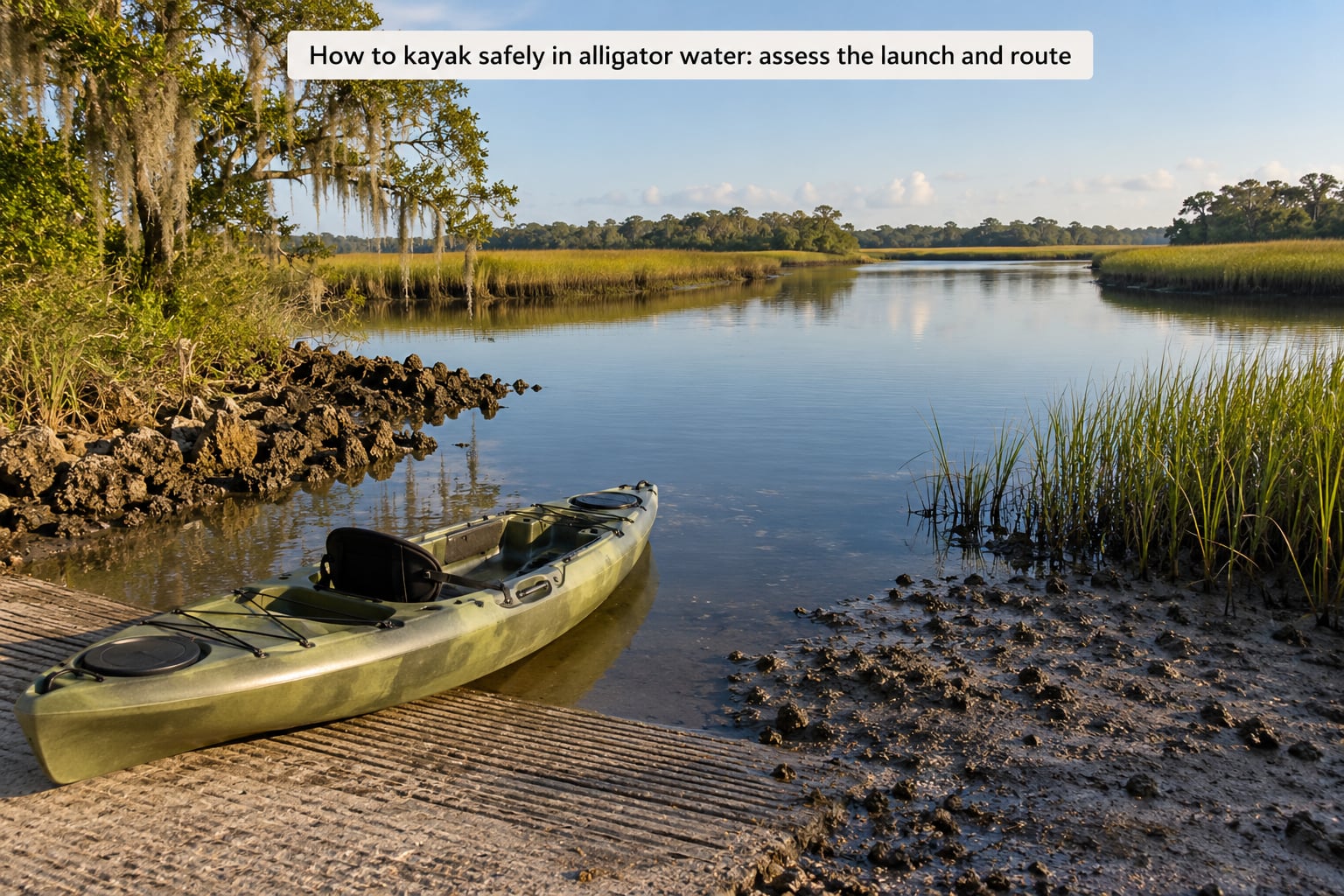
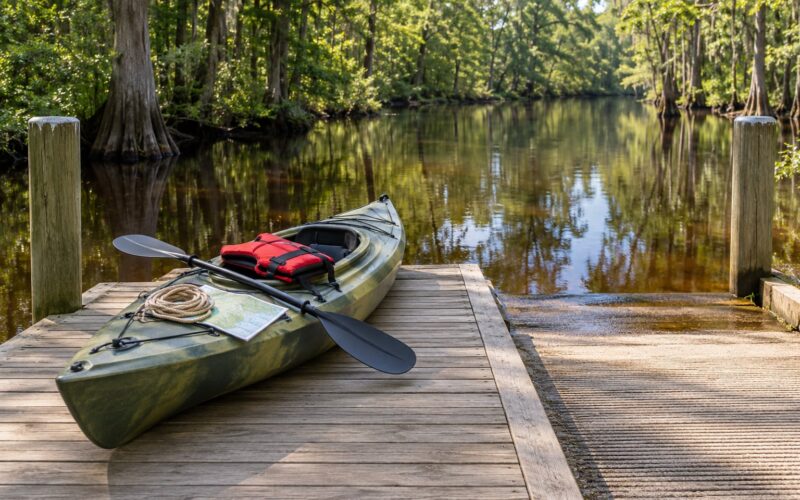
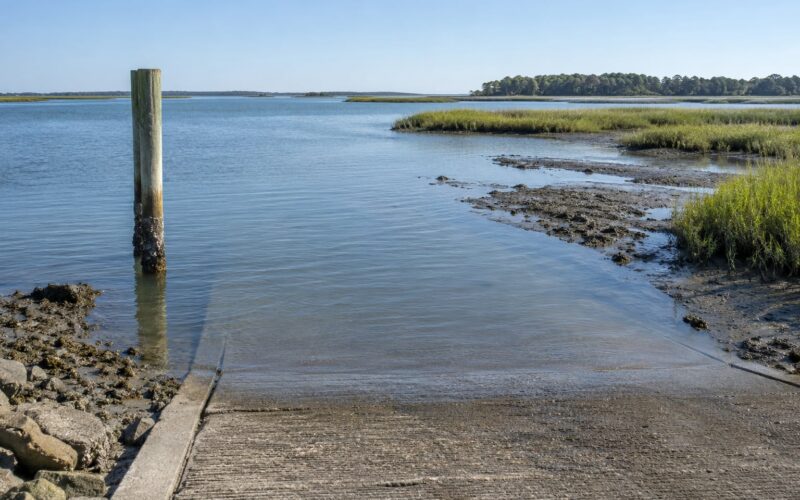
Start at the ramp, not the water. Look at the landing first: is it a smooth ramp you can walk your boat into, or a muddy bank that will have you dragging a hull off balance? Watch an experienced paddler load and unload before you commit to a technique you have never used. A wet, heavy kayak at a steep bank is how people fall in before they have even paddled.
Then read the water. You want to know the depth, the current, the tide stage if it is brackish, and where the channel narrows. Tannic water turns a foot of visibility into two inches, and a submerged gator is simply part of the bottom. Plan your egress points as you plan your line: know where you could get to a bank in under a minute if you had to.
Look for signs before you launch. Mound nests built up out of vegetation and mud. Slides on a bank where a big animal climbs out and goes down headfirst. Wallows. Gator holes scoured out under an overhang, with an undercut lip you cannot see into. Hatchling chirping means a mother is close and defending, so turn around without debate.
One range note that confuses newcomers. American alligators are freshwater and low-salinity animals, and they turn up in inland ponds, rivers, bayous, sloughs and coastal brackish creeks with mangrove edges. They do not live in true open saltwater, so Florida Bay and hard-salt coastlines are not the concern people sometimes assume they are. On the other side, the southern tip of Florida does host American crocodiles in saltwater, and those are a different animal with different behavior.
Pre-launch, in short: check the landing, check the tide and current, check the forecast, look for nests and slides, identify two places you could exit, and confirm the closure list and any seasonal restrictions for the water you are on. Then repeat half of that every hour on the water. Conditions on a tidal creek can change completely between launch and the turn back.
How to kayak safely in alligator water: prepare your gear and float plan
Put the PFD on at the vehicle, not at the water. Tug the shoulder straps until nothing shifts when you shrug, tighten the side straps so you cannot pull the front panel away from your chest, and confirm the crotch strap or tie-down if your model has one. A PFD riding up on your chin is flotation that does nothing.
Test the whistle where you can reach it. Seal the dry bag by rolling the top rather than folding it, squeeze out what you can, then clip it down inside the hull where a capsize will not send it floating away with your phone. Stow the paddle float where you can grab it one-handed. Put the headlamp and the knife on the forward deck or in a pocket, not behind your back.
Now make the call. Tell one person ashore your launch point, route, boat description, number of people on the water, and your planned return time. Say what to do if you are late: who they call, and that the first call is to the county emergency number, not to you. If your phone has no signal at your launch, that is exactly the detail they need in advance.
Success at this step looks simple. You can put your hands on your PFD buckles without looking, your float plan is in someone else’s hands, and you can reach every piece of emergency kit from the seat.
How to kayak safely in alligator water: paddle with wildlife-aware spacing
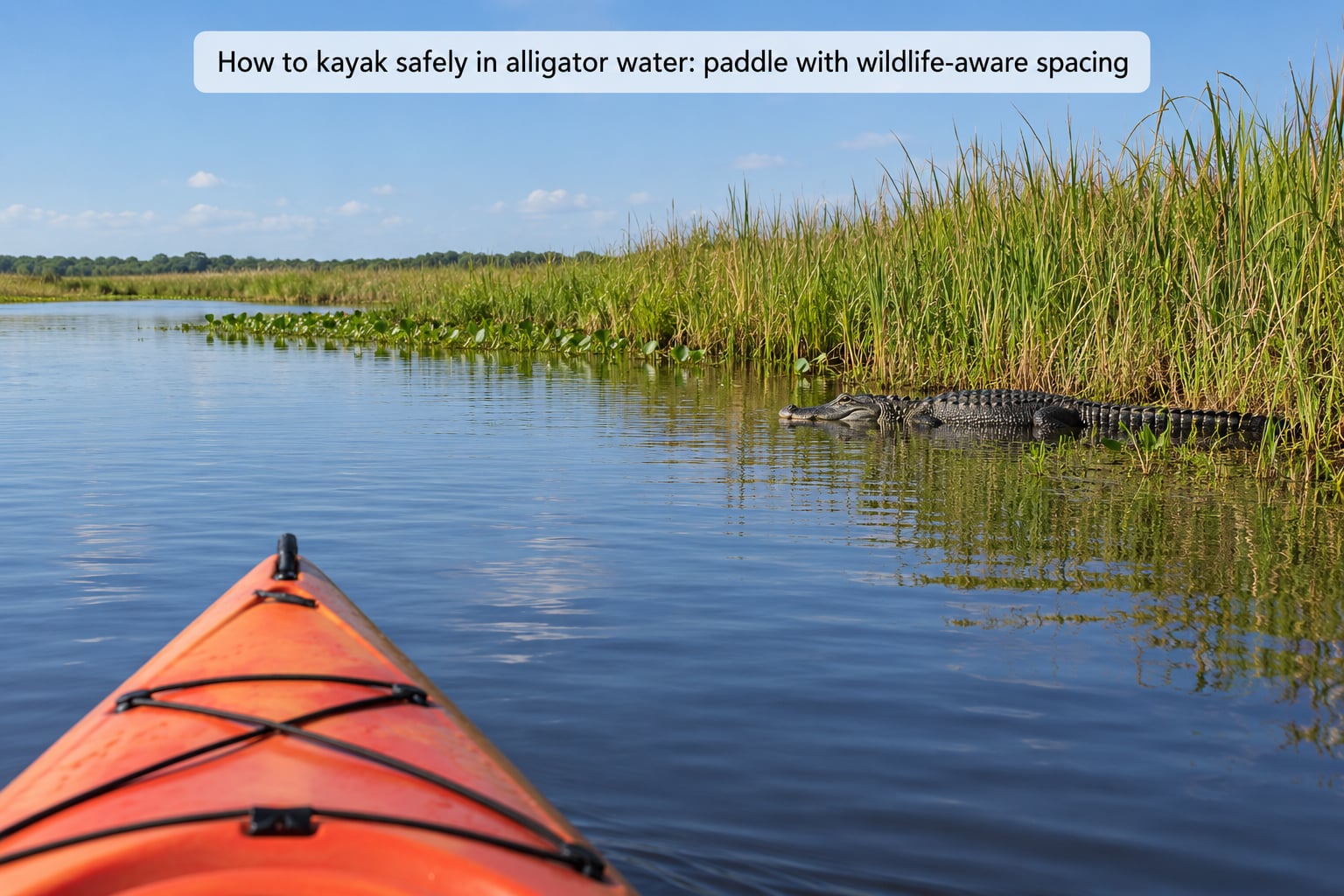
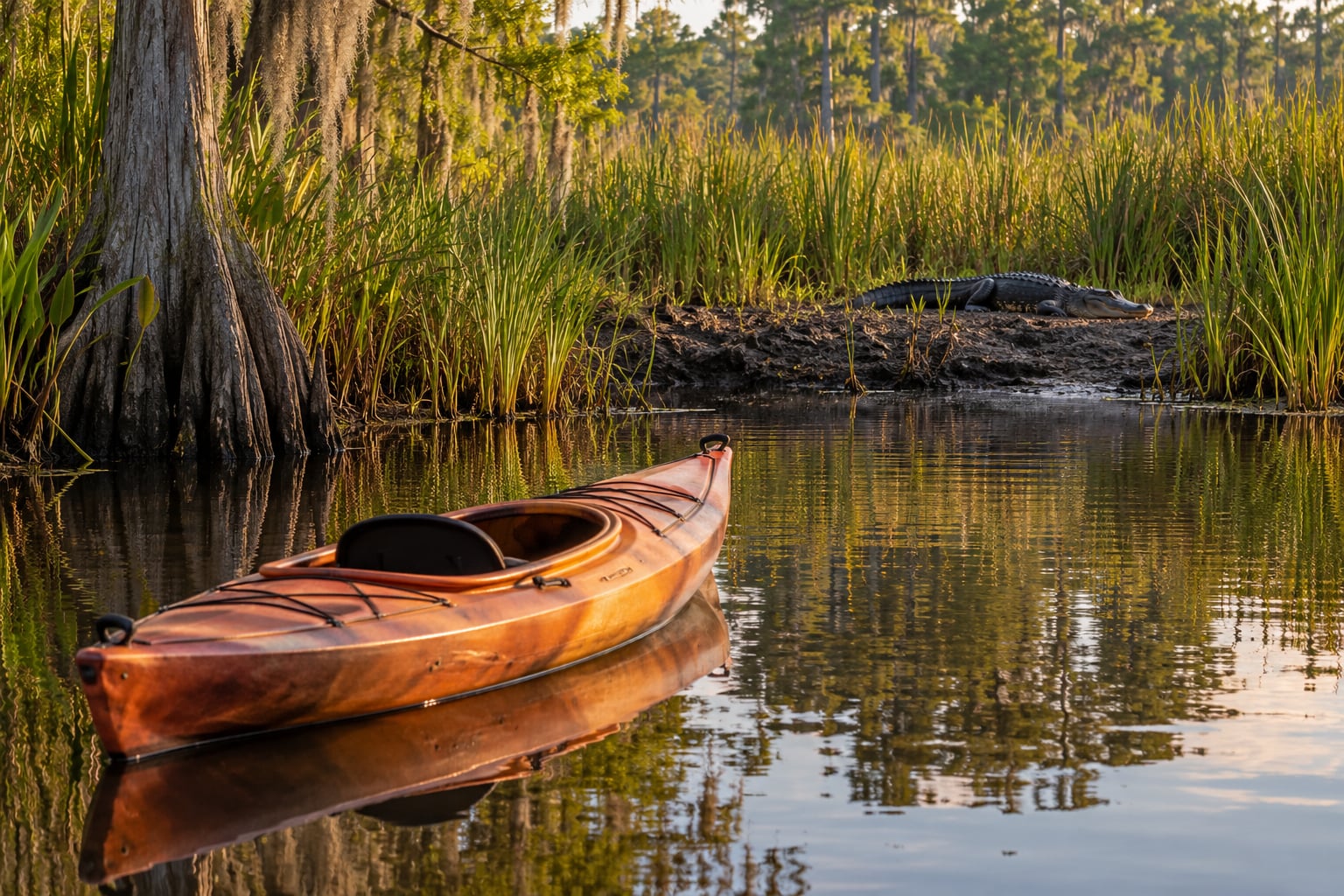
Give every gator the distance that costs you nothing. Far enough that you are not tempted to photograph it, far enough that you are not choosing whether to paddle past it at all. The paddlers who have done this for years describe a wide berth as the whole practice, and they are not being cautious, they are being efficient. Nothing good comes from passing closer.
Keep your paddle cadence slow and even. Splashy, arrhythmic strokes read as a disturbance or a struggling animal, and in shallow tannic water the eruption you see is frequently a gator reacting to being paddled over rather than an attack on you. Avoid a sudden burst of speed near a basking animal. Never block the path between an animal and open water, because you would be cutting off its exit, and never position yourself between a mother and her nest.
Keep your hands and gear out of the water. That matters enormously for kayak anglers, and the ones who fish this water safely follow the same rules: land the fish with a net or gripper, keep both hands above the surface, avoid thrashing the fish on the line, and release it without dropping it in a commotion. Losing a catch to a gator that came in for the surface noise is a story you will hear from every regular angler down there, and losing the fish is the better outcome of the two.
Read visibility as a constraint. When tannic water drops to the point where you cannot see the bottom or a submerged animal, narrow the distance you travel and raise your alert level. If the only way through is a channel edge you cannot see, the safer route is the long way around, or the trip you do not take today.
A few boat-type notes. A sit-ins kayak with a skirt and a raised seat gives you the most freeboard and the least exposure, which is why experienced paddlers in this country favor it. Low sit-on-tops leave you more visible in profile and offer less protection in a collision with a submerged log. Inflatable boats are buoyant and easy to climb back into, which matters more after a fall-in than during one, but they need to be properly inflated and their fins and valves are vulnerable in shallow, snag-filled and shell-covered coastal water. Paddle boards put your whole body at water level with nothing between you and the water; they are workable in open, heavily paddled water and a poor idea for quiet backwaters. Canoes have the same exposure problem as a sit-on-top with less gear capacity.
Do not bring a dog. This one is not a preference. Most of the documented attacks on pets in this country involve small dogs taken near or into the water, and a dog in the water splashing, barking and swimming toward a bank is a trigger no paddler can control. Leave the dog home or on shore with someone.
One mitigation worth knowing: on water that gets regular human traffic, animals are habituated and tend to ignore paddlers at close range. On remote water, the same animal may flee or may object to you entering its space. Heavily paddled water is genuinely calmer for wildlife reasons, not just because you will see more people around.
How to kayak safely in alligator water: respond if an alligator approaches
Here is the contradiction that frustrates readers, because half of what you read says never point your bow at an alligator and the other half says point the bow at it. Both are right, because they describe different intents. When you are simply passing an animal that is minding its own business, you back away and you do not orient on it. When the animal commits to a direct swim at your boat, some experienced guides use the opposite technique: turn the bow toward it and back-paddle, presenting the largest surface and the smallest threat.
| What you see | What it usually means | What to do |
|---|---|---|
| Basking on a log or sandbar, eyes open, no movement | Unconcerned, warming up | Give a wide berth, paddle quietly past |
| Only a bump and a wake on the surface | Submerged animal, size unknown | Slow down, widen your spacing, watch the wake |
| Head lifting and back arching, a huff of air | Startled or mildly threatened | Stop advancing, back off slowly, keep your strokes smooth |
| Jaw clapping, repeated hissing, deep bellow | Actively agitated, wants space | Increase distance, leave the area if you can |
| A steady direct swim toward your boat | Committed approach, territorial or defensive | Slow cadence, consider bow-on and back-paddling, be ready to leave |
| High-pitched chirping from a bank or mat of vegetation | Hatchlings, and a mother nearby | Back out of the area without approaching |
The step sequence, when an animal is coming at you and you want to leave slowly. Keep your strokes smooth and quiet rather than fast. Do not splash, do not shout, do not try to grab it. Orient yourself so you are not cornered against a bank or a mangrove root wall, because a trapped animal has no option but to escalate. If the animal is still moving off when you start back-paddling, leave. If it follows or closes again, get to the nearest safe shallow point and get out, and call for help if it continues after you are out of the water.
Do not hit an alligator with your paddle because a forum post told you to. The people who say a paddle strike on the head is a legitimate last resort are describing a scenario where an animal is already attacking at close range in water you cannot leave. That is not a first response, and treating it as one is how a defensive animal turns into a dangerous one.
At dawn and dusk you get one real advantage, and paddlers use it: alligator eyeshine. A light held low at arm’s length catches the reflective tapetum and tells you where an animal is in the dark water before you are close to it. It also works for deer and anything else out there.
How to kayak safely in alligator water: handle weather, capsizes, and emergencies
The plan for falling in is worth rehearsing once on dry land, because the correct response is not intuitive. Stay with the boat. An empty kayak floats, is easier to spot, and gives you something to hold. Get your torso over the hull and remount over the cockpit rather than trying to climb in from the side, which is what flips a boat under you. Move as little as possible while you do it, and move away from the boat toward the nearest shallow bank rather than out into open water.
Play out the time in the water honestly. General paddling guidance uses a water temperature threshold of roughly 120 degrees as the point where immersion becomes an emergency in a matter of minutes rather than a discomfort, and cold shock, not cold, is what gets people first. That is one reason many paddlers wear a dry top or light neoprene in this country even in summer.
For weather, watch for the afternoon thunderstorm that builds over the flats, for wind that turns a flat creek into a chop, and for rain that drops visibility and inflates tannic water color all at once. For entanglement, treat every submerged branch as live: paddle on one side of the boat, keep your paddle shaft up where you can see it, and back out rather than driving forward. For injury or a communications failure, use the float plan. Signal with the whistle in sets of three, paddle blade down, and stay put and visible rather than trying to cover distance you cannot manage.
Common Mistakes
Launching without checking the rules. Some waters close during nesting season or to protect rookeries, and some launch sites require registration or restrict motorized access. Corrections: check the managing agency’s closure list before you load the roof rack, not at the ramp.
Wearing the PFD but not fitting it. The most common gear error is a loose or unfastened PFD, which rides up over your ears or slides off your shoulders. Corrections: tighten it at the vehicle, and tug the straps hard enough that you cannot move the foam.
Going solo in remote gator country. The buddy system is not about gators, it is about a capsize, a paddle loss or a medical problem in water with no quick egress. Corrections: paddle with someone, or stay on heavily trafficked water where help is closer.
Paddling at dusk or after dark. Eye-shine detection is a genuine advantage, but visibility of your own route is not. Corrections: if you must be out near dark, use the headlamp, slow down, and finish well before you would be picking your way home.
Approaching for a photo. This is the mistake that produces territorial animals and, eventually, the videos of charges. Corrections: use a zoom lens from a distance, or get closer on foot later from a bank with a guide. Never from the boat.
Launching where anglers clean fish. Boat ramps with a cleaning station or a pile of fish guts teach animals that people hand them food. A fed gator loses its fear of humans, and a feeding-conditioned animal is the one scenario experienced guides treat as genuinely dangerous. Corrections: pick a different ramp, or wait and watch whether the animals there react to people at all.
Treating a dry bag as flotation. A sealed dry bag full of phone and keys does not keep your head above water and it can drag you down if it fills. Corrections: the PFD is your flotation. Gear bags are for gear.
Ignoring mating season and heat. Males become active and more territorial as temperatures climb into the spring and early summer, and water temperatures concentrate animals into whatever water is left during drought. Corrections: check the local season guidance for your water and time the trip for cooler months if you can.
A few last tips. Paddle with a steady cadence; noise from a paddle shaft tapped on the hull can help you clear a curious animal at range. Keep your catch and release quietly. And if visibility, weather or animal behavior changes during the trip, that is the whole signal: turn back. Paddlers who get hurt in this country are almost never the ones who paddled too far; they are the ones who kept going after conditions changed.
Frequently Asked Questions
Is it safe to kayak in alligator water?
Yes, with wide margins and preparation. A healthy American alligator in wild country treats an occupied kayak as too large and unfamiliar to be worth the effort, and most encounters end with the animal swimming off. Risk rises when an animal has been fed by people, when you corner or startle it, or when you paddle alone at dusk. Keep a wide berth, wear a fitted PFD, file a float plan and turn back when conditions change.
What do you do if an alligator approaches your kayak?
Keep your stroke rate low and your noise down, and do not splash, shout or grab for it. Make sure you are not pinned against a bank, where a trapped animal has no choice but to escalate. If it is moving off, back-paddle away and leave. If it commits to a direct swim at the boat, some experienced guides turn the bow toward it and back-paddle to present a large, unthreatening front. Then get to the nearest shallow point and get out.
How far should I stay from an alligator while paddling?
Far enough that you are not tempted to photograph it, and far enough that you never have to decide whether to pass at all. Practically, treat the whole visible length of the animal plus a healthy margin as a no-go zone, and give basking animals and holes a wider berth than passing ones. On heavily trafficked water, animals are often habituated and indifferent. On remote backwaters the same animal may flee or may object, so the wide-berth habit pays off everywhere.
Are inflatable kayaks safe in alligator water?
There is no teeth-versus-hull argument here. An inflatable kayak does not attract or deter alligators; what matters is buoyancy and how fast you can get back in after a fall-in, and inflatables are good at both. Watch the hull instead: fully inflate it, and be careful in shallow, shell-covered and snag-filled coastal water, where fins, valves and seams take the abuse. Sit-ins with a skirt and a raised seat give the most freeboard in the country.
What do you do if you fall out of the boat near an alligator?
Stay with the kayak, because an empty hull floats and is far easier to spot than you are. Get your torso across the hull and remount over the cockpit rather than climbing in from the side. Minimize splash, and head for the nearest shallow bank instead of swimming into open water. If an animal is close, do not thrash. Blow your whistle in sets of three and paddle blade down so you can be found.
Can I take my dog, or use a paddle board, in alligator habitat?
Leave the dog at home. Most documented attacks on pets in this country involve small dogs taken near or into the water, and a swimming, barking dog is a trigger no paddler can control from a boat. Paddle boards are workable on open, heavily paddled water but a poor choice for quiet backwaters, since you sit at water level with nothing between you and the surface and no skirt to hold you in. If you want either, pick the busier water and the cooler months.
Conclusion
Do five things before you launch: check the current local conditions, closures and wildlife guidance for 2026, put on a PFD that actually fits, tell someone ashore your route and your return hour, and keep a wide berth from every animal you see. Then keep reassessing, because water that looked fine at the ramp can be a bad idea two hours later.
Turn back the moment conditions turn. Working out how to kayak safely in alligator water is not one clever technique, it is the habit of stopping before the situation does, and the willingness to take the long way home. Follow the rules for the water you are on and the guidance from your state wildlife agency, and when you have a choice between the shorter route and the safer one, take the safer route. That habit, not any technique, is what gets paddlers home from alligator water.