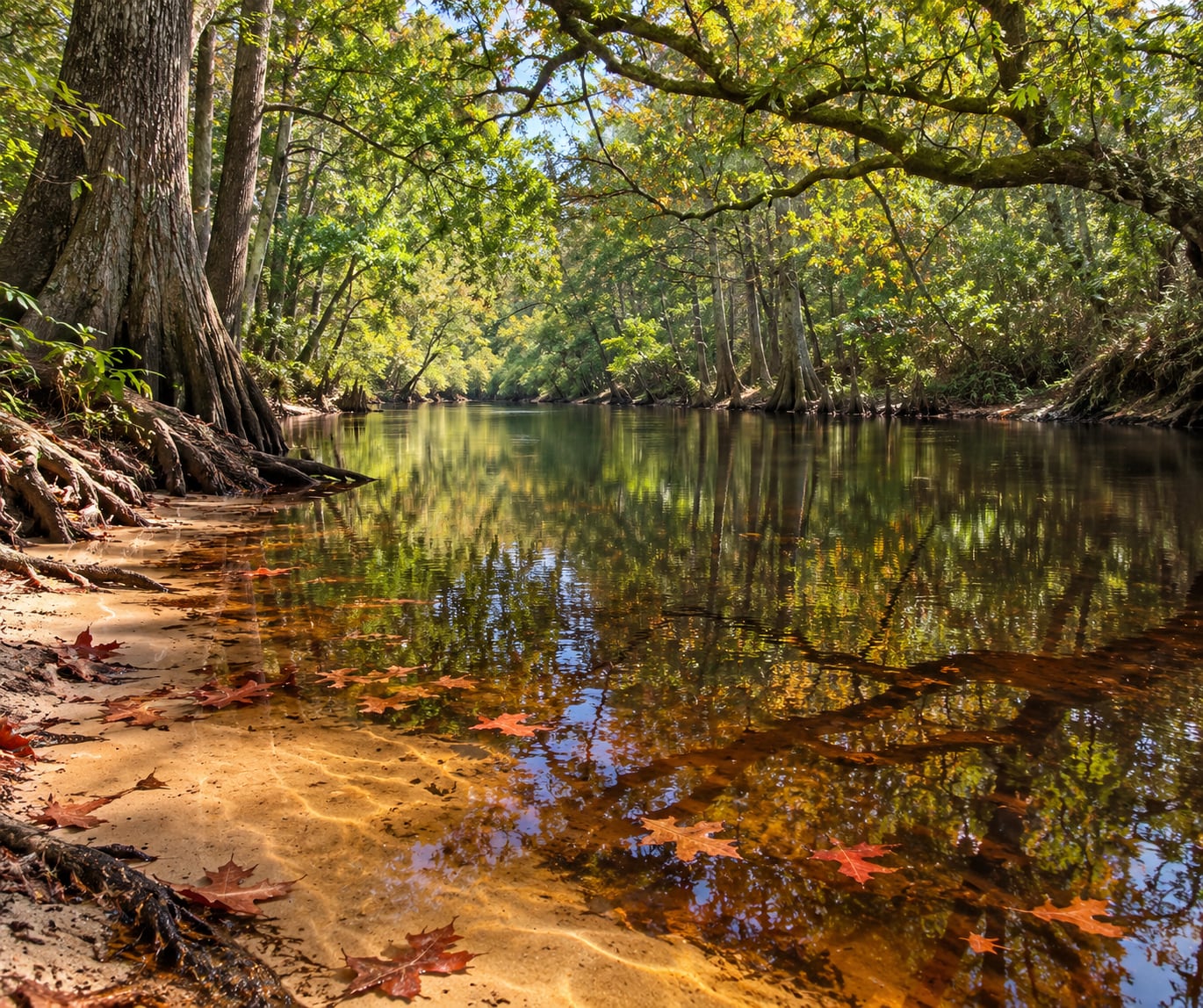
Blackwater rivers look like tea because dissolved tannins, organic compounds leached from decaying leaves, bark, needles and swamp plants, stain clear water amber to dark brown, exactly the color of brewed black tea. The water itself is transparent. Nothing is suspended in it, and the dark color comes from light being absorbed, not from dirt.
The short version:
- Tannins are polyphenols, the same family of compounds that make black tea astringent and red wine dark.
- Rain and groundwater soak through leaf litter and peat before reaching the stream, so the color arrives dissolved, not as sediment.
- Blackwater rivers are usually acidic, low in nutrients and shaded, which shapes everything living in them.
- Tea-colored water is normal on thousands of Southern and Appalachian rivers. Muddy, green or sulfur-smelling dark water is a different story.
That last point is the one worth sitting with. If why blackwater rivers look like tea is a question you arrived with on a riverbank, the answer is usually reassuring. Dark tea-colored water on a clear bottom is doing exactly what the forest chemistry tells it to do.
Table of Contents
- What Makes Blackwater Rivers Tea-Colored?
- Three places the tannins come from
- How Do Tannins Color the Water?
- Why Blackwater Rivers Look Like Tea in Different Light
- What Else Changes a River’s Color?
- Are Blackwater Rivers Clean or Harmful?
- Why Does the Southeast Have So Many Blackwater Rivers?
- What Does Tea-Colored Water Reveal About River Health?
- Frequently Asked Questions
- Are blackwater rivers safe to swim in?
- What is tannic water?
- Does tannin color mean a river is polluted?
- Why does a river get darker after heavy rain?
- Why is the water black in some rivers but clear in others nearby?
- Do tannins make blackwater rivers acidic?
- What to Notice First on a Blackwater River
What Makes Blackwater Rivers Tea-Colored?
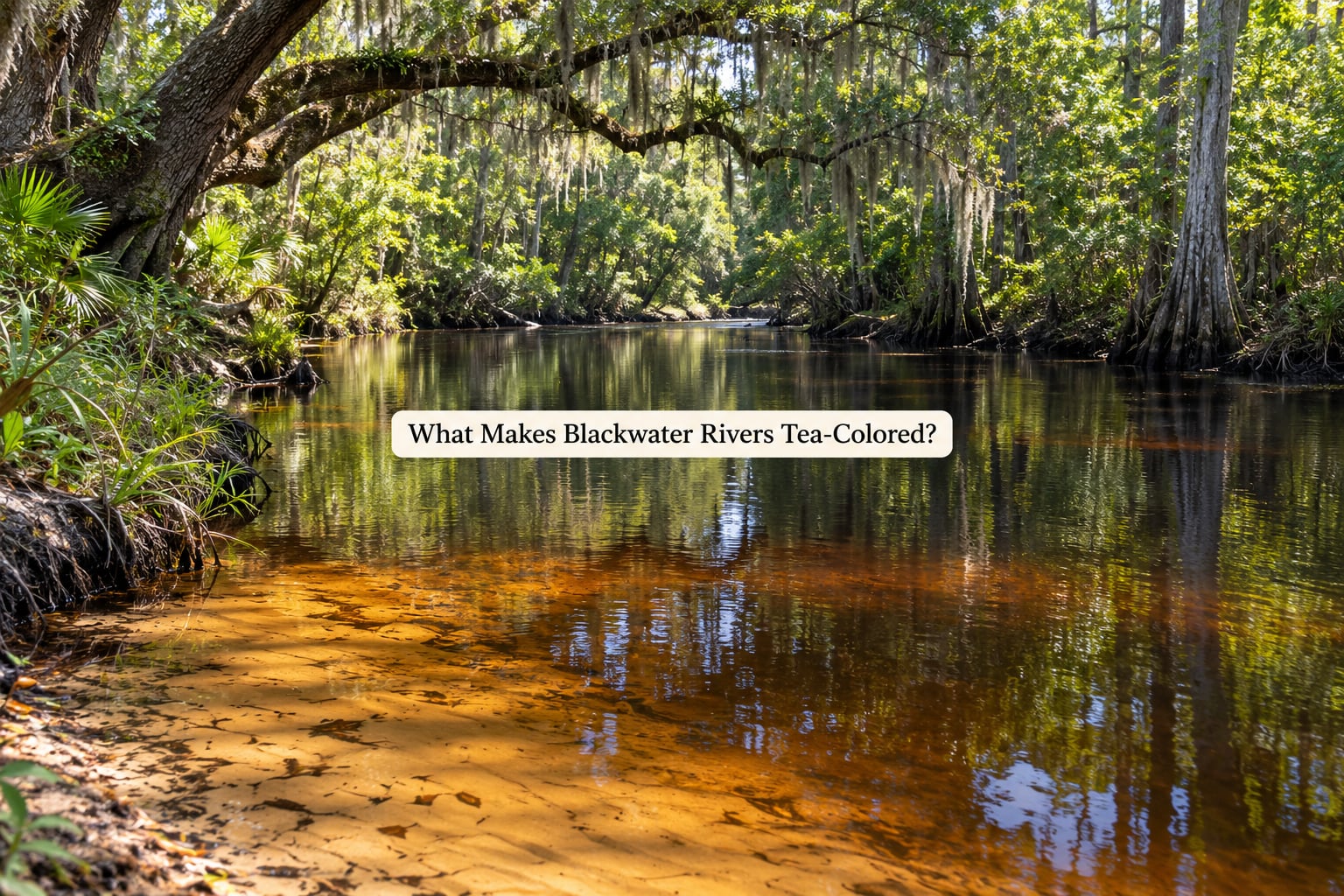
A blackwater river is a slow-moving stream flowing through forest, swamp or wetland whose water is stained by dissolved plant compounds rather than by mud. Those compounds, mostly tannins and related humic substances, are what turn clear water into something closer to the color of a strong brew.
Tannins are large polyphenolic molecules built from rings of carbon and oxygen. Plants make them for reasons that have nothing to do with rivers: they deter insects and mammals from chewing leaves, they slow rot, and they discourage fungi. Oak bark is loaded with them. So are acorns, cypress bark, rhododendron and mountain laurel leaves, red spruce needles and eastern hemlock litter. The word itself comes from tanning hides, the same chemistry used to turn animal skin into leather.
Every blackwater watershed tends to run on its own local recipe. A Florida river might be stained mostly by cypress, oak and palmetto. An Appalachian stream draws on spruce and hemlock needles plus rhododendron thickets. A bog-fed creek in the far north gets much of its color from sphagnum and peat.
Three places the tannins come from
- The canopy. Needles, leaves and bark drop straight into the water, and long-lived tannin-rich wood keeps releasing color as it soaks and decays.
- The forest floor. Rain falling on leaf litter picks up humic substances and carries them to the stream through shallow groundwater flow.
- Wetlands and bogs. Saturated, oxygen-poor soils slow decomposition, letting organic carbon accumulate and dissolve over years before it reaches open water.
That third source is why blackwater rivers concentrate in flat, wet country. Water that spends time in saturated soil collects a much heavier load of dissolved organic carbon than water that runs straight off a hillside.
How Do Tannins Color the Water?
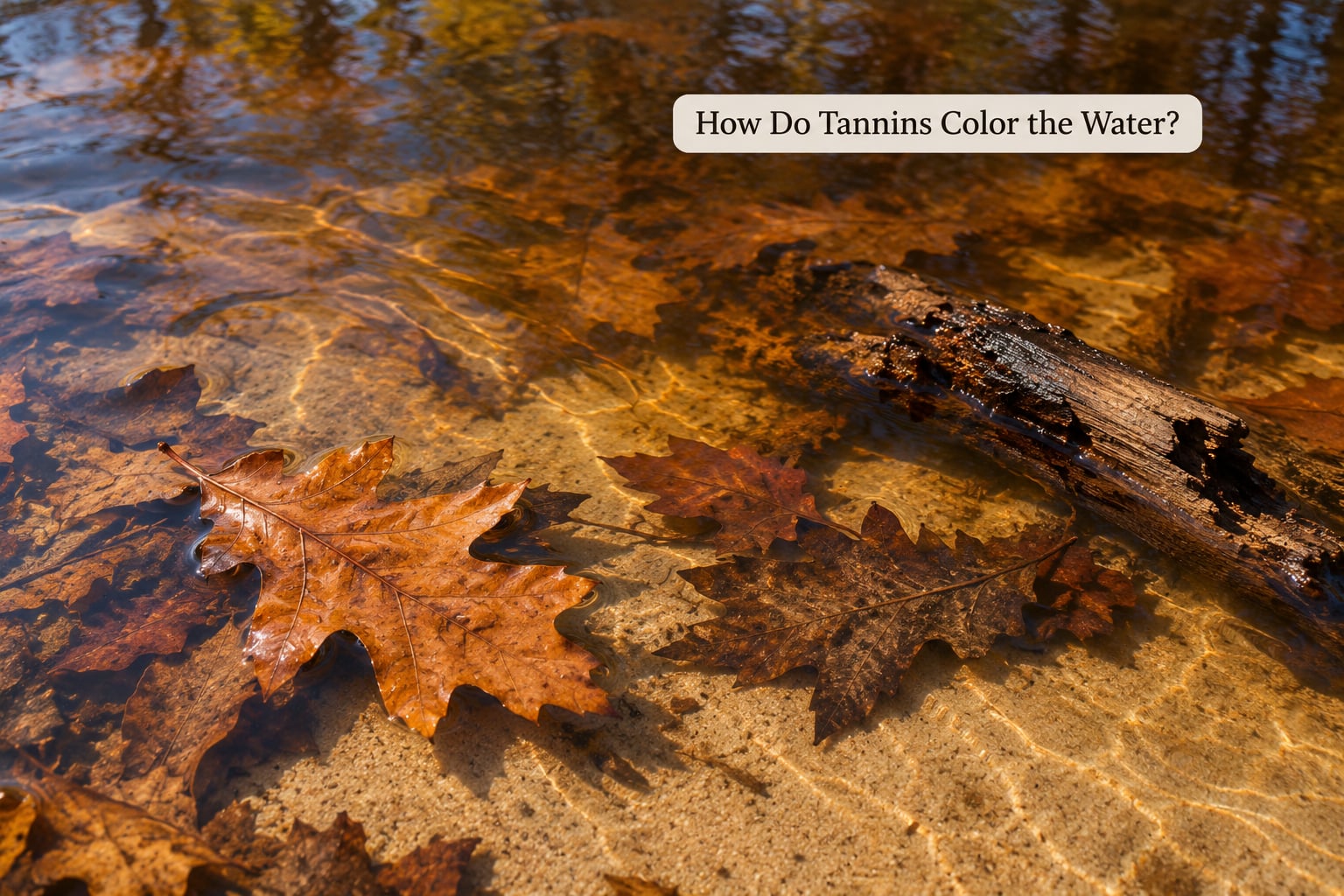
Here is the pathway in plain steps. A leaf falls into the water or onto the wet bank. Microbes break it down, and the decay releases tannin molecules as a fine, water-soluble fraction rather than as visible chunks of leaf. Rain or groundwater then carries those dissolved molecules downstream. Because they absorb light across the visible spectrum, especially the blue and green end, the water reads as brown, amber or near-black.
This is the key distinction, and it is the one most search results get wrong. Sediment muddies water by scattering light in every direction from tiny floating particles. Tannins color water by absorbing it. That is why you can stand over a blackwater river in waist-deep waders, see the sandy bottom ten feet down, and still call the water black. Look for the giveaway: sediment-coated water turns the surface opaque and kills bottom visibility, while tannin water just changes the tint of everything behind it.
Water scientists call this true color, and the standard measure is dissolved organic carbon, or DOC. The humic and fulvic acids that make up much of the DOC are the compounds from peat and soil that give swamp water its color. In a laboratory they can be measured directly, and in practice a simple jar test settles the question: let water stand in a clear glass for a day. Tannin color stays evenly distributed and sharp-edged. Silt settles to the bottom and leaves clearer water on top.
Why Blackwater Rivers Look Like Tea in Different Light
Same river, different day, different color. That is normal and it mostly comes down to light and volume, not chemistry changing.
In full sun over shallow sand, tannin water often looks pale tea or amber, because more light passes through a short path to a bright bottom. Under a closed canopy in a deep run, almost no sunlight reaches the surface to reflect back, and the water reads as coffee or near-black. Overcast days and early morning flatten the contrast and push the color toward uniform brown.
Viewing angle matters as much as light. From above, through clear water toward a light sand bottom, you see tea. Looking downstream into the shaded channel toward a dark bank, you see black. Runners on the Rio Negro report sunlight passing through a bow wave and coming out the color of tea, while the deeper channel beside them stays opaque-looking. It is the same water at two different optical depths.
Rain and season move the needle too. After heavy rain, more water has just washed through wet leaf litter and peat, so the color load jumps. During droughts, flow drops, sunlight reaches the bed, and the water can look darker or duller as algae and tannins concentrate in the remaining channels.
What Else Changes a River’s Color?
Tea color is one possibility among several. These are the others, and the differences are usually obvious once you know what to look at.
| Type of dark water | What causes it | Can you see the bottom? | Smell | What it means |
|---|---|---|---|---|
| Tannin blackwater | Dissolved plant compounds from leaf litter, wood and wetlands | Yes, usually clearly, even in dark reaches | Fresh, earthy, sometimes musty; no sulfur | Natural for forested wetland rivers |
| Silt or sediment runoff | Erosion, construction, logging, storm runoff | No. Water turns opaque within inches of the surface | Musty, dusty | Temporary, but a sign of erosion upstream |
| Algal bloom | Nutrients plus sunlight, common in drought or slow reaches | Often no, with a surface film or mat | Musty, sometimes sulfurous | Usually nutrient loading, not natural tannins |
| Acid mine drainage | Sulfate-bearing strata exposed by mining, oxidized by microbes | Often stained orange, red or yellow-black | Sharp sulfur or rotten eggs | Pollution, and it will not go away on its own |
| Organic or sewage loading | Wastewater, livestock, failing septic systems | No, with foam or surface film | Sulfur, ammonia, rotten | A real contamination problem |
One river can carry more than one of these at once. A West Virginia river is a textbook example: the upper watershed is tannin blackwater stained by spruce and hemlock, and lower stretches of the same system have carried acid mine drainage from abandoned coal work. The mechanism, the color and the smell are different enough to separate them.
Rain is the most common reason a familiar river suddenly looks worse. Runoff from cleared ground, roads and construction arrives as suspended sediment that clears in a few days of good weather. Tannin darkening also rises after rain, but it stays transparent and keeps its bottom visibility, which is how you tell the two apart without any equipment.
Are Blackwater Rivers Clean or Harmful?
Clear is not the same as pristine. Tea-colored water tells you what the chemistry is, not what lives in the water or what upstream did this week.
The natural case is benign. Tannins themselves are not a health contaminant; they are large molecules that most organisms cannot break down, which is why they accumulate rather than disappear. The acidic, low-nutrient chemistry also suppresses many bacteria that flourish in neutral, nutrient-rich water. Early mariners and colonists filling casks from blackwater rivers knew this by practice, and the reason holds up chemically today.
Florida paddlers mostly agree. On r/florida the local consensus is blunt: tea-colored tannic water is just plants, cypress and oak leaves, and it is normal swimming water. Aquarium hobbyists on Aquatic Quotient read a Sarawak blackwater river the same way, ordinary leaching from decaying vegetation rather than a water-quality failure. Kayakers post the dark water as scenery, not as a hazard report.
What tannin water will not tell you is whether there is sewage, livestock runoff, a failing septic system or an algal bloom downstream. That is where the field signs matter.
- Foam or a surface film that doesn’t dissipate, especially in a slow reach.
- Sulfur or rotten-egg smell, which points at sulfate, bacteria or acid drainage rather than plant compounds.
- Sudden change from the last visit with no rain to explain it.
- Fish distress, such as gulls working a stretch, fish floating, or gasping at the surface.
- Algal mats in water that is normally clear to the bottom.
- Local advisories from the state health department or your county, which outrank anything you can judge by eye.
For swimming, fishing and harvesting, the tannin itself is not the thing to worry about. Current conditions are the thing to worry about. Check the local advisory before you paddle or swim, and after heavy rain upstream of you.
Untreated river water is a bad drinking source no matter how clear or dark it looks, because tannin color tells you nothing about pathogens. Boil or treat anything you plan to drink.
Why Does the Southeast Have So Many Blackwater Rivers?
The Southeast sets the record because of geography. Large areas of the coastal plain are flat, sandy and poorly drained, with ancient floodplains, forested wetlands and slow-moving water. Rain falls on oak and cypress forest, moves through layers of leaf litter and sandy soil saturated with old organic matter, and arrives in the river already carrying a heavy dissolved load.
The same recipe appears elsewhere, and the rivers are recognizable once you know the pattern. In northern South America, the Rio Negro and its tributaries are blackwater rivers fed by sandy floodplains and forest litter, and the same is true for the Cristalino basin. Southeast Asia has its own blackwater systems draining peat and rainforest. The Appalachian and Piedmont South, from Florida’s coastal rivers to the blackwater streams of West Virginia, sit in the middle of this range.
| River | Region | Main tannin source | Signature feature |
|---|---|---|---|
| Ogeechee and Canoochee | Georgia coastal plain | Oak, cypress, bottomland hardwood litter | Classic tannin blackwater with clear to the bottom |
| Black River | North Carolina | Cypress and hardwood floodplain | Dark tea color through pine and cypress forest |
| Blackwater River | West Virginia | Red spruce, eastern hemlock, rhododendron | Tannin blackwater above, mine drainage below |
| Rio Negro | Amazon basin, Brazil | Floodplain forest litter, sandy soils | Near-black in deep channels, tea-colored where shallow |
| Cristalino | Amazon basin, Brazil | Riparian forest and flooded forest | Famous water clarity and visible fish below the tint |
None of these rivers are polluted by being dark. Their color is the signature of a forested, low-gradient, nutrient-poor watershed, which is the same combination that makes them good bass water, good bird habitat and good paddling.
What Does Tea-Colored Water Reveal About River Health?
A lot, if you read it as chemistry rather than cleanliness. Dark, clear, tannin-stained water points to a shaded, acidic, oligotrophic system, meaning one with very low nutrient levels. That condition shapes the whole food web.
Light does not travel far into tannin water. Less light penetration means fewer submerged aquatic plants, so the energy base is detritus, fallen leaves and microbes rather than algae and sunlit vegetation. More dissolved organic carbon means more bacteria feeding on that detritus, and bacteria consume oxygen as they do it, so dissolved oxygen tends to run lower than in a clearwater stream with the same flow.
Wildlife and anglers read that structure well. Blackwater rivers tend to hold bass rather than trout, and species that tolerate low oxygen and heavy shade. Turtles, frogs, wading birds and fish-eating birds all concentrate along the edges where insects drop out of the canopy. You will often see more wildlife along a blackwater bank than on a nearby clearwater stream, because the tree canopy is doing the work a rocky riffle would do elsewhere.
Drought changes the picture. Lower flow, less dilution and more sunlight reaching the bed can trigger algae blooms that would not happen in a stable blackwater system. That is the main ecological stress response to watch, and it is one of the reasons fall-flowing tannin rivers matter to the places they run through.
For paddlers, blackwater has a practical character of its own. Slow, tannin-stained water reads as a mirror when the canopy closes over it, and the tannins will stain light-colored boat bottoms, swimsuits and fly lines. Anglers often find dark water harder to see into at distance even though you can see the bottom up close. Neither is a water quality problem. It just takes a little adjustment to how you read the river.
Frequently Asked Questions
Are blackwater rivers safe to swim in?
Usually yes. Tannins are large organic molecules most organisms cannot break down, and the acidic, low-nutrient chemistry tends to suppress many bacteria that grow in neutral nutrient-rich water. The tannins themselves are not a health contaminant. Check local health advisories first, and stay out after heavy rain if runoff or an algal bloom is upstream. Clear tea color alone is not a reason to skip the water.
What is tannic water?
Tannic water is water colored by dissolved tannins, the polyphenolic compounds plants make to deter insects, slow rot and discourage fungi. Oak, cypress, spruce, hemlock and rhododendron all release them as their leaves, bark and needles decay. Because the molecules dissolve instead of floating, tannic water stays transparent even when it looks dark, which is how you tell it from muddy water.
Does tannin color mean a river is polluted?
No. Tannin color is one of the most natural things about a forested wetland river, and thousands of rivers across the Southeast, the Amazon and Southeast Asia carry it permanently. Pollution looks different: persistent foam, a sulfur or rotten-egg smell, orange or red staining, algae mats, fish distress, or a sudden change with no rain to explain it. Those signs, not the tea color, are what warrant a call to the local agency.
Why does a river get darker after heavy rain?
Rain does two things at once. It washes sediment off banks and disturbed ground, which makes water cloudy and opaque. It also runs over saturated leaf litter and peat, picking up a heavy load of dissolved humic substances and tannins before it ever reaches the stream. The second effect is blackwater chemistry; the first is erosion. You can tell them apart because tannin water still shows the bottom and muddy water does not.
Why is the water black in some rivers but clear in others nearby?
It depends on what the watershed is made of. Blackwater rivers drain forested wetlands, sandy soils and saturated floodplains where water spends time in leaf litter and peat, collecting dissolved organic carbon. Clearwater rivers drain steeper terrain with less wetland, so runoff reaches the channel faster with less time to pick up color. A single county can hold both types on adjacent drainages.
Do tannins make blackwater rivers acidic?
Partly, but not as much as people assume. Blackwater rivers are commonly mildly acidic, typically in the 4.5 to 6.5 range, and two things drive it: the humic and fulvic acids from decomposing leaf litter, and the sandy, low-buffering soils the water passes through. Tannins are weak organic acids, so a heavy tannin load does pull pH down, but rainfall and geology set the baseline. That low pH is part of what makes the system naturally unproductive for trout.
What to Notice First on a Blackwater River
Stand still for a minute and check four things. Can you see the bottom, or is the water opaque? Is the smell fresh and earthy, or sulfurous? Is there foam, an algal mat or floating debris? And does this match what you saw on your last visit, accounting for rain?
Tea-colored water with a visible bottom and a clean smell on a river that drains forested wetland is a healthy system doing its job, not a warning. Shallow, slow tannin water holds less light and less oxygen, which is why the fishing and the bird life concentrate along the shaded edges rather than the open channel.
Cloudy water, foam, a sulfur smell, algae or fish distress are the ones that matter. For those, check the state or county water advisory before you swim, paddle or fish, and give the river a few days of good weather before you decide.