Managers run an annual cycle: draw the impoundment down after duck season, let the exposed soil firm up, grow a food crop of moist soil plants or planted grain, then raise the water in stages over that food before and during the season. Water-level control is the lever that drives the whole thing, and the timing of each step shifts with rainfall, soil, species arrival and the goals the manager is working toward. Below is how that process works in practice, season by season, and how managers know whether the habitat is doing its job.
Table of Contents
- Why Managers Manage Impoundments for Ducks
- How Impoundments Are Managed for Ducks
- How impoundments are managed for ducks by season
- Why Water Levels Are the Main Management Tool
- How Managers Create Food and Cover
- How Managers Balance Ducks With Other Wetland Needs
- How Managers Know Whether the Habitat Is Working
- Frequently Asked Questions
- Why do managers lower the water level in duck impoundments?
- What water depth is best for ducks in a managed impoundment?
- Do managers plant food specifically for ducks?
- How long should a duck impoundment stay flooded or drawn down?
- Does drawing down an impoundment help other wetland wildlife?
- Can people hunt in publicly managed duck impoundments?
- What to Do in Your First Year
Why Managers Manage Impoundments for Ducks
A waterfowl impoundment is a shallow, human-modified wetland, often a former rice field or an overgrown agricultural field, fitted with a structure that lets a manager raise and lower the water level on a schedule. What separates an impoundment from a pond is control. A pond fills and stays full. An impoundment can be emptied almost completely in spring and refilled in stages in August, which is what makes it productive for migrating ducks.
The reason this matters is food and cover, in that order. Dabbling ducks such as mallards, pintails and teal feed by tipping up in shallow water and pulling plant seed and bottom-dwelling invertebrates from soft mud. Water that is too deep puts that food out of reach. Water that is drained away removes the birds’ loafing and resting platform entirely.
Managers are aiming at a sequence rather than a single condition: exposed mudflat in spring, a growing food plant through summer, and flooded crop or sheet water in fall. Every species behaves differently in that sequence. Pintail and green-winged teal work the drawdown period, large dabblers use flooded food plots, and wading birds need mud with a certain depth of water over it.
The same manipulation attracts a lot more than ducks. Shorebirds feed on the exposed mud and the benthic invertebrates that develop in it, herons and ibis work the shallow edge, and fish and amphibians use flooded vegetation. That broader benefit is the reason state wildlife agencies and the U.S. Fish and Wildlife Service fund impoundment work.
How Impoundments Are Managed for Ducks
The process has six parts, and they repeat every year. Goals first, then water, then food, then monitoring, then adjustment, then the paperwork that lets any of it happen. Skipping straight to flooding a field in October without a plan behind it is the most common way managers end up with water and no birds.
- Set habitat goals. Decide which species you are managing for, how many acres of food habitat you want on the ground at once, and what the harvest or observation objective is. A hunting impoundment and a birding sanctuary use the same structures and opposite water schedules.
- Manipulate the water level. Open or close the control structure to draw the impoundment down in spring, hold it at low water through the growing season, then raise it in measured stages through late summer and fall.
- Establish vegetation and food. Either let native annual plants colonize the exposed mud, or disking and planting a food crop such as millet, sorghum or corn into it.
- Monitor bird use and habitat condition. Walk the unit, measure depth, note vegetation and food availability, and count birds by species and group size as the season progresses.
- Adjust. Move flooding dates, change target depths, add or drop food plantings, and change how long each unit stays flooded based on what the last year showed.
- Coordinate. Work through your state wildlife agency, the USDA Natural Resources Conservation Service and any local watershed or water district before you change the water level or move dirt.
Step six is the one first-timers tend to skip. On forums, the advice repeats: talk to your local natural resources agent and your watershed district before anything else. Changing surface water is a regulated activity in most places, and a wetland jurisdiction review can add months.
How impoundments are managed for ducks by season
The sequence runs roughly the same everywhere, but the dates sit a month or two apart between the Gulf Coast and the northern tier. Southern managers start drawing down in February and are in the field with a planter by April. Northern managers wait until the ground carries a tractor, which often pushes food planting into late May or June, and they often cannot count on the crop to mature before an early freeze.
| Period | Southern timing | Northern timing | What the manager is doing |
|---|---|---|---|
| Post-season drawdown | Late January to March | March to April | Drain to expose mudflat, test soil, let ground dry enough to work |
| Food establishment | March to May | May to July | Disk, plant a food crop, or allow native moist soil plants to set seed |
| Summer vegetation work | May to July | July to August | Fertilize, disk, burn or mow to release seed and thin competition |
| Slow rise | July to August | August to September | Add water a few inches at a time to soften seed beds and trigger sprouting |
| Full flood | September | September to early October | Raise to the target depth over the food crop, as late as practical |
| Season maintenance | October to January | October to December | Hold levels, top up, monitor use, adjust for early migrants |
| Winter drawdown | January to February | December to March | Start the cycle again once equipment can work the ground |
One detail from the federal wetland management guidance worth borrowing: if you own several impoundments, do not flood them all at once. Stagger the flood dates across roughly a month, and reserve the earliest units for early migrants while saving food in the late-flooded ones. That keeps a food crop available deep into the season instead of stripping it in the first week.
Why Water Levels Are the Main Management Tool
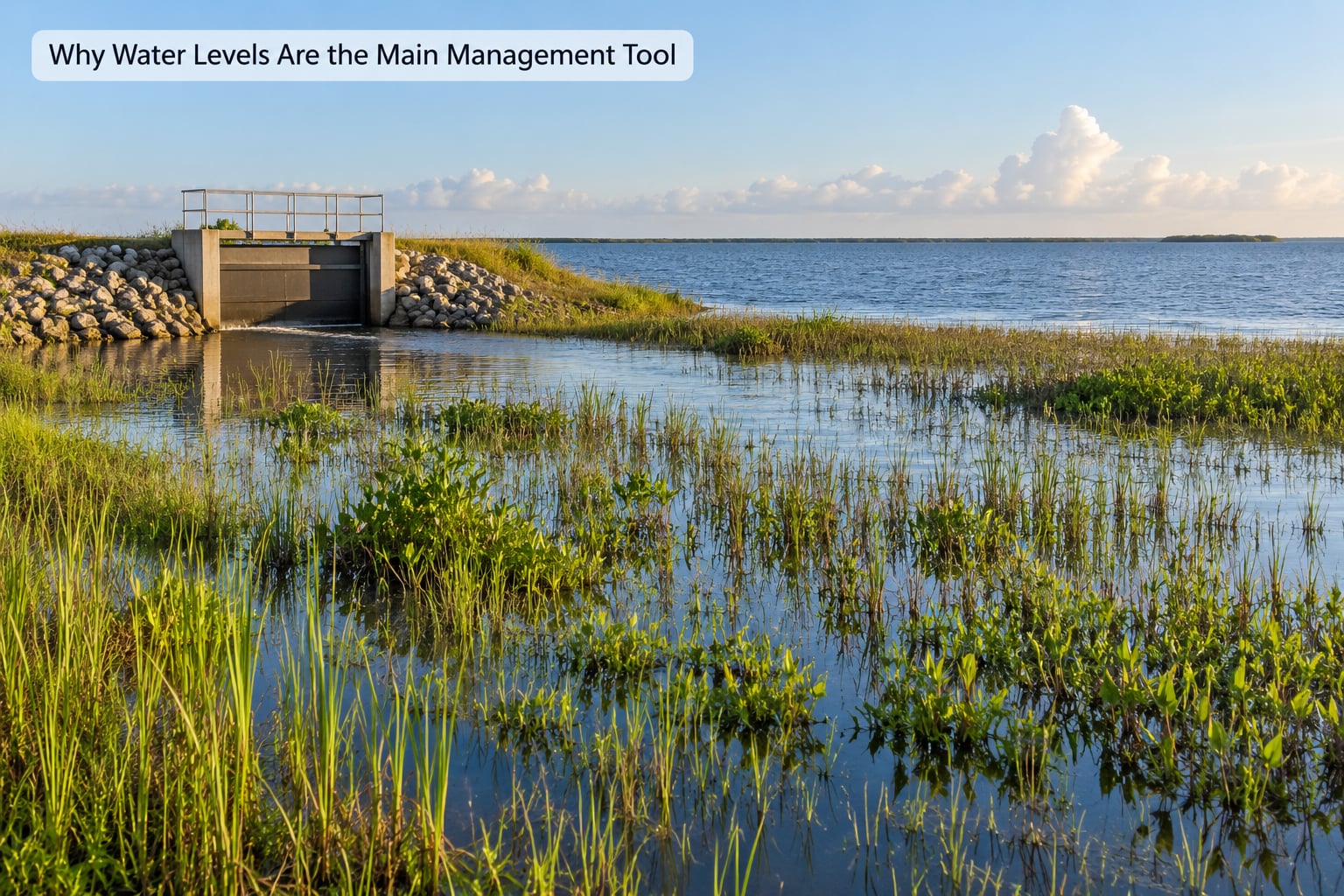
Water level is the control that everything else hangs off, because it decides what plants can grow, what the birds can reach, and whether the soil is firm enough for machinery. In practice the manager is aiming at a mosaic rather than one number: shallow flooded food at one end, open water at the other, and a transition between them.
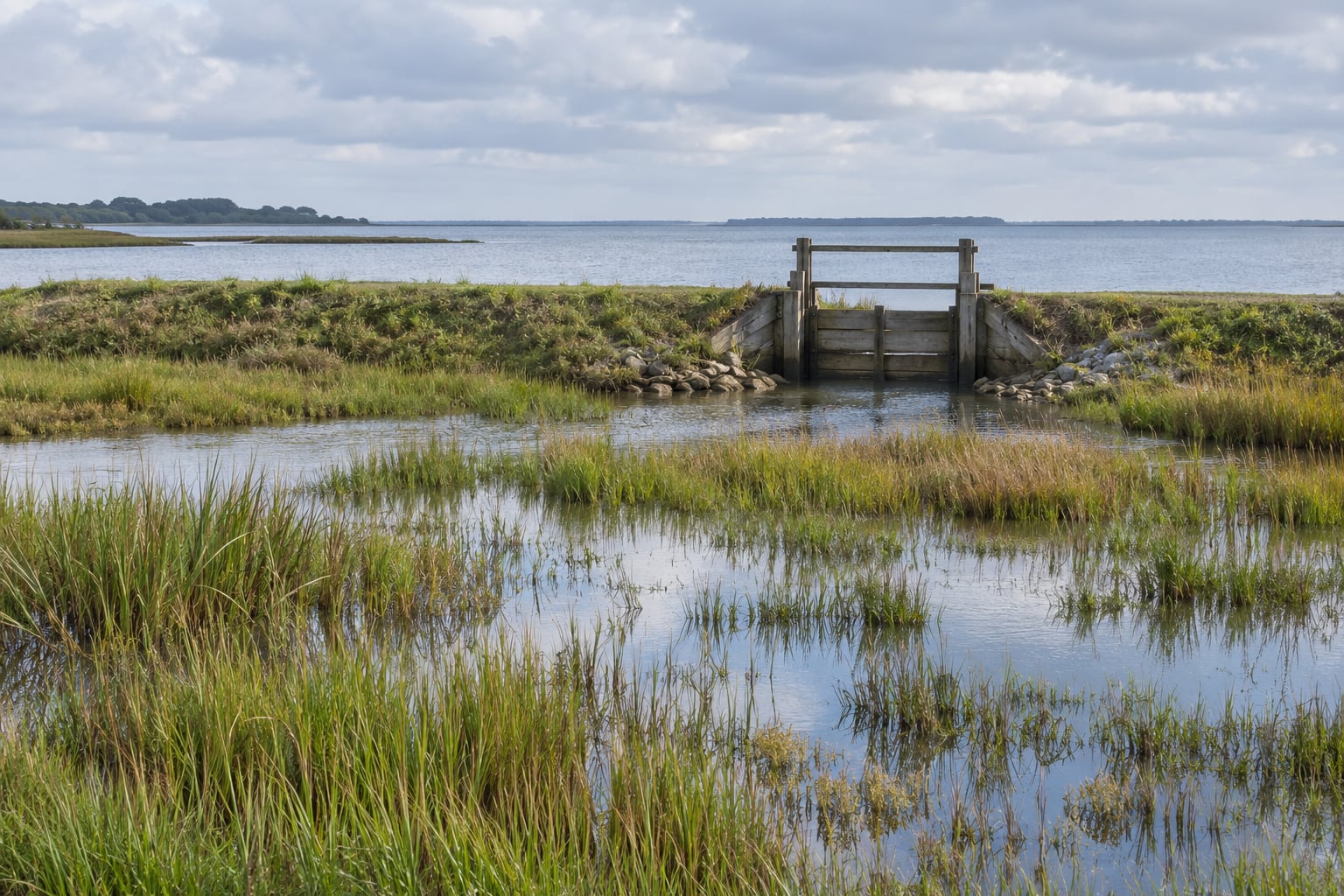
The gear is simpler than most people expect. A rice trunk is a wooden sluice gate set in a dike, lifted and lowered with a board-and-spool or screw mechanism; it is the traditional structure on coastal plain impoundments and typically has a service life of around 20 years. Where timber is expensive, a screw gate, a slide gate, or a bulkhead with a float valve does the same job. Small units can get away with a schedule pipe or a PVC drain through the dike, and pumping handles sites where gravity flow is not available.
Culverts and gravity-fed chainage work when several impoundments sit in sequence, which is one practical reason managers build bigger. A chain lets you flood one unit and let it spill into the next, and it spreads the flooding date automatically. Below roughly 5 acres most managers report inconsistent results; 7 to 8 acres gives enough room for that movement to work.
| Target | Depth | Season | Who it is for |
|---|---|---|---|
| Flooded food crop | 12 to 18 inches | Fall and winter | Dabbling ducks feeding on grain and smartweed |
| Dabbling zone | Keep a large share under 3 feet | Fall and winter | Mallards, pintails, teal working the whole surface |
| Spring sheet water | 2 to 3 inches | Spring migration | Shorebirds probing soft mud |
| Moist soil unit | 2 to 6 inches or damp | Spring and summer | Native seed production, not bird use |
| Resting and safe water | 3 feet and deeper, in sections | Year-round | Ducks at night, loafing birds, predator escape |
The 12 to 18 inch band is the single most important number. Past 18 inches, grain and smartweed sit below what a dabbling duck can reach by tipping up, and the birds move on even though the field looks productive from the levee. Past 3 feet, dabblers stop feeding there entirely, which is why an impoundment that is uniformly deep will hold far fewer birds than one with a deep refuge on a corner.
Drawdown rate matters too. A gradual fall drawdown leaves exposed mud with standing water in it, which is the shorebird condition, and it seeds invertebrates as the ground dries. A sudden dump of water scours seed beds and can carry crop residue out of the unit. The exception is a storm forecast: when heavy rain is expected and runoff is coming, managers on the forums describe being deliberately aggressive with the drawdown to shed water and save the seed.
Timing the final flood is a judgment call. Flood as late as practical, commonly one to three weeks ahead of opening day, so early migrants do not strip the crop on day one. Flood too late and birds have nowhere to sit. Flooding early draws more birds sooner. Managers in practice split their units and flood some early and some late rather than pick one date for everything.
How Managers Create Food and Cover
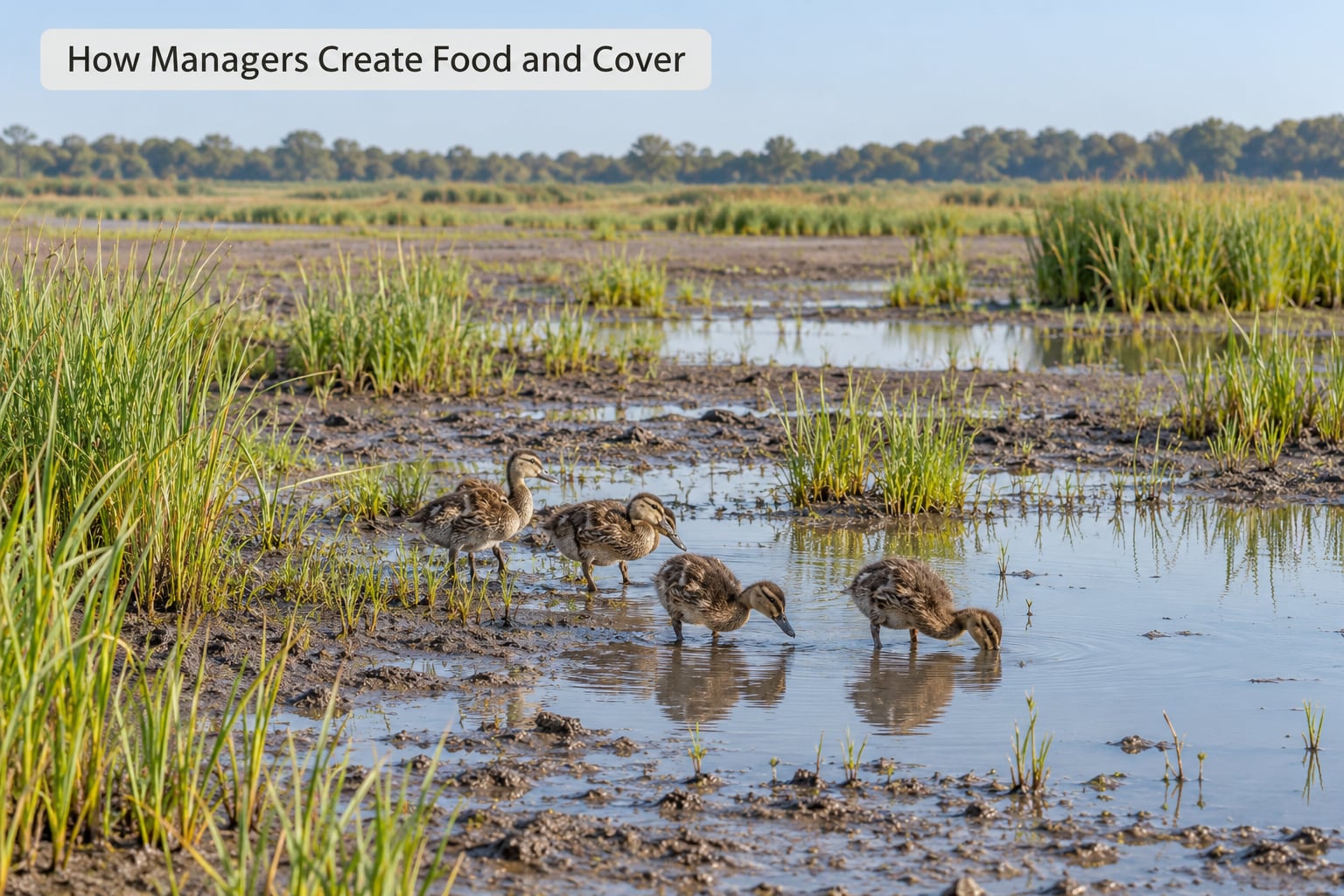
Ducks on a flooded crop are eating something a farmer or a seed bank put there, and the soil itself is feeding them whether anyone planted anything or not. Those are two different management routes, and plenty of managers run both at once.
Moist soil management is the low-input version. Draw the unit down in spring, let the exposed mud dry to the consistency that supports a light tractor or implement, and let the annual plants already in the seed bank do the rest. Giant smartweed, barnyard grass, sedges and native panicum grasses are the usual performers. They set seed through the summer, and a slow autumn rise puts those seeds within reach of dabbling ducks. Where the seed bank is intact, this costs mostly diesel and a disking rig, and it is the approach that degrades least over time.
Planted food crops give more biomass and a longer benefit window. Millet, sorghum, corn and sometimes wheat get disked in and often fertilized with a nitrogen and phosphorus blend, then flooded to 12 to 18 inches so the grain stays within reach and the stalks stand in water as a visual marker. The tradeoffs are real: seed and fertilizer cost money each year, a flood during the growing season can drown the stand, and a crop that fails leaves you with water and mud.
| Factor | Moist soil plants | Planted food crop |
|---|---|---|
| Inputs | Seed bank already present | Annual seed and fertilizer |
| Weather risk | Flooding or drought can wipe out the stand | Same, plus maturity before first freeze |
| Benefit window | Often shorter, more variable | Longer and more predictable once established |
| Nutritional value | Seed plus abundant benthic invertebrates | Seed dominates; invertebrates decline under deep water |
| Labor | Disking and burning only | Planting, fertilizing, disking, burning |
| Long-term effect | Keeps the seed bank alive and diverse | Can narrow plant diversity over repeated years |
That protein comparison is the argument for leaving some mud exposed rather than flooding everything. Bottom-dwelling invertebrates in a drawdown basin carry roughly 40 to 60 percent crude protein; standing grain runs about 8 to 15 percent. Ducks will work a muddy, shallow unit in preference to a deep flooded field because of it, which is why managers who flood everything end up with birds sitting on the water instead of feeding.
Cover is a separate requirement, and food does not provide it. Loafing cover means scattered islands of emergent vegetation and brush within a few hundred feet of open water, where a duck can sit and rest without being visible from above or ambushed from a bank. Corn is not safety. An impoundment with excellent food and nowhere to hide will get used in the evening and abandoned by morning.
Plant diversity is the quiet driver of long-term quality. A unit that produces three or four seed species every year feeds more species of duck and survives more weather than one that produces a single stand. Disking, burning and mowing at different stages each year keep that mix from collapsing into a monoculture.
How Managers Balance Ducks With Other Wetland Needs
An impoundment is not a duck pond, even when the ducks are the reason it exists. The water is shared, and the management decisions that favor one group often cost another something. Knowing where those conflicts land is part of doing this well.
Shorebirds versus ducks. The spring drawdown that lets shorebirds probe two to three inches of sheet water is exactly the condition ducks do not need yet. Managers sequence rather than compromise: drawdown for shorebirds in March and April, build food through summer, flood for ducks in September. Holding sheet water deep into fall would satisfy neither group.
Wading birds versus ducks. Wood storks and herons want the same shallow edge ducks use, and can pick over an impoundment’s contents faster. At some sites managers create a separate shallow unit or refuge rather than trying to share one.
Fish and amphibians. Ducks eat fish eggs and tadpoles, and amphibians need fish-free water. Flooded vegetation with a mix of depths tends to sort this out on its own; a single deep, open unit does not.
Water quality. Ducks do well in turbid water with abundant vegetation. Fish and people who paddle the same water do not. Managers on turbid ground watch for oxygen crashes after a drawdown, when warm water and decaying plant material strip dissolved oxygen, and they avoid the hottest weeks.
Flood protection, agriculture and navigation. Dikes are also flood infrastructure. A full impoundment holds a large volume above the surrounding ground, so water-level decisions get weighed against downstream flood control and against neighbors. Irrigation withdrawals, navigation and hunting pressure are the other standing pressures.
The practical fix for most of this is heterogeneity. Avoid a uniform habitat. Leave some areas at full depth, some at 18 inches, some at sheet water, and some with no water at all, and put the cover islands and the open water within sight of each other rather than in separate corners.
How Managers Know Whether the Habitat Is Working
Monitoring is what turns management from habit into practice. A manager who never walks the unit in August is guessing, and the guesses show up as empty water in November.
| Indicator | What to check | What a healthy unit looks like |
|---|---|---|
| Water depth | Measure at the food plot, the edge and the deep refuge | 12 to 18 inches over the crop, with a portion under 3 feet |
| Vegetation | Percent of bottom in moist soil plants; species present | Three or more seed-producing species, patchy, not a solid mat |
| Food availability | Seed heads, standing grain, invertebrate density at the mud surface | Visible standing crop or dense seed bed, active feeding birds |
| Bird use | Counts by species and group size, at dawn, dusk and midday | Feeding activity at the margins, resting birds on open water, rising birds at dusk |
| Timing of use | First arrival date, peak period, last day with birds present | Use spread across the season rather than stripped in a week |
| Bird condition | Body condition on a sample, wing and bill, foraging posture | Active feeding and preening, not loafing only |
| Condition of the crop | Stand height, seed maturity, any storm or flood damage | Grain still standing and reachable, seeds not stripped early |
The comparison that matters is against last year and against the objectives set in the winter. If birds arrived in October and stripped the field by mid-November, the flood date was early or the units were not staggered. If birds never came, the problem is usually cover, depth or disturbance rather than food. If the vegetation was a single species and the crop thin, the stand needs disking, a burn or a different planting.
Counting is the part managers keep skipping. A fixed route walked twice a week from late August through the season gives you a usable index, and the species mix tells you what you are actually holding. Managers also record the weather, because a failed crop in a dry August and a flooded crop in a wet August need opposite corrections the following year.
There is a longer rotation underneath all of it. Federal guidance on wetland impoundments recommends a full drawdown of water every three to five years in most impoundments to reset plant and invertebrate food resources. Managers who skip those deeper reset years often notice declining plant vigor and fewer invertebrate numbers even in a good-looking field.
Frequently Asked Questions
Why do managers lower the water level in duck impoundments?
Lowering the water, or drawdown, exposes the mud and soil on the impoundment bottom. That exposed surface is where native moist soil plants such as smartweed and barnyard grass germinate and set seed, and where benthic invertebrates develop for feeding. It also lets machinery onto the ground for disking, planting and fertilizing. Without a spring and summer drawdown there is nowhere to grow a food crop before fall flooding.
What water depth is best for ducks in a managed impoundment?
Flood a food crop to 12 to 18 inches, which keeps grain and seed within reach of dabbling ducks. Past 18 inches the food sits below what a duck can reach by tipping up. Keep a significant share of the impoundment shallower than 3 feet so dabblers can feed across the surface, and hold a deeper section as resting and safe water. Spring sheet water of 2 to 3 inches is a different goal, aimed at shorebirds.
Do managers plant food specifically for ducks?
Some do, some do not. Moist soil management relies on the plants already in the seed bank, which usually needs only disking or burning. Other managers plant millet, sorghum or corn and fertilize them for a larger, more predictable crop. Many run both, using natural vegetation in some units and a planted crop in others, which also spreads weather risk and extends the season of available food.
How long should a duck impoundment stay flooded or drawn down?
A typical cycle drains the unit after duck season, roughly January to March in the South and March to April further north, then holds it at low water through summer growing and seed production. Flood-up starts with a slow rise in late summer and reaches full depth by September or early October, then the unit stays flooded through the season. Timing shifts with rainfall, soil conditions and when machinery can work wet ground.
Does drawing down an impoundment help other wetland wildlife?
Yes. Exposed mud with sheet water is feeding habitat for shorebirds, and the invertebrates that develop in a drawdown basin carry far higher crude protein than grain does. Drawdown also exposes shoreline for wading birds and amphibians and encourages a diverse seed plant community. The tradeoff is that drawn-down ground is only useful for a window, so managers sequence the dates rather than holding one condition all year.
Can people hunt in publicly managed duck impoundments?
Often yes, but under agency rules rather than at-will. State wildlife agencies and the U.S. Fish and Wildlife Service set season dates, species limits, reservation systems and sometimes no-hunt periods on their units. Managers also reserve specific impoundments unflooded or unflooded-by-date to keep food available for migrating birds. Check the current condition and access alerts for the unit before you travel, since levels and access change weekly.
What to Do in Your First Year
Pick the unit, not the whole property, and start small. Five acres is about the floor for a result you can repeat, seven or eight gives you the room to move water by gravity, and one unit you can walk every week teaches you more than ten you cannot.
Then do three things before spring: talk to your natural resources agent and watershed district about what you are allowed to change, get your water control structure inspected and working, and decide whether you are managing for hunting, birding, or both. Those answers set the schedule everything else follows.
Walk the unit in July and again in late August. You are checking the same things a season manager checks: depth, plant species, how much food is standing, and whether the birds are feeding rather than just sitting. If birds arrive in October and strip the food by mid-November, you flooded too early. If they never arrive, look at cover and depth before you blame the seed.
And keep a longer view. The three-to-five-year drawdown reset, the plant diversity you protect by disking and burning in rotation, and the records you keep each year are what separate an impoundment that works for a season from one that works for a decade. Everything in this guide comes back to water level and food, and both are easier to manage when you measure them.