To hunt snipe and rails in a marsh, you read the habitat first, then time your effort to the season and the tide. Snipe hold tight in short wet grass and flush in an explosive zigzag; rails run or swim until you corner them, then fly low and slow. Walk the edges, push pole a skiff, or work a high flood tide, and take your shot at close range with an open choke and small non-toxic shot.
Both are migratory birds with short seasons and small bags, and both come with protected look-alikes that will end your hunt if you guess wrong on the ID. Here is the process that works, in the order you should actually do it.
- Confirm the season, bag limit, shooting hours, and legal shot for your state before you leave the truck.
- Know whether the marsh you are walking is fresh, brackish, or salt, because the species list changes with it.
- Time rail effort to the flood tide, ideally arriving an hour and a half before the listed high water.
- Walk with the wind at your back and work the tallest spartina and cordgrass, not the open mud.
- Use a flush-time checklist on every bird, including the protected yellowlegs and dowitchers.
- Take the shot inside 30 yards and end the pursuit when a bird is not positive.
- Mark every downed bird mentally and physically, then work the cover before the tide carries it away.
- Log the day: species, birds, conditions, and where birds were holding.
Table of Contents
- What You Need
- Paperwork and permissions
- Footwear and clothing
- Optics and navigation
- Shooting and calling
- Safety
- Step-by-Step
- Step 1: Check the Rules and Choose a Safe Area
- Step 2: Scout the Habitat and Tides
- Step 3: Plan for Weather, Water, and Visibility
- Step 4: Work the Birds Without Pressing Them
- Step 5: Identify Snipe and Rails Correctly
- Step 6: Take a Legal, Ethical Shot
- Step 7: Retrieve, Field Dress, and Record the Harvest
- Common Mistakes
- Hunting without checking the rules first
- Shooting a look-alike out of frustration
- Ignoring the tide table
- Calling too hard
- Walking too close and too fast
- Shooting at distant silhouettes
- Not recovering wounded birds
- Wading in unfamiliar mud
- Quick Field Tips
- Frequently Asked Questions
- What is the best time for snipe hunting?
- How do you hunt marsh hens?
- What does a rail bird look like?
- Are rails protected birds?
- Do you need a dog to hunt snipe and rails?
- What should you do if the tide or weather turns unsafe in the marsh?
- Conclusion
What You Need
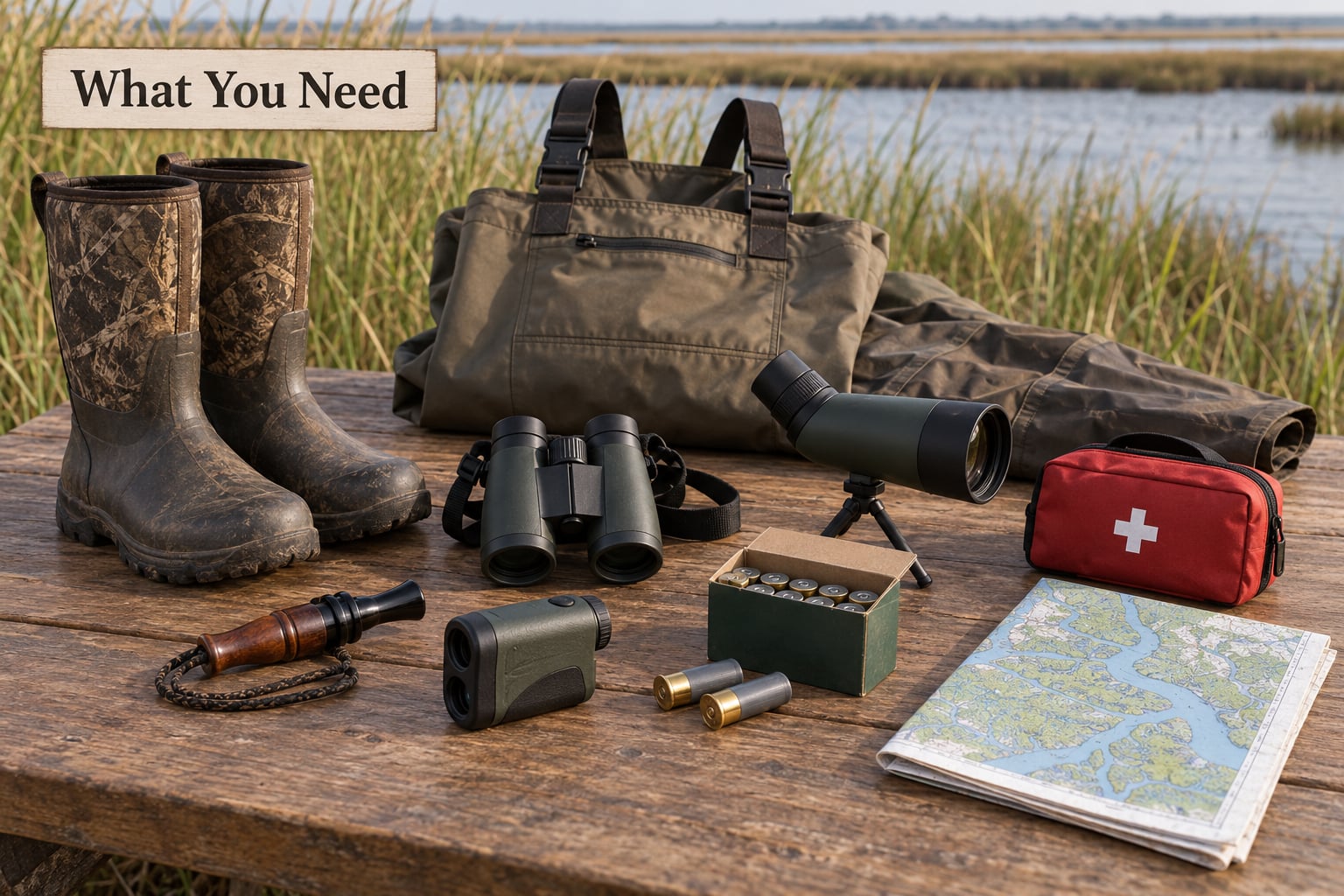
Most of the kit is ordinary, and the list is shorter than people expect. A hunter on the DuckBoats forum described the whole loadout as an 870, cheap shells and a kayak, and that is genuinely close to the truth for a rail hunt.
Paperwork and permissions
A valid state hunting license, the federal migratory bird permit, and a Harvest Information Program registration, all current, sit in a waterproof pocket or a fanny pack on your belt. Snipe and rails are both covered by the Migratory Bird Treaty Act, and a federal duck stamp is not a substitute for any of the three.
Written permission matters as much as the license. Salt marsh is mostly private, and gate creepers get removed from the marsh and sometimes charged. If you are poling a skiff, ask which tidal cuts the landowner allows you to enter, and whether the boat has to be poled rather than motored inside the marsh line.
Footwear and clothing
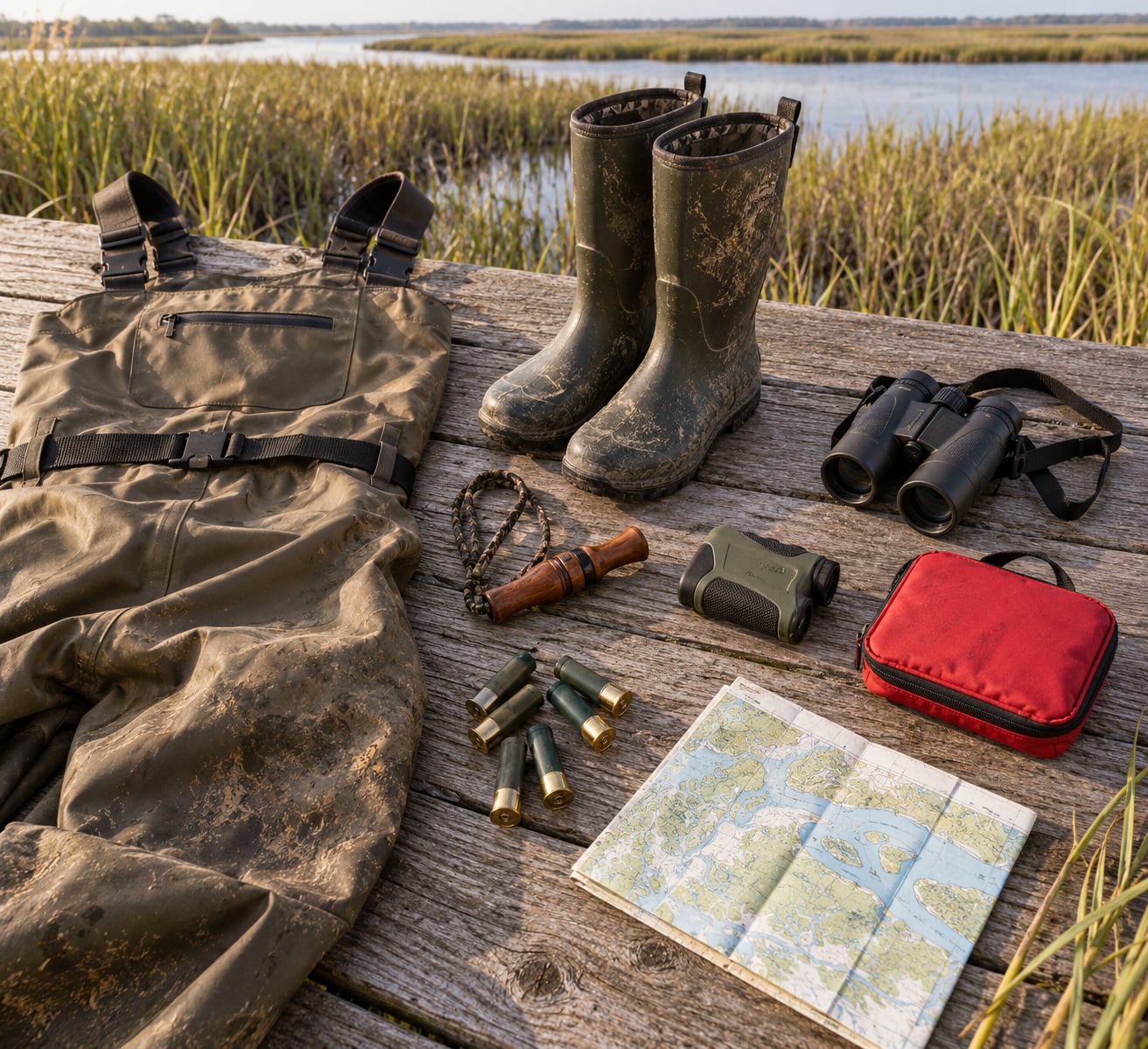
Hip waders are the standard tool for anything you will wade. Knee boots work on wet meadow edges and firm bottom. Rubber boots over neoprene or thick wool socks are the most comfortable option when the ground is wet but firm, and they are far easier to pull a boot out of when the mud does grab you.
Forum regulars describe the failure mode plainly: crossing a slough and ending up well over the knee in thick mud with a wader seam trying to let water through. If you have never walked the ground, scout it at high water in boots first.
Layer for a day that starts near freezing and ends warm. A thin layer that wicks, a windproof shell, and a spare dry pair of socks in a sealed bag cover nearly every southeastern marsh morning. Add insect repellent you have actually tested, a spare cap, and a warm layer you can strip to when the sun comes up.
Optics and navigation
Bin binoculars in a waterproof harness are the single most useful piece of gear after the shotgun. Rails hold still and watch you from twenty-five yards. A 8×42 or 10×42 pair is plenty, and a compact spotting scope helps when you are scouting the same marsh from a bluff or a road bridge.
Bring a tide table you can read without a signal, a headlamp with a red mode, a charged phone in a waterproof case, and a map of the marsh with your escape routes drawn on it. A power bank is worth the weight.
Shooting and calling
The shotgun is a plain one. A 20-gauge over-under or pump in 12 or 20 gauge covers both birds, and .410 bore is a legal and popular choice for snipe and rails specifically. A 28 gauge works, but carry a second shell of a larger gauge for the close rail that shows up at nine feet. Choke matters more than gauge: an Improved Cylinder or Skeet choke keeps the pattern open at the range where you will actually shoot.
Ammo is non-toxic, federally required, and in practice steel, bismuth or tungsten. Number 7.5 through 9 is the usual range for both birds, and larger shot will bruise meat badly at the distances rails are taken. A box of 25 or 50 is more than enough for a legal day.
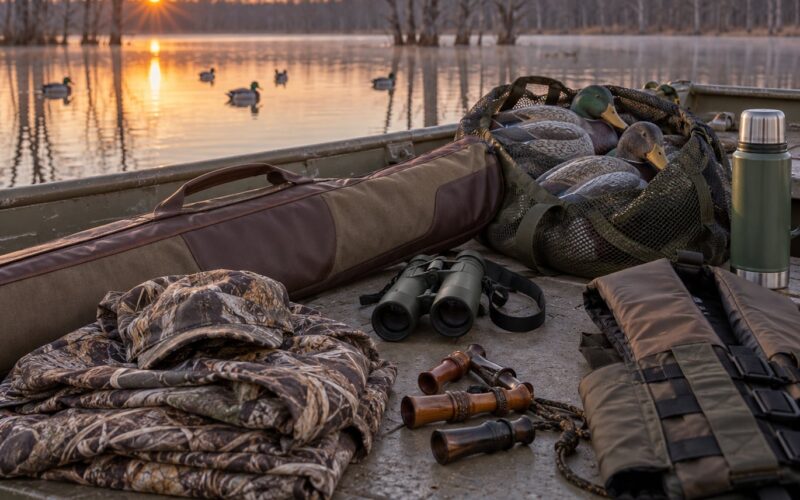
One call does most of the work. A mallard duck call reportedly answers on marsh hens more often than a rail call does, and a short low grunt carries better than volume. Add a waterproof notebook for the flush log and keep the rest of the kit simple.
Safety
Carry a first aid kit, a whistle, a charged phone, a buddy, and a stated turnaround time. Tell someone the launch point, the landing point, and the hour you expect to be off the water. A tide table belongs in that plan, not in your pocket as an afterthought.
Step-by-Step
Step 1: Check the Rules and Choose a Safe Area
Start at the state wildlife agency website, not at a forum post. Season dates, daily bag limits, possession limits, legal shot, and legal shooting hours all change, and rail and snipe seasons often do not overlap at all. Snipe seasons typically run in the fall and again on a short early window, while rail seasons are shaped around tides and often split into a few short segments.
At the same time, confirm which rail species are open in your state. Clapper rail, king rail, sora and Virginia rail are not treated identically everywhere, and some states set the limit by group rather than by species. Know where the hunting zone boundary runs relative to your marsh, and check whether any nesting closure, refuge closure or landowner closure applies to the ground you plan to walk.
You know the area is workable when you can answer three questions without guessing: what species may I take today, how many, and from what distance. If any of the three is unclear, pick a different marsh.
Step 2: Scout the Habitat and Tides
Both birds want the same three things: shallow water, a soft edge, and cover within a few steps. Snipe hunt sedge, wet meadow, flooded pasture and the muddy banks of ditches and sloughs, and they prefer ground that is soggy rather than dry. Rails hold in salt marsh cordgrass, the thickest spartina along tidal cuts, freshwater cattail edges, and the muddy mouths of minor cuts and creeks.
One hunter on the Iowa Water Fowlers forum put it plainly: snipe like soggy ground, so look where everything is flooded. Another on ShotgunWorld described the rail pattern from the boat, working the heads of minor cuts into the marsh because birds up there are holding in the smallest pockets of cover.
Tide decides how much of that cover exists. On a low tide, the tallest cordgrass stands dry and rails are scattered and hard to approach. As the flood tide covers the marsh and pushes birds up out of the softest vegetation, they concentrate in high spots, ridge edges and any slightly elevated ground inside the marsh. Reported hunts that fill a bag in four or five hours are almost always tied to those bigger flood tides, including the perigean tides of September.
Plan the tide around the birds, not around your schedule. A practical target is to be poling or walking so the water reaches the birds roughly an hour and a half before the listed high water, then work back down the tide as it falls. Check the tide table for the specific station nearest your launch, and note the height. Wind moves the effective water level in salt marsh, and a strong onshore or cross wind can raise or drop water well beyond the lunar prediction.
Scouting success looks like three marked spots: a productive edge, a refuge you can reach fast, and an escape route that does not cross deep water. If you cannot name all three, you have not finished scouting.
Step 3: Plan for Weather, Water, and Visibility
Open marsh is the least forgiving place to be caught out. Build the plan around the four things that end trips: rising water, lightning, fog, and cold.
Water is the most common problem. A tide that turned while you were poling a long cut can put you in water over your chest with a loaded boat that floats poorly when it is full of gear. Note the time of high water in your hands, not just in your head, and give yourself a hard turnaround at least ninety minutes before it.
Lightning ends a marsh hunt immediately and without discussion. There is no safe open ground in a cordgrass flat. Leave at the first thunder and move to a vehicle or a building.
Fog and heavy rain cut two things at once. You lose the visual cues that tell you a rail is there, and you lose your dog’s ability to work. In those conditions, slow down and shorten the hunt rather than pushing forward.
Cold is the quiet killer. Wet waders plus wind plus a long walk equals hypothermia well before you feel it, and marsh water is colder than air temperature suggests. Carry the dry layer, drink water, and get out on schedule.
On marsh insects, the practical advice is unglamorous. Repellent applied before you walk, permethrin-treated clothing where legal, and a face net if your local mosquitoes are severe. Most of the people who quit on early-season rails quit because of mosquitoes, not because of birds.
Step 4: Work the Birds Without Pressing Them
Rails are not going to leave because you are walking toward them. A rail in good cover will run, swim, and even grab grasses underwater to hold on rather than fly. It waits for pressure to build, and then it comes out low and reluctant. Your job is to build that pressure at a distance you can cover, not to walk it out at ten feet.
Work with the wind at your back so the birds are facing into it. Push poling a flat-bottomed skiff with a long pole, you hear the pole and the boat before you see either, and you get a different reaction from a walking hunter every time. Slap the water with the pole at the heads of cuts and pockets of cordgrass, not at random, and let the sound do the flushing.
On foot, two arrangements work. A rail drive uses two hunters: one holds the far end of a pocket and pushes the birds toward the other, who stands with a clear lane. Solo, work the windward edge of a patch of tall grass steadily and quietly, and accept fewer birds for cleaner shots.
Calling is worth a try and easy to overdo. Marsh hens reportedly answer a duck call, and a bird will cut you off mid-call if it is close. Grunting calls, short and low, carry better than volume. Call a few notes, then go quiet, because a rail investigating a call stops investigating the first time it hears you again.
Decoys are legal only where the rule allows them, and a handful of decoy rails on a flooded edge is about all that makes sense. Most experienced hunters I would trust do not bother.
You know the approach is working when the birds start moving ahead of you rather than running from you, and when a flush happens at thirty yards or more. If every bird is exploding off at eight feet, you are moving too fast or pushing too much cover.
Step 5: Identify Snipe and Rails Correctly
This is the step that ends more trips than any other, because the protected look-alikes are common and the flush is fast. Work the bird in this order: body shape first, then legs, then sound and flight.
A snipe is a compact shorebird, roughly the length of a hand, with a long straight bill and a striped back that breaks up in grass. It flies with its bill angled down and gives a sharp repeated scaipe call in the air. A rail is a small marsh hen with a short straight bill, a laterally compressed body, a cocked tail, and long legs that hang visibly below the body in flight, sometimes trailing. Rail flight is low, slow and straight for the first beats.
So the flush-time checklist: legs dangling below the body means rail. Long bill, no dangling legs, zigzag climb and a scaipe call means snipe. White along the back edge of the wing rules out snipe and points you toward a yellowlegs or a dowitcher, both of which are protected. If you cannot resolve the bird in a second, do not shoot it. Hunting seasons are long and birds that flush unshot often come back to the same pocket.
Snipe also gives away its presence before you see it. The winnowing display sends a bird up on a slow, side-to-side path, fanning its tail and outer wing feathers to make a helicopter sound you can hear without the bird being visible. A group of snipe feeding together is called a wisp, and when a wisp lifts, the scaiping gives you the range.
Separating snipe from rails is easy compared with separating either from a legal bird. The birds you will mistake most often are the greater and lesser yellowlegs, the dowitchers, and the American woodcock, which is not a legal target in most states during most of the year. Know the woodcock’s chunky, round-bodied look and the woodcock’s soft, clucking flight before you go.
Step 6: Take a Legal, Ethical Shot
Rails are usually taken inside forty yards and often inside twenty. Snipe will be presented closer than that and much more often. Set up so the shot is inside a distance you can hit, and never take a chance shot at a distant silhouette, because a miss on a protected look-alike is a violation and a miss at range is usually just a miss.
On the gun, the two camps split on when to pull. Some shoot immediately on the flush, when the bird is still low and feathers are compressed. Others wait for the straightaway after the first zigzags, where a snipe has to straighten before it climbs. The decision is mostly about your bird and your range: at twenty yards, shoot on the flush. Beyond thirty yards on a snipe, wait for the straightaway, because that is the only window where the bird is predictable. Rails barely need a decision, since the low slow first flight is the entire opportunity.
Follow through on the bird. Wait for the feathers to settle, or the bird drops and the second shot finds nothing. Put the muzzle on the bird’s chest and let the recoil do its work with an open choke, because most of these shots are closer and faster than practice suggests.
Know the direction of fire before you walk, and never shoot at a bird that rises over another hunter, a dog, or a road. A downed bird is your responsibility until it is in hand. If you have wounded a bird and cannot locate it, keep working the cover instead of walking away, and be honest in the record about what happened.
Two more ethical notes. Recover what you can, because birds lost to spartina and tide current are birds needlessly wasted. And do not shoot a bird you cannot positively identify, even when the season is open and the limit is not full.
Step 7: Retrieve, Field Dress, and Record the Harvest
Downed rails vanish fast. Thick spartina, bayberry and soft mud swallow them, and a floating bird goes with the tide or the wind. Mark the flush point and the direction of flight, then work back in a widening circle, checking the water surface as carefully as the grass.
A dog is the difference between recovering birds and losing them. A flushing spaniel of any working breed, and a Boykin spaniel is the traditional choice, will find more downed birds in marsh cover than any amount of patience on foot. Even without a dog, moving slowly upwind of the mark and stopping often pays better than walking fast through the spot.
In a boat, work the current and the wind rather than the bird. Birds drift and float, and so do the pieces of the bird, so a slow sweep of a tide line with a light wind at your back will find more than a search of where you shot.
Field dressing rails and snipe is quick work. Use a dry bag or a zip closure, cool the bird if you have a cooler, and follow your state’s rules on tagging and transporting. Both species are protected migratory birds, and the identification requirements apply at the truck, not just in the field.
Record the day while it is fresh: date, tide and time, weather, species, number of birds, shots fired, and where the birds were holding. That log is the fastest way to get better at this, and it is the only way to tell whether last month’s scouting was real or just a good morning.
Common Mistakes
Hunting without checking the rules first
Seasons, bag limits and shooting hours change, and rail limits are set by species in some states. Read the state agency page the week you go, and screenshot the dates, bag, possession limit and legal shot into your phone so you are not guessing at the truck.
Shooting a look-alike out of frustration
Yellowlegs, dowitchers and woodcock are not targets. Use the legs-and-call checklist on every bird, and remember that a snipe has no obvious white in flight while a yellowlegs flashes a bold white line. A bird you cannot name in one second is a bird you let go.
Ignoring the tide table
You will not find rails scattered across dry grass, and you may not finish the cut you started. Plan around the listed high water, allow for wind-driven deviation in salt marsh, and set a turnaround time before you launch.
Calling too hard
A rail investigating a call loses interest fast. Call a few notes, pause, and let the bird come. A continuous call mostly tells the marsh you are there.
Walking too close and too fast
Birds exploding at eight feet are birds you pressured into flight without a plan. Slow down, keep the wind at your back, and cover less ground. Fewer birds and better shots beat a limit of feathers.
Shooting at distant silhouettes
You cannot hit a snipe at seventy yards, and if you cannot name the bird at that distance you should not pull the trigger. Work the cover until the bird comes to a range where you have a real pattern and a real ID.
Not recovering wounded birds
Mark the bird, work the cover immediately, and get help if you need it. A wounded bird left in the marsh is the worst outcome of the whole day, and a dog in the boat solves most of the problem.
Wading in unfamiliar mud
Soggy marsh ground is where a good hunt gets lost. Scout the bottom in boots, avoid crossing a slough alone, and carry a pole. Getting out is the part everybody plans for and nobody practices.
Quick Field Tips
Start where the water is deepest and work back toward shallower water as the tide falls, so the birds are pushed into the zone you have already covered. Keep a spare dry sock in the boat. Treat any bird seen at over forty yards as a bird to identify, not a bird to shoot. And talk to whoever fishes or crabs that marsh; the ones who never hunt usually know exactly where the birds hold.
Frequently Asked Questions
What is the best time for snipe hunting?
Snipe are most reliable in the first hour after dawn and in the last hour before dark, when they leave cover to feed. Light wind with falling water works best, and fall rains that leave fields soggy concentrate birds on the short grass edges. Fall hunting is the main season, with most states adding a brief spring window. Check your state dates, because a lot of states set the spring season around a harvest survey rather than a fixed calendar.
How do you hunt marsh hens?
Marsh hens, which most people mean when they say clapper rail, are hunted on the flood tide. Arrive so the water reaches the birds about ninety minutes before listed high water, then work the tallest spartina and the heads of small cuts. Push pole a skiff and slap the water to force a flush, or drive with a second hunter from the far end of a pocket of cover. Calls help at close range, but pushing pressure is what actually moves birds.
What does a rail bird look like?
A rail is a small, round-bodied marsh hen about the size of a robin, with a short straight bill, a cocked tail, and long legs that hang visibly below the body in flight. Colors vary: clapper rails are gray and brown, Virginia rails are more reddish, sora are dark with a short yellowish bill, and king rails are rich chestnut with a long red bill. In the field the useful mark is the body, not the color, since light and cover change everything.
Are rails protected birds?
Rails are migratory birds covered by the Migratory Bird Treaty Act, so they may be hunted only during an open season, on legal land, in legal numbers, with a migratory bird permit and HIP registration, and using approved non-toxic shot. Some rail species are not open in every state, and nesting closures can shut ground temporarily. Limits are often set by group rather than species, so read your state agency page rather than assuming one rule covers all four rails.
Do you need a dog to hunt snipe and rails?
A dog is optional but it changes the day. A flushing spaniel, and a Boykin spaniel is the traditional marsh choice, finds birds in spartina and bayberry that you will walk right past, and it recovers downed birds that are otherwise lost to cover and tide. Without a dog, plan the hunt around birds on high ground and around the heads of cuts, mark every flush, and accept a smaller harvest with fewer lost birds.
What should you do if the tide or weather turns unsafe in the marsh?
Stop and leave on your own schedule rather than your birds’. Rising water in a cut with a loaded boat in it is the classic trap, so track the listed high water and turn around well before it. Leave immediately at thunder, because open marsh has no safe ground. In fog, cold, or heavy rain, shorten the hunt and stay within reach of a quick exit, and tell your buddy the plan before you go so someone knows when you are overdue.
Conclusion
The first action is the least exciting one: confirm the current rules for your species and your marsh, and find out who owns the ground. Everything after that follows from knowing what is legal and where you can stand.
Then scout the marsh in boots at high water, note the listed high tide and build your arrival around it, and go with binoculars, a good wader, an open-choked shotgun loaded with small non-toxic shot, and a tide table in reach. Walk the edges, work the wind, and hold every bird to the same identification test before you pull the trigger. Take the shot close, mark what you hit, and work the cover until the bird is in your hand. That is how you hunt snipe and rails in a marsh and still have a hunt you can repeat next week.