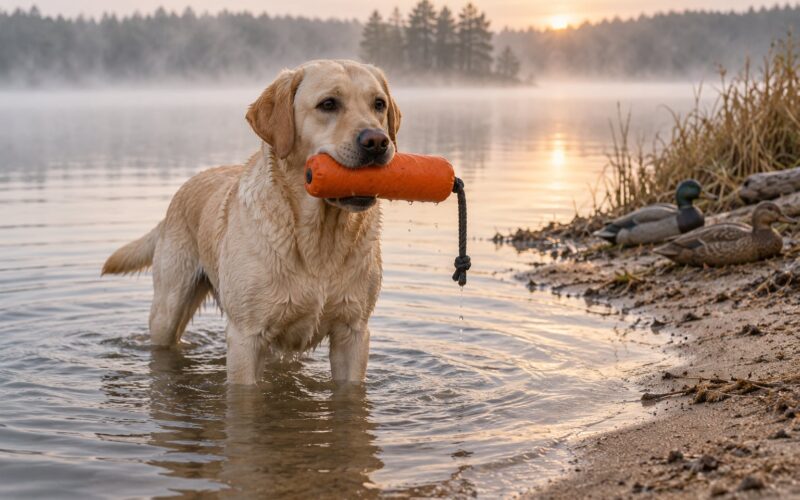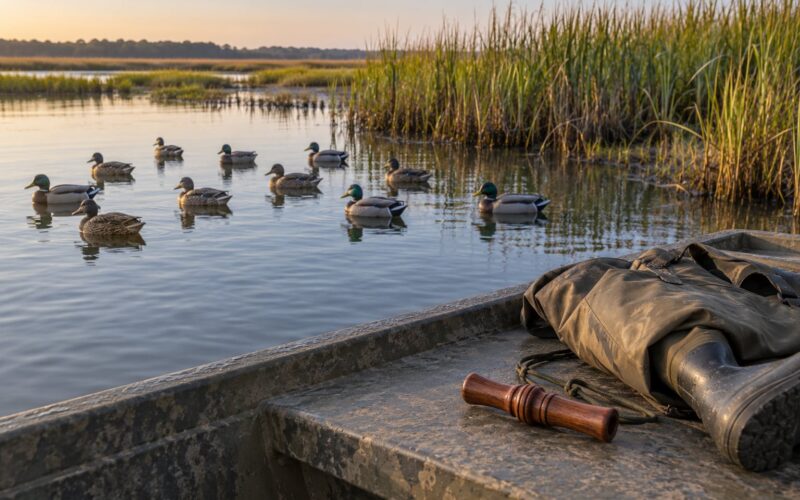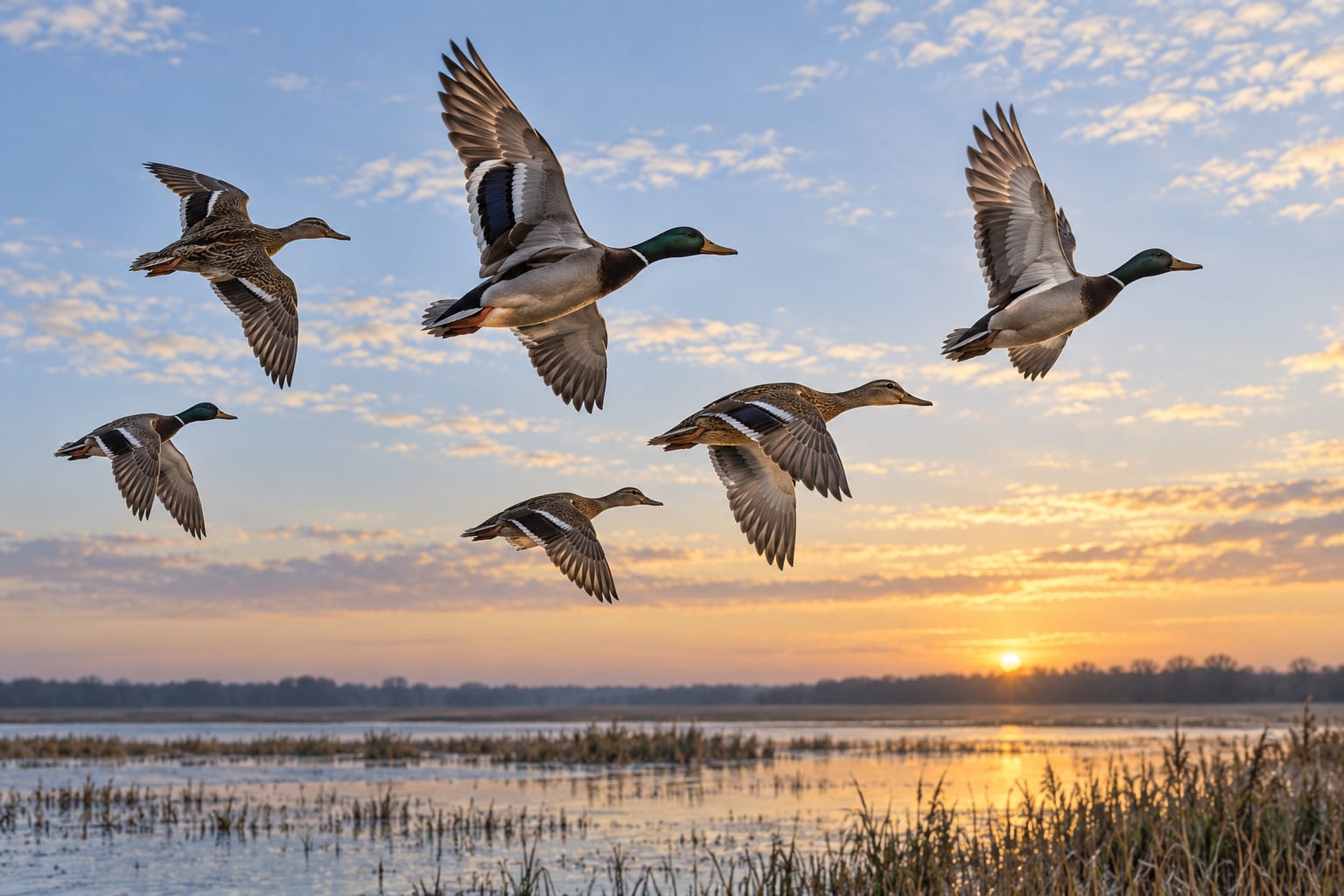
To identify ducks in flight, work from the big marks down: judge size and body shape, separate dabbling (puddle) ducks from diving ducks by wingbeat and takeoff, then read the white marks on the wing, belly and tail before you look at color. Color is the last clue you check, not the first, because it disappears at dawn.
A dabbling duck feeds on the surface and upends for food. A diving duck goes under. Those two feeding styles built two different birds, and they fly differently enough that the split is usually readable in a second or two.
Species and sex bag limits are the reason this matters. A hen mallard, a hen pintail or a sawbill taken by mistake is a real legal consequence, so the goal is a defensible call, not a fast guess. This guide takes about ten minutes to read and gives you an ordered method you can run on any bird that lifts off the water.
Table of Contents
- What You Need
- Step-by-Step
- Step 1: Establish the Duck’s Size and Overall Shape
- Step 2: Check the Head, Bill, and Neck Profile
- Step 3: Look at Wingbeat Rhythm and Body Position
- Step 4: Identify Wing Shape and Pattern in the Right Light
- Step 5: Notice Tail, Foot, and Rear-Body Details
- Step 6: Use Formation and Flock Behavior as Supporting Clues
- Step 7: Apply Color and Plumage Details Only After the Shape
- Step 8: Narrow the Identification and Check the Range
- Common Mistakes
- Frequently Asked Questions
- How can I tell what kind of ducks I have?
- What birds are sometimes mistaken for ducks?
- Is there an app that can identify ducks?
- How can I identify a duck?
- How do I identify ducks at dawn or in poor light?
- Which ducks are hardest to tell apart in flight?
- Conclusion: Start With Shape, Behavior, and Wing Pattern
What You Need
A decent pair of binoculars is the one non-negotiable item. Ten-power glass is the sweet spot for ducks, wide enough to find the bird and narrow enough to hold it steady while you work through the clues.
A spotting scope earns its keep on open water past sixty yards or from a blind where you cannot move. Tripod it if you can. Handheld scopes at that distance make you fight the shake instead of reading wing bars.
Bring a field guide or a reference chart you can reach with one hand. The printable in-flight chart below is built to be the thing you keep in a truck console or a phone case. The Cornell Lab of Ornithology Merlin Bird ID app works as a second opinion, though it is slower than your own eye on a bird that is already overhead.
Set up with the sun behind you whenever you can. Birds crossing in front of you are lit and readable; birds crossing with the sun behind them are dark shapes with a blown-out sky behind. Hunters call this getting the light on the birds, and it is the single biggest upgrade to in-flight identification you can make for free.
Finally, keep a notebook or a notes app. Write the bird down after every flight: what you saw, what you guessed, and whether the guess held up when the bird turned. Six mornings of that will teach you more than any chart.
Step-by-Step
Step 1: Establish the Duck’s Size and Overall Shape
Estimate size against birds you already know. A crow is a decent ruler for the dabbling group, a large goose for the big divers. Small teal look crow-small, most dabblers look crow-to-pigeon sized, and canvasbacks and redheads are pigeon-to-small-goose heavy.
Then look at proportion, which is more useful than raw size. A Northern Pintail is long and thin, all neck and tail. A Northern Shoveler is short and deep with a bill that looks oversized. A Ring-necked Duck is a smooth torpedo. A Ruddy Duck is a compact floating cylinder with almost no neck at all.
How it worked: you can name the silhouette before you see any markings. If the bird looks like a stretched-out teardrop with a pin at the back, you are looking at a pintail regardless of what the head color is doing.
Step 2: Check the Head, Bill, and Neck Profile
Bill shape sorts birds faster than bill color. Broad and spoon-shaped is a shoveler. Short, narrow and stubby with a steep forehead is a teal or a wigeon. Long, slim and slightly drooping at the tip is a pintail. Triangular with a black tip is a canvasback. Flat and wide at the end is a gadwall.
Head profile matters more than most people expect. Gadwall and Black Duck have a flat forehead sloping into the bill. Northern Shoveler has a bulging crown with a kink in the neck where the head meets the body, which looks odd from below and is diagnostic.
Neck length gives you the group before the bill does. Dabblers hold the neck out and slightly down, head leading. Divers tuck the head back toward the shoulders with the bill level, which shortens the apparent profile.
How it worked: bill shape plus forehead slope gives you a two-species answer in birds where the wing pattern alone would not.
Step 3: Look at Wingbeat Rhythm and Body Position
Dabblers fly with fewer, deeper, slower wingbeats and a heavy rowing rhythm. Divers fly with rapid, shallow, almost vibrating wingbeats, and larger divers can throw a whistling note off the wingtips that is audible well before the bird arrives.
The takeoff is the cleanest split in birding. A dabbler springs straight up off the water with almost no forward run. A diver needs a running start across the surface, feet skimming, and only clears when it has that run built up.
Look at the bird as it descends. Dabblers angle their bills down at the end of a glide, almost pointing at the water. Divers approach with the bill level and the body in a straight line.
| Feature | Dabbling (puddle) duck | Diving duck |
|---|---|---|
| Wingbeat | Slow, deep, rowing | Fast, shallow, rapid |
| Wing tips | Pointed | Rounded (Ring-necked Duck is the pointed-wingtip exception) |
| Takeoff | Vertical spring from a standstill | Running start across the water |
| Flight line | Loose, twisting, swirling | Tight, fast, straight lines |
| Bill position | Tipped down on descent | Level in flight |
| Body shape | Flat and broad | Blocky, short-tailed |
How it worked: wingbeat rhythm alone will put any duck into the right group, which is the split you need before species work is worth attempting.
Step 4: Identify Wing Shape and Pattern in the Right Light
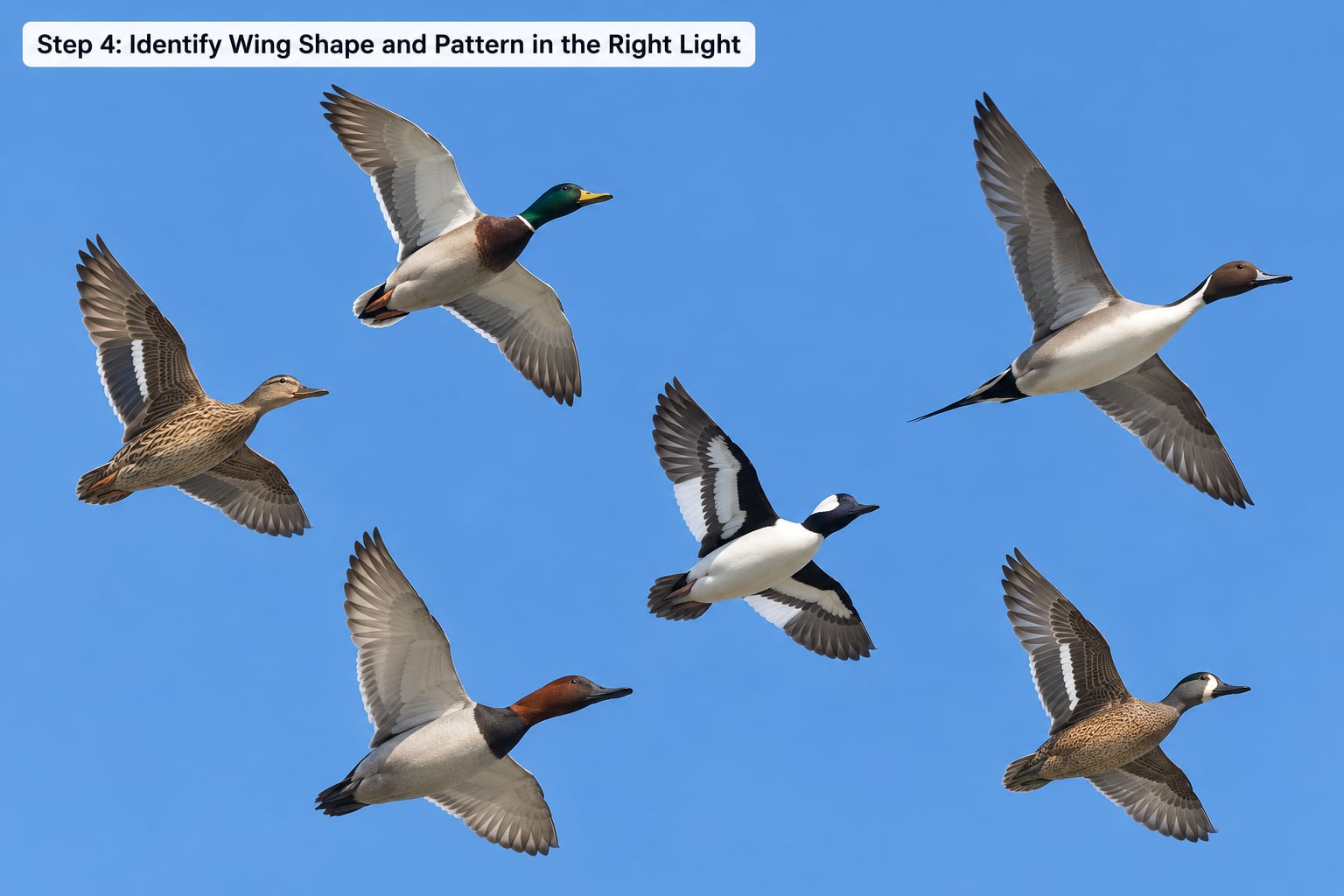
Now read the wing. Two structures matter: the shape of the wingtip, and the pattern of pale feathers inside the wing.
The pointed trailing edge is the standard dabbler signature, rounded is the standard diver signature. Wing tips also tell you group from a long way off, before pattern resolves at all.
The big white patch most hunters mean by a wing bar is the speculum, the colored panel of secondary feathers that shows on many dabblers in flight. Mallards flash a white speculum bordered in black and a blue-purple iridescence. Northern Pintail shows a clean white speculum on a long, otherwise dark wing. Gadwall shows a broken, less distinct white patch, and American Wigeon shows a bold white shoulder patch ahead of a green speculum that often reads as white at distance.
On divers, look for the pale belly flash instead. Scaup, Ring-necked Duck and Redhead all flash a white or pale belly that contrasts with the dark body. Bufflehead shows a big white patch in the wing. Common Goldeneye shows a bold white oval at the base of the wing.
How it worked: wing shape narrows the group, the pattern of white inside the wing narrows it further, and only then does color matter.
Step 5: Notice Tail, Foot, and Rear-Body Details
The rear of the bird is where the diagnostic shape lives. Pintail is unmistakable with its long neck and sharply pointed tail wedge trailing behind it like a dart. Teal has a short, square tail and a compact rear. Mallard and Black Duck have broad, blunt, rounded tails. Wood Duck has a long, bushy tail that sways noticeably and looks wrong for a dabbler if you do not know the bird.
Hooded Merganser and Wood Duck both show a long tail. Merganser drakes carry a rusty fan of feathers at the base of the tail that is visible well past the tail itself.
Watch for trailing feet. Some ducks kick the leg back and leave it hanging after the last downbeat, which reads as a small dark dash behind the body at odd angles.
How it worked: tail shape is a reliable tiebreaker in exactly the pairs where head and wing color fail you.
Step 6: Use Formation and Flock Behavior as Supporting Clues
Flock behavior is a supporting clue, never a proof. Teal twist and dart, changing direction fast and often. Dabblers such as mallards and pintails often swirl into loose balls over open water before settling. Divers frequently string out in a fast, direct line.
Mixed flocks are the normal case, and mixed flocks also help you. The odd bird that is not keeping the flock’s rhythm is usually the one worth glassing.
How it worked: your ID held up because the bird behaved like its group, not just because a marking looked right.
Step 7: Apply Color and Plumage Details Only After the Shape
Only now bring color in. Male dabblers in breeding plumage are often unmistakable: Mallard with the iridescent green head and yellow bill, Wood Duck with the red face and ornate flank pattern, Northern Shoveler with the green head and white breast. That kind of contrast is a fine final confirmation.
It also fails badly. Hens and immature birds are drab brown in most species, and drakes lose their bold colors in eclipse plumage after breeding, so a “male-looking” black-and-white bird in late summer may be a drake wood duck and the drab bird beside it a hen of the same species.
Low light is the other failure. At dawn, in rain or against a bright sky, a dark head reads as black and a pale flank reads as white, and both readings can be wrong. Forum users call color-based ID worthless at first light for exactly this reason.
How it worked: you reached a species using shape, wingbeat and marks, and color only confirmed it.
Step 8: Narrow the Identification and Check the Range
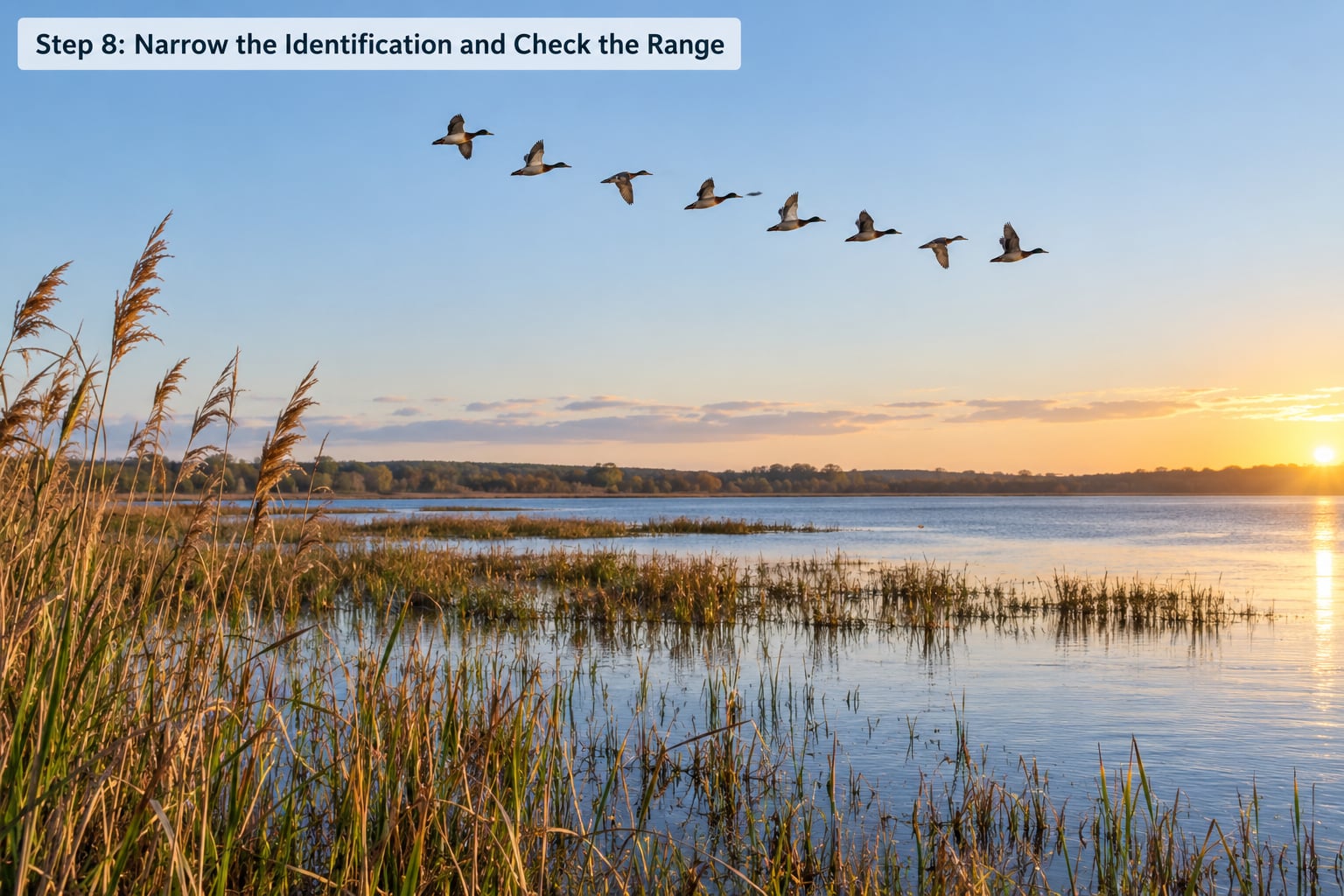
Take your group, size, shape and marks, then check the date and the place. Wood Duck is a timber and flooded-forest bird; you will rarely see one over wide open water in the middle of a prairie lake. Open water and big wind waves mean diving ducks. Marsh edges with flooded vegetation mean dabblers.
Season does the rest. Northern Pintail numbers in the central flyways are heavily weighted to late fall and early winter, while Wood Duck is a common early spring migrant in much of the eastern United States. Regional checklists and eBird range maps narrow your candidate list before you spend any time on it.
Here is the working chart. Relative size is against a crow-sized bird.
| Species | Size | Wingbeat | Tail | Signature in flight |
|---|---|---|---|---|
| Mallard | Large dabbler | Slow, deep | Broad, blunt | White speculum with dark borders; blue-purple iridescence |
| Black Duck | Large dabbler | Slow, deep | Broad, blunt | Darker overall than a hen mallard; pale speculum with less contrast; violet shoulder flash, no white borders |
| Northern Pintail | Large dabbler | Slow, deep | Long pointed wedge | Long slender neck, white speculum on a dark wing |
| Northern Shoveler | Medium dabbler | Fast for its size | Pointed | Oversized spoon bill, kinked neck |
| Gadwall | Medium dabbler | Steady | Pointed | Broken white wing patch; drake has a black rear |
| American Wigeon | Medium dabbler | Steady, bunched | Pointed | Bold white shoulder patch ahead of the speculum |
| Northern Teal | Smallest dabbler | Very fast, twisting | Short, square | Tiny body, darting and acrobatic flight |
| Wood Duck | Medium dabbler | Steady | Long, bushy | Long crested head, white belly flash, tail sways in flight |
| Canvasback | Large diver | Fast | Pointed wedge | Sloping forehead, white belly, long black bill |
| Redhead | Medium diver | Fast | Broad | Rounder head than canvasback, gray back, pale belly |
| Ring-necked Duck | Medium diver | Fast | Broad | Pointed wingtips for a diver; peaked head; pale belly |
| Greater and Lesser Scaup | Medium diver | Fast | Broad | Rounded head, broad white wing bar, pale belly |
| Bufflehead | Small diver | Very fast | Broad | Large white wing patch; compact body |
| Common Goldeneye | Medium diver | Fast | Broad | Bold white oval at the base of the wing; pointed tail |
| Hooded Merganser | Medium diver | Fast | Long, rounded | Long tail, rusty fan behind the tail on drakes |
| Ruddy Duck | Small diver | Fast | Stubby, cocked | Stubby body, no visible neck, often holds tail cocked up |
Two pairs defeat nearly everyone. Black Duck versus hen Mallard: look at the speculum, which shows a clean white band in a mallard and a duller patch with a faint border in a Black Duck, and at the head, which is flatter and darker on a Black Duck. Wigeon versus Gadwall: wigeon shows a crisp white shoulder patch in front of the wing and a pale head, gadwall shows a messier broken patch and a dark head. Bufflehead versus Ruddy Duck: a bufflehead is larger, shows a big white wing patch, and holds its bill level; a ruddy is smaller, has no neck you can see, and cocks its tail.
Greater versus Lesser Scaup cannot be separated reliably in flight, and anyone who tells you otherwise is guessing. Both are broad white-barred scaup, and the head and bill differences that separate them on the water do not carry to a moving bird.
Common Mistakes
Judging color before shape. The most common error by a wide margin, and the one that fails hardest at dawn. The fix is procedural: complete steps one through four out loud or in order, and forbid yourself from naming a color until the group is settled.
Assuming every duck flaps at the same rate. Fast shallow wingbeats in a compact bird over open water is a diver. Slow rowing wingbeats in a flat broad bird is a dabbler. Teal break the rule by being tiny and fast, and Ring-necked Ducks break it with pointed wingtips.
Ignoring size. A small duck and a large duck of the same color are still different birds. Get a size estimate before anything else, even a rough one against a crow.
Reading shadows as markings. A bird backlit against a bright sky shows you shape and no color at all, and the dark underside of a wing reads as a black bar that is not there. Move your position or wait for the bird to cross in front of open water rather than open sky.
Forgetting the non-ducks. American Coot and grebes get mistaken for ducks constantly, and so do gulls on the wing.
| Bird | What gives it away |
|---|---|
| American Coot | Slate gray body with a white bill; flies in a long loose line with steady slow flaps; runs across water trailing its feet |
| Grebes | No visible tail, rear-heavy bodies, legs set far back, sit low in the water |
| Gulls | Long pointed wings with a distinct bend, no white wing patch on a duck pattern, completely different bill |
| Geese | Long neck projecting well past the body, much larger, slower wingbeat |
| Cormorants | Long straight neck, big webbed feet trailing behind, heavy slow flap |
| Small shorebirds | Quick shallow flutter, fast direct flight over open water, no wing bar |
Calling a bird you cannot resolve. If you have no field mark and no group behavior supporting it, pass. Holding fire on an uncertain bird costs one bird, and a mistaken hen, pintail or sawbill costs far more than that.
Sound deserves its own paragraph because it is genuinely useful and badly underused. Ducks are noisy in flight, and the wing noise in particular tells you the group before you can see the bird: divers on fast shallow beats throw a clear whistling or singing note off the wingtips, while dabblers produce a softer fluttering flap. Calls help too. Wigeon gives a repeated rolling shoo-shee-shoo across the sky, Redhead gives a short cat-like mew, and Wood Duck gives a high squeal you will recognize before you see the bird.
Frequently Asked Questions
How can I tell what kind of ducks I have?
Sort the flock into dabbling ducks and diving ducks first. Slow deep wingbeats, a vertical spring off the water and a twisting loose flight line mean dabblers. Fast shallow wingbeats, a running start across the surface and a tight straight line mean divers. Then use size, bill shape and the white marks on the wing and belly to reach a species.
What birds are sometimes mistaken for ducks?
American Coot is the classic mistake: a slate gray bird with a white bill that flies in a long slow line and trails its feet on takeoff. Grebes have no visible tail and sit low in the water. Gulls have long pointed wings with a bend, geese have a long neck projecting past the body, and cormorants trail big webbed feet behind them.
Is there an app that can identify ducks?
The Cornell Lab of Ornithology Merlin Bird ID app will attempt a photo identification, and eBird gives you a regional list of what is around you right now. Neither is fast enough to be your primary tool on a bird already overhead. Use the app and range maps to narrow the list, then confirm with binoculars using the shape and wing cues in this guide.
How can I identify a duck?
Judge size against a crow, then separate dabblers from divers by wingbeat and takeoff, then read wing shape, tail shape and the white marks on the wing and belly. Leave color until the end, because it vanishes at first light and in rain. Habitat, date and your regional checklist do the final filtering.
How do I identify ducks at dawn or in poor light?
Work on shape and rhythm instead of color. Wingbeat rate, takeoff mechanics, pointed versus rounded wingtips, tail shape and white patches on the wing and belly all survive low light better than plumage does. Keep the sun behind you so birds cross in front of you lit rather than silhouetted against a bright sky.
Which ducks are hardest to tell apart in flight?
Greater and Lesser Scaup cannot be separated reliably in flight by any field mark, because the features that distinguish them on the water do not carry to a moving bird. Black Duck versus hen Mallard and American Wigeon versus Gadwall are harder than they should be at long range, where the speculum pattern matters most. Mergansers versus Wood Duck and teal versus Bufflehead separate cleanly on size and shape.
Conclusion: Start With Shape, Behavior, and Wing Pattern
Run the same order every time. Size and body shape, then dabbling or diving by wingbeat and takeoff, then wing shape and the white marks, then tail and rear-body detail, and color last, with habitat and date closing it out.
Start on the next bird that lifts off the water: skip the color entirely for the first pass and just watch the wingbeat and the takeoff. That single habit does more for your in-flight duck identification than any chart in your truck.