To set a duck decoy spread in a rice field, build it in the upwind quadrant in front of your blind, use a J-hook or U-shaped pattern, and leave an open pocket of water about 30 to 35 yards out where the ducks can land and where you have a clean shot. Space the decoys close enough that they read as one flock, keep the whole setup on the side birds approach from, and hide the blind and gear before first light.
Flooded rice has almost no natural cover and sightlines that run for hundreds of yards, so the spread does most of the convincing. Get the pattern, the distance, or the wind side wrong and birds will circle once and leave. That is the single complaint you will read over and over in every waterfowl forum.
Table of Contents
- What You Need
- Step-by-Step: How to Set a Duck Decoy Spread in a Rice Field
- 1. Scout the Rice Field and Confirm Access
- 2. Read Wind, Water, and Duck Routes
- 3. Choose a Concealed Setup Location
- 4. Build the Main Decoy Group
- 5. Add a Secondary Spread
- 6. Add Water Disturbance and Movement
- 7. Conceal the Hunter and Finish the Spread
- Common Mistakes
- Frequently Asked Questions
- How far from my blind should I put my duck decoy spread?
- How many duck decoys should I have in my spread?
- Should I put a lot of decoys in the rice or a little?
- Does the stage of the rice crop change where I set up?
- Why do ducks circle my rice field decoy spread and never land?
- Do stake-out decoys help in a rice blind?
- Conclusion
What You Need
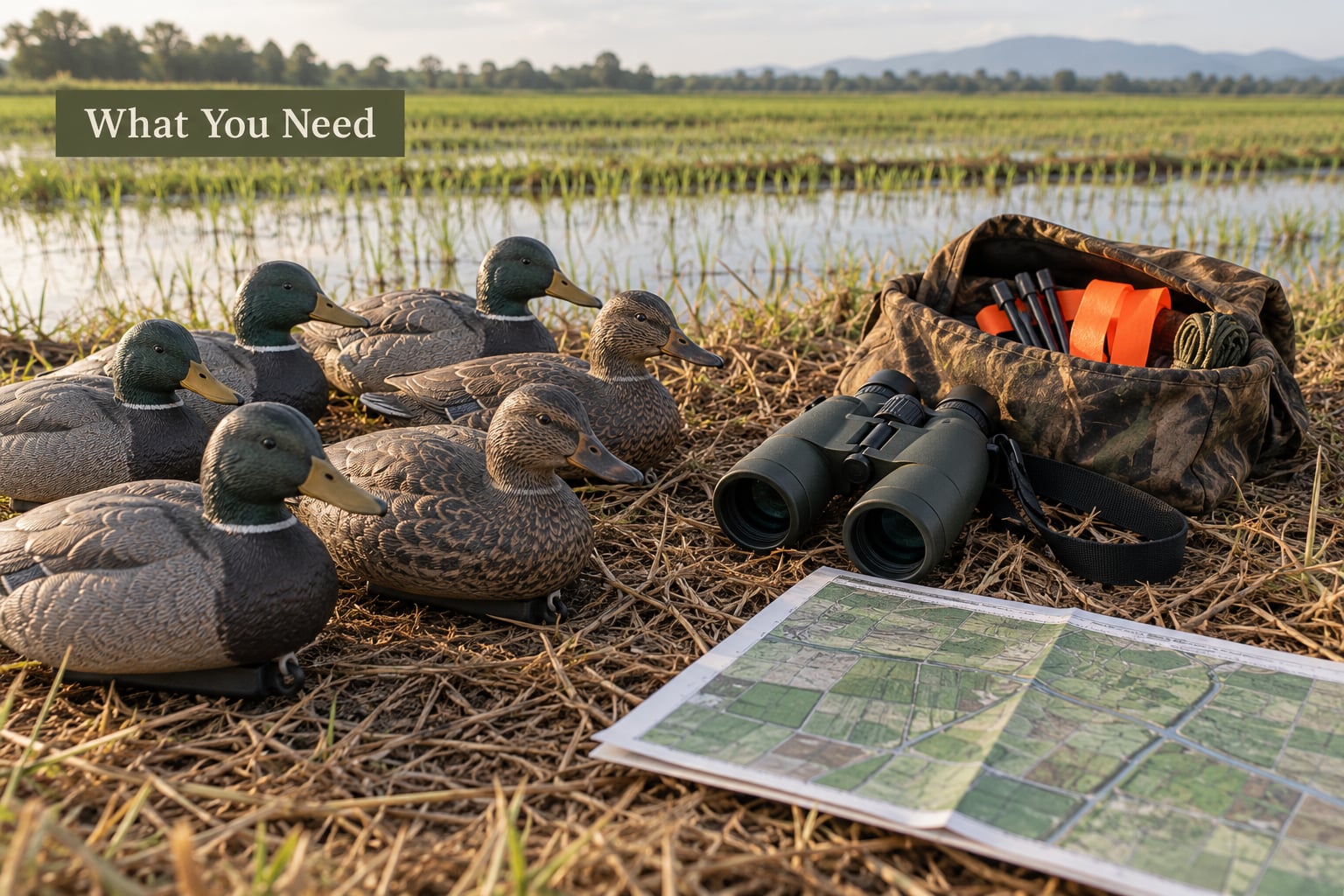
Most of the gear list is small. The part people underrate is how you get the spread across the field.
- Decoys. Full-body floaters for the main group, a smaller number of shell or silhouette decoys for the far edge, and a handful of stake-out decoys on poles. Match the species you are actually seeing.
- Decoy bag and a way to move it. A bag on a shoulder sled, a marsh runner, an ATV, or a boat if the water is deep. Full spreads are heavy and wet ground is slow.
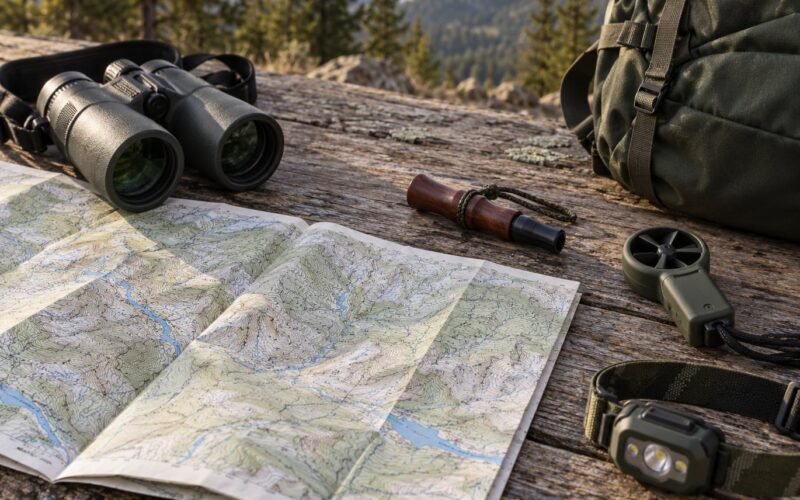
- Binoculars and a map. Mark the field boundaries, the levees, the ring levees, and your legal entry point before you are standing in water holding a decoy.
- Flagging. Low-profile type that will not catch light or move in the breeze. Mark your route out as well as your spot.
- Stake poles and a hammer if you are running stake-out decoys, plus a marker to note the pocket so you can re-find it.
- A personal flotation device, headlamp or spotlight, and a charged phone. Rice ditches are deeper than they look and the mud holds you down.
- Landowner permission in writing or a word, plus the state decoy limit, the shot limit, and whether bait or grain is allowed on the lease.
If you only take three things, take the decoys, the permission, and the flotation device.
Step-by-Step: How to Set a Duck Decoy Spread in a Rice Field
1. Scout the Rice Field and Confirm Access
Walk the boundary before you are carrying anything. Find the legal access point, note which levees are walkable, and check the field stage: flooded at plant stage, planted and emerged, or cut stubble with sheet water. That stage decides where the birds feed and therefore where the spread goes.
Look for standing water in a pocket, a corner, or along a canal edge where the current is slow. Skip a spot where the water is so deep the decoys look like specks from a distance, and skip anywhere the only way in crosses a levee you cannot climb wet.
2. Read Wind, Water, and Duck Routes
Stand at the blind and face into the wind. That quadrant, 30 to 60 yards out in front of you, is where the spread belongs. Birds want to land into the wind, so a spread behind or beside them reads as a trap.
Watch where birds actually enter the field. On a flooded block the ring levee breaks their line and they funnel around it, which is where the pocket should sit. Watch the water too: birds prefer the windward side where the surface is roughened and food is pushed toward them.
3. Choose a Concealed Setup Location
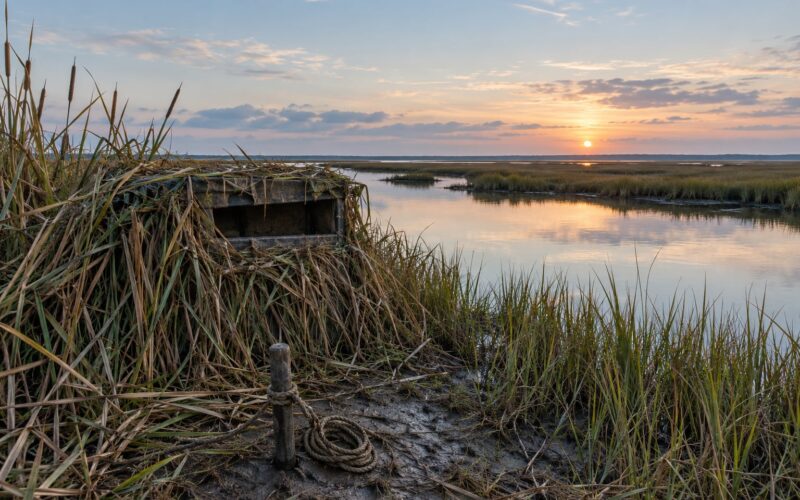
Pick a spot with cover at your back, a clear lane to the pocket, and a safe route in and out. In rice, that usually means a pit blind or a layout blind dug into a levee shoulder where the standing crop screens you and the incoming birds are already low.
Check the shooting lane before you commit. Rice stubble and a levee bank can block a prone shot, and a field with a ring levee cutting across your view means you should move the blind rather than the spread.
4. Build the Main Decoy Group
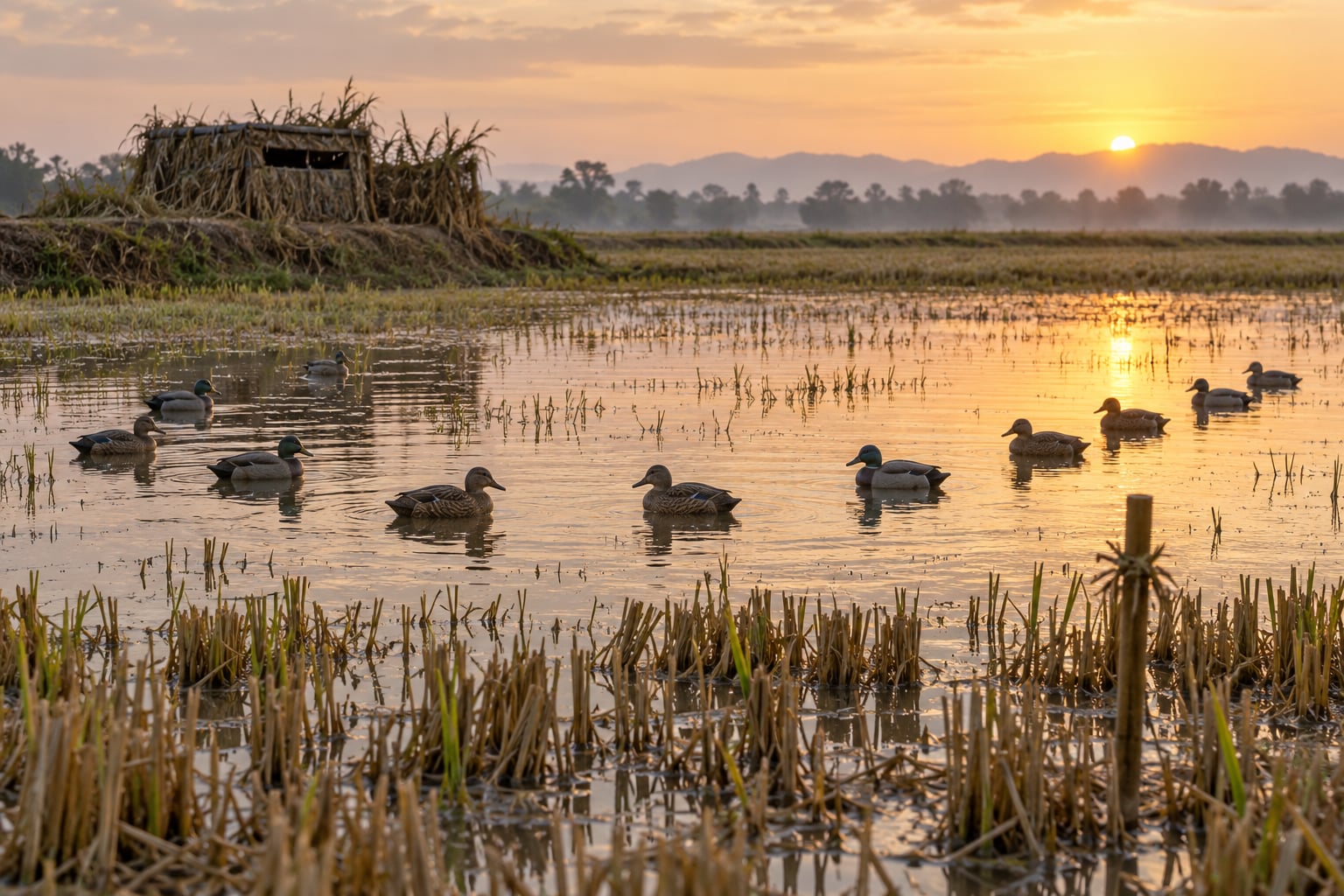
Set the main group in the upwind quadrant as a J-hook or a U, with the open end facing the birds and the closed end running into the wind. Throw the first decoys downwind and work back so the tightest bunch sits farthest from you, which keeps the gap from filling with birds you cannot see.
Leave the pocket empty. That gap is the landing zone and it is where your shots come from.
- Pocket or corner under an acre. 6 to 12 decoys in the main group, spaced 2 to 3 feet apart, with the pocket 25 to 30 yards from the blind.
- Quarter field. 12 to 18 decoys, spaced 3 to 4 feet apart, with the pocket 30 to 35 yards out.
- Half field or larger. 18 to 30 decoys, spaced 4 to 6 feet apart, with the pocket 30 to 40 yards out.
Those are working numbers for flooded rice, not rules. More decoys than the water can support tends to look like a pile of birds that never moves off, and that is worse than a small spread that reads clean.
5. Add a Secondary Spread
Place a smaller, separated group or a line of stragglers to one side and slightly farther out. It tells arriving birds the spot is bigger than it is without making the pattern look stamped out.
Specks are the cheapest tool here. A few speck floaters just past the outer decoys suggest feeding birds that are already out there. Hunters running flooded rice report the same thing repeatedly, that a small number of well-placed specks pulls birds deeper into the pocket.
6. Add Water Disturbance and Movement
A flooded field goes glassy fast at dawn and a still spread looks like decoys sitting on a mirror. Add legal movement: a spinning wing decoy, a couple of feeders working, or a jerk string that ripples the surface.
Keep movement at the far edge and outside the pocket. If the pocket is churning, birds cannot judge it as open water. And give any motorized or rotating decoy room to work, since they generally need a hole roughly three feet by three feet dug out to operate in a flooded field.
7. Conceal the Hunter and Finish the Spread
Break every straight line between the sky and your position. Blind material, a top cover over your head, and camo netting on anything shiny. Shadows inside a pit blind give you away faster than color.
Walk your own route back to the blind with the light behind you and see what you can see. Then pin the spread and the blind with a GPS mark while you still have daylight, because a flooded field at 4 a.m. in fog looks the same in every direction. Finish with a safety check: footing, your line of fire, and the exit path.
Common Mistakes
Most blown spreads come down to one of these, and each has a simple fix.
- No pocket. A solid wall of decoys looks wrong and gives birds nowhere to settle. Cut a gap of 10 to 15 feet facing the wind.
- Spread parallel to the birds’ approach. If birds come in from the side, they see the edge of the spread instead of the flock. Rotate the whole pattern into their approach line.
- Too far from the blind. Past about 40 yards in open flooded rice, decoys stop reading as birds. Pull the group in.
- Over-decing. More birds than the water can support reads as a pile. Cut the count and let the pocket do the work.
- Uniform spacing and height. Even rows at one level look laid out by a machine. Vary spacing and put a few decoys above the water on poles.
- Skipping the rules. Decoy limits, landowner permission, and whether you can plant or scatter grain on that lease are all worth confirming before you are standing in a field at dawn. Do not enter ground you have not been given.
One more habit worth building: when birds hang up and refuse to land, do not rebuild everything. Pull the pocket a few yards closer, kill the motion, and try a feed call before you touch another decoy.
Frequently Asked Questions
How far from my blind should I put my duck decoy spread?
About 30 to 35 yards in flooded rice. Close enough that the decoys still read as individual birds at that distance, far enough that you have time to rise, shoot, and get back down. In a small pocket under an acre, tighten to 25 to 30 yards.
How many duck decoys should I have in my spread?
Enough that the group reads as a flock filling the water you are hunting, and no more. A flooded pocket takes 6 to 12 decoys, a quarter field takes 12 to 18, and a half field or larger takes 18 to 30. Over-decing is the most common mistake beginners make.
Should I put a lot of decoys in the rice or a little?
Little, done well. Hunters who flood the water with birds often get circles but no commits, because the pattern stops looking believable. A clean spread with a real pocket pulls more birds than a bigger, tighter one, and it is easier to adjust once the shooting starts.
Does the stage of the rice crop change where I set up?
Yes, and it matters more than most people expect. Flooded rice at plant stage holds early teal, emerged rice pushes birds to the field edges and open water, and cut stubble with sheet water concentrates birds in shallow corners and along canal edges. Scout the current stage, because a field can look identical to last year and hold birds in a completely different place.
Why do ducks circle my rice field decoy spread and never land?
Usually one of four things: no open pocket, the spread is turned the wrong way for the wind, the group is too far out to read, or the whole pattern sits edge-on to the birds’ approach. Kill any motion, open a gap facing the wind, and rotate the spread before you add more birds.
Do stake-out decoys help in a rice blind?
They add height to the spread, which helps with high-laying birds like wigeon and pintail and with birds that are still wary. Run a handful rather than a wall, vary the heights, and keep the tallest ones outside your shooting lane so nothing blocks a clean shot.
Conclusion
Scout the water and the wind before you pack anything. Stand in your blind, face into the wind, watch where the birds come in around the levee, and put a J or U in the upwind quadrant with a pocket 30 to 35 yards out. Everything else is detail on top of that one decision. Get permission, carry a flotation device, and leave yourself a way home before dark.