Learning how to find deer sign in coastal woods comes down to one habit: read the freshest evidence first, then work outward from it. Tracks in soft mud, a rub with bright exposed wood, a scrape with fresh dirt turned over — one of those means a deer passed through. Three together in a small area means deer live there, and that is where you plan around.
Coastal timber bends the usual rules. Rain softens rub edges, scat goes watery and green in the marsh, and deer trails through knee-high grass can be a foot wide with no tread detail at all. The nine field clues below are ordered the way I work a piece of bottomland hardwood or maritime forest in the fall: soft ground first, then travel lanes, then buck sign, then cover, then confirmation.
Table of Contents
- What You Need
- Step-by-Step: How to Find Deer Sign in Coastal Woods
- Check Soft Ground and Water Tracks First
- Follow the Route Between Cover and Food
- Look for Fresh Rubs and Scrapes
- Read Browse, Tracks, and Droppings Together
- Check Bedding Cover and Escape Routes
- Use Scent, Scrapes, and Seasonal Behavior
- Map Sign Clusters Without Disturbing the Area
- Confirm Current Use and Plan the Next Visit
- Common Mistakes
- Frequently Asked Questions
- How do I find deer sign in coastal woods after rain?
- How can I tell whether deer tracks are fresh?
- What is the best time of day to look for deer sign?
- How do I identify a fresh buck rub in coastal timber?
- Does high tide help me find deer sign?
- Which deer sign should a hunter investigate first?
- Conclusion: Start With the Freshest Sign
What You Need
None of this is expensive. What matters far more than the gear is arriving quietly, knowing exactly where the boundary is, and picking the right hour for the ground you are standing on.
- Legal access information. Property lines, whether the land is private, state wildlife management area, or tribal, and the season dates. Confirm before you walk in, not from the tree line.
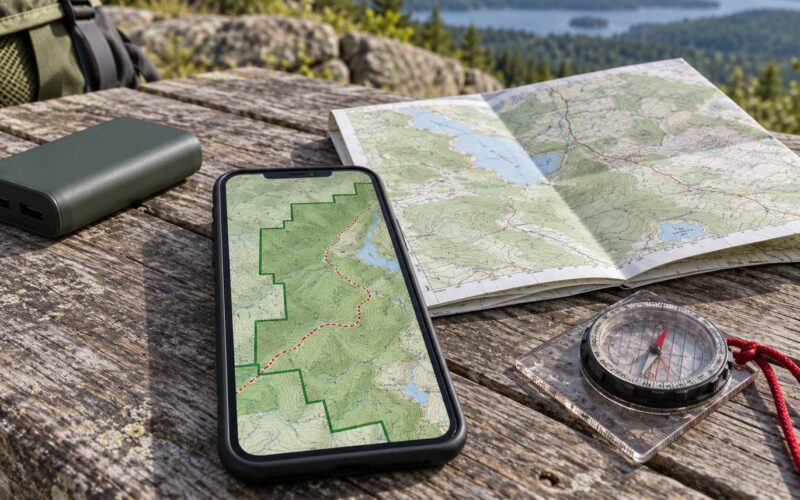
- A phone with offline maps plus a paper backup. Coastal bluff edges and dense understory lose cell service fast.
- A tide table if marsh, estuary, or bottomland is part of the ground. Rising water covers your tracks and closes your exit.
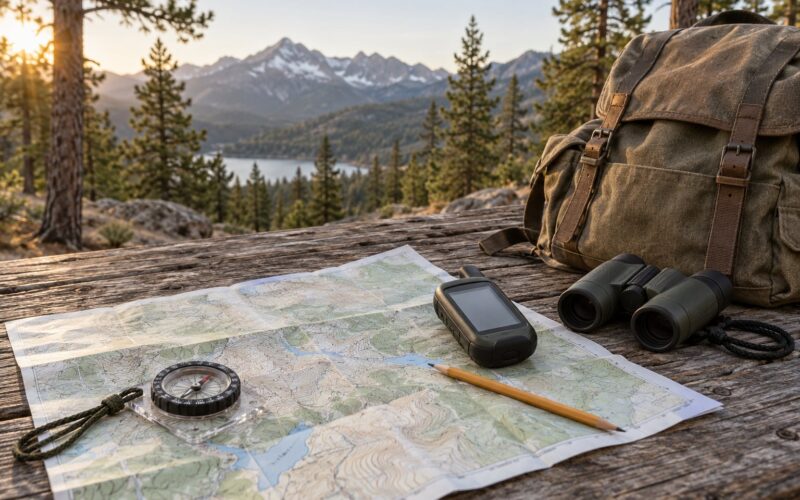
- Binoculars for checking the far end of a trail corridor without walking it.
- A measuring tape or a ruler for stride and track length. Guessing is how people end up planning around a doe.
- Reading glasses if you use them. Half the value of a scrape is the hair at its edge, and you will miss it squinting.
- A camera, and the discipline to photograph each sign from one angle only.
- A notebook or a notes app with a timestamp for every cluster you log.
- Gloves, insect protection, water, and weather-appropriate layers. Wet coastal ground chills you faster than the temperature suggests.
On timing, dawn and the last hour of light are when deer move most, so sign read at those hours tells you where they were in the dark. Scouting mid-morning on a rising tide is a different read entirely, because it shows you what got pushed off cover after the deer settled in.
One note on scent and sound. Deer pick up human scent well before they see you, and coastal wind shifts with the afternoon sea breeze. Know the wind direction for the hours you plan to be in the woods, not just the hour you scout it.
Step-by-Step: How to Find Deer Sign in Coastal Woods
Check Soft Ground and Water Tracks First
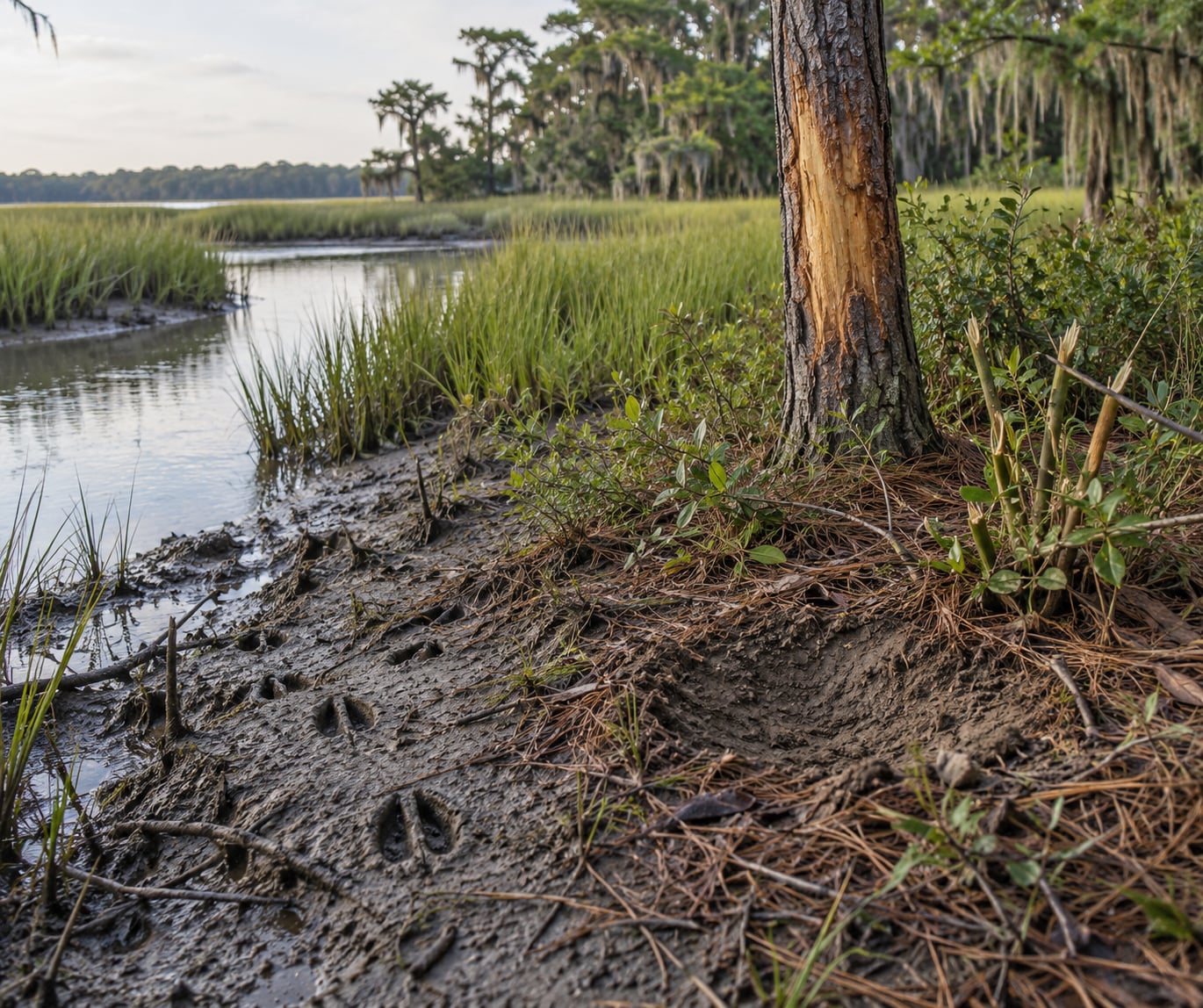
Tracks are the baseline sign because they date themselves. Start at the places that hold moisture and print: creek edges, soft creek-bank mud, sand at the high-tide line, any churned soil at the marsh edge, and low spots in a trail network.
What you are looking for in the print itself:
- Clarity. Crisp edges and defined dew-claw marks mean recent. Smeared, water-filled impressions have had rain on them.
- Direction. The toe points the way the deer went. A cluster pointing one direction and a cluster pointing the other, close together, means this is a crossing, not a through-route.
- Size. Measure hoof-to-heel without the dew claws. Two to three inches covers most deer, and anything past four inches belongs to a mule deer or a blacktail.
- Stride. Walking stride sits roughly 20 to 30 inches between prints of the same track. A sudden stretch to 40-plus inches means the animal was moving faster than a walk.
- Overlap. Later prints cutting across earlier prints mean the trail is being used again.
A single track tells you almost nothing. Three prints from the same animal in a consistent line tell you a deer is moving through here regularly, which is a completely different read.
This is the practical part of how to find deer sign in coastal woods, and it is the step most beginners rush. After a rain, walk the soft ground first and skip everything else until you have seen what is printing.
A quick dating key for the sign you turn up, so you are not guessing at each one in the field:
- Tracks in soft mud — sharp edges, no rain fill, dew claws still showing. Hours old, or at most a night.
- Tracks after rain — edges slumped, water sitting in the print. One to three days old.
- Buck rub — bright pale wood, bark still at the base, edges not weathered. A few days to about two weeks during the rut.
- Ground scrape — dirt dark and moist, hairs on the overhang, ground not re-rained. Days old, and a buck is still working it.
- Droppings — dark, glossy, moist, strong odor, or piled rather than scattered. Under two days.
- Bedding — compressed vegetation still springing up, hair caught in it. Used in the last few nights.
- Browse line — freshly clipped tips, buds intact, no regrowth. Within days.
Follow the Route Between Cover and Food
Deers are creatures of habit. They run the same line between bedding and feeding over and over, and the proof is a repeated trail rather than a single print.
On the ground, a used trail shows as flattened or parted vegetation, worn soil, a rutted path through grass, and the same track prints stacked at intervals. Where two of those paths cross, sign piles up, and that intersection is usually worth more than either trail by itself.
Coastal woods have more of these pinch points than inland woods, because deer have to cross open ground repeatedly:
- Edges where bottomland hardwood meets marsh
- Causeways and canal spoil banks between wet sections
- Wooded bluffs above open benches
- Any strip of dense brush that connects two larger blocks of cover
- Tidal creek crossings at low water
Where the terrain changes type, sign concentrates. A ridge of cypress and tupelo following a bayou will hold more sign than the flat woods on either side of it.
Look for Fresh Rubs and Scrapes
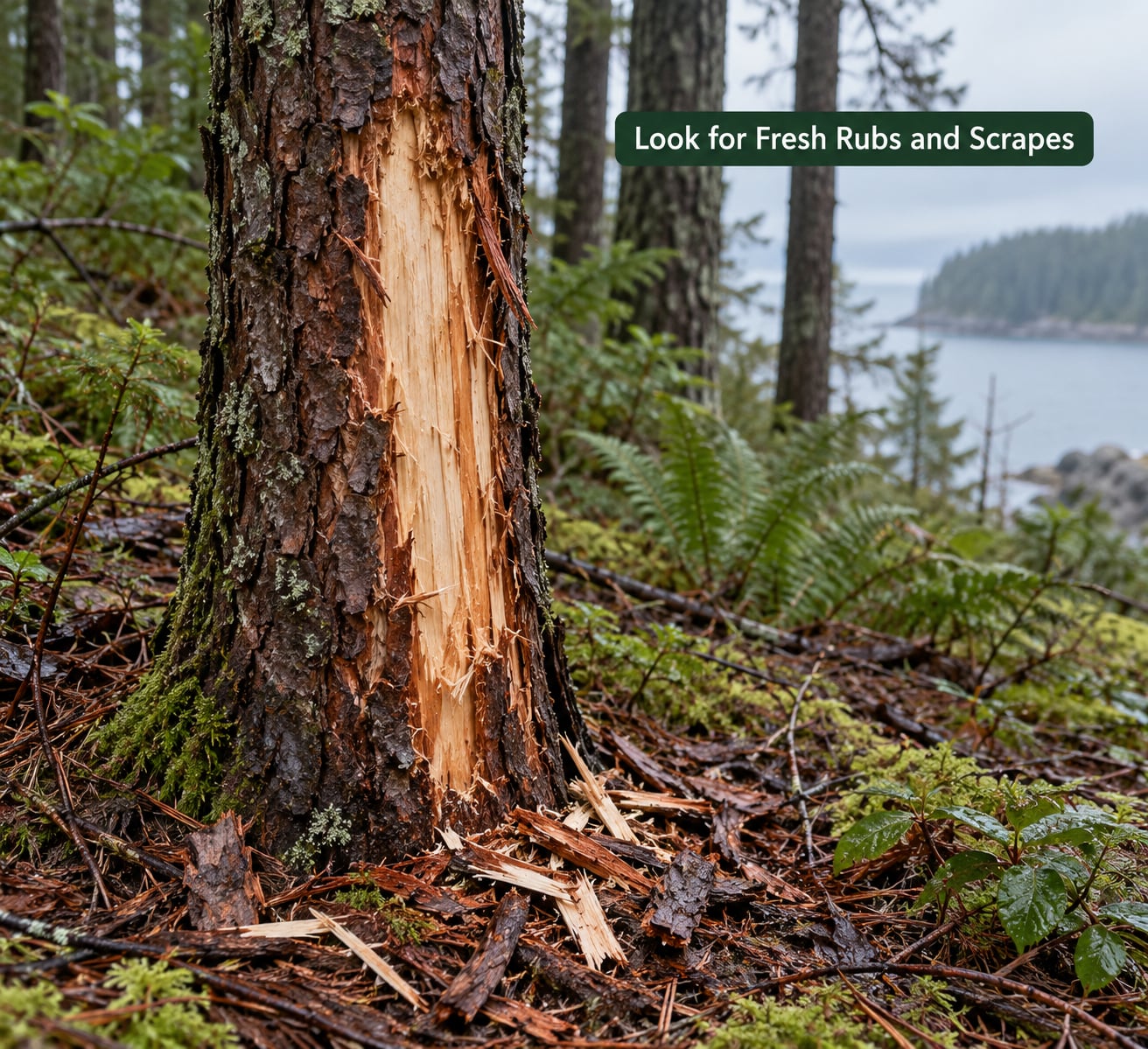
Rubs and scrapes are buck sign only. A rub is a tree the buck worked with his antlers, usually between one and four feet off the ground, with bark stripped and splinters or shavings at the base. Bark still lying on the ground means recent.
A scrape is bare ground, often one to three feet across, sometimes with a bare or overhanging branch above it and a dark urine stain on a nearby stem. Fresh scrape dirt is dark and moist. A scrape that has been rained on twice, or that has grass starting in it, is history.
Fresh rub and a well-tended scrape in the same small area is the single strongest pattern in this whole subject. It means one buck is moving through on a route, checking the same marks, and that route is somewhere you can plan around.
Judging freshness gets harder in a wet climate. Coastal rub edges go soft and dark within days, and the pale wood dulls fast in salt air, so lean on ground disturbance beneath the rub as much as on the rub itself.
Read Browse, Tracks, and Droppings Together
Treating sign one piece at a time is the most common beginner error. A single pile of droppings means a deer was here once. Fresh droppings sitting inside a bed of tracks with clipped browse above it means a deer is here now.
Browse tells you what is eating and how high it feeds. A browse line usually sits between three and six feet, and repeated nibbling leaves short, blunt stubs with a clean cut instead of a torn tip. Fresh clipping means new growth on the stem, buds still present, no regrowth.
In coastal range, watch the understory species rather than assuming. Salmonberry, salal, and evergreen huckleberry carry heavy browse pressure in places where deer concentrate. In the marsh transition, water hyssop and alligator grass get clipped back hard, and that is a deer food sign even where tracks have washed out.
Droppings date by condition. Fresh ones are dark, glossy, moist, and smell strong; older ones pale, dry, and often collapsed into a flat mat. In wet coastal woods, expect scat to turn watery and green, almost cat-vomit in appearance, rather than the neat pellet pile everyone pictures. That is normal, not a different animal.
Check Bedding Cover and Escape Routes
Bedding cover is where sign reads differently from travel sign. A travel trail has prints spaced along a line. A bed has a compressed oval of flattened vegetation, sometimes with shed hair caught in it, and usually a few prints entering and one leaving.
What to look at in coastal timber:
- Dense pine flats with bare, pressed litter
- Thick brush and salal beds where the interior is scuffed but the edge is clean
- Creek banks and root masses with hair on the bark
- Palmetto and switchgrass beds with stems pushed aside and a clear approach lane
Resting sign often sits close to an escape route, which is the practical reason to care. A bed with a single open side tells you how the deer leaves and roughly where. That lane is where a hunter who can wait in the morning gets the shot, and it is worth walking once before the season rather than three times after it.
One caution: feral hogs root in similar cover and flatten similar vegetation. Hog work is more extensive, with soil pushed up and turned, and a wide, blunt-tipped trail that usually pairs with hog tracks, which have two front toes and a dew-claw pattern unlike a deer’s split hoof.
Use Scent, Scrapes, and Seasonal Behavior
Visible sign only makes sense against what the deer are doing that month. In the pre-rut, bucks are traveling and marking. Through the rut they are checking scrapes, rub the same route repeatedly, and spend more time in the open near does. After the rut, all of that fades fast and the fresh sign moves back to feed and escape cover.
Other scent-adjacent signs worth noting: wallowing areas with broken and muddy ground, a rub line of fresh hair caught on a scrape overhang, and scrapes with concentrated dark staining on the soil. Treat all of them as supporting evidence rather than proof.
The rule I hold to is that visible buck sign still gets confirmed by fresh ground disturbance. A scrape with a fresh track across it is a fact. A scrape alone is a maybe.
Map Sign Clusters Without Disturbing the Area
On public coastal land you may not get another visit before opening day, so write it down properly. Log each cluster with location, sign type, freshness, travel direction, and the habitat around it, then add the time and the weather.
Walking a sign cluster matters as much as photographing it. Walk the line rather than the middle, stop at the first good track instead of stomping through the rest, and photograph from a single direction so you can compare it against what you find next time. Most blowouts happen when someone cuts the corner of a productive trail on the way to somewhere else.
What you are really mapping is connection. A scrape alone, a trail alone, a browse patch alone — three separate spots. A scrape with a trail leading to it and browse above it is one place with deer in it, and that is the distinction that decides where you set up.
Confirm Current Use and Plan the Next Visit
The last pass is confirmation, and it is mostly about looking for layering. Overlapping tracks at different depths, soil freshly turned inside an old scrape, a rub with new bark at its base over an older rub scar, several trails converging on one thicket, droppings stacked in pairs rather than scattered.
Any one of those reads as current. Two or more together reads as regular use, and regular use is what you can plan a stand around.
Then go back to a productive cluster at a different hour and from a different direction. Fresh sign from a second angle confirms the route and tells you where the animal came from. Follow every property rule, every access rule, and every regulation that applies to where you are standing — scouting is not an exception to any of them.
Common Mistakes
Assuming every track is fresh. A crisp print means it printed recently, not that the deer is still there. Rain fills and softens impressions within a day or two in coastal rain, so date tracks against the last wet weather rather than by eye alone.
Walking straight through the sign. Cut the corner of a productive trail instead of following it, or you will convince yourself you already found everything there is to find. Step wide of the line and come back to it.
Treating an old rub as current. Rub scars persist for seasons. Look for pale, unweathered wood and fresh bark at the base, plus a track or scrape beneath it, before you build anything on that tree.
Over-reading a single clue. One track is a crossing, not a home range. One browse patch is a snack, not a feed tree. Concentrated, current, varied sign is the pattern worth acting on.
Missing the look-alikes. A narrow path through marsh grass reads as nutria or armadillo until you check hoof shape. A flattened, uprooted bed can be hog rooting rather than a deer bed. Confirm the species before you plan anything.
Searching at the wrong tide or hour. High tide can flood browse and push deer onto high ground, and low tide opens mud that prints beautifully. Check the tide table before you drive, not from the truck.
Ignoring boundaries. The most common way people lose coastal ground is simple trespass while chasing sign onto a neighboring parcel. Know where you are.
If you fix one thing first, start at the freshest, most concentrated sign in the area and work outward from it. Everything peripheral to that cluster is worth less than the cluster itself.
Frequently Asked Questions
How do I find deer sign in coastal woods after rain?
Rain is the best scouting weather there is, because fresh tracks re-register in soft ground and old ones blur. Start at creek edges, tidal mud, and any soft soil in a trail network, and read the freshest prints first. Note that tracks harden and shed detail quickly in coastal rain, so photograph what you find the same morning.
How can I tell whether deer tracks are fresh?
Look at the edges. Sharp, defined walls with visible dew claws and a moist floor mean hours old or at most a night old. Water sitting in the print, slumped edges, and a faded floor mean one to three days. Blowed-out or collapsed impressions, and any track that has filled with rainwater, is older than that. In coastal ground, compare tracks against the last hard rain rather than trusting the eye.
What is the best time of day to look for deer sign?
Read sign at dawn and in the last hour of daylight, when tracks, bedding, and trail use are freshest and least disturbed. Mid-morning after a rising tide is also useful, because it shows where deer were pushed off cover once water covered the low browse. Either way, match the scouting window to the hours you intend to hunt.
How do I identify a fresh buck rub in coastal timber?
A fresh rub shows bright pale wood where bark was stripped, bark shavings or splinters still at the base of the tree, and rub marks usually between one and four feet off the ground. Coastal air dulls exposed wood fast, so look for the loose bark and check beneath the tree for fresh ground disturbance or tracks before you call it current.
Does high tide help me find deer sign?
High tide closes options: flooded browse, submerged trails, and soft mud you cannot cross safely. Low tide is usually better for scouting, because it opens tidal flats and creek edges where tracks print sharply. Rising or falling tide is useful for a different reason, since deer shifting between cover and feed concentrate along the edge where the water meets the woods.
Which deer sign should a hunter investigate first?
Investigate a fresh rub paired with a well-tended scrape, and confirm it with fresh tracks. That combination means one buck is moving through on a repeatable route, which is the strongest signal in this whole subject. A lone track or an old rub is not a plan, and neither is a browse patch with nothing else around it.
Conclusion: Start With the Freshest Sign
Pick legal ground with soft ground and recent weather behind it, find the freshest tracks or rub you can, and work outward from that spot through travel lanes, feeding evidence, bedding cover, and finally the connected sign that ties them together. Move quietly, log what you find while you are standing in it, and let the tide and the wind set the schedule.