To hunt the morning tide for ducks, you pick a tide stage before you ever pick a spot, then build your whole morning around it. The tide moves birds twice a day: falling water pulls ducks off the flats and out toward deeper roost water, while rising water pushes them back onto fresh feed and often closer to shore. Read the official table, know which stage you are setting up for, and be in position before legal shooting time.
That is the whole idea. Everything below just tells you what to do with it in the dark, on moving water, while somebody else is trying to take the same birds.
Table of Contents
- What You Need
- Step-by-Step: How to Hunt the Morning Tide for Ducks
- 1. Build the Hunt Around the Water Level
- 2. Scout the Feeding and Roosting Habitat
- 3. Arrive Early Without Spooking the Birds
- 4. Establish a Safe Decoy and Calling Pattern
- 5. Read the Birds and Make Ethical Shots
- 6. Finish the Hunt Within the Rules
- Common Mistakes and How to Fix Them
- Frequently Asked Questions
- What tide is best for hunting ducks in coastal marshes?
- Should I hunt the incoming or outgoing morning tide?
- What decoy spread works best around a tidal creek?
- Is it legal to hunt near a marine protected area in South Carolina?
- How far should duck calls carry?
- What should I do if I cannot identify a flying duck?
- Conclusion: Start With the Tide and the Feed
What You Need
Requirements change by state, by hunting area and sometimes by species, so treat this as a checklist to verify rather than a fact sheet to trust. Print or screenshot the current regulations the night before, and read them again in the truck.
- State waterfowl hunting licence plus any annual state migratory bird permit your home state requires.
- Federal migratory bird stamp and the signed federal duck stamp, carried with the licence.
- Current state waterfowl regulations: season dates for your zone, daily shooting time, possession limit, bag limit, and any species-specific restrictions such as teal-only or harlequin-only units.
- Shotgun and approved ammunition: steel shot in the gauge and load your state allows, including any minimum shell length.
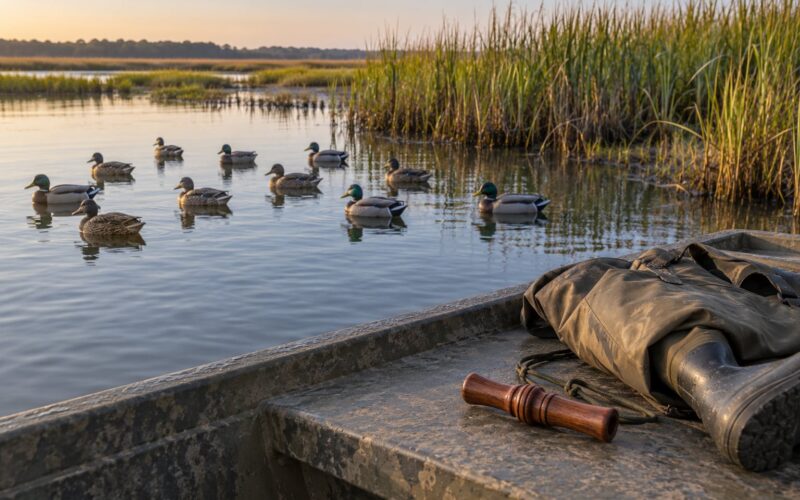
- Decoys you can anchor in current, plus weights and short anchor lines. Fewer, better-anchored decoys beat a big loose raft on tidal water.
- Calls: at least one feed call and one hail call you can run quietly. Add a rolling feeding series once your basics are solid.
- Waders or foul-weather gear that will not soak through, a spare dry layer, and a change of socks if you will be in the water past shooting time.
- Optics and a headlamp with a red or dimmable mode, plus spare batteries.
- Official tide table for the nearest station, the local sunrise time, and legal shooting time side by side.
- Weather forecast for wind, fog, rain and the temperature you will be standing in for two hours.
- Navigation tools: charts, a compass or GPS, and knowledge of your launch and your exit route.
- First aid kit, a charged phone, a whistle, a fire starter, and a partner whose plan you actually know.
- A way to check current rules before you leave. State wildlife agency websites and the U.S. Fish and Wildlife Service waterfowl management pages carry the official season framework.
Step-by-Step: How to Hunt the Morning Tide for Ducks
1. Build the Hunt Around the Water Level
Every tidal hunt starts on paper with a tide table, not on the water with a guess. Find the station that covers your water, note the high and low times and heights, and mark which stage overlaps your legal shooting time.
Two stages matter. High slack water is the pause at the top of the flood, when current dies and loose drift settles. Low slack is the same pause at the bottom of the ebb. Between them the water is either flooding or ebbing, and the difference changes where the birds are and where they are going.
| Factor | Falling (ebb) tide | Incoming (flood) tide |
|---|---|---|
| Water level | Falling through the tidal range | Rising through the tidal range |
| Bird movement | Birds pushed off exposed flats toward deep roost water | Birds drift back onto feed with the waterline, often nearer shore |
| Decoy response | Decoys sit in deeper water as it drains, so keep them reachable | Decoys float up and may raft into shore cover |
| Shot range | Often lengthens as birds move seaward | Often shortens as birds work toward your shoreline |
| Main risk | Your skiff can strand on soft mud as the water drains | Rising water can cut you off from firm ground |
| Best position | Open water or a channel mouth ahead of the moving birds | A point, bar or shoreline blind that birds must work past |
The long-standing field rule is to prefer the falling tide, and it holds most of the time: exposed flats concentrate feeding birds and then push them seaward into decoy range. Hunters on the saltwater and brackish marsh thread at DuckHuntingChat put it plainly, a falling tide is the best tide to hunt. The counter-case is real too. If you are set on a shoreline blind or a point bar, the incoming tide walks birds toward you and shortens your shots, which is exactly what you want when the birds are spooked and staying high.
Use the rule of twelfths to picture what the water is doing without a soundings chart. It says the tide falls one twelfth of the tidal range in the first hour after high water, two twelfths in the second hour, three in the third, and so on through the sixth hour, then reverses.
| Hours after high water | Fraction of tidal range lost | Feet dropped in a 6 ft range |
|---|---|---|
| 1 | 1/12 | 0.5 ft |
| 2 | 3/12 | 1.5 ft |
| 3 | 6/12 | 3 ft |
| 4 | 10/12 | 5 ft |
| 5 | 11/12 | 5.5 ft |
| 6 | 12/12 (low slack) | 6 ft |
That is enough arithmetic to tell you whether a flat you liked at high water will be a dry ridge, ankle-deep mud or still a channel when the birds fly. You can also learn the water by eye. Drift and foam lines pulling seaward, mud that is beginning to firm, grass blades lying away from you and current swinging around a point all point to an ebbing tide. Water climbing a wrack line, softening mud that squelches under your heel, and floating scum drifting toward you point to a flood.
Build a clock, not just a stage. If legal shooting time is half an hour before sunrise and high slack falls an hour after that, you are hunting the back half of the ebb and the water will be dropping under you the whole time. Work backwards from first light: 60 to 90 minutes of setup, 30 minutes of travel, and a tide check the night before. Nearly everyone who talks about knowing how to hunt the morning tide for ducks means the same two things: they know their water, and they know their clock.
| Tide table reading | What it means for your morning |
|---|---|
| High slack 90 minutes before legal shooting time | Best setup: water is holding, birds should already be feeding and moving early |
| Low slack 60 minutes before legal shooting time | Hardest setup: flats are draining, birds are already moving to roost, decoys need re-anchoring |
| Mid-ebb during shooting time | Solid choice from open water or a channel; watch your exit depth |
| Mid-flood during shooting time | Good from a point or shoreline blind; bad from a flat you have to walk out across |
| Tide turns after first flight | Expect a second push; re-check your water depth and your route off |
When wind or weather breaks the pattern, fall back to the wind. Ducks land into the wind, so if the morning breeze is onshore and the tide is doing something unexpected, set your decoys on the upwind side and let the birds come to you. Fog and low cloud pull flight lower and closer, which helps a decoy spread and hurts your range, so slow down and pick your shot. If wind and tide are fighting each other, choose the wind every time. Birds respond to moving air in seconds; they take hours to move with the water.
2. Scout the Feeding and Roosting Habitat
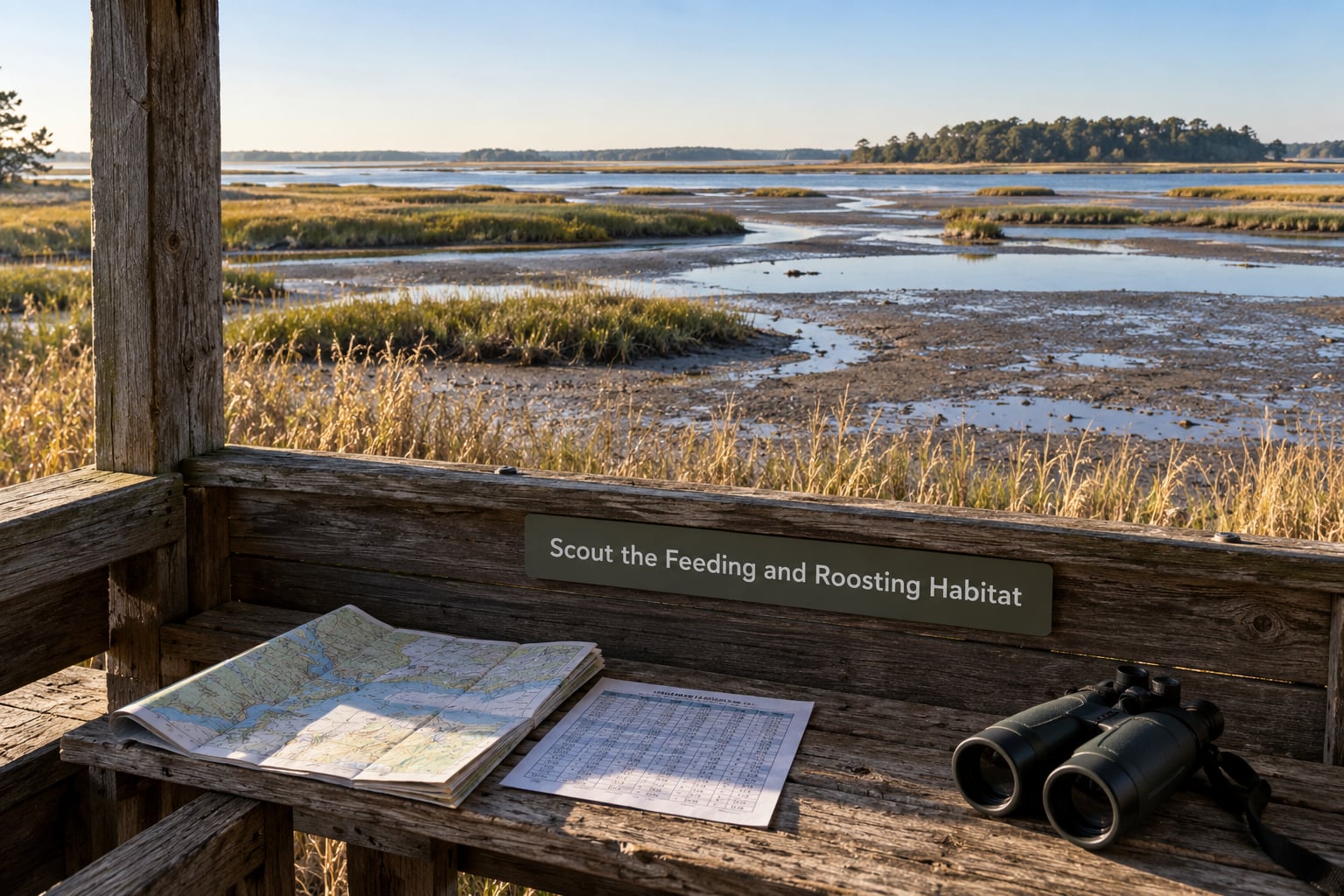
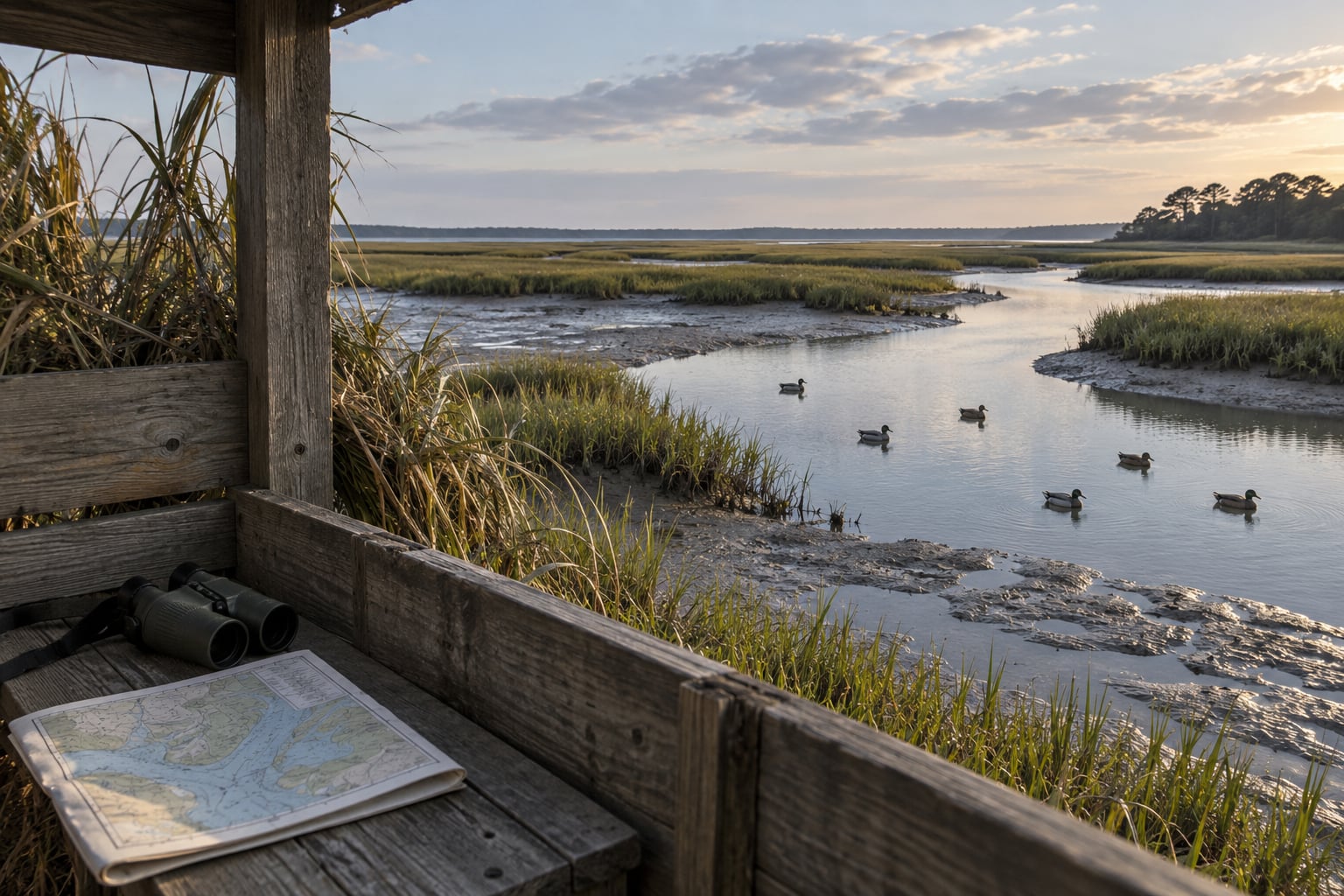
Scout at slack water. Low slack exposes the mud the birds feed on and the channels they use to get to it, which is the ground you will be hunting. A mid-morning scout at low slack on a day before the hunt gives you more than any amount of map study.
Work the places where water concentrates feeding birds: the inside bend of a creek, the lee side of a point, the edge where a salt marsh meets an impoundment dike, the mouth of a freshwater creek in brackish water, and any flooded timber edge holding water after the marsh drains around it. Look for the roost too, the deeper water with cover where birds sit between flights, because the roost tells you which direction the birds will come from.
The signs are unglamorous and reliable. Look for tracks and trails pressed into soft mud, belly-down sitting marks, droppings in the short grass, feathers caught in a snag or a wrack line, and shell fragments in the mud. Watch where birds cross a road or a levee. That crossing line is a flight path, and flight paths hold through tide changes better than feeding spots do.
Time the flight from cover and note the clock. If birds leave the roost twenty minutes before shooting time and are on the water before light, you know the pattern. If the flight is already done when you arrive, you are hunting leftover birds in a used spot, and you should move.
Keep scouting separate from hunting. Do not walk into a closed or restricted area, a roosting island with posted buffers, or a unit with a different season. Check posted boundaries, note which access points are legal, and remember that scouting someone else’s blind from a public vantage is different from entering private ground. When in doubt, stay on the public side of the boundary and look from there.
Finally, scout the exit. Trace the route you will take when you are finished, at the tide stage you expect to be leaving at, not at the stage you left at. This one habit prevents the most common serious problem on tidal ground.
3. Arrive Early Without Spooking the Birds
Arrive early enough that the setup is boring. Birds tolerate a person who was already sitting there far better than a person who just showed up and started moving.
Work the approach in this order. Park where your vehicle cannot be seen from the water if you can manage it, and stop well back from the launch. Check the wind before the last leg, because your scent and your noise both travel downwind, and put the wind at your back for the approach. Walk on the firm ground rather than the soft stuff, take the long way around, and pick a pace you could keep for twenty minutes without stopping.
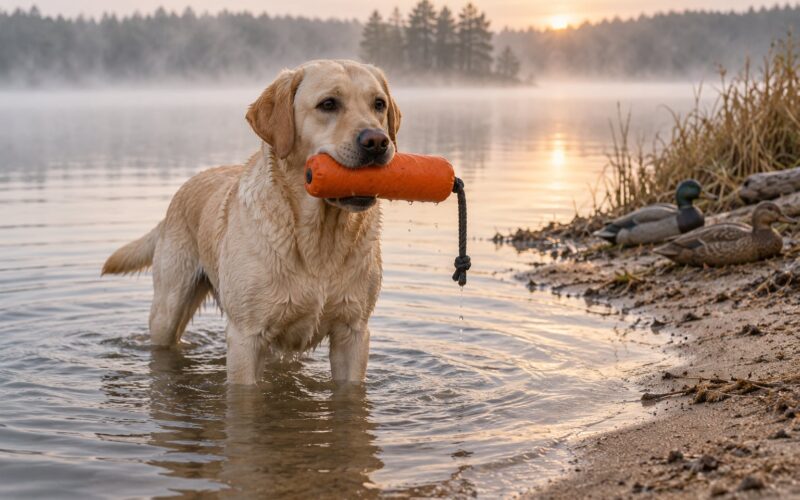
Control noise before you control anything else. Rubber boots are quiet on mud, hip waders are not. Loose gear knocking against a boat gunwale is the loudest thing in a marsh, so strap your shells and your calls down. Talk in a normal voice until you are inside the blind, then stop talking altogether. Let your dog settle on a towel before you set decoys, and never let a young dog range loose water before he has learned to hold.
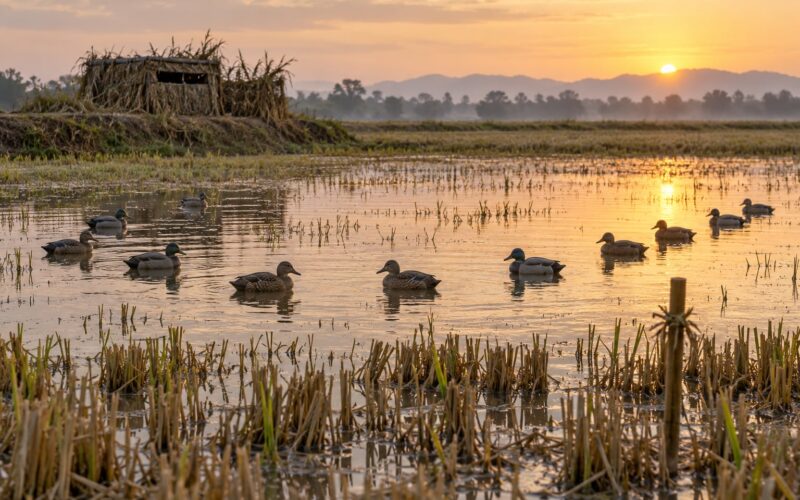
Set decoys, then sit and wait, then judge. You will know the setup is wrong early if birds circle without committing, if they trade at the edge of your spread, if they leave as fast as they came, or if they are consistently passing behind you instead of in front. The most common fixes are simple. Turn the spread into the wind so the birds approach from upwind. Move the decoys closer to the water the birds are actually using rather than the water you wanted them on. Get lower. Sit in the open boat with a camouflage blind on sticks and a push pole is often more effective than a layout blind you had to build on a soft bank.
Check the field of view before you decide you are set. A blind that hides you but gives you one narrow window will cost you birds all morning. A boat blind that turns with the current can look away from your own decoys without you noticing.
4. Establish a Safe Decoy and Calling Pattern
On moving water, decoys are a language problem, not a distance problem. Too many decoys in the wrong water reads as wrong to a bird that has been using this creek all week.
Stay inside your state’s rules on decoy numbers, and remember that some units and some closures restrict them further. Within the limit, use fewer decoys than you would on a still freshwater pond. A tight, believable block of six to ten decoys in the right water will pull better than a large loose raft. Match the scale of your decoys to the species you are after, because a spread sized for mallards looks thin to a flock of teal working the same creek.
Set decoys where the birds will actually feed at the stage you are hunting. That means your floating decoys may need adjusting partway through the morning. On an ebb, check that decoys are not drifting into a channel you cannot reach. On a flood, expect them to raft together or wash up into shore cover, and pull them back before they spoil your lane.
A common field rule from the RefugeForums decoy thread is five decoys for every flock bird that likes to fly low over other ducks, and to keep a clean open lane into the spread. On tidal water I would trim that and treat the clean lane as non-negotiable.
Anchor them like the water demands. Short anchor lines with adequate weight keep a spread coherent and let you pick it up at the end of the hunt. Long lines tangle in current and in submerged brush, and a decoy raft you cannot break up is a decoy raft that reads as a decoy raft.
Calling on tidal water should be restrained, especially with no cover and wind off the water. Start quieter than you think you need to. Vary volume, interval and pitch rather than repeating one pattern, and use the hail call sparingly, mostly when birds are already visible and audible. Stop calling when a flock commits. Loud, continuous calling on open brackish water pushes birds away, and a wind that carries your voice across a flat will do the same thing to your whole morning.
5. Read the Birds and Make Ethical Shots
Most missed birds are read wrong, not missed on purpose. Watch the flock long enough to identify the species, the number of birds, the direction, the altitude and the height over the decoys before you ever think about the gun.
Identify first, every time. Know the species in front of you and whether it is open to harvest today in this area. Several common coastal birds are not harvestable at all, including scoters and many sea duck species, and mergansers and wood ducks differ from puddle ducks in size, behavior and range. If you cannot identify a bird cleanly at the distance you are shooting, that is a bird you do not shoot at.
Judge the shot on range, cover and movement. The right answer at 45 yards in good light with birds coming straight in is usually to take it. The same birds at 70 yards, backlit through fog, at full climb, with a push coming, are not a shot. Dropping a bird you cannot find costs you nothing except pride; wounding one costs the bird and costs you the hunt.
Set a retrieval limit before the hunt and hold to it. Shoot inside the distance where you can see a bird fall, and stop shooting outside it. Mark the fall, note the heading, start counting the time, and retrieve with your dog or by boat inside the range you committed to. Nothing on a tidal flat is worth a long swim through cold brackish water at dawn.
Know when to quit early. If birds are consistently trading outside your spread, if every group that arrives leaves without landing, or if light and fog have taken your range away, the shooting is not clean and the hunt is not improving. Break down before the birds push you into a shot you would regret.
6. Finish the Hunt Within the Rules
The law controls the last part of the hunt as much as the first. End-of-hunt decisions, retrieval and what you keep are all regulated, and the rules are not one national checklist.
Check and follow the daily shooting time, which in most states opens a set interval before sunrise and closes at a fixed morning time. Stay out of designated no-hunting zones, closed areas, refuges with their own restrictions and any marked buffer around a roosting island. Respect the daily bag limit and the possession limit, which are separate numbers and both real, and note that possession limits often count birds you already have at home.
Know the species list for your area. Teal-only areas, harlequin-only areas, and species that are simply not open in your zone are all common in coastal settings, and the open and closed zones can run right alongside each other with a post marking the line. Know the legal methods for the area, including restrictions on bait, electronic decoys and motorized boats. Keep the required species identification on the bird until you are home. Tag every harvested bird as the state requires.
The key point is that legality is a property of the place, the bird and the moment, not of your identification after the trigger is pulled. A hen mallard over the right marsh at the right minute may be completely legal, and the same bird fifty yards away in a closed zone is not. When you are unsure about the zone boundary, the species or the time, the answer is to not take the shot.
Common Mistakes and How to Fix Them
Hunting the falling tide from open water after the birds pushed off the flats. Falling water pushes birds seaward, so a spread set a half hour late will sit behind them. Fix: confirm the direction of movement at the last hour of light and set the spread ahead of it.
Hunting a rising tide from a mud flat. The water arrives, you stand up on a point that is no longer surrounded, and the birds move past you with cover. Fix: on a flood, hunt from a shoreline blind, a point or a boat with the current behind you.
Scouting too close. Walking the creek at high water on the day before shows you nothing useful, because the feeding ground is still underwater. Fix: scout at low slack and look at exposed mud.
Arriving after the birds settle. If the flight has landed and been eaten for an hour, the spot is spent. Fix: plan to be set at least 45 minutes before legal shooting time, and check the previous morning’s flight time from your scouting notes.
Setting decoys in the wrong water for the stage. A spread in three feet of water looks absurd to birds working a foot and a half. Fix: match depth to the feeding stage and adjust again when the tide turns.
Using too many decoys. Overdecoying reads as pressure, especially in late season. Fix: a tight believable block in the birds’ water beats a big raft, and keep the lane into the spread clear.
Calling too loudly and too often. On open tidal water with no cover, loud calling ends the conversation. Fix: start soft, vary the pattern, and stop the moment birds commit.
Ignoring wind because the tide looked better. Fix: birds land into the wind. Put the spread upwind of your blind and let the tide work around that.
Mishandling the dog around cold water and boats. Fix: a life vest for every dog on the water, a ramp or stable gunwale for boarding, towels at the launch, and no free-ranging puppy in a current.
Retrieving past the safe distance. Fix: pick a limit in yards before the first shot and treat it as fixed.
Failing to verify a bird’s identity in the air. Fix: if you cannot name the species and confirm it is open, the shot does not happen.
Relying on general rules instead of current regulations. Fix: read your state’s current waterfowl regulations the night before every trip, every time, including the unit map.
One more habit worth adding: keep a small written log of tide stage, wind, birds seen and where they worked for each spot. Patterns show up after a season of notes and no amount of memory holds them.
Frequently Asked Questions
What tide is best for hunting ducks in coastal marshes?
Most guides on how to hunt the morning tide for ducks settle on the falling tide. Exposed flats concentrate feeding birds and then push them seaward into decoy range. From a point, bar or shoreline blind the incoming tide is the better choice, since rising water walks birds toward you and shortens your shots.
Should I hunt the incoming or outgoing morning tide?
Hunt the outgoing tide from open water, a channel mouth or a boat position, and hunt the incoming tide from a shoreline blind, a point bar or a dike. Outgoing water moves birds off the flats toward deeper water, and incoming water moves them back onto feed closer to shore. The deciding question is where you are set and whether your decoys will be in workable depth.
What decoy spread works best around a tidal creek?
Use fewer decoys than you would on still water, set them in the depth the birds are actually feeding at, and keep a clean open lane into the spread. A tight block of six to ten anchored decoys with short lines reads better than a large loose raft. Many field hunters start near five decoys for every flock bird they expect and trim from there.
Is it legal to hunt near a marine protected area in South Carolina?
It depends entirely on the specific area and the current rules. Coastal refuges, reserve boundaries and some state wildlife areas close waterfowl hunting or impose their own seasons, species lists, boat and blind restrictions. Protected status for birds and habitat is not the same thing as a hunting closure. Check the current South Carolina waterfowl regulations and the refuge or reserve rules for that water before you launch.
How far should duck calls carry?
A well-made call should reach far enough to bring birds to you and no farther, and on tidal water with little cover that means quiet. Wind direction matters most: wind blowing your voice toward open water carries it far more than you want. Start softer than seems necessary, vary your volume and interval, and stop calling the moment a flock commits to your spread.
What should I do if I cannot identify a flying duck?
Do not shoot, and let it go. Many common coastal species, including scoters and several sea ducks, are not open to harvest at all, and a wrong identification is a bird you cannot take back. If you cannot name the species and confirm it is open in that area on that day, the correct shot is no shot. Look for the marks you have drilled: head pattern, speculum color, wing bars and size against a known duck.
Conclusion: Start With the Tide and the Feed
Three things to do before your next dawn trip. Verify your state’s current waterfowl regulations for that area, including daily shooting time and species. Check the official tide table for your station and pick the stage that will be running during legal shooting time. Then scout active feeding water at low slack, so you know where the birds will be and not just where they usually are.
From there it is patience, quiet feet and honest identification. The tide will do most of the work for you if you let it, and the birds will tell you early whether you got it right. If the water is unsafe, the light is gone, or the shooting has stopped being clean, break down and come back on the next tide.