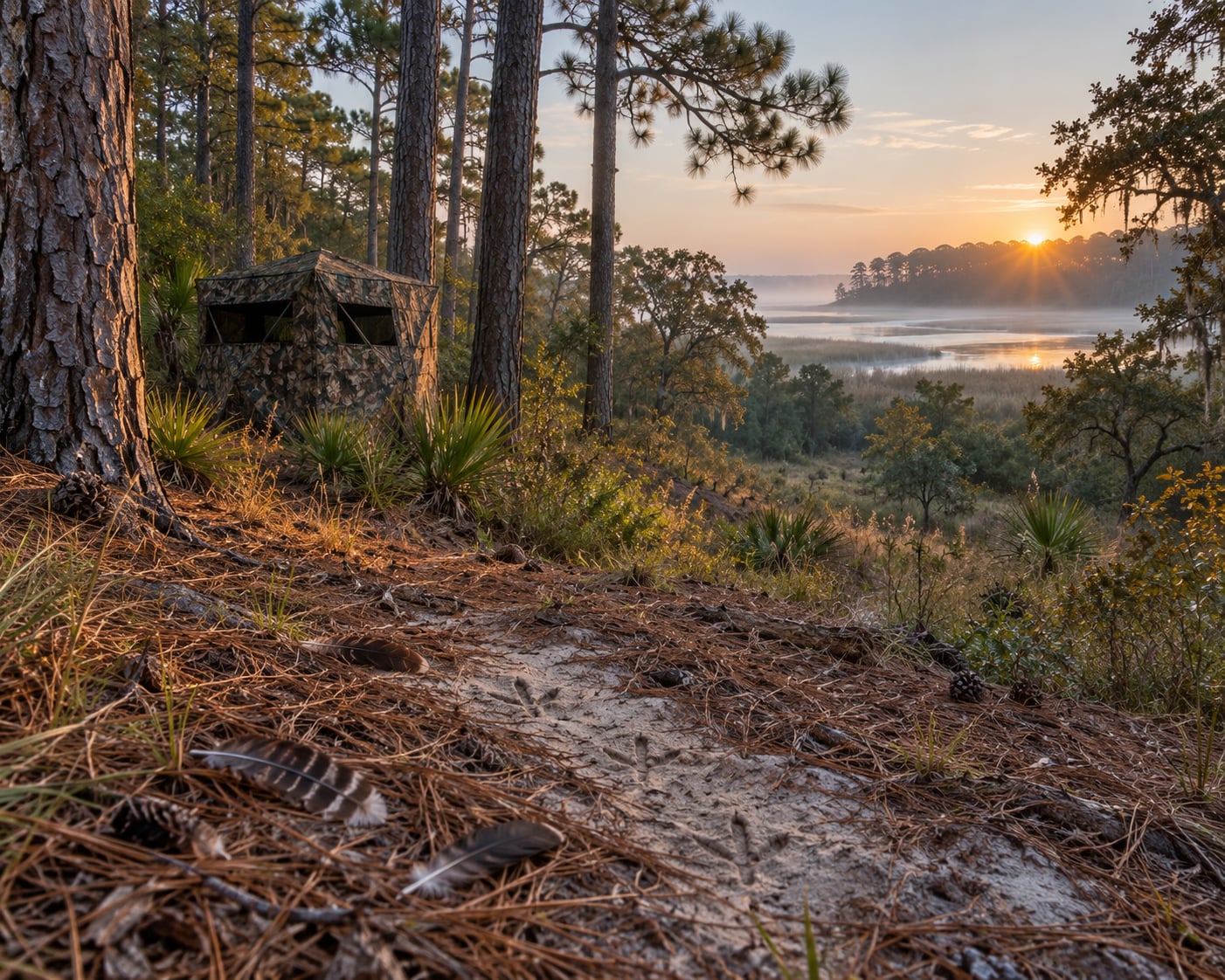
Hunting wild turkey in coastal pine woods comes down to one habit: hunt the edges, not the middle of the timber. Coastal plain gobblers roost in mature longleaf, slash, and loblolly pines, then walk out to the pine-hardwood transition to feed, strut, and loaf through the morning. Find that transition, read the sign in the pine straw, and be settled on the downwind side before fly-down. Walk the open pine instead and you can cover ten acres without laying eyes on a bird.
That is the whole difference between pine country and a hardwood bottom. Sound carries for a long way in open savanna, birds are easier to see at range, and the ones that hold real weight are pinned to a handful of zones you can learn. Everything below — scouting, sign, calls, positioning, and the shot itself — is built around those zones. Check your state wildlife commission for current season dates, bag limits, and legal tags before you leave home; those rules change, and they differ on public land, private land, and leased coastal property.
Table of Contents
- What You Need
- Step-by-Step: How to Hunt Wild Turkey in Coastal Pine Woods
- 1. Confirm the Rules and Access
- 2. Scout the Pine Woods and Transition Edges
- 3. Plan for Wet, Windy Coastal Weather
- 4. Choose Calls and Practice Before the Hunt
- 5. Set Up with a Clear Field of Fire
- 6. Work the Bird Instead of Overcalling
- 7. Identify the Target and Take a Responsible Shot
- 8. Recover, Field-Dress, and Pack Out Responsibly
- Common Mistakes
- Frequently Asked Questions
- What time of day is best for hunting wild turkey in coastal pine woods?
- How far should I set up from a turkey roost in pine woods?
- Should I use a box, slate, or gobble call in coastal pine woods?
- Can I hunt wild turkey near saltwater marshes and coastal wetlands?
- Is it better to hunt wild turkey in rain or dry coastal weather?
- How do I tell a legal adult gobbler from a hen or juvenile?
What You Need
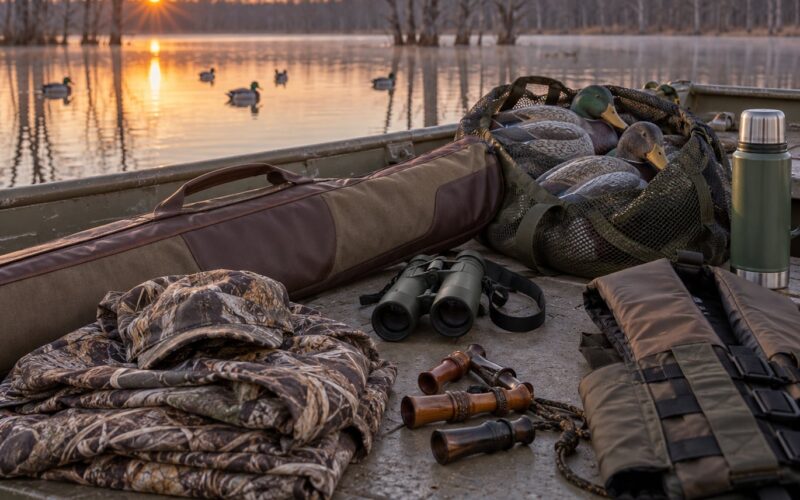
You do not need much gear to hunt coastal pine woods well. You need legal access, a few reliable pieces, and clothing that suits wet ground and salt air. What follows is the kit list I would build from, in rough order of importance.
- Licenses and legal tags. State hunting license, any required turkey permit or federal stamp, and your license number on a visible blaze orange garment. Rules on bearded birds, youth harvest, and multiple-bird limits vary by state, so read the current agency page rather than trusting last season’s memory.
- Land permission. Written or verbal landowner permission for private timber, and a walk-in permit where a state agency manages the land. Boundary markers on the ground beat a phone map every time, especially where a national forest, a state forest, and a WMA meet.
- Safety gear. Eye and ear protection, a charged phone in a waterproof pouch, a compact first aid kit, and a fire source that works when everything is damp. A headlamp matters more than you think at a 4:30 a.m. start.
- Shotgun, sling, and shells. Any legal slug or shot load you have personally patterned. Know where your pattern lands at 30 and 40 yards before opening morning.
- Calls. At least one hen purr and one loud gobbler call. A slate or slate-over-glass round is worth packing as a backup that never dries out. Reeds fail in the humidity that sits over the coastal flat.
- Optics. Binoculars, plain and unbreakable. They are how you find a red head at 100 yards in pine brush.
- Clothing for wet ground. Camo that breaks up your shape in open timber, plus rain gear, spare socks, insect headnet for early-season ticks and mosquitoes, and electrolyte drink. Coastal humidity turns a two-hour walk into a wet one.
- Navigation. Offline mapping on your phone, a compass, and a paper map of the tract in case the phone dies.
Step-by-Step: How to Hunt Wild Turkey in Coastal Pine Woods
Work the hunt in this order and each stage sets up the next. Scout first, read sign second, set up before the birds drop, then let the morning tell you where to be.
1. Confirm the Rules and Access
Before anything else, pull up your state wildlife commission’s turkey page and confirm the season dates, bag limit, legal shooting devices, and whether bearded birds are required. Then sort out where you are allowed to hunt.
Do not assume one website covers everything. A state wildlife management area can have its own access rules, a national forest can have a different set of closures and motor vehicle restrictions, and a private tract needs permission regardless of what any map shows. If a boundary is unclear, treat it as a wall rather than a question you sort out later.
Write the closing time on a card in your hat. On coastal ground the daylight fades faster than you expect once the tree line blocks the last direct sun.
2. Scout the Pine Woods and Transition Edges
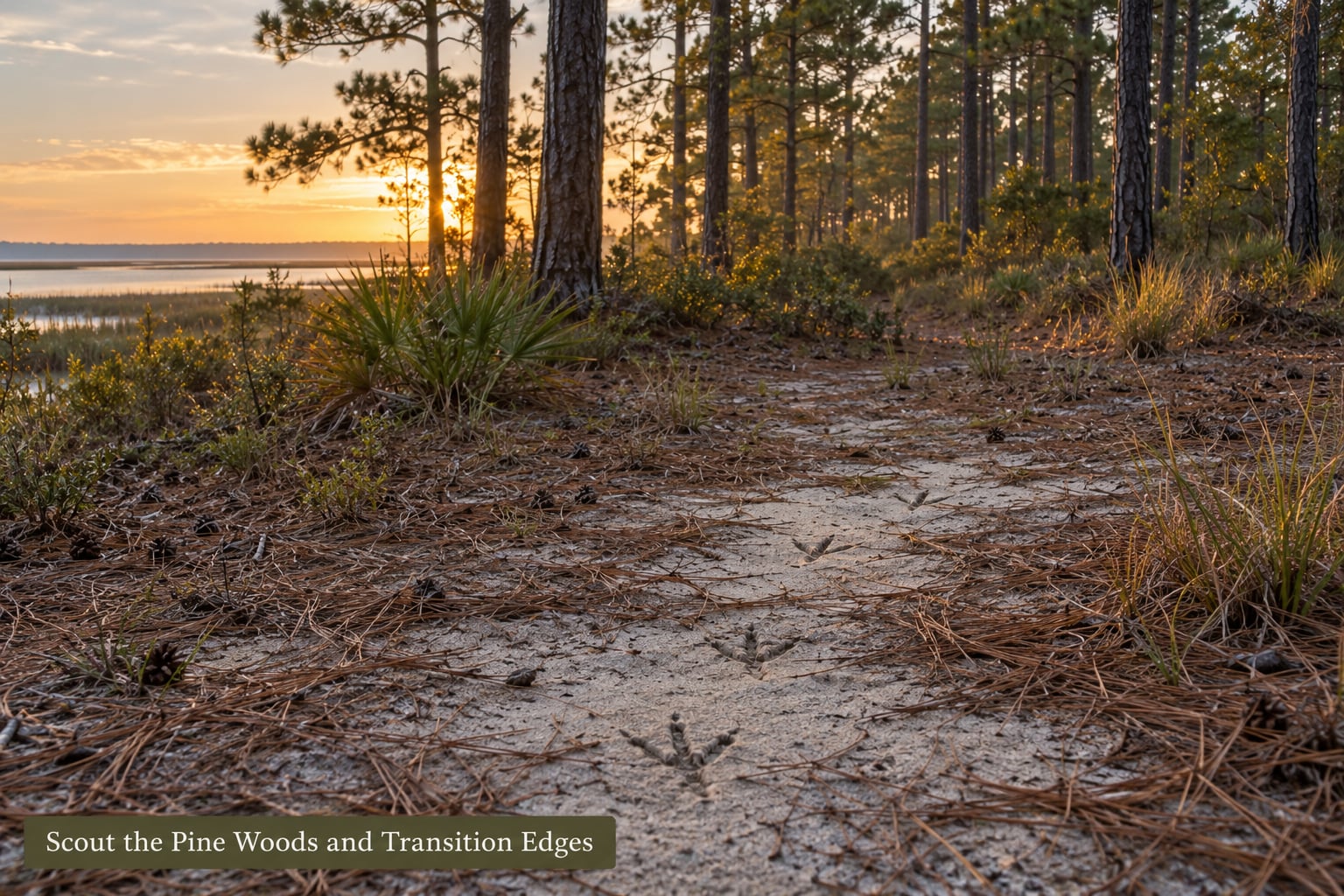
Scout the places where pine meets something else: a hardwood drain, a bottomland creek, a field edge, a powerline cut, a road with sandy shoulders. A state agency publication on the biology and management of the eastern wild turkey makes the point plainly — managing land strictly for short-rotation pine pulp across vast contiguous blocks leaves little prospect for wild turkeys, and clearcutting removes structure birds depend on. Pure pine is not a dead zone, it is just not where the birds are.
Look for the features that concentrate birds in spring: an open hardwood edge with wide sight lines for strutting, a sandy or bare patch for dusting, soft mast and browse in the hardwood drain, and water that funnels movement. A creek crossing or a low gap between ridges is a natural corridor birds use twice a day.
Read sign without exposing yourself. Walk edges and travel lanes, not the middle of the stand. Stop often, look up for roosting birds, and listen. If a patch shows no sign at all, move on — an experienced hunter on a firearms forum put it plainly: find an area with sign or move on.
3. Plan for Wet, Windy Coastal Weather
Coastal plain weather rewrites your plan more often than birds do. Salt spray, drizzle, fog, and a stiff onshore wind can all arrive in the hour before fly-down, and salt-laden wind pushes scent to you in ways an inland breeze never will.
Four factors actually change the hunt: wind direction, ground moisture, temperature swing, and visibility. Wet leaves and wet ground rustle underfoot. Fog flattens light and makes a decoy at 30 yards look like a bird and a hen look like a decoy. Warm fronts loosen birds into open ground earlier; cold nights with warm days push them toward sun-facing hardwood edges.
Plan a retreat you will actually use. Decide before first light where you go if you are soaked, if the wind turns your scent onto a roost, or if visibility drops to nothing. Layer rather than sweat, carry more water than you think you need, and pick footwear with grip over wet pine roots — a twisted ankle at a marsh edge ruins more trips than bad calling does.
4. Choose Calls and Practice Before the Hunt
Match the call to the situation, then make it sound like a bird instead of like a person. A loud gobble is for opening birds up in thick cover or getting a hen to answer. A hen purr is for birds that are already moving or holding tight. Tree yelps and excited yelps pull birds toward a call in open ground. Owl hoots work well in the first hour after dark and often get a roosting tom to answer. Slate calls give the widest range of volume and pitch from one tool.
Volume, pitch, rhythm, and placement decide whether the call works. Volume sets how far it reaches — and how far your location reaches. Pitch controls the mood: higher and faster excites a bird, lower and slower settles one down. Rhythm matters more than most beginners think, because a real hen purr has a rise and a fall rather than a flat buzz.
Practice before you hunt. Ten minutes of calling a week earlier does more for you than any gear upgrade. When you do work a bird, start moderate and let the bird’s response set your volume. Overcalling pushes a gobbler away from a spot you cannot safely reach.
5. Set Up with a Clear Field of Fire
Choose a concealed calling spot with a usable shooting lane, a sensible distance from where the bird should be, and a clean path back to your vehicle. In coastal pine woods that usually means the edge of an opening rather than the middle of it.
Sit so the wind is at your back and your scent travels away from the roost. Face the direction the birds most likely fly down into, and check your backstop — in open flatwoods a gobbler at full stride can cross ten feet in a second, and open ground behind it changes what a miss means. Know what is behind the bird before you decide to shoot.
Keep a sight line you can check on the ground, a knee or elbow braced against something solid, and your head down until you commit. Position beats volume on coastal ground every single time.
6. Work the Bird Instead of Overcalling
Start with a short sequence — three or four purrs, or one gobble and a pause — then shut up and listen. What comes back tells you almost everything.
- A gobble from a single direction: one hen or a lone gobbler, and you have a fix on his location.
- Several hens answering, no gobbler: there is a jake or a hen-picked bird in the group. Be patient; the big bird is often quiet nearby.
- A crashing, running gobble: he heard you, is spooked, and is moving away. Quiet down or stop.
- Silence after a loud series: he shut up or left. More volume rarely fixes this.
Adjust to what you heard rather than repeating the same sequence louder. When birds stop talking entirely, drop to very soft hen purrs. Experienced hunters report some birds will come in silently to a soft purr alone, without ever answering. Give that approach real time, keep still, and let the bird close the last ten yards on its own.
7. Identify the Target and Take a Responsible Shot
Only take the shot when you are certain. On legal adult gobblers you should see a heavy body, a long fan tail held out and up, wings held out and slightly down in front, a red or blue-white head, and a beard that swings with each step. The spur length and the beard both help you age a bird, but only a full view confirms it.
Hens and juveniles get taken by mistake every season, and in pine woods it happens more often because visibility is short and light is flat. If you cannot see the bird clearly enough to confirm beard, body mass, and spurs, do not shoot. Wait for the bird to reposition into better light, or let it go.
When you do shoot: keep the muzzle on a backstop, the stock on your shoulder, cheek welded to the comb, feet planted and body bladed to the bird. Know your firearm, keep it pointed where you would want it pointed, and be aware of the other people hunting the same tract. A safe shot is one where you are certain what you are shooting at, what is behind it, and who else might be standing close to it.
8. Recover, Field-Dress, and Pack Out Responsibly
After the shot, keep the firearm under control and unload it before you move, then track with patience. Hit birds die quickly; misses usually do not travel far, and a wounded bird stays put. Walk the line the bird was flying, look for feathers, and check the grass and wire fence lines nearby.
Follow your state’s tagging requirements exactly — where the tag goes, when it goes on, and what to do if you cannot find the bird are all regulated and they differ by state. Once the bird is secured, cool it promptly and field-dress it in the field. Coastal heat rises fast, and a bird left in the sun will spoil before you walk out.
Carry out everything you can: breast, thigh, and leg meat, plus the recoverable harvest. Take the head and beard if your state allows it. Do not leave a gut pile behind in coastal habitat — it draws predators, feeds scavengers, and leaves visible waste near marsh edges and sand ridges where it does not belong.
Common Mistakes
Almost every wasted coastal pine hunt traces back to one of these. Each one has a simple fix you can make before your next morning walk.
- Overcalling. Fix: three calls, then listen. Let the bird answer before you add volume.
- Skipping pre-season scouting. Fix: two daylight trips to find sign and one dusk trip to note a roost before opening day.
- Ignoring wind. Fix: check the forecast, pick your set-up with the wind, and scent-check your position before you settle.
- Choosing a blind spot with no lane. Fix: work the open edge, not the thicket, and confirm what stands behind the bird.
- Taking a hen or juvenile. Fix: if you cannot confirm beard and body mass without moving, wait or pass.
- Walking noisily through open ground. Fix: stop every 30 yards, glass the next 100, then move.
- Getting wet and chilled. Fix: pack rain gear and a dry layer, and set a real retreat time.
- Crossing a boundary you were not sure about. Fix: treat every unfamiliar line as private land and confirm before you set up.
- Hunting a pure pine block all morning. Fix: work the transition zone — the drain, the road edge, the hardwood margin.
- Shooting beyond your pattern. Fix: pattern your gun, pick a limit, and stick to it even when a bird presents at longer range.
Frequently Asked Questions
What time of day is best for hunting wild turkey in coastal pine woods?
The first two hours after fly-down at first light are the best window, and the hour before sunrise sets up the shot. Coastal plain gobblers roost in mature pines, come down in the open, and gobble hardest right after they hit the ground. By mid-morning the birds settle into feeding and loafing, and by early afternoon they have usually gone quiet in shaded cover. Plan a second positional attempt near a loafing area rather than pushing calling volume.
How far should I set up from a turkey roost in pine woods?
Set up far enough away that the bird must come to you, and close enough that he commits on the way down. Most successful coastal hunts work from roughly 60 to 150 yards off the roost, positioned on the downwind side of the likely landing zone. Sit down before light, keep your body outline below the bird’s flight line if you can, and stay quiet. The closer you sit, the more your scent and movement give you away.
Should I use a box, slate, or gobble call in coastal pine woods?
A slate, or a slate-over-glass round, is the most forgiving choice in coastal humidity because it will not crack and you can run it quiet or loud. Box calls give you more volume and character but need a good strike and dry weather. A gobble call is a short-range tool and works best when a hen is already answering. In open savanna, a loud gobble carries much farther than you intend, so keep the volume moderate and let the response guide you.
Can I hunt wild turkey near saltwater marshes and coastal wetlands?
Often yes, but the rules are often different and the footing is bad. Many coastal jurisdictions manage marsh and wetland edges as part of a wildlife management area with its own closure, access, and vehicle rules, and some areas close during nesting or brood season. Expect standing water, soft mud, and birds that flush at long range. Check the specific area’s regulations with your state agency, wear waterproof boots, and never walk across tidal flats you cannot read.
Is it better to hunt wild turkey in rain or dry coastal weather?
A steady light rain is often the best turkey hunting weather on the coastal plain. Birds stay closer to cover, move slower, and hold tighter, and the soft ground makes tracks easier to read. Heavy rain and fog flatten visibility and make you easier to detect at the same time, so they favor patience and a close setup. Dry windy mornings push scent to you but push birds out where you can see them, which favors open-edge hunting with binoculars.
How do I tell a legal adult gobbler from a hen or juvenile?
Look for three things together: body mass, the tail fan, and the beard. A legal adult gobbler is heavy in the chest, holds a long fanned tail up and forward with wings out and slightly down, and swings a visible beard as it walks. Hens and juveniles run slimmer, hold a shorter rounded fan, and lack a prominent beard. In pine woods, wait for the bird to step into better light before deciding, and pass if you cannot confirm. Rules on minimum beard length differ by state, so verify them before the season.
Start tomorrow with the scouting, not the calling. Two daylight trips to find tracks, droppings, and scratches around the pine-hardwood edges, then one dusk trip to note which pines the birds are using, will put more birds in front of you than any amount of practice in the yard.
When the season opens, be seated before light with the wind at your back, call a short sequence, and then be quiet. Coastal pine woods rewards patience and positioning over volume — and the same hardwood drains and creek crossings that hold the birds in spring are the ground that produces next spring’s gobblers, so hunting them well and managing them well are the same habit. Confirm current regulations with your state wildlife commission before every season, since dates, bag limits, and bearded-bird rules change.