Rust is not a humidity problem you solve with oil. It is a humidity problem you solve by keeping the air around the firearm dry, then keeping a thin film of protection on the metal. Gun rust prevention in humid climates comes down to four things: hold relative humidity between 30 and 50 percent where the gun actually sits, site the storage space away from damp walls and concrete, remove every drop of moisture after a hunt or a range day, and reapply protection on a schedule you actually keep.
The reason that order matters is simple. A film of oil slows corrosion, but it cannot stop it if the air around the firearm stays saturated. Put an oiled rifle in a closed safe in a Florida garage and you have built a small humid box around a piece of steel. People find surface rust there within weeks, sometimes sooner, and then blame the oil for failing.
This guide is written for hunters and outdoor users who keep firearms through long wet seasons, basement safes, garage safes, truck beds, boats and RVs. It is a procedure you can repeat, not a product list. The whole routine takes about twenty minutes per firearm per visit once you have the habit down.
Last reviewed: October 2026.
Table of Contents
- What You Need
- What Humidity Level Actually Causes Gun Rust?
- How to Prevent Gun Rust in Humid Climates: Step by Step
- 1. Identify Where Humidity Reaches the Firearm
- 2. Check the Manufacturer’s Care Instructions
- 3. Clean the Firearm After Use
- 4. Dry the Metal and Internal Surfaces Completely
- 5. Apply a Manufacturer-Approved Rust Protection
- 6. Store It Somewhere Dry: Preventing Gun Rust in Humid Rooms and Safes
- 7. Inspect and Reapply Protection on a Schedule
- Common Mistakes
- Frequently Asked Questions
- What is the best way to prevent gun rust in humid climates?
- Is oil alone enough to protect a firearm from humidity?
- Does stainless steel eliminate the need for gun rust prevention?
- Should I store a firearm in a gun case in a humid climate?
- How often should I check and protect a stored firearm?
- When should rust on a firearm be inspected by a gunsmith?
- Conclusion
What You Need
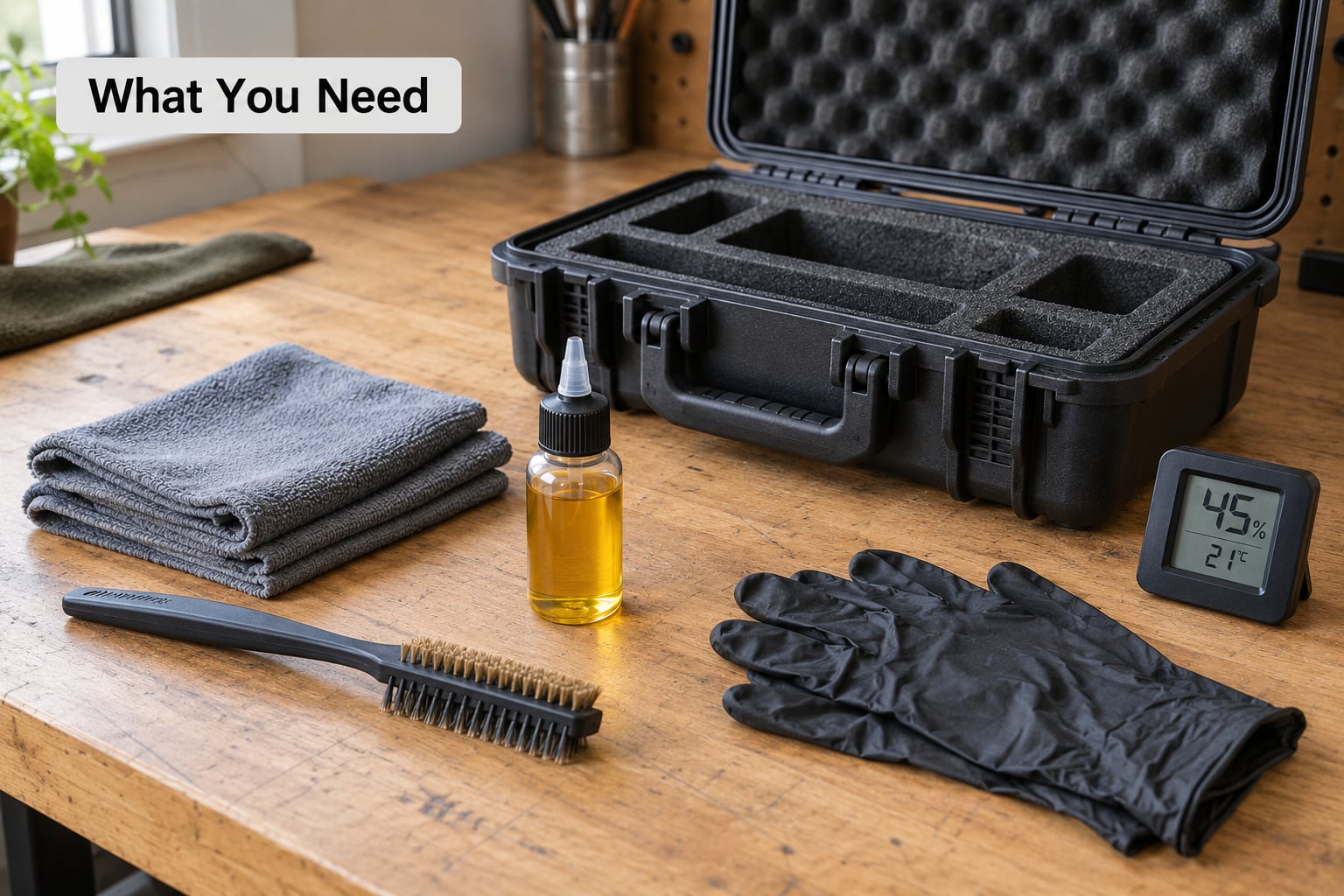
You do not need much to do this well, and most of it is cheap. You do need a way to see the humidity where the firearm is stored, because that single number drives every other decision.
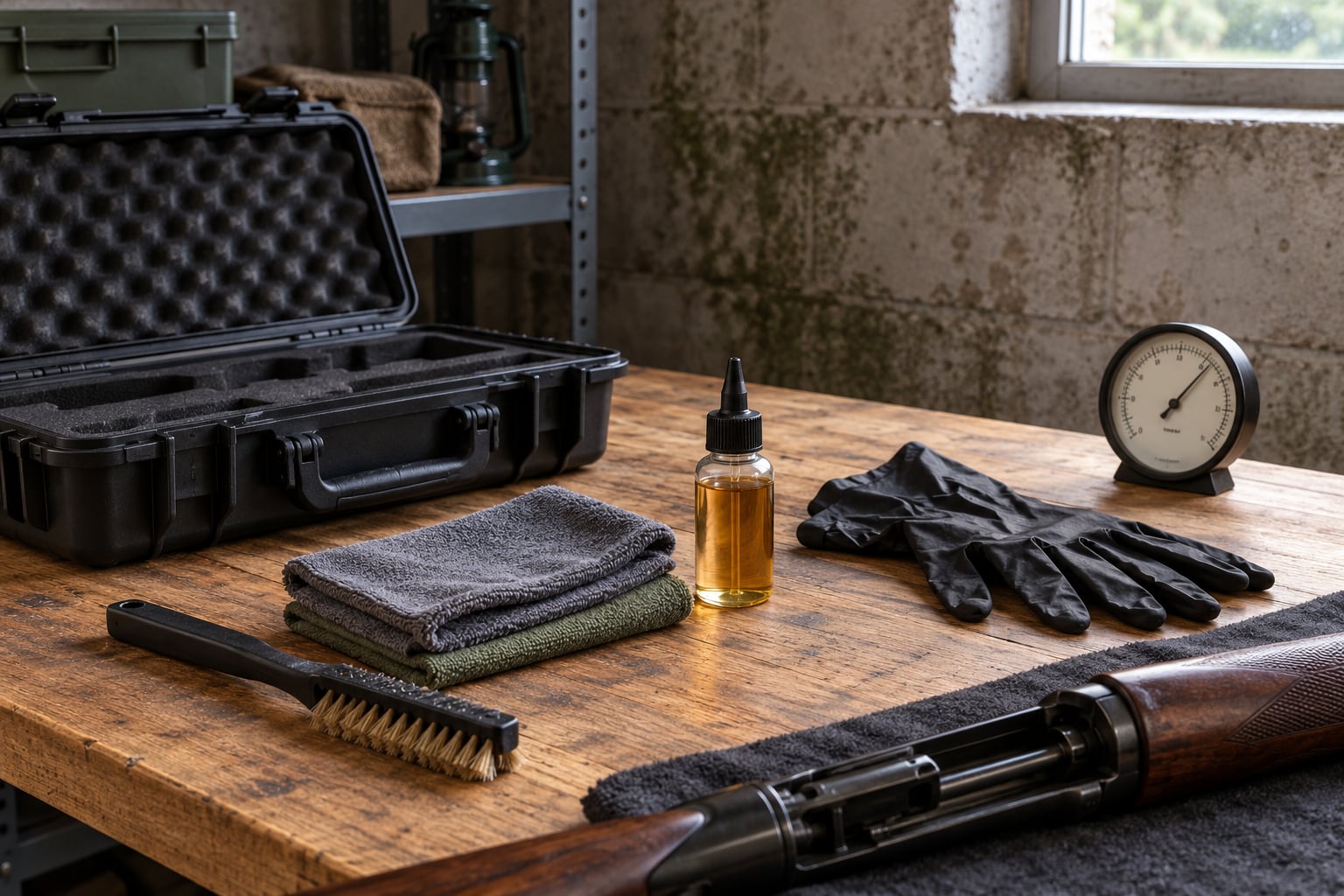
- A hygrometer. A dial model with a remote probe is ideal, since you can leave the probe inside the safe and read the dial from outside. A cheap digital model works fine too. Buy two if you can: one for the room, one for the safe interior.
- Rust-preventive oil or cleaner-lubricant-protectant approved for your firearm. Read the owner’s manual first. The manual for your specific model will state what the manufacturer accepts on the finish, and deviating from it is how people end up with stained furniture or a bolt that gums up.
- Microfiber cloths. Plain, lint-free, kept in a sealed bag so they stay dry until you use them.
- A soft nylon or brass brush. For dust and fouling on exterior surfaces and in the areas a cloth cannot reach.
- Absorbent material for internal surfaces. Clean patches or bore brushes that dry the chamber and bolt area after a wet session.
- A source of controlled airflow. A clean dry air source or a gentle fan, used briefly, speeds drying of internal areas. Do not blow grit into an open action.
- Breathable storage materials. A rust-treated gun sock, a silicone-treated wrap, or a ventilated hard case. Breathable matters more than heavy.
- A moisture-control option for the space. Desiccant or rechargeable beads for a small enclosure, a rod or cordless unit for a mid-size safe, or a dehumidifier for the room the safe sits in.
- Nitrile gloves and a clean, dry bench. Bare hands carry salt and moisture onto the metal. Gloves also keep fingerprints off a finish that is already fragile.
Skip the aerosol rust converters for now. They are for treating damage, not preventing it, and they have no place in a prevention routine.
What Humidity Level Actually Causes Gun Rust?
The number most sources quote is 30 to 50 percent relative humidity, and that is the target. The practical ceiling is closer to 45 to 50 percent, especially for anything with wooden furniture, where the wood swells at higher readings and the finish can be affected. Sustained readings above 60 percent are where surface rust starts appearing on bare and blued steel, often within a few weeks. Below about 30 percent you go the other way, and wood dries out, cracks, and can loosen in the bedding.
Relative humidity is simply the amount of water vapor in the air as a percentage of what the air could hold at that temperature. The “could hold” part is why dew point matters more than the raw number. Air that reads 60 percent at 70 degrees is holding a lot of water. Cool that same air to 55 degrees and the same moisture now sits at 100 percent, and water forms on every cold surface it touches. That is condensation, and it is the single biggest reason a firearm that was fine in the afternoon is damp the next morning.
A sealed safe is a condensation generator. Firearm forums keep rediscovering this: one user reported about 200 milliliters of water collected inside a safe over six months indoors. Nothing was leaking in. Moisture was entering through the door seals and the wall the safe was bolted to, then condensing on the coolest metal inside. Warm daytime air, cool night air, and steel that changes temperature faster than the room around it.
Reading differs by location, which is why a cheap hygrometer tells you so much more than a weather app does. Your house may sit at 45 percent while the basement corner behind the safe reads 68 percent, and that corner is the only number that matters for a firearm stored there.
| Firearm or item | Target relative humidity | Notes |
|---|---|---|
| All-steel pistol, blued or parkerized | 30-50% | Tolerates short excursions above 50% better than anything with wood, but bare steel shows rust first. |
| Rifle or shotgun with wooden furniture | 35-45% | Wood absorbs moisture and swells; keep the ceiling lower and the humidity steadier. |
| AR-pattern rifle, phosphate or cerakote finish | 30-50% | Coating slows corrosion, but the phosphate under a worn finish still pits. |
| Stainless barrel or match rifle | 35-45% | Stainless resists rust but develops pits, which corrosion does. |
| Bows and archery equipment | 40-50% | Cables, glue, and limbs are more sensitive to swing than bare steel. |
| Optics, batteries, and ammunition | 40-50% | Condensation on glass and slow degradation of primers and powder go with high humidity. |
One more caution: very low humidity is not the safe answer some people assume it is. Primers, adhesives in optics, leather, and wood all suffer when the air gets bone dry, and sudden swings in either direction cause more problems than a steady reading in range.
How to Prevent Gun Rust in Humid Climates: Step by Step
1. Identify Where Humidity Reaches the Firearm
Humidity rarely arrives from one place. Walk the storage area and list every path moisture takes: an exterior wall that sweats through block or brick in a coastal county, a bare concrete floor that wicks groundwater upward, a truck bed or storage container that heats all day and sheds condensation at dawn, a closet where wet rain gear and boots are stored next to the case, an RV or boat cabin with the same temperature swings, or simply outdoor air moving through a poorly sealed building.
Then measure instead of guessing. Put one hygrometer where the firearm is, not where you read comfortable. Keep it at firearm height, several inches off any wall, and out of a vent or an air-conditioning supply. If you can, put a second one inside the safe or case itself, since a sealed enclosure can run noticeably higher than the room around it. Leave both running for a week before you buy anything.
Check the readings at three times of day. Early morning catches the condensation minimum after a cool night, mid-afternoon catches the peak, and a late-evening reading shows the rate of recovery. In a well-run basement in a hot humid state, the daily swing alone can be fifteen points. That swing, more than the average, is what does damage.
A close relative reading and a remote probe also tell you whether the safe is effectively isolated. If the probe inside reads the same as the room, the safe is not a controlled environment at all and you need to treat the room, not the box.
2. Check the Manufacturer’s Care Instructions
Before any product touches the metal, open the owner’s manual and find the cleaning and lubrication section. Manufacturers differ on what is safe for their finish, and the differences matter more than most people expect. Some specify a light oil only. Some warn against penetrating sprays. Some caution against any petroleum product on a polymer furniture panel or a coated bolt carrier, because the coating traps grit against the sliding surface.
Finishes also fail in different ways, which changes what you are protecting:
| Finish | How it reacts to sustained humidity | What protection works |
|---|---|---|
| Bluing (traditional hot caustic) | Protective film that breaks down; shows rust as light bloom first, then pitting that cannot be polished out. | Thin oil film renewed on a schedule; rust-free storage. |
| Parkerizing or phosphate | Holds well until worn through at contact points, then corrodes under the coating and flakes. | Oil on exposed and worn steel; light film over the whole part. |
| Cerakote or other polymer coating | Very resistant, but chips expose raw steel that pits fast and rusts under the coating edge. | Keep coating intact, oil any exposed metal, do not abrade. |
| Stainless steel, polished or bead blasted | Does not rust the way carbon steel does, but develops pits from chloride and moisture, especially in marine air. | Free oil, because stainless relies on an intact film; more frequent renewal. |
| Wooden furniture | Absorbs moisture, swells, and can raise or lower in the action as it moves. | Stable humidity matters more than any coating; light oil on the wood |
Note the last row. People focus on the metal and forget that a wood stock sitting in an unconditioned garage is a moisture meter with a gun attached. Interior humidity control protects the furniture and the metal at the same time.
3. Clean the Firearm After Use
The best time to deal with moisture is before it has a chance to sit. After a wet hunt, a rainstorm crossing the trail, or a humid day at the range, run a short cleaning routine rather than a full detail, but do it while the gun is still cool to the touch and before any surface has had time to spot.
Work the way the manual describes. Where the manual directs you to clear the firearm or check it unloaded, follow that instruction exactly, and never point any part of it at a person. Knock off loose dirt and grit with the soft brush, work from the breech end toward the muzzle so debris moves forward, and use only the brushes and patches specified for the caliber and finish you have.
Keep three rules. Do not flood openings, because solvent and cleaner behind a seal or in a stock inlet has no path out. Do not use a product the manual has not cleared, including household oils and general-purpose sprays. And do not push a patch so hard through a chamber that you can abrade the finish and leave bright metal, which is the first place rust shows.
If the firearm is an airgun with a compression tube, a suppressed firearm with a fouled baffle, or anything the manual says needs factory service, stop after the exterior brushing and let the manufacturer handle the internals. Forcing solvent into a sealed tube is how water gets trapped inside a part you cannot dry from outside.
4. Dry the Metal and Internal Surfaces Completely
Water sits in the chamber, under the extractor, in the bolt recess, around the firing pin slot, inside a cylinder, and beneath a magazine well. Those are the places rust starts, and they are the places people skip. After cleaning, run a clean dry patch through the chamber and the barrel the manual specifies, and use the brush and a clean patch on the bolt and bolt carrier surfaces. Repeat with fresh material until the patch comes out clean and dry rather than damp and grey.
For external surfaces, wipe with a dry microfiber cloth and let the metal air dry in a shaded, ventilated space. If you use a gentle air source, keep it moving, keep it clean, and keep it away from loose grit. A slow fan across an open action for a few minutes does more than an hour of impatience.
Do not put a warm, damp firearm straight into a closed case. That is how you seal in the exact conditions you are trying to avoid, and the case then holds that damp air against cold steel until morning.
When the firearm is deeply wet, has standing water in the bore, has been submerged or caught in a flood, or shows rust inside the receiver where you cannot reach with a patch, stop and get a gunsmith. Drying a submerged firearm is a service job, not a field fix, and forcing either water or a solvent into a seized part makes it worse. The same goes for any firearm with a damaged finish, an aftermarket muzzle device, or a scope whose internal fogging has not cleared after the manufacturer-directed break-in period.
5. Apply a Manufacturer-Approved Rust Protection
Once everything is dry, apply a thin, even film of the oil or cleaner-lubricant-protectant the manual approves. Thin is the operative word. A light film displaces the air and water film on the steel; a heavy coat simply collects dust, and that grit becomes an abrasive under a moving bolt. Over-oiling is the most common self-inflicted problem in this whole subject, and it can lead to reliability complaints that have nothing to do with humidity at all.
Use a clean lint-free patch or a small applicator and wipe the exterior steel, the bolt surfaces, the chamber, and any area the manual lists. On a long-term storage gun, a quality rust-inhibiting grease is the better choice than a light oil, because grease does not migrate off surfaces or evaporate in a warm safe. Forum consensus, for what it is worth, is that any quality light oil applied often beats an expensive specialty oil applied once a year.
Keep product off the places where it causes trouble. Wipe the grip panels, the stock finish, the rail tops, the front and rear sight surfaces, the magazine bodies, and the exterior of an optic. A slick rail can shift a mounted scope under recoil, oil on a sight blade can hold grit and blur the sight picture, and grease on a magazine can collect powder residue. If you lubricate a trigger or a bolt carrier for function, follow the manual’s instructions on how much and where, then wipe the excess.
Put a light film on the bore only if the manual says to, and only on a clean bore. There is no benefit to filling the rifling with oil, and there is a real cost if the first round is loose.
6. Store It Somewhere Dry: Preventing Gun Rust in Humid Rooms and Safes
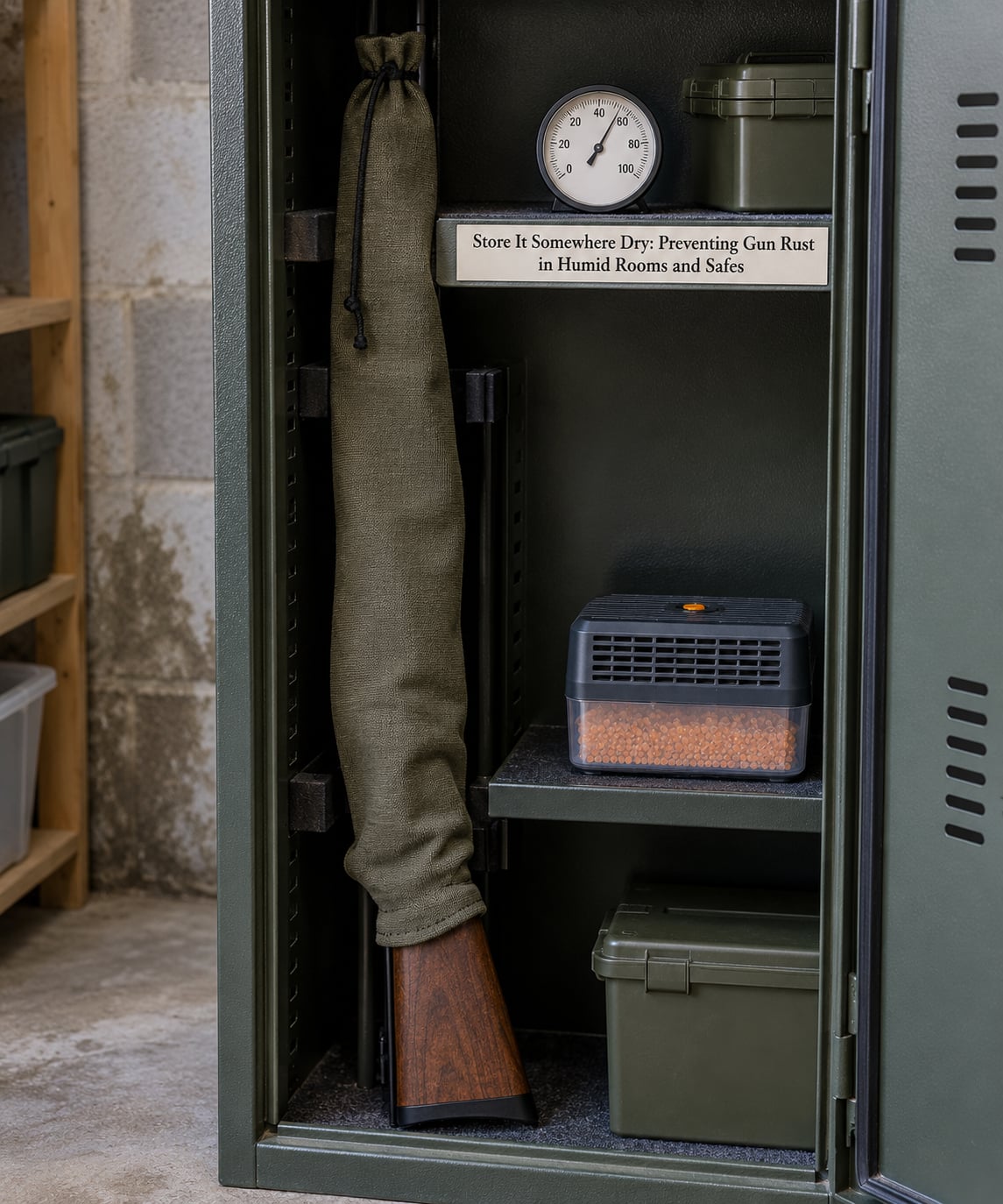
A closed case is a container, not a climate. It keeps dust off and it keeps moisture in. The right approach is to control the humidity in the space, then use physical barriers to keep the airflow and the surfaces separated.
Siting is free and it is the fix people skip. Do not store against an exterior wall, especially on the wall that faces the prevailing wind or the water. Do not sit a case directly on a bare concrete floor or on an unfinished slab; use a pallet, a stand, or rated blocks so air can move underneath. Keep the safe away from a water heater, a sump, a laundry room, and a bathroom wall. In a closed garage, a shelf in the middle of the far wall beats a spot against the siding, even in a humid region.
On physical barriers, forum advice is fairly consistent. A rust-treated gun sock or a silicone-treated wrap is worth using, and inexpensive, because it slows moisture transfer without sealing in what is already there. A ventilated hard case is a reasonable choice in a conditioned room. An airtight plastic tote lined at the seams with foam is a strong option if the firearm inside is bone dry when it goes in, since that approach works better than leaving a firearm exposed to the same air. In all cases, keep the interior dry at the moment of closing.
On the desiccant question, the rule is that it must not touch the firearm or the ammunition directly. Packs of silica gel beads belong in a sleeve, a sachet, or a perforated container, and they need to sit where the air actually moves. Loose beads leave grit on the metal, and grit under a bolt is a reliability problem before it is a corrosion problem. When a pack is saturated, recharge it rather than discarding it: heat it in an oven at 325 degrees Fahrenheit for about two hours, or use the manufacturer’s charging base for the long cycle version, and confirm it is fully dry before returning it to the enclosure.
There is a real debate about whether to dry the air inside the safe or dry the air in the room. The practical answer is that a modest room is usually easier to keep dry than a sealed steel box, because you cannot introduce airflow to a sealed box without drilling into a fire-rated safe, which most owners will not do and many manufacturers will not approve.
| Method | How it works | Best fit | Watch out for |
|---|---|---|---|
| Desiccant packs (silica gel, disposable) | Absorbs water from the air in a sealed space until saturated | Hard cases, small lockers, ammunition cans, travel | Single use, must not touch metal, finite capacity, needs frequent replacement |
| Rechargeable beads or cordless units | Silica or a similar agent that is dried out and reused, with a moisture indicator window | Medium safes where the door opens often | Still no airflow, so capacity is limited; recharging is a recurring chore |
| Electric heating rod | Slowly warms air so relative humidity drops, drawing a small amount of power | Large safes with room for a power source | Needs power; many owners are unwilling to run a cord to a safe |
| Room or garage dehumidifier | Removes water from the whole space, so the safe and the walls both improve | Basements, garages, closets, and any storage room with a door | Running cost, drainage, noise, and the need to keep the space reasonably enclosed for it to work |
Two cheaper tactics get skipped often. Run foam insulation along the safe door seals to cut the slow air exchange that lets moisture in. And dehumidify the surrounding room, which several forum users describe as the single change that fixed a persistent problem, with one reporting a steady 50 percent once a unit was added at the room level.
Access and transport are part of this. A locked safe you cannot get to quickly in an emergency is its own problem, separate from humidity, and moisture control makes no difference if the gun is hard to reach when you need it. When you move firearms, particularly on humid days, treat the case as a sealed environment: warm the firearm and its contents to room temperature before you open the case, or let the case sit closed until it reaches room temperature. Cold gun plus warm humid air inside a case equals condensation, and that includes cases on a boat and in a vehicle.
Leave a firearm in a vehicle trunk or a pickup bed for a full day in hot humid weather and no routine will save it. A trunk is a small oven with metal walls, a high humidity load, and no way to shed moisture. If it has to stay in the vehicle, the case needs to be insulated and the firearm bone dry inside it, and that is a short-term measure.
7. Inspect and Reapply Protection on a Schedule
Routine maintenance is what makes preventing gun rust in humid climates a habit instead of a repair job. A monthly wipe-down of a firearm stored in a conditioned room with wooden furniture is plenty. A firearm in an unconditioned garage or basement in a coastal county wants a weekly glance and a monthly cleaning and oiling. After any wet hunt, a rain crossing, or a trip to the coast, clean and dry it the same day.
| When | What to do |
|---|---|
| Weekly, during humid season | Read the hygrometer, check for the first signs of spotting on exposed steel |
| Monthly | Wipe external steel, renew the thin film on the bolt, chamber, and receiver, refresh desiccant |
| After any wet use | Clean, dry, oil, and return to a dry enclosure before closing it |
| Seasonally | Clean the finish, check the vent holes and door seals, verify the dehumidifier, and check the wooden furniture for swelling or gaps |
| Before a long storage period | Full detail, heavier grease on the steel, clean barrel and chamber, and a desiccant pack in the case |
| After a temperature swing or relocation | Let the firearm reach room temperature inside a closed case before opening it |
Distinguish residue from corrosion as you look. A brown or gray film that wipes off and leaves bright metal underneath is oil and powder residue, and it means clean it and lighten the oiling. Active corrosion does not wipe off. It is a stain that stays in the metal, it feels rough or pitted, and it reappears even after you clean and oil the surface.
Surface rust on bare or blued steel is normally fixable. A brass brush or fine abrasive on a cloth, working with the grain, followed by a thorough wipe, a clean and light oil, will usually restore the surface if the corrosion is shallow. Work in small passes, and stop if the metal starts thinning. On a stainless part or a match barrel, pitting is different: the pits are permanent, they will not polish out, and the fix is a gunsmith and sometimes a rebluing or a refinishing job. The same goes for rust under a blued finish that has already lifted and flaked, or for a firearm with pitting in the chamber or on the locking lugs, where the practical question is whether the part still functions correctly and needs professional assessment rather than a home fix.
Finally, treat the surrounding items as part of the same system. Optics, cameras, rangefinders, and electronics stored in the same room suffer the same humidity. A sealed container with desiccant is cheap insurance for anything that is not a firearm, and ammunition in its original factory packaging in a dry enclosure keeps well below the levels that degrade primers and powder.
Common Mistakes
- Storing a damp firearm in a closed case. The case seals in the moisture. Fix: finish cleaning, drying, and oiling first, and only then close the case.
- Over-oiling. A heavy coat attracts dust and grit, which is abrasive under a cycling bolt. Fix: wipe back to a film you cannot see.
- Using household products such as general-purpose spray lubes and cooking oils. Many are not approved for firearm finishes, and some leave a residue that holds moisture. Fix: use what the owner’s manual clears, usually a quality oil or CLP.
- Measuring humidity in the wrong room. A comfortable living-room reading tells you nothing about a basement safe. Fix: put a hygrometer where the firearm is, at firearm height, away from walls.
- Ignoring the chamber and bolt. Rust starts in the places nobody looks. Fix: rotate clean dry patches through the chamber and wipe the bolt every time.
- Moving a cold firearm into warm humid air. The temperature difference makes water out of the air, on the spot, inside the case. Fix: let the case and gun reach room temperature before opening.
- Letting desiccant touch the firearm or ammunition. Loose gel leaves grit on the metal. Fix: sleeves, sachets, or a sealed container with a perforation.
- Parking a firearm in a vehicle trunk or bed for hours. There is no fix for a full day in a hot trunk. Fix: bring it inside, or treat the vehicle only as a short-term transfer.
- Treating rust without finding the cause. Cleaning a spot on a firearm that is still stored in saturated air just buys a few weeks. Fix: fix the humidity first, then the surface.
Two more worth naming. Drilling holes in a fire-rated safe to run a cord or a hose is a genuine loss of the rating, and there is usually a better answer in dehumidifying the room. And assuming stainless steel means you can skip maintenance is how people end up with a pitted match barrel: stainless resists rust, but in salt air and sustained humidity it corrodes too, as pitting rather than red bloom.
Frequently Asked Questions
What is the best way to prevent gun rust in humid climates?
Control the relative humidity where the firearm is stored, not just the oil on it. Keep readings between 30 and 50 percent, stay under 50 percent for anything with wooden furniture, and treat sustained 60 percent or higher as active corrosion risk. Site the case away from exterior walls and concrete, add desiccant or dehumidify the room, and renew a thin film of rust-preventive oil monthly. Any single measure alone falls short.
Is oil alone enough to protect a firearm from humidity?
No. Oil slows corrosion by displacing the water film on steel, but it cannot remove the moisture in the surrounding air. An oiled firearm sealed in a safe in a humid garage will still spot, because the air is still saturated. The forum consensus is that any quality light oil applied on a schedule beats an expensive specialty oil applied once, but the oil only works when the humidity is already under control.
Does stainless steel eliminate the need for gun rust prevention?
No. Stainless steel resists red rust, but in sustained humidity and marine air it corrodes in a different way, producing pits that cannot be polished out. Bead-blasted and polished match barrels show this first. Stainless also depends on an intact passive film, which means it wants regular re-oiling more than blued steel does, since a free-flowing film is what keeps the surface protected.
Should I store a firearm in a gun case in a humid climate?
A case helps, but only if the firearm is completely dry when the case closes, and only if you leave desiccant inside it in a sleeve or sachet where it cannot touch the metal. An airtight tote with foam along the seams can outperform an open safe in the same air. What the case cannot do is dehumidify anything, so it works as a barrier rather than as a fix for a room that sits above 60 percent.
How often should I check and protect a stored firearm?
In a conditioned room, a monthly wipe and thin oiling is usually enough. In a humid garage, basement, or coastal storage space, check the hygrometer weekly and clean and re-oil monthly, more often in peak season. After any wet hunt, rain exposure, or trip to the coast, clean and dry the same day and return it to a dry enclosure. Before a long off-season storage, detail it and use a heavier grease on the steel.
When should rust on a firearm be inspected by a gunsmith?
Send it to a gunsmith when the corrosion is pitted rather than a surface film, when it is in the chamber or on the locking lugs, when the finish has blistered or flaked, when the firearm was submerged or caught in a flood, or when you cannot reach moisture with a patch and a brush. Deep pitting on a match barrel or a blued surface usually means rebluing or a refinishing job, and a rough bolt or cylinder should never be forced open at home.
Conclusion
Start with the simplest action that fixes most cases: put a hygrometer where the firearm actually sits, read it for a week, and find out whether the room is above 50 percent. If it is, move the case off the wall and off the concrete and get a desiccant pack or a room dehumidifier working before anything else. Then clean and fully dry the firearm after every use, leave a thin film of the oil the owner’s manual approves, and set a monthly reminder to renew it.
That routine takes twenty minutes a month and it costs less than one rebluing. It also keeps the bore, the bolt, the optics, and the wood in the condition you want to find them in next hunting season.