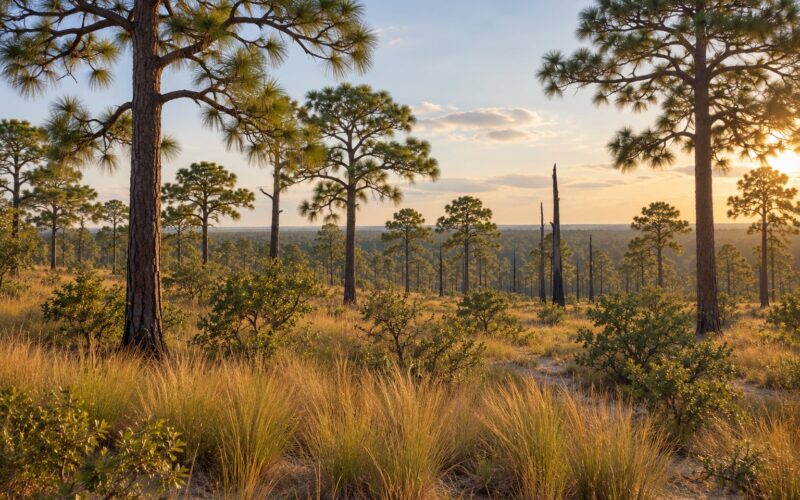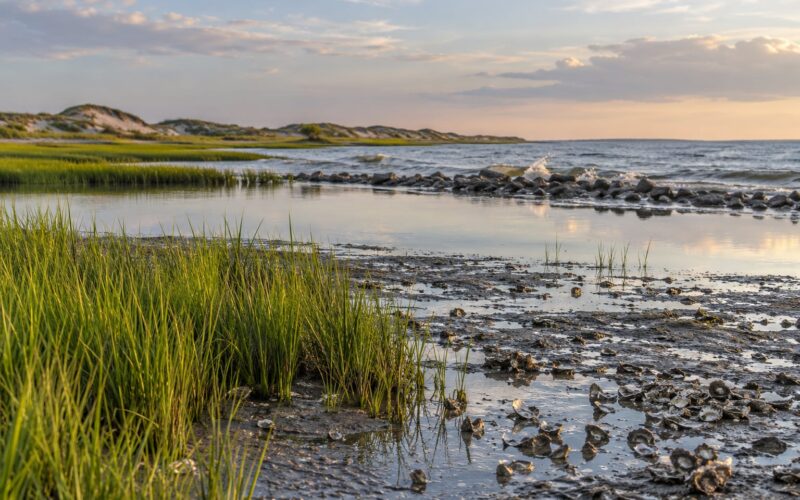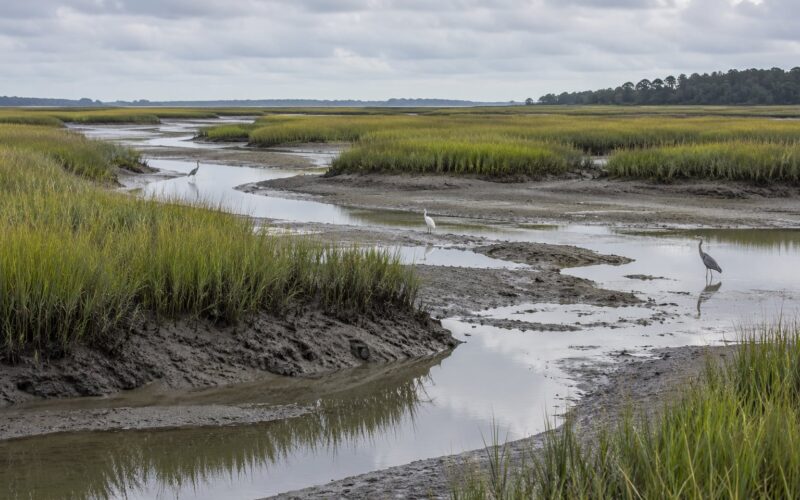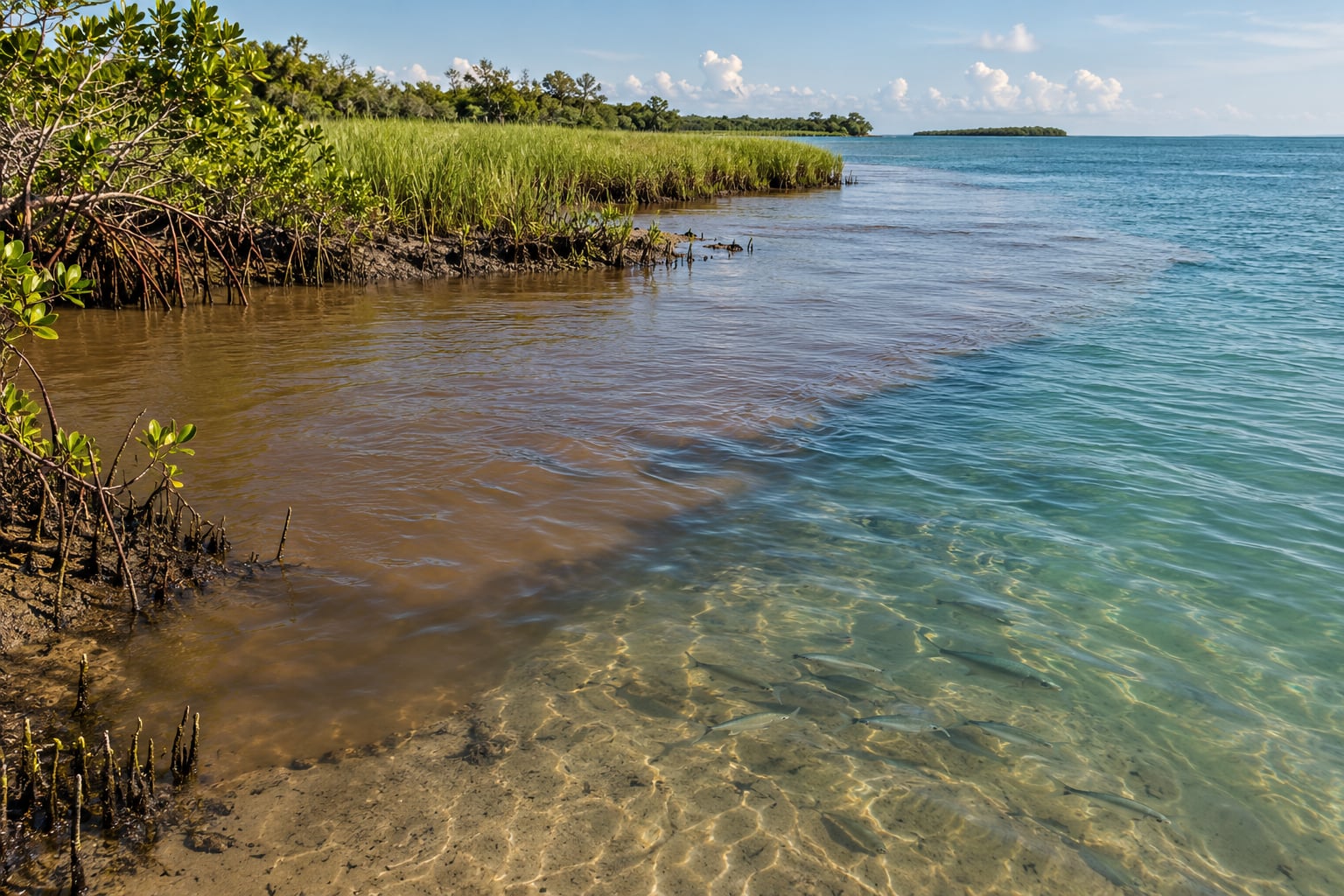
Brackish water is water that sits somewhere between pure freshwater and seawater, usually carrying about 0.5 to 30 parts per thousand of dissolved salt. Fish in it constantly move water and ions across their gills to hold a stable internal balance, and plants lose growth as salt makes water harder to pull in. Where salinity shifts faster than either group can adjust, the result is osmotic stress, slower plant growth, and a reorganized food web.
That is the short version, and knowing how brackish water affects fish and plants matters well beyond the tide line. An estuary is one of the most productive water types on the planet precisely because its salt level keeps moving. A tide, a week of rain, a dry spell, or a storm surge can each swing the number enough to exclude some species and favour others. Read the salinity of a waterway and you can usually predict a good deal of what lives there.
Key takeaways
- Brackish water falls between roughly 0.5 and 30 ppt salt, or a specific gravity near 1.002 to 1.020.
- Fish spend real energy on osmoregulation, and a sudden salinity change costs them more than a slow one.
- Plants cannot move, so they respond by tolerating salt, excluding it at the roots, or storing and shedding it in old leaves.
- Salinity sorts the whole community. Freshwater fish, marine fish, and euryhaline species each occupy their own band.
- The biggest effects often arrive indirectly, through the food web, not through the fish and plants you started with.
Table of Contents
- What Is Brackish Water?
- What the salinity scale looks like in practice
- How Brackish Water Affects Fish
- Two strategies: osmoregulation and osmoconformation
- Fish Responses to Salinity Changes
- How salinity changes habitat, feeding and movement
- Species tolerance is a range, not a point
- How Brackish Water Affects Plants
- Plants that genuinely tolerate brackish water
- How Brackish Water Affects Fish and Plants Differently
- What Changes Brackish Water Quality?
- Simple Ways to Observe These Effects
- Frequently Asked Questions
- What does brackish water do to fish?
- Which fish can live in brackish water?
- How do plants survive in salty coastal water?
- Does brackish water have less oxygen than seawater?
- Why do marsh plants grow in different zones?
- Can human pollution change the salinity of an estuary?
- Conclusion
What Is Brackish Water?
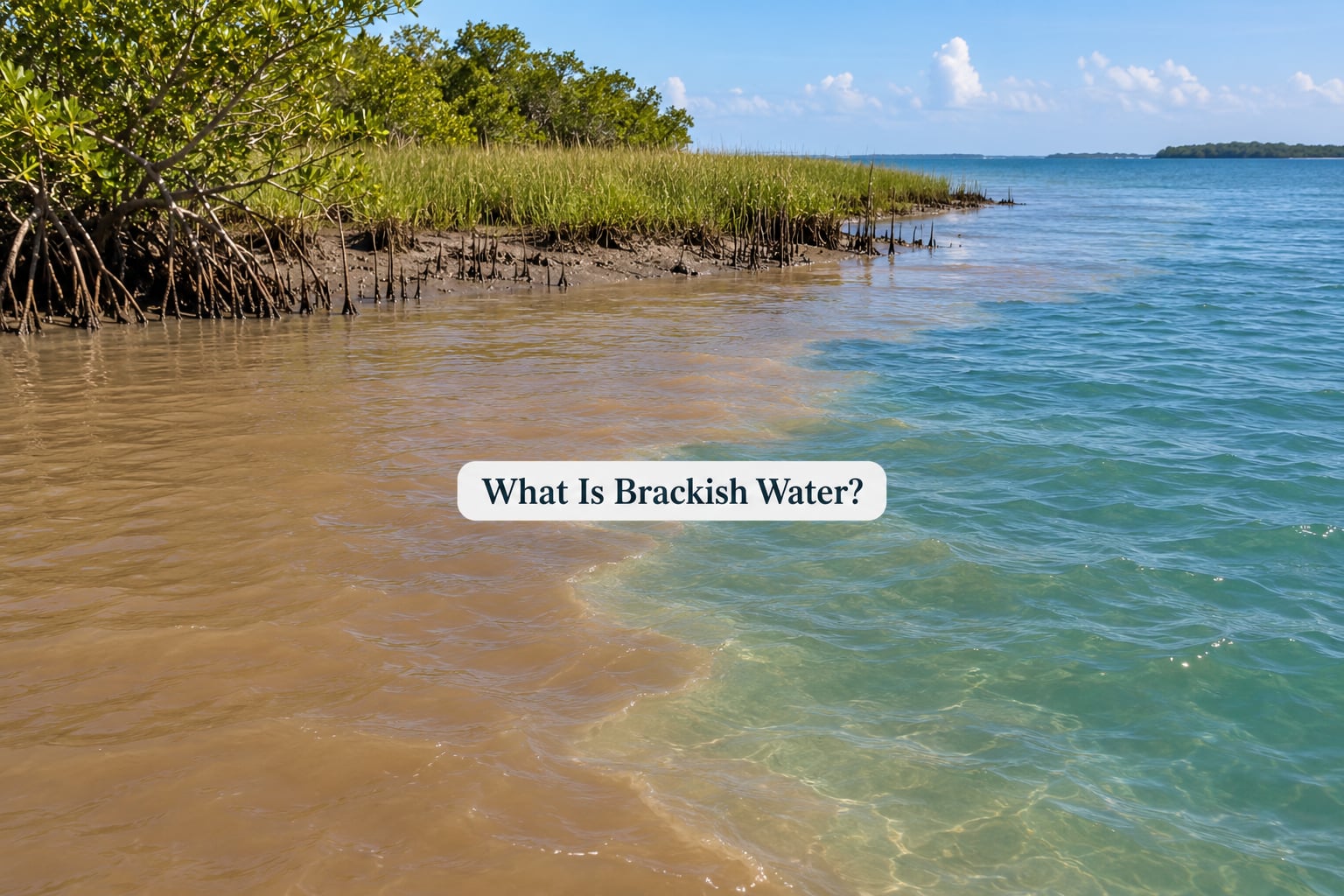
Brackish water is simply water with more dissolved salt than a river carries and less than the open ocean holds. Scientists usually call the range 0.5 to 30 parts per thousand, and aquarium and hatchery work describes it with specific gravity, or SG, where 1.000 is pure water. So the low end of brackish sits around SG 1.002 and the high end near 1.020.
Where it forms is just as important as what it is. Nearly every brackish body on the Atlantic and Gulf coasts of the United States sits at the meeting point of fresh and salt water: river mouths, tidal creeks cutting through salt marsh, coastal lagoons behind barrier islands, and shallow bays that take a flush of ocean water on a spring tide.
The key point for anyone trying to understand how brackish water affects fish and plants is that the number is never static. Average salinity for a creek tells you very little about what a fish has to deal with on a given morning.
Here are the main forces that push it around:
- Tides push salt water up a creek on the flood and pull it back down on the ebb, often producing two salinity peaks a day.
- River flow dilutes. A heavy rain week can drop a creek’s salt level sharply, and a dry week lets salt push much farther inland.
- Evaporation concentrates salt in shallow lagoons and tidal pools, sometimes to levels well above the bay they connect to.
- Storms surge saltwater over marsh and can deliver saltwater intrusion into nearby freshwater wells and into tidal freshwater reaches.
- Sediment and decay add a small but steady load of dissolved material to the water column.
What the salinity scale looks like in practice
| Water type | Salinity (ppt) | Specific gravity | Who lives there |
|---|---|---|---|
| Freshwater | Under 0.5 | Under 1.002 | Sturgeon, largemouth bass in fresh reaches, most freshwater plants |
| Low brackish (oligohaline) | 0.5 to 5 | 1.002 to 1.004 | Baitfish, shrimp, young game fish, cordgrass and submerged grasses |
| Brackish | 5 to 18 | 1.004 to 1.012 | Mangroves, oysters, red drum, spotted seatrout |
| High brackish | 18 to 30 | 1.012 to 1.020 | Salt-tolerant marsh edge, waders, forage fish |
| Marine | Over 30 | Over 1.020 | Oyster reefs, offshore fish, sea grass |
Two details in that table are worth pausing on. First, several brackish habitats sit above 20 ppt, which means a body labelled freshwater by name may not be. Second, the bands are boundaries rather than walls, and a fish that tolerates the low end often cannot handle the high end of the same body.
How Brackish Water Affects Fish
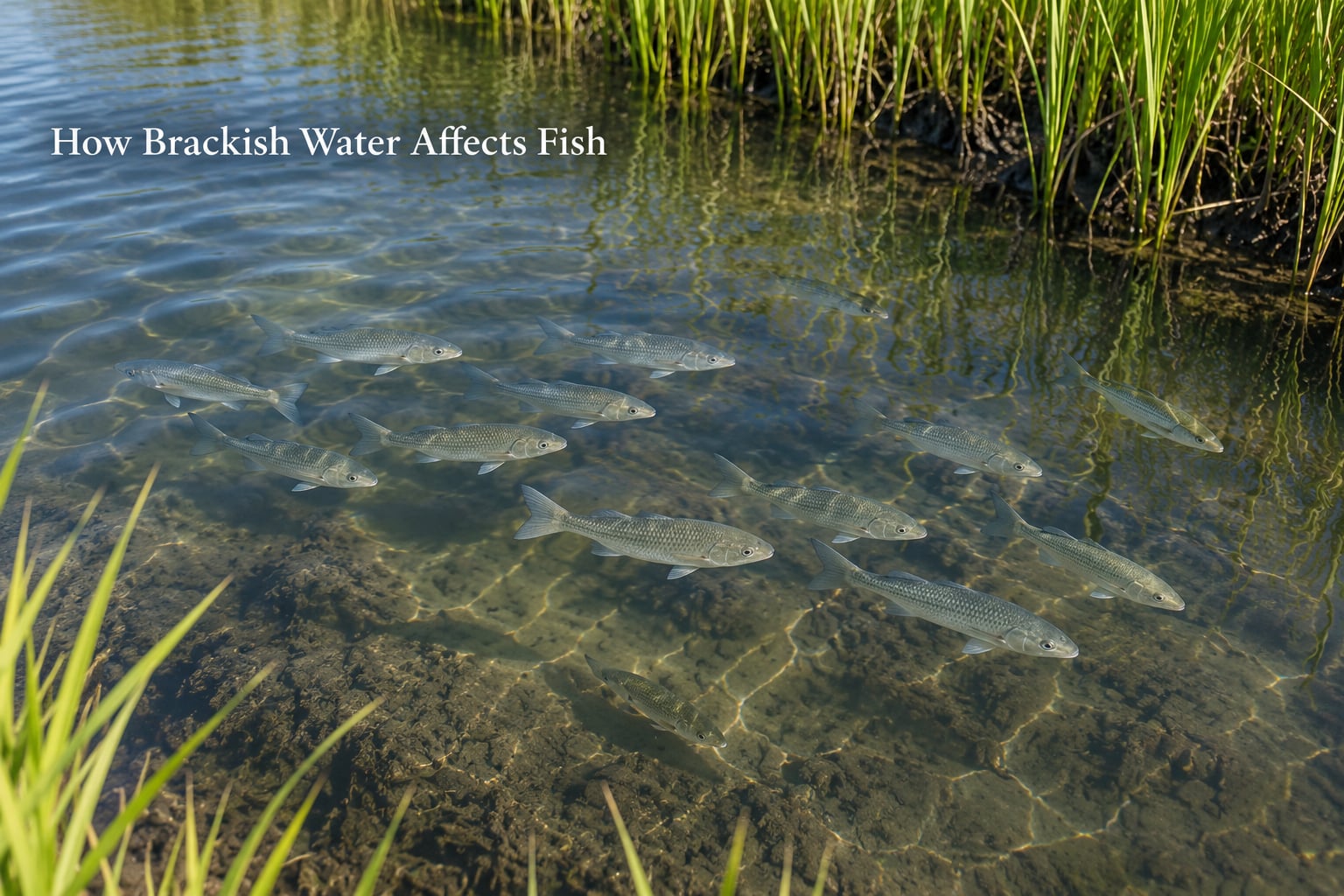
Salt water is a different problem for a fish’s body than fresh water is. Freshwater fish have body fluids with more dissolved salt than the water around them, so water constantly diffuses in and they must excrete large volumes of very dilute urine. Marine fish are the mirror image: seawater is saltier than their blood, so they drink constantly and pump excess salt out through their gills.
Neither strategy is cheap. Osmoregulation is a permanent tax on a fish’s energy budget, and the whole purpose of euryhaline species, which tolerate a wide salinity range, is to pay less of it. Research surfaced in aquarium discussion also links sustained higher salinity, around 8 to 10 ppt in some trials, to muscle dehydration and raised circulating cortisol in fish. Stress hormones are expensive. They suppress growth, immunity, and spawning.
Two strategies: osmoregulation and osmoconformation
| Approach | What it means | Examples | Brackish result |
|---|---|---|---|
| Osmoconformer | Body fluids simply match the surroundings | Many marine invertebrates, jellyfish, most true crabs and shrimp | Weakly affected by salinity change, but limited to a narrow band |
| Osmoregulator with internal salt | Keeps fluids saltier or fresher than the water around it | Most bony fish, molluscs, some crustaceans | Thrives across a gradient but spends energy doing it |
| Osmoregulator, salt tolerant | Regulates and tolerates both directions | Battlenose, spot, drum, menhaden, most baitfish | Dominates brackish estuaries; supplies the forage base |
| Osmoregulator, salt sensitive | Can only manage one direction well | Largemouth bass in fresh reaches, loaches, plecos, cichlids | Drops out below a few ppt; dead ends in brackish habitat |
A useful aside here. Starfish and jellyfish are often grouped with the animals that struggle least in brackish water, and the reason is that many marine invertebrates and gelatinous animals track the salinity around them rather than defending a fixed internal level. That freedom costs them the ability to handle a rapid swing, which is why they stay put while fish move.
Fish Responses to Salinity Changes
How a fish responds depends less on the final salt level than on how fast it got there. A fish that has drifted gradually from SG 1.000 to 1.008 over two months is in a very different situation from one dumped into 1.008 this morning.
When salinity rises beyond a fish’s comfortable range, its body fluids become hypotonic to the water. Water leaves the fish by osmosis, and the fish drinks to replace it while excreting salt through the gills. In a freshwater fish the intestine is not equipped for drinking and salt intake, so a sudden increase in salinity hits it with dehydration it cannot easily correct. Gill tissue takes the brunt of the damage.
When salinity falls toward fresh water, the fish gains water by osmosis and has to excrete it. A marine fish’s gills are tuned for salt excretion and handle excess water poorly, which is why baitfish transferred into fresher canal water struggle. A moderator on an aquariumadvice.com canal-water thread named three separate stressors hitting dumped bait shrimp at once: the sudden salinity drop, the sudden temperature change, and lower dissolved oxygen. Any one of those can be survivable; together they are not.
Watch for these signs in a stressed fish, in rough order of how quickly they show:
- Loss of appetite within a day or two of the change.
- Darkening or paling of colour as stress hormones shift pigment.
- Visible stress lines, a darkening band along the side, often appearing a few days after the shift.
- Lethargy, hanging in a corner or under cover rather than swimming the tank.
- Erratic breathing at the surface, which often points to gill irritation rather than low oxygen alone.
- Clamped fins and a general loss of interest in normal activity.
- Aggression or shoaling changes, sometimes the first thing a caretaker notices.
- Reduced breeding, and poor fry survival even where spawning still occurs.
None of these signs is specific to salt. A fish sitting near the surface in hot weather has gill trouble and no salinity problem at all. That is why the number matters as much as the behaviour.
How salinity changes habitat, feeding and movement
Beyond stress, salinity decides where fish can go. It sets the ceiling for pure freshwater species and the floor for marine-only ones, which in practice means the estuary is stacked with layers: salt-tolerant baitfish at the bottom of the food chain in the brackish middle, game fish patrolling over them, and marine species working the saltier edge.
Feeding follows too. Plankton communities reorganize as salinity changes, and because large-bodied zooplankton such as Daphnia are the first casualty of a rising salt level, the water often turns cloudy and plant-eating invertebrates lose their food supply. Fish that hunt visually suffer; fish that filter the water column do less badly.
Research on shallow brackish lakes found that as salinity climbed, the abundance of plant-dwelling macroinvertebrates fell, and submerged plants stopped providing the refuge those animals normally depend on. Fish in those lakes eat less well as a result. The chain runs through the invertebrates, not the plants.
Temperature compounds all of this. Warm water holds less oxygen, so a salt-driven productivity boom in a warm, shallow lagoon can produce dense algal growth, and decomposition of that growth can strip oxygen out of the water overnight. Fish in brackish systems frequently have to deal with low oxygen and high salinity at the same time.
Species tolerance is a range, not a point
Baitfish, forage species, and game fish tolerate different spans, and the span has a floor and a ceiling:
- Bait and forage fish such as killifish, mudminnows, and inland silversides hold roughly 0 to 30 ppt. This wide band is what makes an estuary work as a nursery.
- Live-bearer groups such as mollies and guppies often handle low-end brackish better than aquarists expect, and aquarists report them doing well above pure freshwater specific gravity.
- Red drum, spotted seatrout, black drum, and flounder move up and down the estuary with the tide rather than staying put.
- Largemouth bass can persist at the fresh end of an estuary. Water kept slightly brackish has been reported to hold bass, but that is a stretch of their range and the fish do not breed well there.
- Pufferfish show how far euryhalinity goes. Adult green spotted puffers are reported by hobbyists to do well from about SG 1.005 to 1.025, with brief overshoots such as 1.015 in a tank at 1.013 causing no harm when ammonia and nitrite are at zero.
- Freshwater favourites such as clown loaches, plecos, and most South American cichlids have no workable answer. There is no acclimation that saves them.
How Brackish Water Affects Plants
Fish can drink, pump, and flee. Plants sit where they rooted and deal with salt by ignoring it, excluding it, or getting rid of it slowly. That constraint explains almost everything about how brackish water affects plants.
The physiological problem is straightforward. Salinity lowers the water potential outside the root, so water moves out of a plant cell rather than in. Growth slows first, then stops. In a freshwater aquarium the same effect shows up as plants that grow more slowly in brackish water and therefore remove fewer nutrients from the water, which in practice makes nuisance algae harder to control.
Salt also interferes with uptake. Roots take up nitrate, phosphate, and other ions through channels that high external salt partially block, and salinity near the root zone slows the conversion of ammonium, which means a heavily planted brackish system can consume less of its nitrogen load than a freshwater one of the same size.
Here are the plant effects worth watching, each phrased so it can be checked in the field or the tank:
- Growth rate drops as salinity rises, and the drop shows up first in new leaves rather than old ones.
- Nutrient and ammonia uptake falls, so the plant does less of the filtering work it did in fresh water.
- Leaves shred, melt, or develop necrotic tips where salt accumulates at the margin or in older tissue.
- Germination and rooting decline, which is why tidal flats and salt marsh often show scattered seedlings rather than a dense stand.
- Flowering and seed production fall at the saltier end of the range, cutting off reproduction before the plant dies.
- Algae often increase relative to plants, because the grazers and plants that would normally hold them back are the first casualties of rising salt.
Waterlogging adds a second stress that is easy to confuse with salt stress. A marsh root sits in saturated, oxygen-poor sediment, and salinity slows the plant’s ability to move oxygen down to those roots. A plant killed by salt and a plant killed by anoxia look similar from a distance, but the fix is different.
Plants that genuinely tolerate brackish water
Tolerance numbers here reflect ranges commonly reported by aquarium hobbyists rather than a single published ceiling, and individual results vary with light, nutrients, and acclimation:
| Plant | Reported workable range | Notes |
|---|---|---|
| Mangroves | Marine to well past marine, SG 1.020 and up | Exclude salt at the roots; the most salt-tolerant plant group there is |
| Java fern | Low-end brackish, around SG 1.002 to 1.003 | Reported to hold at the low end, then shred above it |
| Java moss | Low-end brackish, around SG 1.002 to 1.003 | Shreds visibly once salinity climbs further |
| Anubias | Low-end brackish, around SG 1.002 to 1.003 | Slow growth, so it never outcompetes algae by much |
| Water sprite | Brackish habitat native | Reported to do well across mid brackish |
| Micro sword grass | Brackish habitat native | Reported to handle brackish well; colour may shift |
| Vallisneria | Low brackish only, near SG 1.002 | Melts quickly above the low band |
| Freshwater stem plants and most tropicals | None | Do not survive any sustained brackish level |
That list explains the pattern aquarists keep reporting: hardy freshwater plants are not automatically brackish plants. Hardiness and salt tolerance are different traits, and a plant can shrug off a temperature swing while falling apart at SG 1.004.
How Brackish Water Affects Fish and Plants Differently
The difference is about control. A fish can leave, drink, excrete, or change behaviour. A marsh grass cannot move an inch, so it survives salt by physiology and by position. Mangroves exclude most salt at the roots and dump the rest by shedding old leaves into leaf litter. Cordgrass tolerates salt in tissue and takes it up. Submerged aquatics mostly lose the argument and thin out.
Plants therefore map the salinity gradient as bands. And it works in both directions: a species that cannot survive salt will set the upstream and inland limit, while one that needs salt sets the seaward limit. Where those lines overlap sits the marsh.
Zonation follows position and exposure, not just chemistry. Cordgrass takes the wettest and most regularly flooded zone. Spartina alterniflora holds the middle, then black needlerush takes the drier high marsh. Mangroves take the shoreline and the landward edge in subtropical settings.
The connection between the two groups runs through the habitat itself. Dense root mats trap sediment, slow water, and raise oxygen near the bottom, which is exactly the shelter juvenile fish and baitfish need. Work from a shallow brackish lake study found that submerged plants lost their value as invertebrate refuge as salinity rose, because the invertebrates using them were already gone. Fish lose the creek, then the plants, then the fish.
What Changes Brackish Water Quality?
Salinity is the headline number, but it is the sum of several moving parts, and anything that changes one of them changes how brackish water affects everything downstream.
River flow is the biggest lever in most Southeastern systems. Low discharge lets salt water push upstream into freshwater reaches, and high discharge pushes it back out. Where the water is deeper and the flow slower, salt water slides underneath the fresh layer as a salt wedge, sitting in the channel while fresh water flows over the top.
Tides and storms set the short-term range. A nor’easter can push saltwater over marsh and up into normally fresh creeks, then it drains away over the following days, leaving a pool of water far saltier than the estuary average.
Evaporation and drought do the opposite in shallow lagoons. As water leaves and salt stays, concentration rises and the most salt-sensitive organisms go first.
Sea-level rise slowly raises the baseline. Salinity creep is easy to miss until it is well established, which is one reason managers watch for it explicitly.
Nutrients and sediment change what the water can support. Excess nutrients drive algal blooms, which feed low-oxygen events when they decay. Sediment burial smashes submerged plant beds, and a plant bed that disappears takes the invertebrate refuge with it.
Temperature sets oxygen capacity and evaporation rate. Warm water carries less oxygen, so a warm brackish system has less margin before low oxygen becomes limiting.
Human changes are the ones we cause. Freshwater diversions for agriculture and municipal supply push salt water farther inland. Coastal construction and dredging raise suspended sediment. Desalination plants discharge concentrated brine into coastal water. All three shrink the brackish band that fish and plants depend on.
Restoration runs the other way. Dredged tidal creeks reconnect to the estuary and let salt water back in, reviving marsh and oyster habitat. Embankments and dams have the opposite effect, cutting off the tidal exchange and turning brackish creek into freshwater pond.
So: how brackish water affects fish and plants in any given waterway is mostly a question of what the water body is connected to, and how well that connection works.
Simple Ways to Observe These Effects
You do not need a lab to see this. Pick a tide and a creek, keep a record across a few months, and the pattern shows up quickly.
Measure the gradient. A simple refractometer reading at three points, one near the mouth, one mid-creek, one upstream, repeated at high and low tide, shows you the range the fish actually live in. Record specific gravity and the tide stage together.
Look for plant bands. Stand at the marsh edge and note which species occupies which zone and where the line between them sits. Watch that line between a wet month and a dry one.
Identify what is swimming. Note which species hold in the creek versus the bay, and which change position with the tide. Record what you catch and when.
Check water clarity. After rain, brackish creeks often go cloudy because the salt-sensitive grazers are already gone and nothing is holding the phytoplankton back. Cloudy after a freshet is a pattern worth noting.
Watch the periphyton film. The brown-green film on stems, shells, and rocks in shallow brackish water is algae plus microbes. It thickens as salinity and nutrients rise, and it is the surface that small invertebrates feed on.
Sort the invertebrates by group. Tolerance differs sharply across taxa, with crustaceans generally the most salt tolerant and mayfly and stonefly larvae among the least tolerant. A creek that has lost its mayflies but still holds grass shrimp has moved a long way from where it started.
Time it against the tide. Anything you record without noting the tide stage and the weather is half a data point. The single biggest mistake people make is measuring at low tide on a dry afternoon and assuming it is the average.
In an aquarium the same observations compress into days. Watch plant melt and color, watch fish appetite and color, keep a refractometer on the tank, and change one thing at a time.
On graduated acclimation, the number worth knowing is that salinity should be raised no more than about SG .002 per week, and lowered on a similar pace. Hobbyists report that filter bacteria adapt to freshwater media converted straight to brackish almost immediately up to about SG 1.005, then slow down, and that nitrifying bacteria tolerate shifts better than the fish do. One experienced aquarist put it plainly: adding all the salt at once shocks the fish and the filter at the same time.
Frequently Asked Questions
What does brackish water do to fish?
Brackish water forces fish to spend more energy moving water and salts across their gills to keep their internal balance steady, a process called osmoregulation. If salinity changes faster than the fish can adjust, water moves in or out of the body by osmosis, causing dehydration, ion imbalance, and gill irritation. Signs include loss of appetite, darkening or fading color, stress lines, lethargy, and rapid surface breathing.
Which fish can live in brackish water?
Euryhaline species tolerate a wide salinity band and dominate brackish water: baitfish such as killifish and mudminnows, plus forage like menhaden, tolerating roughly fresh water up to near-marine levels. Red drum, spotted seatrout, and black drum move through the gradient with the tide. Largemouth bass can hold at the fresh end of an estuary, but they do not thrive or spawn there.
How do plants survive in salty coastal water?
Plants cannot move, so they survive by physiology and position. Mangroves exclude most salt at their roots and shed the rest in old leaves, while cordgrass absorbs salt and tolerates it in tissue. Tolerance has limits, though. Growth slows, nutrient uptake falls, and leaves develop dead tips before the plant dies, which is why marsh plants stop at a line.
Does brackish water have less oxygen than seawater?
No. Brackish water is not inherently low in dissolved oxygen; fresh water holds more oxygen than salt water at the same temperature. The oxygen problems in brackish systems come from other causes: warm water holds less oxygen, nutrient-driven algal blooms strip oxygen as they decay, and dense mats of algae and plants block gas exchange at night. Salinity can make those blooms worse.
Why do marsh plants grow in different zones?
Each species tolerates a band of salinity, flooding depth, and sediment type, and the strongest competitors in the overlap set the edge. Cordgrass takes the regularly flooded low marsh, Spartina alterniflora holds the middle, black needlerush takes drier high marsh, and mangroves take the shoreline. Because salinity and flooding change along that line, plants sort themselves into visible bands.
Can human pollution change the salinity of an estuary?
Yes. Freshwater diversions for cities and farms reduce river flow and push salt water farther inland. Dredging and coastal construction raise suspended sediment, and desalination plants discharge concentrated brine. Nutrients from runoff drive algal blooms that strip oxygen overnight. Together these shrink the brackish band that fish and plants depend on for nursery habitat.
Conclusion
Brackish water works as a filter on a whole community, not just a stress on individual fish. Salt level decides which fish can osmoregulate without paying too much, which plants can hold their roots in, and how the food web between them is built. Where that filter sits, and how fast it moves, is set by tide, river flow, weather, and the connections people have built or removed.
If you want to start seeing this yourself, do one thing: go back to the same creek at the same point on the tide for three months and note where the cordgrass line falls and which fish you catch on each visit. The zone moves before anything else does, and it tells you what the rest of the system is about to do.