Oyster reefs protect shorelines by working as living breakwaters: rough shell mounds force waves to break early, lose energy, and drop their sediment before the water ever reaches your marsh, dock, or low-lying yard. They do it while filtering water, growing taller on their own, and creating habitat for fish and crabs.
The word for that growth is accretion, and it matters. A pile of dead shell is only a rock pile. A pile with live oysters cemented to it can add height and width every season, repairing storm damage on its own. That is the difference between a fixed structure and a shoreline that builds itself.
Below is what is actually happening physically, what reefs can and cannot do, and how restoration crews turn loose shells into something protective.
Table of Contents
- What Are Oyster Reefs?
- How Oyster Reefs Protect Shorelines
- How Oyster Reefs Reduce Wave Energy
- How Trapped Sediment Builds More Protection
- Why Living Reefs Protect More Than Just the Water
- What Oyster Reefs Can and Cannot Do
- How Restoration Projects Build Functional Reefs
- How to Protect Existing Oyster Reefs
- Frequently Asked Questions
- Do oyster reefs stop all storm damage?
- Can restored oyster reefs replace seawalls?
- Why do oysters need marsh grass and clean water?
- Are oyster reefs safe to swim, fish, or harvest?
- How long does it take for an oyster reef to form?
- Can homeowners build a small oyster reef on their shoreline?
- Conclusion
What Are Oyster Reefs?
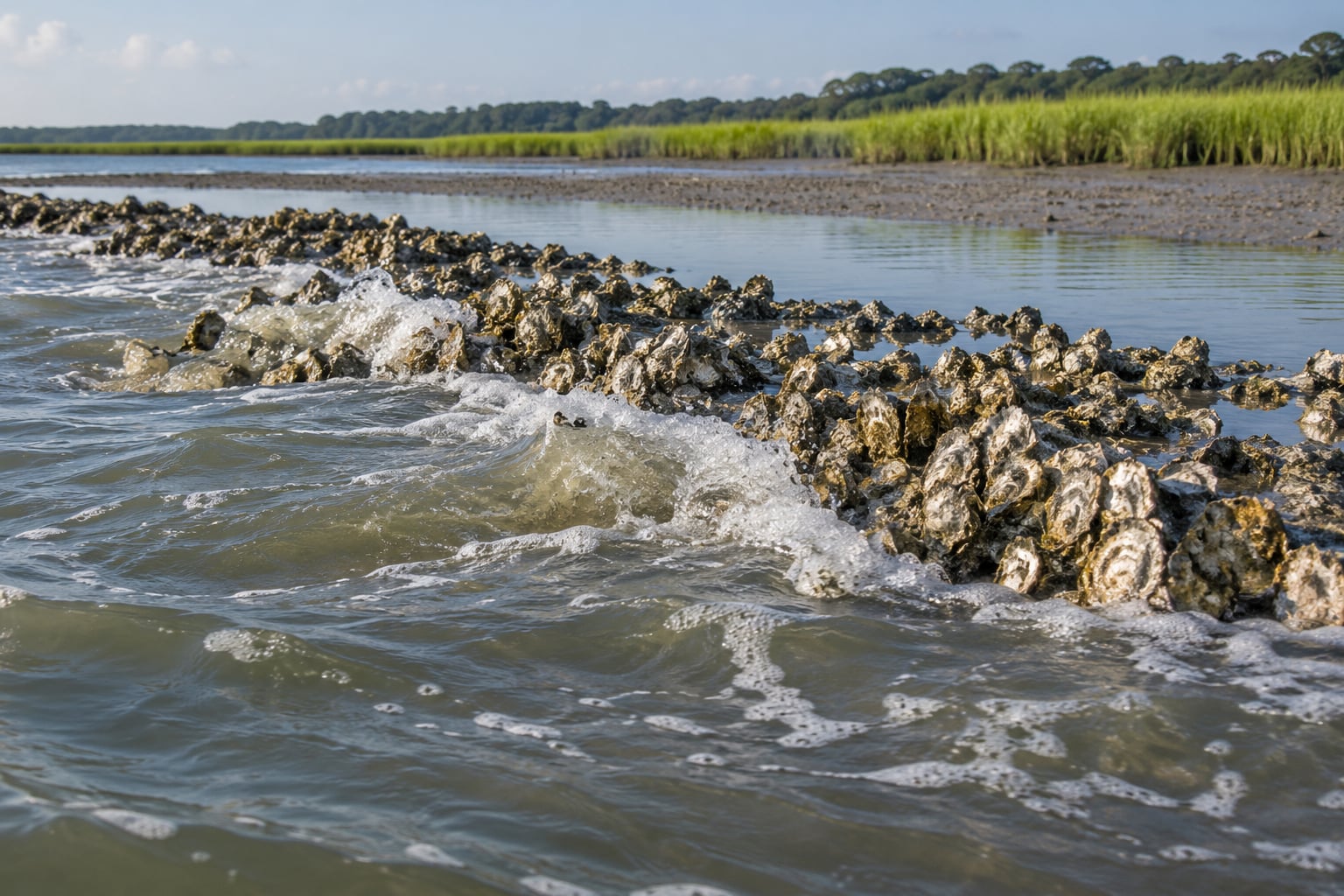
An oyster reef is a mound built from oyster shells, live oysters, and the natural cement that binds them. It starts when free-swimming larvae, called spat, settle onto a hard surface and attach. Each generation leaves shell behind for the next one to grow on.
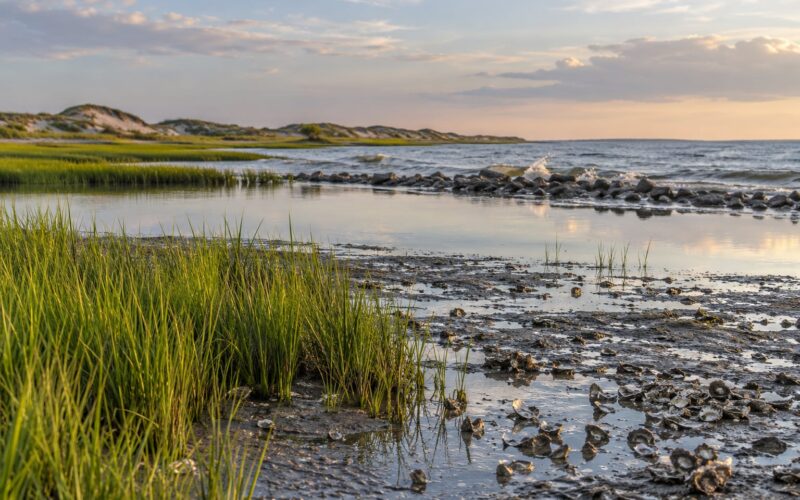
Over decades that accumulation becomes a reef with a raised crest, a broad footprint, and enough surface roughness to disturb moving water. In the American Southeast you will find them in salt marsh edges, on shallow mudflats, in tidal creeks, and along the flanks of barrier islands, usually in water shallow enough to stay mixed and clear enough to feed on.
Historically they were much more common than they are now. The Island Institute reports that New York Harbor alone once hosted more than 200,000 acres of oyster reef, much of it harvested away over two centuries and choked out by shoreline industrialization.
How Oyster Reefs Protect Shorelines
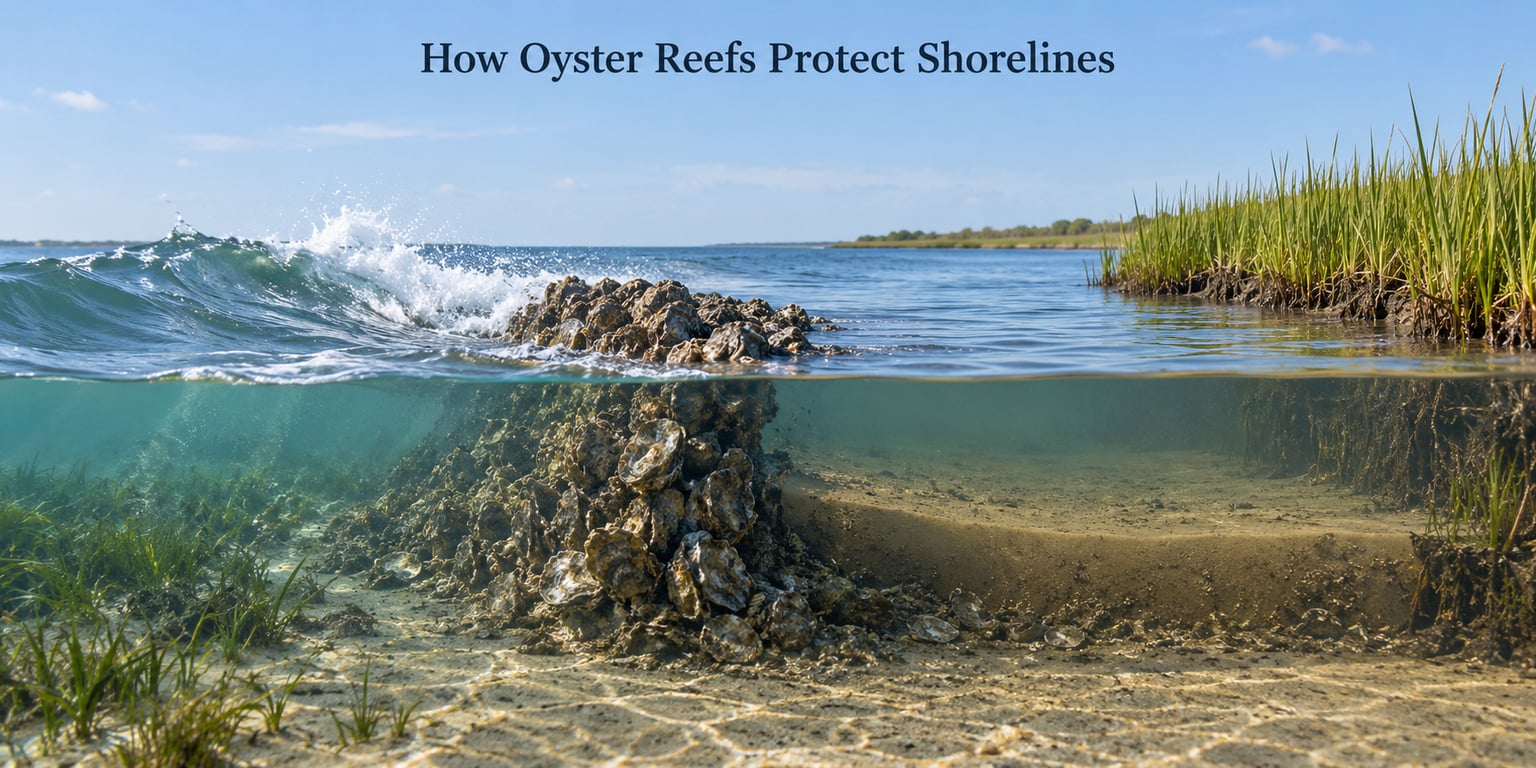
Here is the short version. Oyster reefs protect shorelines through five mechanisms: they break and dissipate wave energy across a rough surface, they partly reflect and redirect incoming waves, they trap sediment that builds new mudflat and beach, they lower storm-surge and flood levels behind them, and over time they slow shoreline retreat.
- Wave energy dissipation as waves break over the reef and lose energy to friction and turbulence.
- Reflection and redirection, sending part of the incoming wave back offshore and part of it along the shore instead of straight at it.
- Sediment trapping, holding fine sediment that would otherwise wash past and out.
- Surge buffering, which measurably reduces water level and wave height on the sheltered side.
- Erosion mitigation, cutting shoreline retreat rates over the life of the reef.
How Oyster Reefs Reduce Wave Energy
Water carries most of its destructive force near the surface, and a wave moving across a shallow bottom loses energy as it feels bottom. Wave height falls as water shallows, so the reef is doing its work exactly where the water is already breaking down.
The shell surface is rough at a scale that matters. A smooth wall reflects a wave and hands the energy back as a reflected wave, which can scour the bed and rattle a shoreline. A reef is porous and jagged, so the same wave collides with millions of shell edges, splits into turbulence, and bleeds off energy instead of returning it.
Crest height sets the threshold. Below it, waves pass over the reef mostly unaffected. Near and above it, waves break on the structure. That is why reef elevation and width matter so much, and why a low reef that has been knocked down by a storm protects far less than the same reef at full height.
Two other variables get less attention than they deserve. A wide reef with gentle slopes attenuates more than a narrow steep one, because the wave has a longer path to lose energy. And a reef sitting in sheltered water in front of a long open fetch has a harder job than one tucked behind a point, which is why exposure is the first thing any site assessment checks.
The Nature Based Solutions Initiative reports breakwater reef treatments mitigated shoreline retreat by more than 40% at one site. You will also see much larger headline numbers circulating online, sometimes claiming reductions of 70 to 99% of wave energy. Treat those carefully. They come from specific sites with specific geometry, and the honest answer is that reported performance varies widely with depth, width, crest elevation, and storm shape.
How Trapped Sediment Builds More Protection
When a reef slows the current, suspended sediment settles out. Mud and sand that would normally be carried along the shore now drop behind and inside the reef, and mudflats rise a little every season.
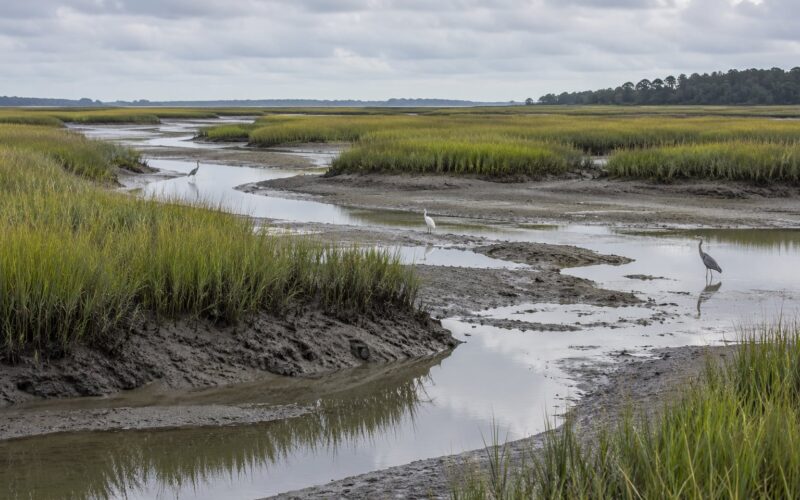
That raised mudflat is the quiet part of the whole system. It widens the shallow buffer so waves break earlier, it converts eroding edge into stable ground, and it creates the wet, firm surface that marsh grasses like to colonize. Once grasses take hold, they add their own drag on flow and their own roots that hold sediment in place.
So the sequence runs reef, then sediment, then marsh grass, then more sediment. Each step makes the next one easier, and the shoreline that was retreating a foot or two a year starts to hold or advance.
This only works where sediment is arriving. A reef placed on a starved shoreline, behind a sediment trap or behind a deep navigation channel, may trap everything for a while and then have nothing left to hold. Restoration groups now watch mud elevation closely for exactly that reason.
Why Living Reefs Protect More Than Just the Water
A reef that does nothing but slow waves is already useful. A living reef also does four more jobs at the same time, and none of them compete with the shoreline protection.
- Nursery habitat. Reef interiors are the sheltered, food-rich hard bottom that juvenile fish, shrimp, and crabs need. Anglers find more structure holding game fish close to marsh edges.
- Food and roosting habitat for birds. Mudflats and reef flats behind the structure host foraging waders and other shorebirds.
- Water filtration. A single adult oyster pumps and filters water continuously, removing suspended sediment and nutrients.
- Self-repair. Live oysters keep growing on the crest after a storm, so the structure recovers rather than needing a rebuild.
At the Hillsmere Shores Marina project on the Chesapeake Bay, crews combined rock headland breakwaters, sand and coir, marsh grasses, and 258 oyster reef balls seeded with spat. The layered design handles a stretch of shoreline exposed to more than 100 miles of open fetch, and each layer covers for what the others cannot do well.
That kind of stacking is common in good design. Marsh handles ordinary tides, the reef handles bigger water, and rock handles the worst of it. Any one layer alone would be a weaker answer.
What Oyster Reefs Can and Cannot Do
Reefs are one layer of protection, not a complete answer. Setting expectations honestly is the fastest way to avoid disappointment, and honest caveats tend to win over promotional claims.
- They do not stop all storm damage. A mature reef significantly reduces wave energy on the sheltered side, but a powerful surge overtopping the crest still delivers water and force inland.
- They need time. Protection ramps up over years as the crest grows and the mudflat builds. A reef in its first season is mostly a pile of shells.
- They need site conditions. Reefs work best in shallow, moderately exposed water with good water quality and some sediment supply. High-energy open coasts and heavily industrialized channels are poor candidates.
- They face predation and disease. Crabs drill, mud crabs smother, and diseases like MSRAV can thin a reef, especially in warm, low-salinity water.
- They cannot fix sea level rise by themselves. Marshes and reefs can migrate inland only if there is undeveloped land behind them. Once a bulkhead or road sits at the high-water line, the system has nowhere to go.
A reef also will not rescue a shoreline that is already losing land faster than the reef can build it. Site selection decides more than any other factor, which is why restoration work starts with surveys rather than shells.
How Restoration Projects Build Functional Reefs
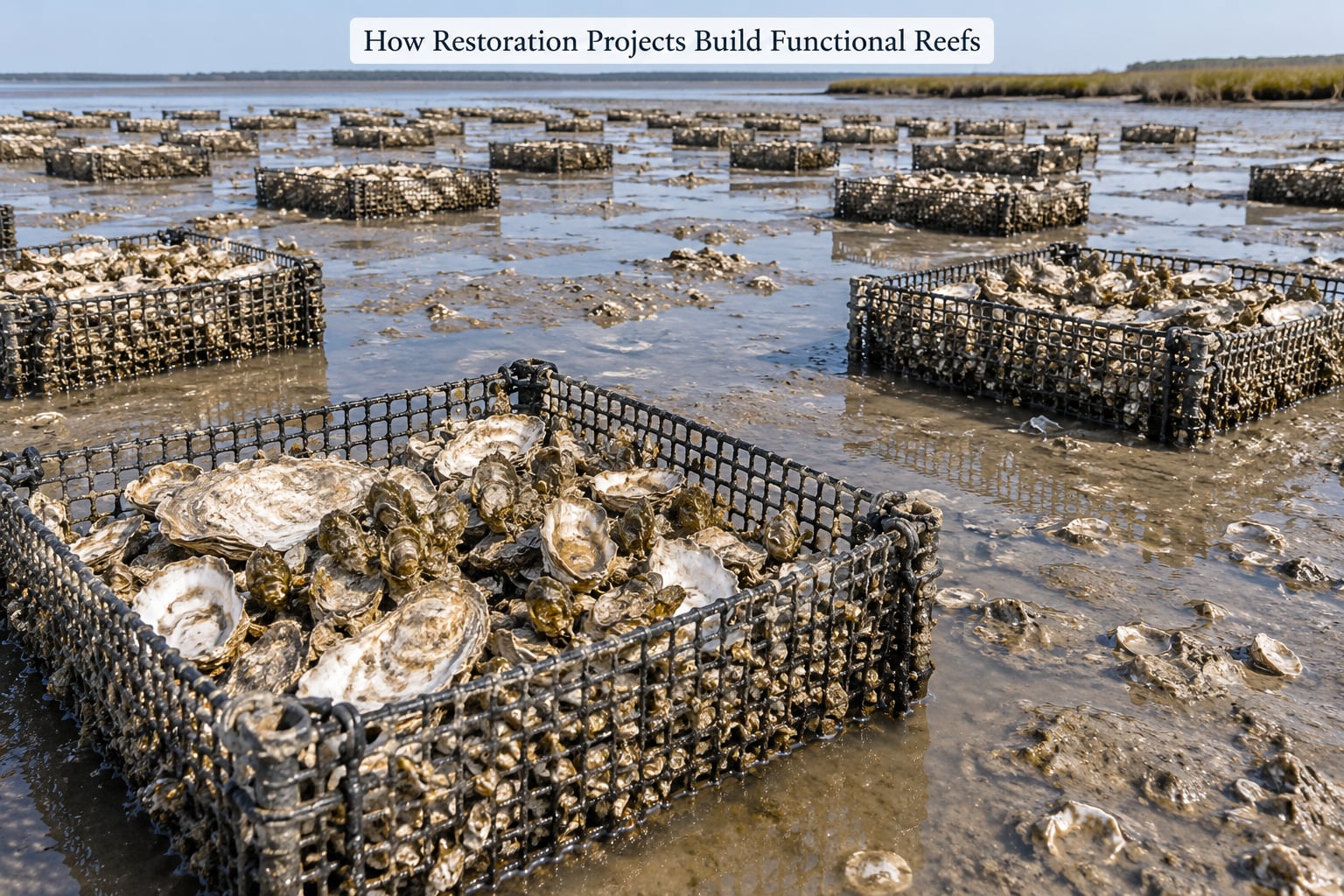
Most modern restoration is less about making something new and more about putting the right hard surface back in the right place, then letting oysters do the building.
- Shell recycling. Spent shells from restaurants, seafood events, and shucking houses are cleaned, sometimes cured so leftover meat cannot attract predators, then bagged or placed in mesh baskets. Restaurants and seafood festivals donate them through local volunteer drives, and several coastal programs run around the country, including one in coastal Louisiana where volunteers stack recycled shell into new reefs.
- Juvenile deployment. Hatchery-raised spat are set on shell, mesh tubes, or purpose-made reef balls. Reef balls add height and roughness quickly, which is how projects like the Hillsmere marina installation get structure in place without waiting a decade for natural recruitment.
- Habitat enhancement. Sometimes the reef already exists and is simply bare. Adding shell, marking it, or protecting it from harvest can restart recruitment on a mature reef.
- Long-term monitoring. Spat counts, shell-height measurements, mud elevation, and shoreline surveys track whether the reef is actually building. Community oyster gardens worked with school groups are a common low-cost way to keep that record.
Many state coastal programs and soil and water conservation districts offer cost-share assistance for private landowners, so a homeowner rarely pays full price for a living shoreline retrofit. Permits usually apply too, since you are placing material in tidal waters.
How to Protect Existing Oyster Reefs
If you boat, paddle, fish, or own waterfront near an existing reef, the easiest wins are behavioral.
- Avoid anchoring, grounding, or dragging gear across reef bottoms. Use a designated mooring field when one exists.
- Follow local harvest rules, including closures that exist for disease and reproduction rather than for abundance.
- Return clean spent shells to a recycling program instead of putting them in a dumpster or on a beach.
- Keep runoff out of tidal creeks. Fertilizer, pet waste, and sediment wash onto reefs and smother spat.
- Leave marsh edges vegetated and avoid mowing right down to the water where the reef is doing the buffering.
- Support restoration groups and local marine monitoring efforts, which mostly run on volunteers and donated shell.
Angling and paddling angles matter here too. Reef structure holds fish close to marsh edges in a way most open bottom never does, and a protected shallows is calmer to paddle than an exposed mudflat.
Frequently Asked Questions
Do oyster reefs stop all storm damage?
No. A healthy reef absorbs and scatters a large share of incoming wave energy and can cut shoreline retreat by more than 40% at well-placed sites, but a strong surge that overtops the reef crest still delivers water and force inland. Think of reefs as one layer in a system that usually includes marsh, dunes, and sometimes rock, rather than a standalone barrier.
Can restored oyster reefs replace seawalls?
Rarely on their own. A reef takes years to reach protective height and keeps growing, while a seawall protects immediately and then degrades, reflects wave energy, and blocks marsh migration. Most planners pair reefs with marsh and upland buffer, and reserve hard structure for the highest-exposure stretches where the site cannot retreat.
Why do oysters need marsh grass and clean water?
Oysters feed by filtering suspended particles, so polluted or sediment-heavy water clogs them and starves them of food. Marsh grass slows flow, traps sediment, and anchors the shoreline, which protects the water quality the reef depends on. Reef, marsh, and watershed are one connected system: damage any layer and the others feel it.
Are oyster reefs safe to swim, fish, or harvest?
Yes, with normal local rules. Oyster reefs in shallow water are not hazardous to waders in typical conditions, and they are popular fishing structure. The real limits come from harvest regulations, water quality advisories after rain or sewage events, and disease closures that are temporary and health-driven rather than a sign the reef is unsafe.
How long does it take for an oyster reef to form?
A reef ball array or shell deployment establishes structure within months, but a reef that reliably reduces wave energy takes several growing seasons to build crest height and trap sediment behind it. Restoration programs typically monitor shell height, spat counts, and mud elevation for years before protection is measurable, and a mature reef keeps improving for decades.
Can homeowners build a small oyster reef on their shoreline?
Usually through a program rather than on your own. Placed material in tidal waters generally requires a permit, and most state coastal programs and soil and water conservation districts run cost-share assistance so homeowners pay a fraction of the cost. A site survey first is essential, since exposure, depth, and sediment supply decide whether a reef will work at all.
Conclusion
The protection is mechanical and simple: a rough, porous reef makes waves break early and lose energy, slows the current so sediment drops and mudflats rise, and keeps growing as new oysters settle onto old shell. Add the fish habitat, the filtration, and the birds, and you get shoreline defense that improves with age instead of wearing out.
Start local. Find out whether a living reef already exists in your watershed, learn who is restoring or monitoring it, and check whether your state coastal program offers cost-share assistance if you own waterfront. The first step is a conversation with the people who already know your stretch of coast.
Updated for 2026.