Cypress swamps form on flat, poorly drained ground where a shallow water table, oxygen-starved soil and water-borne seeds meet, and they matter because that combination produces a forested wetland that stores floodwater, filters runoff, holds carbon and feeds fish, birds and amphibians. Understanding the process explains why these swamps form where they do, and why they are so easily lost.
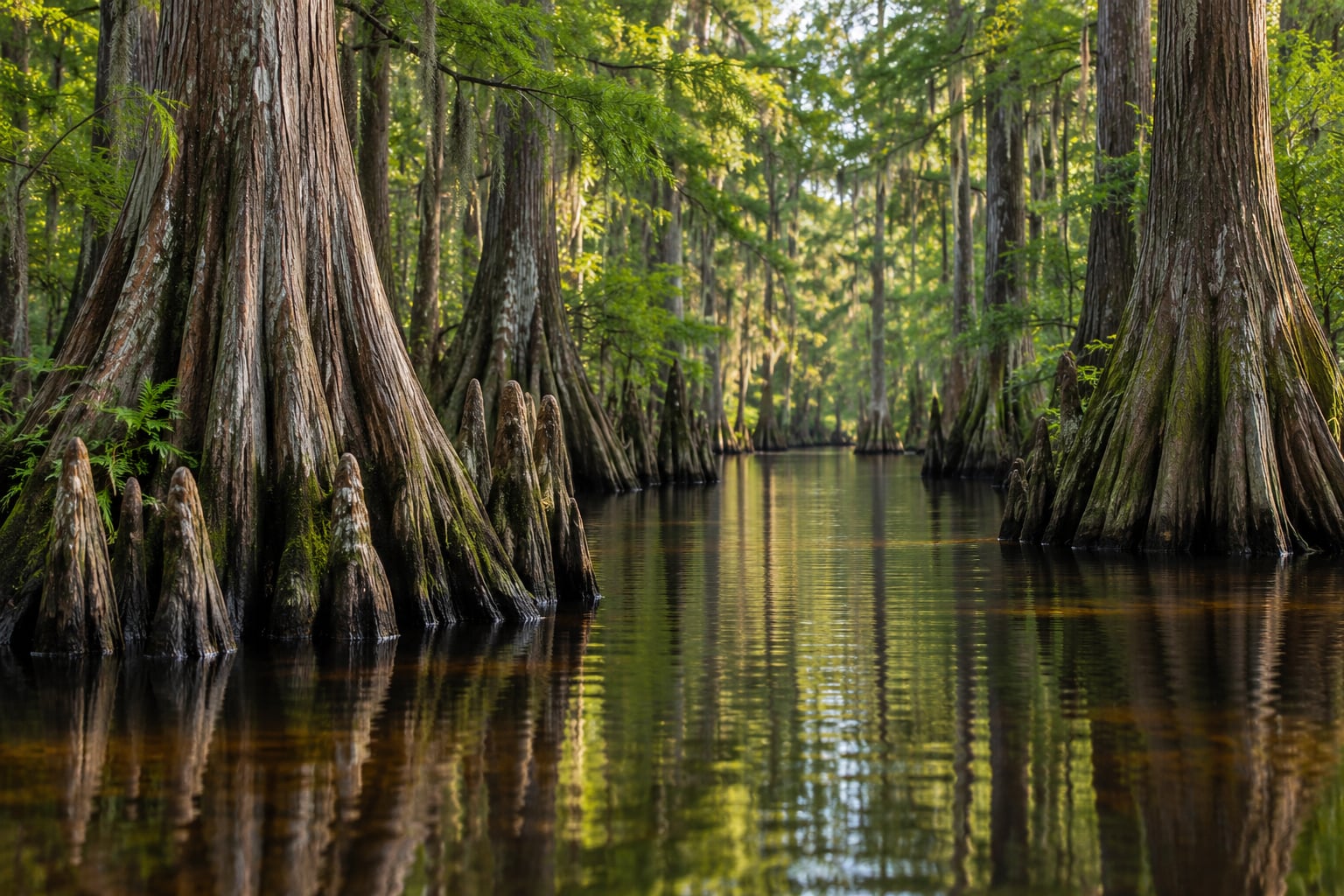
A cypress swamp is a permanently or seasonally flooded freshwater forest wetland, sometimes called a deepwater swamp, where bald cypress (Taxodium distichum) usually grows alongside water tupelo (Nyssa aquatica) over standing tannin-dark water and soft mud. The canopy is tall, open and spidery, and the trunks stand directly in water with flared buttresses at the base.
Bald cypress is the tree that makes these swamps possible. It tolerates standing water that kills most other trees, it drops its needle-like leaves in autumn, and it builds the knee-and-root structure that gives the swamp its unmistakable look.
This guide covers how cypress swamps form and why they matter, in that order: first the formation process, then the conditions that keep a swamp a swamp, the work a swamp does for the watershed, and what to watch for when you are standing in one.
Table of Contents
- How Cypress Swamps Form: From Floodplain to Forest
- The Water and Soil Conditions Cypress Needs
- How Cypress Swamps Form Step by Step
- Why Cypress Swamps Matter
- Cypress Swamps and the Southeastern Coastal Plain
- How Cypress Swamps Change as They Age
- What Threatens Cypress Swamps and How They Recover
- What to Look For in a Healthy Cypress Swamp
- Frequently Asked Questions
- Are cypress swamps the same as bottomland forests?
- Why do bald cypress trees grow with their trunks underwater?
- What are cypress knees, and how do they form?
- Are cypress swamps naturally fire-prone?
- Can a drained cypress swamp be restored?
- What to Notice First
How Cypress Swamps Form: From Floodplain to Forest
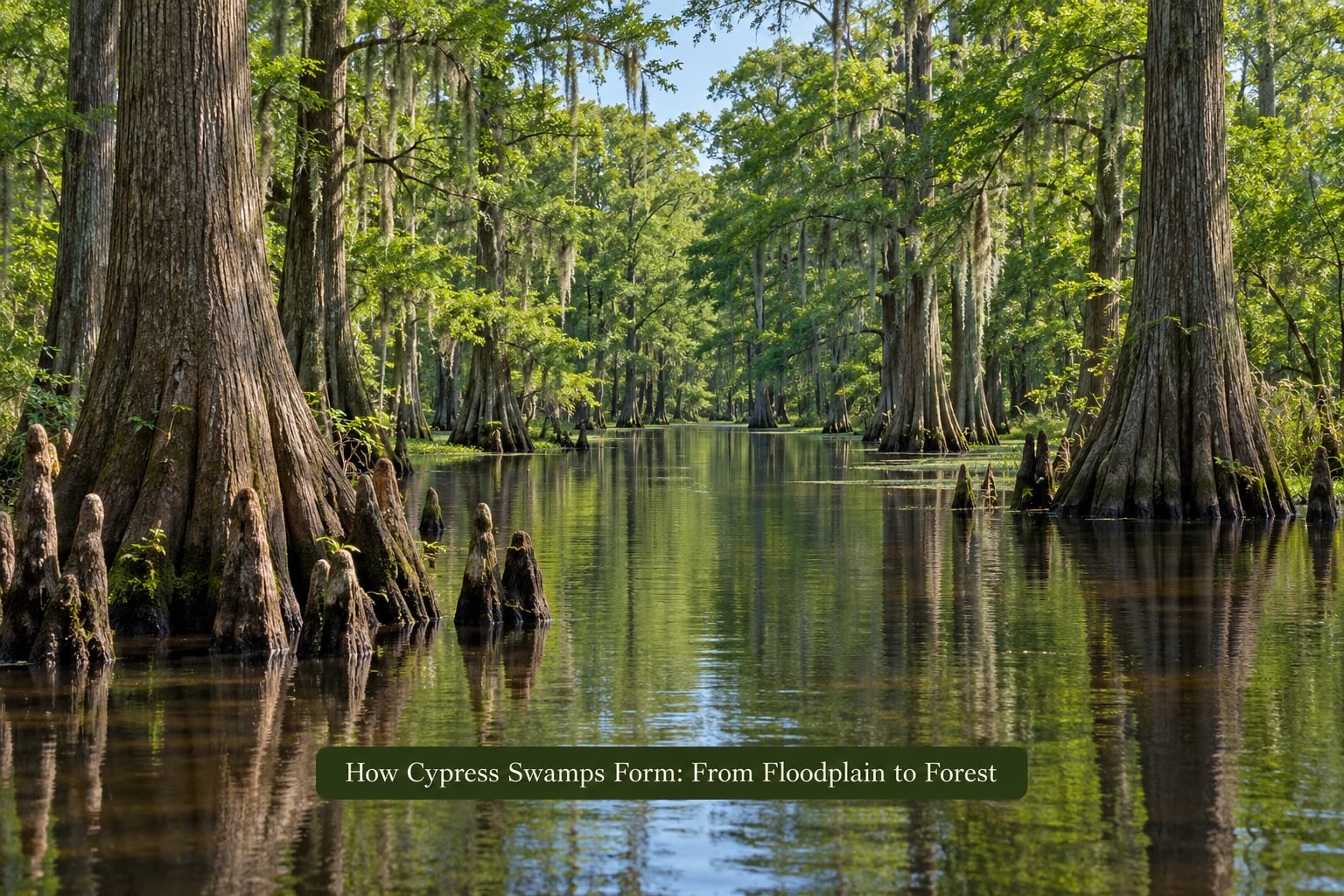
Formation starts with topography, not with trees. If you want to know how cypress swamps form and why they matter, the answer begins on an old floodplain or a sandy plain, where the ground is almost flat and the soil is permeable enough to hold water but flat enough that the water cannot drain away quickly. Rain, a rising water table and slow runoff fill shallow depressions, and the ground surface stays saturated for long stretches of the year.
Saturated soil loses its oxygen supply, because water fills the gaps that air normally occupies in the soil. That low-oxygen condition is the whole opportunity. Most trees cannot respire there, so the ground stays open instead of filling in with upland species.
Seeds arrive, often on the water itself. Bald cypress and water tupelo seeds float and travel downstream, a process called hydrochory, so a healthy upstream stand seeds the next wet depression below it. This water-borne dispersal is the main mechanism that stitches a swamp into a connected system rather than a set of isolated ponds.
Once seedlings are standing in the right depth of water, the swamp builds itself. Cypress roots spread sideways just under the water surface, knees push up around submerged roots, and the canopy closes overhead. Shade and trapped sediment raise the water table a little further, which deepens the very conditions the seedlings need.
Over decades that feedback turns a wet depression into a mature cypress-tupelo forest, and in some places into a rounded cypress dome.
The Water and Soil Conditions Cypress Needs
Not every wet place becomes a cypress swamp. The deciding factor is the hydroperiod, the seasonal pattern of how long and how deep the ground stays flooded, along with the hydric soil that saturation produces. That combination separates a cypress swamp from a marsh, a pond, a bayou or an ordinary bottomland hardwood forest.
| Habitat | Canopy | Typical water depth | What forms it |
|---|---|---|---|
| Cypress swamp | Bald cypress with water tupelo, open and tall | Standing water most of the year, roughly ankle to chest deep | A shallow water table held on flat, poorly drained ground |
| Bottomland hardwood forest | Dense, closed canopy of oak, maple, gum and ash | Shallow or seasonal, often only brief flooding | Floodplain soils with enough drainage for most hardwoods |
| Fresh marsh | Mostly herbaceous, grasses and sedges | Shallow and often fluctuating | Open wetland where trees cannot establish |
| Blackwater bayou or slough | Bottomland hardwoods along the banks | Deep, tannin-stained channel water | A flowing river channel, not standing water |
| Cypress dome | Mostly pond cypress, closed canopy | Shallow standing water, often with organic muck | A round, closed or connected low in flat terrain |
Marsh versus swamp is the most common mix-up. A marsh is dominated by grasses, sedges and other non-woody plants; a swamp is dominated by trees. The water may look similar, but the vegetation tells you which one you are standing in.
Bottomland hardwood forest is the other frequent mix-up. A cypress swamp is flooded deeply enough, often enough, that a hardwood forest cannot outcompete the cypress. Where flooding becomes shallow and infrequent, hardwoods move in and the swamp becomes bottomland woods.
How Cypress Swamps Form Step by Step
Cypress swamps form through a sequence rather than all at once. Read the swamp you are visiting as a paused version of the same sequence.
1. Flat ground holds a shallow water table. A depression in a floodplain or sandy plain collects water faster than it can drain, and the water table stays high.
2. Saturated soil goes oxygen-poor. Water fills the soil pores, the soil develops anaerobic conditions, and tree roots that need air begin to fail. Hydric soils and muck build up over time.
3. Seed arrives on the water. Floating cypress and tupelo seeds are carried downstream by flood pulses and settle in still, shallow water.
4. Seedlings establish in a narrow depth window. Young bald cypress handles shallow flooding and saturated soil, but deep or prolonged flooding drowns the seedlings. This is why formation depends on depth, not simply on wetness.
5. The canopy, knees and root mass reshape the swamp. Trapping sediment, shedding organic matter and shading the water surface raise the water table further, deepening the swamp for the next generation.
Step four is the delicate one. Research on bald cypress recruitment has found that seedlings can grow well on unflooded soil, then decline sharply once flooding begins. Drain the wrong site or flood it too deeply, and the forest that was supposed to arrive never does.
Why Cypress Swamps Matter
Knowing how cypress swamps form explains why they matter, because every service they provide comes from the same combination of standing water, saturated soil and living trees. Here is what a swamp does that a drained field cannot.
- Flood storage. Water that would run straight off a drained tract slows down and sits in the swamp, then leaves slowly.
- Sediment and nutrient trapping. Slow-moving water drops suspended sediment and excess nutrients before the water reaches downstream rivers and estuaries.
- Aquifer recharge. Infiltration through saturated soil and organic muck feeds underlying aquifers that supply wells.
- Erosion control. A dense root and knee mass holds streambanks and shoreline soil together.
- Water quality improvement. Trapping sediment and breaking down some pollutants reduces the load reaching reservoirs and coastal waters.
- Fish and amphibian habitat. The water column and the submerged root mass form the nursery habitat that headwater systems depend on.
- Bird and mammal habitat. Nest cavities, feeding cover and winter food hold migratory waterfowl, songbirds, bats and mammals such as raccoon and bobcat.
- Carbon storage. Waterlogged, oxygen-poor soils slow decomposition, so carbon that would have returned to the air is held in peat and muck.
The flood storage point is the one most often overstated. Swamps damp peak flows rather than stop flooding, and the effect depends on where the swamp sits in the watershed and how much wetland remains upstream.
A clear example is the Atchafalaya Basin in Louisiana, where basin-scale wetlands buffer the river system and hold back floodwater before it reaches the Gulf. A smaller example is a restored Delaware cypress swamp, where re-flooded wetland cells release stored water gradually and improve drainage for surrounding land.
Carbon deserves a fair note. Waterlogged soils do release some methane, a greenhouse gas. The balance between that emission and the much larger carbon volume held in wetland soils is still studied and argued, so claims in either direction should be treated carefully.
Cypress Swamps and the Southeastern Coastal Plain
Cypress swamps are not isolated puddles. They sit along rivers on the Atlantic and Gulf Coastal Plains, and the water leaving a swamp becomes the water downstream, which is why the condition of one swamp shows up in an estuary miles away.
Along the Gulf Coastal Plain, broad areas flood by sheetflow, a thin sheet of water moving across flat ground during heavy rain. Cypress establishes in the wetter swales within that flow. Farther north and east, swamps collect in depressions and along sluggish stream reaches, and the same tree does the work in a colder climate.
The northern limit of bald cypress is much colder than most people expect. Bald cypress reaches Maryland and Delaware, where winter freezes the water and cypress still grows. That range is also why cypress swamps in the Mid-Atlantic are recovering targets after decades of ditching.
The Great Cypress Swamp on the Delmarva Peninsula is a good illustration. It once covered roughly 50,000 to 60,000 acres; ditching in the 1930s drained much of it, and today about 10,000 acres remain inside protected land.
How Cypress Swamps Change as They Age
Cypress swamps are not static scenes. They move through stages, and each stage looks different from the trail.
Early stages begin as open water or marsh. Sediment and organic matter accumulate, water depth drops slightly, and pioneer trees establish in the shallows.
Regeneration follows, when floating seed reaches open water and seedlings establish in the right depth. This is also the stage most easily disrupted, because seedlings are the least flood-tolerant part of the life cycle.
The mature stage is the classic cypress-tupelo forest: a tall open canopy, knees in the water, buttressed trunks and dark tannin-stained water below.
Aging stands develop openings. Trees fall, creating light gaps that cypress and tupelo both fill, and hollow trunks and root balls become shelter for fish, snakes, turtles and birds. Over a long stretch, sediment buildup and subsidence can push a swamp toward a drier state.
That final shift explains the floodplain forest that sits above present-day swamps in places like the Atchafalaya Basin. It is often the remains of a cypress swamp that filled in.
What Threatens Cypress Swamps and How They Recover
The formation sequence explains the damage too. Drainage removes the water that every later step depends on, so the swamp unravels from step five backward.
Agricultural ditching is the biggest historical loss. Ditches lower the water table, drop the water below the seedling window and kill regeneration. Drained swamp land also stops storing floodwater, which is why flooding problems often worsen downstream after a swamp is drained.
Altered water flow works the same way. Blocking a river with a levee cuts off flood pulses, and without those pulses the water table drops even where the land is never directly dug.
Filling and development cover the ground outright. Where drained swamp is filled with clay to raise it for housing, the soil stays hard and poorly drained, and hardy pines often replace what was there, a pattern long remembered locally in places like The Woodlands, Texas.
Saltwater intrusion is the coastal version of the same problem. Rising salt water kills bald cypress, and the result is a ghost forest of bare trunks standing in saline water.
Invasive plants such as Chinese tallow and privet can shade out cypress regeneration, and fire in a heavily drained site can strip the ground cover that a wet site would otherwise carry.
Restoration usually starts with water. Ditch plugging, wetland cells, swales and hummocks raise and vary the water table, and then native trees are planted where hydrology will support them. The Great Cypress Swamp restoration re-flooded about 80 acres of former farmland using 17 wetland cells and planted more than 10,000 native trees.
Hydrology often returns in a few growing seasons. Soil condition and the original forest composition take far longer, sometimes decades, and a restored swamp usually returns as a patchwork of young cypress and tupelo rather than the old-growth stand visitors picture.
What to Look For in a Healthy Cypress Swamp
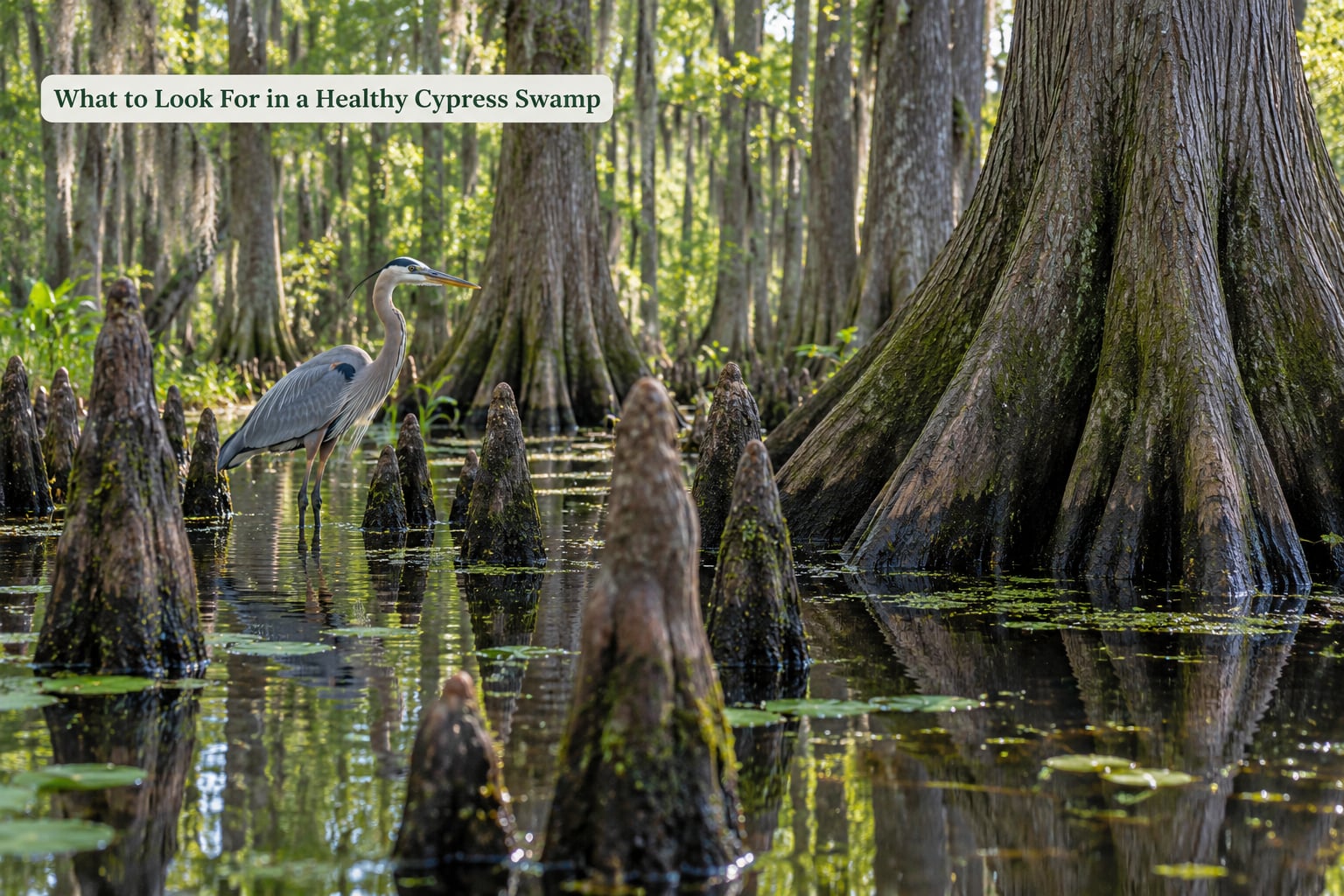
A healthy cypress swamp shows you most of its evidence in the water. Learn to read these signs rather than the photograph in the brochure.
- Standing tannin-dark water. Black tea-colored water comes from tannins leached out of fallen leaves and bark.
- Cypress knees. Knobby vertical growths rise out of the water around submerged roots.
- Buttressed trunks. Flared bases spread into the water where roots run near the surface.
- Bald cypress bark and needles. Fibrous, cinnamon-brown bark peels in strips, and the soft, feathery, deciduous needles turn russet in autumn.
- Fish habitat in the roots. Root balls and knees break the current and shelter small fish.
- Wading birds. Herons, egrets and bitterns hunt the open shallows; songbirds such as prothonotary warblers use the canopy and cavity trees.
- Connected vegetation. Flood-tolerant ground cover, buttonbush and swamp cottonwood continue outward into wetter and drier zones.
One caution about cypress knees on private ground. They are a natural part of the same structure you see in the wild, and cutting them is often illegal on public land and on listed species habitat. They are not a defect, and cutting them does not protect the tree.
A few older cypress trunks develop hollow interiors as water and insect damage open cavities over time. Those cavities are prime nesting and denning sites, which is one reason mature cypress matter more than young cypress.
Frequently Asked Questions
Are cypress swamps the same as bottomland forests?
No. A cypress swamp has standing water deep enough and long enough to keep most hardwoods out, so bald cypress and water tupelo dominate the canopy. A bottomland hardwood forest has shallower and shorter flooding, so oaks, gums, maples and ashes form a closed canopy. Where flooding eases, cypress gives way to hardwoods and the swamp becomes bottomland forest.
Why do bald cypress trees grow with their trunks underwater?
Bald cypress is adapted to waterlogged, oxygen-poor soil. Its roots spread sideways near the surface where oxygen is available, and the base flares into buttresses above the waterline. Pneumatophores, small woody projections that push up from submerged roots and mud, add surface area for gas exchange. The tannin-stained water itself is low in oxygen, so the tree works around that limit.
What are cypress knees, and how do they form?
Cypress knees are upright woody growths that rise above the water from the horizontal roots of bald cypress. The long-standing explanation is that they carry oxygen down to submerged roots in saturated soil. A competing theory holds that knees promote methane oxidation at the surface, which would improve carbon storage. Researchers still debate the mechanism, and knees also add habitat, so treat them as useful either way.
Are cypress swamps naturally fire-prone?
No. Healthy cypress swamps are not fire-prone because flooding keeps the ground wet and the canopy open. Fire risk rises when a swamp is drained, since the water table falls and dry ground fuels burns that water would normally stop. Prescribed fire is used in some management programs, but a drained swamp behaves much more like upland pine woodland during a dry season.
Can a drained cypress swamp be restored?
Partly. Restoring the hydrology is the first step and often the biggest one: ditch plugging, wetland cells, swales and hummocks raise and vary the water table, and native trees are planted afterward. Wildlife returns quickly once water is back. Original soils and the old forest composition take much longer, often decades, so a restored swamp tends to develop into young cypress-tupelo rather than old growth.
What to Notice First
Start with the water, then the soil, then the trees, then the wildlife, in that order. How cypress swamps form and why they matter both come down to that sequence: flat wet ground, oxygen-poor soil, floating seed, and a canopy that deepens the water for the next generation.
Standing dark water, knees, buttressed trunks and a wading bird working the shallows tell you the system is intact. Stay on boardwalks and public access routes, keep to the edges of root masses, and leave the knees where they are.