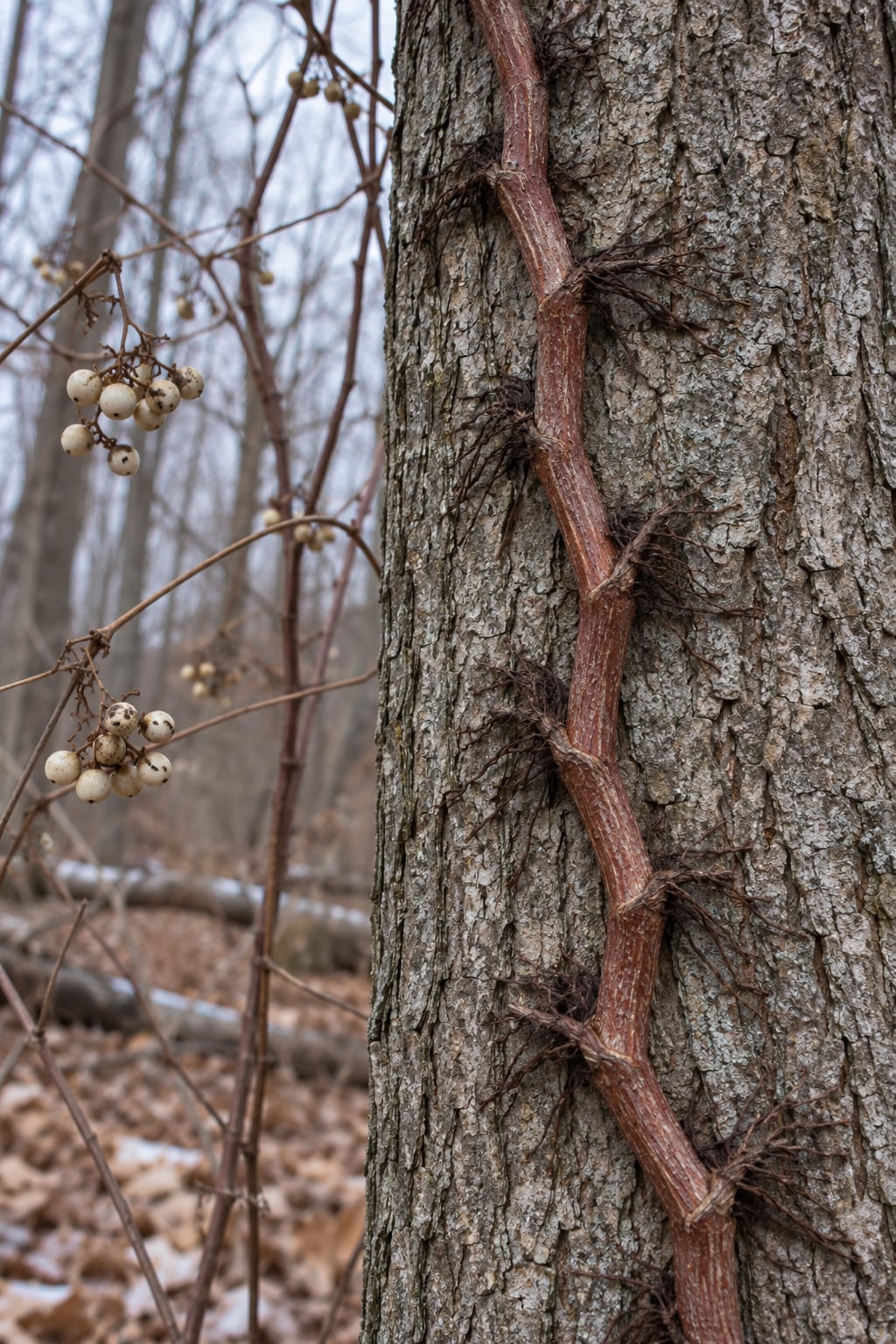
To identify poison ivy in winter, look for the vine itself, not the leaves. Toxicodendron radicans climbs with dark, hair-like aerial roots that give the bare stem a fuzzy, rope-like look, and those roots stay on the trunk all winter. The plant is dormant, not dead. Urushiol, the oily resin behind the rash, is still in the stems and roots, often more concentrated than in summer.
That combination is why winter causes trouble. People see a leafless vine that looks abandoned, grab it while clearing brush or cutting a storm-fallen tree, and end up with a rash two days later. Trail crews, hunters pushing into woodlots, anglers working shorelines and anyone stacking firewood run into the same thing.
Five minutes of careful looking beats an itchy week. Here is what to bring, what to check, and how to be certain before you touch anything.
Table of Contents
- What You Need
- Step-by-Step: How to Identify Poison Ivy in Winter
- 1. Check for a Woody Climbing Vine
- 2. Inspect the Stem Pattern and Bark for Poison Ivy ID
- 3. Look for Winter Berries and Dried Flowers
- 4. Trace Ground Stems to the Root Crown
- 5. Confirm the Location and Avoid Contact
- Winter Look-Alikes: What It Is Not
- Common Mistakes
- Frequently Asked Questions
- Can you identify poison ivy in winter when the leaves are gone?
- What does poison ivy look like without leaves?
- Do white berries always mean a plant is poison ivy?
- Is dormant poison ivy still dangerous to touch?
- How do I tell poison ivy from another climbing vine?
- Should I remove poison ivy from a trail or property?
- Conclusion
What You Need
Winter identification is structure work, not foliage work, so the gear is simple.
- Gloves you can throw away. Disposable nitrile or cheap work gloves. You are handling unknown bark and possibly a saw blade that has been through poison ivy.
- A small digging tool or hand trowel. For moving leaf litter away from a root crown without raking through the whole bank. A dull knife also works for scraping soil back from a stem base.
- A camera or phone. Photos scale, and a plant clinic or extension service can confirm a suspect plant from a close shot of the stem and any berries. A field guide with winter plates is a useful backup.
- A way to mark the spot without touching it. A GPS pin, a flagging ribbon tied to a nearby branch, or a pencil mark on your map. Do not tie a marker to the vine itself.
- Long sleeves and eye protection if the plan is any real cutting. Gloves fail at the cuff, and the cuff is where wrists and forearms get exposed.
If you have none of this and only want to know what you are looking at, binoculars and patience still work. Distance is the safest tool in the kit.
Step-by-Step: How to Identify Poison Ivy in Winter
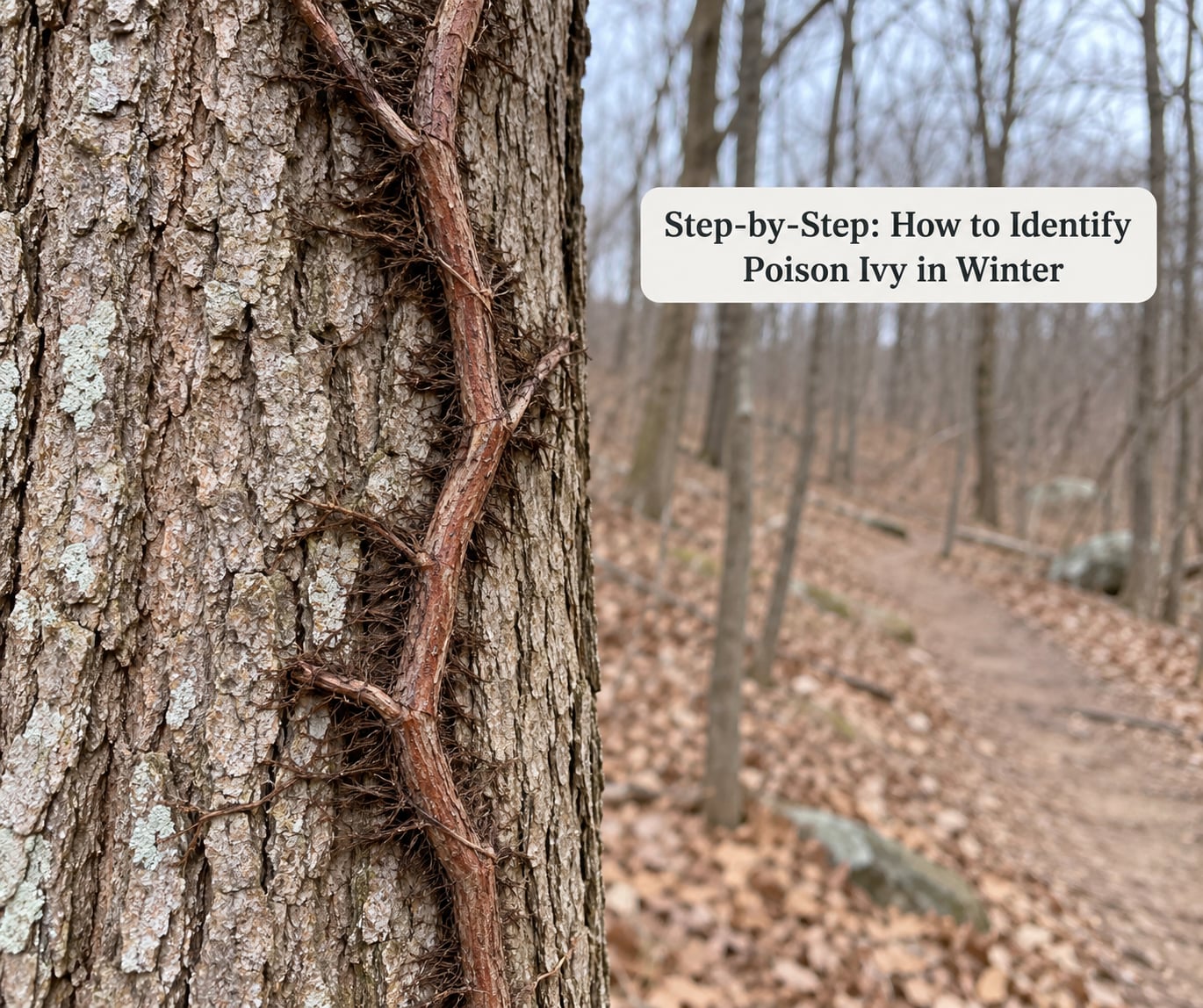
Work through these in order. Each step alone is suggestive, and the combination is what gets you a confident answer. If you cannot find steps one and two, stop and treat the vine as poisonous until someone with field experience confirms otherwise.
1. Check for a Woody Climbing Vine
Poison ivy does not twine. It grips bark, fence posts, siding and trees with hundreds of tiny clinging rootlets called aerial roots. That is the single most reliable cold-season clue, and it is the winter version of the old rhyme about a hairy vine.
At a distance the aerial roots read as fuzz, almost like a rope covered in hair. Up close they resolve into small woody nubs along both sides of the stem, sometimes with a slight reddish cast. Old vines on mature trees are thick enough to hide the host trunk completely, so a tree that suddenly looks shaggy may be a tree wearing poison ivy.
How to tell it worked: you can see the stem attached to its support by rootlets, not spiralling around it like a rope. Virginia creeper holds on with adhesive pad tendrils at the nodes instead, which is a completely different attachment.
2. Inspect the Stem Pattern and Bark for Poison Ivy ID
Follow the stem a foot or two and look at how it branches. Poison ivy branches alternately, one node after another, which creates a zigzag as the stem changes direction around the trunk. The stem is slender and woody, reddish-brown to grayish, and smooth, with no spines or thorns anywhere on it.
Stem color alone proves nothing. Gray on an old trunk section, red on a young shoot, both are normal for the plant and both colors show up on look-alikes. Treat color as supporting detail, never as the deciding feature.
Look for leaf scars next. Each leaf that dropped in fall left a mark, and on poison ivy those scars sit alternately along the stem, often shaped like a shallow U or a horseshoe. Where a side stem left the main stem you will find a slightly raised ring of scar tissue.
How to tell it worked: alternate branching, a smooth thornless stem, and a chain of small alternating leaf scars. Take a close photo here, because that single image is usually enough for an extension service to confirm the plant.
3. Look for Winter Berries and Dried Flowers
Birds eat poison ivy fruit, so clusters often persist well into winter, especially in sheltered spots and along south-facing edges. The berries are small, off-white to pale gray, and hang in loose clusters. Dried flower remnants and empty pedicels stay behind too, forming little star-shaped clusters of twig-like points.
Here is the important part: berries confirm, they do not convict. White or pale berries do not mean poison ivy on their own. Winterberry, honeysuckle and a scattering of other shrubs carry pale fruit in the same season. Use the berries to support a stem you already believe is poison ivy, never to identify one from a distance.
How to tell it worked: pale berries hang from the same zigzag stem with the alternate leaf scars and aerial roots. If the berries are on a separate woody shrub with a different branching pattern, you are looking at two plants.
4. Trace Ground Stems to the Root Crown
Not every poison ivy vine climbs. Many patches spread as ground runners, sending stems out several feet until they find a trunk or a fence and start upward. In winter these runners are thin, reddish and easy to lose under leaf litter.
Scrape lightly back from a suspected runner with your trowel and follow it to the crown. You will often find several stems emerging from one central point, fanning out from a single woody base. Poison ivy also spreads by creeping rhizomes that run shallow and underground, which is why a patch you cut down reappears the next season.
On public ground in the western half of the country, watch for the other growth form. Toxicodendron rydbergii grows as a low shrub or groundcover with no climbing vine at all, sending upright twigs from creeping stems. Winter identification there depends on the stem texture, the alternate leaf scars and the location.
How to tell it worked: multiple stems radiating from one crown, or a runner that clearly links a ground stem to a climbing vine. The crown is a strong confirmation feature, not the only feature you need.
5. Confirm the Location and Avoid Contact
Poison ivy grows where disturbed soil, sun and edge habitat meet, and in winter those edges are bare and obvious. Look along trail margins and the shaded side of treelines, the edges of recent clearings and storm-felled tree openings, fence lines, old road cuts, woodlot borders, campfire rings, livestock rubs and stacked firewood piles.
Record the location before you move on. A GPS pin or a flagged branch costs nothing, and it gives you a chance to confirm the plant at leaf-out in spring or get a clinic to check it now.
Then keep your distance. A dormant vine is not safe to handle. The oil that caused your summer rash is pulled back out of the falling leaves and concentrated in the vine and roots during dieback, so a leafless stem carries a stronger dose than the foliage that people learn to recognize. Crushing a stem, cutting one, or even dragging a boot through a patch can transfer oil to skin, clothing, boots, gloves, saws and dogs.
Never burn it. Urushiol vaporizes, and smoke from a brush pile containing poison ivy can cause severe lung inflammation and has killed people. Treat any winter brush pile as a suspect and keep it out of your fire ring.
Winter Look-Alikes: What It Is Not
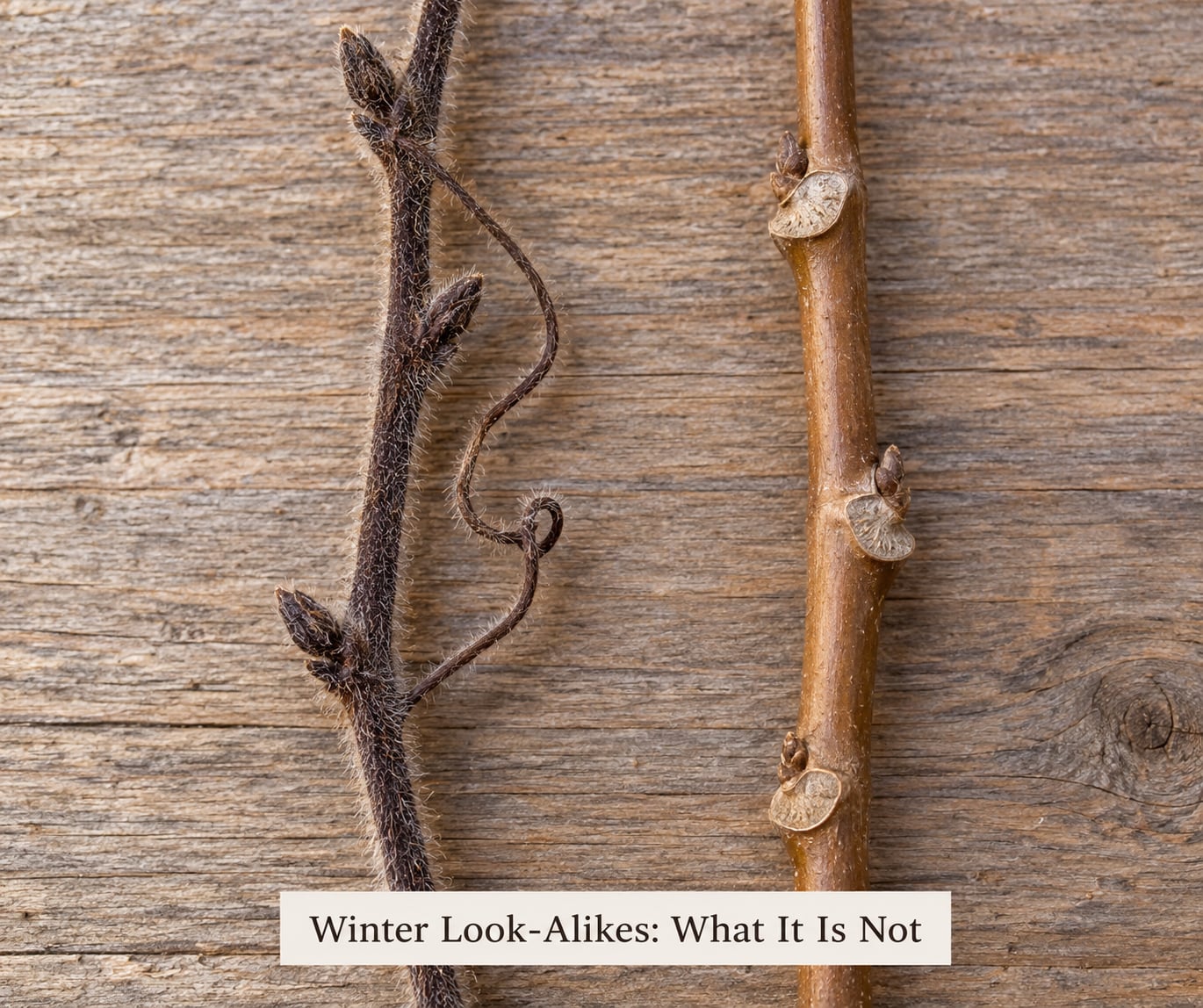
Most winter misidentifications come from skipping this table. Four plants account for nearly all of them.
| Plant | How it attaches | Stem texture | Thorns | Distinguishing mark |
|---|---|---|---|---|
| Poison ivy (Toxicodendron radicans) | Dark hair-like aerial rootlets along the stem | Fuzzy rope look, hairy under close view | None | Alternate leaf scars, pale berry clusters, smooth stem |
| Virginia creeper | Adhesive pads on branched tendrils at the nodes | Smooth, five leaflets when in leaf | None | Visible suction-cup pads, no fuzz along the stem |
| Wild blackberry or raspberry | Canes arching along the ground, rooting at tips | Square-ish, ridged canes | Curved prickles | Any thorn at all rules out poison ivy |
| Trumpet vine | Twines around its support | Smooth woody vine | None | Twining growth and opposite leaf arrangement |
| Winterberry holly | Upright shrub, no climbing | Smooth gray twigs | None | Red berries on a freestanding shrub, never on a climbing vine |
The rule that carries the most weight is the simplest one: if you find thorns or prickles, it is not poison ivy. If the vine grips with fuzz instead of twining or pads, keep treating it as poison ivy until you know better.
Common Mistakes
Waiting for leaves before deciding. People delay through winter, then get surprised in spring. Decide at the vine stage, from the aerial roots and the stem pattern.
Treating a leafless vine as dead. Dormant means inactive growth, not inactive oil. The same rash risk exists in December that exists in July.
Assuming every hairy vine is poison ivy. Several vines carry fuzz or rust-colored hairs. The rhyme is a shortcut, not a diagnosis. Confirm with aerial roots plus alternate leaf scars plus a growth habit that matches, and when in doubt send a photo to a university extension plant clinic.
Pulling the vine off the tree to see what it is. Tearing the vine breaks the rootlets and can fling oil. Observe from a few feet away and photograph instead.
Looking only upward. Ground runners and low shrubs get missed. Follow stems back to the crown and check the shaded ground layer beneath the canopy.
Treating one missing sign as proof of absence. No berries, no vine fuzz, no leaves means the evidence is incomplete, not that the plant is gone. Judge the combination.
Prevention is mostly positioning and clothing. Stay on the middle of the trail rather than squeezing between a trunk and a fence line. Pull on long sleeves and gloves before brush season rather than after a rash. Keep boots and dogs out of low patches along shorelines and trail edges. Wash tools and gloves with soap and water before they touch skin or laundry, and keep brush piles away from campfires and burn barrels.
If contact already happened, wash the skin with lukewarm soapy water for about fifteen minutes as soon as you can. Plain dish soap works because it cuts the oil; lukewarm water opens the pores better than cold. Wash under running water, remove contaminated clothing and wash it separately, and do not scratch, because breaking the skin spreads the oil and raises infection risk. Cool compresses, calamine or other topical antihistamines can ease itching. Seek medical care for facial or eye involvement, a rash covering a large area, blistering, breathing trouble, or signs of infection such as fever and pus. If you used a folk remedy such as a plant wash or juice, stop it. Unproven remedies delay treatment without removing the oil.
Frequently Asked Questions
Can you identify poison ivy in winter when the leaves are gone?
Yes, and winter is often easier than summer. The climbing vine is bare and fully visible, with dark hair-like aerial rootlets along the stem, alternate branching, small U-shaped leaf scars, and pale berry clusters that often persist into cold months. Ground patches show several stems fanning from one crown. Confirm the combination of clues rather than any single sign.
What does poison ivy look like without leaves?
It looks like a slender woody vine, reddish-brown to grayish, gripping a tree, fence or post with fuzzy aerial roots instead of twining. Thin stems snake along the ground or climb, branching in a zigzag with alternating leaf scars. Small clusters of off-white berries may hang on into winter. Densely covered tree trunks can look like the tree itself.
Do white berries always mean a plant is poison ivy?
No. Several shrubs, including winterberry and various honeysuckles, carry pale berries in the same season. Berries support an identification but never make one on their own. Use them together with aerial rootlets along a climbing stem, alternate leaf scars, a smooth thornless stem, and the growth habit. If those do not line up, treat the berries as unrelated.
Is dormant poison ivy still dangerous to touch?
Yes. Urushiol is present in roots, stems, vines and berries, and during fall dieback it is drawn back out of the leaves and concentrated in the vine and roots. Cutting, crushing or pulling a dormant vine can transfer oil to skin, clothing, boots, tools and pets. Never burn it, because the smoke carries the oil and can severely injure lungs.
How do I tell poison ivy from another climbing vine?
Check the attachment mechanism first. Poison ivy grips bark with hundreds of dark hair-like aerial rootlets and never twines. Virginia creeper uses adhesive pads on branched tendrils, trumpet vine spirals around its support, and wild blackberry canes arch along the ground with curved prickles. Any thorn rules out poison ivy. Leaf arrangement and stem texture confirm the call.
Should I remove poison ivy from a trail or property?
Winter is the best time to see and treat it, because the plant is dormant and you can trace every stem back to its crown. Cut the vine well below the crown, treat the stump with a labeled herbicide or stump product according to its directions, and expect regrowth from rhizomes the next season. Do not burn it, and never work without gloves, long sleeves and eye protection.
Conclusion
Start with the vine. If there is a woody climbing stem gripping bark with hair-like aerial rootlets, you are probably looking at poison ivy, and the rest of the clues decide how sure you are.
Confirm with the combination: alternate branching and leaf scars, a smooth thornless stem, pale berry clusters when present, and multiple stems from one root crown. Then keep your distance, mark the spot so you can check it at leaf-out, and keep it away from any fire.