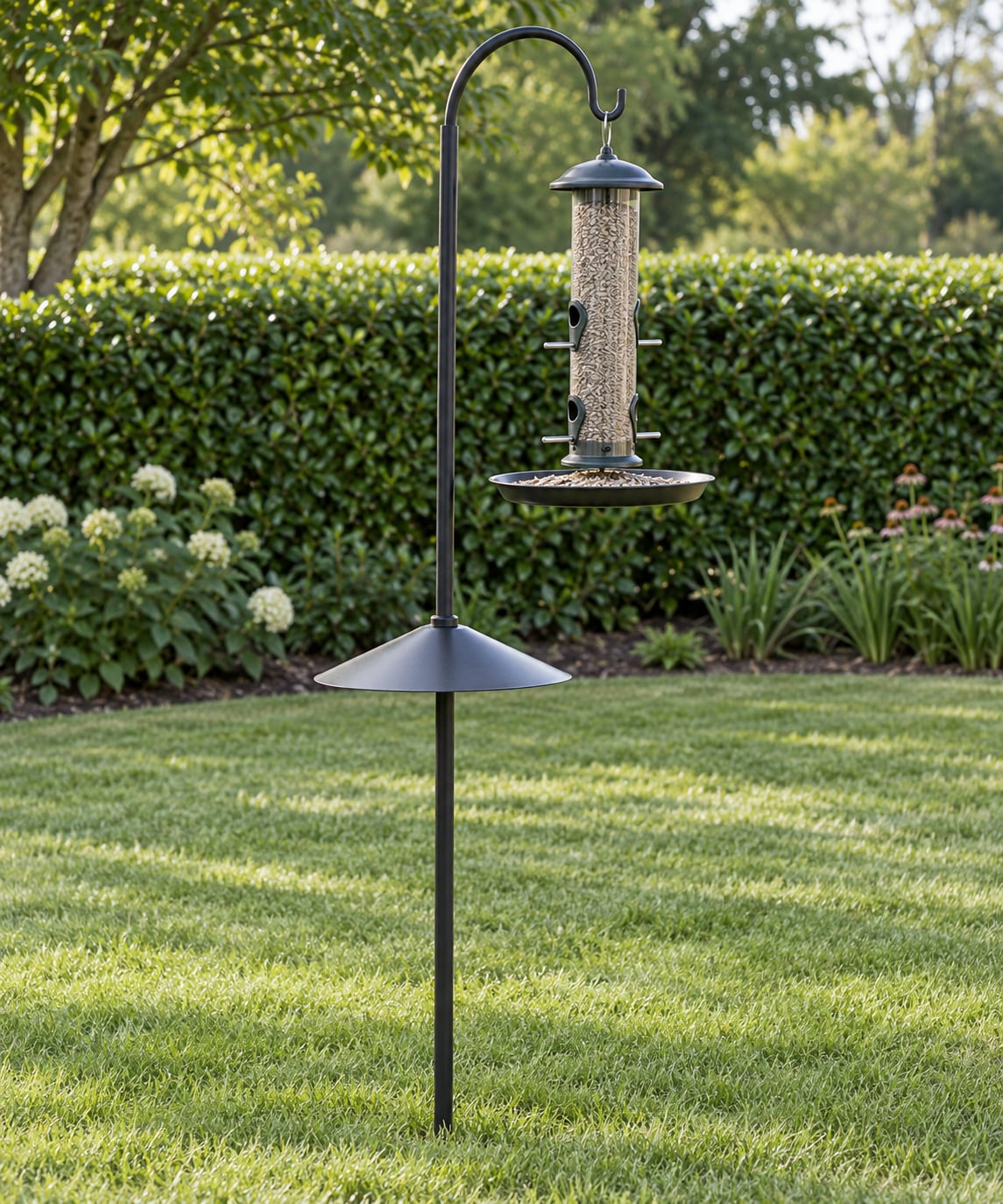
To feed birds without attracting rats, you need the right seed in the right feeder on the right pole, in the right spot. Hulled sunflower hearts or nyjer instead of cheap filler mixes, a smooth metal pole with a baffle, at least 4 feet off the ground and 8 feet from anything climbable, filled lightly in the morning and swept clean before dark. That setup removes nearly every reason a rat shows up.
Nobody sells a rat-proof feeder, and anyone who tells you otherwise has not met a rat. What you are building is a rat-resistant system, and it is three things working together: food rodents will not bother with, hardware they cannot climb, and a cleanup habit that removes spilled seed before dark. Miss any one of the three and you are back to square one.
Before the steps, one thing worth saying plainly. Feeders are often blamed for rat problems that started somewhere else. A garage bin with a chewed corner, an open compost pile, a dog bowl on the porch, a stack of firewood against the house, barbecue grease congealing on a patio rail, fruit dropping in a crabapple tree. One Talk of the Villages forum poster took the feeder down after spotting rats and kept finding droppings on the porch anyway. So when you work through this guide, audit the rest of the property too.
The hardest question any feeder owner asks is whether to stop feeding altogether. The top-voted answer on r/pestcontrol is blunt: stop feeding the birds. Traps and poison can go out all day, but the food keeps coming back. That answer is half right, and the rest of this guide explains the honest version, including a staged pause you can use without giving up on the birds.
Table of Contents
- What You Need
- Step-by-Step
- How to Feed Birds Without Attracting Rats
- Choose a Feeder Rats Cannot Exploit
- Use Seed and Food That Discourage Rodents
- Place the Feeder Where Rats Have Less Cover
- Clean and Maintain the Feeding Area
- Make the Surrounding Area Less Inviting
- Common Mistakes
- Frequently Asked Questions
- What bird seed will rats not eat?
- Will cayenne pepper in bird seed keep rats away?
- Is there an anti-rat bird feeder available?
- Will rats leave my garden after I stop putting out bird seed?
- How high should I hang a bird feeder to keep rats out?
- What smell do rats hate?
- Conclusion
What You Need
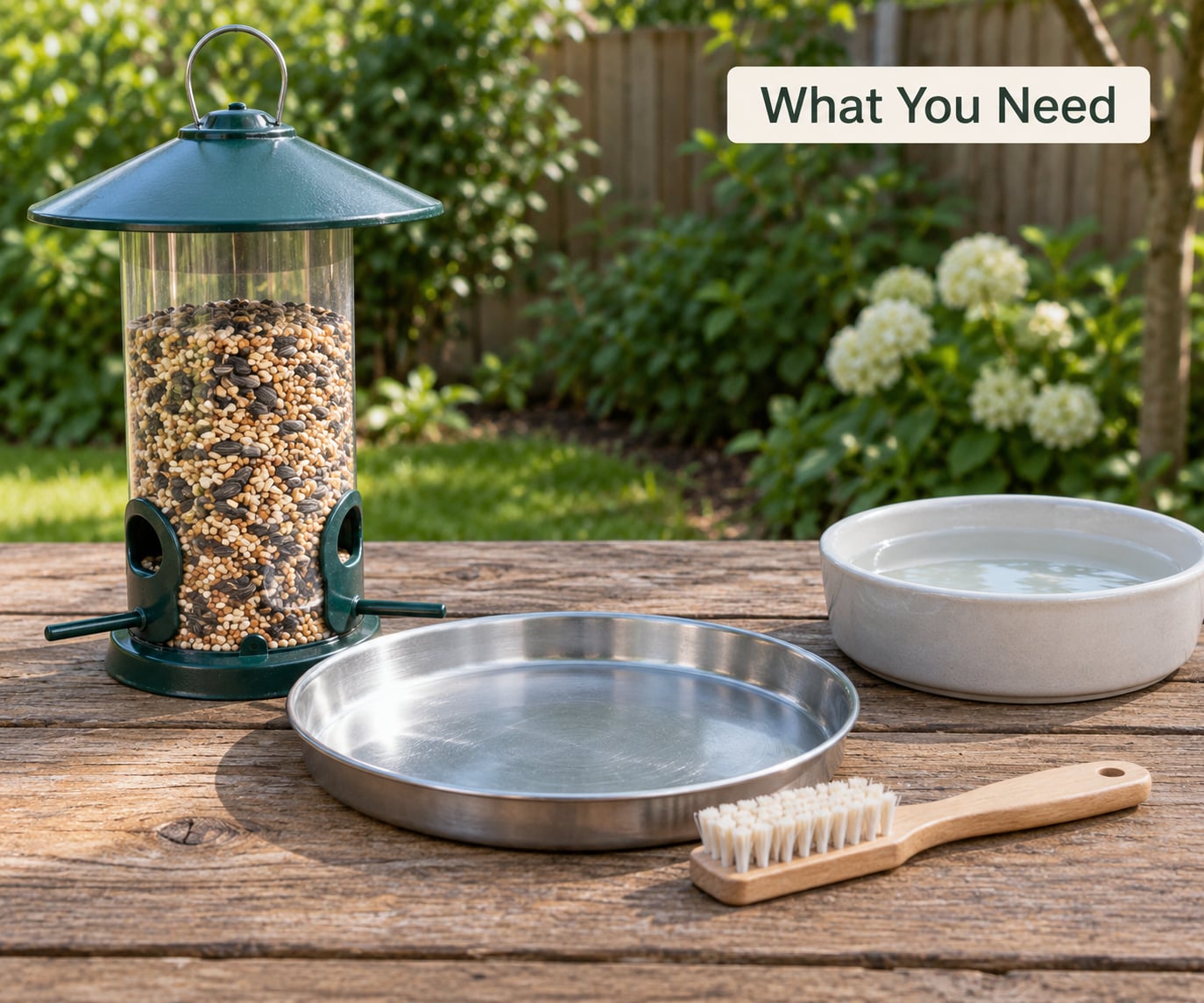
You do not need a large equipment list. Most of this is a handful of items you may already own.
- A tube, hopper or caged cylinder feeder with a removable, washable tray. Skip open platform feeders and bird tables if rodents are already a problem, because they spill by design.
- A smooth metal pole, or a wooden pole you can sleeve with PVC pipe. Rats need texture to grip; smooth PVC stops them cold.
- A tube baffle or domed baffle, roughly 5 feet up the pole, plus a wide cone or plate beneath the feeder to block the climb.
- Hulled sunflower hearts, nyjer seed or safflower. Nyjer is spelled niger in older UK bird food writing, which trips people up when they search.
- A metal storage bin with a tight lid for seed. Rats chew through cardboard sacks and plastic totes, so metal is the only reliable container.
- A stiff nylon brush, a bucket, gloves and a hose for cleaning. A bottle brush gets into seed ports that hands never will.
- A small hand rake or shop vac to collect spilled seed and hulls from underneath.
- Optional: a shallow plastic tray or an upturned tub lid to build a seed catcher, a jar of petroleum jelly or coconut oil for a grease barrier, and a bag of coarse gravel or flat paving to lay under the feeder.
Step-by-Step
How to Feed Birds Without Attracting Rats
The core strategy is simple: remove the reasons rats use your yard, one at a time. Rodents are not hunting your feeder. They are responding to three specific things, and each one has a fix.
- Food on the ground. Hulls and spilled seed are the single biggest attractant. Catch it, sweep it, and never let it accumulate in grass or mulch where you cannot see it.
- Food available overnight. Birds feed in daylight. Rats feed after dark. An overfilled feeder is an all-night buffet, so fill lightly in the morning and clear leftovers before dusk.
- An easy climb and a predictable route. Rats are strong climbers with flexible bodies and excellent balance. A smooth pole in open lawn, away from fences, trees, shrubs, deck rails and pergolas, removes the route.
Do these three things consistently for a few weeks and the visits usually stop. Add the hardware improvements in the next sections and most rat problems never start.
A useful detail about timing: night vision. Rats and mice handle very low light far better than birds do, so dusk is when they start moving and birds have already gone to roost. Cleaning at dusk matters more than cleaning at noon.
Choose a Feeder Rats Cannot Exploit
Rat resistance comes down to mesh size, roof coverage, seed port design and how much food touches the ground. A feeder with a solid metal body, a roof over every port and ports small enough that a rat cannot reach in without exposing its head is already ahead of most designs.
Here is how the common types compare for rodent resistance.
| Feeder type | Rodent resistance | Best use |
|---|---|---|
| Tube feeder with plastic or metal mesh | Good. Small birds can reach seed, rats cannot fit a paw through the mesh | Default choice for a rat-prone yard |
| Caged cylinder feeder | Good to very good. Wire cage excludes squirrels and rats, and it swings away from a climbing route | Yards with squirrels and rats together |
| Hopper with glass or metal body and a roof | Moderate to good. Roof blocks rain and hulls, but a hungry rat will still climb a pole | Mixed-species feeding where a tube will not work |
| Weight-activated or squirrel-proof feeder | Mixed. These are engineered against squirrels, and squirrels and rats defeat many of them | Squirrel pressure first, rodents second |
| Platform feeder or bird table | Poor. Open design, open access, spilled food by design | Only with a screened vermin tray beneath it and a daily sweep |
| Suet cage | Moderate. Crumbs fall straight down and cages often have large gaps | Winter only, on a pole, with a tray underneath |
Two hardware details do more work than the feeder itself. First, the pole: it should be smooth metal or a wood pole sleeved with PVC pipe, set in a heavy base so it cannot be rocked. A Facebook backyard birding group member reported that sleeving her pole in PVC worked so well she had not seen another rat since, because the rodents could not get a grip. Second, the baffle: a tube baffle or domed baffle at about 5 feet, plus a wide cone or plate below the feeder, gives you two separate barriers instead of one.
Skip tree hangers entirely if rats are a problem. Any hanging feeder is a suspended food source a determined rodent can reach, and the line itself is a ladder.
Use Seed and Food That Discourage Rodents
Seed choice is where most feeders go wrong, because filler-heavy mixes are cheap and the birds do not care much. Rats are far less fussy than birds, and the grains humans dislike are the grains rodents clean up first.
Hulled sunflower hearts are the top pick. Birds eat the kernel and the shell, so nothing lands below. Nyjer seed works the same way and stays in a ported feeder. Safflower is not eaten by most rodents once it is mature, which makes it a useful stand-in for hulled seed. Black oil sunflower is nutritious but generates hulls, so put it in a feeder with a seed catcher and expect to sweep. Shelled peanuts are excellent for birds and attract squirrels, which is usually worse for you than rats.
Avoid milo, cracked corn and wheat in the same feed, and avoid any mix where you can read a long ingredient list that is mostly grain. Those seeds are the leftovers nobody wants, so they end up on the ground and they are exactly what rats are scanning for. Cheap filler mixes are the single most common reason a tidy garden becomes a rat problem.
Portion control matters as much as seed type. Fill the feeder with roughly a day and a half of seed, not a two-week supply. Birds will eat what you put out; they do not need a full hopper to be satisfied. In winter the amount goes up and the risk goes up with it, so winter suet, fat balls and fatty seed deserve a tray underneath and a shorter cleaning interval.
On cayenne and hot pepper seed, the honest version: it works better than nothing and worse than the marketing implies. Wild Birds Unlimited describes hot pepper food as deterring roughly 90% of squirrels and rodents that try it, and explicitly not 100%. Birds cannot taste capsaicin the way mammals do, so the seed is safe for them. Home and Roost tested spiced seed on squirrels and found that both birds and squirrels ate it, which is the kind of field result that gets left out of product descriptions. Treat hot pepper as one layer in a stack, never as the layer you rely on.
Never scatter seed on the ground for sparrows, doves or wagtails. If you want to feed ground-feeding birds, put that food on a separate small table with a screened metal tray fitted underneath, positioned well away from the main feeder. That keeps the ground feeding behavior without turning your lawn into a feeding station.
Place the Feeder Where Rats Have Less Cover
Placement is the cheapest control you have, and it is the one most people skip. King County Public Health guidance for feeder placement is the number most wildlife agencies repeat: mount the feeder at least 4 feet off the ground and at least 8 feet horizontally from any structure a rodent can climb, including fences, tree branches, shrubs, shed walls, deck rails and pergolas.
That 8-foot gap is the part people miss. A pole 8 feet from a fence is a puzzle to a rat. A pole 2 feet from a fence is a staircase. Walk your yard and count the climb highways within 10 feet of where the feeder sits: fence lines, deck and porch rails, shed and garage walls, tree trunks and low branches, dense shrubs, ivy on a wall, a woodpile, a trellis, an air-conditioning unit, a downspout. Every one of them either moves further out or gets blocked.
Now the part the AI answers on search pages keep repeating, because it is the mechanism behind the rule. Rats are prey animals with poor daylight vision and a strong instinct for exposure. Open lawn with nothing overhead feels dangerous to them. They will cross it, but they will not set up camp there, and they will not spend long at an exposed feeder. So place the pole in the middle of open ground if you can, with a clear line of sight and no shrubbery within 8 feet in any direction. You get a similar bonus by keeping the area mowed short under and around the feeder.
Roof rats complicate the high-feeder logic, because they live and nest above ground in shrubs and trees rather than in burrows. UC IPM notes roof rats prefer dense vegetation, so a feeder hung near a hedge or under a tree canopy may be closer to a roof rat highway than you think. Push the pole away from canopy and shrubs, and treat the shrub line itself as a climb route.
A hard surface underneath helps more than people expect. Paving, gravel or bare soil lets you see every seed and hull, makes sweeping realistic, and stops grass and mulch from hiding a growing pile. If you cannot change the surface, a seed catcher tray is the answer.
One last safety point on placement: keep the feeder out of sight of windows where possible. Squirrels that learn a reliable food source become bold, and bold squirrels are followed by bolder rodents. An exposed feeder in the middle of an open lawn also stays visible to cats and hawks, which discourages rodents on their own.
Clean and Maintain the Feeding Area
Cleaning is where rodent control and bird health meet. Cornell Lab of Ornithology guidance recommends cleaning feeders roughly every two weeks, with more often if they get wet or soiled. A feeder that is never cleaned becomes a wet hull and droppings reservoir, which makes birds sick and makes the spot more attractive to rodents at the same time.
Here is a repeatable routine.
- Inspect every few days. Look under the feeder first. A light scatter of hulls is normal; a carpet of seed means spillage you cannot control and the feeder needs a tray or a rethink.
- Sweep or vacuum before dusk. Do it daily during peak season and after high winds. Seed in grass and mulch is invisible, which is why problems seem to appear from nowhere.
- Wash components every two weeks, sooner after rain or if droppings are visible. Remove all seed, then scrub with a solution of about one part bleach to nine parts water, wearing gloves.
- Rinse and dry completely before refilling. A wet feeder breeds mold and bacteria, and damp seed is food for rodents.
- Check hardware each month: baffle secure, pole firm, no gnaw marks on the tray or base, no gaps a rodent has widened. Replace chewed plastic parts, since the first thing a rat chews is plastic.
- Refresh the seed. Old seed at the bottom of a hopper goes stale and oily. Dump it, wash the hopper, and only refill when you are ready to clean it again in a few days.
Do not add bleach, ammonia, or any cleaning product near an open water dish birds share with your garden. Move the dish, clean, let everything air out, and put it back the next day.
While you are up a ladder, build a seed catcher. This is the cheapest real fix for ground spillage and it takes about fifteen minutes.
Materials: a shallow plastic tub lid or a shallow tray slightly wider than the feeder base, a pair of metal clips or small screws, a drill, and optional gravel to weigh it down.
- Measure the feeder base and cut the tray 6 inches wider on every side so seed arcs off the feeder and lands inside the rim.
- Hold the tray upside down so the raised rim creates a lip that seed cannot roll over.
- Fix the tray to the pole just under the feeder with clips or screws, tight enough that a squirrel jumping on the feeder does not tip it.
- If the tray is light, add a layer of gravel or a couple of flat stones.
- Check it after the first windy day, because a tray that catches wind is a tray that ends up on the lawn with your seed on it.
- Sweep the tray out every few days with everything else. A full catcher tray is just a slower version of the same problem.
Make the Surrounding Area Less Inviting
Habitat denial is the step that decides whether the rest of your work holds. Rats need three things in any order: food, water and shelter. You have already handled feeder food, so this is about water and cover.
Shelter and harborage. Trim shrubbery and branches so nothing comes within 8 feet of the feeder pole. Move the woodpile off the house and away from the feeding area, ideally onto a rack rather than the ground. Keep decks, porches and sheds clear of stored boxes and clutter, and seal gaps larger than a quarter inch with steel wool or welded wire. Ivy on a wall is a ladder, and dense ground cover like unmulched leaf litter gives rats a tunnel.
Other food. Secure garbage in metal bins with tight lids, not plastic totes or bags that a rat can chew. Move pet food bowls inside after meals, or feed pets indoors. Compost needs a rodent-resistant bin, because it is a food source and a shelter in one. Clear barbecue grease off patio rails and decks, wipe down the grill base, and pick up fallen fruit under fruit trees. Home and Roost makes a broader point worth sitting with: making a garden unattractive to rats also makes it less attractive to hedgehogs, frogs, bees and butterflies, so keep the harshest changes outside the strip around your feeder.
Water. Rats need a reliable water source and will travel further for one than for food. Fix dripping outdoor taps, refresh bird-bath water every other day rather than topping it up, and scrub the bath because algae and droppings contaminate it. A bath you never clean is a rodent water station with feathers in it.
Grease barriers. Smearing a thick layer of petroleum jelly or coconut oil onto climbing surfaces such as fence rails, downspouts and deck railings can slow a determined rodent. It is a short-term tactic, because dust and rain wear it off within days, and it works best on a horizontal top edge. Reapply weekly if you use it.
Do not scatter poison or snap traps casually. Rodenticide poses a secondary poisoning risk to owls, hawks, foxes and pets that eat a poisoned rodent, and it is easy to do harm while trying to solve a rat problem. If an infestation is active, talk to a licensed pest professional or your local wildlife agency, and say plainly that birds are feeding on your property.
If rats are already coming to the feeder, run a staged pause. Step one: take in or take down every food source for two to four weeks, including the suet and the peanut jar. Step two: clean everything, remove fallen seed, and seal access points while the yard is empty of food. Step three: monitor at dusk with a flashlight for several nights. Step four: restart with a single feeder of hulled sunflower hearts on a baffled pole in open ground, filled in the morning only. If the visits return at step four, the feeder is not the cause, and you should look at garbage, compost, pet food or the woodpile instead.
Rats will leave once the food disappears, and the timeline is usually a couple of weeks rather than months, because the population turns over fast and they relocate when they have to. What keeps bringing them back is a reliable meal. Stop the reliable meal and the rest of the plan has a chance to work.
Common Mistakes
Almost every rat complaint I can trace comes down to one of the six habits below. Each one has a specific fix rather than a general instruction to be tidier.
| Mistake | Why it attracts rodents | Better fix |
|---|---|---|
| Feeding on the ground or from a platform feeder | Open design spills seed by design, and rats do not need to climb for any of it | Move to a tube, hopper or caged feeder on a pole, with a seed catcher tray underneath |
| Buying cheap filler-heavy seed mixes | Milo, wheat and cracked corn are the parts nobody eats, so they end up as ground food for rats | Buy hulled sunflower hearts, nyjer or safflower and skip the long ingredient list |
| Filling the feeder to the brim and leaving it stocked | Overnight food is exactly what rats eat, since birds are done by dusk | Fill with about a day and a half of seed in the morning and clear leftovers before dark |
| Placing the feeder beside a fence, shrub or deck rail | Cover gives cover and a climb route, and rodents use it to reach the pole in seconds | Move the pole at least 4 feet off the ground and 8 feet from anything climbable, in open lawn |
| Not cleaning under the feeder for months | Spilled seed and hulls build a food pile you cannot see, and stale wet seed attracts rodents and bacteria | Sweep or vacuum daily at peak, wash every two weeks, and dry fully before refilling |
| Storing seed in a plastic tote or cardboard sack | Rats chew through both, and a chewed bag in a garage is a full pantry for them | Use a metal bin with a tight-fitting lid, and keep it in a sealed space |
| Ignoring the rest of the property | Open garbage, compost, pet food, BBQ grease, fallen fruit and firewood give rats food and shelter even with no feeder | Audit non-feeder attractants before blaming the feeder, and secure or remove each one |
Two smaller habits cause trouble as well. Hot pepper seed treated as a solution rather than a deterrent of last resort fails when a hungry rat simply eats through it. And a feeder hung from a branch hands a rodent a rope to climb, so pole-mounted beats tree-hung every time in a rat-prone yard.
Frequently Asked Questions
What bird seed will rats not eat?
Hulled sunflower hearts and nyjer seed are the safest choices because birds eat the kernel and the shell, so nothing lands on the ground. Safflower is ignored by most rodents once it matures. Black oil sunflower is nutritious for birds but creates hulls, so use it only with a seed catcher. Seed buried in milo, wheat or cracked corn is what rats eat first, which is why cheap filler mixes are the worst option.
Will cayenne pepper in bird seed keep rats away?
Partly, and not as much as product descriptions suggest. Birds cannot taste capsaicin the way mammals do, so the seed is harmless to them. Wild Birds Unlimited puts efficacy at roughly 90% of the squirrels and rodents that try the food, and says plainly it is not 100%. A Home and Roost test found both birds and squirrels ate their spiced mix. Use it as one layer, not as the layer you depend on.
Is there an anti-rat bird feeder available?
Not a truly rat-proof one. What exists are rat-resistant designs: a tube feeder with fine metal or plastic mesh, a caged cylinder feeder, or a weight-activated feeder with a wide baffle. These are built mainly against squirrels, and squirrels and rats together defeat plenty of them. The feeder is only part of the answer anyway, since the biggest attractant is seed on the ground and food left in the feeder overnight.
Will rats leave my garden after I stop putting out bird seed?
Usually, within about two weeks, because they relocate when a reliable food source disappears. The reason so many attempts fail is that other food keeps coming back: garbage, compost, pet bowls, fallen fruit, and seed already buried in grass or mulch. Stop all of it at once, clean thoroughly, seal access points, and the rats will move on. Restart slowly with one feeder of hulled sunflower hearts and see whether they return.
How high should I hang a bird feeder to keep rats out?
At least 4 feet off the ground, and at least 8 feet horizontally from anything a rat can climb, which is the placement guidance public health and wildlife agencies repeat. Height alone is not enough, because roof rats live and nest above ground in shrubs and trees. Pair the height with a smooth metal or PVC-sleeved pole, a tube baffle around 5 feet up, and open, mowed ground with no cover within 8 feet.
What smell do rats hate?
There is no scent that keeps rats away long, which is why mint, garlic and citronella products disappoint people. Rats have a strong sense of smell that adapts quickly to a familiar odor. What does work is physical, not aromatic: a smooth surface they cannot grip, a metal seed bin they cannot chew, and removing the food itself. A grease barrier of petroleum jelly or coconut oil on a climbing rail can slow a determined rodent for a few days.
Conclusion
Start this week, in this order. Look under the feeder and sweep every seed and hull you find. Then take the feeder down, wash it, dry it completely, and put it back up on a smooth pole with a baffle in open ground, 4 feet off the ground and 8 feet from fences, shrubs or the house. Switch to hulled sunflower hearts or nyjer, fill lightly in the morning, and clear the rest before dusk.
That last part is the one people skip, and it is the one that decides the outcome. If rats still turn up after two or three clean weeks, stop pointing at the feeder and audit the rest of the property, because garbage, compost, pet food, fallen fruit, an outdoor tap and a woodpile will keep a population in your yard indefinitely. Work that list and the birds stay on the menu.