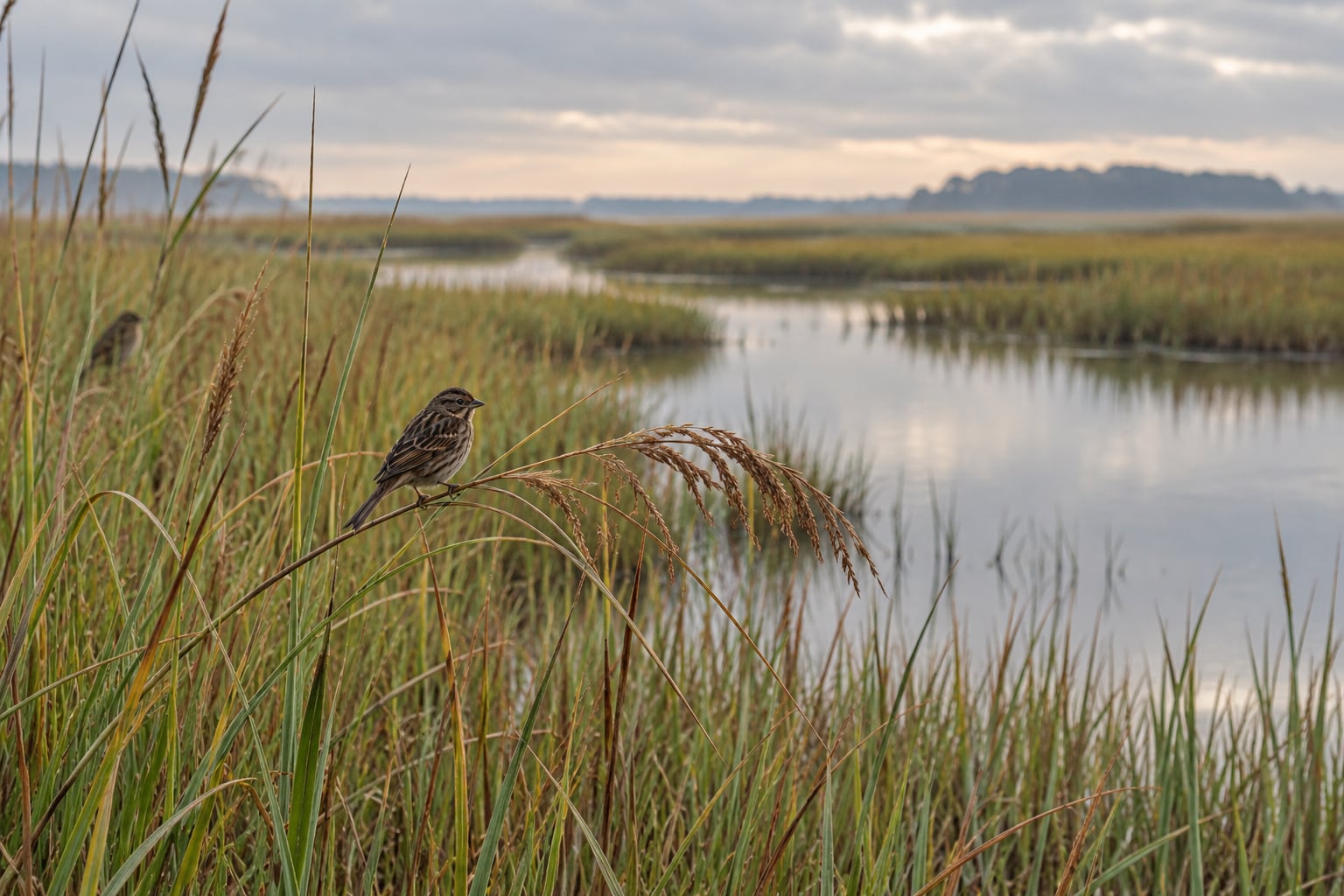
If you want to know how to identify sparrows in a marsh, start with where the bird is standing, not with its color. Saltgrass cordgrass marsh or a cattail bog, a gray cheek patch or a saffron eyebrow, the answer is usually in the habitat and the shape before it is in the plumage detail.
Marsh sparrows are hard for one reason: the birds are skulking, the light is flat, and several species look almost identical for the first ten seconds. Learning to identify sparrows in a marsh gets much easier when you work in a fixed order instead of hunting for a bird you can already picture.
Here is the order I use. Habitat and season, then size and shape, then a short list of field marks, then voice, and finally a record of what you saw. Take a first look through binoculars at 10x rather than reaching for a camera, and give the bird thirty quiet seconds before it flushes.
Table of Contents
- What You Need Before You Walk Into the Marsh
- Step-by-Step: A Repeatable Marsh Sparrow Identification Process
- Step 1: Check Habitat, Range, and Season First
- Step 2: Compare Size, Shape, and Movement
- Step 3: Examine Plumage With the 7 Field Marks
- Step 4: Use Calls to Confirm a Concealed Bird
- Step 5: Know the Common Southeastern Marsh Sparrows
- Seaside Sparrow
- Saltmarsh Sparrow
- Nelson’s Sparrow
- LeConte’s Sparrow
- Henslow’s Sparrow
- Swamp Sparrow
- Savannah Sparrow
- Marsh Sparrow
- Step 6: Confirm With More Than One Clue
- Step 7: Record the Bird Without Disturbing It
- Common Marsh Sparrow Identification Mistakes
- Frequently Asked Questions
- What is the easiest way to tell a Saltmarsh Sparrow from a Seaside Sparrow?
- Can I identify marsh sparrows from photographs taken at a distance?
- Why might a marsh sparrow not be singing when a bird guide expects it to?
- Should I use recorded calls to attract or confirm marsh sparrows?
- What should I do if I see a sparrow that does not match any common marsh species?
- Are marsh sparrows dangerous to approach or disturb?
- Start With Habitat, Shape, and Voice
What You Need Before You Walk Into the Marsh
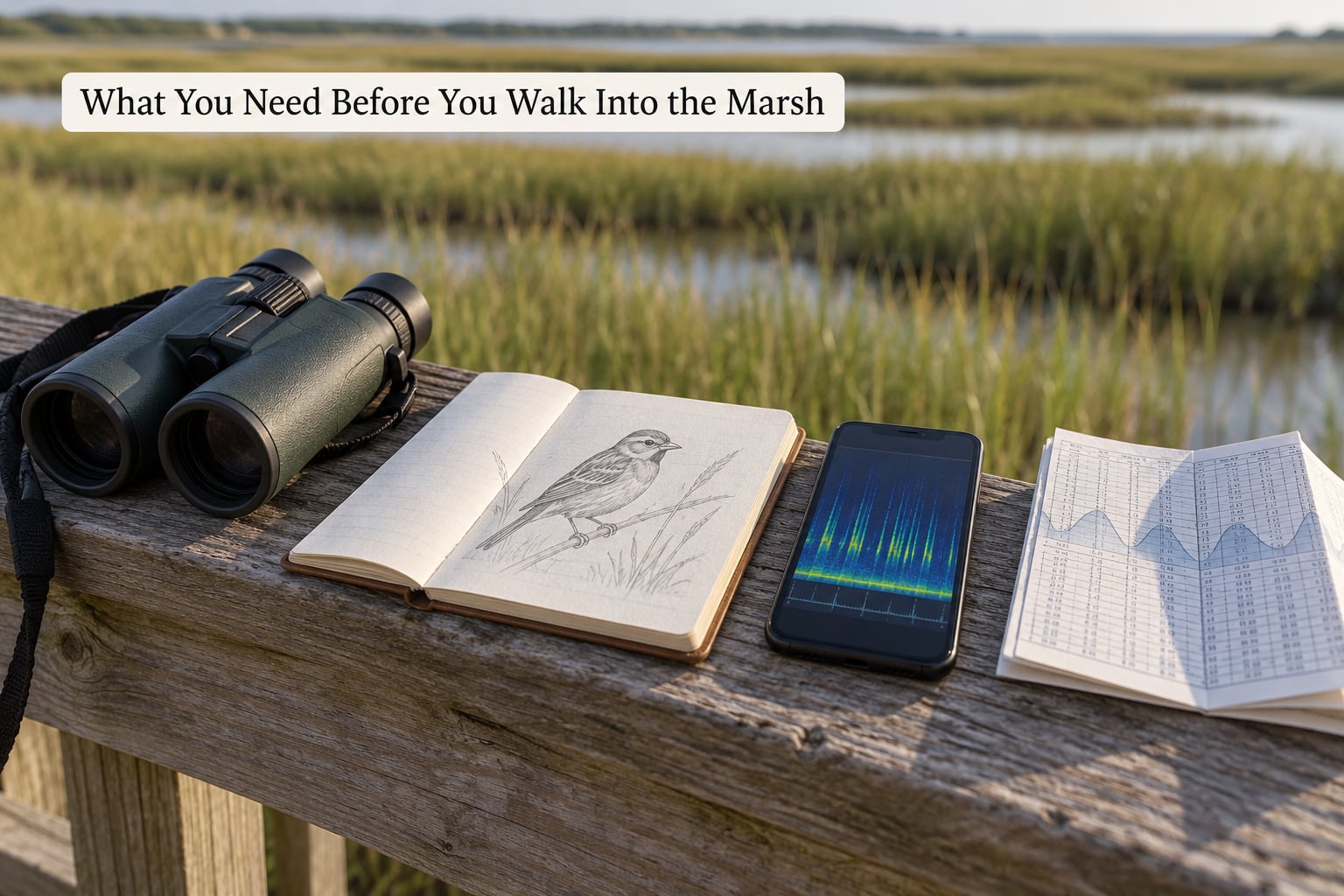
You need very little, but each item below solves a specific problem that marsh birding creates.
- Binoculars, 8×42 or 10×42. Ten power gets you a usable view of a bird that stays low in the grass. Eight power keeps the image steady in wind, and wind is constant in an open marsh.
- A regional field guide or app with subspecies plates. Marsh sparrow appearance changes across the range, and a guide that shows only one plumage per species will mislead you.
- A source of verified call recordings. Cornell Lab accounts and regional bird club archives are better than unverified clips, because mislabeled recordings teach the wrong thing.
- Tide and weather information. High tide pushes birds onto the upper marsh edge and open mud where they are far easier to see than at mid tide.
- Safe footwear and clothing. Mud, sharp shell, ticks, and brackish water are the normal conditions. Tall boots and a dry layer in the vehicle matter more than any gadget.
- A notebook and a camera with a long zoom. A zoom lens gets you the head and back shots you need later, when you want a second opinion.
Step-by-Step: A Repeatable Marsh Sparrow Identification Process
Step 1: Check Habitat, Range, and Season First
Habitat narrows the candidate list faster than any other clue, because marsh sparrows rarely ignore the vegetation type they are built for.
Cordgrass, saltgrass, and needlerush in a tidal saltmarsh point you toward Seaside Sparrow, Saltmarsh Sparrow, and in the Northeast, Nelson’s Sparrow. Cattail, sedge, and brushy freshwater edges point toward Swamp Sparrow and Nelson’s. Open wet pasture, weedy field edges, and hay fields bring Savannah Sparrow, LeConte’s Sparrow, and Henslow’s Sparrow, none of which are really marsh birds but all of which turn up on marsh edges.
Season does the rest of the filtering. A tidal marsh in midwinter holds a different set of birds than the same marsh in May, and winter birds are in worn, faded plumage with most of the crisp markings gone. If you are working from October through February, plan on fewer visible field marks and lean much harder on shape, habitat, and voice.
Step 2: Compare Size, Shape, and Movement
Size and shape is the fastest field test, and it works even when the bird is 80 yards out in poor light. Birders call this GISS, general impression of size and shape, and it is more reliable than color for marsh sparrows.
Look at the bill first. Seaside Sparrow carries a long, heavy, blunt bill built for probing mud and picking insects out of wrack, noticeably heavier than the fine pointed bill of a Saltmarsh Sparrow. Seaside is also the largest of the group, roughly six to eight inches, with a long rounded tail and strong legs and feet that let it climb a grass stem and cling on.
Nelson’s Sparrow looks short-tailed and round-bellied, that pot-bellied look birders mention constantly, and it often sits flat with the body nearly horizontal on a stem. Swamp Sparrow is compact with a rounded head, a fairly long bill, and noticeably long legs for a sparrow. Savannah Sparrow is small and short-tailed, and it flicks its tail constantly while it works the ground.
Movement is the tiebreaker. Watch whether the bird runs along exposed mud, uses short upward flights between clumps, clings sideways to a stem, or flushes straight up in a short, hesitant flight. Ground-runners such as Savannah and Seaside give you a longer view. Henslow’s and LeConte’s usually drop flat and stay down.
Step 3: Examine Plumage With the 7 Field Marks
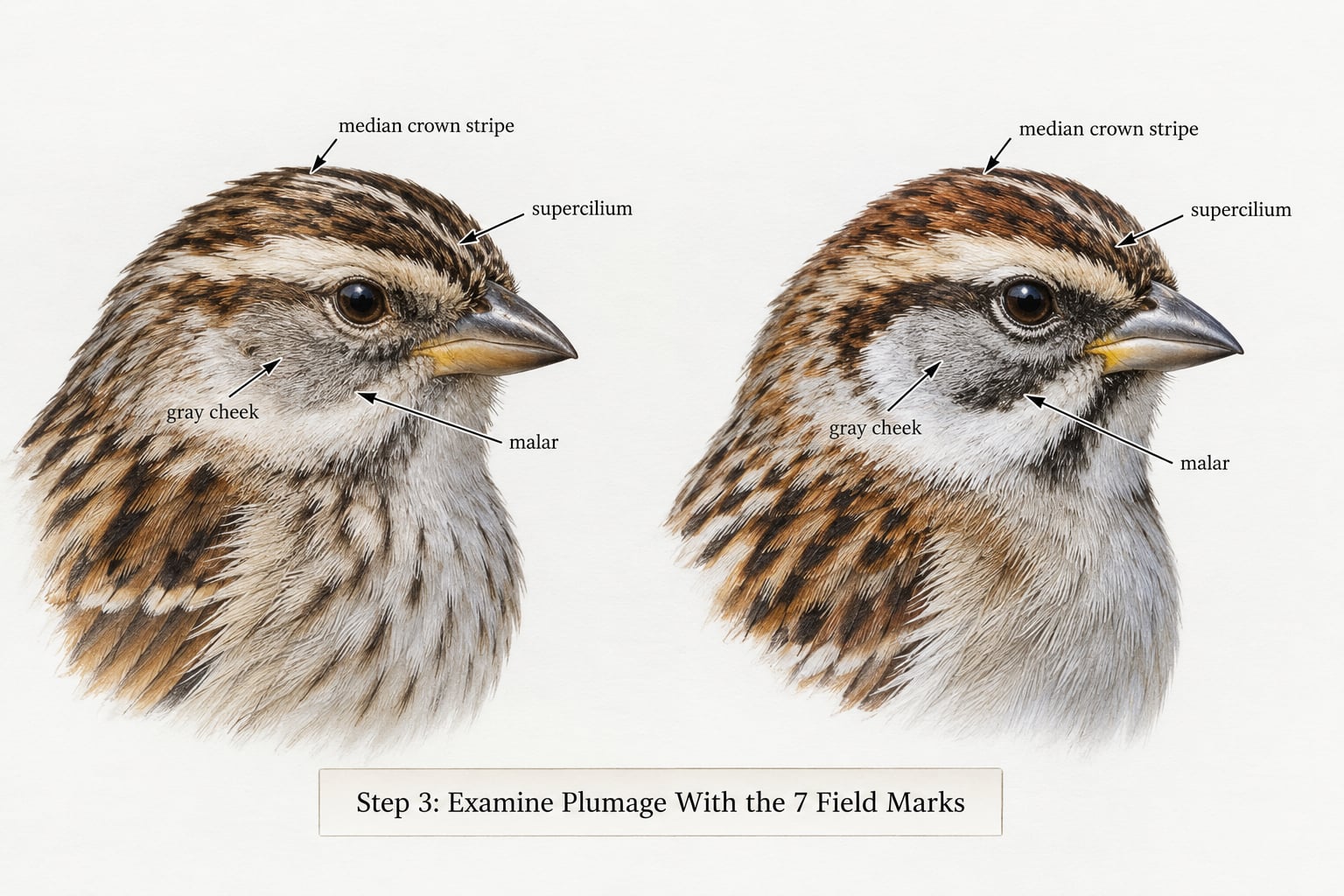
You do not need every mark at once. Two or three clear marks plus a correct habitat will identify most birds you will meet, so check the head and breast first because that is the part usually visible.
- Face pattern. This is the highest-value mark in the group. Nelson’s shows a bright saffron to orange eyebrow, a gray cheek patch, and dark whisker or malar lines below the gray. Saltmarsh Sparrow shows an orange-buff face with a leaden gray cheek panel and a clean white throat. Swamp Sparrow shows a plain gray face with a rusty cap and a clear white throat. Seaside Sparrow shows a bold yellow spot in front of the eye with whitish moustache lines on a dark face.
- Crown stripes. A pale median crown stripe with darker lateral stripes is common across the family, and a broad, clean central stripe is a useful supporting mark on LeConte’s Sparrow and on LeConte’s-type individuals. The crown of Nelson’s is often a warm rusty or rufous cap rather than a striped one.
- Supercilium and eye ring. Note the eyebrow shape and where it starts. A long saffron supercilium running well past the eye reads as Nelson’s. A complete pale eye ring on a gray face is typical of Swamp Sparrow, and Savannah’s eyebrow is shorter and paler with a yellow patch in front of the eye.
- Breast streaking. The pattern matters more than the amount. Nelson’s has a gray breast band with fine cinnamon or blurry streaks over a buffy background. Saltmarsh Sparrow has fine, soft, blurry streaks on a buffy breast. Savannah Sparrow has narrow, crisp, dark streaks running onto a clean white belly. Swamp Sparrow is essentially unstreaked on the breast, with gray under the chin.
- Back pattern and braces. Look for pale streaks on the mantle and scapulars, sometimes called back braces. Reddish brown wings and a strongly patterned back suggest Saltmarsh or Nelson’s. Swamp Sparrow’s wings and back are plain reddish brown with little streaking, which is a real advantage when it perches in the open.
- Wing bars and tertials. Two pale wing bars are typical. The length of the tertials, the innermost flight feathers covering the folded wing base, relative to the primary projection, the reach of the wingtips past the tertials when the wing is closed, is one of the marks birders argue about most. Treat it as supporting evidence only, because judging it demands a clear view of the folded wing.
- Flank color and tail. Clean buff flanks with no streaking favor Swamp and Savannah. Heavy flank streaking favors the sharp-tailed group. Tail shape is a genuinely useful shape clue: long and rounded on Seaside and Saltmarsh, short and narrow-tailed on Nelson’s, LeConte’s, and Henslow’s.
Step 4: Use Calls to Confirm a Concealed Bird
Voice is how most marsh sparrows are found, and in a marsh you often hear the bird long before you see it. Wind across cordgrass is loud, so the first thing to do is stand still, turn your head slowly, and let your eyes scan the grass ahead of where the sound seems to come from. Sound carries unevenly, and a bird can be well away from the spot the voice appears to be.
Each species gives you a usable handle. Nelson’s gives a harsh introductory chip followed by a raspy trill. Saltmarsh Sparrow gives a flat, buzzy trill that carries a long way over open marsh. Seaside Sparrow gives a buzzy song with a muffled trill mixed in. Swamp Sparrow gives a clear, sweet, musical trill that carries surprisingly well. Henslow’s gives a dry, staccato, insect-like buzz rather than a trill. Cape Sable Grasshopper Sparrow gives a short, weak, insect-like note that is genuinely hard to pick out of marsh noise.
Know the limit of this clue. A bird in fall may give only a single chip, and wind can shred the tail end of a song so that you hear a trill with no introduction, which is exactly how a Nelson’s gets reported as a Saltmarsh. Use song to support a visual ID, not to replace it, and practice against recordings from the region where you are actually birding.
Step 5: Know the Common Southeastern Marsh Sparrows
These are the birds you are most likely to argue about in the Southeast. Learn their combinations rather than their single marks.
Seaside Sparrow
The big dark one, and the easiest of the saltmarsh group to recognize once you know it. Long heavy bill, long rounded tail, strong legs, a yellow spot in front of the eye, whitish moustache lines, and a whitish throat on a dark face. It clings to grass stems, works wrack lines at the tide edge, and scratches in the mud with its feet. Range runs along the Atlantic and Gulf coasts. The Cape Sable subspecies of southern Florida is a different animal: smaller, in freshwater sawgrass, and one of the rarest birds in the country, so treat any sawgrass bird in that area with real care.
Saltmarsh Sparrow
Orange-buff face, leaden gray cheek patch, crisp white throat, and fine blurry streaks down a buffy breast, with rusty brown wings and back. The trill is the giveaway when the bird stays down. It is a saltgrass and cordgrass specialist, and its whole life cycle depends on marsh that floods on a normal tidal cycle. Nesting plants are submerged by storm surge and rising seas, and that makes correct species-level reporting genuinely useful rather than merely satisfying.
Nelson’s Sparrow
Saffron eyebrow, gray cheek, orange face, dark whisker lines, and a gray band with fine cinnamon streaks across a buffy breast. The shape is short-tailed and round. Nelson’s is the freshwater and brackish member of the group in most of the Southeast, using coastal marshes in the north, brackish marshes and prairie potholes farther west and inland. In the Northeast it meets Saltmarsh Sparrow, and where the two ranges meet, hybrids blur the field marks for good.
LeConte’s Sparrow
Small, secretive, and easy to walk past. Broad pale median crown stripe, buffy orange face, gray cheeks, finely streaked buff breast, and a short tail. It holds a flat posture in dense grass and shows a white outer tail feather when it flushes. Tallgrass prairie remnant, wet hay field, or a damp meadow edge is where to look. Often a spring and fall migrant in the Southeast.
Henslow’s Sparrow
Greenish olive head, rufous wings, a big head on a short body, a short spiky tail, and a habit of flattening into the grass when it flushes. Rank grass and shrubby overgrown fields are the habitat, and a marsh edge that borders tall weedy vegetation can produce one. The dry insect-like buzz is unmistakable once you have heard it a few times.
Swamp Sparrow
Rusty cap, reddish brown wings and back, plain gray face, complete white throat, unstreaked gray breast, and long reddish legs. Boreal bogs, sedge swamps, cattail marsh, beaver ponds, and wet brushy meadow. A coastal plain form is darker and grayer than northern birds, so the cap and wing color vary across the range. It perches in the open more than the others, which makes it the easiest to confirm with a photograph.
Savannah Sparrow
Not a marsh specialist, but it turns up at every marsh edge. Yellow patch in front of the eye, short notched tail, heavily and crisply streaked breast, and constant tail flicking while foraging on open ground. If you are on a grassy path or a roadside verge, this is often the bird you actually have.
Marsh Sparrow
Worth a note because older field guides and older checklists still use it. Marsh Sparrow is not a species. It was a broad group name that bird organizations split apart, and the names on this list, plus Sharp-tailed Sparrow in the west, are what replaced it. If a book uses the name without explanation, look for the publication date before trusting its identifications.
Step 6: Confirm With More Than One Clue
One good mark can be wrong. A bird backlit by low sun can look orange when it is buff, and a long primary projection in a photograph is easy to overread.
Require at least two independent clues from different categories, such as a face mark plus a habitat, or a breast pattern plus a song. Account for subspecies, because Nelson’s, Swamp, and Seaside Sparrows all have named geographic forms that differ in face color and overall tone. Account for plumage wear, which strips feather edges in late summer and makes crisp streaks look blurry and well-marked birds look plain. And be honest about hybrid zones in the Northeast, where Saltmarsh and Nelson’s interbreed along the Atlantic coast and many birds cannot be identified to species from field marks alone. Genetic work has found substantial error in confident field identifications from that zone, which is exactly why a careful birder stops at the pair rather than the species.
Step 7: Record the Bird Without Disturbing It
A good record is the difference between an identification and a guess. Get three photos if you can: the head at full zoom for face marks, a side view for breast and flank, and a back view for the mantle and wing. A single wide shot rarely holds the marks you need.
Log the basics while they are fresh: date, time, exact location, tide stage, water depth, the dominant vegetation, how many birds, and what each one was doing. Note the behavior, since a bird running on mud, clinging to a stem, or flicking its tail is part of the evidence, not decoration.
Skip playback. Marsh sparrows are already under pressure from flooding, development, and sea level rise, and calling a skulking bird into view can push it off nesting cover or expose it to predators. If you want a recording for your own learning, record what you hear naturally rather than drawing a bird out. When you enter the sighting into eBird, describe the field marks you actually saw rather than naming a species alone, because that is what lets a regional reviewer confirm or question the record usefully.
Common Marsh Sparrow Identification Mistakes
Nearly every wrong marsh sparrow report I have seen comes down to one of six habits.
Judging by color alone. Color is the first thing to go at distance, in bad light, and in worn plumage. Fix: decide on shape and habitat while the bird is fresh, then add plumage detail only if you can actually see it clearly.
Treating song as call. People hear a trill, name the bird, and never check whether the introductory chip was there. Fix: learn the full song structure for the three or four species in your area before you rely on voice at all.
Ignoring subspecies and seasonal wear. A coastal plain Swamp Sparrow is not the same bird as a northern one, and a July Saltmarsh Sparrow is not the crisp bird in an April photograph. Fix: check the range and the date before trusting any single color.
Forcing a rarity. The rarer the bird, the more likely a common species is being stretched to fit. Fix: describe the bird in neutral terms first, list the candidates, and only then name it.
Judging size with no scale. Marsh sparrows look big and small depending on the grass they are standing in. Fix: compare two birds in the same patch of vegetation, or use a known object such as a mudflat plank or your own boot.
Overusing playback. It produces a view of a stressed bird and can get a report rejected. Fix: wait, scan, and let a second look do the work.
A few habits that help more than anything else: pick a scan pattern and work it instead of drifting, arrive before sunrise when birds are calling and the light is low and even, and note the negative evidence too, meaning which species you expected and did not see. Birders on BirdForum threads about Saltmarsh versus Nelson’s Sparrows in the Everglades keep returning to the same point, that experienced people disagree on photos, and posts on r/whatsthisbird are full of confident IDs that later get revised once someone asks which mark was actually visible. Expect to revise your own call. That is normal, not failure.
Frequently Asked Questions
What is the easiest way to tell a Saltmarsh Sparrow from a Seaside Sparrow?
Size and bill do most of the work. Seaside Sparrow is the larger bird, with a long heavy blunt bill, a long rounded tail, strong legs, a yellow spot in front of the eye, and a dark face with pale moustache lines. Saltmarsh Sparrow is smaller and finer-billed, with an orange-buff face, a leaden gray cheek patch, a clean white throat, and fine blurry streaks on a buffy breast. Habitat and voice confirm it.
Can I identify marsh sparrows from photographs taken at a distance?
Sometimes, but only for the species with strong face or shape marks. A good photo of a Swamp Sparrow with a rusty cap and white throat works at almost any range. A distant shot of a Saltmarsh or Nelson’s Sparrow usually hides the cheek patch, bill proportions, and primary projection, which are exactly the marks that separate them. Get a full zoom head shot or a sound recording before you commit to a species.
Why might a marsh sparrow not be singing when a bird guide expects it to?
Timing, weather, and stage of life. Most marsh sparrows sing hardest during the pre-dawn chorus and again near dawn, so arriving at nine in the morning can mean silence. Wind across open marsh buries short calls, birds often stop singing once paired or once nests are built, and birds in worn summer plumage sing less. A bird quietly feeding is still a bird worth identifying on shape and plumage.
Should I use recorded calls to attract or confirm marsh sparrows?
Skip the attraction part. Playback draws a skulking marsh bird into the open, can pull it off nesting cover, and puts it at risk, and many experienced birders avoid it in tidal marsh because these species are already losing habitat to flooding and sea level rise. For learning, use verified regional recordings ahead of the trip and record what you hear naturally in the field. Sound is still the fastest way to find these birds.
What should I do if I see a sparrow that does not match any common marsh species?
Slow down and describe it before naming it. Record the habitat and vegetation, relative size against something known, bill shape, face pattern, breast streaking, tail length, and any voice. Then check regional specialty species, because Sharp-tailed Sparrow, Grasshopper Sparrow, and several others can appear on a marsh edge. A written description in a notebook plus a photo gives an expert something usable, while a bare species name gives them nothing.
Are marsh sparrows dangerous to approach or disturb?
They are not dangerous, but they are easily harmed by disturbance. These birds are small, ground-nesting, and already stressed by flooding and development, and a disturbed nesting bird can lose its cover or its nest. Stay on boardwalks and dry ground, keep a generous distance from anything you suspect is a nest, avoid playback, and keep dogs out of nesting habitat. Watching quietly from a distance produces better birds and better photographs.
Start With Habitat, Shape, and Voice
Do this on your next trip. Note where the bird was and when, then narrow by habitat, then by size, shape, and movement, then check the face and breast marks, then let the voice settle the call.
Two clues from two different categories is enough to be confident. One color on a distant bird is not, and neither is a trill heard through wind. Write the record down while you are standing there, with photos if you can get them, and let the field marks speak instead of the name you walked in expecting.
That sequence works whether you are confirming a routine Seaside Sparrow in a cordgrass flat or staring at a puzzling Saltmarsh and Nelson’s type bird in a brackish pan. Knowing how to identify sparrows in a marsh is less about memorizing every mark and more about working the same order every single time.