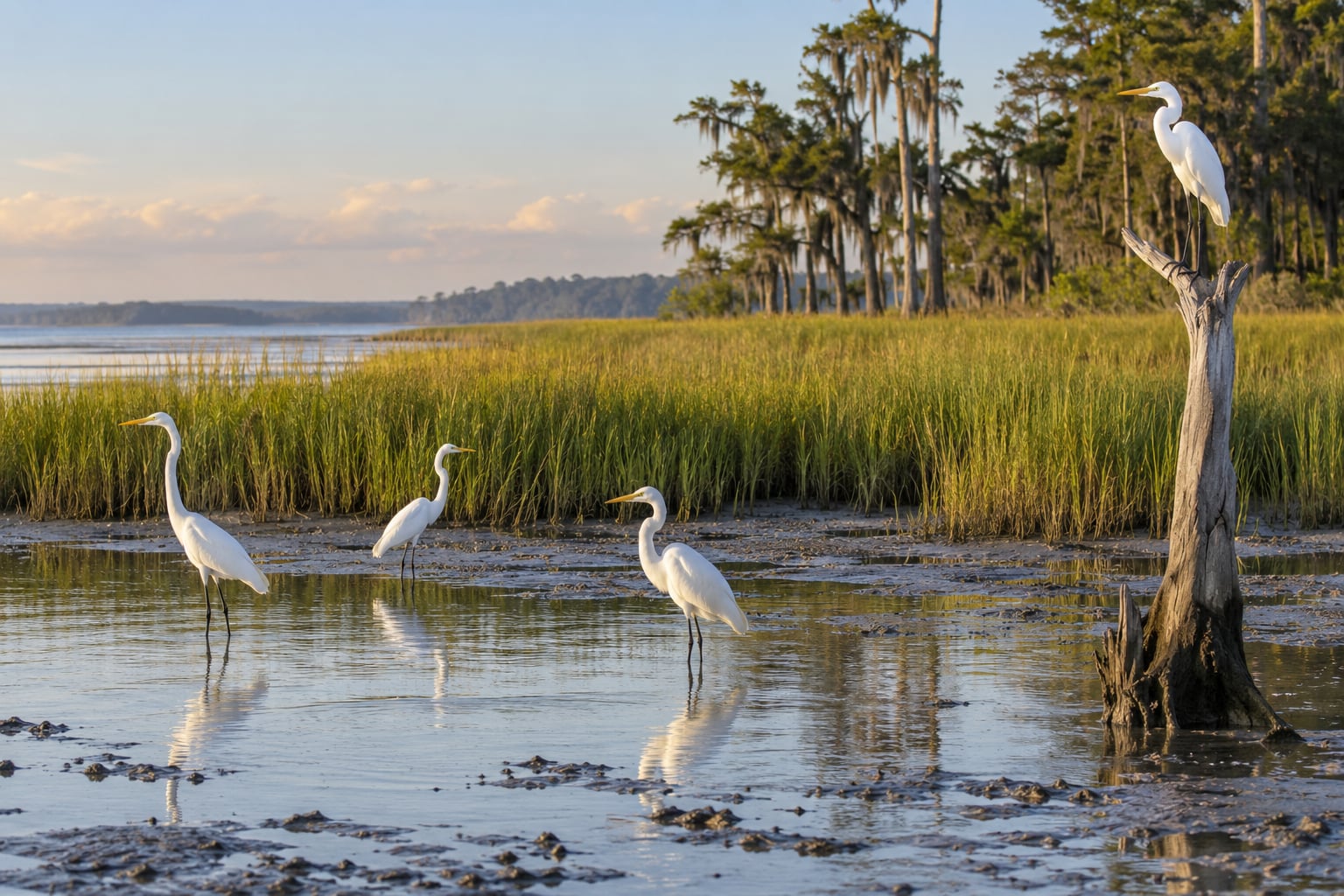
To find wood storks in summer, hit shallow water where the level is dropping: tidal creeks at low tide, drawdown ponds, crawfish fields, and reservoir edges between mid-June and late September. The birds stop guarding nests once chicks fledge in late July, and post-breeding dispersal spreads them across open country where you can watch from a road, a boat, or a pond bank.
That is the whole trick. Wood storks (Mycteria americana) are hard to see in spring because they are locked inside rookeries most birders cannot enter. Summer turns the same birds into roadside birds. One coastal Carolina report described a pair arriving only a few days after the season’s typical return, so timing shifts with the weather and it pays to check a current regional report before you drive.
Budget a morning rather than an afternoon. Summer heat sends these birds to roost early, often by 7 a.m., so your real window runs from first light until roughly mid-morning. Difficulty is low if you have binoculars and a tide chart, and moderate if the good habitat is only reachable by boat.
Table of Contents
- What You Need
- Optics
- Bird data and reports
- Conditions and safety
- Access
- Step-by-Step
- Choose the Best Summer Window
- Target Wetlands, Rookeries, and Nearby Perches
- Plan Around Tides, Weather, and Access
- How to Find Wood Storks in Summer in the Field
- Record and Share the Sighting Responsibly
- Common Mistakes
- Searching only at the old nesting colony
- Ignoring scattered feeding birds
- Arriving after mid-morning
- Calling every white bird a stork
- Getting close to nesting or roosting birds
- Trusting one location or one old report
- Quick Field Tips
- Frequently Asked Questions
- Where can I see wood storks in summer?
- Are wood storks still found at their nesting colonies in summer?
- What time of day is best for seeing wood storks?
- How can I tell a wood stork apart from a white ibis?
- Why might I see a lone wood stork away from a wetland?
- How far should I stay from wood storks and their nests?
- Conclusion
What You Need
Most of the gear is ordinary birding kit, but two items decide whether a trip is productive.
Optics
A pair of binoculars in the 8×42 range handles roadside birds at 40 yards. For a stork feeding a quarter mile out across a marsh, a spotting scope earns its keep — 20×60 or 25×60 is plenty, and a tripod or beanbag rest stops the shake that ruins distant photos.
Bird data and reports
Load a field guide app before you leave, and pull the hotspot map for the counties you are driving through. Recent checklists tell you which ponds are holding birds this week rather than which ones held them three years ago. A tide chart for your target water body matters as much as the app.
Conditions and safety
Sun protection matters more than most people expect, because you will be facing open water in southern summer heat. Pack water, insect repellent for marsh edges, and closed-toe shoes that can get wet. A hat and a light long-sleeve shirt will do more for you than any camera.
Access
Check whether your target needs a refuge pass, a state park reservation, or a permit for a boat launch. Wildlife drives and boardwalks may require a timed entry slot in peak season. Confirm road conditions the morning you go; dirt tracks through bottomland woods wash out fast in summer thunderstorms.
Step-by-Step
Work through these in order. Skipping ahead to a spot without a tide or report check is the most common reason a summer stork trip comes up empty.
Choose the Best Summer Window
Plan for the second week of June through the end of September. Birds are present earlier in Florida, Georgia, and South Carolina than in Louisiana or Texas, where most of the summer population arrives as post-breeding wanderers dispersing out of Central America and the Yucatan.
Two sub-windows matter. Late June through early July gives you foraging adults and, at good colonies, young birds standing on branches near the nests. Mid-August into September is peak dispersal: the birds are mobile, numerous, and often found well away from water, on cropland edges and pasture.
Heat reshapes your hours. Once temperatures climb, storks feed in the cooler early window and then move to shade or roost. Get to the site before sunrise and you will have them; arrive at noon in July and you may be looking at an empty pond.
Target Wetlands, Rookeries, and Nearby Perches
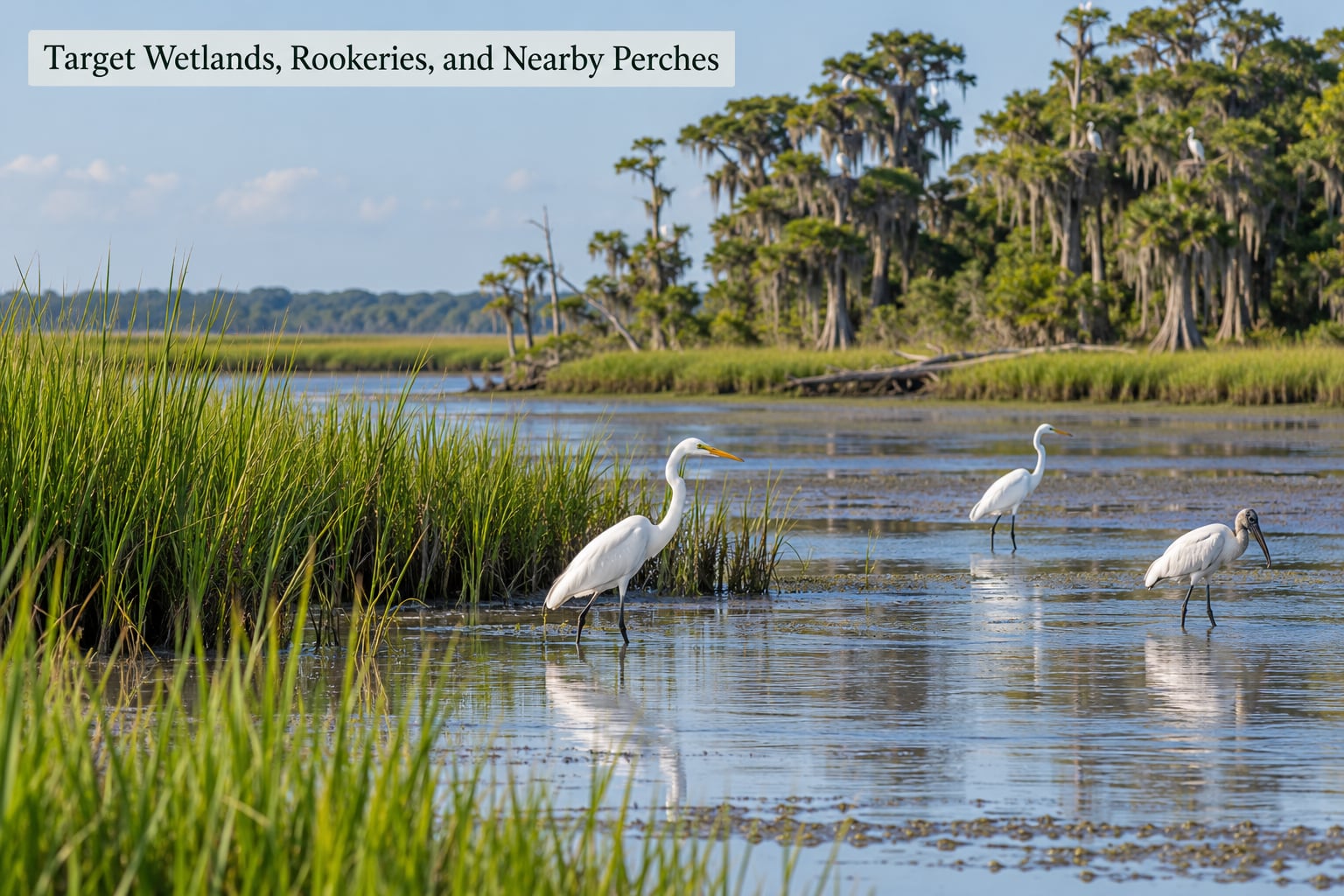
Read the water level, not the bird list. A wood stork needs shallow water roughly 4 to 12 inches deep and a concentration of small fish and frogs. Receding water, from tide, rain, or a managed drawdown, is what concentrates that prey — so your best odds are at a receding edge, not a full pond.
Reliable summer habitat types, roughly in order of how well they deliver:
- Managed drawdown ponds and impoundments. Water dropped on purpose for the summer produces exactly the conditions storks want.
- Crawfish ponds. Southern Louisiana and parts of the Gulf Coast hold large working ponds that cycle water all summer.
- Tidal creeks and brackish marsh. Best within a few hours either side of low tide.
- Cattle ponds, ditches, and rice fields. Small water, big prey concentration, easy to view from a road.
- Established rookeries and their perches. Big cypress or swamp colonies in Florida and Georgia still work in summer, usually from a public overlook or nearby road.
Add the nontraditional sites, because summer is when they pay. Field edges, wooded margins beside a canal, and roadside ditches along back roads hold scattered feeding birds that no checklist will ever list.
Plan Around Tides, Weather, and Access
On tidal ground, the tide table is the whole plan. Wood storks feed in the shrinking shallows and follow them as they drop, so the productive window sits near low tide. Arrive two hours before low water and work the exposed mudflat and shallow edge until the water starts to push back.
Wind matters more than most visitors expect. A steady onshore breeze holds scent and pushes small prey downwind into shallower water, which can put birds in a tight feeding group you can find from a distance. Flat calm works too, but you will see fewer birds concentrated in one spot.
Thunderstorms are the main summer risk to a trip. Water, roads, and visibility all change fast, and a dirt track that was fine at dawn can be a puddle at noon. Check the forecast and the radar in the morning, not the night before.
Then confirm access. Read the current rules for the refuge, state park, or wildlife management area, and follow them without exception — including closures around roosting or nesting birds. Never push a gate, walk a closed boardwalk, or wade into marked nesting habitat. Colonial birds flush in a panic when disturbed, and a single careless approach can cost a whole colony the afternoon and part of the season.
How to Find Wood Storks in Summer in the Field
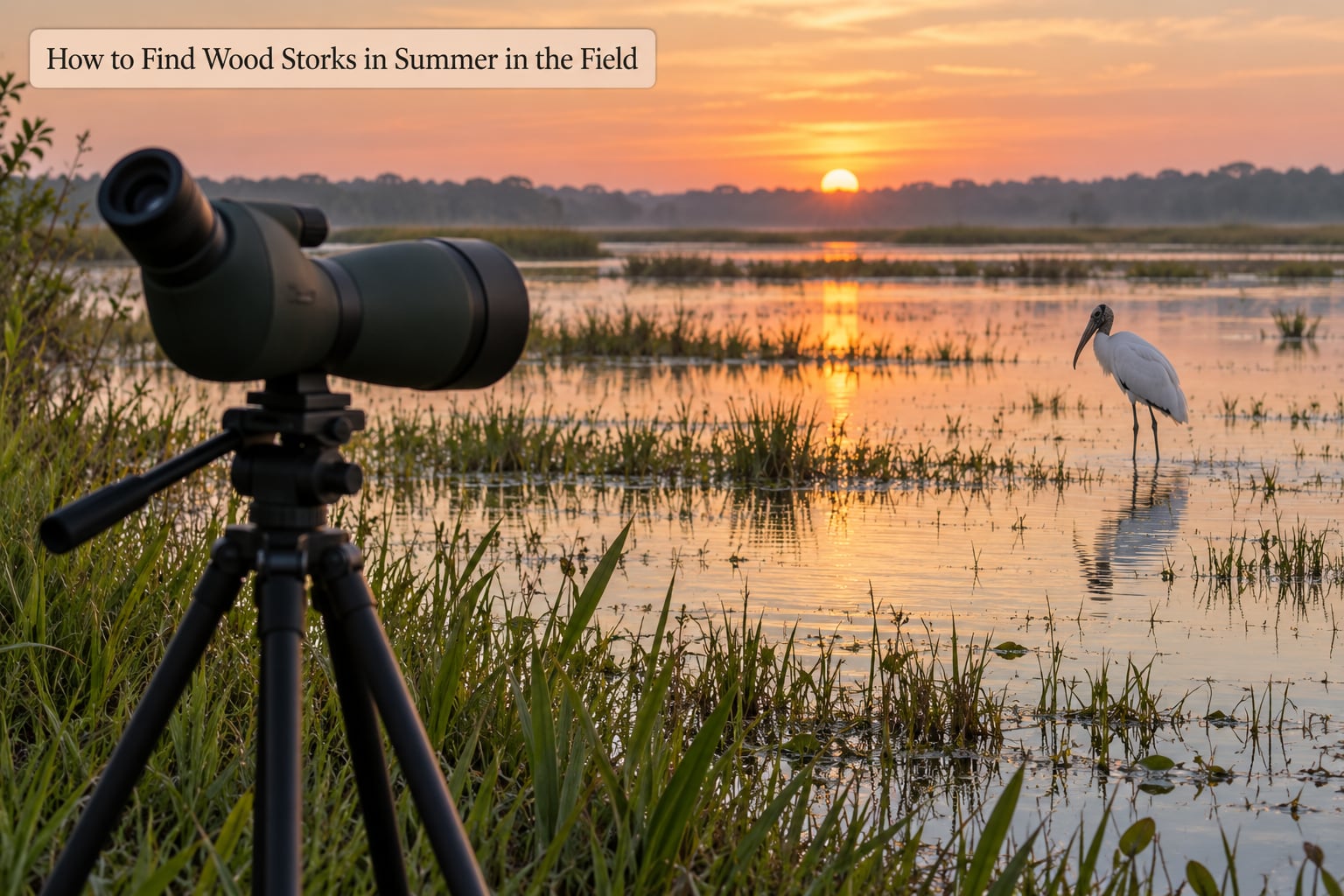
Scan in a fixed order so you cover the whole scene without wandering. Open water first, then shoreline, then sky.
On open water, look for the silhouette before the detail. A foraging wood stork stands about four feet tall with a rounded back, a heavy body, and a long bill angled into the water. Several together read as a group of pale shapes that move with a slow, deliberate shuffle — feet in the water, head forward, one deliberate step after another.
Alongshore, check the single highest thing in the frame. Storks perch on bare branches, snags, fence posts, and old dock pilings, and they like the isolated snag with no other birds around it.
In the sky, watch for coordinated soaring. Wood storks ride thermals with neck and legs extended, and they travel in loose lines or kettles. Circling storks over a field usually mean birds are feeding in that field below, which is far easier than hunting for white shapes in choppy water.
Confirm the identification before you record it. The marks that hold up at distance: a featherless dark gray head, a thick bill that curves downward, snow-white body plumage, and solid black flight feathers that flash when the bird is in the air. Juveniles are browner and muddier, with duller wing tips.
Learn the two lookalikes and you will stop second-guessing yourself. White ibis are smaller, shorter-legged, and have a thin, strongly downcurved red bill. A standing wood stork towers over ibis in the same puddle. Egrets and spoonbills are slimmer and move differently — spoonbills feed with the bill open and swept side to side, storks shuffle and probe. From a moving vehicle, height and bill shape do most of the work.
Record and Share the Sighting Responsibly
Write it down while you still see it: date, time, exact location or coordinates, habitat type, number of birds, behavior, and whether any were juveniles. A good location description — road name, pond number, distance from a marked intersection — is worth more to the next birder than a general name.
Flag the photo or video quality honestly. A distant record confirmed by behavior is a real record; a blurry one that cannot be re-checked is weaker, and both are useful.
Submit through eBird, iNaturalist, or the state wildlife commission’s form when you are done. Reporting matters more for this species than most because post-breeding birds wander far from any monitored site, so your sighting may be the only evidence that a given pond is in use.
Common Mistakes
Searching only at the old nesting colony
The colony is where birds were in spring, not necessarily where they feed in July. Adults leave to feed across the landscape while fledglings remain. Look outward from the rookery, not only at it.
Ignoring scattered feeding birds
A single stork in a roadside ditch counts, and small groups are often the biggest number you will get all day. Do not skip a stop because the checklist shows zero.
Arriving after mid-morning
Summer roosting starts early, often around 7 a.m. Heat and a low sun both cost you birds. Reverse your schedule around the birds, not around your day.
Calling every white bird a stork
Egret, ibis, and spoonbill flocks are common in the same habitat. Check head, bill, and size before you record it — a misidentified flock is worse than a blank one.
Getting close to nesting or roosting birds
Resist every shortcut. Flushes from a colony are expensive for the birds and can close an area to you for the rest of the season. Watch from the designated overlook, with the scope, and leave the disturbance behavior behind you.
Trusting one location or one old report
Storks shift between roosts and feeding grounds as they work, and much of the best summer habitat is private or boat-only. Pull current checklists, check at least two or three water bodies, and expect to drive more than you planned.
Quick Field Tips
Keep the sun behind you whenever possible; front light flattens a white bird into an unreadable shape. Use a rest — tripod, monopod, or a solid truck bed — because a 25x scope on a free hand is a frustrating hour.
When a group of storks circles overhead, that is your location marker. Drop the search and watch where they come down, because they usually return to the same shallow spot. Check habitat edges too: the margin between open water and vegetation is where the prey concentrates and where birds stand most often.
And if birds start head-bobbing, calling, moving off, or leaving repeatedly, you are too close. Back out along the same route you came in, slowly, and give the site a rest before you return.
Frequently Asked Questions
Where can I see wood storks in summer?
The best summer wood stork habitat is shallow water that is receding: drawdown ponds, crawfish fields, tidal creeks near low tide, cattle ponds, and flooded field edges. Florida, Georgia, and South Carolina hold birds year-round, while Louisiana and Texas see most of their birds from mid-June through September as post-breeding wanderers disperse inland from Central America. Search roadside ditches and pasture margins as well as the obvious wetlands.
Are wood storks still found at their nesting colonies in summer?
Yes, at established rookeries you will usually still see birds in summer, though fewer adults are present. Adults leave the colony to feed across the surrounding landscape once chicks approach fledging in late July, while juveniles remain until they fly. Best viewing is from public overlooks and nearby roads, never from inside the colony, since colonial nesters flush easily and disturbance can cost a whole colony the day.
What time of day is best for seeing wood storks?
Early morning, from roughly 30 minutes before sunrise to mid-morning, is the strongest window in summer. Birds feed in the cooler hours and then move to shade or roost, and in the Southeast they often settle into a roost by about 7 a.m. once temperatures climb. Overcast coastal mornings extend the window. Arrive before first light to be in place when the first birds start moving.
How can I tell a wood stork apart from a white ibis?
Size and bill shape settle it. A wood stork stands close to four feet tall with a thick bill that curves slightly downward, a featherless dark gray head, and solid black flight feathers. A white ibis is noticeably shorter, with thinner reddish legs and a long, slender, strongly downcurved bill. When both feed in the same puddle, the stork towers over the ibis, which is usually the fastest confirmation from a distance.
Why might I see a lone wood stork away from a wetland?
Lone birds show up well outside the mapped summer range because post-breeding dispersal is wide-ranging and unpredictable, and individuals often hang around a productive pond until the prey thins out. A single stork may also be resting between feeding bouts, moving to shade, or scouting a new site. These wanderers are exactly why checklists matter — an unusual location that has never produced a stork is worth reporting.
How far should I stay from wood storks and their nests?
Watch from the designated overlook, trail, or roadside viewing area and keep all marked buffer distances, which are set by the refuge, state park, or wildlife agency running the site. Do not enter a rookery, cross ropes, or approach a roost to improve an angle. Colonial birds are sensitive to disturbance, and crowding causes flushing, nest abandonment risk, and sometimes closure of the area. If birds move off or call repeatedly as you watch, you are too close, so back away and leave.
Conclusion
Start with a current regional bird report and a recent checklist for the counties you can reach today, because summer wood stork locations change week to week. Pick two or three places with shallow water that is dropping, check the tide and the radar, and be in position before first light.
Scan open water, then shoreline, then sky, confirm with head and bill shape, and record what you see so the next birder gets the benefit. Most trips end with a handful of birds from the road, which is exactly how this species should be watched.